The American mining company Freeport McMoRan, Inc. claims to give Papuans a chance to jump from the Stone Age to the steel age. “This is not a job for us, it is a religion,” said the late James R. Moffett, Freeport’s CEO of many years.Footnote 1 Like missionaries, the company claims that they have brought civilization, and assumes that the Papuans had none of their own. Its representatives proudly describe their Freeport mine operation in superlatives: the world’s largest goldmine, the world’s most profitable copper mine, the largest private employer in West Papua, and the largest taxpayer to Indonesia.Footnote 2 For many Papuans, however, the mining company is marked by two contradictory characteristics: its gigantic scale and its invisibility. Its scale has attracted a great deal of attention, especially due to its open-pit mining techniques and their environmental impacts in West Papua. The mining produces about 167 million metrics tons of mine waste (tailings) per day which is dumped directly into the Aijkwa River. The company itself predicts that by 2041, when their contract of work ends, they will have dumped a total of 3 billion tons of tailings into West Papua’s land and waterways.Footnote 3
In contrast to its scale, Freeport has concealed the structure of power that sustains the company’s growth. While mining in other parts of the region has been subject to “resource wars,”Footnote 4 indigenous Papuan communities in the mining area, particularly the Amungme and the Kamoro, remain largely powerless.Footnote 5 The company has also managed to survive various scandals and controversies, and the rise and fall of Indonesian political regimes; through the Old Order, to the New Order, to post-reform Indonesia they have maintained a close relationship with the Indonesian government. In the United States, Freeport successfully evades public scrutiny of its environmental and political practices in West Papua. The Freeport case raises several questions: How does Freeport manage to operate in West Papua? How does its presence shape Papuans’ perceptions of themselves and their relationships with foreign actors? How has Freeport generated particular forms of Indonesian and U.S. state conduct in West Papua? And how has the Freeport mine become the stake of not only American capitalism in the postcolonial world but also the Indonesian project of occupation in West Papua?
This article focuses on the case of Freeport Indonesia, a subsidiary of Freeport-McMoRan, and its actions in West Papua, a self-identifying term referring to the Papua and West Papua provinces of Indonesia. Freeport has been widely discussed in the framework of its problematic relationship with indigenous Papuan landowners and the Indonesian state.Footnote 6 Denise Leith, most prominently, has assessed the company’s relationship and origin with the New Order authoritarian regime.Footnote 7 The company has also been accused of committing or at least being complicit in human rights abuses against the Papuans thanks to the excessive presence of the Indonesian security forces in their concession area.Footnote 8 The importance of Freeport for Indonesia’s development and pro-growth economy is beyond question. Freeport was the first foreign investment in the country, and since 1991 it has made over $16 billion in direct payments to the Indonesian government.Footnote 9 Moreover, Indonesian scholars have conveyed Freeport’s centrality to Indonesian nationalism in West Papua.Footnote 10 In these various roles, it is clear that Freeport is a crucial economic, social, and political actor.
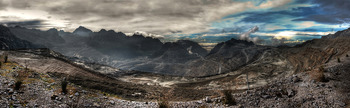
Freeport Mine at Grasberg, West Papua. Copyright by Richard Jones.

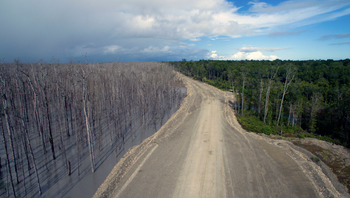
Withered trees in tailings slurry deposition area at the Aijkwa River and green trees outside of the deposition area. Copyright by Muhammad Yamin/AEER. Used with permission.

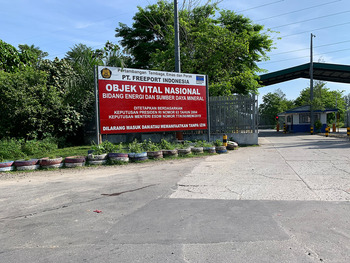
A sign stating that mine is a vital national object. Author’s photo.

By the author and Feransis.

Many studies about Freeport fit within broader scholarship in anthropology and legal studies on corporate forms and their power. Early studies of corporations focused on the colliding ecologies and epistemologies of their activities in the context of the political economy of capitalism.Footnote 11 Contemporary scholarship highlights the “nature of corporate forms” and their “material and symbolic power,” as well as their embeddedness in complex social relations.Footnote 12 Welker, in particular, has examined the relationship of mining corporations with the state as “a set of material relations and processes rather than a metaphysical entity.”Footnote 13 She further applies theories of personhood in emphasizing “relationality, interdependence, and context.”Footnote 14 In her approach, corporations must always be enacted.Footnote 15 In recent years, the dominant strand of inquiry in the anthropology of corporations has been an examination of their responses to critique through “corporate social technologies.”Footnote 16
While this scholarship is important and relevant to the case of Freeport, it has been unable to account for the centrality of Freeport in the constitution of Papuan consciousness, especially in the widespread production of discourses about Freeport among indigenous Papuans. Other corporations, such as British Petroleum (BP) and Korindo, have scales and environmental impacts similar to Freeport’s, yet for ordinary Papuans and their nationalist movements, Freeport remains symbolically more powerful, because Freeport is not merely a mining company but also a key political actor. Footnote 17 Papuans’ discourses on the corporation, largely neglected to date, point to the unique political role that Freeport plays in the region and how it is situated within the broader history of colonialism and imperialism. They argue that, as a corporation, Freeport is not only criminal but also colonial.Footnote 18 These discourses express Papuans’ national and global consciousness and their understanding of the inner workings of American imperialism in collusion with the Indonesian state. The Papuan discourses about Freeport also challenge existing studies that have relied on Indonesia’s and Freeport’s points of view. They require us to study Freeport in a way that consider its character within the broader historical development of corporations as political actors.
This article will illuminate the relationship between corporations and contemporary politics of colonialism. That Freeport is an American company necessitates a more in-depth examination. I will juxtapose various forms of narrative that challenge existing scholarship on Freeport. These include Papuans’ narratives of the company; narratives from the company’s own archives; Dutch Archives; the National Archives and Records Administration of the United States, including the newly declassified archives on West Papua edited by the National Security Archive;Footnote 19 and document leaks in West Papua. My study of these narratives is complemented by an ethnographic study I carried out in the company town of Timika, from which Freeport has run its operation since 1967. I bring these various approaches together in order to contribute to contemporary scholarship that is reconsidering colonialism and imperialism. While scholars have argued that the global order is marked by the “coloniality of power,” Footnote 20 an afterlife of colonialism, and “imperial durabilities,”Footnote 21 the case of Freeport in West Papua makes clear that its mining operation is constitutive in the formation of West Papua as a site of ongoing colonial and racial domination. Secondly, by developing a meaningful connection between West Papua, the Indonesian state, and the broader politics of the U.S empire, this article shows that the history of decolonization is not marked by a rupture, or a progressive narrative from colonialism to independence, but rather by realignments and new formations of colonial and imperial modes of governance.
I Am, the Seventh Bullet
I am a bullet, made from the ore of Papuan land, deep down in the earth where we, the Papuans live, under the snowy mountain of Ertsberg. I was dug and dredged by a giant instrument, and then I was melted in an extremely hot furnace. I became soft like mud. Then, I was sent through a pipe, until I realized I was already inside a giant tanker. I am ore from this land. That tanker carried me when I was soft like porridge, like mud. Then I arrived there, in a city that I did not know. I heard people with red skins saying, “This is America.” Yes, I remember it. It was the United States of America. I had arrived in the United States.
I did not know how many days we sailed. I did not know how many nights or days we were in the tanker. Inside that giant tanker, I could not tell because there was an eternal light in there.… I could not move. I could not get away. I could do nothing but surrender. Then, after I arrived in a busy port, I was brought onto an enormous truck. In a massive factory, I was processed.… I was brought to a bullet factory where I was poured. Every machine there worked automatically. I could not see any human beings. Well, there were a few people there. By then I realized, I had become a bullet.
Until then, I just cried. I was aware that I was made to shoot, to kill enemies.… I realize, and indeed it has become a habit among the bullet folks, that it has become our pride if we can successfully penetrate our enemies’ chests to kill them. But that was not for me. I was packed and given a label. Then I was carried into a huge room. I met many of my friends, the bullet folks. I realized then from the conversations I heard that I was on a ship, which sailed to Indonesia. Indonesia was foreign to me. Is it a city? Is it a country? Maybe it is a war zone.Footnote 22
That is how Bastian Tebai, a young Papuan writer from the western cordillera of Central Highlands introduces his protagonist. He wrote this story, entitled “I Am, The Seventh Bullet,” in 2016. Tebai represents a young generation of Papuan writers who have had access to higher education and publishing opportunities through online literary platforms, where this story was first published. Tebai’s story, one of the most compelling Papuan narratives about Freeport, makes explicit how Papuans feel about the mining and how Papuans see themselves in this constellation.Footnote 23
The story itself begins with the Bullet running away from the scene of a killing. It kills a famous Papuan freedom fighter Musa Mako Tabuni. The Bullet runs and ends up in a confession room of a Catholic priest at the school of theology and philosophy in Jayapura, the capital city of West Papua. Papuan pastor Johannes Kegou listens to this confession and says, “You are the only witness to Mako Tabuni’s killing and now they hunt you.” The Bullet responds, “Indeed. I am the seventh bullet which killed Musa Mako Tabuni. I am the eyewitness, and I will testify. That’s why I come to you. I need your protection.”
There is no way that Tebai could write this story without Freeport, just like Gabriel García Márquez could not possibly have written One Hundred Years of Solitude without the United Fruit Company. Freeport, Tebai’s story indicates, is the historical condition under which knowledge and meaning about corporate and state violence in West Papua is possible and even archived. Using Tebai’s short story to offer what Kirsch calls “indigenous modes of analysis,”Footnote 24 this article will begin its examination of Freeport’s role in West Papua’s political history and in what Papuans perceive as their colonialization by Indonesia.
There are at least three ways in which Tebai’s story reveals Papuans’ sophisticated understanding of the mining operations. First, it provides an analysis of the global commodity chain of copper that comes from Papuan land. Second, the story deploys a geography in which a network of historical actors—the United States, Indonesia, and West Papua—are connected through copper and its extraction. Third, Tebai establishes a direct connection between the copper that forms the bullets that kill Papuans and its origin on Papuan land. This story can be considered a material history of killing but also a material history of impunity.
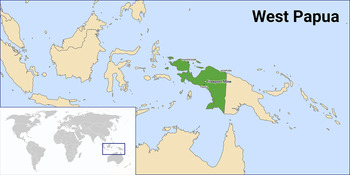
It did not take fifty years for Papuans to understand and incorporate discourses about mining, Indonesian soldiers, human rights abuses, and America into their consciousness. West Papua occupies 459,411 square kilometers, or about 23 percent of Indonesian territory. As of 2020, West Papua’s population was 4,338,918, nearly half being native Papuans who self-identify as Melanesians. Papuans have lived in their homeland in the western part of New Guinea, the world’s largest tropical island, for at least forty thousand years (see Map 1). While neighboring areas to the west came under Dutch control in the sixteenth century, western New Guinea was left to itself until about the nineteenth century. It became a Dutch colony and was incorporated into the Netherlands East Indies in 1898, almost two hundred years after Indonesia.Footnote 25 In 1961, the Dutch colonial government established the New Guinea Council (Dutch: New Guinea Raad), a representative body of the Papuan people to prepare them for independence, projected to take place in 1975. However, the United States under the Kennedy Administration, which was increasingly concerned with political development in Southeast Asia, brokered the New York Agreement that forced the Dutch and Indonesia to sit at the same table. In 1962, the Dutch, without Papuans’ knowledge, signed an agreement that ordered the transfer of West Papua to the United Nations Temporary Executive Authority (UNTEA), and then to Indonesia. On 1 May 1963, West Papua was officially transferred to Indonesia. As part of the agreement Indonesia was to organize a referendum, or an act of free choice, to determine whether the Papuans wanted to be independent or join Indonesia. Under the military’s rule, however, Papuans were forced to vote for Indonesia in 1969, two years after Freeport signed its contract with the Indonesian government to mine on Papuan land.
Most historical narratives about the transfer present Dutch motives to retain West Papua, Indonesia’s to take it over, and American involvement in the dispute as all strictly political. Yet an examination of Freeport’s corporate history and its entanglement with the White House and the broader imperial policy of the United States in the 1960s offers a different understanding of the transfer process. Moreover, the nature of the relationship between the Indonesian government and Freeport, as framed under their contract of work, and the involvement of the Indonesian security forces in Freeport’s operations, allow us to see this transfer as a case not of decolonization, but of colonial expansion in a postcolonial world.
The Deep History of Freeport: Concealment and Disclosure
Freeport’s extraction of West Papua’s minerals has its origin in the Dutch era. A substantial reserve of copper was discovered in 1936 in the southern part of the Central Highlands when a Dutch geologist named Jean Jacques Dozy, and his two companions, Frits Julius Wissel and Anton Hendrik Colijn (the latter the son of the Dutch prime minister), explored the Carstensz massif.Footnote 26 These three explorers worked for the Netherlands New Guinea Petroleum Company (Nederlandsche Nieuw Guinea Petroleum Maatschappij, NNGPM) whose concession covered the Carstensz massif. That company had been founded the year before by the Shell Group under its affiliate Bataafsche Petroleum Maatschappij (BPM), and the Rockefeller-owned Standard Vacuum Oil Co., and Far Pacific Investments.Footnote 27 By 1959, the East Borneo Company (Dutch: Oost-Borneo Maatschappij), a coal and petroleum company that had leased its oil exploration rights in East Borneo to BPM in 1902, obtained a permit to explore the Carstensz through BPM.Footnote 28 That company then partnered with Freeport Sulphur under the name Zuid-Pacific Koper Maatschappij NV to carry out preliminary explorations for the reserve in 1960–1962.Footnote 29 The most mysterious period in the company’s history, which coincided with the most important period of West Papua’s political history, was during the exploration phase from 1960 until the signing of a mining contract in 1967.
Freeport signed a contract of work (Indonesian: kontrak karya) with the Indonesian government for the exploitation of copper in the area five years after the New York agreement and two years before the implementation of the Act of Free Choice in 1969 that determined the status of West Papua. Freeport was the first foreign company to sign a significant investment contract with the authoritarian regime of the New Order. Freeport’s lawyers were also involved in writing the county’s first foreign investment law (UU No. /1967). Under this law, their mining concession was designated as a vital national asset (Indonesian: obyek vital national). That status placed it under the jurisdiction of the international company and the Indonesian central government and made it subject to the protection of the Indonesian security forces. This legal reform might seem mundane, but in fact it is unique, in two respects: First, through a contract of work, it stipulates the transfer of limited sovereignty from “the state” to a corporation. Secondly, “the state” that signed the contract was only ruling administratively and was not yet legally recognized as the sovereign in West Papua. How did Freeport manage to carry this off? Tebai’s story provides no answer, but he does point to the role of an American conspiracy.
Historian Greg Poulgrain contends that the key to Freeport’s entry into West Papua is the concealment of the copper and gold discovery.Footnote 30 World War II had prevented it from being made public. Even after the war, during the confrontation and negotiation of the status of West Papua, no official document from the Dutch, Indonesian, or U.S. governments mentioned the reserve, which, according to the estimation in 1966, contained thirteen million tons of copper in outcrops alone.Footnote 31 Dutch historian Drooglever rightly states that big business had demonstrated little interest in West Papua before World War II, except for the oil industry, which established itself in Babo and Sorong.Footnote 32 Until 1966, the Dutch American political scientist Arend Lijphart still claimed that West Papua had no economic potential: “It is clear that West New Guinea was not a great economic asset to the Netherlands.… The spectacular claims of wealth in gold and uranium have to be strongly discounted.”Footnote 33 This claim becomes Lijphart’s foundation for his theory that Dutch colonialism in West Papua was an emotional and psychological enterprise.
But a critical question must be asked: considering the central role that the United States played in the transfer, how much did the discovery of these metals influence American foreign policy toward West Papua? How does Bastian’s material history of Papuan killings bear on this process? An examination of archives from the Netherlands, the United States, and Indonesia reveals that from the late 1950s every party involved in the dispute, except for the Papuan people, knew about West Papua’s massive copper reserves, and its abundant gold reserves, and that this hidden knowledge paved the way for the Indonesian occupation of the territory.
After the expedition, Colijn published a bestselling book about the trip and discovery, so the existence of mineral deposits was known at least among the Dutch public. Footnote 34 In 1949, a Dutch report put the gold content at the Carstensz at 15 grams per ton, which is considered high grade. This report was reiterated by the Government Geological Foundation’s report, and later, in 1961, it was confirmed by correspondence between the Oost-Borneo Maatschappij and the Dutch government.Footnote 35 Considering the potential for investment and the reserve’s commercial value, the Dutch Ministry of Foreign Affairs wrote a declaration of no objection to the U.S. Embassy in Den Haag in April 1961.Footnote 36 It is unclear why the Dutch still denied the existence of these reserves in 1962, and prior to the New York Agreement there was no discussion with the Kennedy Administration regarding them.Footnote 37
From the American archives, in a map printed in January 1951, the Central Intelligence Agency identified the distribution of important mineral and oil deposits in West Papua, including copper and gold in the Carstensz massif.Footnote 38 Early in the 1960s, various companies in the United States, Japan, France, and the Netherlands made bids for these reserves. The State Department’s archive indicates that two American companies, Freeport Sulphur and Guggenheim Exploration, declared their intentions to the U.S. representatives in Jakarta in 1966.Footnote 39 The archive also mentions a proposal that the company Mitsui and the Japanese government made to the Indonesian government to explore the reserve.Footnote 40 Japanese scientists had been involved in an expedition to the Carstensz in 1964, with Sukarno’s approval.Footnote 41 While the primary goal of that expedition was to ascend the summit—the highest in Southeast Asia—it also emphasized the scientific study of the region’s geological features. An aerogram from the State Department on 14 April 1966 shows that personnel from the U.S. Embassy in Indonesia had met two Freeport representatives, Forbes Wilson and Robert Duke, and received a memorandum of their mining proposal on 7 April. The memorandum was intended to “acquaint the responsible officials of the United States State Department with the interest of Freeport Sulphur Company in reviving its previous project for the further investigation and development of a large copper-iron-gold ore deposit located in West Irian, Indonesia.”Footnote 42 The question of what happened from 1962 to 1965 seems to be extremely important.
In 1962, when the United States brokered a peace negotiation between the Netherlands and Indonesia over the status of the region, it took a more careful approach. The wording of the New York Agreement, which was signed on 15 August 1962, at least stipulates the need to hear Papuans’ aspirations:
Indonesia will make arrangements, with the assistance and participation of the United Nation Representative and his staff, to give the people of the territory the opportunity to exercise freedom of choice. Such arrangements will include: […]
(c) Formulation of the questions in such a way as to permit the inhabitants to decide (a) whether they wish to remain with Indonesia; or (b) whether they wish to sever their ties with Indonesia;
(d) The eligibility of all adults, male and female, not foreign nationals, to participate in the act of self-determination to be carried out in accordance with international practice, who are resident at the time of the signing of the present Agreement and at the time of the act of self-determination, including those residents who departed after 1945 and who return to the territory to resume residence after the termination of Netherlands administration.Footnote 43
Although ambiguous, the wording offers a chance for the exercise of Papuans’ democratic rights toward self-determination. However, in parallel to the change of regimes in the White House, the increasing pressure of the Vietnam War, and the success of military-led coups in Indonesia in 1965, the shift of attitudes in the White House was visible, if not from the archive then from the change in the U.S. political stance toward the region.Footnote 44
A close examination of telegrams from the U.S. embassy in Jakarta to the State Department during the 1960s reveals two strands of conversations that give us a clue as to what extent business interests in mining shaped U.S. policy in West Papua. The first is a set of documents that record conversations about the Papuan uprisings after Indonesian military forces arrived in the region. The second set of archives concerns mining and American economic interests in West Papua and more broadly in Indonesia. This jarring compartmentalization of the correspondence points to the bureaucratic regime of the archive, which gives an illusion that the spheres of politics and economics are fully separated. Records pertaining to mining and business interests are deliberately silent on the existence of Papuans, while the archives on the Papuan uprisings make no mention of the mineral reserves. This omission can be attributed to an enduring structure of concealment, dating from the Dutch era, and the fact that racism is an organizing principle of both the U.S. state and many American corporations.
Rutherford points out how the Kennedys (both John F. and Robert) shaped Sukarno’s perception of Papuans as primitive.Footnote 45 Archives from John F. Kennedy Library show that his administration considered Papuans too backward to have their own nation. Robert W. Komer, on the staff of the National Security Council under McGeorge Bundy, portrayed the West Papuan issue as “a quite nice little dispute over an indeterminate number of head-hunters living in one of the few really isolated and comparatively unexplored areas of the world.”Footnote 46 When the Dutch Ambassador to the United States, Herman van Roijen, asked how West Papua differed from West Berlin, Kennedy replied, “Oh, that is entirely different because there are something like two and a quarter million West Berliners where there are only seven hundred thousand of those Papuans. Moreover, the West Berliners are highly civilized and highly cultured, whereas these inhabitants of West New Guinea are living, as it were, in the Stone Age.”Footnote 47 Kennedy considered the right to self-determination as, to borrow Getachew’s terms, a racially differentiated principle.Footnote 48
After J. F. Kennedy’s assassination, State Department records show that there was an intensive discussion between the U.S. government, Freeport, and a committee of Indonesian military generals who had just toppled Sukarno. Peter Dale Scott wrote that Freeport had discussed the mine with Indonesian officials in April 1965, a few months before the U.S.-sponsored October coup.Footnote 49 Freeport’s official, Forbes Wilson, did not mention this meeting, but instead wrote that he had met Indonesian officials in February 1966, right when the Indonesian Army committed one of the worst massacres of the twentieth century. General Suharto himself sent the Minister of Oil, Mining, and Minerals, Ibnu Sutowo, and the Minister of Foreign Affairs, Adam Malik, to see the proposed mining site in West Papua. These two ministers happened to be heavily involved in the anti-Communist purge and had played the role of mediators between Suharto and the United States. Some documents even suggest that Malik received financial aid from the CIA on behalf of the Indonesian Army.Footnote 50
Starting in 1962, the U.S. embassy also conducted a series of meetings with Papuan nationalists.Footnote 51 The news of Papuan uprisings from 1965 was widely reported by embassy staff and American missionaries, so a strong case can be made that the United States understood how the Papuans felt about the Indonesian invasion.Footnote 52 The United States also received briefs and reports from the U.N. Secretary-General and Indonesian officials that informed them that Indonesia would never let the Papuans determine their future democratically. By 1968, the U.S. Department of State claimed, “Retention of West Irian as [a] full-fledged Indonesian province is a political necessity for [the] Suharto government and Adam Malik.… As [the] Department [is] aware, we are dealing here essentially with stone-age, illiterate tribal groups whose horizons are strictly limited and who would be unable to grasp alternatives involved in free plebiscite. A free election among groups such as this would be much more of a farce than any rigged mechanism Indonesia could devise.”Footnote 53 The United States continued this racist policy until 1969, when, according to the New York Agreement, the Papuans were supposed to decide whether to join Indonesia or to become an independent nation-state.
The Role of Henry Kissinger
On 8 July 1969, Henry Kissinger—then the National Security Advisor to Richard Nixon—wrote to Nixon on the eve of the President’s visit to Indonesia: “The West Irian ‘Act of Free Choice’ will be underway during your visit. It consists of a series of consultations, rather than a direct election, which would be almost meaningless among the Stone Age cultures of New Guinea.… You should not raise the issue. If the Indonesians do, you should tell them that we understand the problems they face in West Irian.”Footnote 54 Twenty years later, Kissinger sat on Freeport’s board of directors.
Henry Kissinger, a controversial figure in American foreign policy, has worked directly with Freeport since at least 1988 as an individual and through his consulting firm, Kissinger Associates, which he founded in 1982 with Brent Scowcroft, his assistant during his tenure as Nixon’s National Security Adviser. Stapleton Roy, the former United States Ambassador to Indonesia (1996–1999), served on the company’s board as well. Kissinger also forged a powerful connection with the Rockefeller family, whose Standard Oil invested in Nederlandsche Nieuw Guinea Petroleum Maatschappij.Footnote 55
In September 1991, Kissinger visited Freeport’s job site in West Papua and met its American executives.Footnote 56 In 2000, he paid another visit to Indonesian President Abdurrahman Wahid when Freeport’s term of contract was subject to revaluation and political challenges.Footnote 57 As the Jakarta Post reported, Kissinger, “called on the Indonesian government to honor its contract with the copper and gold mining enterprise PT Freeport Indonesia amid growing criticism over the company’s mining activities.”Footnote 58 Kissinger’s involvement in this venture fits with the larger narrative of his extraordinary role in U.S. foreign policy after World War II and his vested interests in private companies that benefited from that policy. His consulting firm provides, in his words, “geopolitical-economic advice” and helps clients “with their international planning.”Footnote 59 In regard to West Papua, it is clear that Kissinger continued the racist policy of the previous U.S. government and even expanded it to suit his personal interests. Octovianus Mote, then chair of the United Liberation Movement of West Papua (the official representative of the Papuan liberation movements) accused Kissinger of playing a “role in the human tragedy in West Papua” while he was National Security Adviser and Secretary of State. Mote asserted that Kissinger’s role could constitute grounds for prosecuting him as a war criminal.”Footnote 60
How should we understand the series of events from 1959, when Freeport expressed its interest in the reserve; the 1962 New York Agreement that forced a transfer of administration of West Papua from the Netherlands to Indonesia; the Indonesia-Freeport Agreement in 1967; and then the failure of the international community to secure a fair and democratic referendum when West Papua became part of Indonesia in 1969?
The archival studies show that while racism and geopolitical imperatives of the Cold War seem to have played a strong role in the decision, the need for stability for American business interests, including Freeport, appears to have contributed to the United States not pressuring Indonesia to genuinely carry out the Act of Free Choice. Neither Freeport’s corporate historiography nor U.S. government public accounts mention the Papuans’ struggle for self-determination, or even the fact that a referendum was still needed to legitimize Indonesian rule in West Papua when the Indonesia-Freeport Agreement was signed in 1967.Footnote 61 And neither publicly mention that Freeport had met with the committee of Indonesian generals before September 1965. Freeport managed to bypass the question of Papuans’ self-determination and signed a contract with a government that was not yet the official ruler in West Papua, whether by virtue of some free market ideology, the American national security strategy against the spread of communism, the company’s intimacy with the White House and the U.S. embassy in Jakarta, or some combination of the three.Footnote 62 There was clearly a close connection between the American-sponsored Indonesian anti-communist purge and West Papua’s fate. Only in 1969 did the UN recognized Indonesia’s full sovereignty over the region.Footnote 63
It is therefore appropriate that Freeport framed their history as a “conquest,”Footnote 64 not only because, as Leith has strongly argued, Freeport used Suharto’s patronage and the Indonesian military’s protection to carry out their business in Indonesia, but also because the arrival of Freeport in West Papua allowed for the initiation of the Indonesian military’s pacification project in West Papua.
The Extractive Zone as a Site of Dispossession and Occupation
Freeport’s operation in West Papua employed a legal instrument called a “contract of work” (CoW). A CoW is a comprehensive contract between the Indonesian government and a company, which governs the company’s rights and obligations with respect to all phases of a mining operation, from exploration to mine closure. A CoW applies to a specifically defined geographical area called the “contract area.” The CoW company is the sole contractor for and responsible for all mining activities in the contract area, from taxation, employment, and training of Indonesian nationals to providing infrastructure for the local population.Footnote 65 The difference between a CoW and a regular mining concession lies not only in its comprehensiveness, but also in the legal relationship it establishes between a company and the state. Under a CoW, the company and the state are positioned in an equal legal footing. This is in contrast to a mining concession, in which the company has a weaker legal position as a concession grantee. A CoW also grants a company, in this case Freeport, an extremely wide area of operation, unlike mining concessions, which are more limited.Footnote 66
While a CoW can be understood as, to use Easterling’s term, “extrastatecraft”—an umbrella term “describing the often-undisclosed activities outside of, in addition to, and sometimes even in partnership with statecraft,”Footnote 67 Freeport’s CoW reminds us of something more archaic in the study of corporations, namely a chartered company. In European models from the sixteenth to nineteenth centuries, the state granted special privileges to chartered companies.Footnote 68 In some cases, they were created to help the state control trade and resources outside of the state’s purview. In this way, chartered companies became “an organ of imperial expansion.”Footnote 69
In the case of Freeport, the CoW not only encompasses the mining rights in West Papua but delegates administration and defense in the CoW area. In 1967, when the contract was signed, the rights covered approximately 24,700 acres, but by 1991 this had expanded into 4.8 million acres.Footnote 70 In contrast to the mining operation, the delegation of administration and defense took place in piecemeal fashion and was marked by two characteristics. One was that Freeport found itself in an unpacified territory and had to build the entire administration of and infrastructure in the mining site, while the Indonesian government made use of the former Dutch government structure to govern this territory remotely. Not until 1996 did the area in and around the mine become a district under the Indonesian administration. Secondly, while Freeport did not have its own army, its operations necessitated the deployment of the Indonesian security forces in its site. Indonesian security forces have been in West Papua since 1963, but the arrival of the Indonesian security forces for the mining operation became a permanent pretext and feature of Indonesian rule in the territory. It was against this backdrop that Bastian Tebai wrote of the embeddedness of the Bullet in the mining site.
When the mining began, approximately three thousand indigenous Papuans lived in the concession area.Footnote 71 They consisted of the Amungme ethnic group who lived on the mining site in the Highlands and the Kamoro who lived in the coastal and riverine areas in the lowlands. As the company took an enclosure of large land area for mining, these indigenous communities, especially the Amungme, protested. Before the arrival of mining, the Amungme had traveled through the seventeen valleys that constituted their trade and kinship networks in the southern Carstensz area.Footnote 72 They also used the area for horticulture, hunting, and gathering forest products.Footnote 73 Carolyn Cook, for instance, described how Freeport acquired Magal clan’s territory, Waa Valley, and built Tembagapura town on Amungme land in the late 1960s.Footnote 74 The Amungme did not consent to this alienation of their land, nor were they compensated for it. Kelly Kwalik, an important Amungme figure, said, “There had never been any story in the world that the world’s largest mountain of gold and copper was bought with twelve rolls of cowrie shells, twelve steel axes, ten cans of corned beef, and twenty machetes.”Footnote 75 The protests continued until 1973, when protestors killed four Freeport workers. During subsequent protests that took place during President Suharto’s visit that March, Indonesian security forces killed about forty Amungme as retaliation.Footnote 76
The arrival of the mine radically transformed the Amungme world, and a group of Amungme militants emerged who affiliated themselves with the National Liberation Army of West Papua, an anti-colonial army that began a nationalist struggle against Indonesia in 1965.Footnote 77 Three major figures of that army in the 1970s were Bonny Niwilingame, Kelly Kwalik, and John Ondawame, who made up a second generation of Amungme people who had studied at a coastal missionary school and were then sent to Jayapura to attend a school for teachers and university. Three of them went to the Victoria Headquarter in the forested borderlands between West Papua and Papua New Guinea and participated in the guerrilla struggle against Indonesia.Footnote 78 In 1977, in the most coordinated insurgency against the Indonesian military forces, Niwilingame, Ondawame, and Kwalik returned to their homeland and on 22 June, Niwilingame and Kwalik attacked Freeport. Amungme warriors sabotaged and cut the company’s slurry pipes and destroyed mining facilities.Footnote 79 Following this insurgency, the Indonesian military conducted a military operation in the Central Highlands, including in the mining area, after which West Papua was designated a military operation zone (Indonesian daerah operasi militer), the first area in Indonesia given that status. The Amungme settlement of Agimuga was bombed and destroyed. At least eleven thousand Highlanders—two thousand from the mining site alone—were killed or involuntarily disappeared, while hundreds of thousands were displaced or forced to migrate to the lowland cities.Footnote 80
In 1996, another insurgency took place in Timika. The uprising began on Christmas Day of 1995 with a series of shootings by unidentified snipers in Freeport’s concession area. The largest “riot” broke out on 10 March 1996, when thousands of Papuans from Waa, Banti, and Timika attacked the company’s facilities, including security posts, laboratories, and other buildings. They forced the company to halt its operation for three days with estimated losses of US$2 million in property and US$9 million in operational costs.Footnote 81 More than the 1977 incident, this one had a clear impetus in the mining area. For the first time in West Papua’s history, a human rights report from the area received international attention because of an intervention by the Archbishop of Jayapura, Father Munninghoff. The report detailed the atrocities carried out by the Indonesian security forces against the indigenous Papuans and also described how Freeport had directly involved itself in the atrocities by providing personnel and support for the Indonesian military operations.Footnote 82 Two Amungme leaders, Yosepha Alomang and Tom Beanal, separately filed suit against Freeport-McMoRan in a U.S. federal court and a Louisiana state court, respectively, alleging that Freeport had engaged in human rights violations against the Amungme.Footnote 83
These incidents called for a decisive change in the company’s approach to indigenous communities, especially through the establishment of corporate social responsibility and community development frameworks, yet more than twenty years after the company did so human rights abuses continue to take place in and around Freeport’s mining concession.
Freeport consistently denies that it has anything to do with the human rights abuses that continue to be perpetrated by the Indonesian security forces,Footnote 84 but Papuans like Bastian Tebai insist that there is a relationship. For Papuans, Freeport has reconfigured their universe from a rural indigenous landscape into an industrial, militarized space. This transformation has also been marked by a specific form of U.S. imperial and Indonesian colonial presence. While Freeport’s close relationship with Indonesian security forces has been widely discussed,Footnote 85 few studies have focused on the material implication of this relationship, and how the security structure in the mining town illustrates a highly sophisticated arrangement of contemporary colonialism.
The presence of the Indonesian military in Timika, for instance, characterizes a specific form of military urbanism in which militarization and the logic of warfare penetrate city development and urban planning.Footnote 86 This includes the deployment of military infrastructure as part and parcel of urban planning, the normalization of militarized practices of surveillance and demarcated borders, the use of political violence against and through common urban infrastructure, and a seamless molding together of civilian and military life.
Almost all units within the Indonesian military and police have built bases and headquarters in the city and within Freeport’s concession. They guard the entrances of all concession areas and fill various roles in the company management. Ballard and Banks state that the military build-up in Timika has increased from about a hundred security personnel in the early years of their operation to three thousand in 2009.Footnote 87 Freeport reported that in 2006 2,625 Indonesian security personnel were stationed in their mining concession, and that they paid US$9.2 million for their services.Footnote 88
In 2016, I received a set of Freeport’s internal documents that were leaked and circulated among journalists in West Papua. These “wild documents” reveal how much Freeport spends on various expenses, ranging from “recreation and moral support” to office maintenance for nine military units and ten police units (with about 2,560 personnel in total) operating in their mining concession. The military payments go to the Papua Regional Military Command, the Mimika Regional Military Command, the Navy, the Air Force, the Military Police, the Cavalry Battalion, the Aviation Unit of the Armed Forces, the Special Air Force Unit in the Mozes Kilangin Airport, and the Special Forces. The police payments include those to the Papuan Regional Police, the Mimika Regency Police, the Tembagapura Police Office, the Kuala Kencana Police Office, the Mimika Baru Police Office, the airport police office, the Water and Air Police, the Police intelligence unit, the Mobile Bridge, and the Amole Taskforce.Footnote 89 Anecdotal evidence from the period from June 2009 to December 2011 suggests that Freeport’s Security Risk Management Department paid more than US$3 million per month to these various units of Indonesian security forces.Footnote 90
On top of the official security assignments, members of the military have also engaged in various companies’ operations and businesses. A case in point is the 2011–2016 Freeport Director Maroef Sjamsuddin, a former vice-head of the Indonesian Intelligence Agency. He co-owns a security company, PT Harmoni Sinergi, which trains Freeport’s local security officers, and reports in the press have said that the training was conducted under the tutelage of the Special Forces.Footnote 91 Sjamsuddin’s case is not extraordinary. It has been public knowledge in Timika that Indonesian security forces have also been involved in aspects of the town’s illicit economy, such as prostitution, alcohol trade, and illegal gold panning. Several sources in Timika told me that some twelve thousand workers are engaged in illicit gold panning operations along the Aijkwa River, where the company dumps their tailings and mining waste. The landscape of this illegal panning for gold can be seen from the air, with hundreds of bivouacs run by primarily Indonesian migrants, although Papuans from various ethnic groups are also heavily involved. The most peculiar thing about this “illicit” gold panning is that it takes place in “the legal space” of Freeport’s operations. They take place in the mining concession, entrances to which are heavily guarded by Indonesian security forces. Inside the illicit gold panning area, different blocs are run or protected by various units within the Indonesian security forces. Many violent conflicts in Timika have been attributed to competition in this realm.
While it is hard to elicit comments from Freeport on their engagement with the Indonesian security forces, the company has tried to frame the relationship in a positive light. In 2006, Freeport stated their position on the presence of the Indonesian security forces in their concession as follows:
PT Freeport Indonesia, on the same basis as all businesses and residents of Indonesia, relies on the government of Indonesia for the provision of public order, upholding the rule of law and protection of personnel and property. The Grasberg mine has been designated by the government as one of Indonesia’s national vital assets. In addition to the security provided by the Indonesian police, this designation as a national vital asset result [sic] in the Indonesian security institutions playing a significant role in protecting the area of company operations. The Government of Indonesia is responsible for employing police and military personnel and funding and directing their operations. From the outset of PT Freeport Indonesia’s operations, because of the limited resources of the government of Indonesia and the remote location and lack of development in Papua, the government of Indonesia has looked to the company to provide logistical and infrastructure support as well as supplemental funding for these necessary services. The company’s project area is large—encompassing 700,000 acres and currently having a population of more than 120,000. The Government of Indonesia continually assesses the security situation for the project area and adjusts the police and military presence as it deems necessary to provide adequate security to the mine as well as the surrounding area.Footnote 92
Three points are implicit in this statement. First, the designation of Freeport’s concession as a vital national asset justifies the intensive process of securitization and militarization of this landscape. In other words, the security presence is carried out through a formal channel required by the state. Second, Freeport provides infrastructure and supplemental funding for this “service.” That is, instead of replacing the sovereignty of the state, the company recognizes and reinforces it—the arrival of the company offered a platform to create this landscape as a state space. Third, the security forces’ business has been extended into a domain that was previously the exclusive privilege of the state. At this juncture, state sovereignty seems to expand to encompass competing networks of authority and accumulation. This case exemplifies how the entwined projects of nation-state formation and transnational capital must be central to our understandings of how nation-states have formed more generally. In the specific case of Indonesia, however, we need to give special scrutiny to how the state military apparatus has engaged with capitalism.
The involvement of the Indonesian security forces in the extractive enclaves and various plantation projects in the border is neither new nor surprising. For instance, in Aceh, where separatist aspirations are equally strong, ExxonMobil has been accused of complicity in and even of having enabled the Indonesian military operations (daerah operasi militer) in 1990–1998.Footnote 93 Like Freeport, ExxonMobil paid the Indonesian military as private security support for its mining as part of their contract. However, West Papua differs from Aceh in several major respects, namely that Aceh was formally part of Indonesia when Exxon began its operations there in 1968, while West Papua was not when Freeport entered in 1967. Freeport and Indonesian security forces arrived in an area yet to be pacified by the Indonesian state. In addition, while mining sites are the main target for protection by the Indonesian security forces, Indonesian forces have also used Timika as a command base for their broader military operations in West Papua.Footnote 94 A further key difference is that ExxonMobil and the Indonesian government made use of a production sharing contract, not a CoW. The former does not stipulate the transfer of even limited sovereignty to foreign entities and is much more limited in scope than a CoW.Footnote 95 While legal scholars use the term “corporate crime” to refer to cases like this, I think the term “crime” overemphasizes corporate intentions at the expense of understanding the cases’ locations within broader configurations of overlapping sovereignties.
Freeport and Contemporary Colonialism
In this last section, I want to situate Freeport within debates among the historians of corporations and colonialism. Historians of corporations have agreed that the modern transnational corporation emerged from the colonial era, with the British East India and the Dutch East India Company as two prominent examples. As companies, they were important colonial actors, and historians have contended that, in most contexts, colonialism involved both the state and corporations. Secondly, historians have discussed when companies became colonizers and have contended that a company transitions from trading entity to imperial power when it acquires territory. Revisionist history has challenged this view and considered the company not only in terms of its role in “commerce or domestic politics” but also as a transnational political actor.Footnote 96
Taking Papuans’ analysis seriously, this article has argued that Freeport as a mining company is a colonial actor and has acted in tandem with the United States and the Indonesian government, not only in their mining enterprise but also in determining the political fate of West Papua, a territory with a population that claims itself as a nation. Considering colonial practices as processual, I have showed that colonial relations between the Papuans, the Indonesian state, and Freeport have been marked by active realignments of colonial forces and methods.Footnote 97 While these relations can be called imperial or colonial duress,Footnote 98 coloniality of power,Footnote 99 or crypto-colonialism,Footnote 100 the new configuration has included a transformation of Indonesia from a postcolonial into a new colonial state, and for the Papuans, from a colonial past under the Dutch to a colonial present under Indonesia. The West Papua case demonstrates that the temporal dimension of colonialism outside of settler state settings is marked by duration but also by recursion, including a recursive return of corporate roles in contemporary forms of colonialism. In West Papua, Freeport does not take over the state’s security task or occupy a large tract of territory outside the purview of the European imperial system like old European charter companies did. Instead, it employs its modern equivalent of covering the state’s financial costs of carrying out its warring tasks,Footnote 101 and a skillful navigation of the configuration of the U.S. imperial structure. As Collins and McGranahan suggest, the U.S. empire should be understood as “an ensemble of colonizing practices and policies,”Footnote 102 that is composed of “a series of chronological and coeval imperial formations”Footnote 103 drawing on, among others, the spread of capitalism. This configuration of the U.S. empire, then, makes possible the supporting role of corporations like Freeport that are not driven merely by the interest of the colonial state in which they operate, or the imperial state in which they are affiliated, but by a variety of forms of political communities and their interests. As a company, Freeport depends on multiple political relationships that it nurtures in Indonesia and the United States, and thus is subject to no single entity. As Stern says, Freeport has “a precarious but potentially potent form of ‘structural autonomy’ and thus corporate sovereignty.”Footnote 104
This new understanding challenges the prevailing orthodoxy of empire and colonialism that uses the British Empire as “the ur model of imperialism,”Footnote 105 but it also challenges the denials by Freeport, the Indonesian state, and the United States of their different role in this contemporary colonial and imperial formation. Making use of ethical and religious frameworks to name the moral and political implications of this relationship, Papuan literature like Tebai’s makes visible what is concealed by power. His prose not only emerges as a means to convey knowledge about the mining, but also extracts new forms of political experience that reflect on the relationship between the mining and Papuan dispossession. By examining the case of Freeport, this study suggests that Papuans define their situation as a colonial present by showing how the corporation has partnered with the state to enact and invent new relations of domination and dispossession.