According to Searle (Reference Searle1969), questions are classified as requests for missing information. But in naturally occurring conversations, including child-directed speech, questions serve many different functions (Holzman, Reference Holzman1972; Shatz, Reference Shatz1978). For example, they are also used as indirect requests for action or objects (‘Could you give me that?’), as permission requests (‘Can I sit in this chair?’), as clarification questions (‘Is this what you meant?’), as rhetorical questions (‘What shall I do?’), as questions to enquire about the recipient's knowledge (‘When was the French revolution?’), as interaction vehicles (‘How do you do?’) and as means of establishing common ground (‘Did you see that?’, ‘It's great, isn't it?’). For the hearer to respond appropriately to a question, she must recognize the speaker's specific intention in a given situation.
A specific type of question that children in Western cultures face frequently is test questions, used to ask for information obviously already known to the questioner. Test questions constitute up to one-third of all questions children experience, and are even more frequent than genuine requests for missing information (Shatz, Reference Shatz1979; Siraj-Blatchford & Manni, Reference Siraj-Blatchford and Manni2008). Researchers have taken such questions to be mainly aimed at assessing children's knowledge without their being aware of it (Garvey, Reference Garvey1975; Shatz, Reference Shatz1979; Walker & Armstrong, Reference Walker and Armstrong1995). But test questions can also serve simply as ‘interaction vehicles’, especially for younger children, to keep the interaction going by establishing or maintaining joint attention (Olsen-Fulero & Conforti, Reference Olsen-Fulero and Conforti1983; Shatz, Reference Shatz1979; Snow, Reference Snow1972). This latter interpretation is supported by the fact that parents use test questions more often in play-oriented activities and real questions more often in serious activities (Walker & Armstrong, Reference Walker and Armstrong1995). There has been considerable research on how children answer test questions as probes for knowledge, especially concerning younger children's ‘Yes’ bias (e.g. Okanda & Itakura, Reference Okanda and Itakura2010; Fritzley & Lee, Reference Fritzley and Lee2003) and older children's tendency to indicate that they do not know an answer as a result of the question format (open-ended vs. yes/no question) and interviewer knowledge (Waterman, Blades & Spencer, Reference Waterman, Blades and Spencer2004). Less is known about children's understanding of the ‘interaction vehicle’ function (e.g. asking ‘Where is the doggy?’ while looking at a picture of a dog together with the child).
Since test questions have the same grammatical form as genuine questions for missing information – and in most cases the answer to a test question is the same as if it were a genuine question – a simple explanation would be that young children are not aware of the different intentions behind them. Recent research, however, suggests that children shortly after their first birthdays can assess another's knowledge state on the basis of either interacting with them or even observing their interactions with other people or objects (e.g. Moll & Tomasello, Reference Moll and Tomasello2007; Tomasello & Haberl, Reference Tomasello and Haberl2003). In their own nascent communication, children of this age provide missing information only when necessary (e.g. Liszkowski, Carpenter & Tomasello, Reference Liszkowski, Carpenter and Tomasello2008), and slightly older children even tailor their own communication to the informational needs of the partner (O'Neill, Reference O'Neill1996; Salomo, Graf, Lieven & Tomasello, in press). It is thus not implausible to assume that young children readily determine whether or not the adult has some particular piece of information before she asks a question.
In addition, it seems that parents mark ‘interaction vehicle’ test questions with a special intonation and/or facial expression, although we are not aware of any empirical studies exploring this issue. But such special ostensive cues might also help children to determine when an adult is asking a question seriously and when she is being playful and is not pursuing purely informational ends. There is some evidence from the literature on pretence that parents mark pretence episodes with facial expressions and vocal cues and that young children can use these ostensive cues to recognize the playful intentions of adults (Lillard, Nishida, Massaro, Vaish, Ma & McRoberts, Reference Lillard, Nishida, Massaro, Vaish, Ma and McRoberts2007; Nishida & Lillard, Reference Nishida and Lillard2007; Rakoczy & Tomasello, Reference Rakoczy and Tomasello2006). Additionally, a recent study showed that children aged 1;2 use intonation to interpret others' actions as intentional or accidental (Sakkalou & Gattis, unpublished observations).
While it is known that children respond appropriately to parental test questions just as often as to directive questions and genuine questions, that is, at a rate of about 60–70% (Dore, Reference Dore, Ervin-Tripp and Mitchell-Kernan1977; Olsen-Fulero & Conforti, Reference Olsen-Fulero and Conforti1983; Shatz, Reference Shatz1979), no study to our knowledge has directly addressed whether children provide different kinds of answers to genuine questions and test questions. This issue is important not only for assessing children's communicative competence in general, but for interpreting other experimental studies in which children are asked test questions. Siegal (see, e.g. Reference Siegal1999) has repeatedly pointed out that questions which breach the Gricean maxims (Grice, Reference Grice, Cole and Morgan1975) – and this is potentially the case for test questions – might corrupt the results of studies meant to investigate other cognitive abilities. In particular, the claim is that children assume a speaker's messages will be motivated by cooperativeness, non-redundancy, truthfulness, relevance and clarity – rules that create a ‘logic of conversation’ and enable conversational implicatures. Posing questions where the answer is obviously known, or repeating questions when the answer has already been given, supposedly sets aside rules of relevance and quantity and might therefore produce mistaken implicatures resulting in inappropriate responses (see, e.g. Waterman et al., Reference Waterman, Blades and Spencer2004). However, other authors have challenged this explanation, questioning whether children do actually hold Gricean expectations towards conversations (Lee & Eskritt, Reference Lee and Eskritt1999; Lillard, Reference Lillard1999) and emphasizing that they often do well with the same type of test question in other studies (Lillard, Reference Lillard1999). Hence, it is not clear whether children expect communicators to adhere to the Gricean maxims and whether their interpretation and response to questions is influenced by question type.
In the present study, therefore, we investigated whether children differentiate and respond differently to test questions and genuine questions. We manipulated two factors. First, since parents use test questions more often in play-oriented activities and real questions more often in serious activities (Walker & Armstrong, Reference Walker and Armstrong1995), we implemented the situation as either a shared game with the experimenter (‘Interact’ situation), or else children were involved in an activity with a second experimenter and only observed the experimenter doing things for herself non-ostensively (‘Onlook’ situation). Second, based on the observation that adults mark test questions with a special intonation and/or facial expression (special ostensive cues), we manipulated the attitude of the questioner as either playful or serious. These two factors were crossed, yielding two consistent (‘Onlook/Serious’, ‘Interact/Playful’) and two inconsistent (‘Onlook/Playful’, ‘Interact/Serious’) conditions. In all conditions two identical objects were used: one by the adult to attract the child's attention before hiding it intentionally (we call this the known object), and another identical object which fell from the table seemingly unbeknownst to the adult (we call this the informative object). The adult then asked the child ‘Hm, where is the [object]?’ We measured which of the two objects the children indicated as the presumably asked-for object. If children correctly infer the underlying intent of the question, they should be more likely to interpret the question as requesting missing information and to subsequently choose the ‘informative object’ when they are only onlookers and the adult is asking the question seriously. In contrast, they should interpret the question as a test question and choose the ‘known object’ when they are in a shared game with the adult and the adult asks the question playfully. There was no clear prediction for what should happen in the two inconsistent conditions.
METHOD
Participants
The subjects in this study were 33 German-speaking children (17 female, 16 male) with a mean age of 2;2 (range=2;0–2;4). Participants were obtained from a database of parents from a middle-sized German city who had volunteered to participate in studies of child development.
Design and materials
We used a mixed between- and within-subject design to avoid carry-over effects. Each child received both types of situation (‘Interact’ and ‘Onlook’), but only one type of attitude: 16 children received both situations with a playful attitude and another 17 children received both situations with a serious attitude. Thus each child received four trials in the ‘Interact’ situation and four trials in the ‘Onlook’ situation: eight trials in total. Of all 264 possible trials 40 trials were excluded from the analysis because children did not respond to the final question by indicating one of the two objects (17 trials), they were distracted during crucial parts of the manipulation (8 trials), they chose an object before the final question had been uttered (6 trials) or they only touched the object out of self-interest, i.e. they were not willing to hand it over to the adult even after repeated prompting (5 trials). An additional 4 trials had to be excluded due to maternal influence or experimenter error. The order of situations was counterbalanced. The side of the table from which the informative object fell, and on which the known object was hidden, was also fully counterbalanced.
Materials used for the game in the ‘Interact’ situation included a box, four pairs of identical small stuffed animals and a dark blue piece of cloth. For the ‘Onlook’ situation we used four pairs of identical office tools and an oblong cover. The order of the objects used in each situation was randomized between trials.
Procedure
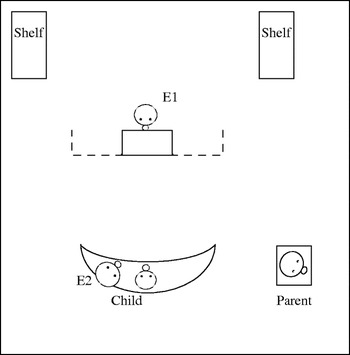
Children were familiarized with the main experimenter (E1) and an assistant experimenter (E2) during a short warm-up. During trials, parents were placed in a corner of the testing room, facing away from children and they were instructed not to intervene during the study. The testing room was set up in a symmetrical way as shown in Figure 1, with two shelves in the corners, a small table in the middle of the room, two Plexiglas barriers next to the table, and a banana-shaped seat located 2 meters from the table. The Plexiglas barrier was merely to prevent children from reaching the object too quickly.
Set-up of the testing room.

After a short period of joint play with both experimenters, E2 and the child took a seat on the banana and E1 started the first condition. In the ‘interact’ situation, E1 invited the child and E2 to be spectators to a magic show. She presented her magic box, took out a piece of ‘magic’ cloth and two identical toy animals. Throughout this situation she addressed children using a high-pitched voice, smiling, calling them by name and using attention-getters like ‘Look!’ The child watched as E1 spirited away one of the two toys. As she did this E1 accidentally knocked the other toy from the table with her elbow – an action that went unnoticed by E1. The hiding of the toy was done ostensively: E1 addressed the child directly, saying: ‘You know what? Now I'm going to spirit away this teddy [showed the object]! Look! This is how you do it: Abracadabra, hey presto! The teddy's disappeared!’ [E1 puts the object under the cloth].
In the ‘onlook’ situation, E1 took her leave from the game and announced that she had to do some work. E1 went to one of the shelves and pretended to be busy. The child and E2 took a seat on the banana and engaged in a mildly interesting game (e.g. book reading). After a short period of ‘work’, E1 gave E2 a hidden cue (short cough) which indicated that she would now start the manipulation. Upon getting this cue, E2 directed children's attention to E1's action by saying ‘Oh, look what [E1's name] is doing!’ When the child looked in her direction, E1 went back to the table. While bending over the table so that her head was roughly at the same height as in the ‘Interact’ condition, she manipulated one of the identical office tools for a while and – as if to herself – uttered the label of this object three times (to equate to the amount of labelling that occurred during the hiding episode in the ‘Interact’ situation). Then she openly but non-ostensively put the tool under the cover while the other object fell from the table unnoticed by her. E1 made the object fall by pulling an invisible string beneath the table which was attached to the object.
In both situations, after the objects had disappeared – one on the floor and one under the cover – E1 looked briefly at the child, then at the centre of the table and finally asked ‘Hm, where is the [toy/object], [child's name]?’ This last question was uttered either with a serious attitude in which E1 expressed surprise and suggested a lack of information by using a puzzled facial expression and low to high rising intonation, or with a playful attitude in which E1 displayed a playful facial expression (smile) and a high to low falling intonation. If the child did not respond, the question was repeated two times before the trial was aborted. As soon as the child indicated one of the objects, E1 first retrieved the indicated object and then the other object in a neutral manner, without giving any feedback about the choice.
Coding and reliability
For each trial it was coded whether children were attentive during the crucial part of the demonstration when both the hiding and dropping of the objects took place. Attentiveness was coded when the demonstration table was in the visual field of the child and the child was not obviously fussing. After confirming that the children were attentive, for each trial we coded which of the two candidate objects (informative or known) children first retrieved, touched, pointed to or indicated verbally (e.g. by saying ‘fell down’ or ‘under the cloth’). In the few cases where children pointed to one object but then touched or verbally indicated another one, we scored the more elaborate answer, assuming that moving towards one of the object locations to touch the object, or making a verbal utterance, required more effort than merely pointing to an object. There was only one child with a minimum of one valid trial in each of the groups and in each situation, all other children had at least two valid trials. All sessions were video-recorded and coded by the primary experimenter based on the video material. A random sample of eight children was assessed by an independent second coder who was blind to the condition and the hypotheses of the study. Inter-rater reliability was a perfect 100%.
RESULTS
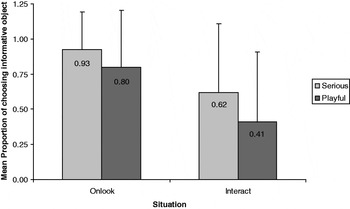
As a dependent variable we calculated the proportion of trials in which children chose the informative object relative to the total number of valid completed trials (ranging from 1–4). Overall, children had a bias towards the informative object (Overall Total=0·69), but the manipulated factors affected their choice as well (see Figure 2).
Mean proportion of choosing the informative object for each condition (with Standard Deviations).

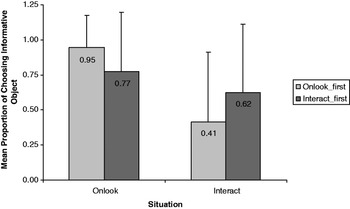
We conducted a repeated measures ANOVA including the factors situation (‘Onlook’, ‘Interact’), attitude (‘Serious’, ‘Playful’) and situation order (‘Onlook’ first or ‘Interact’ first). This analysis revealed a significant main effect for ‘situation’ (F 1,29=23·7, p<0·001, r=0·45), as well as a trend for the interaction between ‘situation’ and ‘situation order’ (F 1,29=3·8, p=0·061, r=0·12). The factor ‘attitude’ did not reach significance (F 1,29=2·76, p=0·11, r=0·09), nor did the order in which the situations were presented (F 1,29=0·01, p=0·93, r=0·0). None of the other possible interactions was significant.Footnote 1
The interaction of situation with situation order can be seen in Figure 3. Children were more likely to choose the informative object in the first situation they observed than in the second situation. We interpret this interaction in the ‘Discussion’ section below.
Mean proportion of choosing the informative object for situation and order of presentation (with Standard Deviations).

DISCUSSION
In the present study, two-year-old children interpreted questions differentially either as test questions asking for shared content or as genuine questions for missing information based on the situation. In an interactive situation children were more likely to offer the known object as the referent (i.e. the one the adult intentionally hid while the child watched), while in an onlooking situation (in which the adult was seeking something) they were more likely to indicate the informative object (i.e. the one that fell from the table seemingly unbeknownst to the adult). Unexpectedly, the attitude with which the question was expressed did not influence children's responses. It is very possible that this is a side-effect of our design which gave individual children the opportunity to compare situations (as within-subject factor) but only ever gave them experience of the experimenter expressing one type of attitude (as between-subject factor). Hence, children could have taken this to be the adult's standard way of asking questions, instead of a special marking for serious or interactive intent.
The overall preference for the informative object can be explained either by attentional factors – the dropping of the object attracted children's attention – or by their strong prosocial motivation to provide help (Warneken & Tomasello, Reference Warneken and Tomasello2007). Children's strong predisposition to help might have dominated their response in the presence of an object which clearly provides helpful information to the adult – thinking along the lines of ‘This object is part of the current action, she will miss it, regardless of whatever else has happened’. This prosocial explanation is to some extent supported by the influence of the order in which the situations were presented. Independent of the specific situation, children were slightly more likely to choose the informative object in the first task than in the second task, showing that without the possibility of comparing the situation, children tended to interpret the question helpfully rather than playfully.
A very rich interpretation of these results would be along the lines of a Gricean-type serial processing model as proposed with regards to directives by Searle (Reference Searle1969) and by Gordon and Lakoff (Reference Gordon and Lakoff1971). According to this account, questions in general should be backed up by a set of abstract felicity conditions which are jointly assumed by hearer and speaker – one of them being that questions ask for missing information. A literal interpretation is always retrieved first, but, if the speaker intentionally violates the felicity condition and asks for something obviously already known, the hearer is entitled to draw the inference that the speaker has an unusual communicative intention, for example asking a test question.
In our study, children readily interpreted the question as having a non-literal meaning, even though the speaker never obviously violated the felicity condition because there was always an informative option available. Thus children should have always interpreted the question as asking for the informative object (the literal interpretation). Instead, they interpreted the question differently and provided differing responses based on the shared situation type.
The ease with which children interpret a test question appropriately has led Shatz (Reference Shatz1979) to propose that such frequently occurring paradigmatic frames, like test questions, potentially take on the status of “routines which give children experience in identifying in the speech stream utterances with special response demands” (p. 1098). In this view, children do not try to infer the communicator's communicative intention but rather rely on inflexible and routine response patterns – that is, they start off by showing an action response whenever feasible and acquire other response patterns as the result of repeated routine interactions, i.e. learn that a special intonation marks a question as asking for (shared) information rather than for action. But in our study the child could not employ a routine response; she had to determine that in one situation a known or shared object is a good response and in the other an informative or helpful response is appropriate – by determining which of the two objects was informative for the experimenter.
Our finding is in line with many studies showing that children interpret one and the same utterance differently when presented in differing contexts or with different attitudinal expressions (e.g. Allen, Reference Allen1991; Babelot & Marcos, Reference Babelot and Marcos1999; Liebal, Behne, Carpenter & Tomasello, Reference Liebal, Behne, Carpenter and Tomasello2009; Bosco, Bucciarelli & Bara, Reference Bosco, Bucciarelli and Bara2004). Thus, we assume that children's attempts to infer the social intent of the communicator need not be based on complex inferential processes, departing from literal meaning; nor can their attempts be reduced to any fixed response strategy. Instead, children interpret the situation flexibly based on a shared understanding of many different aspects of the context. They try to determine which of the possible answers would yield optimal relevance (Wilson & Sperber, Reference Wilson, Sperber, Horn and Ward2004) to both of the participants – based on a mutual assumption of basic cooperativeness in communication (Tomasello, Reference Tomasello2008). Children's reasoning in each of the conditions could thus be paraphrased as: ‘Why is she communicating for me given our common ground?’ This predicts that children should respond differently based on the type of situation as part of the common ground shared between child and adult. Children recognize on the basis of these general understandings and their local understanding of particular structured contexts (like hiding–finding games or everyday searching situations) what are the adult's instrumental intentions (what goals she is aiming at in the physical situation) and what are her communicative intentions (which they typically attempt to comply with).
This same kind of logic also applies to children's responses to such things as test requests (e.g. the adult asking the child to fetch objects that she could more easily fetch herself; see the study of Grosse, Moll & Tomasello, Reference Grosse, Moll and Tomasello2010) and question directives (e.g. ‘Can you give me the newspaper?’). In both of these cases, again, it is unlikely that children are either engaging in complex inferential processes or blind following of routines; they understand the adult's intentions and communicative intentions based on their shared common ground and some assumptions about motives and relevance.
Determining the kinds of experience children need with test questions to be able to infer adult intentions appropriately is a question with not only theoretical, but also practical implications. Cross-cultural research, for example, suggests the possibility that asking children questions to which one obviously knows the answer is important preparation for formal education where test questions are one of the main methods of assessing children's knowledge. Brice-Heath (Reference Brice-Heath1988) observed that African American families do not ask their children test questions very frequently, and she proposed that this absence might be one of the factors contributing to the difficulties that these children face in the US school system. A practical implication of a different type concerns research methodology. In experiments, children are often asked test questions (Siegal, Reference Siegal1999), and our results suggest that they will be using the shared context of the situation to distinguish such questions from real questions – which means that experimental situations must be carefully constructed.
The current study thus demonstrates that from a very early age young children can tell the difference between genuine requests for information and test questions that are simply aimed at keeping the interaction going. Combined with other recent research, these results demonstrate one more of the myriad ways in which young children use their social–cognitive skills to determine the instrumental and communicative intentions underlying communicative acts.