Introduction
Tobacco use is growing rapidly in low income countries due to steady population growth coupled with tobacco industries targeting these areas. It is estimated that more than 80% of the world's tobacco-related deaths will be in low and middle income countries by 2030 (Vanker et al., Reference Vanka, Roshan, Ravi and Shashikiran2009). Each day 55,000 children in India start using tobacco and about 5 million children under the age of 15 are becoming addicted to tobacco (Vanker et al., Reference Vanka, Roshan, Ravi and Shashikiran2009). A recent study showed prevalence of individuals consuming tobacco was 29.6% in Uttar Pradesh, a state in northern India (50.0% among males and 9.1% among females) and 34.6% in Karnataka, a southern Indian state (41.0% among males and 14.9% among females) (Chaudhry et al.). Curiosity, peer influence and parental tobacco use are some of the factors influencing children and adolescents tobacco use (Ravishankar and Nagarajappa, Reference Ravishankar and Nagarajappa2009).
The FDI World Dental Federation adopted a position statement on tobacco in 1996 and urges its member associations and oral health professionals to take decisive actions to reduce tobacco use and nicotine addiction among the general public (Warnakulasuriya, Reference Warnakulasuriya2002). In 2002, the WHO supported government of India in setting up 12 tobacco cessation clinics (TCCs) in diverse settings (cancer treatment centres, psychiatric centres, medical colleges and non-governmental organisations [NGOs]) to help people stop tobacco use. These tobacco cessation services have achieved quit rates of approximately 16%, with behaviour change counselling, the least expensive and most feasible option. The role of TCCs in India was expanded in 2009 to include training on cessation and developing awareness on tobacco cessation (Kaur, Reference Kaur and Jain2011).
The issue of tobacco control has had almost unanimous support among public health professionals as a principle focus of policy attention. Despite their attention and advances in tobacco smoking treatment, cessation rates remain stagnant, possibly to the lack of new channels to reach tobacco users. In recent years, the delivery of tobacco cessation practices by health professionals in a primary care practice setting has received much attention (Pizzo et al., Reference Pizzo, Licata and Piscopo2010). Numerous controlled studies examining cessation counselling interventions delivered by physicians and dentists have demonstrated the efficacy of healthcare providers in reducing smoking among their patients (Tomar, Reference Tomar2001; McCartan et al., Reference McCartan, McCreary and Healy2008; Weaver et al., Reference Weaver, Whittaker, Valachovic and Broom2002). One recent proposal that dentists are not effective as tobacco use counsellors is perhaps better interpreted as evidence for the need for appropriate training, which has significant effect both on the likelihood of healthcare workers counselling patients and the tobacco quit rate achieved by these patients (Warnakulasuriya, Reference Warnakulasuriya2002; Wilson et al., Reference Wilson, Taylor, Gilbert, Best, Lindsay, Willms and Singer1988).
A dental school-based, tobacco use cessation programme that increases student's knowledge, creates a clinical environment, and provides TUC counselling experience was able to significantly increase the proportion of tobacco users receiving tobacco use cessation counselling (Gelskey, Reference Gelskey2002). Studies have shown that information channelled through the mass media tends to influence higher social strata while persons in the lower educational group appear to decode and respond best to verbal information (Halling, Reference Halling, Uhrbom and Bjerner1995). Tobacco use cessation (TUC) counselling by dental healthcare professionals has been shown to be an effective method of helping tobacco users to quit (Smith et al., Reference Smith, Warnakulasuriya, Feyerabend, Belcher, Cooper and Johnson1998). Evidence also suggests that TUC increases tobacco abstinence rate in smokeless tobacco users (Townsend, Reference Townsend, Roderick and Cooper1994). with more number of current smokers seeking dental care annually, dentists have regular opportunity to impact on tobacco users.
The major challenge for India in the twenty-first century is to make early tobacco use cessation treatment available to all tobacco users, evolve treatments that are culturally relevant and appropriately tailored to individuals and the population, and view tobacco cessation in the wider picture of prevention activities.
Several authors have proposed that incorporating tobacco cessation intervention curriculum content into formal professional education is the best way to ensure better clinician performance in tobacco interventions (Warnakulasuriya, Reference Warnakulasuriya2002; Tomar, Reference Tomar, Husten and Manley1996). Thus, the current study was undertaken to assess Indian dental students’ and practicing dentists’ perceptions of tobacco cessation content in the curriculum and their attitudes concerning their professional responsibility to help users quit tobacco.
Material and Methods
The survey was conducted among dental fraternities of Moradabad city. Convenience samples of 210 subjects were selected for the study. Dental students perusing their under graduate dental education from two dental colleges and registered dental practitioners in Moradabad were recruited. Focus was placed on dental students closest to graduation, internship students as they were most likely to have been exposed to complete curriculum content and the BDS third year students who have been just exposed to patients in clinical dentistry. Participation of the subjects in the survey was voluntary.
Measurement
In developing the survey questionnaire, several items were drawn from the survey on senior dental student's attitude towards smoking cessation guidelines used by Yip et al. (Reference Yip, Hay, Ostroff, Stewart and Cruz2000) These items were modified with some additional items for use with the Indian study subjects. The survey was pilot tested using a small convenience sample of students and modification were made in questionnaire as necessary. Seventeen closed item questionnaires regarding TUC were used to determine students’ and registered dental practitioners’ attitudes. Each item consisted of a statement and a five-point Likert scale, ranging from strongly agree to strongly disagree. These items focused on three areas:
1. Professional responsibility involved dental fraternities’ attitude towards the dental professionals’ responsibility to promote tobacco cessation.
2. Scope of dental practice: involved attitudes regarding the extent to which the tobacco cessation services are recommended in Indian dental schools. The item includes statements regarding the scope of TUC in dental practice (for example, ‘it is within the scope of dental practice to ask patients if they use tobacco’; ‘it is within the scope of dental practice to prescribe nicotine replacement therapy’).
3. Effectiveness centered on attitudes regarding the effectiveness of tobacco cessation promotion in the dental setting in helping patients to quit tobacco use.
The questionnaire included questions on whether or not participants had ever received training in tobacco cessation promotion, and their current level of interest in receiving training. Also the extent to which they anticipate that patient resistance might be a barrier to tobacco cessation promotion in the dental setting.
Procedure
In the student sample, the time and date of survey was intimated to the students well in advance. Questionnaires were distributed during scheduled class time and/or clinical courses. Students were assured that the information they provide would remain confidential and thus were encouraged to be truthful in their response and were instructed to give only one answer for each question, which they felt is most appropriate. For practitioners, all registered private dentists of Moradabad were approached at their clinics; questionnaires were administered and collected the next day. Additionally, follow up interviews were conducted on a small number of students to cross check responses. The researcher randomly selected 10 students from interns, 10 students from thirdyear BDS and five practicing dentists, and administered the same questionnaire after 5–7days. Agreement between the test and retest was estimated by calculating kappa coefficient for six questions; two questions from each of the three subdivided areas. The kappa values showed highest agreement in the range of 92% to 100%, for the accessed questions in all the groups. This study was approved by the institutional review board of Kothiwal Dental College, Moradabad, India.
The survey data were analysed using the SPSS 10.0 software package. Descriptive statistics using frequency distributions and percentages were generated for all questions. The results were collapsed into dichotomous variable: agreement and disagreement to get better inference of the result. Respondents who answered neutral were considered in disagreement group. Pearson chi-square statistics were used to derive p-value for group difference in proportion. Statistical significance level was set at p = 0.05.
Results
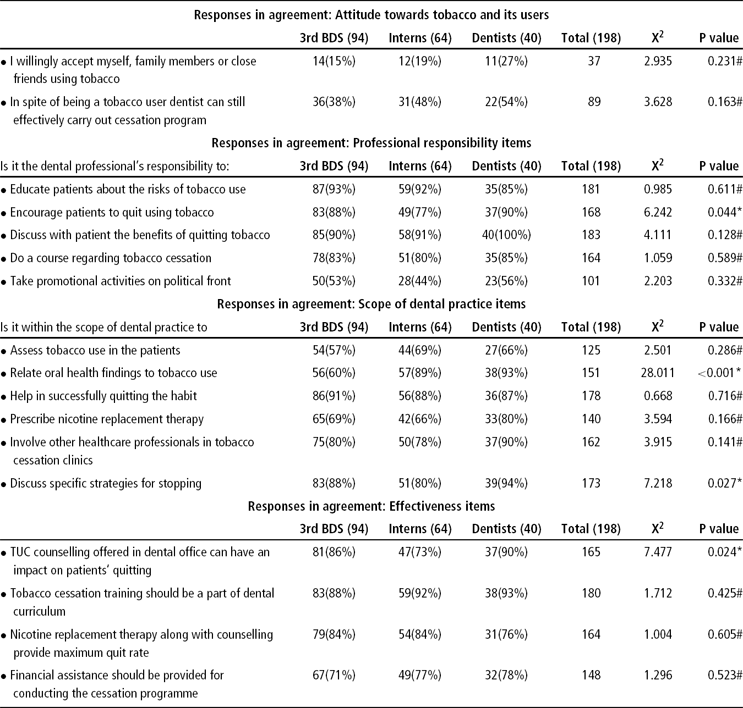
The response rate was 94% (198/210). Out of 198 respondents, 47%(94) were BDS third-year students, 32% (64) were interns and 21% (40) were practicing private dentists of Moradabad city. The mean age of the students was 22.4 years (19–24 years) and the mean age of practicing dentists was 35.4 years (30–46 years). Responses to various items regarding TUC are shown in Table 1.
Response of dental fraternity towards tobacco use cessation

(#) Not Significant p> 0.05, (*) Significant p < 0.05.
Attitude towards tobacco use
Eighteen per cent of the respondents willingly accepted themselves, family members, or friends using tobacco. Forty-five per cent of the respondents felt they can effectively carry out the cessation programme, in spite of them being a tobacco user themselves.
Professional Responsibility & Scope in dental practice
Nearly 84.8% of the respondents felt that it is a dental professional's responsibility to encourage patients to quit tobacco use. The difference in the response rates among three groups was statistically significant (p = 0.044). Eighty-two per cent of the total respondents want to take up training in tobacco use cessation but very few respondents (51.1%) want to take up promotional activities on a political front.
Just over 75% of the total respondents felt it is within the scope of dental practice to relate oral health findings to tobacco use. Third-year BDS students have the least positive response of only 60%. The difference in response among the groups was statistically significant (p < 0.001). Just over 87% of the total respondents felt that a specific strategy has to be adapted for tobacco use cessation, practicing dentists showing the maximum positive response. The difference in the responses was statistically significant (p = 0.027) among the groups. Nearly 71% of the respondents felt that a dentist have to prescribe nicotine replacement therapy.
Perceptions of effectiveness
About 83.3% of the total respondents felt that TUC counselling offered in the dental office will have an impact on patient's quitting with practicing dentists showing greater positive attitude. The difference was found to be statistically significant (P = 0.0237). Nearly 91% of the respondents feel that TUC training should be a part of dental curriculum. Nearly 83% of the total respondents felt that nicotine replacement therapy along with counselling will provide maximum quit rate, out of which practicing dentists showed slightly less positive response. Nearly 75% of the total respondents felt that some financial assistance (reimbursement) should be provided for conducting the cessation activities.
Discussion
The results of this study reveal important information about Indian Dental fraternities (students and practitioner) attitudes towards tobacco use cessation promotion in the dental setting. Focus was placed on dental students closest to graduation, internship students as they are most likely to have been exposed to complete curriculum content and the BDS third-year students who have been just exposed to patients in clinical dentistry. Since these students are in different stages of readiness to change and would soon enter into their chosen profession, they are most likely to develop a belief system about their professional responsibilities. The registered dentists were also included to know the influence of private dental practice on their attitude towards tobacco use cessation. Nearly all the dental students and practitioners agreed that it is their professional responsibility to educate patients about the risks of tobacco use and discuss the benefits of quitting and encouraging the patients to quit. This result is in agreement with the results of previous studies addressing students and practitioners attitudes (Yip et al, Reference Yip, Hay, Ostroff, Stewart and Cruz2000; Johnson et al., Reference Johnson, Lowe and Warnakulasuriya2006). The healthcare system's movement towards prevention and holism might have influenced the health profession students to realise the appropriateness of their role as a tobacco use interventionist. Health reports in journals as well as community and media campaigns expose these roles and may influence dental students’ and practitioners’ belief and attitudes (Jacquelyn et al., Reference Jacquelyn, Fried, Reid and DeVore2004).
A greater number of practicing dentists felt it was their responsibility to encourage patients to quit tobacco use compared to dental students. Some dental students might be sceptical of their tobacco interventionist role, as they are in the early stages of their professional education. Goldstein et al. suggested that innovative educational materials need to be matched to the healthcare provider's stage of readiness to change and to specific barriers (Goldstein et al., Reference Goldstein, DePue, Monroe, Lessne, Rakowski, Prokhorov, Niaura and Dube1998). In the early stage (precontemplation, contemplation, and preparation for action), healthcare workers (dental students) may need to learn more about the effectiveness of smoking cessation counselling including the importance of follow up care. In the later stages (action and maintenance), healthcare workers (practicing dentists) can be supported by learning how to improve their skills, select patient resources, and improve office systems to support the tobacco cessation counselling. Responses suggest that the majority of dental students and practitioners are positive but had some reservation about how TUC fit into a dental setting as they are not certain whether all activities come under the scope of TUC. This difference in response among the third-year students and other groups with respect to scope, may be due to lack of knowledge as their curriculum does not expose them to oral health findings related to tobacco use in their third year. Clinical knowledge for relating oral health findings with tobacco use is included in the curriculum mainly in the final year.
Reservation is also seen in recommending Nicotine Replacement Therapy and involving other healthcare professionals in TUC. It may be because dental students do not view active involvement in an individual quitting effort as a part of dentist role. They are content with a more hands off approach, providing general information and education but not becoming more actively involved. This may be because of lack of tobacco cessation education in dental curriculum in India. The lack of training in the formative years of dental education is one of the most significant barriers to carry out tobacco use cessation among dental care providers.4 Warnakulasuriya reviewed two previous decades of tobacco cessation activities among dental care providers and concluded that the most significant barrier to tobacco cessation counselling (TCC) by providers remains the lack of tobacco cessation education during formative years of training.4 However, not all tobacco cessation counselling activities are equally increased by tobacco cessation education. Numerous factors have been identified by health care providers and healthcare students as impacting TCC activities (Monson et al., Reference Monson and Engeswick2005).
The lack of TUC education during the formative years of training is reflected in our study by the finding that nearly 91% of the respondent wanted TUC training to be a part of dental curriculum. In the formative years of dental education in India, dentists incorporate tobacco use as vital signs when taking a patient's medical history, and that this routine practice is taught as well as modelled in dental schools. Contrary to this, in our result, 94% of the dental practitioners wanted to discuss specific strategies for tobacco control which was significantly less among the students. Tobacco cessation counselling education should stress the importance and impact of asking each patient about tobacco use. Additionally, the effectiveness of assisting patients to quit and arranging follow-up should be emphasised (Monson et al., Reference Monson and Engeswick2005).
There was a strong correlation between self-reported skills, perceived barriers and attitudes on tobacco intervention levels among dentists, i.e. the higher the perceived skills, the lower the perceived barriers to intervention and the more positive the attitudes to intervention, the higher the level of intervention (Lund et al., Reference Lund, Lund and Rise2004). There is a significant difference in response on the effectiveness of TUC offered in the dental office, with interns giving the least positive response and practitioners showing greater positive response. As the interns are in the final stages of their training, they are more oriented and interested in learning the clinical skills which they perceive as the most important for their professional success in dentistry. Other reasons can be the students’ perceived ability to be successful, students’ priorities, and lack of faculty reinforcement (Weaver et al., Reference Weaver, Whittaker, Valachovic and Broom2002), non-inclusion of TUC training in dental curriculum in India. Furthermore 75% of the respondents urged that financial assistance should be provided for conducting the tobacco cessation programme. If not this may act as a constraint; as in an US study more dentists than physicians reported the lack of insurance coverage as a barrier to TUC counseling (Warnakulasuriya, Reference Warnakulasuriya and Johnson1999; Gerebet, Reference Gerebet, Coates, Zahnd, Richard and Cummings1989) Regarding taking TUC on a political front, it is well known that health professionals are a critical resource for advancing the agenda of tobacco control, by actions which empower the community, catalyse policy and promote technical assistance to other stakeholder groups. They communicate information on the health consequences of tobacco to people as well as policy-makers. These served to sensitise the government as well as the judiciary to the need for comprehensive tobacco control legislation.
Limitation
A weakness of the present study was that the survey relied on dental fraternities self-reported behaviour which in the medical literature is generally found to have been exaggerated communication. Even with such exaggeration, the data is still convincing given the good number of dental personal's show positive attitude towards tobacco use cessation. The survey did not assess whether the dental fraternities themselves use tobacco or not nor did the survey assess the TUC practice by the dental fraternities.
Conclusion
Attitudes of dental fraternity appear to be positive regarding the dental professional's responsibility to counsel patients on tobacco use cessation. Dental fraternity is a resource waiting to be used in the work of tobacco use prevention. It is known that dentists as a captive audience to provide advice on tobacco use prevention during treatment procedures. However, some have reservations about the extent to which tobacco cessation services fit within the scope of dental practice, the efficiency of such services and the patient receptiveness. To enable dentists to work towards a protocol they need further training on tobacco use cessation counselling and should be reimbursed for this service. And dental education should include tobacco use cessation in their curriculum. The findings indicate a policy to encourage dentists to counsel patients on tobacco cessation.
Financial support
This work was financially supported in part by funds from Rural Dental Society for Oral Diseases-Prevention and Cure (grant number: 002/04/2012) we thank them for their kind cooperation.
Conflict of interest
None.
Ethical standards
Authors assert that all procedures contributing to this work comply with the ethical standards of the nation and institutional ethical committee on human experimentation and with the Helsinki Declaration of 1975, as revised in 2008.