


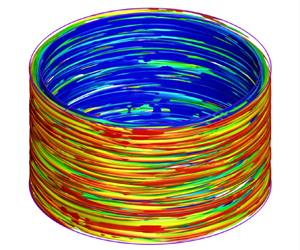


1. Introduction
Polymeric fluids are used to produce a huge variety of consumer products from household items to state-of-the-art composites used in applications of critical global needs (Denn Reference Denn2004; Larson & Desai Reference Larson and Desai2015; Benzi & Ching Reference Benzi and Ching2018). The nonlinear viscoelastic response of this class of fluids gives rise to a new class of instabilities and flow states that complicate liquid state processing of polymers. In fact, the strong coupling of inertial and elastic forces commonly quantified by the Reynolds ( $Re$) and Weissenberg (
 $Wi$) numbers, respectively, leads to various flow transition routes to turbulent flow states that are specific to polymeric fluids (Morozov & van Saarloos Reference Morozov and van Saarloos2007; Muller Reference Muller2008; Dutcher & Muller Reference Dutcher and Muller2013). A fascinating example is the elastically dominated inertialess flow state dubbed ‘elastic turbulence’ (ET) (Groisman & Steinberg Reference Groisman and Steinberg2000). Elastic turbulence displays large velocity fluctuations in a wide range of spatial and temporal scales with a power-law decay of the kinetic energy spectra in a frequency domain
 $E(k)\sim k^{-\alpha }$ with the exponent
 $\alpha >3$ (between 3.3 and 3.6 depending on flow geometry) (Fouxon & Lebedev Reference Fouxon and Lebedev2003; Steinberg Reference Steinberg2019). Thus, due to the steep decay of the velocity spectrum, ET is essentially a spatially smooth and temporally random flow, dominated by a strong nonlinear interaction of a few large-scale spatial modes (Groisman & Steinberg Reference Groisman and Steinberg2004; Steinberg Reference Steinberg2021).
In parallel shear flows, a full transition road map from inertial turbulence (IT) to a new turbulent-like regime dubbed elasto-inertial turbulence (EIT) has been discovered (Samanta et al. Reference Samanta, Dubief, Holznera, Schäfer, Morozov, Wagner and Hof2013; Choueiri, Lopez & Hof Reference Choueiri, Lopez and Hof2018; Lopez, Choueiri & Hof Reference Lopez, Choueiri and Hof2019; Shekar et al. Reference Shekar, McMullen, Wang, McKeon and Graham2019). Specifically, a reverse transition route from IT via a laminar base flow state to EIT is realized in pipe flows at a subcritical  $Re\sim O(10^3)$ (Choueiri et al. Reference Choueiri, Lopez and Hof2018), whereupon enhancement of elastic forces either by increasing the polymer concentration and/or increasing
 $Wi$ to
 $O(10)$, the flow first relaminarizes as the inertial quasi-streamwise vortices are gradually weakened and are finally eliminated (Choueiri et al. Reference Choueiri, Lopez and Hof2018; Lopez et al. Reference Lopez, Choueiri and Hof2019). This relaminarized state exhibits drag reduction beyond the maximum drag reduction asymptote (Toms Reference Toms1948; Lumley Reference Lumley1969; Virk Reference Virk1975) and subsequently undergoes a secondary instability, namely, elasto-inertial instability that results in a dominant flow structure consisting of two-dimensional sheets of highly stretched polymers in channel flows, and streamwise elongated streaks in pipe flows (Choueiri et al. Reference Choueiri, Lopez and Hof2018; Sid, Terrapon & Dubief Reference Sid, Terrapon and Dubief2018; Lopez et al. Reference Lopez, Choueiri and Hof2019; Shekar et al. Reference Shekar, McMullen, Wang, McKeon and Graham2019, Reference Shekar, McMullen, McKeon and Graham2020). The kinetic energy spectrum in the EIT regime has a
 $-14/3$ scaling, which is distinctly different from the Kolmogorov scaling of
 $-5/3$ for IT but close to the
 $-3.5$ scaling for ET (Fouxon & Lebedev Reference Fouxon and Lebedev2003; Groisman & Steinberg Reference Groisman and Steinberg2004; Dubief, Terrapon & Soria Reference Dubief, Terrapon and Soria2013; Steinberg Reference Steinberg2019). It should also be noted that another transition route towards EIT that bypasses the laminar state has been realized in pipe flows at a supercritical
 $Re$ (Choueiri et al. Reference Choueiri, Lopez and Hof2018).
In curvilinear shear flows, our recent simulations (Liu & Khomami Reference Liu and Khomami2013a,Reference Liu and Khomamib; Song et al. Reference Song, Teng, Liu, Ding, Lu and Khomami2019) of the viscoelastic Taylor–Couette (TC) flows, i.e. the flows between two concentric, rotating cylinders (Taylor Reference Taylor1923), taken together with some preliminary experimental findings (Lee, Sengupta & Wei Reference Lee, Sengupta and Wei1995; Dutcher & Muller Reference Dutcher and Muller2011), are indicative of the existence of reverse transitions from IT to a new flow state that is more akin to ET than EIT. Specifically, at high levels of fluid elasticity, i.e.  $Wi=60$, the Newtonian turbulent Taylor vortex flow (TTV) at
 $Re=3000$ and large radius ratio
 $\eta =R_i/R_o=0.912$ is stabilized to a flow state resembling the Taylor vortex flow (TVF), where
 $R_i$ and
 $R_o$ are the inner and outer cylinder radii, respectively (Dutcher & Muller Reference Dutcher and Muller2009; Song et al. Reference Song, Teng, Liu, Ding, Lu and Khomami2019). In this transition the inertial small-scale Görtler vortices (GV) (Wei et al. Reference Wei, Kline, Lee and Woodruff1992; Dong Reference Dong2007) are eliminated; conversely, a similar Newtonian TTV at a small
 $\eta$ (
 ${=}0.5$) transitions directly (without relaminarization) to an elasticity-dominated turbulence (EDT), as evidenced by destabilization of large-scale Taylor vortices (TV) via a hoop stress driven elastic/inertio-elastic Görtler instability that results in small near-wall turbulent vortices (Liu & Khomami Reference Liu and Khomami2013b; Song et al. Reference Song, Teng, Liu, Ding, Lu and Khomami2019). A drastic drag enhancement (DE) is observed for these two very different, in fact nearly opposite, vortical changes. Evidently, the localized small-scale elastic structures in viscoelastic TC turbulence display streamwise-oriented flow topology, that are in stark contrast to the trains of weak spanwise-oriented flow structures with inclined sheets of polymer stretch in EIT of parallel shear flows. Hence, the underlying elasticity-driven physics and in particular the role of hoop stresses in the generation of turbulence and vortical structures, DE, and the realization of a distinct flow state, namely EDT, remain an open question.
To this end, the viscoelastic TC flow is an ideal flow to examine the effects of polymeric elasticity mainly manifested through hoop stresses on flow transitions, pattern formations and turbulence dynamics (Groisman & Steinberg Reference Groisman and Steinberg1996, Reference Groisman and Steinberg1997, Reference Groisman and Steinberg1998a,Reference Groisman and Steinbergb; Crumeyrolle & Mutabazi Reference Crumeyrolle and Mutabazi2002; Dutcher & Muller Reference Dutcher and Muller2011; Latrache, Crumeyrolle & Mutabazi Reference Latrache, Crumeyrolle and Mutabazi2012; Dutcher & Muller Reference Dutcher and Muller2013). In what follows, we will demonstrate a novel transition route from IT to EDT in viscoelastic TC flow. This transition from a Newtonian TTV is facilitated by increasing the maximum chain extension ( $L$) of the polymer additives that leads to a significant increase in hoop stresses that play a central role in determining flow patterns, dynamics and transitions. Specifically, the transition has three distinctive aspects: (1) dramatic DE; (2) a stabilization step that leads to a laminar flow much like the modulated wavy vortex flow (MWV); and (3) a subsequent destabilization of the laminar flow to an EDT regime with the hallmark signature of ET, i.e. a spatially smooth and temporally random flow with a
 $-3.5$ energy spectrum scaling. In turn, the underlying physical origin of this transition and the commensurate competition between inertial and elastic body forces are discussed.
2. Problem formulation and computational details
Direct numerical simulations using a fully spectral, three-dimensional parallel algorithm (Thomas et al. Reference Thomas, Al-Mubaiyedh, Sureshkumar and Khomami2006a; Thomas, Khomami & Sureshkumar Reference Thomas, Khomami and Sureshkumar2006b, Reference Thomas, Khomami and Sureshkumar2009; Liu & Khomami Reference Liu and Khomami2013a,Reference Liu and Khomamib; Song et al. Reference Song, Teng, Liu, Ding, Lu and Khomami2019) have been performed to examine the flow dynamics in viscoelastic TC flow. We have chosen  $d=R_o-R_i$,
 $d/(\varOmega R_i)$,
 $\varOmega R_i$,
 $\rho (\varOmega R_i)^2$ and
 $\eta _p \varOmega R_i / d$ as scales for length, time, velocity
 $\boldsymbol {u}$, pressure
 $P$ and polymer stress
 $\boldsymbol {\tau }$, respectively. Here
 $\varOmega$ denotes the inner cylinder angular velocity, and
 $\rho$ the solution density. The outer cylinder is considered to be stationary. The polymer stress
 $\boldsymbol {\tau }$ is related to the conformation tensor
 $\boldsymbol{\mathsf{C}}$ through the finitely extensible nonlinear elastic-Peterlin (FENE-P) constitutive relation (Bird et al. Reference Bird, Curtiss, Armstrong and Hassager1987). The dimensionless governing equations for the incompressible flow of FENE-P fluid are
 $$\begin{gather} \boldsymbol{\nabla}\boldsymbol{\cdot}\boldsymbol{u} = 0, \end{gather}$$
 $$\begin{gather}\frac{\partial \boldsymbol{u}}{\partial t}+\boldsymbol{u}\boldsymbol{\cdot}\boldsymbol{\nabla}\boldsymbol{u} ={-}\boldsymbol{\nabla} P+\frac{\beta}{Re}\nabla^2\boldsymbol{u}+\frac{1-\beta}{Re}\boldsymbol{\nabla}\boldsymbol{\cdot}\boldsymbol{\tau} \end{gather}$$
and
 \begin{equation} \frac{\partial \boldsymbol{\mathsf{C}}}{\partial t} + \boldsymbol{u}\boldsymbol{\cdot}\boldsymbol{\nabla}\boldsymbol{\mathsf{C}}=\boldsymbol{\mathsf{C}}\boldsymbol{\cdot}\boldsymbol{\nabla}\boldsymbol{u} +(\boldsymbol{\nabla}\boldsymbol{u})^\textrm{T}\boldsymbol{\cdot}\boldsymbol{\mathsf{C}}-\boldsymbol{\tau}+\kappa \nabla^2\boldsymbol{\mathsf{C}}, \end{equation}
where polymer molecules are modelled as dumb-bells composed of two beads and a nonlinear spring, and the polymer stress  $\boldsymbol {\tau }$ can be related to the stress conformation tensor
 $\boldsymbol{\mathsf{C}}$ via the relationship
 \begin{equation} \boldsymbol{\tau}=\frac{f(\boldsymbol{\mathsf{C}})\boldsymbol{\mathsf{C}}-\boldsymbol{\mathsf{I}}}{Wi}. \end{equation}
The function  $f(\boldsymbol{\mathsf{C}})$, known as the Peterlin function, is defined as
 \begin{equation} f(\boldsymbol{\mathsf{C}})=\frac{L^2-3}{L^2-\textrm{trace}(\boldsymbol{\mathsf{C}})}, \end{equation}
where  $Re=\rho \varOmega R_i d/\eta _t$, with the total zero-shear viscosity
 $\eta _t$ being the sum of the solvent (
 $\eta _s$) and polymeric (
 $\eta _p$) contributions;
 $Wi=\lambda \varOmega R_i /d$, with
 $\lambda$ being the elastic relaxation time; and
 $\beta =\eta _s / \eta _t$. Here
 $L$ is the maximum chain extensibility, in particular, the polymeric shear stress and normal stress (hoop stress) tend to increase at higher extensibilities, corresponding to the shear-thinning behaviour in both the shear viscosity and first normal stress coefficient (Ghanbari & Khomami Reference Ghanbari and Khomami2014). The governing equations are supplemented by no-slip boundary conditions at walls, as well as periodic boundary conditions in the axial direction with a periodicity length of
 $4{\rm \pi} d$. A small diffusive term
 $\kappa \nabla ^2\boldsymbol{\mathsf{C}}$ is added in the bulk flow region for numerical stabilization (Sureshkumar, Beris & Avgousti Reference Sureshkumar, Beris and Avgousti1995, Reference Sureshkumar, Beris and Avgousti1997). The original constitutive equation without the diffusive term is applied at the cylinder walls, hence, where boundary conditions for
 $\boldsymbol{\mathsf{C}}$ are not imposed.
Inspired by previous simulations of EIT (Sid et al. Reference Sid, Terrapon and Dubief2018; Lopez et al. Reference Lopez, Choueiri and Hof2019; Shekar et al. Reference Shekar, McMullen, Wang, McKeon and Graham2019) and viscoelastic TC flow (Liu & Khomami Reference Liu and Khomami2013a,Reference Liu and Khomamib; Song et al. Reference Song, Teng, Liu, Ding, Lu and Khomami2019), we pursue a transition route from IT to EDT in a small gap viscoelastic TC flow system of  $\eta =R_i /R_o=0.912$,
 $Re=3000$,
 $Wi=60$ and
 $\beta =0.8$, by enhancing the extensional viscosity and hoop stresses via increasing
 $L$ from 30 to
 $240$. The
 $L$ values considered correspond to an extensibility number
 $(E_x =2L^2(1-\beta )/3\beta )$ ranging from 150 to 9600 (Xi & Graham Reference Xi and Graham2010; Lopez et al. Reference Lopez, Choueiri and Hof2019). Based on our previous calculations (Song et al. Reference Song, Teng, Liu, Ding, Lu and Khomami2019), for
 $L\leqslant 120$ a Schmidt number
 $Sc\,[\equiv (Re\kappa )^{-1}]$ of
 $0.42$ is used with a mesh size of
 $128\times 256\times 256$ in the
 $r\times \theta \times z$ directions and a time step of 0.005; in order to reliably capture the polymer stress field at
 $L\geqslant 130$ a larger
 $Sc$ (
 ${=}0.83$) is used along with a larger mesh size of
 $128\times 256\times 512$ and a smaller time step of 0.001. Simulation with finite
 $Sc$ could modify the reported flow transitions; however, the spatial resolution and the
 $Sc$ number used in this study are large enough to nearly quantitatively capture the essential flow features. Evidently, the choice of
 $\beta$ affects the critical
 $L$ for transition to elasticity-dominated flow as well as the onset of numerical instability. Nevertheless, the reported results not only capture the essential flow dynamics but also provide mechanistic insight for the novel reverse flow transitions observed in the viscoelastic TC flow. All the simulations for the viscoelastic TC flow are initiated from the Newtonian TTV state (Dutcher & Muller Reference Dutcher and Muller2009). Sufficiently long simulations [typically of
 ${\sim }300T$,
 $T=d/(\varOmega R_i)$] are executed to ensure that statistically steady flow states have been realized. Moreover, ensemble averages are obtained over a time period of
 ${\sim }120T$.
3. Results and discussion
Our results indicate a novel flow transition route from IT to EDT that contains a stabilization step ( $L=30\sim 120$) and a subsequent destabilization step (
 $L=130\sim 240$), as evidenced by the vortical changes depicted in figures 1 and 2. Similar to our previous findings (Liu & Khomami Reference Liu and Khomami2013b; Song et al. Reference Song, Teng, Liu, Ding, Lu and Khomami2019), these transitions lead to a dramatic DE, namely, from
 $24\,\%$ to
 $81\,\%$ in the stabilization step and from
 $50\,\%$ to
 $138\,\%$ in the destabilization step, as shown in table 1. The angular momentum current
 $J^{\omega }$ in viscoelastic turbulent TC flow is defined as (Song et al. Reference Song, Teng, Liu, Ding, Lu and Khomami2019)
 \begin{equation} J^{\omega}=r^3[\langle u_r\omega \rangle-\beta \partial_r \langle\omega\rangle /Re - (1-\beta) \langle\tau_{r\theta}\rangle/r /Re]. \end{equation}
Hereafter,  $\langle \,\rangle$ denotes ensemble averaging in time, the
 $\theta$- and
 $z$-directions. Here
 $\omega =u_\theta /r$ denotes the angular velocity. The right-hand terms of (3.1) represent in sequence the contributions of convective flux (
 $J^\omega _c$), the diffusive flux (
 $J^\omega _d$) and the elastic source/sink term (
 $J^\omega _p$) to the angular momentum (Song et al. Reference Song, Teng, Liu, Ding, Lu and Khomami2019). The Nusselt number is calculated as
 $Nu_\omega = J^{\omega }/J^{\omega }_{lam}$, with
 $J^{\omega }_{lam}$ being the Newtonian laminar value; hence,
 $J^\omega _c/J^{\omega }$ represents the inertia contribution to
 $Nu_\omega$, i.e. convection mainly arising from the large-scale TV, and
 $J^\omega _p/J^{\omega }$ represents the elastic contribution. As shown in figures 1(a) and 2(a), the Newtonian TTV regime can be viewed as a superimposition of near-wall small-scale GV on the large-scale TV that occupy the entire gap (Dutcher & Muller Reference Dutcher and Muller2009). To be more specific, as fluid inertia is enhanced gradually, the TTV is realized via a sequence of flow transitions from circular Couette flow, to axially periodic TVF, and then subsequently to wavy vortex flow (known as WVF), MWV, chaotic wavy vortex (CWV) flow, wavy turbulent vortex (WTV) flow and finally to TTV flow (Dutcher & Muller Reference Dutcher and Muller2009). In the TTV regime, the large-scale TV are highly oscillatory in time, as evidenced by their fluctuating boundaries, i.e. the inflow (blue) and outflow (red) stripes (see figure 1a). The spatial small-scale fluid motions are ascribed to the inertial small-scale GV that lead to high-intermittency oscillations of the large-scale TV (see figure 2a). The dominant spatial mode for this flow regime is
 $k_0=5$ and the energy spectrum has a
 $-5/3$ scaling signifying its IT origin (see figure 3a).
Nusselt number  $Nu_\omega = J^{\omega }/J^{\omega }_{lam}$ where
 $J^{\omega }$ is the angular momentum current defined in (3.1) and
 $J^{\omega }_{lam}$ is its Newtonian laminar flow counterpart, convective flux (
 $J^\omega _c$) and polymeric elastic source/sink (
 $J^\omega _p$) contribution to the angular momentum
 $J^{\omega }$ of TC flows at the middle of the gap for various
 $L$. Here
 $L=0$ corresponds to the Newtonian TTV flow; DE is calculated as
 $(Nu_{\omega }-Nu_{\omega }^{L=0})/Nu_{\omega }^{L=0}$.

Space–time plots of radial velocity  $u_r$ obtained along the axial line at
 $r=(R_i+R_o)/2$ and
 $\theta ={\rm \pi}$ for (a) Newtonian TTV, (b)
 $L=30$, (c)
 $L=60$, (d)
 $L=120$, (e)
 $L=130$, (f)
 $L=160$, (g)
 $L=200$, (h)
 $L=240$. The blue and red contour regions correspond to the radial inflows (
 $u_r<0$) and outflows (
 $u_r>0$), respectively.

Instantaneous vectors of radial ( $u_r$) and axial (
 $u_z$) velocities and contour plots of streamwise vorticity
 $\omega _\theta$ in (
 $r, z$) plane with
 $\theta ={\rm \pi} /2$,
 $0\leqslant z \leqslant 2{\rm \pi} d$ and
 $R_i\leqslant r\leqslant R_o$.

One-dimensional spectra of the streamwise turbulent kinetic energy ( $\langle u'_\theta u'_\theta \rangle$) for (a) the stabilization step and (b) the destabilization step, where the azimuthal velocity fluctuation
 $u'_\theta$ is sampled at the middle of the gap. Hereafter, the fluctuating velocity
 $\boldsymbol {u}'$ is obtained as
 $\boldsymbol {u}'=\boldsymbol {u}-\langle \boldsymbol {u} \rangle$.

Evidently, the stabilized flow is characterized by a gradual elimination of the inertial small-scale GV and stabilization of the large-scale TV. Specifically, when polymer additives with  $L=30$ are introduced, the small-scale GV are greatly weakened (see figure 2b) and consequently, the large-scale TV exhibit temporally random wavy oscillations (see figure 1b) resulting in a weakly turbulent flow, namely, the WTV flow regime (Dutcher & Muller Reference Dutcher and Muller2009). For
 $L=60$, the disordered wavy oscillations of the large-scale TV become weaker (see figure 1c) as the near-wall small-scale GV are almost eliminated (see figure 2c). This is reminiscent of the Newtonian CWV flow regime (Dutcher & Muller Reference Dutcher and Muller2009). Further increase in
 $L$ to
 $120$ relaminarizes the viscoelastic TC flow to a MWV-like laminar flow that has trivial interactions between two neighbouring stabilized large-scale TV, as evidenced by the small temporal variations of large-scale TV boundaries (see figures 1d and 2d). This stabilization step is qualitatively opposite to the classic inertially driven transition sequence, namely, from TVF to MWV, CWV, WTV and finally to TTV (Dutcher & Muller Reference Dutcher and Muller2009). Spectral changes as
 $L$ is enhanced are shown in figure 3(a), namely, drastic decrease of small scales by several orders and increased dominance of the primary spatial mode (
 $k_0=5$) and its superharmonics.
The subsequent destabilized flows result from the nonlinear interactions of the large-scale TV which become unstable as  $L$ is increased over
 $130$. These interactions are manifested as a complex combination of merging and splitting along with oscillating of the large-scale TV (see figures 1 and 2), much like the experimental observations of the so-called merge–split transition to EIT in viscoelastic TC flow of
 $Re\sim O(10^2)$ (Cagney, Lacassagne & Balabani Reference Cagney, Lacassagne and Balabani2020; Lacassagne et al. Reference Lacassagne, Cagney, Gillissen and Balabani2020). Specifically, vortex merging and splitting events (VMSE) trigger a nonlinear transition to a chaotic regime dubbed elasticity-dominated chaotic flow (EDC) for
 $L=130$ and
 $160$ (see figures 1e,f and 2e,f). In the EDC, the large-scale TV are stable with a lifetime of
 ${>}30T$, and have relatively larger axial sizes corresponding to a dominant spatial mode
 $k_0=3$ and 4 for
 $L=130$ and
 $160$, respectively (see figure 3b). The flow approaches the EDT regime for
 $L=200$ and
 $240$, which is characterized by a highly intermittent occurrence of the VMSE and the notably distorted large-scale TV (see figures 1g,h and 2g,h). In contrast, no dominant spatial mode is identified for the EDT (see figure 3b), and remarkably, a
 $-3.5$ spectral scaling is observed for these two regimes, thus justifying the designation of EDC and EDT. Recently, experimental studies on the elasto-inertial transitions in TC flow of viscoelastic polymer solutions have shown that shear-thinning acts to suppress elastic instabilities in the viscoelastic TC flows (Lacassagne, Cagney & Balabani Reference Lacassagne, Cagney and Balabani2021). The simulation results here support this argument, i.e. elasticity-dominated turbulent flow occurs at high
 $L$ values where shear thinning effects are minimal but the driving force for instability and flow transition, namely hoop stresses and elongational viscosity, are large. Similar to inertialess ET (Groisman & Steinberg Reference Groisman and Steinberg2000, Reference Groisman and Steinberg2004; Steinberg Reference Steinberg2021), these two flow regimes are spatially smooth and temporally random and the flow dynamics are dominated by the VMSE of oscillating large-scale TV. This points to the universality of flow-microstructure coupling and energy spectra in elastically dominated flows over a broad range of
 $Re$. Hence, the spatial small-scale fluid motions are originated by VMSE via the resulting chaotic variations of polymer stresses at smaller scales (Groisman & Steinberg Reference Groisman and Steinberg2000, Reference Groisman and Steinberg2004; Steinberg Reference Steinberg2021).
The intricate competition between inertial and elastic nonlinearities underlying this transition route is substantiated in figure 4 via the changes in total turbulent kinetic energy ( $E_t$) and elastic potential energy (
 $E_p$). Note that,
 $E_t$ is calculated by the fluctuating velocity
 $\boldsymbol {u}'$ that results from the large-scale TV oscillations and the small-scale turbulent motions, and thus can be viewed as a proper dynamical measure of inertial nonlinearity. Evidently, the stabilization step has a slight increase in
 $E_t$ followed by a more pronounced decrease in the destabilization step. For
 $L<130$,
 $E_t$ is much larger than
 $E_p$. However,
 $E_p$ becomes larger than
 $E_t$ after the onset of EDC at
 $L=130$ and increases continuously as
 $L$ is increased. This clearly demonstrates that the nonlinear flow dynamics are inertia-dominated and then elasticity-dominated in the stabilized and destabilized flows, respectively. This is consistent with the above findings that the EDC and EDT are essentially of elastic origin as the inertial small-scale GV are fully eliminated.
Total turbulent kinetic energy  $E_t$ and elastic potential energy
 $E_p$ of viscoelastic TC flow for various
 $L$;
 $L=0$ corresponds to the Newtonian TTV flow. Here
 $E_t=8{\rm \pi} ^2 \,\textrm {d} \int _{R_i}^{R_o}\langle \boldsymbol {u}'^2 \rangle /2r\,\mathrm {d}r$ and
 $E_p=8{\rm \pi} ^2 \,\textrm {d}\int _{R_i}^{R_o} (1-\beta )(L^2-3)\langle \ln (f(\boldsymbol{\mathsf{C}}))\rangle /(2ReWi) r\,\mathrm {d}r$.

The classic Pakdel–McKinley (PM) criterion (McKinley, Pakdel & Oeztekin Reference McKinley, Pakdel and Oeztekin1996; Pakdel & McKinley Reference Pakdel and McKinley1996) for identification of the primary elastic instability in curvilinear flows (Larson, Shaqfeh & Muller Reference Larson, Shaqfeh and Muller1990; Larson Reference Larson1992; Sureshkumar, Beris & Avgousti Reference Sureshkumar, Beris and Avgousti1994; Shaqfeh Reference Shaqfeh1996; Groisman & Steinberg Reference Groisman and Steinberg1998b; Al-Mubaiyedh, Sureshkumar & Khomami Reference Al-Mubaiyedh, Sureshkumar and Khomami1999, Reference Al-Mubaiyedh, Sureshkumar and Khomami2000, Reference Al-Mubaiyedh, Sureshkumar and Khomami2002) should provide insight on flow destabilization observed in this study. The extended version of this criterion for viscoelastic TC flow with negligible inertia is given by (Schäfer, Morozov & Wagner Reference Schäfer, Morozov and Wagner2018)
 \begin{equation} \sqrt{\epsilon}Wi^{rheo}\geqslant\frac{M_{crit}}{\sqrt{2}}\sqrt{1-\beta}\sqrt{1+\frac{3}{2}\epsilon+ \frac{\epsilon^2}{2(\epsilon+2)}}, \end{equation}
where  $\epsilon =d/R_i$ is the curvature,
 $Wi^{rheo}=N_1/(2|\varSigma _{r\theta }|)$ is the rheological Weissenberg number defined by the ratio of first normal stress difference
 $N_1=\tau _{\theta \theta }-\tau _{rr}$ and the total shear stress
 $\varSigma _{r\theta }$ that herein has an inertial part across the gap, i.e. the Reynolds stress
 $\langle u'_ru'_\theta \rangle$ (Song et al. Reference Song, Teng, Liu, Ding, Lu and Khomami2019), since high-
 $Re$ viscoelastic TC flows are considered in the present study;
 $M_{crit}\approx 1.8$ is the instability threshold obtained experimentally that corresponds to the instability condition
 $\sqrt {\epsilon }Wi^{rheo}\approx 0.61$ for onset of the elastic instability (Schäfer et al. Reference Schäfer, Morozov and Wagner2018). Evidently,
 $\sqrt {\epsilon }Wi^{rheo}$ is flow and geometry dependent and thus can serve as a dynamic indicator for the coupled inertial and elastic nonlinearities in curvilinear flows. However, this criterion does not explicitly take into account finite extensibility of the polymer chain, quantified by
 $L$ in the FENE-P model. It is clear that the value of
 $L$ plays an important role in both polymer induced flow transitions and drag modifications. Motivated by this fact, Li, Sureshkumar & Khomami (Reference Li, Sureshkumar and Khomami2015), in their study of polymer induced drag reduction in channel flows, developed an effective Weissenberg number for the FENE-P model (
 $Wi^{eff}=Wi^{rheo}[1-\textrm {tr}(\boldsymbol{\mathsf{C}})/L^2]$) to more accurately capture flow microstructure coupling in the extensionally dominated regions of the flow, i.e. the biaxial extensional flow between streaks. To this end, we have changed the ‘rheological Weissenberg number’
 $Wi^{rheo}$ as the effective Weissenberg number
 $Wi^{eff}$ in the extended PM criterion. In turn, the instability onset condition, i.e.
 $\sqrt {\epsilon }Wi^{eff}$, has been determined based on this criterion (see table 2). It should be noted that
 $Wi^{rheo}$ and
 $Wi^{eff}$ are functions of the radial position. Specifically, they have nearly equivalent maximum values near both cylinder walls and their respective minimum values occur at the middle of the gap. Hence, values at the middle of the gap are used to determine the critical onset condition for the instability. Using this new criterion, i.e.
 $\sqrt {\epsilon }Wi^{eff}$, the onset condition for instability monotonically increases as
 $L$ is increased and becomes larger than the critical value of
 $0.61$ suggested by Schäfer et al. (Reference Schäfer, Morozov and Wagner2018) at
 $L=130$, which corresponds to direct numerical simulation predictions of the onset of elasticity-dominated flows. Thus, this new PM criterion not only provides much more reasonable values for the onset condition of the elastic instability, but also correctly captures the changes in this condition as
 $L$ is enhanced, even at relatively high
 $Re$.
Minimum values of ensemble-averaged instability onset condition across the gap for various  $L$.

4. Conclusions
In summary, a complete transition route from IT to EDT has been numerically realized for the first time in the viscoelastic TC flow. This transition route that leads to significant DE is composed of a first stabilization step that gives rise to a MWV-like laminar regime, followed by a destabilization step that gives rise to EDT that has the hallmark signatures of ET. Taken together with another  $L$-driven transition in a large gap viscoelastic TC flow with
 $\eta =0.5$ (Liu & Khomami Reference Liu and Khomami2013b) from IT to EDT where the laminar state is bypassed, it paves the way for developing a full transition road map from IT to EDT in curvilinear wall bounded shear flows. Despite distinct differences in coherent structures and turbulent friction drag between EDT in TC flow and EIT in parallel shear flows, they have similar turbulent energy spectra. This points to the universality of elastically driven turbulent flow of dilute polymeric solutions, irrespective of the origin of elastic body forces. To this end, a solid foundation for research on polymer-induced transitions in high and low
 $Re$ shear flows focused on detailed mechanistic understanding of EDT and ET and existence of spectral universality in this class of flows has been developed.
Acknowledgements
The calculations were completed on the supercomputing system in the Supercomputing Center at the University of Science and Technology of China.
Funding
This work was supported by the National Natural Science Foundation of China (J.S., Z.W., N.L. and X.L. grant numbers 12172353, 92052301, 12172351, 11621202, 11572312), the Science Challenge Project (N.L. and X.L. grant number TZ2016001), the National Science Foundation (B.K. grant number CBET0755269) and the Fundamental Research Funds for the Central Universities and the USTC Research Funds of the Double First-Class Initiative (Z.W.).
Declaration of interests
The authors report no conflict of interest.



