Introduction
Anxiety symptoms and anxiety disorders are highly prevalent in later life (Bryant et al., Reference Bryant, Jackson and Ames2008), although they commonly have their onset many years earlier (Gonçalves and Byrne, Reference Gonçalves and Byrne2012). The epidemiology of psychotic symptoms and psychotic disorders in later life is less certain, although some estimates indicate a relatively high prevalence for both (Henderson et al., Reference Henderson1998; Perälä et al., Reference Perälä2007). In clinical samples of mainly young and middle aged adults there is a strong association between schizophrenia and certain anxiety disorders (Tibbo et al., Reference Tibbo2003; Naeem et al., Reference Naeem, Kingdon and Turkington2006; Braga et al., Reference Braga, Reynolds and Siris2013), but this association is less firmly established in older people.
Population data investigating the association between low prevalence disorders such as schizophrenia and high prevalence disorders such as depression and anxiety in older people are rare. Saha et al. (Reference Saha2012) have written extensively on the association of self-reported delusion-like experiences, rather than schizophrenia itself, with depression and anxiety, but have not focused particularly on older people. They found that both anxiety and depressive disorders were associated with delusion-like experiences, and that there was a dose-response relationship between the severity of depressive disorder and the odds of reporting delusion-like experiences.
It is unclear whether similar associations obtain in later life, and, if they do, whether they might be moderated by the presence of cognitive impairment or general medical conditions. Accordingly, we sought to investigate whether self-reported delusion-like experiences were associated with anxiety and affective disorders in older people. We also investigated the extent of distress and disability associated with delusion-like experiences in older people as proxies for their likely clinical significance. Finally, we investigated whether any such relationships in later life might be influenced by the presence of cognitive impairment or general medical conditions.
Methods
Study design
The second NSMHWB is a national probability survey of community-residing persons aged 18–85 years that was conducted in urban and rural Australia during 2007. The NSMHWB employed a multistage, stratified sampling strategy and purposively oversampled older people. Of a total sample of 8,841 persons, there were 1,905 (21.5%) persons aged 65–85 years. Interviews were conducted by trained lay interviewers using a modified version of the Composite International Diagnostic Interview (CIDI 3.0; Kessler and Ustun, Reference Kessler and Ustün2004).
The NSMHWB focused on high prevalence mental disorders, including affective disorders, anxiety disorders, and substance use disorders. Whilst the survey did not formally identify individuals with current or lifetime psychotic disorders, it did ask participants a nested series of questions designed to ascertain the presence or absence of three pre-specified delusion-like experiences. The NSMHWB survey interview also asked participants whether they had ever been diagnosed with schizophrenia.
We identified those participants who met DSM-IV criteria for an anxiety disorder or an affective disorder over the previous 12 months. Data on anxiety disorder and affective disorder were available for all 1,905 older participants.
The presence of the three pre-specified delusion-like experiences was also ascertained. Data on delusion-like experiences were available for 1,903 older participants. Two participants had missing data on these variables, but neither met diagnostic criteria for a 12-month history of anxiety disorder.
Participants were asked about three delusion-like experiences as follows: (1) Whether you ever felt that your thoughts were directly interfered with or controlled by others; (2) Whether you ever felt that people were too interested in you; and (3) Whether you ever had special powers that most people lack.
Specific subsidiary questions were asked of respondents who answered affirmatively to any of these three initial questions, including questions to establish whether the delusion-like experiences had been experienced in the previous 12 months (see Supplementary file).
Cognitive function was assessed on the MMSE (Folstein et al., Reference Folstein, Folstein and McHugh1975), a screening test for cognitive impairment, which generates scores of 0–30, with higher scores representing better performance.
The presence of six general medical conditions (asthma, cancer, stroke, heart disease, arthritis, diabetes) was ascertained through questions asking whether participants had ever had one of these conditions diagnosed by a doctor or a nurse. For the purposes of the present study, only those participants who had these conditions over the past 12 months were included.
Psychological distress was assessed on the ten-item Likert-type Kessler scale (K10; Kessler et al., Reference Kessler2003), which generates scores of 10–50, with higher scores representing greater distress. Disability was assessed on the 12-item Likert-type World Health Organization Disability Assessment Schedule (WHODAS12; Luciano et al., Reference Luciano2010), which generates scores of 12–60, with higher scores representing greater disability.
Statistical analysis
Population prevalence estimates were calculated using survey data routines employing individual weights and 60 delete-one jackknife replications. Logistic regression models were used to investigate the associations between the presence of each of the delusion-like experiences, and anxiety or affective disorder and putative covariates. Analyses were conducted in Stata 13.1 (StataCorp, 2013).
Results
There were 1,905 participants aged 65–85 years with a mean (SD) age of 73.28 (5.81) years. Of these, 904 (47.45%) were male. The majority of participants were married (1,004; 52.7%) or widowed (566; 29.71%), with smaller proportions divorced (190; 10.0%) or separated (44; 2.31%). Less than one fifth (373; 19.58%) had a university education. From a list of six chronic general medical conditions, participants reported a mean (SD) of 1.67 (1.14) illnesses. Their mean (SD; range) MMSE score was 28.26 (2.32; 15–30) and 151 (7.93%) scored 24 or less. The mean (SD; range) K10 score was 13.11 (4.36; 10–44) and the mean (SD; range) WHODAS12 score was 16.51 (6.32; 12–55).
Eighty-two (4.2%) older people met diagnostic criteria for a DSM-IV anxiety disorder over the previous 12 months, including 26 (1.3%) with generalized anxiety disorder, 31 (1.5%) with post-traumatic stress disorder, 10 (0.5%) with panic disorder, 6 (0.3%) with agoraphobia (0.3%), 23 (1.2%) with social phobia, and 14 (0.7%) with obsessive compulsive disorder. Some older people met diagnostic criteria for more than one anxiety disorder. The diagnostic interview did not cover simple phobia.
Thirty-two (1.68%) older people reported a 12-month history of at least one delusion-like experience (DLE). Four individuals reported being directly interfered with or controlled by others, five reported that things had a special meaning for them, and 24 reported that they had special powers that other people lack. One individual reported both that they had been interfered with or controlled by another person and that they had special powers. Women were more likely than men to report DLEs (2.3% vs. 1.0%; χ 2 = 4.9, p = 0.027).
Older people with DLEs reported greater levels of psychological distress on the K10 than older people without DLEs (15.3 vs. 13.1; F(1, 1,902) = 8.31, p = 0.004). However, their mean level of self-reported disability on the WHODAS12 was not significantly different to that of those without DLEs (17.8 vs. 16.5; F(1, 1,894) = 1.27, p = 0.26).
In a series of univariate analyses, the presence of DLEs was significantly associated with separated marital status (χ2 = 7.2, p = 0.007), but not with MMSE score (F(1, 1,903) = 0.56, p = 0.46), with the presence of one or more general medical conditions (χ2 = 0.27, p = 0.61), or with the presence of a 12-month history of alcohol abuse (χ2 = 0.15, p = 0.69), or dependence (χ2 = 0.09, p = 0.77).
Of the 32 older people who reported delusion-like experiences over the past 12 months, only one reported that they had consulted a psychologist and none reported that they had consulted a general practitioner (GP) or a psychiatrist for a mental health problem during this period. Despite this, older participants who reported the presence of DLEs were more likely than those who did not report DLEs to be taking tranquilizers (χ2 = 14.75, p = 0.000), but not sleeping tablets, anxiolytics, antidepressants or mood stabilizers.
We next investigated whether older people with DLEs had consulted a GP for a physical health problem during the past 12 months, and 31/32 (96.9%) reported that they had. This was not significantly different to the GP consultation rate among older people without a history of DLEs.
Of the 82 older people who met diagnostic criteria for a DSM-IV anxiety disorder over the previous 12 months, six also reported one or more delusion-like experiences over the same period. In contrast, of 1,823 older people without an anxiety disorder during the previous 12 months, 26 reported delusion-like experiences (7.3% vs. 1.4%; χ 2 = 16.5; p = 0.000).
Of the six participants who both had an anxiety disorder and reported a DLE over the past 12 months, one reported being interfered with or controlled by another person, one reported that things had a special meaning for them, and four reported that they had special powers.
There were too few older people with an anxiety disorder and a DLE to test whether particular anxiety disorders were more likely than others to be associated with DLEs. However, two participants with DLEs had generalized anxiety disorder, two had post-traumatic stress disorder, two had obsessive-compulsive disorder, one had social phobia, and one had agoraphobia. One of these six participants with DLEs met diagnostic criteria for both post-traumatic stress disorder and social phobia, and another met diagnostic criteria for both obsessive-compulsive disorder and agoraphobia.
Of the 44 older people who met diagnostic criteria for a DSM-IV affective disorder over the previous 12 months, one also reported one or more delusion-like experiences over the same period. In contrast, of 1,861 older people without an affective disorder during the previous 12 months, 31 reported delusion-like experiences (2.27% vs. 1.67%; χ 2 = 0.10; p = 0.757).
Two older people (0.10%) reported that a doctor had told them that they had schizophrenia. However, neither of these individuals met criteria for a current anxiety nor affective disorder, and, curiously, neither reported current nor lifetime delusion-like experiences. No older people with anxiety disorder reported a history of mania or hypomania.
Although the presence of a 12-month history of anxiety disorder (χ 2 = 16.41, p = 0.000) or affective disorder (χ 2 = 22.20, p = 0.000) was associated with a significantly greater risk of reporting suicidal thoughts over the past 12 months, the presence of a 12-month history of DLEs was not (χ 2 = 0.91, p = 0.340).
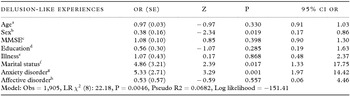
We used multivariate logistic regression (see Table 1) to model the association between a 12-month history of delusion-like experiences and a 12-month history of anxiety disorder, whilst adjusting for age, sex, marital status, education (university or not), MMSE score, the presence of up to six general medical conditions, and the presence of a 12-month history of affective disorder. For this analysis, complete data were available for 1,905 participants. There were strong positive associations between the presence of DLEs and anxiety disorder (OR 5.33 (95% CI: 1.97–14.42) z = 3.29; p = 0.001) and between the presence of DLEs and separated rather than married marital status (OR 4.86 (95% CI: 1.33–17.75) z = 2.39; p = 0.017). In addition, there was a negative association between male sex and the presence of DLEs (OR 0.38 (95% CI: 0.17–0.86); z = –2.34; p = 0.019). However, there were no significant independent effects for age, MMSE score, university education, the presence of one or more chronic illnesses, or the presence of affective disorder.
Multivariate logistic regression analysis modelling association between delusion-like experiences and anxiety and affective disorders

aAge in years (continuous); bMale 1, Female 0; cMini-Mental State Examination score (continuous); dUniversity education 1, Nil 0; eOne or more general medical conditions in past 12 months 1, Nil 0; fSeparated marital status 1, Married 0; gDSM-IV Anxiety disorder over the past 12 months; hDSM-IV Affective disorder over the past 12 months.
We were not able to model the influence of alcohol use disorders on delusion-like experiences because there were too few cases of 12-month alcohol abuse and alcohol dependence. No participants who reported delusion-like experiences or who met diagnostic criteria for a 12-month anxiety disorder or affective disorder also met criteria for an alcohol use disorder.
We conducted additional analyses to see whether the reported age of onset of anxiety disorder moderated the relationship between anxiety disorder and delusion-like experiences. The age of onset of anxiety disorder was similar in older people with and without delusion-like experiences, so we were unable to speculate on whether the onset of anxiety disorder preceded the onset of delusion-like experiences, or vice versa.
Discussion
We found that community-residing older people who met DSM-IV criteria for an anxiety disorder over the past 12 months were more likely to report delusion-like experiences than those without an anxiety disorder. Unlike the situation pertaining to younger people (Saha et al., Reference Saha2012), we found no similar relationship for affective disorder.
Delusion-like experiences were more commonly found in women. This finding is in keeping with a substantial body of existing work in older people indicating a higher prevalence of psychotic disorders in women (e.g. Meesters et al., Reference Meesters2012). In addition, delusion-like experiences were reported more frequently by those with separated rather than married marital status. The reasons for this are unclear, although it is possible that the presence of delusion-like experiences might have led to separated marital status. Alternatively, separated marital status might have reduced the opportunities for reality testing or might be associated with putative risk factors for psychotic symptoms, such as a history of traumatic experiences, lower social support, and stressful living arrangements.
Delusion-like experiences were associated with increased self-reported psychological distress but not with increased disability. Although psychotic symptoms are known to commonly accompany cognitive impairment and dementia (Bassiony and Lyketsos, Reference Bassiony and Lyketsos2003), we found no such relationship in the survey data. Most participants scored 24 or greater on the MMSE and those who scored 23 or less might have had impaired recall of delusion-like experiences. This is a potentially important consideration as the history of delusion-like experiences was provided by the participants themselves, and no informant history was obtained. There was no significant relationship between delusion-like experiences and the presence of self-reported general medical problems.
As the NSMHWB was a cross-sectional survey and no age of onset data were obtained for delusion-like experiences, we were not able to establish a temporal relationship between anxiety disorders and delusion-like experiences.
There were strong associations demonstrated between the use of “tranquilizer” medications and the presence of delusion-like experiences, suggesting that prescribers had identified those older people with DLEs as having a mental health problem requiring treatment. However, the older people with delusion-like experiences denied consultations over the previous 12 months with (GPs) or psychiatrists for mental health problems. This apparent paradox appeared to be explained by older people with DLEs obtaining prescriptions of psychotropic medications from GPs without acknowledging to the survey interviewer the presence of a mental health problem. Thus, it seems that GPs were correctly identifying and treating older people with delusion-like experiences. Of course, it remains possible that the older people did actually discuss mental health issues with their GP but, for whatever reason, did not disclose this to the survey interviewer.
Our findings must be considered preliminary as they are based on relatively small numbers of older people with anxiety disorders and DLEs. There are also some important methodological limitations inherent in the administration of a structured questionnaire by trained laypersons in order to ascertain the presence of delusion-like experiences. For example, this approach does not allow the use of the clarifying open-ended questions commonly used by expert clinicians to ascertain the level of insight associated with a false belief. In addition, this approach is likely to work better for bizarre delusions, which could not possibly be true, rather for non-bizarre delusions, which could possibly be true. Furthermore, metaphorical language is in common use and can sometimes be misconstrued as evidence of delusional experiences.
The three psychosis screening questions and their follow-up questions (see Supplementary file) did not exhaustively exclude other, non-delusional, explanations for affirmative responses. Thus, it is possible that the prevalence of delusion-like experiences was overestimated in this survey. On the other hand, the three psychosis screening questions did not canvass the entire range of common delusional beliefs so it is also possible that the prevalence of delusion-like experiences was underestimated. In addition, guardedness due to mental disorder or general wariness, and social desirability or other demand characteristics of the interview situation might have tended to reduce affirmative responses.
The population sampling method used in the NSMHWB excluded homeless people, people living in temporary accommodation such as caravan parks, and people living in institutional settings such as hospitals, nursing homes and hostels. Thus, the prevalence estimates for both anxiety disorders and for the delusion-like experiences reported here are likely to be underestimates, potentially weakening the observed relationship between the two.
Although considerable uncertainty remains, one likely implication of the present findings is that clinicians seeing older people with anxiety disorders should be alert to the possibility of comorbid psychotic symptoms.
Conflict of interest declaration
None.
Description of authors’ roles
G. Byrne formulated the research questions, conducted the analyses and drafted the paper. S. Steele and N. Pachana refined the research questions and edited the paper.
Acknowledgments
Access to the NSMHWB data set was kindly provided by the Australian Bureau of Statistics.
Sources of financial support
None that are specific to this paper.
Supplementary Material
To view supplementary material for this paper, please visit http://dx.doi.org/10.1017/S1041610215000113.