Cambodia was the first country in South-East Asia to establish protected areas. The forests surrounding the temples of Angkor were declared a national park in 1925. By 1969, six wildlife sanctuaries had been set aside covering 2.2 million hectares or 12 percent of the country for the protection of wildlife.Footnote 1
The 2003 Cambodian ‘National report on Protected Areas’ written with the support of Western experts claimed that the country has been a pioneer in wildlife conservation in Southeast Asia. According to the report, the wildlife conservation apparatus, especially protected areas (PAs), had been set up during the colonial and postcolonial eras. This narrative draws largely from the belief that wildlife conservation in tropical countries is a product of European colonialism. It is one of the main theses of John Mackenzie's seminal book on hunting and conservation in the British empire, where big game hunters, the ‘penitent butchers’, have been instrumental in wildlife conservation.Footnote 2 French colonial wildlife conservation policy has attracted less scholarly attention, but recent works have stressed the key role played by the Muséum National d'Histoire Naturelle (MNHN) in nature and wildlife protection in Africa, while research on Indochina has focused mostly on forestry in Vietnam.Footnote 3
This article explores how a wildlife conservation apparatus, including PAs, was developed in Cambodia from the colonial era when it was part of French Indochina to the end of the twentieth century, and the roles played by international actors, mostly France and the International Union for Conservation of Nature (IUCN). It investigates the forms of wildlife protection implemented in Cambodia, taking into account the global context of conservation policies. It studies how the recommendations of foreign experts were translated into local decisions, and measures the respective weight of local populations and leaders, Western scientists, colonial administrators and then international officials and experts, in decision-making regarding wildlife management. By encompassing the whole of the twentieth century, it is possible to understand the evolution of the conservation efforts from the colonial to the postcolonial periods, up to Cambodia's reintegration into the international community in the 1990s after nearly a quarter of a century of armed conflict. It shows that, unlike the British in Malaya or the Dutch in Indonesia, the colonial French administration only introduced limited hunting regulations.Footnote 4 PAs for wildlife conservation were first established in the 1960s, and then again in 1993, each time with the IUCN's support. A study of the species deemed protected offers the means to evaluate the efficacy of wildlife conservation in Cambodia. A century of colonial and international conservation policies designed and implemented with little involvement of local populations, and marked by decades of war and social upheaval followed by rapid economic growth, have failed to protect the forest cover and wildlife in Cambodia, or to prevent the extinction of a number of animal species.
The reports and correspondence of French and Cambodian administrators kept in the National Archives of Cambodia (NAC), laws and regulations published in the Bulletin administratif du Cambodge or in the Journal officiel de l'Indochine, and the accounts of French and Cambodian hunters constitute the main sources on the colonial period in this study. Much of the post-1945 material in Cambodian archives was lost during the war, but between independence and the 1970 coup that brought Cambodia fully into the Vietnam War, the Sangkum Reastr Niyum government's decisions were published in the official gazette Rāj kicc, and discussed in the press. Historians can also rely on a few publications, reports and hunting stories that survived the Khmer Rouge regime. From the late 1940s, IUCN and MNHN reports, proceedings, meeting minutes and scientific papers constitute a major source of information on wildlife conservation in Cambodia. A few actors and witnesses of the postwar period have also provided useful information.
1900–45: Cambodia in the time of imperial conservationism
In the early twentieth century, the Khmer kingdom was a protectorate with its own royal administration, but ruled by the French since the end of the nineteenth century.Footnote 5 Wildlife management introduced in Cambodia at the beginning of the twentieth century was part of colonial policy—a result of tense power relations, and compromises between the metropole and the colony, the colonisers and colonised.
Cambodia and the emergence of the conservation movement
In the first decades of the twentieth century, various international conferences held in Europe played an important role in the definition and emergence of conservation policies in the tropics. France took part in the 1900 London Convention for the Preservation of Wild Animals, Birds and Fish in Africa, the 1913 Internationale Weltnaturschutzkonferenz in Bern, hosted the Congrés international pour la protection de la nature in Paris in 1923 and 1931, and was a party to the 1933 London Convention Relative to the Preservation of Fauna and Flora in their Natural State.Footnote 6 In 1914, a year after the Bern conference and in the wake of a public campaign led by the MNHN and the Société nationale d'acclimatation in favour of the protection of elephants and rare birds, the French colonial office asked the governor-general of Indochina to provide the information needed to draft a presidential decree to regulate hunting in Indochina.Footnote 7 The decree was meant to be framed on the law of 1844, the main legal text on hunting in France. The law had introduced a hunting licence, established hunting seasons and listed authorised hunting techniques.Footnote 8 From the very beginning, the protection of fauna in Indochina followed the path of utilitarian conservation through hunting regulation rather than that of the preservation of nature for its own sake, even if the latter was supported by a number of French actors.Footnote 9 In 1925, in the wake of the first Congrès held in Paris, of the creation of the Camargue nature reserve and a decree regulating hunting in Cochinchina, the Commission for the Protection of Colonial Fauna chaired by Abel Gruvel, a professor at the MNHN, ordered a study on the implementation of wildlife protection and the setting up of wildlife reserves in Indochina. While the first ‘national parks’ established in Algeria in 1921 were mostly a means to preserve landscapes, the MNHN then pushed for the creation of natural reserves in the empire that would protect an entire ecosystem.Footnote 10
Hunting regulation in the Cambodian protectorate
The Protectorate regulated hunting as little as it could and only under pressure from the metropole. Starting in 1914, the governor-general of Indochina and the resident superior of Cambodia signed a series of administrative orders. The hunting of marabou (Leptoptilos javanicus, L. dubius), egret (Egretta garzetta, E. sacra, E. Eulophotes), and pelican (Pelecanus philippensis, P. onocrotalus) was prohibited. These large birds were being hunted by the thousands for their feathers. They were protected mostly because they preyed on rodents, a major threat to crops. Then, in 1917, the killing of elephants (Elephas maximus) was forbidden. The Khmer king had already passed a krity (royal ordinance) in 1901 to protect pachyderms as they were considered a part of the realm's wealth. Overly destructive hunting techniques or those considered unsporting, such as the use of traps or nocturnal hunting with lights, were also prohibited, except against ‘vermin’, a category that included tigers (Panthera tigris), leopards (Panthera pardus) and wild boar (Sus scrofa).Footnote 11
In 1927, the president of the French Republic issued a decree to regulate hunting in Indochina, which was amended in 1934. Hunters were required to hold a permit to carry weapons and a hunting licence specific to the class of game sought: the big game licence, the regular licence for deer and boar, the small game licence, the licence for professional hunters, and the vermin destruction licence. However, the decree still allowed for natives hunting with bows, stakes or crossbows without a permit. Title III of the decree contained provisions for the ‘protection of colonial fauna’. Endangered species could be réservé (reserved), their hunting being totally prohibited, or protégé (protected), limits being set on the number, age and/or sex of the hunted specimens. The lists of reserved and protected animals and the opening and closing dates of the hunting season were set by the governor-general. The decree also allowed the governor-general to create PAs: ‘In parks of refuge and temporary hunting reserves, it is prohibited at all times to engage in hunting.’Footnote 12 In the wake of the international conferences, France intended to provide Indochina, and therefore Cambodia, with conservation tools inspired by British conservation policies in Africa, which tended to appropriate access to hunting grounds and game for the benefit of the elite.Footnote 13
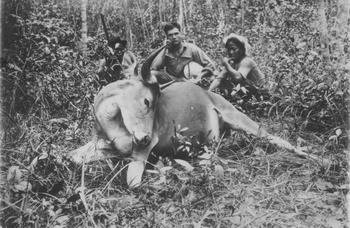
In 1940, a krity by King Monivong (r. 1927–41) introduced hunting licences for Cambodians. It determined the legal framework to hunt on private property, established a hunting season from November to June, listed the reserved species—elephant, egret, marabou and pelican—and the protected species, which included banteng (Bos javanicus) (fig. 1), gaur (Bos gaurus), buffalo (Bubalus arnee), kouprey (Bos sauveli), hare (Lepus peguensis), deer (Cervus unicolor, Muntiacus muntjak, Axis porcinus, Rucervus eldii), bear (Ursus malayanus, U. thibetanus), and most of the bird game. Forest service officers were in charge of enforcing hunting regulations. The ordinance was merely a transcription of the French 1927 decree and took no account whatsoever of local practices or of the ecology of the species it was supposed to protect. For example, the hunting season included the breeding season for wild cattle.Footnote 14 Trapping techniques, which were very common, and the sale of bush meat, skins and bones, an important source of additional income for Cambodian farmers, were prohibited. The prohibition of commercial hunting, a provision that was not in the 1927 decree, echoed article 9 of the 1933 London Convention that asked parties to regulate the sale and export of trophies.Footnote 15 With the 1927 decree and the 1940 krity, only the few who could afford to purchase a hunting licence, that is, members of the Cambodian and colonial elites, enjoyed legal access to the most valuable game. Officially, the prohibition of commercial hunting made it either impossible or pointless for most Khmer peasants to engage in hunting.
French hunter and banteng (Bos javanicus), 1930s. Personal collection of the author.

Colonial Protected Areas
Several studies were carried out in Cambodia from the late 1920s onwards to establish parks and reserves as defined by the 1927 decree or on the model of the Madagascan nature reserves set up with MNHN's support. None were implemented.
Only two PAs were created in Cambodia during the colonial period, neither of which met the needs of fauna protection. Angkor Park was the first. It was established in 1925 to ensure the conservation of the temples and their development in view of accommodating tourists. This was not a ‘national park’ or ‘park of refuge’ but an archaeological park; a PA, but not with wildlife protection in mind.Footnote 16 A hunting reserve had been set up in Angkor in 1912 to allow tourists to see and shoot animals, which could be caught and brought from other provinces for that purpose.Footnote 17 The idea was to add hunting as an alternative activity for the few wealthy tourists who came from far away. The site managers were responding to a demand for imagined lost temples in hostile jungle.Footnote 18 After Angkor Park was set up, when Indochinese tourism was booming, hunting was banned, not to protect wildlife but to prevent visitors from being bothered by the unwelcome gunshots of the colonial ‘Nimrods’.Footnote 19 The second PA was a game reserve of nearly 350 ha created in 1936 near Bokor in Kampot province for the leisure of King Monivong, an enthusiastic big game hunter. It was intended to allow the king to hunt in peace and quiet.Footnote 20
French residents against wildlife conservation policies
In 1914, and again in 1925, the colonial administration consulted French residents in charge of supervising the provinces on the advisability of setting up PAs in Cambodia. Through their letters, a broad consensus emerged to oppose any wildlife protection policy in Cambodia. Resident superior François Baudoin summarised the views of the French administrators in 1914:
Suffice it to say that the population of Cambodia is still too sparse and that there are vast uncultivated areas where game and, in general, all animals live and breed safely. Under these conditions, the hunting practised by the few natives holding weapons’ licences and a few Europeans as a distraction does not constitute a danger to the conservation of fauna in Cambodia, against which, moreover, farmers are compelled in many places to protect themselves by all means in their power to prevent a herd of deer from wiping out in one night their season-long efforts and their only means of existence.Footnote 21
This stance became the guideline for state action in Cambodia on hunting and wildlife conservation throughout the colonial period. Colonial administrators sought to avoid measures that could be irritating to the inhabitants, particularly farmers and European hunters, while they were anyway unable to enforce them for lack of sufficient police officers.Footnote 22 They differentiated between animals ‘useful’ to humans, which could possibly be protected, and ‘nuisibles’ animals considered as vermin, which should be eradicated.Footnote 23 This anthropocentric conception of animal life made them reluctant to preserve a complete area, and therefore a whole ecosystem, as MNHN advocated.
Local French administrators showed an ability to strongly resist the colonial office's instructions influenced by pro-nature lobbies. Colonial administrators delayed the inclusion of a species in the lists of protected or reserved animals when it seemed inappropriate to them. In 1929, the Colonial Wildlife Protection Commission determined that the rhinoceros (Rhinoceros sondaicus) was in danger of extinction in Indochina and should be ‘reserved’. However, the resident superior and the resident of Kampong Cham considered the animal to be ‘dangerous and useless’, and Rhinoceros sondaicus was not included on the reserved species list until 1936, six years after the last identified rhino in Cambodia had been shot in Kampong Cham by customs officer Merle.Footnote 24
In the 1930s, veterinarian René Sauvel brought a new species of wild cattle, the kouprey, to the attention of Achille Urbain, director of the Zoo of Vincennes. Urbain classified it and named it Bos (Bibos) sauveli in 1937.Footnote 25 The resident superior issued a circular stating that ‘in any case, hunters must refrain from killing “ko-prey” whose species is in danger of extinction’.Footnote 26 The 1940 krity included it in the list of protected species, which meant that it could be shot with the consent of the administration after purchasing a big game licence. Trophies of the new endangered animal were particularly sought after by big game hunters, and it was still possible to shoot it legally.Footnote 27
The regulation of hunting in Cambodia during the colonial period was entirely designed by the French. Their conception of wildlife management aimed first and foremost at good hunting management and at ensuring long-term sources of income. The big game licence and the destruction licence, which gave access to the best trophies, were sold at high prices with an added fee per head of game killed.Footnote 28 It never generated large revenue. A forest inspector returning from a mission in Africa wrote: ‘it would be futile to use Kenya as an example to create similar benefits in a less favoured country’.Footnote 29
There was a wide tolerance in the application of hunting regulations, especially, but not only, in favour of the elite. Inspector of the Forest Service of Indochina, Maurice Mangin, complained to the Société d'acclimatation, which lobbied for nature protection in the colonies: ‘In practice, we come up against an astonishing force of inertia on the part of civil servants.’ Trapping and trade in skins, bones and bush meat continued long after 1940. The prohibition of commercial hunting that would have affected the livelihood of people living in or near the forest was never enforced. By and large, local administrators determined what hunting practices were tolerated and rejected the creation of PAs.Footnote 30
1945–70: Cambodia and the emergence of the global conservation movement
The end of the Second World War saw the founding of the United Nations Educational, Scientific and Cultural Organisation (UNESCO), whose first director-general Julian Huxley was a strong proponent of wildlife conservation, and of the International Union for the Protection of Nature (IUPN) in 1948, which became the IUCN.Footnote 31
A country peripheral to the global conservation movement
On 18 June 1945, General De Gaulle, president of the provisional French government, and his minister of colonies, Paul Giaccobi, signed three decrees on the protection of nature in the French empire based on the 1933 London agreement. These texts organised a game inspectorate in the colonies and created two councils under the minister of Colonies: a high council in charge of hunting regulation and game reserves and a High Council for the Protection of Nature in charge of the creation of PAs. Indochina was represented by colonial hunters and its game inspector.Footnote 32
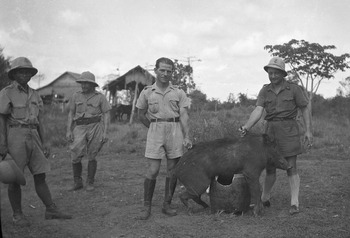
When the colonial power resumed its rule over Cambodia in 1945, local guerrillas opposed the French. The Khmer Issarak movement and then units of the People's Army of Vietnam denied the French access to remote forest areas, where fauna was the most abundant. The number of weapons in circulation, carried by security forces, Khmer Issarak and village self-defence militia, led to a sharp increase in hunting and poaching, particularly of deer and wild cattle in the open forests (fig. 2). Enforcing the law in the forests north of Kampong Thom, in the northeastern and eastern parts of the country, in the Cardamom Mountains and in the Elephant Mountains, turned out to be very difficult.Footnote 33
French soldiers and wild boar (Sus scrofa), Cambodia, early 1940s. Personal collection of the author.

In 1949, Cambodia became an associated state within the Union française (French Union). After agriculture and forestry affairs were handed over to the Cambodian authorities, the issues of hunting and conservation were theoretically under Cambodian jurisdiction. However, the French continued to exert their influence.Footnote 34 The 31 December 1949 law passed by the Cambodian parliament made French hunting regulations applicable in Cambodia. It was not until 1952 that a Cambodian National Water, Forestry and Fisheries Department was created under the authority of the Ministry of Economy before moving to the Ministry of Agriculture.Footnote 35 The 1940 krity remained the main legal text regulating hunting in Cambodia until the 1970s. Hunting regulation and wildlife conservation were still in alignment with French colonial practices post-independence.
The main priorities of Prince Sihanouk and his Sangkum government were economic development and nation building. In order to increase national income, the Sihanouk government invested in infrastructure and agricultural development with a plan to expand cultivated areas and the timber industry, all of which could be detrimental to wildlife. Big game licences sold at high prices appeared as a means to access much-needed foreign currency.Footnote 36 Tourist brochures praised the abundance of game. A 1958 leaflet on ‘Big game hunting in Cambodia’ published in French and English claimed that ‘Cambodia offers some of the best hunting to be found in Asia’. It focused on elephants, tigers and leopards, deer (including the endangered Eld's deer), sun bears, pheasants and wild cattle. It insisted, however, that the kouprey was ‘now very rare in Cambodia and it is absolutely forbidden to hunt it’.Footnote 37 Despite the government's propaganda, the number of foreign tourists in Cambodia remained very low and their contribution to the national economy negligible.Footnote 38
Cambodia had two major assets, which made it of interest to international conservation networks: a majestic and very rare species of endemic wild cattle with an undeniable ‘charisma’,Footnote 39 and the great Lake Tonle Sap, a natural wetland of exceptional ichthyological and ornithological value.
In 1949, Sauvel proposed the creation of ‘a vast national park including both the Angkor architectural group and the various Khmer temples scattered throughout the forest and the entire region between the colonial road 1bis, the Stung Sen and the Dangrecks range’, one of the kouprey's main distribution areas.Footnote 40 Then, in 1952, Charles Wharton of Cornell University filmed the elusive wild cattle for the first time. Urbain, president of the organising committee of the IUCN's founding conference in Fontainebleau in 1948, brought up the issue of its preservation:
It is recommended that the Union française should approach the government of Cambodia asking that necessary measures be taken to ensure the preservation of the kouprey (Novibos sauveli) in its natural habitat and in establishing an adequate reserve and in placing this animal on the list of strictly protected animals, except for scientific permits.Footnote 41
The ban on kouprey hunting was regularly reiterated, but without the state having the means to enforce it. Despite recommendations by Western scientists and the participation of Cambodian minister Son Sann, then an intern at the French Ministry of Foreign Affairs, at the 1949 Lake Success conference, where the IUPN and UNESCO linked life on earth to nature preservation, Cambodia did not take any major initiative. In the early 1950s, the main action in favour of the environment was the 1952 launch of a ‘Tree Day’, rukkh devā, to be celebrated annually. The international movement towards conservation of the environment supported by UNESCO had not yet reached this part of Southeast Asia.Footnote 42
The endemic animal, the foreign expert and the international organisation
In 1958, Cambodia became an IUCN member on the invitation of its president Roger Heim and participated in the general assembly in Athens in September. It was an important step in its involvement with the global conservation movement.Footnote 43 This move came after an effective campaign led by the American biologist Harold Jefferson Coolidge. A founding director of the IUCN, Coolidge was already a ‘bull elephant of the global conservationist movement’ who had a particular interest in Indochina and Cambodia.Footnote 44 He participated in the making of Charles Wharton's 1952 film and advocated for urgent conservation measures in favour of the kouprey. He wrote in 1954: ‘The Cambodian Government has been urged to take special measures to protect this primitive bovid by establishing a permanent reserve in the area of their natural habitat.’Footnote 45 Up to 1958, Coolidge was chairman of the IUCN Species Survival Commission, which could send ecologists to survey species status. ‘In 1955, Lee Talbot, a young California ecologist, visited 30 countries over six months period, and made recommendations that are in several cases being implemented by the government concerned.’Footnote 46 Talbot's mission helped define the IUCN's priorities and the forms of action it intended to develop with governments.Footnote 47 In Athens, the IUCN decided to strengthen its cooperation with the United Nations in order to influence more countries to create national parks. The Cambodian delegation returned home from the conference favourably impressed. Upon its return, the Ministry of Agriculture issued an order to prohibit the hunting of kouprey, rhinos and sun bears.Footnote 48 This order was in line with the existing regulation, but it showed a new will of the Cambodian government to get involved.
Meanwhile, the Cambodian government invited MNHN in 1958 to participate in a project to establish a research centre on marine and freshwater resources. The Museum responded by commissioning researchers, the first one being the ichthyologist Maurice Blanc. The Museum would work under the Cambodian government with the support of the French embassy's assistance mission in Phnom Penh. Several French researchers took part in this project. At the same time, a group of botanists led by Jules Vidal working from the Museum's collections prepared Flore du Cambodge, du Laos et du Vietnam, published in several issues from 1960, sparking interest in Cambodian nature in Europe.Footnote 49
A Cambodian programme for wildlife conservation
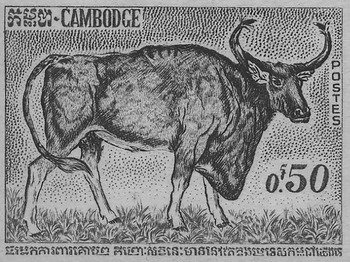
In the early 1960s, Prince Sihanouk embraced the issues of wildlife conservation and environmental protection, declaring the kouprey a national symbol (fig. 3). Sihanouk's sudden interest in nature conservation at a time of nation building was fostered by a desire for international recognition. Joining the IUCN and engaging in nature conservation programmes was a way for the Khmer leader to enjoy acknowledgement of his actions by world leaders and Western scientists. It would also become a tool for strengthening the power of the state over the most remote provinces of the country. Bos sauveli's range comprised the north of Kampong Thom, and the east of Kampong Cham, Mondolkiri and Ratanakiri provinces, that is, areas near the borders with Thailand and Vietnam that needed to be secured and where many villagers, especially those from indigenous ethnic minorities, were reluctant to accept the authority of the government.Footnote 50
Cambodian postage stamp depicting a bull kouprey (Bos sauveli) (1964).

In November 1960, Sihanouk issued a circular prescribing ‘to take new intelligent measures to preserve and develop’ Cambodia's fauna and forests.Footnote 51 To this end, in 1962, he created a High Council for Hunting, Krum prịksā jān’ khbas khāṅ pramāñ’, ‘charged with giving its opinion on general policy in matters of hunting and wildlife protection’. It was chaired by the head of the Department of Agriculture and included representatives of the Ministries of the Interior, Defence, Tourism, Agriculture, the director of Water, Forests and Hunting, and the game inspector. The organic link between hunting and conservation was in line with what existed in France, the United States and the British Commonwealth. Three months later, on a council recommendation, the issuing of hunting licences was suspended, except for destruction licences granted to foreigners wishing to shoot tigers and leopards.Footnote 52
In April 1964, Sihanouk gave a speech to controllers who had graduated from the National School of Agriculture that was widely publicised as propaganda. He defined the mission of the controllers as: ‘1. To increase the economic potential of the country, by increasing production, especially agricultural production, 2. To fight against the senseless destructions our rural sahajīvin [comrades] indulge on our forest resources.’ He urged them to fight overfishing and the abuses committed by hunters, primarily through education of the rural masses.Footnote 53 Provincial and regional fauna protection committees were organised. They were chaired by the governors and included representatives from agriculture and education, the security forces, the local leaders of the royal Khmer socialist youth and commune chiefs. The government tried to involve local communities, although commune chiefs and youth leaders were more representative of the government than of the villagers. These committees were responsible for enforcing hunting regulations and for submitting proposals to the High Council for Hunting.Footnote 54
Meanwhile, Cambodia began to designate wildlife reserves where hunting would be prohibited. Maps of 2,221,960 ha of reserves were finalised in November 1964: The Kirirom reserve in Kampong Speu (81,720 ha); Phnom Prich in Kratie and Mondolkiri provinces (195,120 ha); Lomphat in Ratanakiri (197,480 ha); Cardamom Mountains (280,640 ha) and Kulen in the north of the country (1,467,000 ha). More than 12 per cent of the country's area was gazetted for wildlife conservation, and 300,000 ha around Lake Tonle Sap and an additional area of 20,000 ha in the Cardamoms were also considered for conservation. Angkor Park, whose main function was temple conservation, but where destruction of fauna and flora was forbidden, covered an additional 10,000 ha. Conservation efforts focused primarily on rare and endangered species such as the kouprey, which was reported in the Kulen, Phnom Prich, and Lomphat reserves, serow (Capricornis sumatrensis), Eld's deer, hog deer, giant ibis, and Edwards's pheasant (Lophura edwardsi).Footnote 55
Conservation policy enforcement was the responsibility of the Water, Forestry and Hunting Department, at the Ministry of Agriculture, notably its game inspectorate, adhikārṭhan pramāñ’. The agents were ranked in three groups. Engineers were all trained in European and American schools specialising in forest management. Middle management officers, the controllers, were trained in Phnom Penh at the National School of Agriculture, where they received a 20-hour class in game management and hunting. The rangers were trained at a special school in Kampong Cham. The officers in charge of nature and wildlife conservation were primarily foresters. However, the High Council for Hunting and the provincial and regional committees allowed for coordination with law enforcement and local administrations and for the involvement of outside personalities ‘whose skills in hunting and wildlife matters [was] recognised’. In June 1964, Hoeur Lay Inn, a former agriculture secretary and an avid hunter, who had been close to Sihanouk since they were classmates at the Lycée Chasseloup-Laubat, joined the high council with his cousin Ung Tin Pak, ‘the greatest hunter in Cambodia’, who had ‘discovered’ the Kirirom site.Footnote 56
Two Cambodian officials appear to have been particularly active in promoting wildlife conservation in the 1960s: Tan Kim Huon was director of Water, Forestry and Hunting. An agricultural engineer trained in France, he was elected member of parliament for Preah Vihear province in 1966.Footnote 57 Ou Kim San was his assistant. As head of Cambodia's nature protection service and game inspector, he was in charge of setting up reserves and enforcing hunting regulations. Himself a big game hunter and ornithologist, he gave the controllers hunting lessons. Thanks to him, the ‘three reserves, specially set up to preserve kouprey, received maximum attention from the Khmer government and [were] permanently supervised by game rangers’.Footnote 58 Ou Kim San also took part in ecology studies. In 1952, after the Wharton mission to film Cambodia's wild cattle, he carried out a census of Cambodia's kouprey population. From then on, he worked regularly in the field with Western researchers, such as Charles Wharton or Pierre Pfeffer.Footnote 59
The involvement of international organisations and experts
Cambodian action plans were developed in line with, or with the support of, international cooperation projects, notably of the IUCN, UNESCO, FAO, the United States and France. Indeed, expertise remained largely with Western scientists. Faced with the massive environmental damage that occurred as a result of demographic and economic growth in Southeast Asia, the Tenth Pacific Science Congress held in 1961, of which Coolidge was the secretary-general, asked the UNESCO regional office to set up a working group. It was convened in February 1962 in Bogor, Indonesia. There, the IUCN offered to act as a technical adviser to a dozen Southeast Asian countries, including Cambodia, sharing its experience in Europe and Africa, where PAs played a central role in conservation policies. A few months later, Cambodia sent an official from the Ministry of Agriculture to the First World Conference on National Parks organised by the IUCN in Seattle.Footnote 60 The following year, Coolidge, after a series of meetings with Southeast Asian governments, had the ‘South East Asia project on wildlife resources and parks’ endorsed by the IUCN general assembly in Nairobi.Footnote 61
Coolidge and the IUCN appear to have been the real instigators of wildlife reserves in Cambodia in 1963–64. To achieve his conservation goals, and to address a critical lack of funds, Coolidge took advantage of his various professional positions. As executive director of the Pacific Science Board of the US National Academy of Sciences, he succeeded in setting up a ‘joint wild cattle research program’ between the United States and Cambodia funded by USAID. This project led by Wharton ended abruptly in 1964 when Sihanouk rejected American aid in the context of tensions due to the escalation of the Vietnam War, blaming the American scientist for having killed two kouprey while attempting to capture them for scientific purposes.Footnote 62
In 1965, the IUCN organised a conference in Bangkok on the ‘Conservation of Nature and Natural Resources in Tropical South-East Asia’ with the support of FAO, UNESCO and the government of Thailand. Cambodia only sent a written presentation of its conservation efforts. The conference, which was an important turning point in regional cooperation, was prepared by Harold Coolidge, and Lee and Martha Talbot. It was largely dominated by research on Malaysia, the Philippines, Thailand, and to a lesser extent Indonesia, Brunei, Vietnam and Laos.Footnote 63
Despite its absence at the Bangkok conference and having broken off with the United States, Cambodia was not excluded from international cooperation on nature conservation. In 1966, Coolidge was elected president of the IUCN. Thanks to its status as a nongovernmental organisation (NGO), the Union was able to continue its support for the establishment of reserves in Cambodia. However, the IUCN was severely lacking funds and USAID could no longer be solicited. Two UN agencies particularly involved in the conservation of nature and natural resources, FAO and UNESCO, provided assistance.Footnote 64 Tan Kim Huon, Cambodia's director of Water, Forestry and Hunting, was also Cambodia's FAO delegate. Between 1965 and 1970, the organisation sent botanist Peter Shaw Ashton, then lecturer at the University of Aberdeen, as a consultant to study the flora of the Cardamom Mountains.Footnote 65 UNESCO collaborated regularly with Cambodia on education, archaeology and the development of Angkor Park. It invited Cambodia to participate in the 1968 Biosphere Conference, a major global conference.Footnote 66 At the same time, it commissioned the Danish architect Erik Hansen to design a development project for Phnom Kulen near Angkor. In his final report, Hansen ‘stressed the need to consider Phnom Kulen as a botanical, zoological and archaeological reserve and recommended that this site and its surroundings be declared a national park’.Footnote 67 Hansen joined IUCN expert Noel Simon's call to provide protection for gibbons. Simon was concerned because of the possible extinction of Hylobates pileatus, while Hansen thought that gibbons could attract tourists.Footnote 68
Although Cambodia did not send a delegation to the IUCN general assembly in New Delhi in 1969, its links with the Union remained strong.Footnote 69 Coolidge was a personal advocate of a plan to preserve kouprey funded by the World Wildlife Fund (WWF). For him, at a time of reconciliation between Cambodia and the United States, ‘It would be desirable to have a group jointly sponsored by FAO and UNESCO, with Cambodian, French and US scientists participating in efforts to try and save this unique gene bank from extinction.’Footnote 70 The visit of the American expert to Cambodia in December 1969 was staged as that of a VIP, showing Coolidge's influence in the decision-making process.Footnote 71 Meanwhile, cooperation with France continued, particularly with MNHN, the IUCN's main contact point in France. Just before his appointment as director of the museum in 1965, Maurice Fontaine went to Phnom Penh to revive cooperation with Cambodia. Researchers such as Pierre Pfeffer, Hubert de Saint-Girons and Jean-Marie Klein also travelled to conduct fieldwork in ecology and oceanography and to collect specimens. Fontaine himself was teaching endocrinology at the Faculty of Medicine in Phnom Penh.Footnote 72
Cambodia also organised awareness-raising campaigns through the Association des amis des forêts et des pêches (Association of Friends of Forestry and Fisheries) and the Tree Day, which continued to be celebrated every year. Tan Kim Huon, member of parliament, then rector of the Royal University of Agriculture from 1969, was particularly involved in these actions. From reading the reports of Western experts or the pro-government press in Cambodia, one has the impression that Cambodia had been very active on conservation issues since 1958. In 1964, Tan Kim Huon proposed that Norodom Sihanouk be given ‘the glorious title of “Great protector of nature”’.Footnote 73
A not so bright outcome
In 1962–63, big game hunter Hoeur Lay Inn published a series of articles in the pro-governmental French language magazine Réalités cambodgiennes that castigated the ban on hunting and the inefficiency of reserves.Footnote 74 Limitation of hunting and the setting up of PAs were not accepted by a segment of the Sangkum leadership. He and other opponents of the conservation scheme became members of the High Council for Hunting. According to him, only Kirirom and Phnom Prich reserves were functional in 1965. Kirirom was mainly protected for its splendid landscape and pine trees as a holiday resort. It was developed to host Sihanouk's guests and wealthy tourists. Wildlife protection was a minor concern. There, as elsewhere in Cambodia, foreign guests and the ruling class could hunt for trophies.Footnote 75 A coffee table book published by the Ministry of Information in 1962 included a section on wildlife in the chapter on ‘Tourism in Cambodia’ under the title ‘La chasse’ (Hunting). It stated without any ambiguity:
Due to the indiscriminate destruction affecting the reproduction of certain species, the Royal Government decided to create several national reserves and to temporarily suspend the issuance of hunting permits. However, the regulations currently under consideration will allow tourists wishing to hunt in the Cambodian forest to be granted all facilities.Footnote 76
High-ranking officials, wealthy businessmen and foreign big game hunters faced little difficulty when they wanted to shoot protected wildlife, including kouprey.
In any case, patrols in the vast reserves of Lomphat, Kulen or the Cardamoms were of little use against poaching. At the end of the Sihanouk regime, there were only 24 rangers in charge of the surveillance of more than 2 million ha.Footnote 77 In 1965, a joint circular from General Lon Nol, vice-president of the Council of Ministers and Minister of Defence, and agriculture secretary Chuon Saodi showed that the various measures taken for wildlife conservation were resounding failures:
It has been noted with regret that despite memos and circulars from the presidency of the Council of Ministers, the Ministry of National Defence and the Ministry of Agriculture, some unscrupulous hunters continue to commit massacres of our wildlife. Some people take advantage of the privileged position they occupy—and the guns placed at their disposal to ensure the defence of the territory and the security of the country, the village and the property of the inhabitants—to devote themselves to the destruction of game. This state of affairs has gone on long enough, and it must be brought to an end once and for all.Footnote 78
Priority was then given to the fight against poachers targeting the most endangered species or operating in wildlife reserves, and to the control of firearms and ammunition, without any noticeable effects. The training of the game officers was very basic. Between 1945 and 1970, Ou Kim San appears to have been the only Cambodian officer who was familiarised with the various issues of wildlife conservation. Foreign experts were not necessarily of much help. Hansen, who was in charge of drawing up the national park project at Kulen, was certainly a great architect, but he did not know much about tropical ecology. Starting with the Samlaut revolt in 1967 and continuing after the Labansiek revolt in 1968, communist guerrillas spread out into the hinterland and it became dangerous for government agents to venture into the forest. Moreover, American bombings targeted these areas, especially in the eastern part of the country.Footnote 79 Pfeffer's field trip to Phnom Prich in 1969 showed that conservation work was still possible there, but it was an exception.Footnote 80
The Cambodian government had to play off conflicting imperatives over economic development, security matters especially in the context of the Vietnam War, finance, nation building, and international recognition for which it played the card of a wise user of natural resources, which was palatable both to the IUCN and UN agencies. One of the strongest markers of the failure of the conservation programmes undertaken by the Sangkum Reastr Niyum under these circumstances was the collapse of the kouprey population. Despite the special protection it enjoyed, it fell from an estimated 500–800 heads in 1952 to only 200 in 1969, although the rate of decline seems to have slowed between 1964 and 1969.Footnote 81
1970–93: Conserving wildlife in a time of war
War and wildlife conservation
Following the March 1970 coup that overthrew Sihanouk and established the Khmer Republic, almost all of the wildlife PAs came under the control of the communist guerrillas, who were not interested in the conservation of nature. The Khmer Republic remained a member of the IUCN, but it was not in a position to implement any conservation policy.Footnote 82 The expansion of war, the air strikes and the end of conservation programmes alarmed international experts. Although forest cover remained largely preserved, the fauna, and in particular large fauna, elephant, cattle and deer, was targeted by the military.Footnote 83 Jeffrey McNeely, a young anthropologist commissioned by the UN Economic and Social Commission for Asia and the Pacific, expressed the fears of the scientific conservation community in November 1975, a few months after the Khmer Rouge takeover:
In the aftermath of the Cambodia section of the war, large numbers of urban-dwellers and refugees were sent out into the hinterland to clear new land for planting rice, and since they were on very short rations, they can be expected to have hunted every living creature they could find. One can only hope that such animals as the kouprey are inherently cautious enough to avoid hunters by becoming nocturnal and spending the day in thick vegetation.Footnote 84
For Democratic Kampuchea (DK), wildlife was mainly a product that could be traded for weapons and industrial goods with China.Footnote 85 The regime cut its links with foreign organisations, including the IUCN. Cambodia was able to reconnect with international conservation circles only after the fall of the Khmer Rouge in 1979, at a time when civil war raged, especially in the border areas with Thailand. As the United Nations did not recognise the People's Republic of Kampuchea (PRK) supported by the Socialist Republic of Vietnam, Cambodian authorities had links only with the Eastern bloc.
While war was raging in Cambodia, negotiations between the IUCN, the United Nations Environment Programme (UNEP) (established in 1972), and other UN agencies had led to the publication in 1980 of a ‘world conservation strategy’ that emphasised both on the protection of biodiversity and the need for sustainable development with concerns about basic human needs. Two years later, at the Third World Congress on National Parks held in Bali, IUCN representatives agreed to continue to expand the number and size of PAs, but also to take into consideration the needs and aspirations of local populations, notably in terms of development.Footnote 86 Subsequently, the IUCN published a handbook on the management of PAs in the tropics that devoted a whole section on ‘local people and protected areas’. It stated that ‘the success of management depends very much on the degree of support and respect awarded to the protected area by neighbouring communities’.Footnote 87
Kouprey and international interest in Cambodian wildlife
Thanks to the kouprey, whose conservation status was then completely unknown following more than a decade of war and the genocidal regime of the Khmer Rouge, Cambodia aroused the interest of scientists attending the 1981 Hunting World Exhibition held in Plovdiv, Bulgaria.Footnote 88 PRK was invited to attend the 25th working session of the IUCN's commission on PAs in India in February 1985, just after a rare kouprey sighting.Footnote 89
Even after Coolidge's death in 1985, the IUCN's interest in Cambodia was fuelled by the question of the survival of Bos sauveli, one of the 12 most endangered species listed by the Species Survival Commission. In India, the speech of the Cambodian director of forests was a typical case of Soviet-style wooden language. It showed that nothing had been done since the late 1960s. PAs were still acknowledged, but could not be managed anymore. Angkor Park was classified as one of the ten most threatened in the region.Footnote 90 The bottom line was for the IUCN to reconnect with Cambodia: “The point was to seek communication on conservation issues, in hopes of supporting any efforts to establish protected areas and implement effective management (or at least interest) in conserving rare and endangered species, not least the kouprey.”Footnote 91
The IUCN however, despite its NGO status, remained constrained by the political situation and the lack of UN recognition of the Phnom Penh regime. In 1986, IUCN consultants John and Kathy MacKinnon wrote:
Kampuchea has just emerged from an appalling period of sectarian genocide during the Pol Pot regime which resulted in the murder of almost all trained and educated personnel. The country is faced with a terrific challenge to build up its expertise again. Kampuchea needs international assistance in training and manpower development for planning and managing natural areas. It is a tragedy that global politics denies the possibility for most western countries to provide this sort of assistance at the present time. Until such time as an international settlement on Kampuchea is reached, Kampuchea will remain very dependent upon Vietnam and a few other socialist countries for technical aid.Footnote 92
The MacKinnons published this text when the USSR entered the Perestroika era, during which aid to Eastern bloc countries was severely cut. No environmental experts could be sent to Cambodia.Footnote 93 Based on the prewar existing reserves, the McNeely 1975 draft report, and prewar maps of forest cover and satellite imagery, Kathy and John MacKinnon proposed a series of PAs for Cambodia covering a total of 2,340,300 ha. In the meantime, the WWF asked John MacKinnon to visit Vietnam, Cambodia and Laos, to discuss the case of the kouprey. The WWF provided field survey equipment and sent two Vietnamese and three Laotians to India for training. In March 1987, a bull was spotted at the Vietnam–Laos border. In January 1988, the IUCN, WWF and zoo representatives joined a workshop organised by the Vietnamese authorities in Hanoi to gather all available information. It was also attended by a Cambodian delegation. A ‘kouprey action plan’ was set up.Footnote 94 In the following months, the Cambodian government drafted a decree on forest management that included provisions for the protection of wildlife. However, the prakās (administrative order) establishing the list of protected species was never gazetted.Footnote 95 Cooperation between the IUCN and Cambodia was hampered by international politics. In June 1987, the IUCN invited the government of DK, which included Sihanouk and the Khmer Rouge, the only one recognised by the UN, to join the Union after having paid the country's outstanding fees since 1974 or to participate at the general assembly as an observer. This invitation could only irritate the PRK. Finally, in 1990, Cambodia ‘was deemed to have withdrawn from state membership of the Union’ and the next year, the IUCN stated: ‘Cambodia does not participate in any international conventions or programmes concerned with protected areas.’Footnote 96
Two NGOs managed to establish programmes on natural resources management with the Cambodian Ministry of Agriculture: Coopération internationale pour le développement et la solidarité (CIDSE) on fishing, and the Regional Community Forestry Training Center for Asia and the Pacific (RECOFT), which organised training for rangers and officials. Their work in Cambodia was supervised by the vice-minister for agriculture, Mok Mareth, a biologist trained in France. Two Western experts played an important role in linking RECOFT with Cambodia: David Ashwell, an Australian vegetation ecologist who had experience with PA planning, and Richard Engelhardt, a UN official.
Conservation in Cambodia: An IUCN-sponsored phoenix
At the beginning of the 1990s, several major steps were taken towards global conservation and sustainable development. The IUCN, UNEP and WWF published in 1991 an updated version of the ‘world conservation strategy’. In February 1992, the IUCN organised the fourth world congress on PAs in Caracas, which insisted on the need to involve local populations in PAs and their management. A few months later, the 1992 United Nations Conference on Environment and Development was held in Rio.Footnote 97
As soon as the United Nations Temporary Authority in Cambodia (UNTAC) was deployed in 1992, the IUCN asked Ashwell to write a report on conservation issues in Cambodia. Ashwell travelled to Cambodia and was hired by UNESCO as a natural resources consultant for the zoning and environmental management plan for Angkor and by the UNDP to work with John MacKinnon. UNESCO acted as a liaison between the IUCN and Cambodia. It organised a presentation of the IUCN to Cambodia's Supreme National Council. Meanwhile, Engelhardt, then the UNESCO representative in Cambodia, contacted Prince Sihanouk in Beijing ‘with a view to the renewal of Cambodia's lapsed membership in IUCN and the establishment of an IUCN programme of assistance to Cambodia in the area of environmental conservation’. Two weeks before the UN-sponsored ballot, Sihanouk agreed to welcome Ashwell as the IUCN's representative in Cambodia.Footnote 98 The period that followed the election was one of political turmoil that lasted until the new constitution drafted by the constituent assembly was promulgated in September.Footnote 99 The new government included a Ministry of Environment, whose portfolio was entrusted to Mok Mareth. Fearing that the forests of the country would be granted as concessions to logging companies, the IUCN worked together with the palace, the Department of Forests and Wildlife and the Ministry of Environment to set up a system of PAs in Cambodia.
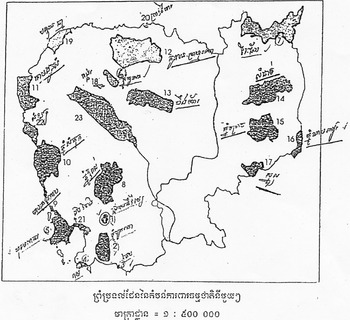
Few field studies, whether to demarcate, list the species or consult local populations, were possible as most of the vast envisioned PAs were then either patrolled or controlled by the Khmer Rouge guerrillas. The IUCN team had to rely on the existing documentation, US and UNTAC maps, satellite imagery, and some low-level flights. The limits of the former game reserves and the quality of the forest cover were the main criteria to define the new PAs, which were classified according to the guidelines of the 1991 ‘Caring for the Earth’ document and the 1992 Convention on Biological Diversity. At the time, information on the wildlife trade provided by TRAFFIC tended to show that Cambodian forests had retained most of their fauna. In November 1993, two months after the proclamation of the new constitution, Sihanouk, once again King of Cambodia, signed the krity that created twenty-three PAs, including seven uḷānadhamm jāti (national parks) and nine ṭaen jaṃrak satv brai (wildlife sanctuaries). The ordinance was accompanied by a 1/500,000th sketch map (fig. 4).Footnote 100
Protected areas in Cambodia; Royal decree on the establishment of Protected Areas, 1993.

The krity was passed at a time when Cambodia was economically and politically highly dependent on international support. It contained all the Union's proposals. The IUCN worked with the Ministry of Agriculture and the Ministry of Environment to validate the envisioned PAs, but local villagers could not be involved. Despite former senior ecologist Raymond Dasmann's effort to push the IUCN to take into account local practices in the 1970s, the 1982 Bali Action Plan, and the 1992 Caracas Conference, the Union's ‘approach to conservation and environmental expertise [still] bore the mark of centralized technocratic elitism’.Footnote 101
A rush of NGOs and international organisations followed UNTAC. After 1993, a multitude of organisations involved in nature conservation, including the most influential at the global level, such as the UNEP, UNDP, WWF, Wildlife Conservation Society, and Fauna and Flora International, opened offices in Phnom Penh. This was the beginning of a new era for wildlife conservation in Cambodia, in which the IUCN and even the Cambodian administration were only actors among others, and where France was a minor player.
Conclusion: Foreign aid and effectiveness of conservation policies
The impact of nearly a century of conservation policy in Cambodia, between the 1914 decree banning the hunting of egrets and the 1993 krity that established PAs was far from impressive. The French colonial authorities showed only limited interest in the conservation of Indochina's wildlife and forests.Footnote 102 Cambodia cannot be considered as ‘the first country in South-East Asia to establish protected areas’. Only in the 1960s, did the personal commitment of a few IUCN activists, notably Harold Coolidge, as well as Sihanouk's desire to strengthen his authority over the most remote provinces and to gain international recognition for his actions, lead Cambodia to improve its conservation tools and create wildlife reserves. War swept away in a few months the achievements made over the previous decade. It was not until 1993, once again with the support of the IUCN, that wildlife conservation became an important issue in Cambodia.
After 1993, the involvement of international organisations did not produce all the expected effects. Hylobates pileatus, Rucervus eldii, Axis porcinus, Thaumatibis gigantean, Leptoptilos dubius, which were already listed as endangered in Cambodia before the war, the then more common Crocodylus siamensis, Bos javanicus, Bos gaurus and Elephas maximus, all now classified as globally endangered or critically endangered, are still found in Cambodia. But Bos sauveli, now classified as possibly extinct, Rhinoceros sondaicus, Capricornis sumatrensis, Lophura edwardsi, Pelecanus onocrotalus, and also Panthera tigris have disappeared from the Cambodian ecosystems.Footnote 103 Throughout the twentieth century, Bos sauveli played its part as a flagship species. From 1937 to the 2000s, it was a powerful driving force for raising support for wildlife conservation. However, this did not prevent its extermination. On the contrary, kouprey remained a source of meat and a desired trophy. The post-conflict context strongly affected local wildlife, including in PAs where poaching and logging operations were frequently reported.Footnote 104 When Jeffrey McNeely presented his propositions in 1975, he warned clearly that:
National parks and reserves will be briefly described, including location, importance, and relevance to Mekong development programmes. However, this should be seen as only the first effort to outline such areas; only considerably more detailed research on the ground by the government involved can firmly establish boundaries, species present, zoning, status of forests, and all the other data needed to support a reserve system.Footnote 105
Even though substantial resources and funds were available when the international community came back to Cambodia, the haste that prevailed in 1993 had adverse effects. Despite the IUCN's own recommendations, the importance of the involvement of local populations, the choice of the location and its environment, the actual enforcement of laws and regulations and the training of personnel, all important factors of PAs’ effectiveness, were overlooked.Footnote 106 It is only since the turn of the twenty-first century that Cambodian decision-makers, forestry and wildlife officials, activists, villagers and scientists, have all been able to be involved in conservation projects.Footnote 107