Governments pursue their international goals through the setting of foreign policy. Chief executives endeavor to choose foreign policies that respond to the exigencies of the international system; they seek to respond optimally to external circumstances and to the policies chosen by other countries to advance their goals. But the tools of foreign policy have domestic consequences. Military interventions, trade policy, foreign aid, economic sanctions, and alliance commitments, for instance, all exact costs from and provide benefits to different sectors of the domestic polity. To use these tools to advance a country's international goals means that some domestic groups benefit and others are harmed: “For any choice of foreign policy, there will be winners and losers at the domestic level; what one player values, another may discount.”Footnote 1 Foreign policy tools thus have a domestic political component.
In democracies, governments have to build domestic support for the use of foreign policy tools. In the United States, which we focus on in this article, presidents must build legislative coalitions because of the separation of powers system. Presidents are not free to simply design the optimal policy for foreign engagement; instead they must obtain domestic approval. Legislators may have their own preferences about foreign policy, given the impact policy has on their local constituencies and therefore their re-election prospects. Legislators may find it politically costly to yield to the president's foreign policy concerns. Foreign policy, then, results from some combination of these domestic and international pressures.
Our goal is to use international relations theory to examine the impact of these different pressures on U.S. foreign economic policy since the late 1970s. We focus on two questions. First, which domestic groups have supported an internationalist policy in aid and trade since the late 1970s? We explore three factors that have not been considered together before: the foreign policy concerns of the president, domestic political economy pressures, and ideological preferences. Second, are the groups that support international engagement through trade the same as those that support foreign economic aid? We compare the influence of these three factors to show that the groups supporting the two foreign policy tools are different.
We bring together two distinct theoretical approaches to examine the sources of American foreign policy: foreign policy analysis and international political economy. Few, if any, studies of preferences regarding American trade or aid policy account for the foreign policy concerns of presidents. These studies of both public opinion and legislative voting on trade have concentrated on which type of political economy model best explains trade preferences.Footnote 2 Most focus on the domestic political economy sources of trade preferences and do not examine how foreign policy pressures enter the process. For instance, Hiscox's important research on congressional voting on trade tests which model of constituency preferences best explains such voting, but this study did not examine the role of U.S. presidents and how their desire to project power abroad in pursuit of American interests may drive international trade legislation.Footnote 3 Among the few studies of aid policy preferences that have been conducted, most have focused on the characteristics of the foreign recipients of aid as an indirect way of identifying the donor's interests; they do not examine how politics within donor states actually bring these foreign policy pressures to bear.Footnote 4 Others consider the aid preferences of domestic groups but ignore the role of the executive branch.Footnote 5 Understanding the domestic sources of support and opposition to foreign policies is important because it highlights the domestic constraints on leaders as they try to employ these foreign policy tools.
In contrast, studies of American foreign and security policy emphasize the importance of the international context and the foreign policy concerns of the president:
Presidents answer to a national constituency and have a constitutional responsibility to promote security. This lends itself to a global outlook and the projection of U.S. power and influence abroad. Congress, on the other hand, is comprised of electorally independent legislators who are selected by smaller geographic constituencies; therefore, legislators tend to have a more parochial outlook.Footnote 6 They have more to gain by protecting domestic earmarks than they do by allocating foreign aid.Footnote 7
These studies often debate the relative importance of Congress and the president in foreign policy; an important contribution of this research has been to underline the strong powers of the president in this area.Footnote 8 Certain studies of foreign economic policy, so called “statist” theories, have also argued for the dominance of the executive branch.Footnote 9 In particular, national security concerns often generate support for the president's position in Congress: “even if members' personal preferences would lead them to disagree with the president, their operative preferences are likely to be shaped by public support for the White House during periods of international tension.”Footnote 10 This approach suggests that rather than responding to domestic constituency pressures, legislators respond to the president. It also suggests that the president is most powerful when national security concerns can be credibly invoked.Footnote 11 Many of these foreign policy studies do not explicitly account for the role of political economy factors, however. Thus foreign policy analysis and international political economy approaches offer two distinct ways to understand preferences surrounding U.S. foreign policy. We seek to combine their insights.
In addition, our research uses the comparison between foreign aid and trade policy to address two other important ideas in foreign policy analysis, which are not usually discussed in the international political economy field. First, we elaborate on an important framework for understanding foreign policy, foreign policy substitutability. “Foreign policy substitutability is the idea that many individual foreign policies are applicable toward the same goal; such policies are said to be ‘substitutable’ for one another…. For example, in a given situation, a state may attempt to affect another state's behavior either with donations of foreign aid or by threatening or using military force.”Footnote 12 This implies that studying a single policy tool in isolation can be misleading because leaders can choose one instrument over another given their external efficiency. This approach calls for the integrated study of different foreign policy tools, advice to which we adhere.
But this framework often assumes that states are unitary actors and that foreign policies are substitutable to the extent that their external effects are similar.Footnote 13 While substitutability has been challenged on other grounds, our approach is to drop the unitary actor assumption and explore how considerations of domestic politics affect substitutability.Footnote 14 For example, Palmer, Wohlander, and Morgan argue that states will use foreign policies to produce change or maintenance in the international system.Footnote 15 Given these international goals and a budget constraint, states will use substitution to devise the optimal combination of foreign policy tools. On this account, domestic political factors do not explicitly bear on substitution decisions. Some in the literature have suggested a role for domestic politics, for instance, by showing the influence of divided versus unified government in substitution among policies.Footnote 16 Our approach is to look at legislative voting on two types of foreign economic policies to see if the coalitions supporting them are similar enough to allow easy substitutability for presidents.
Foreign aid and trade policy are logically substitutable according to this theory. Most and Starr argue that trade and aid can be conceptualized as policy tools serving the goal of “adaptation for coordination or collaboration.”Footnote 17 As such, according to substitutability theory, these foreign policies could be “alternative routes by which decision makers attain their goals… ; decision makers who are confronted with some problem or subjected to some stimulus could, under at least certain conditions, substitute one such means for another.”Footnote 18 Leaders should be able to choose between them to best address pressure emanating from the international environment. However, these two policies may have different domestic consequences and thus require different domestic support coalitions. Presidents may have a hard time switching between different policies if their domestic consequences—and hence their domestic support groups—are distinct. Legislators whose votes are necessary for such policy substitutions are often caught between the president's foreign policy priorities and their own domestic constituency pressures.
In other words, while the president may view aid and trade policies as essentially the same because they achieve the same foreign policy goal, they are not viewed as substitutable by certain domestic groups, and therefore some members of Congress who support one policy will not support the other, and vice-versa. As one scholar of foreign policy notes,
Many issues in international negotiations can only be resolved by trade-offs involving packaged linkages between unrelated items…. Such tradeoffs can often produce net results that are strongly beneficial to the collective national interest of the US but may disadvantage the interests of some US domestic subgroups. In such situations, and they occur daily, an organized special interest group that fears prospective disadvantage will seek to summon the aid of members of Congress or key officials in executive branch departments. Where the political balance in a congressman's district is close, and such an interest group is locally strong, he must listen to the group attentively or decide that political life no longer interests him.Footnote 19
Domestic politics may thus constrain policy substitutability and make policy choice much more sensitive to internal, rather than external, conditions.
Our comparison of aid and trade policy preferences also sheds light on a second claim. The conventional wisdom about American foreign policy after World War II is that a broad, bipartisan coalition supportive of international engagement in many policy areas existed in the United States:Footnote 20 “inasmuch as liberal internationalism is both ‘internationalist’ and ‘liberal,’ its implementation required broad institutional support, not just strong leadership by the executive branch…. [C]ommitting the United States to collective security pacts, alliances, and multilateral economic institutions depended on Senate ratification.”Footnote 21
While debate remains over how sturdy this coalition is now,Footnote 22 less attention has been focused on the extent to which the same domestic groups supported all forms of international engagement. Most researchers do not explicitly discuss patterns of support underlying the different types of foreign policy tools used for global engagement.Footnote 23 In contrast, our approach is to provide a more nuanced view of the internationalist coalition by focusing on politics within issue areas and to examine whether similar domestic groups supported both trade and aid policy. If different forces in domestic politics generate distinct coalitions supporting aid and trade, then we must amend our model of foreign policy substitutability to incorporate domestic politics more fully. This refined understanding of foreign policy substitution also suggests the need for a more nuanced understanding of the idea of the internationalist coalition in American foreign policy and its reliance on many different types of foreign policy tools.
Using voting in the U.S. House of Representatives from the 96th to the 108th Congresses (1979–2004), we examine three sets of factors that might explain legislative preferences on trade and aid. First, we focus on whether foreign policy concerns affect voting. Some research has suggested that when considering foreign policy issues, legislators respond more to the president's view of the national interest than they do to their domestic constituents.Footnote 24 We seek to determine to what extent presidential influence and foreign policy concerns are apparent in these issue areas. Second, we use a standard theory of political economy, the Stolper-Samuelson theorem, to understand preferences in these two areas as a consequence of their domestic distributional effects. Finally, we examine the impact of ideology on preferences. Some claim that the distributive impact of these policies is so small that the role of ideology must be more important than that of material interests.Footnote 25 Unlike most studies of aid or trade, we examine all of these important alternative hypotheses.
We find strong support for political economy (Stolper-Samuelson) theories in both trade and aid policy. A central core of support for international engagement in trade and aid lies in the constituencies that gain economically from trade and aid.Footnote 26 Surprisingly, political economy preferences affect legislative voting in aid as much as they do in trade and in the same way. This lends support to the idea of a single coalition supporting international economic engagement and to the claim of foreign policy substitutability.
Differences do exist, however, in the domestic bases of support for trade and aid policies. First, foreign policy pressures as reflected through the president's endorsement of foreign policy legislation are far more apparent in congressional voting on trade than in aid. Second, liberals and left-leaning constituencies are more favorable to aid than trade, while conservative legislators prefer trade to aid. This ideological divide looms larger in aid than trade. These differences have implications for the theory of foreign policy substitutability and claims about the internationalist coalition. Our research thus shows the need to incorporate both political economy models and foreign policy theories to understand American foreign policy.
Foreign Economic Policy Preferences
U.S. presidents propose most foreign policy initiatives. Majorities in Congress must approve a president's foreign policy proposals before they can be implemented. In this comparison of aid and trade policy, we focus our attention on the legislature and in particular on the House of Representatives.Footnote 27 Studying legislative voting provides detailed information about preferences over foreign economic policy, and it allows us to bring together political economy models and foreign policy theory.
Why would legislators support an internationalist policy of generous aid and trade liberalization? A first hypothesis, our null hypothesis, is that legislators vote idiosyncratically. Both issues may seem arcane and distant from domestic politics; hence, no predictable group of legislators should support aid or trade. No set of factors should be able to explain systematically legislators' votes on trade and aid policy, since legislators (and their constituents) either do not have preferences or do not know them. To the extent that trade and aid are marginal to the U.S. economy, this perspective gains plausibility. Trade and aid, however, both seem important to the U.S. economy. American trade dependence has grown much since the 1970s. By 2000, roughly 25 percent of the U.S. economy was accounted for by exports and imports.Footnote 28 Economic aid has been a less salient part of the U.S. economy, but not insignificant. Though it has totalled less than 1 percent of U.S. gross domestic product (GDP) since the Marshall Plan ended, the United States is the largest absolute donor in the world since its GDP is so large.Footnote 29 Since aid is a smaller part of the economy, one might expect that economic factors would explain it less well. On the other hand, it is an important foreign policy tool for presidents; thus, one might expect foreign policy interests to dominate this policy.
In addition to the null hypothesis, we explore three other theories that may explain legislators' votes. The first focuses on the foreign policy priorities of presidents and their power over Congress; this model assumes that presidents' foreign policy concerns drive legislative voting. The other two models imply that legislators will have their own distinct preferences for trade and aid policy based on the nature of their constituencies. Below we examine the specific hypotheses derived from foreign policy, political economy, and ideological models.
Presidential Power and Foreign Policy Concerns
Studies of foreign policy often claim that the president is the dominant actor.Footnote 30 Legislators follow the president's lead because presidents have more intense preferences and better knowledge about foreign policy. In this theory, presidents have strong preferences over policies such as aid and trade because these are important foreign policy tools, and presidents are responsible for responding to foreign policy challenges. However, as Krasner has noted, Congress provides an important check on the ability of the president to implement his foreign policy goals:
The political needs and constituencies of Congressmen are different from those of the President…. Because Congressmen represent geographically specific areas, they are bound to have different concerns from the president's. While the President can be held accountable for the broad effect of policy, rarely can members of the legislature. To get reelected, members of Congress must serve relatively narrow constituencies.”Footnote 31
By this account, presidents need to convince legislators to vote for their foreign policy choices often against the legislators' preferences. Such presidential influence is likely to arise from several sources, including the linking of national security concerns to trade or aid (that is, playing the “security card”) and the offer of side payments to legislators.Footnote 32 As we discuss later, the African Growth and Opportunity Act (AGOA) provides an interesting case where President Bill Clinton had to use both strategies to craft a winning legislative coalition to advance a foreign policy priority. Following other scholars, we argue that legislators often listen to or are persuaded by the president's foreign policy concerns and, following party loyalty, vote in accord with the president. Presidents propose foreign policy to meet external pressures, and legislators vote in favor if they come from the president's party and against if they are from the opposition party.Footnote 33 The ability of presidents to get their preferences realized in Congress, despite other influences, has been examined.Footnote 34 Fleisher, Krutz, and Hanna show that presidents' rate of success in getting their legislation in foreign policy passed is extremely high, and higher than in domestic policy.Footnote 35 These data suggest that presidents' foreign policy concerns can often override the local constituency interests of legislators.
According to this argument, domestic political economy or ideological factors reflected in their constituencies should have little predictable effect on legislators' support for aid or trade policy; rather, legislators' support should change as the president's party and foreign policy interests change.Footnote 36 Interestingly, in all of the votes we study in which presidents take a position, presidents have endorsed bills that oppose protectionism and/or liberalize trade and promote economic aid. Hence getting legislators to vote with them means that presidents must convince those who oppose international engagement to support it. Unlike other political economy studies of preferences for trade or aid, we explore the potential influence of the president and his foreign policy concerns. Unlike existing studies of the influence of the president, we study political economy variables as well.
Additionally, previous work evaluating the influence of the president on foreign policy has assumed little differentiation across issue areas. Some studies do acknowledge differences across issue areas in presidential power, but this research tends to distinguish only between foreign economic policy and military/security policy in general.Footnote 37 Our study is the first to document differences in the influence of the president over Congress among types of foreign economic policy, while also assessing important political economy and ideological factors that influence legislators as well.
Economic Interests and Preferences for Aid and Trade
Legislators, however, might develop their preferences regarding foreign policy as a consequence of their re-election goals. Legislators desire to remain in office. This office-seeking motivation leads them to pay attention to their constituents. Voters may not know much about policy, but they tend to vote legislative incumbents out of office when bad outcomes arise. Avoiding such bad outcomes means that legislators may vote according to the distributional consequences that policies are expected to have for their constituents. Legislators anticipate public reaction to the policies and vote to maximize their chances for re-election, as others have shown.Footnote 38
The distributional consequences of policies in turn depend on the economic characteristics of legislators' districts. Trade and aid, according to various theories, have distributional consequences; thus, different districts, because of their different economic compositions, will experience the costs and benefits of aid and trade flows differently. One of the most prominent theories, the Stolper-Samuelson theorem, predicts that the distributional consequences of international economic policies will vary by factors of production.Footnote 39 That is, those who own more capital and those who own relatively more labor will differ in their preferences over these policies because they will differentially gain (and lose) from them. This model sees the primary cleavage as one between capital and labor. In advanced industrial countries, which are abundant in capital—especially human capital—the relatively scarce factor, unskilled labor, will lose from policies that open the economy to the world and its poorer economies. As others have argued, we expect groups well endowed with human and/or physical capital to support trade and groups mainly endowed with unskilled labor to oppose it.Footnote 40 Legislators who come from districts that are well (poorly) endowed with human capital should be more likely to support (oppose) trade liberalization legislation.
How does this model apply to foreign aid?Footnote 41 Studies of aid have shown that donor economic interests seem to affect the flow of aid by shaping which recipients receive it.Footnote 42 These studies have not detailed the winners and losers from aid in donor countries nor tested whether they exhibit the preferences attributed to them, which is what we do here. Following models proposed by economists, we point out the distributive consequences of aid for donor countries.Footnote 43 Two effects are associated with aid: a direct income effect (the transfer of purchasing power usually financed by taxes) and a change in the terms of trade. Individuals' preferences for foreign aid in the donor country depend on their factor ownership and on these terms of trade effects. Because aid affects the international terms of trade, it in turn changes the distribution of income among factor owners in the donor. The preferences of factor owners then depend on how the terms-of-trade effect interacts with their endowments.
As Mayer and Raimondos-Møller note, a necessary condition for foreign aid to increase the welfare of a person in the donor country is that the transfer raises the person's income.Footnote 44 An increase in a person's income will occur if the recipient country's propensity to consume exceeds the donor's for the good that uses relatively intensively the factor that the person owns relatively more of than the average person. For example, a transfer will increase a person's income in the donor country if the recipient country has a higher propensity to consume the capital-intensive good than the donor country does, and the person's capital ownership ratio exceeds that of the average person in the donor country. Since poor recipient countries have a higher marginal propensity to consume certain goods, such as capital-intensive imports, than rich donor countries, a transfer would raise the world prices of these goods.Footnote 45 Then individuals in the donor country whose factors of production are intensively used in the production of these goods have incentives to favor foreign aid, as the Stolper-Samuelson theorem anticipates. Since exports from rich countries to poor tend to be capital intensive, owners of capital in the donor country benefit from aid through the terms of trade effects.Footnote 46
The main conclusion of distributional models of aid using the Stolper-Samuelson framework is that owners of capital in donor countries tend to gain from economic aid and are therefore more likely to support it. On the other hand, owners of relatively unskilled labor in the donor country are likely to lose from aid and thus should oppose it. Legislators who come from districts that are well (poorly) endowed with human capital should be more likely to support (oppose) foreign aid legislation. If the Stolper-Samuelson model is correct, we should see similar class cleavages over aid and trade.
Ideology and Preferences for Aid and Trade
A long debate has occurred over the relative role of ideology and interests in legislative voting.Footnote 47 It is important to distinguish between these two factors, even though both are likely to matter for legislators. Ideology is harder to define than economic interests. We identify ideology with a set of beliefs about the proper role of government in the economy, especially regarding income redistribution.
In American politics, a liberal-conservative ideological spectrum is often used to describe political beliefs.Footnote 48 This traditional left-to-right ideological scale may help explain views toward foreign aid and trade.Footnote 49 The liberal-conservative political spectrum identifies liberals as being more supportive of government intervention in the economy, especially to deal with redistribution to the poor.Footnote 50 The conservative position is associated with beliefs about the importance of individual effort and the market as a means of wealth generation and distribution; government intervention is often seen as inefficient and ineffective. Given these beliefs, one would expect individuals holding liberal values to support aid and be less enthusiastic about free trade, especially if it was seen to hurt worse-off groups domestically; those holding conservative values should be more supportive of free trade and oppose aid as a form of government intervention to redistribute wealth globally. Ideological factors suggest that support for aid and trade would come from different groups in the United States, and thus that substitution between these two policies would be difficult. Ideological predispositions would create a left-right cleavage over the best policies for international engagement, with the right supporting tradeFootnote 51 and the left favoring aid.Footnote 52
In sum, our central hypotheses are:
H1. Presidential influence and foreign policy concerns. Legislators should be more likely to support economic aid and trade liberalization if the policy has the endorsement of the president who shares their party affiliation.
H2. Economic interests. The greater the endowment of human (or physical) capital in a district, the higher the probability that the legislator votes in favor of trade liberalization and foreign aid.
H3. Ideology. The more conservative the members of a district are, the greater the probability that the legislator votes in favor of trade liberalization but the less likely the legislator votes in favor of foreign aid.
Empirical Evaluation of the Hypotheses
Research Design
Our analysis focuses on voting in the U.S. House of Representatives from the 96th to 108th Congresses. After identifying all votes relating to aid and trade policy for the period 1979–2004, using the Voteworld program, Congressional Quarterly Weekly, and the Congressional Record, we selected votes that met certain a priori criteria to identify clearly legislators' preferences toward aid and trade. In trade, since the Constitution gives Congress explicit control over trade policy, presidents must bargain with Congress for trade-negotiating authority. The president must then bring any international agreement back to Congress. In addition, legislators can introduce trade legislation because they have constitutional authority over national trade policy. We examine all three types of bills below: presidential authorization to negotiate in trade, final passage of trade agreements, and individual legislator bills to regulate trade policy. We include trade votes that (1) had clear consequences for U.S. trade policy (for example, were not procedural votes or “sense of Congress” votes), (2) did not deal with individual products unless those products involved major U.S. industries (for example, steel, automobiles, textiles, sugar), and (3) had been used by previous scholars in roll-call vote analysis of trade policy (though we update our sample in time beyond the existing literature).
For foreign aid, the president also needs congressional approval since this involves taxing and spending. Congress must agree to the president's proposals to appropriate and then allocate funds for foreign aid each year. Unlike in trade, aid appropriations are usually part of a much larger foreign operations bill, which contains spending for all forms of international activity in the federal government. House committees amend the president's proposals and then these bills may face amendments on the House floor. We focus on these amendments since they give a clearer picture of preferences for aid alone.
For aid votes, we use three criteria to direct attention to preferences for economic aid. First, votes had to be focused on economic aid amendments. We do not include votes targeted toward military aid or final-passage votes of the entire annual foreign aid bill that covers many types of aid. Second, votes had to have clear financial consequences for economic aid distributed through key foreign aid programs, such as the main U.S. bilateral aid agency, United States Agency for International Development (USAID), or key multilateral organizations.Footnote 53 These votes had to deal with aid flows and not with other key issues such as AIDS, labor rights, or abortion. Third, we exclude votes that dealt with specific countries, such as votes on aid to Nicaragua in the 1980s. These bilateral aid votes rarely concerned only economic aid. After examining results using our key economic aid votes, we expand our sample to include country-specific and military aid votes that in principle should have more foreign policy implications. This additional analysis provides further evidence for our theoretical arguments.Footnote 54
Our votes should indicate general preferences about economic aid or trade. Our dependent variables are the legislator's vote on aid bills and his/her vote on trade bills. Votes were recoded so that 1 equaled support for aid or trade liberalization, while 0 indicated opposition.
Preliminary Observations
Before the multivariate analysis, we compare supporters and opponents of economic aid and trade policy on one basic dimension to see whether they differ; we show that they do, suggesting that a single “internationalist coalition” does not exist. Figure 1 plots the ideological orientation of the average legislator who supports and opposes aid or trade, using the average dw-nominate score with 95 percent confidence intervals. dw-nominate is a commonly used measure of legislators' ideological orientation, derived from their roll-call voting, where −1 is most liberal and 1 is most conservative.
Average legislator ideology scores by issue area and year

Figure 1 shows that the supporters and opponents across these two issue areas are very different. The average aid supporter is far more liberal than the average trade supporter. The pattern of support and opposition in the two areas is almost completely reversed. Opponents of aid are the most likely to support trade. Note also that the gap between supporters and opponents is far larger in aid; indeed, in trade there are times when the average ideological scores of supporters and opponents overlap. This difference suggests that ideology is much less important for trade than aid. Figure 1 makes clear that supporters of international engagement differ from one issue area to another, and thus that the politics of building coalitions supportive of trade or aid differ.
Multivariate Analysis
This section examines the hypotheses deduced from models of foreign policy, political economy, and ideology using multivariate regression analysis. This allows us to estimate how the three sets of variables affect the voting of legislators and to make comparisons across issue areas. Our data are in a panel format with the legislator-vote as the unit of analysis. We estimate a series of panel probit models for each issue area. Our model specification includes vote-fixed effects to control for any unmodeled heterogeneity across votes and differences in the yeas-nays margin across votes.Footnote 55 Heterogeneity across legislators is accounted for by calculating robust standard errors. Because of the relatively small number of observations per legislator, we do not use legislator-fixed effects. The panel specification means that we are combining votes within and across congressional sessions, which allows us to compactly analyze our data. Running separate probit regressions for each vote yields identical conclusions.
Independent Variables
To understand the impact of the foreign policy concerns of presidents, we include a variable to estimate their support for a bill and their ability to sway legislators. Following Meernik and Oldmixon, we created a presidential support variable coded as 1 if the president was of the legislator's same party and the president supported aid or trade liberalization, and 0 otherwise.Footnote 56 If the presidential foreign policy hypothesis is right (see H1 above), this variable prezsupport should be positive.
We test predictions made by Stolper-Samuelson models by measuring capital endowments at the district level; Stolper-Samuelson models propose that the greater the amount of capital (human capital or physical) used in the district (relative to unskilled labor), the more likely is a vote in favor of aid or trade. Following other scholars,Footnote 57 we measure this by the percentage of people working in high skill jobs in the district (%highskill). We expect this measure of human capital to be positively related to support for aid and freer trade, as H2 states.
Ideologically based theories suggest that legislators from more conservative districts will support free trade but oppose foreign aid, while legislators from more liberal ones will have opposite preferences. Following scholars in American politics, we measure legislator ideology using dw-nominate scores.Footnote 58 Legislators with more negative values are more liberal and those with more positive values are more conservative. As H3 suggests, we expect this variable to be negatively related to aid and positively to trade.
We include a number of control variables that others in the literature have identified. The role of organized interest groups is likely to be important.Footnote 59 Political action committee (PAC) contributions from corporate sources (corppac%), labor groups (labpac %), and money-center banks (banks with high overseas exposure)Footnote 60 (bankpac %) are operationalized as a percentage of total PAC contributionsFootnote 61 and taken from the electoral cycle preceding the Congress where we observe an actual vote. We include regional control variables because other foreign policy studies have concluded that regional politics in the United States are important.Footnote 62 Finally, we also included a number of demographic variables at the district level. A more complete discussion of these variables is in the online appendix.Footnote 63
Our basic equation is:

Where X′ is a matrix of control variables, V′ a set of vote fixed-effects, and the underlying probability model assumes a normally distributed error with mean 0 and variance 1.
Results
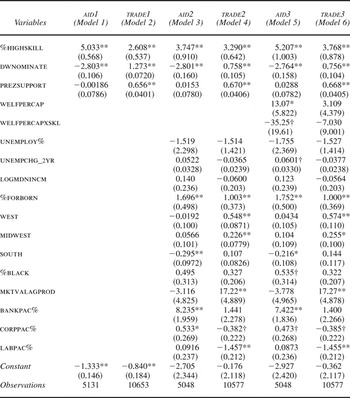
Our results, presented in Table 1, strongly suggest that the null hypothesis of idiosyncratic votes by legislators can be rejected. Legislators' votes can be systematically predicted on the basis of their constituency and the impact of the president; legislators have their own foreign economic policy preferences. Each of the three factors we focus on accounts for some part of a legislator's vote for aid or trade. But the impact of the three factors varies across the two issue areas.
Panel probit with population average effects and vote fixed effects (omitted)

Notes: Standard errors in parentheses. Models estimated using the xtprobit command with the pa (population average) and robust extensions. This is equivalent to running xtgee with a Bernoulli family and probit link with robust standard errors and exchangeable correlation matrix.
† p < .10;
* p < .05;
** p < .01.
First, we evaluate H1, which considers the influence of foreign policy on legislative voting, as reflected in the position of the president. The foreign policy concerns of the president (prezsupport) are salient for trade policy. When a president takes a position on trade legislation, legislators from the president's party are more likely to adopt this position (almost always protrade). Legislators not in the president's party when the president takes a position, or legislators in the president's party when the president does not take a position, are less likely to support trade liberalization. This is shown when we take Model 2 of Table 1 and change our prezsupport variable from 0 to 1, resulting in an estimated change in probability of voting for trade of 26 percent, but only 3 percent for aid. Hence while we observe the strong influence of the president on trade policy voting and thus support for H1, we do not observe this for economic aid. Alternative specifications of the president's position produced similar results.Footnote 64 A president's foreign policy preferences seem to weigh more heavily in trade than aid. This contrasts with Kesselman's findings that emphasized the role of the president in influencing aid roll-call voting, and supports the skepticism about this result.Footnote 65
Furthermore, there is evidence that the influence of the president in trade policy depends on the legislator's party. In trade policy, Democratic presidents seem more able to sway their party members to vote with them. As illustrated in Figure 1, the ideological divide on trade policy is largely eliminated during the Clinton administration. President Clinton put considerable pressure on members of his party to vote for trade liberalization,Footnote 66 and he was able to sway Democratic legislators who, according to political economy and ideological theories, might have opposed trade liberalization. Clinton, for example, used a combination of rhetoric linking trade to national security concerns and concessions (particularly on environmental issues) to win Democratic legislators over on the North America Free Trade Agreement (NAFTA) and AGOA.Footnote 67 Republican legislators generally have political economy interests that are more favorable to trade, which is one reason presidential persuasion has been less influential: such legislators do not need persuading. But in economic aid, Republican presidents who favor aid have not been able to convince many of their Republican colleagues to support it; domestic political interests seem to override presidential pressure. An asymmetry of influence exists. Democratic presidents appear to have more capacity to pull Democratic legislators toward trade than do Republicans toward economic aid.
The Stolper-Samuelson model in H2 does well in both aid and trade votes. Our measure of capital endowments (%highskill) is highly significant and positive for both aid and trade votes, indicating that legislators from districts with high levels of human capital are more likely to vote in favor of foreign aid and free trade. The results for trade are consistent with those found in the literature. The strong positive relationship for aid is as predicted by the political economy model, but is more surprising than anticipated.
To simulate how changes in our %highskill variable lead to estimated changes in the probability of supporting trade or aid, we use Model 2, hold the other variables at their sample means, and increase the %highskill variable from its mean to one standard deviation above its mean. The magnitude of the effect of our skill variable is similar across the two issue areas, which is surprising given that aid is a much smaller element of the economy than trade. Moving from the mean to one standard deviation above the mean leads to a 9 percent increase in probability of supporting aid and a 9 percent increase for trade. This result indicates that a core group of supporters exists in supporting both trade and aid. Thus our findings extend previous research in trade policy to research in foreign aid. Groups well endowed with capital support international engagement through trade and aid; they are perhaps the core of “the internationalist coalition” that allows greater substitution among foreign economic policies.
Next, we consider our ideological measures. While difficult to disentangle, ideological beliefs may have important effects independent from the political economy and foreign policy factors. Our liberal-conservative measure (dwnominate), which scales legislator voting from −1 for liberal to 1 for conservative, is negative and significant for aid, while positive and significant for trade, as H3 proposes. As predicted, more left-leaning legislators favor aid and oppose trade, largely, we surmise, because of their beliefs about the role of the government in the economy.
The effect of ideology also appears to be much larger in aid than in trade. This is shown by taking Model 3 and holding all variables at their means and increasing the dwnominate variable by a single standard deviation, leading to a −37 percent change in probability of supporting aid, but only a 13 percent change for trade. The effect of aid is three times as large for aid as for trade.
How does the influence of the political economy and ideological variables compare to the influence of the president? For the aid votes, the answer is clear: the ideology and skill variables produce substantial changes in the probability of voting for aid, whereas the presidential variable does not. For trade, the influence of the president is much more sizeable, a 26 percent increase in the probability of voting for trade. To assess the magnitude of this variable, we determine how much the skill or ideology variables in the trade votes would need to change to produce an effect equivalent to the influence of the president. The skill variable would need to move from the 10th to the 90th percentiles of its distribution and the ideology variable from the 25th to the 75th percentiles, both relatively large changes. Presidential influence matters for trade policy in ways that prior research has neglected, and this influence matters more than in economic aid policy.
Control Variables
While not our focus, Models 2 and 3 report results with a number of additional control variables; they show that our main results do not change when we control for many other factors. Organized interest groups may influence policy. We see that labor PAC contributions (labpac%) were negatively correlated with protrade voting (in keeping with previous results). Contributions from money-center banks (bankpac%) were positively correlated with support for foreign aid, similar to what Broz and Hawes observe with financial bailouts and IMF voting.Footnote 68 We do not observe this relationship in trade policy. Our measure of spending by corporate PACs (corppac%) was mostly insignificant. District agricultural production (mktvalagprod) is not significantly related to the set of foreign aid votes in our sample, but highly agricultural districts tend to be more free-trade oriented. Compared to legislators from the northeast, southern legislators were less likely to support foreign aid. Legislators from the West (west) and Midwest (midwest) are more likely to vote in favor of free trade compared to northeastern legislators. Legislators from districts with large foreign-born populations (%forborn) are likely to vote in favor of foreign aid and trade, though this effect is larger for aid. Our measure of unemployment level (unemploy%) and change in (state level) unemployment were almost always negative but never significant. There is no consistent relationship between (the log of) median income (logmdnincm) and either trade or aid voting.
Robustness
We perform many robustness exercises to show that our results are quite resilient. Our models correctly predict a very high percentage of actual votes by legislators: between 71 to 74 percent for trade and 74 to 76 percent for aid.Footnote 69 The accuracy of our model does not appear to be driven by our choice of variables, estimation strategy, or other potential misspecifications, as we discuss below.
Alternative and Additional Variables
One criticism of the capital endowment variable (%highskill), which is widely used, is that it might capture other effects beyond economic factors. While our Stolper-Samuelson variable (%highskill) remains positive and significant in our models in Table 1 even if we include a variable controlling for education levels (the percentage of the district above age eighteen with a college education), we also collected other measures of capital and labor endowments, following the procedure laid out by Ladewig and continue to find results supportive of Stolper-Samuelson-type preferences (see supplementary materials).Footnote 70 Taken together with the results for our original Stolper-Samuelson variable (%highskill), we find strong support for H2 and our models of economic interests in both aid and trade.Footnote 71
An alternative ideology measure is district ideology, which we measure as the percentage of the two-party vote for the president that goes to the Republican candidate. This variable produces generally identical results as the legislator-specific measure.
An important literature argues that governments use fiscal policy to alter the distributive effects of international integration, in particular to compensate the losers from globalization.Footnote 72 We expect welfare spending to be positively associated with support for trade and aid.Footnote 73 Because data at the congressional district level is not available, we focus on state welfare spending per capita (welf_percap), but we obtain similar results if we use welfare measures as a percentage of GDP or federal welfare spending within a state. We also interact this measure with our district level skill measures to consider Hanson and colleagues' public finance hypotheses.Footnote 74
While our measure of per capita welfare spending (statewelf_percap) is positive and significant for aid votes, it is insignificant for our trade votes. Hence we find some support for the ideational claim that higher domestic compensation is linked to greater generosity toward aiding foreign countries,Footnote 75 but little support for the compensation hypothesis that domestic redistribution can reduce opposition to trade openness.Footnote 76 We also find an interactive relationship between our %highskill measure and statewelf_percap for foreign aid voting, but not for trade voting. Adding these variables to our models does not change our main results.
Alternative Estimation Strategies
Our main results persist if we look at our votes individuallyFootnote 77 or using a different panel estimator.Footnote 78 We estimated models with sets of legislators depending on their reelection percentages to take into account heterogeneous electoral incentives. Our results do not substantively change. Finally, we estimated our models from Table 1 including a different, larger set of votes that we classified as being “less directly focused.” These votes satisfied most of our selection criteria, but were not as narrowly focused. Our main results hold for this larger sample. Overall, our results are quite robust.
Why Do These Differences in Aid and Trade Arise?
Political economy factors, foreign policy concerns, and ideology help account for legislative voting on aid and trade, but they do so in different ways. Why? Interestingly, the same political economy factors operate in the two areas. Legislators seem to respond to the economic endowments of their constituents. As Stolper-Samuelson models predict, districts heavily endowed with high-skill workers gain from freer trade and more aid, and their legislator's voting choices reflect this. Surprisingly, this is just as true for aid as for trade. Even though aid is a smaller part of the U.S. economy than trade, aid is often seen as an important means of economic engagement with the world economy. Legislators hence respond to the political economy pressures of their constituents similarly. This suggests that political economy factors might help shape a broad internationalist policy orientation across multiple policy areas.
In contrast, foreign policy pressures and ideology exert different effects on legislative voting in aid and trade. For our economic aid votes, the ability of the president to inject his foreign policy concerns into the process and sway legislators is much more limited than in trade. Given the importance of foreign aid as a tool of foreign policy, one wonders why the president has such limited ability to push legislators away from their constituents' interests. Several scholars note that the appropriations process in foreign aid gives Congress, and especially particular House committees, substantial power over foreign aid.Footnote 79 However, this perspective treats all foreign aid as if it were alike. Research has suggested that the extent of presidents' influence over Congress depends in part on the degree to which they can inject national security concerns into the process.Footnote 80 For example, when legislators believe that presidents have valid national security reasons for a policy, presidents should have an easier time convincing legislators to vote for it.
What happens to the influence of the president if we consider aid votes that are more tightly linked to national security issues? To probe this further, we identified two additional types of votes that fell outside the criteria we used to select aid votes above: votes that dealt with aid to a specific country (bilateral aid) and ones that dealt with military aid. These votes deal with particular presidential foreign policy and security initiatives; the debates around them underline the importance of sustaining the president's ability to conduct foreign policy.Footnote 81 These differences among the types of aid bills suggest that presidential power may vary across them. The more a vote directly affects U.S. national security, the more a president's endorsement will get members of the president's party to vote for it, even if their constituency-based preferences would lead them to oppose it.
Models for these two types of aid votes produce positive and highly significant coefficients for the impact of the president.Footnote 82 Their substantive effects are also sizeable. Using the specification in Model 3 from Table 1, changing the prezsupport variable from 0 to 1 increases the probability that a legislator votes in favor of bilateral aid by 32 percent and military aid by 31 percent. The difference between the insignificant impact of the presidential variable in the general economic aid votes and its sizable impact on military and bilateral aid votes reinforces our claim that the presidential variable does a good job of indicating the president's foreign policy concerns. Second, it shows that when the president can credibly invoke foreign policy concerns, legislators are more likely to move away from their local interests and to support the president's more national preferences.
Furthermore, evidence exists that the influence of the president differs across issue areas depending on the legislator's party. In trade policy, as noted above, Democratic presidents seem more able to sway their party members to vote with them, which is why Figure 1 shows fewer ideological differences during the Clinton administration (103rd to 106th Congresses). Conversely, Republican administrations (97th to 102nd, 107th to 108th Congresses) were more influential with bilateral economic aid votes, with debates on these votes frequently shaped by national security factors. When presidential influence is significant, it will be easier for presidents to build a legislative coalition in favor of their preferred foreign policy tools. Trade generally seems to be an easier issue for presidents, especially Democratic ones, to do this. But when Republican presidents can convince Republican legislators that foreign aid is a national security issue that is critical to the foreign policy goals of the president, presidential influence in aid may be important. To the extent that presidents can convince legislators to refrain from voting based on their local constituency interests—whether driven by political economy or ideological forces—they can build a coalition for internationalism and substitute among their foreign policy tools more easily.
The two issue areas also differ in terms of the role of ideology. For our general economic aid votes, the ideological convictions of legislators play a more substantial role than in trade. Lumsdaine and others have suggested that ideological influences in aid should be strong because the material consequences are more limited and because aid addresses the same core left-right ideological debates.Footnote 83 We thus find strong support for aid on the more liberal wings of both parties, and a general alignment of Democrats in favor of aid as a means of redistributive transfer to poorer countries and Republicans opposed to such redistributive intervention. General economic-aid votes show a marked influence of ideology, but the influence of ideology drops significantly for votes more tightly linked to U.S. national security. Our models for the bilateral aid votes show that the substantive effect of increasing legislator ideology by a standard deviation beyond its mean value was only −19 percent, compared to −37 percent for our main sample of economic aid votes. Furthermore, the absolute difference between the impact of ideology on trade (12 percent) and on bilateral economic aid (−19 percent) or military aid (4 percent) is smaller compared to our main economic aid votes. Once we include aid votes that are linked strongly to national security, the impact of ideology diminishes and becomes more similar to that in trade.
In sum, trade and aid policy differ in their bases of support. Republicans generally favor trade and oppose aid, while Democrats support aid and vote against trade. No single internationalist coalition exists for these two areas; they require that the president build different support coalitions. To the extent that presidents can override the local-constituency interests of legislators, they may be able to construct a single internationalist coalition for aid and trade. But it is likely that presidents see trade and aid as only partially substitutable since they cannot usually expect the same groups to support both policies.
The AGOA illustrates the difficulty of policy substitution due to domestic political constraints. In the late 1990s, the Clinton administration urged the approval of AGOA on the basis of a “trade not aid” policy; President Clinton termed it the “NAFTA for Africa” act, as it focused on trade expansion with Africa.Footnote 84 Initial formulations of AGOA sought to give qualifying African nations increased U.S. market access, which was considered “the first step in replacing aid with trade,” as Republican Representative Phil Crane noted.Footnote 85 AGOA was a high foreign policy priority for Clinton as a means of dealing with the many foreign policy issues bedeviling the continent, and foreign policy concerns explicitly governed eligibility for AGOA's benefits.Footnote 86 As Clinton underlined, “this package advances U.S. economic and security interests by strengthening our relationship with regions of the world that are making significant strides in terms of economic development and political reform.”Footnote 87
It was an unlikely act for a Democratic president to originate since it favored trade over aid and sought to open up import-sensitive industries in unskilled labor-intensive districts. Democrats, especially those in the Congressional Black Caucus, balked at the idea of declining aid budgets to Africa and the overtly neoliberal trade agenda.Footnote 88 Furthermore, some U.S. manufacturing firms, especially in textiles, resisted AGOA because of the imports it allowed.Footnote 89 Because of these domestic constraints, Clinton failed to get AGOA passed on his first try in 1998.Footnote 90 But in 1999, after using his state of the union address to link AGOA to American national security goals, Clinton and Republican leaders were able to pass it having made strong efforts to address the concerns of Democrats about the reduction of aid to Africa and to reduce the impact on textile districts.Footnote 91 Presidents often lack the ability to shift between foreign policy tools without paying high political costs because of domestic political factors.
Conclusion
The votes of U.S. legislators on trade and aid policy can be systematically explained. The foreign policy concerns of the president, political economy pressures, and ideological predispositions account for a substantial portion of legislative voting on these foreign policy issues. These factors weigh differentially on legislators in the two issues areas. One main difference is that the president's foreign policy concerns are less able to influence voting on economic aid issues than on trade. This finding recalls the older debate over the role of the state (that is, the executive branch) versus society in foreign economic policy making.Footnote 92 In this debate, scholars often found that the chief executive's national interest concerns guided foreign policy to a greater extent than did societal pressures from interest groups and legislatures. Such statist claims were weighed against more Marxist ones, which emphasized political economy pressures.
Our work joins this debate and advances it in two ways. First, this important debate can now be approached with more empirical precision. New data sources, such as those on congressional voting examined here, and systematic analysis of foreign policy choices allow us to explore these arguments more systematically. It is easier to distinguish the impact of political economy factors from foreign policy concerns than in the early days of this debate. Second, our results make a substantive contribution by showing that executive power over foreign policy clearly varies by issue area. On questions of economic aid, chief executives are more constrained since legislators are more influenced by their local constituency preferences and have substantial control over the appropriations process. Trade policy, on the other hand, presents opportunities for chief executives to override local interests. Examining other issues areas, such as foreign investment, to see the extent of executive versus constituency influence would be valuable.
Our results also have implications for two important claims in the literature on foreign policy. First, we show that foreign policy substitutability needs to take domestic politics into account to a greater extent; substitutability between trade and aid policy may be limited because of internal constraints. Since different domestic groups support aid and trade, U.S. presidents may have a difficult time switching between these two policies. Because of constituency pressures on legislators, they will often be unable to vote as the president wants, and this may be especially true when moving back and forth between trade and aid since different groups support the two policies. Domestic politics sets important but variable limits on the ease with which policies can be substituted for one another in the international arena. Bringing political economy models together with foreign policy ones, then, is useful in allowing us to see how the domestically derived preferences of legislators may affect the ability of presidents to construct foreign policy.
Our argument about the extent of substitutability has implications for new research in international relations. The groups that support internationalism as a grand strategy may vary more than expected across issue areas. U.S. engagement with the world seems to depend on different domestic coalitions in different issue areas. While some scholars note the differences across issue areas in presidential power and legislative politics,Footnote 93 our findings highlight that many legislators possess different preferences toward trade and aid given their domestic constituencies. Thus presidents have to create different coalitions to pass trade and aid bills, which complicates their ability to engage in policy substitution in support of an internationalist strategy.
Political economy factors, however, provide a shared source of support between trade and economic aid. Legislators appear to anticipate the economic effects of trade and aid policies on their districts and vote accordingly. In particular, Stolper-Samuelson models of trade and aid preferences receive important corroboration. Districts with large percentages of high-skill workers provide the most striking common source of support for the two policies. This political economy model helps explain commonalities in support for internationalism that are not revealed by foreign policy models.
While political economy explanations of trade policy are common, our work moves the political economy literature forward. Most of that literature never mentions the president's foreign policy concerns.Footnote 94 How does taking this factor into account change our view of trade policy? We wonder, for instance, if the results about how political economy models affect the trade policy preferences of legislators might change if one included a measure of presidential foreign policy concerns in the model.
The work of foreign policy scholars, as noted above, clearly shows that the president's national security priorities affect legislative voting on all sorts of foreign policy questions. Our work then brings together two traditions that have developed in isolation. We show that one cannot understand the evolution of foreign trade and economic aid policies without considering both the president's foreign policy preferences and legislators' constituents and their political economy preferences. Legislators are moved by both sorts of pressures in defining their foreign policy preferences.
Our findings raise questions for future research. How do legislative preferences regarding trade relate to public preferences? Do legislators primarily represent the interests of their constituents? Our results suggest, as does a substantial portion of the literature on public opinion and trade, that the public supports or opposes trade because of its economic implications.Footnote 95 Some new research, however, casts doubt on this claim. This research suggests that public preferences regarding trade are motivated by noneconomic factorsFootnote 96 and/or that citizens do not hold legislators accountable for voting on trade.Footnote 97 If these studies are correct, then our results are puzzling. Why would legislators form preferences around the economic effects of trade on their constituents if the constituents themselves do not? Why would legislators' votes line up with their constituents' interests and ideological preferences if voters do not hold legislators accountable? Our results in this context raise large questions about the connection between voters and legislators. Does public opinion on trade affect legislators' voting? Does their voting conform to the economic interests of their constituents? Developing more empirical research on this connection seems to be an important frontier for the literature.
Domestic politics matters greatly for the pursuit of American foreign policy. Combining theories of political economy, ideology, and foreign policy can help one to better explain American foreign economic policy and the possibilities for substitution between different foreign policy instruments. A focus on the foreign policy concerns of the president, however, shows that domestic preferences are not the only component of a legislator's calculus of how to vote. On the other hand, a focus on political economy and ideological models helps one to understand the important domestic limits that presidents face when attempting to use the tools of foreign policy influence. Foreign policy may not respond optimally to the external environment; domestic politics may shape which foreign policies can be used and to what extent each one can be employed. These relationships influence the possibilities for policy substitution, which in turn shape the construction of coalitions in support for international engagement. These coalitions may differ across issue areas. Future work should continue to refine our understanding of the domestic politics of internationalism by focusing on the bases of support for particular policy instruments.