Statement of Research Significance:
Research Question(s) or Topic(s): We evaluated whether pauses, extracted from natural speech using automated digital procedures, would differentiate people with Mild Cognitive Impairment and Alzheimer’s Dementia from healthy aged. Main Findings: Aggregating results across 13 studies, people with Alzheimer’s Dementia showed much longer pauses than people considered healthy aged, and without dementia. This effect was halved, but still pronounced, for people with Mild Cognitive Impairment. Study Contributions: Automation of speech analysis can greatly expand the assessment of neurodegenerative disorders and potentially improve early identification of one of the most devastating and costly diseases affecting humans. Pauses seem a particularly important aspect of speech to focus on.
Introduction
Speech affords an important window to understand cognitive functioning in people with mild cognitive impairment (MCI) and Alzheimer’s disease (AD). Traditional measures are based on “face-to-face” unstructured clinical observation (e.g., as in a mental status examination) or structured neuropsychological assessment. While promising, even brief traditional measures often require substantial transportation, time and financial resources for the patients, their caregivers, support staff, and professional staff (Jedenius et al., Reference Jedenius, Wimo, Strömqvist, Jönsson and Andreasen2010; Michalowsky et al., Reference Michalowsky, Flessa, Hertel, Goetz, Hoffmann, Teipel and Kilimann2017). Further, the reliability and validity of these tests for their intended uses are far from perfect (Calamia et al., Reference Calamia, Markon and Tranel2013). Neuropsychological tests, in particular, are not optimized for repeated assessment as they suffer from practice effects and limited alternate forms. Moreover, they have far from optimal sensitivity and accuracy (particularly false positive and false negative errors) for monitoring changes over time within individuals; particularly in transitioning from preclinical to clinical disease stages (Diaz-Asper et al., Reference Diaz-Asper, Chandler, Elvevåg and Thomas2024, Han et al., Reference Han, Nguyen, Stricker and Nation2017). Automated speech analysis (ASA) is a promising solution for improving reliability, validity, and efficiency assessing people with MCI and AD (Chandler et al., Reference Chandler, Diaz-Asper, Turner, Reynolds and Elvevåg2023; Diaz-Asper et al., Reference Diaz-Asper, Chandler, Turner, Reynolds and Elvevåg2022). The present study conducted a quantitative meta-analysis of automated speech production, a particularly promising feature of speech.
ASA for neuropsychological assessment has existed for six decades (Oldfield & Wingfield, Reference Oldfield and Wingfield1965) and has demonstrated proof of concept in dozens of studies to date. ASA involves a broad set of methodologies, including acoustics – focusing on nonverbal physical properties of speech (e.g., pitch, intensity, emphasis, and speech quality), speech production – focusing on verbal production without regard to the semantic content (e.g., pausing, speech rate), and language – focusing on the semantic meaning of speech, and pragmatic aspects of speech (e.g., syntax, articulation). Owing in part to large language modeling (LLM), improved computer processing power, and the development and dissemination of a wide array of speech-processing tools, potential solutions have advanced dramatically in the last decade (Foltz et al., Reference Foltz, Chandler, Diaz-Asper, Cohen, Rodriguez, Holmlund and Elvevåg2023). Despite this, there exists few commercial, clinical, or other solutions that have been implemented to complement clinical care, assessment, or clinical trials. Perhaps the most promising solutions involve assessment of “soft” neurological signs based on performance of vocal articulation. For example, vocal diadochokinetic tasks (DDK; Hitczenko et al., Reference Hitczenko, Segal, Keshet, Goldrick and Mittal2023) have shown promise for measuring motor functions in patients with various psychiatric and neurodegenerative disorders. However, their relevance to Alzheimer’s disease, particularly as a predictive tool for tracking progression from MCI, is less clear.
There are several reasons why implementation of ASA for AD and MCI assessment has been surprisingly slow. First involves the reality that speech is highly dynamic across speaking tasks and is also modulated by the presence/absence of social stimuli (Wells & MacFarlane, Reference Wells and Macfarlane1998), affective/arousal state, culture and external contingencies, to name a few. There is no consensus on what the most appropriate speaking task is to evaluate cognitive impairments, how it should be measured (e.g., in person, automated administration, avatars) and how to minimize the impact of potentially confounding factors. A person’s pauses, for example, might reflect very different cognitive processes and have different value for understanding AD and MCI when, for example, they are reciting overlearned verbal material (e.g., the words to their national anthem), completing a verbal fluency task, discussing politics with a partner or while leaving a voicemail at a doctor’s office while driving. Second, computation of speech features is highly idiosyncratic, and there are tens of thousands of potential features that are observed in the literature. It is unclear which are most relevant to neuropsychological assessment (and which domains), and which are most relevant to MCI and AD. Third, feature integration – involving how multiple features are combined into a single actionable score, has varied across studies. The rise of machine learning and artificial intelligence (AI) approaches facilitates integration of hundreds and thousands of features, which is in direct contrast to some approaches that focus on a few conceptually interpretable features. The former approach prioritizes accuracy over interpretability and explainability; whereas the latter approach favors explainability/interpretability over accuracy (Chandler et al., Reference Chandler, Foltz and Elvevåg2020; Diaz-Asper, Hauglid, et al., Reference Diaz-Asper, Chandler, Elvevåg and Thomas2024; Yarkoni & Westfall, Reference Yarkoni and Westfall2017).
Speech production, and in particular speech pauses, is promising for measuring cognition in people with MCI and AD. Pauses involve the response times related to verbal information – for example, in the pause times separating words, ideas and responses. Pauses can reflect the involvement of a variety of verbal, attentional, working memory, episodic, semantic, and autobiographical long-term memory processes. Pause length exaggerates within people as their cognitive resources are experimentally taxed (Cohen et al., Reference Cohen, Morrison, Brown and Minor2012, Reference Cohen, Dinzeo, Donovan, Brown and Morrison2015; Cohen, McGovern, et al., Reference Cohen, McGovern, Dinzeo and Covington2014). Pause times also increase with healthy aging (Kim et al., Reference Kim, Na, Chung and Shin2021) and are a feature of many neuropsychiatric and neurodegenerative disorders (Cohen, Mitchell, et al., Reference Cohen, Mitchell and Elvevåg2014; Cohen & Elvevåg, Reference Cohen and Elvevåg2014; Cummins et al., Reference Cummins, Epps, Breakspear and Goecke2011; Parola et al., Reference Parola, Simonsen, Bliksted and Fusaroli2020). While pauses are but one of many potential speech analytic features, they are relatively face valid as a measure of cognition, are linked to an important socio-cognitive function, employ a ratio scale in milliseconds – and thus, can be interpreted as a reaction time behavior. Moreover, they are generally computationally simple to derive and process, improving their ability to be disseminated across languages, communities, peoples, and platforms. As telehealth appointments have increased in popularity due to the COVID-19 pandemic and continue to improve access to care (particularly for older adults), pauses represent a potentially cost-effective and easily captured process score during neuropsychological assessment.
The present study aimed to accelerate the implementation of speech analysis into clinical practice by conducting a meta-analysis of studies investigating whether pauses differ between cognitively healthy older adults (CHOA) and people with MCI and AD. To our knowledge, only one meta-analysis exists on automated speech analytic tools for AD (Saeedi et al., Reference Saeedi, Hetjens, Grimm and Latoszek2024), and it was focused on broad acoustic features (e.g., “alterations in rhythm, timing, stress, and pitch”) for differentiating AD and CHAO groups. This prior meta-analysis included only four studies that included pause metrics and did not evaluate effects related to MCI. In the present study, we addressed these limitations with respect to pauses, and evaluated an additional feature, speaking rate, to help evaluate whether relationships are relatively specific to pause times or generalize to speech production more generally. Speech rate showed significant effects in the Saeedi et al. (Reference Saeedi, Hetjens, Grimm and Latoszek2024; k = 3 studies) meta-analysis and was represented in the larger literature we identified in our meta-analysis. Moreover, it is a relatively interpretable feature that is easy to derive using automated speech recognition systems. We considered speaking task and pause feature in this study, with the guiding expectation that certain features from specific tasks are optimal for differentiating diagnostic groups, and this is critical knowledge for guiding future speech analysis development — notably in identifying early markers of AD, in tracking individuals over time and differentiating healthy from non-healthy cognitive decline. Our research questions were as follows:
-
Q1: Do pauses or speaking rates differ between CHOA and people with MCI and AD
-
Q2: Do these effects vary as a function of speaking task?
-
Q3: Do these effects vary as a function of pause feature (i.e., how it is computed)?
Methods
Eligibility criteria: Potential studies were identified from PubMed using the search terms: (speech and pause) AND (dementia or cognitive decline or mild cognitive impairment or amnestic MCI). Potential articles were reviewed by psychology doctoral students and confirmed for inclusion/exclusion by a clinical psychologist (author AC). Data were extracted by doctoral graduate students either manually or using generative AI (Chat GPT version 4.0) and verified manually. Data were confirmed by reviewing them with the source article. Additionally, data from a manuscript written by the authors here was included in the meta-analysis (Divers et al., Reference Divers, Cohen, Elvevåg, Chandler, Turner, Reynolds and Diaz-Asper2025). No human data were used in preparation of this article, making the article exempt from review by the LSU Institutional Review Board, and in compliance with the Helsinki Declaration.
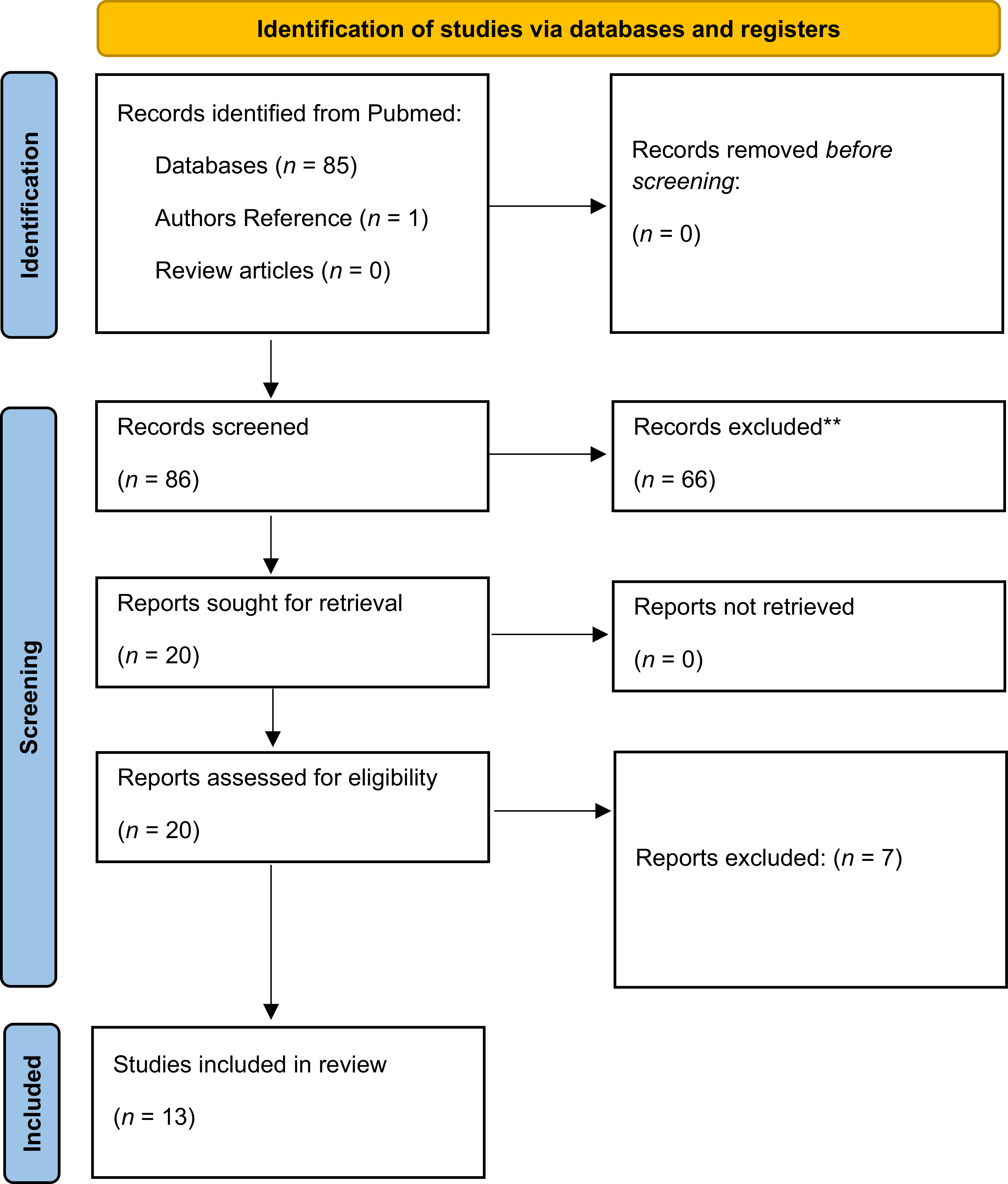
Our inclusion criteria included: Recruitment of novel data from older adults (50 years or older), with either “documented” Alzheimer’s or at-risk diagnosis (MCI) and CHOA, speech analysis from a clearly defined speaking task that yielded a measure of speech production using an automated acoustics/NLP procedure (that is based on more than merely word count), with descriptive statistics for speech measures sufficient to compute an effect size (e.g., M, SD, R, R 2, odds ratio). Studies that employed machine learning without sufficient statistics to compute feature level effect sizes were excluded. Number of pauses was not considered in this study as it primarily reflects the numbers of words or utterances, and its interpretation depends on the nature of the task (with increasing pauses potentially reflecting better and worse performance depending on the task). See Figure 1.
PRISMA flow diagram of search strategy and study evaluation. Legend: Diagram illustrating the process of literature identification, screening, eligibility assessment, and inclusion following the preferred reporting items for systematic reviews and meta-analyses (PRISMA) guidelines. Template source: Page et al. (Reference Page, McKenzie, Bossuyt, Boutron, Hoffmann, Mulrow, Shamseer, Tetzlaff, Akl, Brennan, Chou, Glanville, Grimshaw, Hróbjartsson, Lalu, Li, Loder, Mayo-Wilson, McDonald and Moher2021).

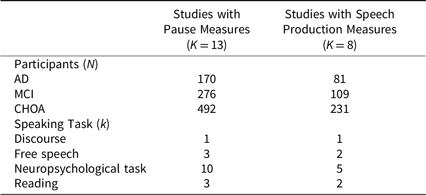
Our search yielded 13 studies with pause measures, and 8 studies with speech production measures (see Table 1). Pause measures included average pause length (k = 8), median pause length (k = 1), percentage of pauses meeting a predefined criteria (k = 4), number of predefined “long” pauses (k = 3), maximum pause length (k = 1), average pause length before phrases (k = 1), and total pause length (k = 4). Speech production measures included articulation rate (k = 4), reading rate (k = 1), and word rate (k = 4). Effect sizes were coded so that increasing scores reflect putative dysfunction (i.e., slower speech rate, longer pauses).
Descriptive statistics for the studies included in this meta-analysis

Note: AD = Alzeimer’s disease, MCI = mild cognitive impairment, CHOA = cognitively healthy older adults, K = number of studies, N = number of participants, k = number of speaking tasks. Studies may have reported data from multiple tasks.
Speaking tasks were organized into the following categories: discourse (involving multiple speakers), neuropsychological task (involving a standardized neuropsychological task), free speech (involving a time-limited monologue on a prespecified topic), or reading task (involving reading out loud of printed text).
Analyses
We were interested in understanding effects for pauses and speech rate (evaluated separately), comparing AD and CHOA groups, MCI and CHOA groups, and AD and MCI groups. Analyses were conducted in three steps. First, we evaluated effects by study using a random effects meta-analysis, with studies weighted by their standard error estimates. Model parameters were estimated using restricted maximum-likelihood. Confidence intervals were estimated using adjustments in Hartung and Knapp (Reference Hartung and Knapp2001a, Reference Hartung and Knapp2001b). Heterogeneity of effects was evaluated using I 2 (percent of variance due to between-study heterogeneity), Tau (standard deviation of the true effect sizes), and the confidence intervals of the independent variable (IV). For these analyses, data were aggregated by study, such that multiple effects within each study were averaged.
Second, we conducted sensitivity analysis for effects in the first step that showed moderate or greater heterogeneity (i.e., defined as I 2 value > 0.50; Higgins & Thompson, Reference Higgins and Thompson2002). This involved computing effect sizes by speech feature and by speaking task (rather than by study); evaluated using both as moderators in a Multilevel Meta-analysis. A test of moderators was used to evaluate whether differences between subgroups were significant, and we evaluated coefficient values (divided by their standard error) as a t-statistic to evaluate statistical significance.
Third, we recomputed our meta-analysis (in the first step) employing a “greedy selection” strategy, selecting the maximum effect size in each study for pause and speech rate-related features (Hastie, Tibshirani & Friedman, Reference Hastie, Tibshirani and Tibshirani2017). Greedy selection strategies (e.g., backwards elimination or forwards selection) are often used in regression and regularized regression analyses to improve computational efficiency, to optimize accuracy, and to provide transparent interpretative strategies, particularly when large numbers of features are used. Though greedy selection strategies are not often employed in meta-analysis to our knowledge, it was used here as an exploratory analysis based on our observation that individual studies reported many conceptually similar features with different effects. While individually significant, the results (when averaged within studies) were surprisingly modest and heterogeneous in many cases. This allowed us to estimate potential effects, acknowledging inconsistency in effects within studies and between them (in the features they reported were significant). In essence, this allows an estimation of the upper asymptote on accuracy (i.e., a “best case” evaluation of effects), which we acknowledge are biased and potentially problematic.
Heterogeneity was assessed using the I2 statistic and Cochran’s Q test. Sensitivity analyses were performed to assess the robustness of the findings. Publication bias was assessed using visual inspection of funnel plots (see supplemental materials). All statistical analyses were performed using Meta (Balduzzi et al., Reference Balduzzi, Rücker and Schwarzer2019) and Metafor (Viechtbauer, Reference Viechtbauer2010) in R.
Results
Pause times differentiate people with AD and MCI from CHOA
Meta-analytic results are plotted in Figures 2 and 3. Individuals with AD showed longer pauses than CHOA (Hedges’ g = 1.2), though there was substantial heterogeneity across studies. A more modest but still meaningful effect (Hedges’ g = 0.66) was observed between these groups in speech rate. The heterogeneity across these studies was also more modest.
Meta-analysis plots, averaging effect sizes within each study. Legend: Negative effect sizes reflect longer pauses and slower speech by the group with more severe cognitive deficits, AD = Alzeimer’s disease, MCI = mild cognitive impairment, CHOA = cognitively healthy older adults, SMD = standardized mean difference; SE = standard error; weight = percentage contribution of each study to the overall meta-analysis; IV, random, 95% CI = inverse variance weighting method with random effects model and 95% confidence interval; heterogeneity statistics: Tau2 = estimated variance of true effects; Chi2 = chi-squared statistic; df = degrees of freedom; P = p-value for heterogeneity test; I 2 = percentage of variability due to heterogeneity rather than sampling error.

Meta-analysis plots, maximum effect sizes across features and tasks within each study (using a “greedy” feature selection strategy). Legend: Negative effect sizes reflect longer pauses and slower speech by the group with more severe cognitive deficits, AD = Alzeimer’s disease, MCI = mild cognitive impairment, CHOA = cognitively healthy older adults, SMD = standardized mean difference; SE = standard error; weight = percentage contribution of each study to the overall meta-analysis; IV, random, 95% CI = inverse variance weighting method with random effects model and 95% confidence interval; heterogeneity statistics: Tau2 = estimated variance of true effects; Chi2 = chi-squared statistic; df = degrees of freedom; P = p-value for heterogeneity test; I 2 = percentage of variability due to heterogeneity rather than sampling error.

Individuals with MCI showed longer pauses than CHOA (Hedges’ g = 0.62), with minimal heterogeneity across studies. A modest effect (Hedges’ g = 0.27) was observed between these groups in speech rate.
Individuals with AD showed longer pauses than those with MCI (Hedges’ g = 0.62), with modest heterogeneity across studies. No effect was observed between these groups in speech rate.
With one exception, the funnel plots (in supplemental figures 1 – 5) suggested there was limited bias across studies. Studies of patients with AD versus controls showed some outliers, for example, with much larger effects sizes being seen in Walker et al., Reference Walker, Pevy, O’Malley, Mirheidari, Reuber, Christensen and Blackburn2023 than other studies (see Figure 2).
Heterogeneity of effects could reflect variability in speaking task or speech feature examined across studies
In six separate sensitivity analyses evaluating the potential moderating effects of speech tasks and speech features, none of the omnibus moderator tests were statistically significant (F values < 1.59, p values > 0.29). We conducted this again looking at interactions between speech task and speech feature, and again, failed to find statistically significant moderation effects (F’s < 1.98, p’s > 0.21). These analyses were underpowered, as the number of studies ranged from two to eight. For qualitative purposes, we report the few significant interactions here. This includes significant effects of pauses across speech task for differentiating AD and CHOA groups (Coefficient (Standard Error) = −3.43 (1.28), t = 2.69, p = 0.04); effects from studies using speech from memory tests (e.g., story, sentence and word recall tasks, autobiographical memory recollection task) were generally larger than other tasks (e.g., Coefficient (Standard Error) for each of these tasks versus other tasks > 3.62 (1.17), t’s > 3.10, p’s < 0.02). However, this was heterogeneous across studies, as results for one study (evaluating speech from childhood memories; Divers et al., Reference Divers, Cohen, Elvevåg, Chandler, Turner, Reynolds and Diaz-Asper2025) were negligible, whereas other studies evaluating speech from recent events (e.g., Walker et al., Reference Walker, Pevy, O’Malley, Mirheidari, Reuber, Christensen and Blackburn2023) showed profound group differences (i.e., Hedges’ g = 3.69). These should be interpreted very cautiously, as the analyses were underpowered and there were many interactions included in these analyses.
Effect sizes for both pause times and speech rates increase when optimized using a “greedy” feature selection strategy
Effect sizes for group comparisons improved modestly (i.e., by approximately 0.25 standard deviations) in nearly every case and were “large” (i.e., < 0.80) in every case except one. Heterogeneity statistics were moderate (approximately 50% in most cases as well). This confirms reports in each individual study that group differences were observed. See Figure 3.
Discussion
We conducted a meta-analysis of speech production and pause features and their relationship to AD and MCI. Thirteen studies were identified in total, with a cumulative 1,359 people. There were three notable findings. First, pauses were, on average, over one standard deviation longer in AD versus CHOA groups, and speech rate measures were slower at about half that magnitude. Second, pauses were, on average, about two-thirds of standard deviations longer in MCI versus control groups, and speech rate measures were slower, at about half that. Third, there was considerable variability in speaking task, speech feature, and group differences across studies. There were insufficient commonalities across studies to detect trends in our sensitivity analysis, though effects from memory tests tended to be qualitatively larger than seen for other tasks. These results suggest that speech measures, particularly involving pauses, are promising for differentiating people with versus without AD/MCI. Given the near-infinite ways that speech and language can be objectified, the present findings help clarify particularly promising aspects of speech to focus on.
Several methodological details need to be resolved to advance the field toward clinical implementation of pause analysis for individual-level interpretations. The first involves evaluating how and why speaking tasks systematically affect speech production. As noted in the intro, speech pauses can reflect the involvement of a variety of verbal, attentional, working memory, episodic, semantic, and autobiographical long-term memory processes. It stands to reason that speaking tasks taxing memory might be optimal for differentiating people with versus without AD or MCI, given the centrality of memory impairment to AD and potentially to MCI (at least, to AD-MCI). However, the medium (e.g., in-person, virtual, automated application) and context for delivering the task are also unclear. In the present meta-analysis, studies used a variety of media, including mobile phones, human interviewers, interactions, monologues, and avatars, and the relative impact of these for differentiating groups was unclear. The second methodological detail involves mathematical computation of pauses. There are many methods with which to compute pauses that can employ, for example, acoustic versus language processing approaches. Within these, there are a myriad of software and parameters that can vary, and various functionals can be used to aggregate pauses within a speech sample. These different approaches often show surprisingly modest convergence (Angelopoulou et al., Reference Angelopoulou, Kasselimis, Goutsos and Potagas2024). To our knowledge, methodological optimization for deriving pauses for evaluating neurodegenerative disorders is in its infancy. The third methodological detail involves how multiple features are interpreted, as they can be evaluated individually or integrated together as part of conceptual or data driven (e.g., regression, machine learning or AI) methods. These approaches have well documented pros and cons, with a trade-off regarding interpretability and explainability versus accuracy (see intro). The current study did not examine machine learning studies, as their “black box” approach obfuscates answering our primary questions regarding pauses and speech rate. However, high levels of accuracy have been reported in the literature in prior studies (e.g., 89% in Yuan et al. (Reference Yuan, Cai, Bian, Ye and Church2021)); see (De La Fuente Garcia et al. (Reference De La Fuente Garcia, Ritchie and Luz2020)).
Ideally, it would be possible to find consensus around speaking tasks, deployment media, feature processing and computation, and integration. Some attempts have been documented in the literature (Lanzi et al., Reference Lanzi, Saylor, Fromm, Liu, MacWhinney and Cohen2023), aided in part by the sharing of standardized corpora. While the present study was not designed to find this consensus, it is worth noting that Walker et al., Reference Walker, Pevy, O’Malley, Mirheidari, Reuber, Christensen and Blackburn2023 showed much larger effects than any of the other studies examined here, and it was the lone study using an interactive virtual agent. Its speech task involved responses to two pre-recorded questions meant to tap recently formed memories. A small feature set was derived using an automated feature extraction method from shareware software (i.e., Praat). This supports the notion that memory is particularly important for measuring pause anomalies in people with AD, is capturable through “interactive” speech and can be quantified using simply derived features. The effects for people with MCI using the same task were respectable, but much more modest in magnitude compared to other studies examining people with MCI. For this reason, it is difficult to argue for consensus around the methods of this study without replication and cross-validation. To our knowledge, there has been limited consensus beyond research groups and organizations, and this is constrained by the reality that many speech analytic approaches are commercial in nature and, hence, proprietary. This echo larger concerns about the use of objective technologies to understand mental functions by consumer groups and by regulatory agencies (Diaz-Asper et al., Reference Diaz-Asper, Hauglid, Chandler, Cohen, Foltz and Elvevåg2024; Wang et al., Reference Wang, Lee and Shin2023).
An important step in implementing speech analytic technologies involves validating them in different people, different languages, from different generations, and in different age groups. Pauses systematically vary as a function of culture (Cohen et al., Reference Cohen, Rodriguez, Opler, Kirkpatrick, Milanovic, Piacentino, Szabo, Tomioka, Ogirala, Koblan, Siegel and Hopkins2024), and may vary in ways that affect cognitive resources. For example, verbal fluency tasks based on recalling animals may differ dramatically as a function of urbanicity, climate, and ability to travel. This is important to consider if norms are to be established for evaluating an individual’s performance. Moreover, the availability and sophistication of NLP tools, which vary as a function of language, may systematically affect results for languages in unanticipated ways (Diaz-Asper et al., Reference Diaz-Asper, Hauglid, Chandler, Cohen, Foltz and Elvevåg2024). Other individual differences that can affect pauses and speech rate, for example, the severity of depression and anxiety, co-occurring medical conditions, use of treatment and recreational pharmacological agents, accessibility, and physical disabilities, and technological familiarity, are important to consider for validation. Finally, if speech analysis is to be used to track changes within people over time, it is also important to know how stable these metrics are over time – particularly the epochs of clinical interest (e.g., weeks, months, and years). Ideally, variance due to these sources can be differentiated from those due to “healthy” cognitive decline and neurodegeneration. This is particularly true for capturing decline in preclinical samples, when cognitive decline is often dependent on subjective report and is difficult to reliably substantiate using traditional cognitive tests.
There are some limitations with interpreting the present data. First, the samples examined in this study were relatively homogeneous in socio-demographics and language. Thus, the current findings may not generalize to other groups of people. Second, the speaking tasks evaluated in this meta-analysis are commonly seen in research projects, and many are common to neuropsychological evaluations. However, they did not reflect all or even most verbal activities that people engage in, particularly as they navigate their daily routines. The degree to which the results generalize to other speaking activities and neuropsychological tests is unclear. Third, participants in the studies differed in co-occurring medical and cognitive issues, and in medical treatment they were receiving. It is not clear how this may have affected the results, but it was something we were unable to evaluate systematically. It seems highly unlikely that the effects observed were driven by differences in pharmacotherapy across groups and between studies. However, this should be examined in future research.
The present findings reflect an important milestone in advancing speech analytics for measuring aspects of neurodegenerative disorders. Of the many ways that speech can be objectified, pauses appear particularly salient. While there are most certainly other, more sophisticated methods available (e.g., using Natural Language Processing), pauses have the benefit of being face valid, interpretable in ratio format as a reaction time (i.e., milliseconds), tied to known socio-cognitive functions, and relatively easy to measure, compute and interpret. Moreover, they are relevant to most of the world population and can be applied to many, perhaps most, speaking tasks used in clinical practice. Automation of speech analysis can greatly expand assessment of neurodegenerative disorders and potentially improve early identification of one of the most devastating and costly diseases affecting humans.
Supplementary material
The supplementary material for this article can be found at https://doi.org/10.1017/S1355617725101677.
Acknowledgments
The present study was supported by a grant to Dr Diaz-Asper from Rotary USA’s Coins for Alzheimer’s Research Trust (CART). NB: CART does not use grant numbers.
Competing interests
The authors declare that there are no competing interests.