Style enjoys a pivotal position in sociolinguistic variation, with stylistic (or intraspeaker) variation constituting a principal component together with linguistic variation and social (or interspeaker) variation (see Eckert & Rickford, 2001:1). Historically speaking, the traditional delimitation of style in variationist studies is based on the speech styles continuum established by the pioneering studies by Labov (1966) and Trudgill (1972, 1974) for the sociolinguistic interview—style as a reflection of the speaker's attention to his or her own speech (AS: Attention to Speech model) and using the interlocutor and/or the topic and/or the context of conversation as factors in determining the linguistic variety to be employed in a given situation. On the other hand, based on Giles' Speech Accommodation Theory (SAT; see Coupland 1980, 1985, 1988; Giles & Coupland, 1991; Giles & Powesland, 1975; Giles & Smith, 1979) in the Audience Design model (AD), “intraspeaker variation is a response to interspeaker variation, chiefly as manifested in one's interlocutors” (Bell, 1984:158). In order to satisfy the audience, to persuade them and to identify with them, we design our speech as if it were a product to be sold to our audience, adopting those features that are more acceptable for them (see also Biber & Finegan, 1994 for a different perspective).
But style in general is a multidimensional phenomenon that cannot be modelled on a single unidimensional theory, and thus stylistic studies have to progress, as Eckert & Rickford (2001:2) suggest, in understanding as more permeable the boundaries between the three main components of sociolinguistic variation: stylistic (or intraspeaker) variation, linguistic variation, and social (or interspeaker) variation. In this sense, some of the aforementioned approaches follow a unidimensional framework in that they are either derivative of attention to speech (AS) or reactive to audience-related concerns (SAT and AD). In contrast, the much more recent approach of Speaker Design theory (SD) views stylistic variation as a resource in the performing (active creation, presentation, and even recreation) of speaker individual and interpersonal identity, that is, stylistic variation viewed as a resource for creating as well as projecting one's persona (see Coupland, 1985, 2001a; Eckert & Rickford, 2001; Schilling-Estes, 1999, 2002; Traugott & Romaine, 1985).
OBJECTIVES
This article is a case study that examines the peculiarities of the speech of a radio presenter in a local station in Murcia and compares it to the audience's linguistic behavior in the context of a vernacular speech community. Our main purpose is to find out whether the Audience Design (AD) model or Speaker Design (SD) approach can account for the patterns observed. If neither of them happens to be totally satisfactory, we shall try to offer an alternative account, based on or derived from AD or SD approaches, but with the necessary modifications to account for the data adequately.
THE SOCIOLINGUISTIC SITUATION OF THE LOCAL DIALECT
Murcian Spanish, like Andalusian, can best be considered as a southward extension of varieties originating in the central-north areas of the Iberian Peninsula (see Alvar, 1996; Hernández-Campoy, 2003; Hernández-Campoy & Jiménez-Cano, 2003; Hernández-Campoy & Trudgill, 2002; Lapesa, 1988; Zamora-Vicente, 1989).
Sociolinguistically speaking, this variety is stereotyped as ‘the orchard pronunciation’ (“el habla de la huerta”), with connotations of ruralness, and even relative stigmatization as ‘bad speech’ for Murcian speakers (see Sánchez-López, 1999, 2004; and Cutillas-Espinosa, 2001, 2004), who considered it unaesthetic, incorrect, inadequate, and substandard. But the particularly contradictory situation is that this overt view of their local variety as ‘bad speech’ is for public consumption only. Despite Murcian speakers' negative value judgments of their own speech, they do not abandon it entirely. In many ways, the local accent clearly has covert prestige (see Trudgill, 1972), combined with what could be called a linguistic inferiority complex. In Labov's (1966) terms, this is an area of linguistic insecurity amongst local speakers with a strong double consciousness situation.
METHODOLOGY
Data gathering
Linguistic data were obtained by analyzing recordings of the interactions between a radio presenter and members of his audience in a daily music program broadcast live by the MQM (Más Que Música) local radio station from 6 to 8 p.m. This program is broadcast from Santomera, a small town some 12 kilometers from Murcia. Its audience participates very actively, by phoning to ask for a song to be played, or to give their number in order to meet other people, or just to talk to the radio presenter. The average duration of calls ranges from 3 to 5 minutes. It is necessary to distinguish between the general audience of the program (all its listeners and their average social characterization) and the limited group of people who actually phoned the radio station, whose speech is the object of study in this article. We shall call the latter the audience interlocutors from now on.
Additional data were obtained from an interview with the radio presenter, both quantitative and qualitative. As far as the quantitative analysis is concerned, we looked at the same variables studied in the presenter's speech on the radio. We wanted to check whether his high use of standard forms was exclusive to broadcasting or extensive in his everyday use of language, thus making sure that linguistic divergence from the audience interlocutors was a phenomenon related to the mass media setting. The interview was conducted by the authors themselves in an informal atmosphere, three months after the recordings were carried out and once the data had been analyzed. We tried to emphasize this informality by using the nonstandard Murcian accent. Both of us are native speakers of this accent, and we use it in our everyday life. The choice of the accent was conscious, as we have already remarked, but it is worth pointing out that it was also ‘natural’ insofar as the radio presenter addressed us using this same accent from the very beginning of the interview. We tried to disguise the fact that we were questioning him, transforming the questions into subject-raising remarks, so that by the end of the interview we were engaged in a lively, relaxed conversation.1
The questions were the following:

As far as the qualitative analysis is concerned, we tried to elicit from him opinions that might provide evidence supporting some account of his stylistic behavior. The questionnaire was devised to obtain information about the following aspects, moving from a first stage of ‘subtle’ asking to a more direct type of question at the end: (a) presenter's awareness of the social and linguistic features of his audience (questions 1–7); (b) opinions about nationwide radio stations, their presenters, and their status as models (questions 8–11); (c) attitudes toward Murcian speech (questions 12–16); (d) opinions about media communication and language use (question 17); and (e) direct questions about the presenter's divergence from his audience interlocutor's speech (questions 18–22).
Informants
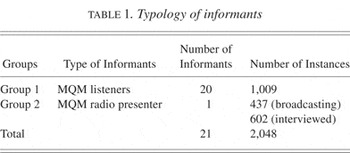
Twenty-one Murcian informants (20 listeners and the radio presenter) participated, from whom 1,446 occurrences of the linguistic variables were quantified for the study based on the radio program (Table 1). We also quantified 602 occurrences from the presenter's speech in the interview. The informants who were recorded and analyzed were mostly male and female adolescents (secondary school students) and male working-class adults (skilled and nonskilled manual laborers: electricians, plumbers, wood workers, metal workers, etc.). Their phone calls usually took place while studying, in the case of the adolescents, or at work (sometimes on the road) in the case of workers. This information about the geographical provenance and occupation of the audience interlocutors was regularly part of the content of the phone exchanges between the radio presenter and the listeners: Who are you? What do you do? Where are you from? Where are you now? or What are you doing at the moment? and What do you want? or What would you like to say?
Typology of informants

Linguistic variables
For the purpose of our study, four variables were selected: (r), (l), (s), and consonant reduction, which are all salient features in this accent. The deletion of certain consonants implies vowel changes that are outside the scope of our study (see Hernández-Campoy & Trudgill, 2002).
Variable (r)
‘r’ in syllabic coda position, as in comer (‘eat’) and carne (‘meat’), has two different realizations: (1) the maintenance of [r] as in Standard Castilian Spanish in all post-vocalic positions, and (2) r-deletion (word-finally) or assimilation (word-medially), which are the nonstandard realizations.

Variable (l)
‘l’ in syllabic coda position, as in el (‘the’) and alto (‘high’) has three different realizations (one standard and two nonstandard): (1) the maintenance of [l] as in Standard Castilian Spanish in all post-vocalic positions, (2) l-deletion in word-final position, and (3) regressive assimilation when followed by another consonant (normally in word-internal position), or even liquid permutation:

Variable (s)
‘s’ in syllabic coda position, as in casas (‘houses’), has two different realizations: (1) the maintenance of [s] as in Standard Castilian Spanish in all post-vocalic positions, and (2) s-deletion as the nonstandard form—unlike Andalusian, the ‘intermediate’ aspirated form is not usual in Murcian Spanish (see Penny, 1991, 2000).

Consonant reduction
This includes cases of consonant loss, normally after a stressed syllable, as in the -ado/-ido verbal endings (cansado, ‘tired’) or the preposition para (‘to/for’), and the simplification of stressed diphthongs (muy, ‘very’) by omitting the second vowel element (found in some elderly people or uneducated speech in general):

RESULTS
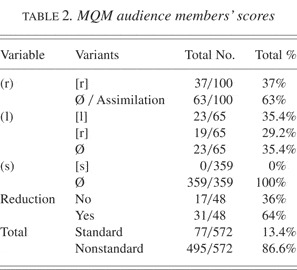
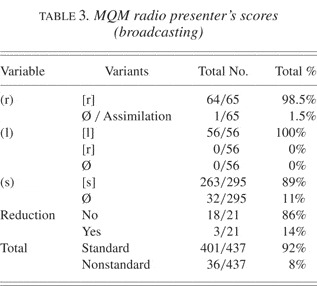
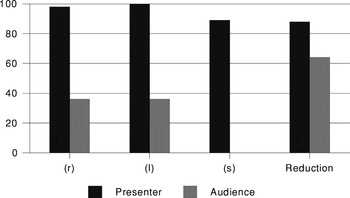
Tables 2 and 3 show the differences in use of standard forms between the audience interlocutors and the radio presenter (Figure 1). There is a radical divergence in linguistic behavior between the presenter and the audience interlocutors, which remains more or less stable throughout the four different variables under study.2
Gender-based variation was also analyzed—in fact, there were 10 male and 10 female informants—though differences in the percentage of standardization between male and female audience are not statistically significant: being Ho = null hypothesis, χ2(H0 ≤ 3.84; p < .05) = 0.082. On the whole, women use more standard forms than men, with the exception of variables (s) and (r), where there is little or no difference at all. There is also little variation in the speech of the presenter depending on the gender of the addressee. It is not possible to suggest any generalization, but there is a slight, though statistically not significant, χ2(H0 ≤ 3.84; p < .05) = 2.443, preference for a higher use of nonstandard forms when addressing women (i.e., the presenter accommodates more intensely to women's speech).
MQM audience members' scores

MQM radio presenter's scores (broadcasting)


Percentage of use of standard forms by presenter and audience interlocutors in the four different variables under study.
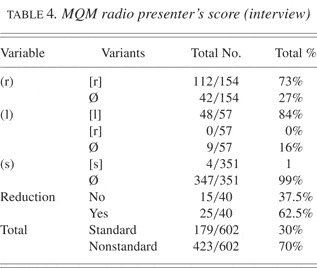
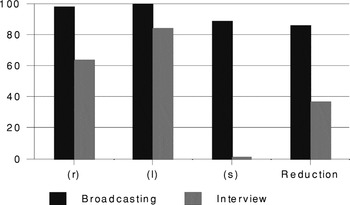
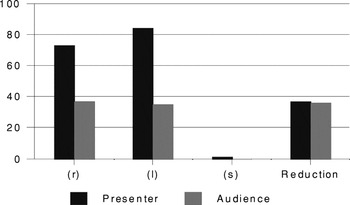
Table 4 shows the results of the quantification of the interview data, in which the presenter displays a drastically different linguistic behavior from that shown in his radio program speech, a difference that is statistically significant: being Ho = null hypothesis, χ2(H0 ≤ 10.82; p < .001) = 395.026. Nonstandard forms are now predominant on the whole, and there were significant increases of nonstandard forms for all variables (see Figure 2). In spite of this, his speech is still far more standardized than that of his audience interlocutors for variables (r) and (l). On the other hand, the presenter is as nonstandard as his audience interlocutors for variables (s) and ‘reduction’. He uses the zero variant of (s) in practically all cases (99%) and a proportion of reduction that approximately equals that of his audience interlocutors (see Figure 3). This reinforces the status of (s) and ‘reduction’ as vernacular landmarks. In addition, it shows that the linguistic behavior of the presenter is caused by the broadcasting context, and consequently, it cannot be regarded as a general feature of his everyday speech.
MQM radio presenter's score (interview)


Presenter's use of standard forms (%) in broadcasting and in the interview.

Percentage of use of standard forms by the presenter (in the interview) and the audience interlocutors of the radio program.
ANALYSIS OF RESULTS AND DISCUSSION
Two observable patterns arise: (1) radical divergence between presenter's and audience's speech in broadcasting, and (2) much higher use of nonstandard forms in the context of the interview with the presenter. We shall now have a look at how these patterns could be explained.
The Audience Design and Speaker Design models
It seems that the predictions of Bell's model are contradicted by the linguistic behavior of the presenter in our study. He does not seem to be interested in expressing ‘shared identity’ with the audience interlocutors, at least by linguistic means. However, the interview revealed that he is fully aware of the social and linguistic features of his potential audience. In his answer to question 1, he said that it consisted of working-class people, teenage students, and housewives, in that order. In spite of this, he designs a type of speech that does not fit their social and linguistic characteristics. We cannot confirm here audience-based style shifting in the sense of Selting (1983) and Bell (1982, 1991, 2001). This conclusion is further supported by the quantitative data obtained in the interview. It provides us with another paradox, because the audience in this case (two researchers from the University), probably because of their status and educational background, should also have caused a high level of standardization—though we consciously used the local Murcian accent. However, what we get is just the opposite (see Table 4). For some reason, the presenter regards the interview situation as less deserving of his most standard forms than the broadcasting one. Some additional kind of consideration (not audience) is needed to explain this pattern.
As discussed earlier, more recently, speaker design approaches suggest that stylistic variation is not a response to an existing situation, but rather a way to shape communicative situations and project a self-image. In other words, language does not merely reflect categories such as gender or style; rather, it is an essential component in the building of such categories (Bell, 1999; Cameron, 2000; Coupland, 1985, 2001a; Kiesling, 1998; Wong & Zhang, 2000; for an overview, see Eckert, 2000 or Schilling-Estes, 2002). The speaker design approach would suggest that our presenter could be performing an identity and building a persona. But, since he admits in question 13 that he does not particularly like the accent he uses at work (the standard), what are the motivations? In other words, the fact that the announcer performs a particular role does not explain the nature of that role. Our speaker acknowledges that he is aware of social attitudes towards the vernacular accent of Murcia, the standard question, language and the media, and so forth. It is obvious that all of these influences are essential in determining his final linguistic performance. But in this particular case, the performance itself does not provide an explanation; rather, it is just a symptom of a social pressure in a particular direction—more specifically, a whole set of beliefs about the standard accent in Spain, the accent used in the Region of Murcia, and the appropriate variety to be used in broadcasting. Thus, the script of our presenter's linguistic behavior using a professional voice is not a completely free choice, given that it has probably been written or decided by someone else as a linguistic policy for the radio station, which is based on linguistic attitudes, norms, and concepts of appropriateness and correctness that go in the direction of the standard. To understand our presenter's behavior, we inevitably need to go further than the performance, and analyze the script. In doing this, we insist on the notion that individual creativity is restricted by rules or structural constraints (see Bell, 1999; Cameron et al., 1992; Eckert, 2000) and suggest that these constraints actually comprise a unit made up of linguistic attitudes, norms, and concepts of appropriateness and correctness. This unit is what we call script.
Predetermined performance: Script as radio talk norms behind a professional voice
In this section we will analyze the different aspects that may have influenced the linguistic behavior of our presenter. In other words, we shall try to analyze the ‘script’, understood as a kind of linguistic (language or accent) policy or instructions to be complied with, abstracted from a set of attitudes, norms, and beliefs about ‘appropriate’ and ‘correct’ speech in a given situation, within a specific community under study, and which normally—but not always—go in the direction of the standard prestige variety. This script may take the form of a professional voice used as a result of this linguistic policy, which may or may not coincide with the user's linguistic preferences. We base our analysis on some of the presenter's opinions in the interview.
All of these factors contribute to a mental script in which the standard as such is hardly under discussion. Nonstandard varieties are accepted to be ‘wrong’ versions of some ‘right’ linguistic variety, a fact that is reinforced by spelling conventions and prescriptive pressures. This state of affairs is also maintained by allowing a place for nonstandardness. Some regional accents have their own status and respectability and this minimizes the possibility of a ‘revolt’ against the standard. Thus, partial tolerance becomes the perfect alibi for generalized prejudice against the regional varieties and praise of the standard.
Our presenter answered quite clearly to the question of why he used such a standard accent to address his audience interlocutors. He said that, in broadcasting, there are many people listening and it is inappropriate to use vernacular forms. There are contradictory feelings and it seems that our presenter is not an exception, but rather a confirmation of a general pattern in the Region of Murcia. As stated earlier, it is what Labov (1966) called a case of double consciousness. On the one hand, the Murcian accent is ‘coarse’, rural, even ‘ugly’; on the other hand, it is our accent, and it is as respectable as any other, and we should all defend it. In his answer to question 13, our presenter moves from the negative appreciation of the accent to its praise without a pause. This apparent contradiction does not seem to be a problem. On the contrary, it helps to establish two well-differentiated spheres of influence—the Murcian accent is acceptable in family and everyday life, but it should not be used in the media.
This pattern is further reinforced by broadcasting managers. Presenters are instructed to avoid vernacular forms, which are regarded as a sign of disrespect to the audience. Pronunciation has to be ‘correct’ (again, prescriptivism and the popular beliefs about spelling and pronunciation), clear, and intelligible. There does not seem to be anything intrinsically wrong about the Murcian accent, but from the viewpoint of broadcasting, it is seen as inappropriate. These principles are deeply rooted in the mental script of sociolinguistic behavior of the whole community, in such a way that the audience interprets linguistic divergence as a sign of respect, and not contempt. The broadcasting context is a sufficient justification.
Additionally, Bell is right in stating that “communicators need to persuade their audiences,” but this persuasion does not always necessarily imply the use of linguistic means, as Bell himself admitted in later work (see Bell & Johnson, 1997). Our presenter shows identity with his audience, but he does not need to express it by using vernacular forms. He accommodates to this audience's tastes in topics and music. From the conversational viewpoint, the topic of short telephone interactions always depends on the characteristics of the audience interlocutor. Most conversations deal with the caller's job—what they are doing while they talk to him, where they are going if they phone from a vehicle—or about the caller's studies, with the inevitable complaints about teachers and exams; or else they are concerned with interpersonal relationships, such as: Have you got a boyfriend? or Would you like to have one? These are the topics that all of his audience will be able to understand and identify with.
In short, MQM presenters provide their audience with the music and the conversation they want. They do it by using an accent that, in most cases, is very distinct from their own. However, this does not seem to affect their audience's interaction with the presenter. It is assumed to be a part of the normal communicative conventions used in broadcasting. This reflects what Jiménez-Cano & Hernández-Campoy (2004:83) described as being a diglossic situation in Murcia: “a bi-dialectal situation—with a diglossic nature—where code-switching or dialect-shift is largely biased by diaphasic and/or diastratic factors: the higher the social class of the speaker, the higher the level of managing more adequately with both dialect varieties in different contexts; and, conversely, the lower the social class of the speaker, the lower the level of having a good command of both varieties, with the use of the local one predominating in most situations.” In other words, the script shared by the presenter and his audience justifies and explains the patterns of their interaction, thus preventing misunderstanding in the form of an offensive interpretation of linguistic divergence.
CONCLUSION
In this article we have shown how the Audience Design model fails to explain the linguistic behavior of a radio presenter in a local program. The fact that the announcer does not try to sound like his radio audience is an interesting counter-example to work like Coupland's or Bell's about radio announcers who do use accommodative or self-expressive style shifting as a solidarity-building tool.
We have also looked at the Speaker Design approach. Methodologically, research in this field may be enriched by interviewing the speaker, as shown in this article, so as to get a confirmation of our initial interpretations, as practiced by the Ethnography of Speaking, the Social Psychology of Language, and Folk Linguistics. Without that source of data, the sociolinguist's remarks can always be labelled as judgmental or even subjective. Theoretically, as Schilling-Estes (1998) stated, speakers may also take a more proactive role in using language to construct a particular role or identity for specific communicative purposes. But, additionally, and crucially, the fact that all Speaker Design approaches acknowledge the existence of a ‘structural’ part in stylistic performance, which we can call ‘normativity’, ‘correctness’, ‘appropriateness’, and so forth, has been underlined. Certainly these concepts cannot be shoe-horned into a fully workable definition of ‘script’ as a general principle or as a predictive model of style variation, but it is true that ‘normativity’, for instance, is often a potent constraint on style, and it may well be a decisive concern in the context at hand. Also, by adhering to a generic norm that is characterized as a ‘script’ in our attempt to explain this case, by no means do we intend to return to a dated form of discussion on style. What we are rather suggesting is that our presenter's performance reinforces the need to look into that structural part that we call ‘script’.
In this way, the analysis and diagnostic explanation provided with our counter-example underlines, as Coupland (2001b) suggested, the need to avoid generic theoretical models for a complex multidimensional phenomenon and, as such, however, to develop permeable and flexible multidimensional, multidisciplinary, and interdisciplinary approaches to speaker agency that take into consideration both the reactive (responsive) and proactive (initiative) motivations for style-shifting: “a far broader, more flexible, interpretative, and ethnographic apparatus to capture the stylistic processes at work” (Coupland, 2001b:209). In this sense, we have attempted to point out the limits to the freedom of the speaker to design his style. Otherwise, stylistic variation would become a highly individualistic phenomenon (as personal as identity building can be). As we know, speakers do not build their speech regardless of sociolinguistic norms; they use preexisting scripts (in terms of rules, structural constraints, or simply attitudes) that establish what can be said and what cannot be said. It is within these schemes that speakers move, making decisions in each specific moment. This is especially so in the case of mass media communication, where broadcasting conventions (radio talk norms) and attitudes toward the question of the standard and the vernacular forms are essential in order to decide or shape the professional voice to use. This is the reason why the behavior of a local radio presenter in Murcia may not be the same as that of radio presenters in Germany, New Zealand, or even Andalusia in Spain. The covert prestige situation in Murcia, with the specific attitudes toward the vernacular variety, justifies the eradication of local forms in a context where standard forms are selected on an undeniably ideological basis. The listeners are ready to accept that their own loved and hated speech is not appropriate for the radio, where the standard ‘correct’ speech is expected. The presenter is therefore re-creating, but not creating, a Murcian approach to this linguistic matter. The discussion may potentially be taken to other fields (such as gender studies) where ‘performative’ approaches have been proposed. As a matter of fact, actors help to create characters and may well include some original ideas in their performance. But we should not forget that, in spite of this, someone has written the script for them and they compliantly make use of it as a way of building, as well as projecting, an acceptable image and identity, thus determining their sociolinguistic behavior. In this way, the behavior of a single person (either linguistic or not) can only be understood in the context of the set of norms that establish the accepted limits of individual freedom.