INTRODUCTION
Saron Thallwitz, 1891, comprises four species: S. inermis Hayashi in Debelius, 1983; S. marmoratus (Olivier, Reference Olivier and Olivier1811); S. neglectus De Man, 1902; and S. rectirostris Hayashi, 1984 (De Grave & Fransen, Reference De Grave and Fransen2011). The ‘marble shrimp’, S. marmoratus is widely distributed in the Indo-Pacific, from the Red Sea and eastern Africa to Australia, French Polynesia and Hawaii (De Grave & Fransen, Reference De Grave and Fransen2011). In its native habitat the species ‘is one of the most common forms of the Indo-West Pacific coral reefs’, found on coarse coral rubble or under rocks, ‘among branches of Sargassum,…branches of the coral Stylophora’, often in pairs (Holthuis, Reference Holthuis1947; Al Kholy, Reference Al-Kholy1961; Davie, Reference Davie, Wells and Houston2002). A territorial predator, nocturnal in its habits, it shelters in crevices during the day and forages for prey at night. Due to its showy colours and hardiness it is a popular ornamental species, though it is reportedly aggressive and best kept in fish-only aquaria (http://reefkeeping.com/issues/2007-05/as/index.php, viewed 28 July 2013). Nevertheless, it is common in the trade, selling for 10–28 US$.
In the course of recent studies of the hard bottom biota off the Mediterranean coast of Israel photographs were taken of an unfamiliar hippolytid shrimp. Upon examination it was identified as S. marmoratus. It is the second Indo-Pacific hippolytid species recorded in the Mediterranean Sea (Froglia & Deval, Reference Froglia and Deval2012).
RESULTS
SYSTEMATICS
Infraorder CARIDEA Dana, 1852
Family HIPPOLYTIDAE Spence Bate, 1888
Genus Saron Thallwitz, 1891
Saron marmoratus (Olivier, Reference Olivier and Olivier1811)
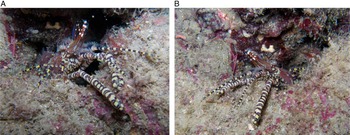
(Figure 1A, B)
(A) Saron marmoratus: Mediterranean Sea, Israel, Nahariya, 20 July 2013, frontal view; (B) S. marmoratus: Mediterranean Sea, Israel, Nahariya, 20 July 2013, lateral view (photographs by S. Rothman).

Palæmon marmoratus Olivier, Reference Olivier and Olivier1811: 665.
Saron marmoratus Holthuis, Reference Holthuis1947: 6, 25 (extensive synonymies within).
MATERIAL EXAMINED
Mediterranean Sea: Israel, Nahariya, 20 July 2013, 33°02.032′N 35°04.261′E, 28 m, rocky knoll surrounded by coarse sand, 1 male.
DIAGNOSIS
Rostrum usually longer than carapace, curved upward. Carapace with single orbital margin. Antennular peduncle without erect spine on 3rd segment. Antennal peduncle with basicerite lacking prominent distoventral tooth. Second pereiopod with movable finger smooth, not finely serrate, on opposable margin, carpus composed of 9–13 articles. Fifth pereiopod with two subdistal spines on merus. Fourth pleopod with appendix interna attached to endopod over much of length (after Chace, Reference Chace1997).
Colour in life: carapace and abdomen dun coloured and bearing purple centred roseate spots differing in size and forming a mottled pattern. Anterior margins of carapace pale yellow with brownish irregular crescentic markings. Abdomen dorsally with roseate-ringed yellowish blotches. Antennular and antennal flagella dark reddish-brown with whitish rings, antennal scale dark reddish-brown, distally mottled white. The third maxilliped and the pereiopods are pale yellow regularly ringed by brown bordered bluish bands, whereas the massive first pereiopods display complex irregular annulations (Figure 1A). Seemingly gaudily-coloured, the pattern is in fact perfectly suited for concealment on algae covered rubble and rocky bottoms (Figure 1B).
REMARKS
The species is known to display great variations in colour pattern (De Grave et al., Reference De Grave, Chan, Fujita, Okuno, Naruse, Chan, Tan, Ahyong and Reimer2012, figure 2D–F), including diurnal change in hue (Debelius, Reference Debelius1984). Yet a specimen photographed in Eilat, at the northern Gulf of Aqaba, presents a colour pattern that corresponds well with the Mediterranean specimen (http://www.superstock.com/stock-photos-images/4141-17071, viewed 28 July 2013).
The presence of S. marmoratus in the Mediterranean raises questions as to its possible vector/pathway. The marine aquarium trade, already implicated in introductions of invasive alien species, has recently shifted from fish-only tanks to miniature reef ecosystems that include many invertebrates (Rhyne et al., Reference Rhyne, Rotjan, Bruckner and Tlusty2009). ‘Marble shrimps’ are hardy and attractive crustaceans, popular among aquarists for their ornamental coloration. Though native to the Indo-Pacific, they have been widely distributed by the industry, and may have been introduced to the wild by aquarists. The crevice-inhabiting S. marmoratus may have been conceivably transported to the Mediterranean in the fouling community on the hull of slow moving vessels, such as drill vessels and semi-submersible platforms, arriving from the Persian Gulf or the Indo-West Pacific to service the burgeoning offshore oil and gas industry in the south-east Levant (Ferreira et al., Reference Ferreira, Goncalves and Coutinho2006; Wanless et al., Reference Wanless, Scott, Sauer, Andrew, Glass, Godfrey, Griffiths and Yeld2010). However, given the species' presence in the Red Sea (Heller, Reference Heller1861; Kossmann, Reference Kossmann and Kossmann1880; De Man, Reference Man1881, Reference Man1897; Coutière, Reference Coutière1898, Reference Coutière1910; Nobili, Reference Nobili1901, Reference Nobili1906; Balss, Reference Balss1915; Al Kholy, Reference Al-Kholy1961; Debelius, Reference Debelius1984) and the Gulf of Suez (Balss, Reference Balss1915; Ramadan, Reference Ramadan1936; Gurney, Reference Gurney1937), and the length of its zoeal stage (8 days at 26–29°C, fide Sankolli & Kewalramani, Reference Sankolli and Kewalramani1962) it is suggested that S. marmoratus has entered the Mediterranean through the Suez Canal, as have nearly four-fifths of the alien crustaceans in the Mediterranean Sea (Galil, Reference Galil, Galil, Clark and Carlton2011).
ACKNOWLEDGEMENTS
We thank Yair Yam and Oren Klein, Putsker Diving Club, Nahariya, for helpful diving services and the use of their facilities. Partial support for this research was provided by the European Community's Seventh Framework Programme (FP7/2011-2015) for the project Vectors of Change in Oceans and Seas Marine Life, Impact on Economic Sectors (VECTORS) (B.S.G.).