Mechanical circulatory support through left ventricular assist devices (LVADs) is increasingly being used as a bridge to heart transplantation in patients with end-stage heart failure (Reference Neyt, Smit, Van den Bruel and Vlayen1). As the number of patients with end-stage heart failure is growing without an accompanying increase in available donor hearts, LVADs are also being used as destination therapy, that is, as an alternative to heart transplantation. The REMATCH trial (Reference Rose, Gelijns and Moskowitz2) demonstrated improved 1-year survival after LVAD support, in comparison to optimal medical therapy (OMT) and was the basis for the FDA to approve destination therapy in the United States. Long-term survival, however, was poor, because of mechanical failure of the devices used. Newer devices, using continuous-flow rotary pumps are smaller and more durable. Survival after implantation of a continuous-flow LVAD is significantly better than with the older pulsatile-flow devices (Reference Slaughter, Rogers and Milano3).
In 2007, partly based on economic considerations, the Dutch Health Care Insurance Board (CVZ, College voor zorgverzekeringen) concluded that pulsatile-flow LVADs as destination therapy for end-stage heart failure could not be included in the basic healthcare package (4). Because of the technological advances with smaller and better performing continuous-flow LVADs, the Dutch CVZ requested a new Health Technology Assessment report including an economic evaluation of these LVADs as destination therapy in patients with end-stage heart failure. This economic evaluation incorporates the best available randomized control trial (RCT) evidence on continuous-flow LVADs and original real-world cost data with such a device in the Netherlands.
METHODS
A cost-utility analysis was performed for the Dutch context. National pharmaco-economic guidelines were followed (5). A societal perspective was applied. A Markov model was set up with monthly cycles and a lifetime time horizon, with costs and effects discounted at 4 percent and 1.5 percent, respectively.
The target group consisted of adults with chronic end-stage heart failure, contraindications for a heart transplant, left ventricular ejection fraction (LVEF) of 25 percent or less, and New York Heart Association (NYHA) class IV for at least 90 days despite OMT (Reference Rose, Gelijns and Moskowitz2;Reference Slaughter, Rogers and Milano3). The analysis was restricted to the use of an LVAD implant as destination therapy. The comparator for these patients was OMT. The average age and male/female proportion was 64 years and 83 percent based on two trials evaluating LVAD as destination therapy (Reference Rose, Gelijns and Moskowitz2;Reference Slaughter, Rogers and Milano3).
Model
A hypothetical cohort of 1,000 patients was modeled in Microsoft Excel 2010. Uncertainty was incorporated with the @Risk 5.7 (Palisade Corporation) add-inn.
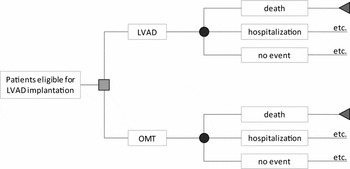
A model is set up to calculate the incremental impact on both costs and effects. Figure 1 presents the structure of the Markov model and is able to incorporate these incremental impacts. The green square indicates the choice between the LVAD and OMT. The red circles indicate the possibility that a patient dies in a given period (with the blue triangle as an end point), is hospitalized, or that no event occurs. For those who survive, the same events can occur in the following monthly cycles. As such, multi-state life tables were created for both the LVAD and OMT cohort. Half-cycle correction was applied, which assumes that patients do not die at the end of a monthly cycle but rather halfway.
LVAD Markov model. LVAD, left ventricular assist devices; OMT, optimal medical therapy.

Estimation of the Treatment Effect
There are only two randomized trials with LVADs as destination therapy in patients with end-stage heart failure who are not candidates for cardiac transplantation. These trials were identified in a systematic search of the literature (Reference Neyt, Smit, Van den Bruel and Vlayen1), including the following databases: Medline, Embase, the Cochrane Database of Systematic Reviews, CENTRAL, and DARE. The search date was 30th June 2010, with an update on January 6, 2011. Studies were selected by two independent reviewers if the study evaluated LVAD as destination therapy for patients with end-stage heart failure and if at least one of the following outcomes were assessed: survival, functional status, quality of life, postoperative complications, or device-related adverse events. A language restriction for English, French, German, or Dutch articles was included. Details of the search strategy are available in the HTA report (Reference Neyt, Smit, Van den Bruel and Vlayen1).
The first trial compared a pulsatile-flow LVAD with OMT (REMATCH trial) (Reference Rose, Gelijns and Moskowitz2). The second trial compared a pulsatile-flow LVAD with a continuous-flow LVAD (HeartMate II Destination Therapy Trial) (Reference Slaughter, Rogers and Milano3). A direct comparison between a continuous-flow LVAD and OMT has never been performed in a randomized trial. Therefore, the treatment effect used in the Markov model was based on an indirect comparison based on these two trials. The indirect comparison was performed unadjusted because of the comparable inclusion criteria and similar outcomes with the pulsatile-flow LVADs in the two trials.
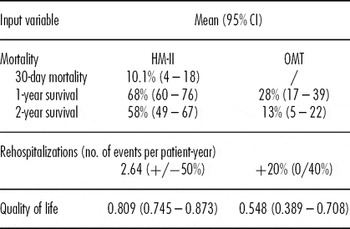
In the REMATCH trial, the relative mortality risk was 0.52 (95 percent confidence interval [CI], 0.34–0.78; p = .001). Survival at 1 year was 52 percent versus 28 percent in favor of the pulsatile-flow LVAD over OMT (2). At 2 years, this was 29 percent versus 13 percent (Reference Dembitsky, Tector and Park6). In the HeartMate II Destination Therapy Trial, the relative mortality risk was 0.54 (95 percent CI, 0.34–0.86; p = .008). Survival at 1 year was 68 percent versus 55 percent. Survival at 2 years was 58 percent versus 24 percent in favor of the continuous-flow HeartMate II (HM-II) over the pulsatile-flow LVAD (Table 1) (3).
Input Variables (Mortality, Rehospitalizations, and Quality of Life)

Note. More details on these variables, their probability distribution and sources are available in the supplementary data.
HM-II, HeartMate II; LVAD, left ventricular assist devices; OMT, optimal medical therapy.
In the OMT group, the 1-year and 2-year survival of 28 percent and 13 percent corresponded with an average monthly mortality risk of 10.1 percent and 6.2 percent during the first and second year, respectively. In the LVAD group, the 30-day mortality for implanting the HM-II at the University Medical Center (UMC) Utrecht was 10.1 percent (7/69) (Reference Neyt, Smit, Van den Bruel and Vlayen1), which was similar to the 30-day mortality of 10.3 percent (6/58) in another study (Reference Coyle, Ising and Gallagher7). Taking this into account, and with a 1-year and 2-year survival of 68 percent and 58 percent, the average monthly mortality risk was estimated to be 2.5 percent between the second and 12th month, and 1.32 percent during the second year.
The trials had a 2-year follow-up period. However, extrapolation to a lifetime horizon is necessary to calculate the number of (quality-adjusted) life-years gained. In the OMT group, with a 2-year survival of 13 percent, we assumed that all patients were deceased after 3 years, with a linear number of monthly deaths during the third year. In the LVAD group, the monthly mortality during the second year was used to extrapolate results. To reflect the impact of ageing during extrapolation, the monthly mortality risk in the model was increased with the absolute increase in risk of dying for the age and gender-adjusted Dutch population, which is based on the original Dutch life table (available at www.ag-ai.nl/download/7693-AG-tafel+2003–2008DEF.pdf).
Repeat Hospitalization
The number of repeat hospitalizations in the HM-II group was 2.64 per patient-year or 0.22 per patient-month in the HeartMate II Destination Therapy Trial (Reference Slaughter, Rogers and Milano3). The OMT group was not included in this trial, and it remains unclear whether there are less or more hospitalizations per patient-year across treatment groups. Therefore, an indirect estimate was made. The REMATCH trial mentioned the median survival and number of hospital days (apart from the number of days for drug administration and LVAD implantation) for both the OMT and LVAD groups. Based on these data, OMT patients were hospitalized 16 percent (24/150 days) of their time and pulsatile-flow LVAD patients 21.6 percent (88/408 days) after hospital discharge for the initial LVAD implantation (Reference Rose, Gelijns and Moskowitz2). In the Heart Mate II Destination Therapy Trial (Reference Slaughter, Rogers and Milano3), the pulsatile-flow LVAD group had a rehospitalization rate of 4.25 per patient-year. Applying the proportion reported in the REMATCH trial to the HeartMate II Destination Therapy Trial resulted in a rehospitalization rate of 3.15 in the OMT group, or approximately 20 percent more compared with the HM-II LVAD (3.15 compared to 2.64). Because this estimate is very uncertain, scenario analyses were performed with both 0 percent and 40 percent.
Utilities
Besides survival, we also evaluated quality of life (QoL). Existing trials have shown that QoL with an LVAD is superior to OMT (Reference Rose, Gelijns and Moskowitz2;Reference Dembitsky, Tector and Park6). However, none of these studies have used a generic utility instrument, which provides a result between 0 ( = death) and 1 ( = perfect health).
Only Moskowitz et al. (Reference Moskowitz, Weinberg, Oz and Williams8) directly measured utility values applying the standard gamble technique in patients with a pulsatile-flow LVAD as bridging therapy. Due to a lack of better and more recent data, the utility measures from this study were applied in our model: 0.548 (± 0.276, 95 percent CI, 0.39–0.71) before implantation and 0.809 (± 0.136, 95 percent CI, 0.75–0.87) during LVAD support. These utilities were kept constant in our extrapolations. We come back to this optimistic assumption in our discussion.
Estimation of Costs
A distinction was made between patient days in an intensive care unit (ICU), hospital nursing days, imaging tests, laboratory tests, blood products, function examinations, physiotherapy, dietetics, social work, drugs, outpatient visits, the LVAD HeartMate II device, and accessories. Travel costs were also taken into account.
There were no cost data available on LVAD destination therapy as, at the time of this study, the intervention was not included in the national care package in the Netherlands. LVAD as bridging therapy was considered the best available source for costs. Financial anonymized data of 69 patients with a HM-II implantation were put at our disposal by the UMC Utrecht for further analysis.
The following databases were used for context-specific costs: ‘Farmacotherapeutisch Kompas’ (http://www.fk.cvz.nl/) and ‘Medicijnkosten’ (http://www.medicijnkosten.nl/), hospital data, and standard costs from the Dutch guidelines for cost analyses (Reference Hakkaart - van Roijen, Tan and Bouwmans9).
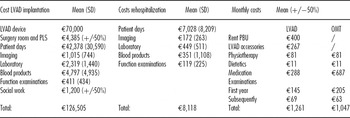
Costs for LVAD implantation were measured from the day of implantation up to the day of hospital discharge. Costs generated before LVAD implantation were conservatively not interpreted as incremental costs, because most of these costs are also generated in the OMT group (e.g., to determine the status of the patient). Costs per repeat hospitalization were included in the model. These costs were based on real-world cost data from the identified repeat hospitalizations (N = 69) in our real-world sample, excluding hospitalizations for LVAD replacements (N = 3) and explantation (N = 3). An overview of these costs is provided in Table 2.
Costs for LVAD implantation, repeat hospitalizations, and monthly (follow-up) costs

Note. Details for these cost categories are available in the supplementary data.
LVAD, left ventricular assist devices; OMT, optimal medical therapy; PBU, power base unit; PLS, permanent life support.
Sensitivity and Scenario Analyses
We performed one-way and probabilistic sensitivity analyses. The following one-way sensitivity analyses were performed to handle methodological uncertainty and check the robustness of results for changes in the most uncertain parameters and for possible future LVAD price changes: a 3 percent discount rate for both costs and effects to apply equal discounting; different extrapolation scenarios: not to increase the monthly mortality risk, increase the monthly risk with the absolute increase in risk of dying for the age and gender-adjusted Dutch population to reflect ageing (base case), or doing this applying the relative increase in risk of dying; 0 percent, 20 percent (base case), and 40 percent more hospitalizations per patient-year in the OMT group; service life of 3 or 5 years (base case 4 years); QoL 0.15 lower than in the base case in both the LVAD and OMT group, that is, 0.66 and 0.4, respectively; and lowering the cost of the LVAD device to €50,000 (base case €70,000). Results of the one-way sensitivity analyses are shown on a tornado chart. Details for more scenario analyses are available in the HTA report (Reference Neyt, Smit, Van den Bruel and Vlayen1).
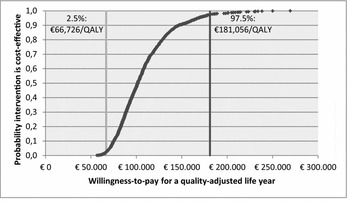
All stochastic variables were modeled probabilistically. Transition probabilities and utilities were modeled as beta distributions and cost variables as gamma distributions (see Supplementary Table 1 and Table 2, which can be viewed online at www.journals.cambridge.org/thc2013107 and www.journals.cambridge.org/thc2013108). Beta distribution are typically used for variables restricted to the 0–1 interval and gamma distributions for right-skewed (cost) distributions. Variables for which information was scarce were modeled as uniform distributions with a wide confidence interval (±50 percent). Results of the probabilistic model are shown on the cost-effectiveness plane and cost-effectiveness acceptability curve, which shows the probability an intervention is cost-effective (y-axis) depending on the willingness to pay for a quality-adjusted life-year (QALY) (x-axis).
RESULTS
The cost of an LVAD implant was approximately €126,000, of which the device itself represented the largest cost (€70,000), followed by the cost of inpatient days (including intensive care) being on average €42,400 (Table 2).
Based on the lifetime model, the (undiscounted) life expectancy was 0.82 years (95 percent CI, 0.66–0.99) and 4.33 years (95 percent CI, 3.17–5.71) for the OMT and LVAD group, respectively. This reflects that these patients have a high mortality risk and a substantial improvement in life expectancy after LVAD implant. The discounted incremental effect is 3.23 (95 percent CI, 2.18–4.49) life-years gained (LYG) or 2.83 (95 percent CI, 1.91–3.90) QALYs. Combined with a discounted incremental cost of approximately €299,100 (95 percent CI, 190,500–521,000), this results in an incremental cost-effectiveness ratio of €94,100 (95 percent CI, 59,100–160,100) per LYG or €107,600 (95 percent CI, 66,700–181,100) per QALY. The latter results are presented on the cost-effectiveness plane (Supplementary Figure 1, which can be viewed online at www.journals.cambridge.org/thc2013109). The cost-effectiveness acceptability curve (Figure 2) shows that there is no chance for this intervention to be cost effective under a willingness to pay €56,000 per QALY. LVAD as destination therapy has only 16 percent chance to be cost-effective if the willingness to pay increases to approximately €80,000 per QALY.
The cost-effectiveness acceptability curve. QALY, quality-adjusted life-year.

The scenario analyses show that in most cases, the ICER remains above €100,000 per QALY (Supplementary Figure 2, which can be viewed online at www.journals.cambridge.org/thc2013110). The ICER is approximately €120,000 per QALY when QoL would be lower, LVAD service life is 3 years, or if the discount rate would be 3 percent. A (drastic) drop in the cost of LVAD implantation and/or extending the LVAD's service life is necessary to lower the ICER. The high ICERs are not only due to the implantation cost but also to the costs for repeat hospitalizations and follow-up costs.
DISCUSSION
Treatment with the continuous-flow HeartMate II results in a significantly better survival and quality of life in comparison with optimal medical treatment (Reference Slaughter, Rogers and Milano3). However, the implementation costs and costs for repeat hospitalizations and follow-up are high, leading to an ICER of €94,100 (95 percent CI, 59,100–160,100) per LYG or €107,600 (95 percent CI, 66,700–181,100) per QALY gained.
Very detailed financial Dutch hospital data were at our disposal. This enabled us to perform a detailed cost calculation of LVAD implantation. These cost data are based on the implantation of a continuous-flow LVAD as bridging therapy. No data for destination therapy were available at the moment of the evaluation. Although the patients in the Dutch sample were much younger (on average 44 years) than the patients in the two RCTs, the 30-day mortality was similar as in other studies (see before, 10.1 versus 10.3 percent). Nevertheless, based on expert opinion, it is expected that the implantation cost of the same device will very probably be similar for bridging and destination therapy. Therefore, the real-world cost data for our sixty-nine patients were considered to be the best available and reliable data. Furthermore, it should be stressed that the real-world sample of patients is only used for cost information, while the treatment effect is based on the RCT results. As such, the strengths of both RCT and observational data are combined in this economic evaluation.
There were no data available to reliably estimate the use of home care, doctor visits, costs of antibiotic treatment at home, time costs of informal care providers, or productivity costs for patients with an LVAD as destination therapy. In older patients, the potential positive impact of LVAD implantation on productivity will be small, but especially in younger patients this has to be taken into consideration. In general, it is likely that taking into account all these cost categories in the analysis would further increase the incremental costs, and thus the ICER.
A limitation of the present study was that no direct head-to-head trial has been performed between OMT and a continuous-flow LVAD, and therefore an indirect comparison based on the two published RCTs was necessary. The treatment arms receiving the pulsatile-flow LVAD showed very similar outcomes in both trials and allowed such an indirect comparison. Based on expert opinion, optimal medical therapy has not changed much between the time of the REMATCH trial and the more recent HeartMate II trial. If the medical therapy would have improved significantly during the last years, than this would have further deteriorated the LVAD's cost effectiveness.
Almost no data on utilities are available for LVAD implantation. In contrast to disease-specific instruments, utility instruments are not commonly used in RCTs. The only study that tried to measure QoL has major weaknesses. It dates from 1997, included only a small group of patients (N = 29) with an LVAD as bridging therapy, and could not measure QoL in the most debilitated patients (i.e. informative missing values). The results were also relatively positive, especially because QoL was measured during hospitalization. This may be due to the “honeymoon period” effect (Reference Moskowitz, Weinberg, Oz and Williams8): the patient overestimates his QoL because he is still conscious of his bad situation before surgery, he is happy that he survived the procedure and does not yet fully realize the limitations and consequences of living with an LVAD. The assumption of a constant utility value in the long-term extrapolation is also optimistic. Changing this assumption would further deteriorate the already relatively unfavorable cost-effectiveness outcomes for continuous-flow LVADs.
The NYHA class is a subjective measure which is very often used in clinical trials to evaluate symptoms in heart failure patients. The NYHA class is often translated in economic evaluations to QoL. This indirect approach is subject to major weaknesses. A literature survey showed that 99 percent of research papers do not reference or describe their methods for assigning NYHA classes and an inter-operator comparison on NYHA class II and III patients gave a result that was little better than chance (Reference Raphael, Briscoe and Davies10;Reference Spertus11). Furthermore, QoL is very dependent on co-morbidities and similar changes in NYHA class may result in very different changes in QoL depending on the presence of these co-morbidities (Reference Van Brabandt, Camberlin and Neyt12). In general, it is preferable to measure QoL with a generic utility instrument, such as the EQ-5D. Such a generic utility instrument should be included in the RCTs, in addition to the disease-specific instruments to provide robust input for both treatment groups in economic evaluations.
We performed a systematic literature search for economic evaluations (Reference Neyt, Smit, Van den Bruel and Vlayen1) by visiting the Web sites of International Network of Agencies for Health Technology Assessment (INAHTA) members, the Cochrane Library Health Technology Assessment Database and NHS Economic Evaluation Database, Medline, and Embase (January 2011). However, identified studies (Reference Adang, Groenewoud, van Hees, Krabbe and van der Wilt13–Reference Messori, Trippoli, Bonacchi and Sani16) date from before the publication of the Heart Mate II Destination Therapy Trial and thus could not include RCT evidence on pulsatile-flow LVADs in their evaluation. Nevertheless, all previous economic evaluations indicated that with prices and longevity of LVADs at that time, it was very unlikely that the intervention was cost effective. Costs of the initial intervention in these older studies were comparable with our own cost calculations and no price reductions of the LVAD devices were noticed. In January 2012, an economic evaluation of the HM-II LVAD was published (Reference Rogers, Bostic, Tong, Adamson, Russo and Slaughter17). Applying a 5-year time horizon, the ICER of the continuous-flow device was $198,184 per QALY gained and $167,208 per LYG. The authors concluded that the cost-effectiveness associated with the continuous-flow LVADs for destination therapy has improved significantly relative to the pulsatile-flow devices, which had an ICER of $802,700 per QALY. The authors anticipate that continued refinement of patient selection criteria, technological advances, and improvements in management strategies will converge and result in the demonstration of LVADs as an economically effective treatment option for patients with advanced heart failure (Reference Rogers, Bostic, Tong, Adamson, Russo and Slaughter17). Nevertheless, based on current evidence, both studies show this is at present not yet the case and thus continuous-flow LVADs may not be considered cost-effective.
In conclusion, previous studies indicate that treatment with continuous-flow HeartMate II results in a significantly better survival and quality of life in comparison with optimal medical treatment. Despite these significant improvements, LVAD implantation as destination therapy remains a relatively expensive intervention.
Policy Implications
From an efficiency point of view, based on currently available evidence and costs, reimbursement of LVAD implantation as destination therapy is very questionable. These results remain up-to-date until new evidence with significantly better outcomes for mortality, QoL, side effects and/or costs are presented.
Newer LVADs may become smaller and require less energy, which may have a positive influence on the durability and mobility of the battery. Technical improvements may also result in a lower risk of adverse events such as infections, bleeding, and neurological events (Reference Kirkels, De Jonge and Lahpor18). Further research should also try to capture the impact of LVAD implantation on QoL. Applying a generic utility instrument, in addition to disease-specific instruments, should be encouraged. This research should be performed in appropriate research settings, preferably an RCT, and try to avoid undue financial burden on patients, hospitals or the general healthcare system.
This possible future RCTs should consider whether to compare different types of LVADs (like the HeartMate II Destination Therapy Trial) or compare the best LVAD with OMT. Some stakeholders may consider it unethical not to provide LVAD therapy to both treatment groups. However, LVADs are currently not considered cost-effective nor reimbursed for destination therapy. Furthermore, comparing OMT with the best performing LVAD would cost less and/or enable to set up a larger trial with the same investment due to the high investment cost with LVADs. And finally, this trial would also reflect possible improvements in OMT (if any) and provide a direct comparison of OMT and LVAD therapy. In combination with a measurement of QoL in both treatment groups with a generic utility instrument, this would enable to calculate the incremental gain in quality-adjusted life-years.
SUPPLEMENTARY MATERIAL
Supplementary Table 1: www.journals.cambridge.org/thc2013107
Supplementary Table 2: www.journals.cambridge.org/thc2013108
Supplementary Figure 1: www.journals.cambridge.org/thc2013109
Supplementary Figure 2: www.journals.cambridge.org/thc2013110
CONTACT INFORMATION
Mattias Neyt, MSc, PhD (mattias.neyt@me-ta.eu), Ann Van den Bruel, MD, PhD, ME-TA, Medical Evaluation and Technology Assessment, Belgium
Yolba Smit, MD, Independent researcher, The Netherlands
Nicolaas De Jonge, MD, Department of Cardiology, University Medical Centre Utrecht, The Netherlands
Michiel Erasmus, MD, Department of Cardiothoracic Surgery, University Medical Centre Groningen, The Netherlands
Diederik Van Dijk, MD, PhD, Department of Anesthesiology and Intensive Care, University Medical Centre Utrecht, The Netherlands
Joan Vlayen, MD, ME-TA, Medical Evaluation and Technology Assessment, Belgium
CONFLICTS OF INTEREST
This work was supported by the Dutch Health Care Insurance Board (CVZ, College voor zorgverzekeringen) with project number 660/012/2010 to Mattias Neyt, Ann Van den Bruel, Yolba Smit, and Joan Vlayen. Michiel Erasmus has received consulting fees and support for travel from unspecified sources. The other authors report they have no potential conflicts of interest.