Introduction
Whiteflies in the Bemisia tabaci (Gennadius) (Hemiptera: Aleyrodidae) complex are important global agricultural pests. This insect is very adaptive and feeds on over 1000 species of plants (Abd-Rabou and Simmons, Reference Abd-Rabou and Simmons2010). It also transmits over 100 plant viruses (Jones, Reference Jones2003). The important B. tabaci-transmitted viruses in vegetable crops include Cucumber vein yellowing virus (CVYV), Squash leaf curl virus (SqLCV) and Tomato yellow leaf curl virus (TYLCV). TYLCV (family Geminiviridae; genus Begomovirus) is a serious virus of tomato (Solanum lycopersicum L.), and has been a problem in Egypt for several decades (Mazyad et al., Reference Mazyad, Omar, Al-Taher and Salha1979). SqLCV, also a Begomovirus, is a New World problem in cucurbits, but it has more recently spread to, and became problematic in, Egypt and other Middle Eastern countries (Farag et al., Reference Farag, Amer, Amin and Mayzad2005; Al-Musa et al., Reference Al-Musa, Anfoka, Misbeh, Abhary and Ahmad2008). Cucurbit crops displaying the symptoms of SqLCV have low yield, and this is an emerging problem in Egypt (Farag et al., Reference Farag, Amer, Amin and Mayzad2005). CVYV (family Potyviridae; genus Ipomovirus) is pervasive in cucumbers (Cucumis sativus L.) in Egypt and other Middle Eastern countries (Mansour and Al-Musa, Reference Mansour and Al-Musa1993). These viruses, coupled with direct feeding from whiteflies, pose ongoing problems to vegetable growers in Egypt and elsewhere. The B and Q biotypes of B. tabaci (Middle East-Asia Minor 1 and Mediterranean, respectively [Dinsdale et al., Reference Dinsdale, Cook, Riginos, Buckley and De Barro2010]) attack crops in fields in Egypt (Abd-Rabou, Reference Abd-Rabou1999).
Insecticides are commonly used to manage whiteflies and associated whitefly-transmitted viruses (Bacci et al., Reference Bacci, Crespo, Galvan, Pereira, Picanço, Silva and Chediak2007). Conventional and biorational insecticides can vary in their impact on target pests as well as effects on natural enemies in cropping systems (Desneux et al., Reference Desneux, Decourtye and Delpuech2007; Simmons and Abd-Rabou, Reference Simmons and Abd-Rabou2011). The objective of this research was to determine the relative efficacy of some biorational insecticides on infestations of B. tabaci and incidence of some whitefly-transmitted viruses in seedling and mature stage plants of the selected crops in Egypt.
Materials and methods
Three experiments were conducted in grower fields in Egypt in 2010. The experiments consisted of foliar insecticidal sprays of seedling stage crops, foliar sprays of mature plants and insecticide-treated seeds. All insecticides were consistent in the two foliar experiments. Only one insecticide from the foliar experiments was used in the seed-treated experiment. All seven crops were represented in each experiment.
Foliar application on seedling stage crops
An experiment was conducted using foliar sprays of four insecticides in six vegetable and one row crop at the seedling stage. A relatively low whitefly infestation was expected. The crops were green beans (Phaseolus vulgaris L., ‘Bronco’), cucumber (‘Madina’), eggplant (Solanum melongena L., ‘Baladi’), potato (Solanum tuberosum L., ‘Spunta’), squash (Cucurbita pepo L., ‘Iskandarani’), sugar beet (Beta vulgaris L., ‘Monte Bianco’) and tomato (‘Baladi’), which were grown in Minufiya, Qalyubiya, Giza, Behira, Daqhlyia, Kafr el Sheikh and Fayoum Governorates, respectively. Local standard field preparation was done. Three biorational insecticides were used: Actara 25% WG (thiamethoxam, a neonicotinoid; Sygneta Crop Protection, Basel, Switzerland), Biofly (a formulation of the fungus Beauveria bassiana (Balsamo) Vuillemin, 30 × 606 cells/ml; BIOTECH Company, Cairo, Egypt) and Neemix® (1% azadirachtin; Tagros Chemicals (India) Limited, Chennai, India). A conventional insecticide used in this study was Actellic 50% EC (pirimiphos-methyl; Syngenta Crop Protection AG), which was used as a treated check. An untreated check of no spray was also used. Plots were 0.13 ha for each treatment and untreated check. Sprayings were done at the rates of 0.5, 1.0 and 1.5 m/l of water for each insecticide, and was accomplished by the use of a knapsack sprayer with Cp-20 of 20-litre capacity. The sprayer had a TX-6 hollow-cone nozzle and the spray (61.5 litres/ha) was dispensed at a pressure of three bars. Pre-spray counts of adult and nymphal whiteflies were made just before spraying. No pre-spray virus assessment was done. Post-spray counts of B. tabaci and incidence of plants infected with whitefly-transmitted viruses were made 7, 14 and 21 days after the application. However, no virus assessment was done in sugar beet, a crop that has no known whitefly-transmitted virus problem in Egypt. (Sugar beet was included to obtain additional information on the response of the whiteflies to the insecticide treatments.) Adult whitefly counts were made after gently turning over leaves selected for a leaf sample from the middle section of each randomly sampled plant. The percentage of healthy and infected plants in each sample was calculated based on the percentage of sample leaves (one leaf per plant) that appeared to be infected with CVYV in cucumber, SqLCV in squash and TYLCV in tomato, eggplant, potato and green bean. Random samples of 80 whitefly-infested leaves were examined from each plot. Bemisia tabaci nymphs were counted with the aid of a stereoscopic microscope. Data were analysed using the SAS computations (SAS Institute, 2010). Significant differences were determined at P< 0.05. Data were pooled across insecticide rates because no significant rate effect was detected within either treatment for a given crop; each 80-leaf sample was represented three times. Data for each whitefly stage and virus incidence were subjected to analysis of variance, and the Student–Newman–Keuls test was used to compare among insecticide treatments within a given crop. The percent reduction in whitefly infestation was calculated according to the equation of Henderson and Tilton (Reference Henderson and Tilton1955):
 $$\%\,Control = 100\times (1 - ((Ta\times Cb)/(Tb\times Ca))), $$
where Ta = post-treatment insect counts, Cb = untreated insect count before treatment, Tb = pre-treatment counts, and Ca = untreated insect count after treatment. Percentage data were transformed using arcsine transformation before the analysis, but the results are presented on back-transformed data.
Foliar application on mature stage plants
An experiment with foliar insecticides on mature stage plants was carried out using the same four insecticides and at the same rates, and same crops and sites as in the above-mentioned seedling experiment. Relatively high populations of B. tabaci were expected, as is common in Egypt on the mature crops during September and October (Abd-Rabou and Simmons, Reference Abd-Rabou and Simmons2010). Each treatment was conducted in 0.13 ha, and foliar spraying and data collection and analyses were done as described above.
Seed treated systemic insecticides
An experiment was carried out to evaluate three systemic insecticide seed treatments against B. tabaci and whitefly-transmitted viruses in seedlings of the seven crops and sites as mentioned in the foliar experiments. Relatively low whitefly infestation was expected. The insecticides were Aldicarb WS (a carbamate; Bayer CropScience, Monheim am Rhein, Germany), Actara, and Gaucho WS (imidacloprid, a neonicotinoid; Bayer CropScience) at the rates of 50, 100 and 150 g/100 kg seeds. Each treatment was conducted in a 0.13 ha plot, and an untreated check of the same size plot was also used; 11 to 15 days after planting, sampling as described in the foliar experiments was done weekly for three weeks to assess the population of B. tabaci and incidence in whitefly-transmitted viruses. Sampling, whitefly counts and data analyses were done as described in the foliar experiments, except there was no pre-treatment of sampling.
Results
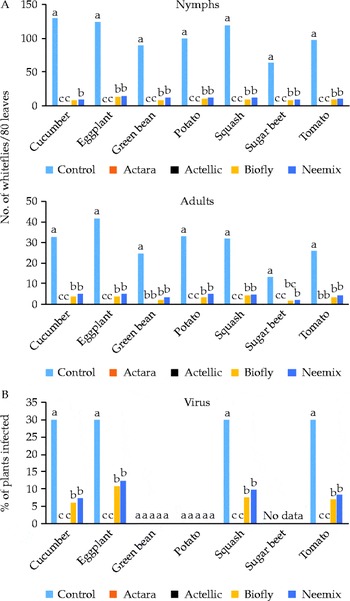
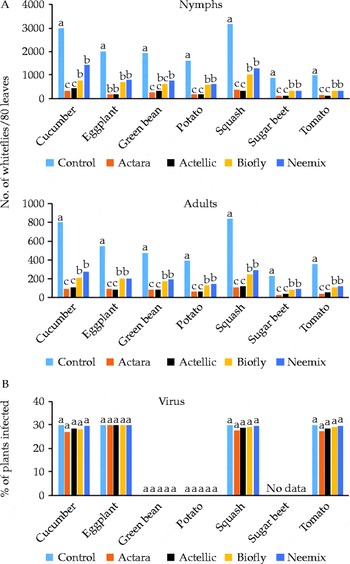
Relatively low and high natural whitefly populations were obtained in the experiments. Overall counts of whitefly nymphs were highly correlated with counts of the adults (r= 0.98; P< 0.0001). Whitefly counts in the untreated plots were relatively low in the foliar seedling experiment (averages among crops ranged from 45 to 116 nymphs and 6 to 37 adults per 80 leaves; Fig. 1) as compared with mature crops (averages among crops ranged from 835 to 3111 nymphs and 219 to 824 adults per 80 leaves; Fig. 2). All the insecticide treatments significantly affected whitefly counts in both foliar experiments (Figs 1 and 2) as well as the seed-treatment experiment. In the foliar experiment on seedlings, Actara and Actellic resulted in 100% suppression of both adults and nymphs in each plot, while Biofly and Neemix resulted in significantly less (83–94%) suppression in each plot. Similarly, suppressions of whitefly nymphs and adults in the foliar experiment on mature crops were significantly greater (83–91%) in plots treated with Actara or Actellic as compared with most plots treated with Biofly or Neemix (60–75% suppression). Whitefly counts for untreated plots in the seed-treatment experiment were similar (averages among crops were 45–90 nymphs and 6–21 adults per 80 leaves) to the experiment on foliar treatment of seedlings (Fig. 1), and insecticide treatments resulted in less than five nymphs or adults per 80 leaves in the former experiment.
(A) Whitefly (Bemisia tabaci) populations of nymphs and adults (B) and incidences of plants displaying symptoms of whitefly-transmitted viruses three weeks after foliar treatments of seedlings with selected insecticides in field plots of seven crops. Mean bars within a crop and with different letters are significantly different (P< 0.05) according to Student–Newman–Keuls test.

(A) Whitefly (Bemisia tabaci) populations of nymphs and adults and (B) incidences of plants displaying symptoms of whitefly-transmitted viruses three weeks after foliar treatments of mature plants with selected insecticides in field plots of six crops. Mean bars within a crop and with different letters are significantly different (P< 0.05) according to Student–Newman–Keuls test.

In crops where virus symptoms were observed, incidences of viruses were moderate, averaging about 25–35% infection for plants in the control plots (Figs 1 and 2). No whitefly-transmitted viruses were observed in the plots of green bean and potato regardless of whether they were treated or untreated. In the other crops of the foliar seedling experiment, low incidences of viruses were observed in plots treated with Biofly or Neemix, while no virus symptoms were observed in plots treated with Actara or Actellic (Fig. 1). No effect was observed for any insecticide on incidence of whitefly-transmitted viruses in either crop in the experiment on mature foliar plants (Fig. 2). In the experiment with the insecticide-treated seeds, displays of virus infections were low (0–5%) as compared with about 30% in the untreated plots.
Discussion
Three of four biorational insecticides were evaluated under both high and low levels of whitefly infestations. All of the insecticides were effective in suppressing the populations of whiteflies, regardless of crop or experiment. In the seedlings, the suppressed populations apparently resulted in a delay in infection by the whitefly-transmitted viruses. In contrast, there was no relief on virus infection in the mature plants because the plants were apparently infected before being treated. No attempt was made to isolate virus or complex of viruses in the crops. Because the incidences of the viruses were not based on molecular confirmation, there was probably an underestimation of infection and there may have been a mixture of viruses. Although other pests such as aphids can transmit viruses and be impacted by the insecticides in this study, aphids were not common in the crops during this study. Whiteflies (B. tabaci) were the most abundant foliage pests in the crops. Because the different crops were located in different locations, the study was not set up to compare whitefly populations among crops or among locations. Moreover, because counts were per leaf and leaf size varies among crops, direct population comparisons are not possible. However, the trends of effects of the biorational insecticides were consistent among the crops and their efficacies were similar to the impact of the conventional insecticides.
Factors such as climate, pest complex, plant-disease complex, potential for pest resistance, size of crops, local regulations, economics and environmental concerns must be considered in the development of integrated pest management strategies. Actellic and Aldicarb were used in this study as the conventional insecticides from two classes (organophosphate and carbamate, respectively). In 2010, the US Environmental Protection Agency and the manufacturer of Aldicarb reached an agreement to terminate all use of this pesticide in the US because of food safety concerns (EPA, 2010). The future status of Aldicarb around the globe remains to be seen. Similarly, neonicotinoids may be more regulated in the future because of concerns about some unintended effects, although neonicotinoids are commonly used globally for whitefly management. Because all insecticides in this study had similar impacts on the whitefly populations and on incidences of the selected whitefly transmitted viruses, this suggests that all of the analysed biorational insecticides may be considered as a tool in a whitefly management strategy in some vegetable productions in Egypt. This study also supports the value of early timing for the dual benefits of suppression strategies against B. tabaci to help with problems from whitefly-transmitted viruses.
Acknowledgements
The authors thank Amnon Levi and Rugang Li for helpful suggestions on the manuscript. This publication is sponsored by the U.S. – Egyptian Science and Technology Joint Fund (STDF) in co-operation with the USDA and Egyptian Ministry of Agriculture under Project Number 3732. This article reports only the results of research. The mention of a proprietary product does not constitute an endorsement or a recommendation for its use by USDA.