Implications
Rumination activity has been suggested as an indicator of overall cow health. Devices measuring rumination are now available and have been successfully validated, indicating a strong correlation between visual observations and data reported by this technology (Schirmann et al., Reference Schirmann, Chapinal, Weary, Vickers and Von Keyserlingk2009). Therefore, our objective was to evaluate the association between changes in rumination time and early stages of disease and to assess the performance of two proposed disease detection indices. Consistent reductions in rumination activity, both within cow and relative to healthy mate cohorts, were observed for each health disorder at the day of diagnosis. Although the ability of the proposed algorithms for detecting each specific disease was variable, the use of technology on disease monitoring is promising.
Introduction
Early detection of disease, leading to a prompt intervention is key to successful health programs in dairy operations, as timely identification and treatment can help prevent animal suffering, extended therapy costs and milk yield reductions associated with severe disease (LeBlanc et al., Reference LeBlanc, Lissemore, Kelton, Duffield and Leslie2006).
In large confinement dairy systems, fresh cows are commonly housed in pens where surveillance and treatment are facilitated. Screening includes visual observation for general brightness, alertness and appetite, and the use of daily milk weights when available. Assessment of body temperature and palpation per rectum for detection of metritis are also common practices (Guterbock, Reference Guterbock2004). However, a recent survey on fresh cow-handling practices in California dairies (Espadamala et al., Reference Espadamala, Pallares, Lago and Silva-Del-Rio2016) evidenced limited consistency across dairies regarding fresh cow-screening practices. Signs of health disorders of interest and the intensity of how those signs were evaluated were variable and most techniques were based on non-specific and subjective observations. In addition, restrictions on labor available per cow associated with increased dairy herd sizes in North America (Barkema et al., Reference Barkema, Von Keyserlingk, Kastelic, Lam, Luby, Roy, LeBlanc, Keefe and Kelton2015) have become a challenge for systematic checking of animals at risk of disease on a regular basis.
Sensor systems measuring cow physiological, behavioral and production parameters are currently in use in commercial dairies allowing for automated detection of specific events, such as estrus and health disorders (Steeneveld et al., Reference Steeneveld, Vernooij and Hogeveen2015). In the case of estrus detection, an improvement from 55% to 80% in heat detection rate has been reported when visual detection methods are replaced by automated systems (Firk et al., Reference Firk, Stamer, Junge and Krieter2002; Kamphuis et al., Reference Kamphuis, DelaRue, Burke and Jago2012; Steeneveld et al., Reference Steeneveld, Vernooij and Hogeveen2015).
Rumination activity has been suggested as an indicator of rumen condition, cow comfort and overall health (Hansen et al., Reference Hansen, Nørgaard, Pedersen, Jørgensen, Mellau and Enemark2003; Herskin et al., Reference Herskin, Munksgaard and Ladewig2004; Krause and Oetzel, Reference Krause and Oetzel2006). Indirect methods for assessment of rumination have been proposed due to labor intensive and inaccurate measurements derived from visual observation. Devices measuring rumination by differentiating specific movements and sounds are now available and have been successfully validated (Kononoff et al., Reference Kononoff, Lehman and Heinrichs2002; Braun et al., Reference Braun, Tschoner, Nydegger and Hässig2013), resulting in automated continuous monitoring of rumination in cattle. The rumination monitoring system used in this study has been tested in dairy cows (Schirmann et al., Reference Schirmann, Chapinal, Weary, Vickers and Von Keyserlingk2009). Associations between rumination behavior and calving events, as well as peripartum metabolic status and disease, have been reported, evidencing variable magnitudes in the change in rumination activity at the time of disease (Schirmann et al., Reference Schirmann, Chapinal, Weary, Vickers and Von Keyserlingk2009; Liboreiro et al., Reference Liboreiro, Machado, Silva, Maturana, Nishimura, Brandão, Endres and Chebel2015; Stangaferro et al., Reference Stangaferro, Wijma, Caixeta, Al-Abri and Giordano2016a, Reference Stangaferro, Wijma, Caixeta, Al-Abri and Giordano2016b and Reference Stangaferro, Wijma, Caixeta, Al-Abri and Giordano2016c). Consequently, evaluating the potential application of measurable changes in rumination as early alert tools for disease is of benefit.
Here we investigated the dynamics of rumination within the peripartum period and early lactation in cohorts of cows that were closely monitored for disease. Our hypothesis was that daily rumination time is decreased when health disorders occur and the magnitude of the changes is large enough to be detected by use of mathematical algorithms. Therefore, our objective was to evaluate the association between changes in daily rumination time (dRT) and early stages of specific diseases within the postpartum and early lactation. In addition, the performance of two proposed indices based on changes in dRT, used as alerts for disease detection, was evaluated.
Material and methods
Animals and animal housing
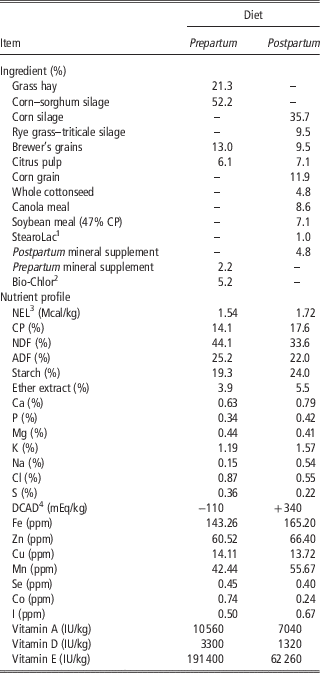
This study was conducted at the University of Florida Dairy Unit (Gainesville, FL, USA) with the approval of the Institutional Animal Care and Use Committee. The study population consisted of 210 multiparous Holstein cows enrolled at 21 day before estimated due date from November 2013 to August 2014. The Dairy Unit milks ~500 Holstein cows twice daily, with a rolling herd average of 10 000 kg/cow. Details on animals and management procedures are provided in a previous report (Paudyal et al., Reference Paudyal, Maunsell, Richeson, Risco, Donovan and Pinedo2016). In brief, dry cows were moved from a far-off dry period pen to a prepartum pen 21 to 28 days before expected calving. Prepartum housing consisted of a tunnel ventilated sand bedding barn with sprinklers over the feed bunk. The diet fed during the prepartum study period is provided in Table 1. Feed was delivered once a day at ~0830 h and was pushed up four times a day between feedings. Cows were moved out of the prepartum pen within 3 h after calving and housed in a hospital barn from day 0 to 2 postpartum. Cows in the hospital were fed the postpartum total mixed ration. At 3 days postpartum, healthy cows were moved to the main lactating herd and kept in 2-row sand-bedded freestall barns equipped with head locks. Freestall barns were equipped with fans with misters and sprinklers over the feed bunk. Stocking density in the freestall barns that housed early lactation cows ranged from 80% to 92%.
Ingredient and nutrient composition of prepartum and postpartum diets (dry matter (DM) basis)

NEL=net energy of lactation; DCAD=dietary cation anion difference.
1 StereoLac energy supplement contains hydrolyzed vegetable oil (Energy Feeds International, San Leandro, CA, USA).
2 Bio-ChlorTM (Arm & Hammer Animal Nutrition, Princeton, NJ, USA) contains the following (DM basis): 48.6% CP, 13.5% starch, 2.07% Mg, 1.22% K, 1.49% Na, 3.60% S and 9.09% Cl.
3 Calculated at 11 and 19 kg of DM/day for the prepartum and postpartum diets.
4 Area under the curve from the receiver operating characteristic analysis.
Lactating cows were fed a postpartum total mixed ration (Table 1) formulated to meet or exceed the requirements of lactating cows weighing ~680 kg and producing 45 kg of 3.5% fat corrected milk (n 3.0.8.1) as recommended by the National Research Council (NRC, 2001). Feed was delivered twice a day at approximately 0600 and 1500 h and feed was ‘pushed up’ twice a day between each feeding. Cows were milked twice daily at 0600 and 1800 h and individual milk yield was automatically recorded at each milking (AfiFarm Program, SAE Kibbutz Afikim, Israel). Fresh potable water was available to all cows.
Experimental procedures
Health monitoring
Cows’ health was monitored by the University of Florida veterinarians and trained farm staff. Prepartum cows were observed daily by trained farm staff for any indication of clinical disease. Calving-related events such as dystocia and twins were recorded by farm personnel. According to the farm standard operating procedures, all cows went through a routine postpartum health evaluation at days 4, 7 and 12 after calving. This evaluation was performed immediately after the morning milking and included assessment of attitude (stance/posture, how the cow holds her head, and alertness), rectal temperature, rectal palpation and examination of vaginal discharge, udder inspection, assessment of urine ketone bodies (Ketostix, Bayer Corporation, Elkhart, IN, USA) and investigation of displacement of the abomasum. In addition, automatic health reports were created for every milking event based on individual milk production and milk component levels provided by the AfiFarm system. Cows with deviations from pre-established ranges on at least two parameters (20% deviation between predicted v. actual milk yield and milk components) within two consecutive milkings were automatically sorted for a complete health examination. Specific health disorders considered in our analyses included mastitis, metritis, clinical hypocalcemia, depression/dehydration/fever (DDF), digestive conditions, lameness and clinical ketosis, and were assessed until 60 days in milk (DIM). The definite diagnosis for the diseases in study was made by University of Florida veterinarians or trained farm personnel based on the Dairy Unit standard operating procedure definitions developed at the University of Florida College of Veterinary Medicine. In brief, these disorders were defined as follows: Mastitis, presence of significant flakes and clumps in milk – udder quarter may be hot, swollen, hard and painful with watery or serous secretion; metritis, cow presenting watery, fetid or non-fetid vaginal discharge that is dark red to brown in color within 21 DIM; clinical hypocalcemia, down cow or cow unsteady before calving to 1 or 2 days after calving with no other abnormal physical exam findings (especially mastitis or metritis) – head may be turned into the flank or may be extended, ears are cold and the nose is dry; DDF, dehydration was defined as sunken eyes, dry hair coat and skin tent that remained >2 s. Cows were considered depressed if activity, responsiveness and appetite were reduced. Fever was defined as rectal temperature >39.5°C; digestive conditions included indigestion and diarrhea; lameness, presence of arched back or favoring one leg or abnormal gait; and clinical ketosis, negative milk deviation, off milk, licking pipes, unsteady, nervous attitude, strong positive in the urinalysis (Ketostix, Bayer Corporation Elkhart, IN, USA). Cows were considered under the category sick (DZ) at the time of diagnosis if any of the previous disorders was diagnosed.
Recording of rumination and activity data
Approximately 21 days before predicted calving date, cows were enrolled in the study and affixed with a neck collar containing rumination loggers (SCR Engineers Ltd, Netanya, Israel) that have been previously described and validated (Schirmann et al., Reference Schirmann, Chapinal, Weary, Vickers and Von Keyserlingk2009). Data were continuously captured by two antennas and downloaded daily into a central computer. Rumination was recorded in minutes per 2-h intervals and total dRT was calculated for statistical analyses.
Predictive models and statistical analysis
During this observational cohort study two indices were developed to explore the association between dRT and disease events considering specific and overall disease: (i) Cow index (CIx) based on changes in dRT occurring in the affected cow at the day of disease diagnosis, relative to the previous days; and (ii) Mates index (MIx) based on deviations in dRT in the affected cow relative to healthy pen mates. As dRT around parturition is normally reduced (Schirmann et al., Reference Schirmann, von Keyserlingk, Weary, Veira and Heuwieser2013; Büchel and Sundrum, Reference Büchel and Sundrum2014; Pahl et al., Reference Pahl, Hartung, Grothmann, Mahlkow-Nerge and Haeussermann2014), if disease occurred ⩽10 DIM, CIx was calculated as the difference between dRT on the day of diagnosis (d0) and dRT at the day of calving (cRT) in the affected cow (d0 v. cRT) divided by the average (d0 v. cRT) in the population of healthy animals. This value provided an estimation of the rate of recovery from reduced dRT at calving to normal dRT levels. For disease events occurring >10 DIM, CIx was calculated as the difference in dRT on d0 minus the average dRT during −3 day to −5 day relative to d0 (avg −3 to −5 days), divided by avg −3 to −5 days. Therefore, CIx=(d0RT−avg −3 to −5 days)/(avg −3 to −5 days). The time of occurrence of a disease event was set at the time of diagnosis by the attending veterinarian or the farm personnel.
Mates index was calculated as the difference between the affected cow and healthy pen mates for the value (d0RT−avg −3 to −5 days) divided by d0RT in healthy pen mates. Therefore, MIx=[(affected cow d0RT−avg −3 to −5 days)−(pen mates d0RT−avg −3 to −5 days)]/pen mates d0RT. To account for the effect of calving when cows were diagnosed within 10 DIM, the MIx was multiplied by the correction factor [d0RT/(avg −3 to −5 days)] from healthy cows.
Subsequently, binary alerts for diagnostic were tested based on multiple CIx and MIx indices (ACIx and AMIx) values. Cut-off values were evaluated by use of receiver operating characteristic (ROC) curves generated with the LOGISTIC procedure of SAS (Version 9.4; SAS Institute Inc., Cary, NC, USA). An ROC curve is a graphical method to determine the performance of a diagnostic test and represents a plot of the sensitivity of a test versus the false positive rate (1 – specificity) computed for various cut-off points to select the optimum point for distinguishing between affected and non-affected individuals. The area under the curve (AUC) is a global summary statistic of diagnostic accuracy and is equivalent to the probability that a randomly selected individual with a positive status has a greater test value than a randomly selected individual with a negative status (Greiner et al., Reference Greiner, Pfeiffer and Smith2000). The thresholds were evaluated by observing the combined values for specificity and sensitivity. As a result, a reference cut-off value for the alerts was calculated as the average difference between index values in healthy mates and affected cows at the same lactation period (dry period; 1 to 10 DIM; and >10 DIM). An ACIx indicating a positive disease event was determined when the difference between healthy mates’ average CIx and the affected cow’s CIx was greater than the reference cut-off value. The AMIx was determined as 1 when the difference for MIx between healthy mates and the affected cow was greater than the average overall index difference. A combined alert (CmbA) was created using the parallel interpretation for ACIx and AMIx; that is, cows that tested positive to any of the two alerts were considered as affected (Dohoo et al., Reference Dohoo, Martin and Stryhn2009).
Sensitivity and specificity for each cut-off value were calculated by use of the FREQ procedure (SAS), considering the agreement between the reported disease event and the value of the corresponding alert index (0; 1). Cow-days were considered for the calculation of both SE and SP. However, when a cow had a positive alert in agreement with a positive disease diagnosis through multiple subsequent days, this was counted as one event in the calculations. The SE calculations were performed considering the proportion of cow-days deemed as sick that had a concurrent positive alert. Similarly, specificity was calculated as the proportion of healthy cow-days that had negative tests. Disease diagnostics from the University of Florida veterinarians and farm staff were considered as references for true disease states assessed until 60 DIM.
Predictive values (PV) of positive (PV+) and negative (PV−) tests were calculated as follows: PV+=(Number of cow-days with a positive alert and a positive disease diagnosis×100)/Number of cow-days with a positive alert; PV−=(Number of cow-days with a negative alert and a negative disease diagnosis×100)/Number of cow-days with a negative alert.
It was expected that some cows would present with concomitant health conditions (Ospina et al., Reference Ospina, Nydam, Stokol and Overton2010), but to maintain a smaller number of disease categories, each condition was analyzed separately.
Results
Rumination activity and disease presentation
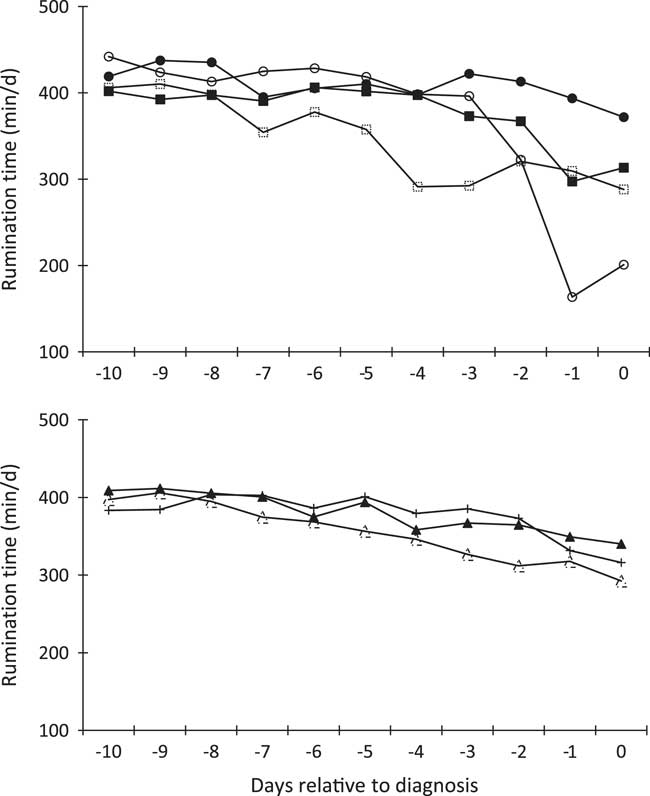
The initial study population consisted of 210 multiparous Holstein cows. A total of 198 cows successfully completed the study until 60 DIM. Overall, 74 cows were not affected by any of the health disorders in analysis during the study period and were categorized as healthy. Average (±SD) dRT for healthy cows during prepartum was 413.6±114.9 min/day and increased with DIM from 429.6±107.28 (0 to 10 DIM) to 454.3±92.5 (11 to 53 DIM) and to 488.1±96.2 min/day (>53 DIM, P<0.001). Average dRT was greater in healthy cows (459.2 ±104.3) compared with sick individuals (335.2±131.7; P<0.0001). Consistent negative changes in rumination activity were observed for each disease during the 7 days previous to diagnosis (Figure 1).
Average daily rumination time (min) from −10 day to the day of disease diagnosis (d0). (a) Mastitis (■), metritis (□), clinical hypocalcemia (○), depression/dehydration/fever (●). (b) Digestive disorders (▲), lameness (+) and clinical ketosis (△). A total of 43, 32, 7, 32, 64, 25 and 45 cows were diagnosed with mastitis, metritis, clinical hypocalcemia, depression/dehydration/fever, digestive conditions, lameness and clinical ketosis.

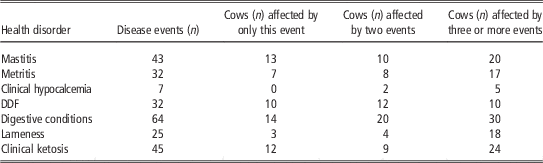
A total of 136 cows developed at least one of the disorders considered in the study and 12 animals left the farm before reaching 60 DIM. The frequencies for disease occurrence and the number of cows having concomitant health disorders are presented in Table 2.
Distribution of health events by disease and frequencies of cows affected by one, two or more health disorders included in the study (until 60 days in milk)

DDF=depression/dehydration/fever.
Rumination time and peripartal health disorders
The resulting reference cut-off values from the ROC analysis for CIx were 0.242, 0.606 and 0.136 for dry period, 1 to 10 DIM and >10 DIM, respectively. For MIx, the resulting reference cut-off values were 0.234, 0.635 and 0.128 for dry period, 1 to 10 DIM and >10 DIM, respectively.
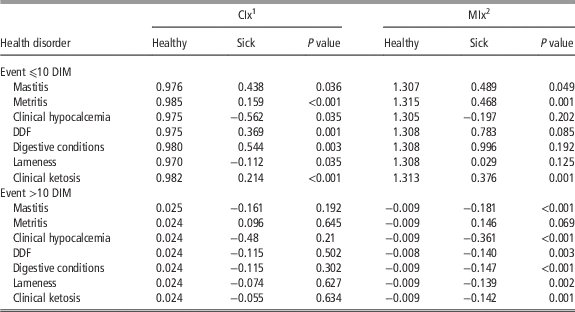
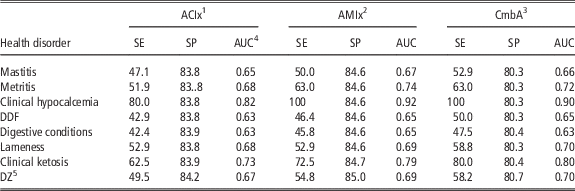
Average CIx for cows that were diagnosed with disease between 0 and 10 DIM were significantly smaller than those for healthy cows in all the specific disorders (Table 3). The AUC from the ROC analysis for DZ cows (affected by any of the study disorders) was 0.67 (Table 4) and ranged from 0.63 (DDF and digestive conditions) to 0.82 (clinical hypocalcemia) for specific diseases. Cow index alert (ACIx) had 49.5% SE and 84.2% SP in detecting DZ cows. The ACIx was most effective detecting clinical hypocalcemia (SE=80.0% and SP=83.8%) followed by clinical ketosis (62.5% and 83.9%), lameness (52.9% and 83.8%), metritis (51.9% and 83.8%), mastitis (47.1% and 83.8%), DDF (42.9% and 83.8%), and digestive conditions (42.4% and 83.9%; Table 4).
Average rumination indices by health status and specific disorder

CIx=Cow index; MIx=Mates index; DDF=depression/dehydration/fever.
A total of 43, 32, 7, 32, 64, 25 and 45 cows were diagnosed with mastitis, metritis, clinical hypocalcemia, depression/dehydration/fever, digestive conditions, lameness and clinical ketosis.
1 Cow index based on changes on daily rumination time (dRT) occurred in the affected cow on the days previous to the diagnosis. CIx calculated the difference between dRT on the day of diagnosis (d0) and dRT at the day of calving (cRT) in the affected cow (d0 v. cRT) divided by the average (d0 v. cRT) in the population of healthy animals. For disease events occurring >10 DIM, CIx calculated the difference in dRT on d0 minus the average dRT during −3 day to −5 day relative to d0 (avg −3 to −5 days), divided by avg −3 to −5 days.
2 Mates index based on the deviation on dRT in the affected cow relative to previous days and to healthy pen mate cohorts. MIx=[(affected cow d0RT−avg −3 to −5 days)−(pen mates d0RT−avg −3 to −5 days)]/pen mates d0RT. When cows were diagnosed within 10 DIM, the MIx was multiplied by the correction factor [d0RT/(avg −3 to −5 days)] from healthy cows.
Sensitivity and specificity of the proposed alerts by specific disease condition

SE=sensitivity; SP=specificity; DDF=depression/dehydration/fever.
1 Cow index alert based on changes on daily rumination time occurred in the affected cow on the days previous to the diagnosis.
2 Mates index alert based on the deviation on daily rumination time in the affected cow relative to healthy pen mates.
3 Combined alert considering a parallel interpretation for ACIx and AMIx.
4 Area under the curve from the receiver operating characteristic analysis.
5 Affected by any of the study disorders.
Average MIx were smaller for affected cows compared with healthy animals in mastitis, metritis and clinical ketosis in 0 to 10 DIM. For disorders diagnosed after 10 DIM the differences were significant for all the diseases except for metritis (Table 3). The AUC value for the DZ cows was 0.69 (Table 4). This value was greatest for clinical hypocalcemia (0.92) and smallest for DDF and digestive conditions (0.65). The alert based on pen mates comparison (AMIx) had 54.8% SE and 85.0% SP in detecting DZ cows. The AMIx was most effective in detecting clinical hypocalcemia (SE=100%, SP=84.6%) followed by clinical ketosis (72.5% and 84.7%), metritis (63.0% and 84.6%), lameness (52.9% and 84.6%), mastitis (50.0% and 84.6%), DDF (46.4% and 84.6%), digestive conditions (45.8% and 84.6%; Table 4).
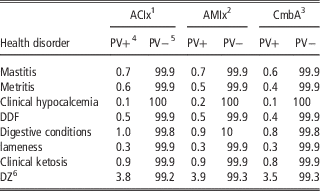
To increase alert SE, a CmbA was created using the parallel interpretation of ACIx and AMIx. Resulting SE and SP for CmbA are presented in Table 4. Predictive values of positive and negative tests are provided in Table 5.
Positive and negative predicted values (%) for the proposed alerts by specific disease condition in the study population

DDF=depression/dehydration/fever.
1 Cow index alert based on changes on daily rumination time occurred in the affected cow on the days previous to the diagnosis.
2 Mates index alert based on the deviation on daily rumination time in the affected cow relative to healthy pen mates.
3 Combined alert considering a parallel interpretation for ACIx and AMIx.
4 Predictive value of a positive test.
5 Predictive value of a negative test.
6 Affected by any of the study disorders.
Discussion
We evaluated the association between dRT and early stages of disease around calving and during early lactation. In addition, the performance of two proposed disease detection indices based on the magnitude of the changes in dRT was assessed. We tested two approaches; the first based on the magnitude of the variation in dRT in the individual cow across time and the second considering simultaneous fluctuations in dRT in pen mates. The latter approach was intended to avoid false positive test results that could originate from external conditions other that disease (e.g. management changes, extreme weather conditions, etc.).
Average dRT depended on proximity of calving and the lactation status of the cows. For healthy cows, dRT during prepartum was 413.6 min/day and, as presented in preceding studies, this variable was consistently reduced around the day of parturition, likely as a result of limited feed intake and calving-related stress (Huzzey et al., Reference Huzzey, Von Keyserlingk and Weary2005; Schirmann et al., Reference Schirmann, Chapinal, Weary, Vickers and Von Keyserlingk2009; Clark et al., Reference Clark, Lyons, Millapan, Talukder, Cronin, Kerrisk and Garcia2015). Following parturition, dRT consistently increased with DIM, which is in correspondence with the subsequent increase on dry matter intake as the lactation progresses. The continuous increment in dRT past 53 DIM contrasts with findings reported by previous research (Soriani et al., Reference Soriani, Trevisi and Calamari2012) that indicated that the peak in rumination occurred within 15 DIM and remained constant thereafter. However, evidence from another report (Huzzey et al., Reference Huzzey, Von Keyserlingk and Weary2005) indicates that DMI increases until 6 weeks of lactation, which would explain the increment in rumination beyond the transition period.
As expected, across the whole study period, average dRT was greater in healthy cows (459.2 min/day) compared with sick animals (335.2 min/day). In our study, consistent negative changes in rumination activity were observed for each disease during the 5 days previous to diagnosis, which is in accordance with studies demonstrating a correlation between RT and blood markers of inflammation and disease during the early lactation (Calamari et al., Reference Calamari, Soriani, Panella, Petrera, Minuti and Trevisi2014). Similar findings were reported by previous researchers (Liboreiro et al., Reference Liboreiro, Machado, Silva, Maturana, Nishimura, Brandão, Endres and Chebel2015) who observed reduced daily rumination time under multiple conditions, including twin delivery and metritis. Similarly, previous studies (Siivonen et al., Reference Siivonen, Taponen, Hovinen, Pastell, Lensink, Pyörälä and Hänninen2011; Fitzpatrick et al., Reference Fitzpatrick, Chapinal, Petersson-Wolfe, DeVries, Kelton, Duffield and Leslie2013) found reduced rumination during endotoxin induced clinical mastitis and another study (Sterrett et al., Reference Sterrett, Wadsworth, Harmon, Arnold, Clark, Aalseth, Ray and Bewley2014) observed decreased RT during subclinical milk fever and ketosis. Results from another study (Kaufman et al., Reference Kaufman, LeBlanc, McBride, Duffield and DeVries2016) also indicated reduced RT for multiparous ketotic cows and a report (Soriani et al., Reference Soriani, Trevisi and Calamari2012) indicated that acute phase proteins increase indicating inflammatory status in sick cows resulting in lower rumination time.
All this evidence supports the proposed use of alert systems for health monitoring, relying on changes on rumination dynamics at the time of disease. Recent studies (Stangaferro et al., Reference Stangaferro, Wijma, Caixeta, Al-Abri and Giordano2016a and Reference Stangaferro, Wijma, Caixeta, Al-Abri and Giordano2016b ) evaluated a commercial alert system for disease detection that combined the use of rumination and activity data. Reported sensitivities were high but, unfortunately no corresponding specificity data was presented, which hampers an adequate evaluation of the proposed algorithms.
In this study we proposed potential methodologies for on-farm disease monitoring. Continuous raw rumination data that provided individual RT (min) at 15-min intervals were used for the analyses. This detailed information offered the flexibility to estimate multiple cut-off points rather than being dependent upon the manufacturing company algorithms for disease detection. In addition, raw data provided the opportunity for developing two different approaches; one based on RT variation relative to the same individual and the other relation these changes to concurrent variation in pen mates. However, the aim was to assess the potential for finding possibly sick animals rather than testing the ability of the system on differentiating among diseases.
Low RT in postpartum cows due to calving associated stress (Büchel and Sundrum, Reference Büchel and Sundrum2014; Pahl et al., Reference Pahl, Hartung, Grothmann, Mahlkow-Nerge and Haeussermann2014; Clark et al., Reference Clark, Lyons, Millapan, Talukder, Cronin, Kerrisk and Garcia2015) increased the chances of false positive results. Therefore, our indices were estimated differently for disease events occurring before and after 10 DIM and used the reference postpartum rate of recovery in RT from healthy cows at the beginning of lactation (0 to 10 DIM). For disorders occurring early postpartum, we compared the difference between RT on the day of diagnosis and dRT at calving (cRT) in the affected cow v. values for normal cows. This idea is supported by data from another study (Schirmann et al., Reference Schirmann, von Keyserlingk, Weary, Veira and Heuwieser2013) that demonstrated that cows suffering unspecific inflammation around parturition had a slower increase in dRT after calving.
Interestingly, the indices used for both alerts were consistently lower in sick cows compared with healthy cows, indicating lower levels of rumination at the time of diagnosis. However, these differences were not significant in all the cases, which may be the result of high levels of variation in dRT in the affected cows.
Average CIx values for cows that were diagnosed with disease between 0 and 10 DIM were significantly smaller than those for healthy cows in all the specific disorders, indicating that the rates of postpartum increase in rumination were different for both groups, with sick animals having a slower recovery. The AMIx showed a better performance with ranges of SE from 46% (digestive conditions) to 100% (clinical hypocalcemia) and 54% (digestive conditions) to 100% (clinical hypocalcemia) for models A and B, respectively. Specificity was close to 85% and 73% for models A and B, respectively. Interestingly, the best performance for the proposed alert systems was determined for the detection of clinical hypocalcemia. This finding could be explained by the expected effect that low levels of calcium in blood would have on rumen contractions and rumination activity. However, as only seven cows were presented with this disorder during the study, more data would be required to confirm this outcome.
This variation in disease detection performance can be attributed to the specific system affected and the differences on the level of stress and the resulting degree of reduction in feed intake.
The predictive value of a positive test is the probability that given a positive test, the animal actually has the disease. Likewise, the predictive value of a negative test is the probability that given a negative test, the animal does not have the disease (Dohoo et al., Reference Dohoo, Martin and Stryhn2009). These estimates depend on the SE and SP of the test and the prevalence of the disease in the population in which it is used.
Predictive values of positive tests were very small for all the alerts proposed in this study. This may be explained by three combined elements: first, the prevalence values for each of the diseases in analysis were moderate. Second, and more important, the use of cow-day as the unit of analysis resulted in a proportion of cow-days with disease events very small when compared with the total cow-days during the study period. Finally, as indicated in the ‘Materials and methods’ section, when a cow had a positive alert and a positive disease diagnosis, the subsequent days that continued indicating a positive alert were counted as the same event, which resulted in lower SE and had a strong effect on the calculation of PV+. This decision of excluding subsequent positive alerts in cows presenting disease followed the idea that the interest of the farmer is to early detect potentially sick cows; subsequent alerts in the following days would not be relevant for individuals that have already been identified. Opposite to the low PV+ reported here, the use of cow-days in the calculation resulted in very high PV− values, as the proportion of cow-days for healthy cows was very high.
From a practical point of view, a consequence of the low alert PV+ is that, even with moderate to high SP values, a significant proportion of positive alerts may not correspond with cows that are actually sick. This drawback would be especially relevant in large herds with low prevalence of disease, where high numbers of healthy cows would be indicated as potentially sick. Contrarily, high PV− will result in very low proportions of sick cows that missed by the alert, as they are mistakenly considered healthy.
As presented in the objectives, the purpose of analyzing each disorder separately was to determine whether these disease events would be accompanied by changes in RT that are large enough to be detected by the proposed alerts. Therefore, the aim for this DZ alert is to identify animals with a greater probability of being sick and requiring a more detailed health checking, rather than leading towards a potential diagnosis, which is not feasible with the proposed alerts, that are unable to discriminate among specific health disorders.
Our evaluation of SE and SP for the proposed alerts considered the day of diagnosis as the reference for the calculations. A different approach suggesting the use of time-window analyses was developed by Kamphuis et al. (Reference Kamphuis, Dela Rue, Mein and Jago2013). The authors used a time window that included a certain number of milkings centered around a clinical mastitis event to link mastitis episodes with alerts generated by a in-line mastitis-detection system. Consequently, any alert occurring within this window would be considered a true positive. A similar approach could be used in the evaluation of the alerts proposed in our study, considering any disease event occurring within a predetermined number of days before and after the time of the diagnosis. This will likely result on greater SP values.
Previous research has shown that specific physiological events result in changes in opposite directions for specific activity parameters. A well reported example is parturition that is accompanied by reductions in RT and increases in activity (Clark et al., Reference Clark, Lyons, Millapan, Talukder, Cronin, Kerrisk and Garcia2015; Liboreiro et al., Reference Liboreiro, Machado, Silva, Maturana, Nishimura, Brandão, Endres and Chebel2015). Conversely, in the case of disease, both activity and rumination are expected to be reduced (Liboreiro et al., Reference Liboreiro, Machado, Silva, Maturana, Nishimura, Brandão, Endres and Chebel2015). Fluctuations in milk yield have also been included in indices detecting disease. Interestingly van Hertem et al. (Reference van Hertem, Maltz, Antler, Romanini, Viazzi, Bahr, Schlageter-Tello, Lokhorst, Berckmans and Halachmi2013) demonstrated that the combination of milk yield, neck activity and rumination could also be used for the automatic detection of lameness. In that study, lame cows had lower milk yield compared with non-affected cows and had a reduced ruminating time during the night around the day of diagnosis. In addition, the nighttime to daytime neck activity ratio was significantly higher for lame animals mainly due to the decreased neck activity of the lame cows during the day. Similarly, King et al. (Reference King, Dancy, LeBlanc, Pajor and DeVries2017) reported that cows diagnosed with pneumonia, subclinical ketosis, displaced abomasum, metritis and hoof disorders had altered patterns one or more behavior and production parameters, including rumination time, activity and milk yield.
Consequently, as indicated by the aforementioned studies, a potential way to improve the performance of the proposed alerts is to combine concurrent measurements in multiple parameters. A possible approach is to develop decision trees that consider multiple sources of sensory data, as proposed by Steensels et al. (Reference Steensels, Antler, Bahr, Berckmans, Maltz and Halachmi2016) that combined rumination, activity and milk yield to assess the probability of a cow being sick. Nonetheless, in our study we centered in one parameter and the attention was only focused on the size of RT changes around disease. However, we recognize that combining RT with changes in other behaviors and performance would likely enhance our ability for early detection of health disorders.
A strength of our study is that we compared the rumination with both the individual cow and the pen cohort. This approach enabled us to consider changes in rumination in individual cow due to changes in the ration, the feeding times, inclement weather conditions, etc. As presented by a previous report (Paudyal et al., Reference Paudyal, Maunsell, Richeson, Risco, Donovan and Pinedo2016), there is a significant effect of heat stress on the changes in the pattern of rumination for sick cows and these alterations are distinct for specific health disorders and metabolic conditions. This research was conducted in a university farm with very close monitoring of cow health, including veterinary visits on a regular basis (3/week) during the whole year, prompt identification of diseases and precise diagnosis were important assets. However, some degree of misclassification in disease diagnostic is unavoidable and a level of undetected health problems by the attending veterinarians and the farm personnel should also be expected, resulting in an imperfect gold standard.
Relevant to the dairy industry, in addition to the potential for detection of disease, rumination monitoring may also provide an estimation of the overall status of health and cow well-being by groups, which is indicator of welfare conditions on the farm.
In conclusion, consistent negative changes in rumination activity, both within cow (CIx) and compared with cohorts (MIx), were observed for each postpartum disease at the day of diagnosis. The ability for detecting disease of the proposed alerts was variable and dependent on the time of disease relative to calving and the reference for comparison applied to the index. Further research exploring the potential of combining rumination dynamics and other biological parameters for early detection of disease is required.
Acknowledgments
The authors acknowledge the valuable assistance of University of Florida Dairy Unit personnel that collaborated during the development of this study. The authors also acknowledge the support of SCR Engineers Ltd that provided the rumination monitoring system used in this study.