INTRODUCTION
The life cycle of marine organisms shows especially in temperate regions, seasonal patterns in growth, reproduction and abundance (Coma et al., Reference Coma, Ribes, Gill and Zabala2000). For tropical and subtropical regions, it reflects the seasonal influence of the tides on phenology, coverage, mortality and vertical migration of the intertidal organisms (revised by Coutinho, Reference Coutinho, Pereira and Soares-Gomes2002).
According to Underwood & Chapman (Reference Underwood and Chapman2000), the temporal variability in the abundance of organisms in a medium period (annual) is, in general, smaller at higher levels on rocky coasts. At lower levels, with less severe environmental conditions, the number of organisms is variable with the period of the year due to the fluctuations in the recruitment process, predation and/or competition that are frequently not predictable. At higher levels, the air temperature and food availability, identified as crucial environment factors, depend on the rise of the tide, affecting the dynamics of marine filter invertebrates. Any change in the tidal level substantially influences the distribution, abundance and interactions of many adult organisms, incapable of adjustment (Denny & Paine, Reference Denny and Paine1998). Numerous studies have shown that the higher vertical distribution limit of species correlates with thermal tolerance limits (revised by Stenseng et al., Reference Stenseng, Braby and Somero2005).
An important structural and dynamic determinant of the benthic intertidal community is related to the physical wave action (Helmuth & Denny, Reference Helmuth and Denny2003); one of these effects is the enlargement of the intertidal zone, where the water spray allows the organism to spatially and temporally extend their occupation (Little & Kiching. Reference Little and Kiching1996). Also, substrate topography has an environmental spatial influence on the intensity of these variables, which in turn, might affect the biological processes during both low and high tide periods (Guichard et al., Reference Guichard, Bourget and Robert2001). Physical features of the environment, and consequently the local assemblage structure may change abruptly over a small spatial scale in highly complex habitats (Beneditii-Cecchi & Cinelli, Reference Benedetti-Cecchi and Cinelli1997). The heterogeneity of the substratum can modify the specific hydrodynamic pattern during the high tide and influence the shading and wind intensity during the low tide (Guichard et al., Reference Guichard, Bourget and Robert2001).
Breakwaters have been used in marinas and ports construction and in the protection of sandy beaches against coastal erosion. Such anthropogenic alterations modify the landscape by adding new habitats and favouring benthic species' recruitment/colonization (Chapman & Bulleri, Reference Chapman and Bulleri2003). Such habitats are three-dimensional, offering a variety of different environments affecting orientation, shading and degree of exposure to waves in the intertidal region. The small-scale horizontal variability is still more evident due to the larger spatial heterogeneity. The horizontal and vertical variability on benthic community distribution in piers a few hundred metres apart is quite common if they present different orientations in relation to wave swell, which causes an alteration in the hydrodynamics pattern (Bulleri & Chapman, Reference Bulleri and Chapman2004).
In 1980 two breakwaters composed of granitic boulders were constructed on the north coast of the State of Rio de Janeiro and we expect that the vertical distribution of the intertidal benthic assemblages should be different on both breakwaters due to their different wave exposure degree, which reflects the breakwater orientation and the wave swell at each site. The second hypothesis to be tested is that the annual variation in the intertidal benthic community zonation should be related to the seasonal variability of the tides, to air temperature, wave height and periodicity.
MATERIALS AND METHODS
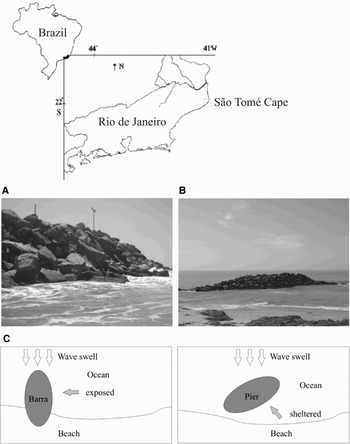
The piers are located on the beaches Barra do Furado (22°05′S 41°08′W) and Farol de São Tomé (22°04′S 41°07′W), northern coast of the State of Rio de Janeiro. The distance between them is around 2 km, and they are referred to as Barra and Pier, respectively. They were formed by transplanted granitic boulders presenting discontinuous and irregular surface forming ‘steps’ (Figure 1A, B). Both piers have a total inclination of 50°, but do not present the same orientation as to the ripples–wave swell (Figure 1C). The main consequences are different wave exposition degree and hydrodynamic pattern alteration mainly on similar slope surfaces.
Studied sites area at the northern coast of Rio de Janeiro State: (A) Barra do Furado beach (Barra site); (B) Farol de São Tomé beach (Pier site); (C) breakwater schematic representation at both sites with local swell orientations, which reflect in different wave exposure degrees.

Spatial variability
Although both piers are not uniform in relation to wave exposure, the sampling surfaces were controlled and standardized with homogeneous slopes. To measure and express the wave exposition degree on the sampling rocky surface of each pier the wave size was evaluated with a 2.0 m long ruler with 0.5 cm divisions, 50 m distant from the observer; the wave period corresponds to the time interval in seconds between the successive passage of two crests by a fixed point. The results were compared with the proposed Table by Schoch & Dethier (1997 (cited in Murray et al., Reference Murray, Ambrose and Dethier2006), which provides a classification (very protected, protected, half-protected, half-exposed and exposed) and a scale of 1 to 10, respectively from very protected to exposed.
Annual variability
The differences in the benthic assemblages in the four studied periods were compared using the parameters tide level, air temperature and wave period and height. The tide influence was evaluated through the extreme values of high tide level and the total immersion index (according to Gevertz, Reference Gevertz1995) that relates the number of tides exceeding the respective average with the total amount of tides. Thirty previous days of the four periods of sampling data were used.
The environmental parameters air temperature and height and period of waves, which correspond to the time interval in seconds between successive crests by a fixed point, were supplied by the Brazilian Navy from a meteorological station of Farol de São Tomé beach. Two daily observations were used (9:00 and 15:00 h) for each parameter, considering also the 30 days previous to each biological sampling. The significance of the environmental parameters variation among the periods was tested using analysis of variance (ANOVA, P < 0.05) followed by the Tukey honestly significant difference multiple comparison test (HSD) (P < 0.05).
Sampling programme
A spatial variability sampling programme was carried out at both sites in May 2005 in the morning and at low tide. Three vertical profiles, 4 m wide and 6 m distant were sampled at each site. Along each profile, 400 cm2 quadrats were photographed from 0.2 m above tide level to a selected point above the organism on the highest portion of the rocky substrate. At Barra it was necessary to alter the number of quadrats used in the intertidal sampling, due to its larger extension (N = 18 at Barra and N = 10 at Pier). The sampled organisms included the sessile and sedentary animals and algae species settled on the rocky substrate. Due to the substrate discontinuity, the determination of each observation height was performed in sections using the adapted Gevertz method (1995). These piers were built with boulders, which are highly irregular and offer innumerable microhabitats quite different from one another in terms of light, shadow, humidity and protection against wave exposure. To avoid and control the boulders' irregularity influence, the sampling surface at each section of all vertical profiles on both study sites was relatively perpendicular and had its external faces facing the sea. A digital camera Cannon PowerShot A510 4.1 Mp in a watertight case was attached to a 20 × 20 cm PVC photoquadrat framer. Each photograph was analysed for per cent cover using the CPCe V 3.1 (Coral Point Count for Excel) software program, which estimates bare space and the species percentage cover applied to a digital grid of 100 points in the photograph. The distinction between primary and secondary canopy was not considered.
An annual variability sampling programme was carried out at the Pier site in each season of the year: 9 May 2005, 22 July 2005, 3 October 2005 and 14 February 2006, hereby referred to as Time 01, 02, 03 and 04, respectively. Four vertical profiles, 4 m wide and 6 m distant, each representing one study unit were sampled at this site using the methodology described above.
Data analysis
The benthic assemblages at the different levels were evaluated through taxonomic composition, richness and average species cover percentage in each profile and site. The comparative analysis of the benthic assemblages at both sites (spatial variability) and periods (annual variability) at the different heights included a multi-dimensional scaling (MDS) with Bray–Curtis similarity coefficient for percentage data. The adequacy of the configuration of the samples for MDS was obtained from the stress value, which provides an excellent spatial representation when below 0.05 (Clarke & Warwick, Reference Clarke and Warwick2001). The intertidal nomenclature of the different levels studied was based on Lewis (Reference Lewis1964).
The ANOSIM permutation test (one-way) was used to evaluate the significance of the differences between the pre-defined groups from the MDS method. The similarity matrices included the percentage cover of the organisms present at each height of each site or each time. The units sampled at same height (each site or period) were treated separately to increase the permutations possibility and, consequently, the power of the test (Clarke & Warwick, Reference Clarke and Warwick2001). The similarity percentages procedure (SIMPER) defined the contribution of the most abundant species between and within groups (site or period) for the MDS. A cut-off of cumulative dissimilarity of 80% was applied (Boaventura et al., Reference Boaventura, Ré, Fonseca and Hawkins2002). Data analysis was performed with PRIMER software.
RESULTS
Spatial variability
WAVE EXPOSURE
The wave exposure degree between piers was quite different. The average period criteria of the waves at Barra (5.8 ± 1.6) classified the site as half-exposed (scale 8) whereas the Pier site (1.0 ± 0.6) was classified as well protected (scale 1). The height criteria of the waves classified the Barra site (2.0 ± 1.2) as half-exposed (scale 8), whereas the Pier site (1.0 ± 0.6) was classified as half-protected (scale 6). Therefore, considering the wave parameters, the Barra site presented a higher degree of exposition compared to the Pier site.
BIOTIC DATA
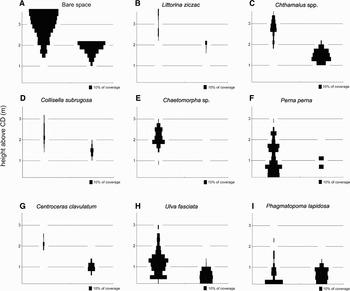
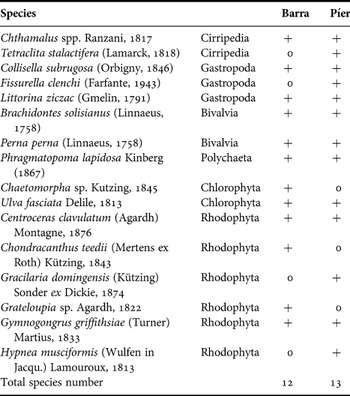
The total richness was similar at both piers, with 12 species registered at the Pier and 13 at the Barra (Table 1). Exclusive species were Chaetomorpha sp. Kützing 1845, Chondracanthus teedii (Mertens ex Roth) Kützing 1843 and Grateloupia sp. Agardh, 1822 at Barra and Tetraclita stalactifera (Lamarck, 1818), Fissurella clenchi (Farfante, 1943), Gymnogongrus griffithsiae (Turner) Martius 1833 and Hypnea musciformis (Wulfen in Jacqu.) Lamouroux 1813 at Pier. The graphical representation of the vertical distribution of the main species shows differences on the vertical amplitude and relative abundance at both sites (Figure 2). Throughout the vertical axis of the piers, the species colonized higher levels of the substrate at the Barra site.
A graphical representation of the vertical distribution pattern of the representative species at the Barra and Pier sites with the correspondent tide level.

Intertidal benthic species recorded at Barra and Pier.

The lower intertidal zone had less empty space at Pier and Barra sites (Figure 2). The gastropod Littorina ziczac (Gmelin, 1791), despite its low average cover value (Barra: 3.0%; Pier: 5.7%), characterized the superior limit of the intertidal zone. The cirriped Chthamalus spp. Ranzani, 1817 presented the highest average cover in the superior portion of the intertidal zone (Barra: 21.3%; Pier: 63.7%). The gastropod herbivore Collisella subrugosa (Orbigny, 1846) presented a large vertical distribution band at Barra, extending from the superior portion to the mean of the intertidal zone, very similar in extension to the chlorophyte Chaetomorpha sp. The bivalve Perna perna (Linnaeus, 1758) presented a discontinuous vertical distribution at the Pier, and was restricted to the inferior portion while at Barra it was more abundant, also occupying the mean portion of the intertidal zone. The rodophyte Centroceras clavulatum (Agardh) Montagne 1876 occupied a superior position at Barra, with inferior average covering in relation to Pier (Barra: 5%; Pier: 23.3%). Amongst the most representative species of the inferior portion of the intertidal zone of both sites, the chlorophyte Ulva fasciata Delile 1813 presented a larger distribution band, reaching the superior portion of the pier at Barra. The polychaete Phragmatopoma lapidosa Kinberg (1867) was more abundant at the inferior extremity of the intertidal zone at Barra (58.7%), while the average cover values at Pier were more homogeneous through the entire inferior band, around 45%.
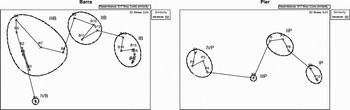
The MDS analysis at the different heights of both sites showed four main groups with 50% similarity, which corresponded to the four bands of the intertidal zone (Figure 3). The MDS plots showed a gradient of samples with height. A low stress value (0.05) indicated the MDS plots were a good representation of the true multivariate pattern.
MDS representation of the benthic assemblages at different heights on Barra (B: left) and Pier (P: right) sites (B1 and P1: lower quadrat at Barra and Pier = 0.2 to 0.4 m; P10: upper quadrat at Pier = 2.0 to 2.2 m; B18: upper quadrat at Barra: 3.6 to 3.8 m).

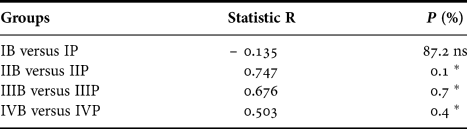
When examining the hypothesis of significant differences between equivalent bands of distinct sites, the ANOSIM similarity analysis evidenced the largest differences between bands II, III and IV, respectively (Table 2). The comparison between group I (superior band) of Barra and Pier did not present a significant value (R = –0.135; P: 87.2%).
ANOSIM results of the paired-test between equivalent groups at Barra (B) and Pier (P) from MDS analysis.

* ,significant (P < 5%); ns, non-significant.
The SIMPER analysis revealed the species that contributed most to the distinction between equivalent bands of distinct sites: empty space (40.54%), Chthamalus spp. (35.14%) and L. ziczac (10.53%) in the superior band; Chthamalus spp. (36.69%), Chaetomorpha sp. (20.32%), empty space (17.04%) and P. perna (8.34%) in the superior intermediate band; U. fasciata (24.88%), Chthamalus spp. (18.56%), P. perna (16.76%), C. clavulatum (12.10%), P. lapidosa (9.24%) in the inferior intermediate band; and P. perna (31.56%), U. fasciata (31.31%) and P. lapidosa (23.63%) in the inferior band of the intertidal zone.
Annual variability
ENVIRONMENTAL PARAMETERS
The average tide level during the 30 days previous to the sampling date was 0.81 m in May 2005; 0.83 m in July 2005; 0.58 m in October 2005 and 0.70 m in February 2006. The extreme low and extreme high tides were 0.2 and 1.5 in May 2005, 0.1 and 1.5 m in July 2005, −0.3 and 1.3 m in October 2005; −0.2 and 1.3 m in February 2006, respectively.
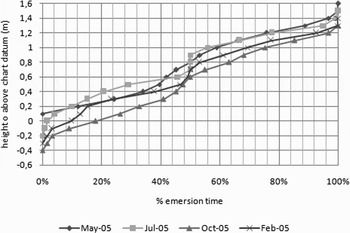
The tide frequency (Figure 4) in each studied period indicated that above 1.4–1.6 m (equivalent to Q07) the substrate is 100% emersed all the time, and from 0.2–0.4 m (Q01) the organisms are found to be 8% emersed in July 2005 and 28% in October 2005. For the heights 1.0–1.2 m (Q05) it is observed a difference of about 20% of immersion time between the months of May 2005 and July 2005 to October 2005 and February 2006, with a higher air exposure in the latter.
Tide level and emersion time percentage for the 30 previous days of each sampling data in the four studied periods on the north coast of the state of Rio de Janeiro.

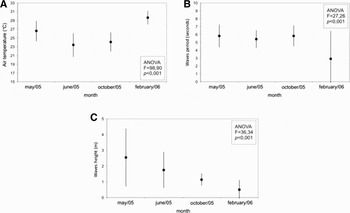
The air temperature, wave height and period differed significantly between the four periods (Figure 5). The air temperature showed the highest values and the smallest variation in February 2006 (4°C), while the lower values and the highest variation occurred in July 2005 (9°C) (Figure 5A). The Tukey test indicated that July 2005 and October 2005 did not differ significantly (P > 0.05). The wave regularity was similar in May 2005, July 2005 and October 2005 (average of 5 to 6 seconds), while February 2006 registered the lowest values (average of 3.2 seconds) and the largest variation (9 seconds) (Figure 5B). The Tukey test revealed that only February 2006 differed significantly from the others (P < 0.01). The wave height presented the largest values (3.75 m) and variation (3.25 m) in May 2005, with significant differences between months (P < 0.01) (Figure 5C).
Medium values (±SD) of air temperature (A), wave height (B) and wave period (C) in the four studied periods at the Pier site, northern coast of Rio de Janeiro State (N = 30).

BIOTIC DATA
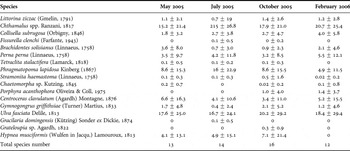
The taxonomic composition of the studied pier was very similar in all four periods, with a total of 13, 14, 16 and 12 species in May 2005, July 2005, October 2005 and February 2006, respectively (Table 3). The exclusive species were Gracilaria domingensis (Kützing) Sonder ex Dickie 1874 (July 2005), Grateloupia sp. (October 2005), F. clenchi (July 2005 and October 2005) and Porphyra acanthophora Oliveira & Coll 1975 (October 2005 and February 2006). The most abundant species, Centroceras clavulatum, Chthamalus spp., lapidosa Phragmatopoma and Ulva fasciata occurred with more than 50% coverage in all periods.
Species and percentage cover average values ±SD in the study periods on the north coast of Rio de Janeiro.

In all study periods, the average number of species was higher in the intermediate quadrats, corresponding in May 2005 to quadrat Q05 (6.8 ± 2.2), in July 2005 to Q05 (6.0 ± 0.8), in October 2005 to Q06 (5.3 ± 2.1) and in February 2006 to Q04 (5.3 ± 2.1).
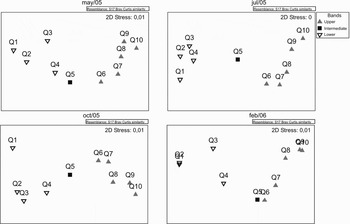
The resultant diagrams of the MDS ordination method of the sessile organisms at each height (quadrat) and time studied shows the seasonal variation of the benthic community in the intertidal region (Figure 6). The stress values varied from zero (July 2005) to 0.01 (May 2005, October 2005 and July 2005 and October 2005), indicating an excellent graphical representation of the similarities between heights. In all periods, the higher (Q6 to Q10) and lower quadrats (Q1 the Q4) form two stable groups, the first always being located on the right side of the diagram and the second on the left. The intermediate quadrat Q5 varies in accordance with the time of the year: in May 2005 it was closer to the lower zone; in July 2005 and October 2005 it was closer to a more intermediate position and in February 2006 it was very close to the higher quadrats. In synthesis, an isolated intermediate band was verified in July 2005 and October 2005, reflecting a narrow transition band between the superior and inferior quadrats.
MDS representation of the benthic assemblages in the four studied periods (Bray–Curtis similarity) with the 10 intertidal sampled quadrats at the Pier site, northern coast of Rio de Janeiro State (Q1: 0.2 a 0.4 m; Q10: 2.0 a 2.2 m).

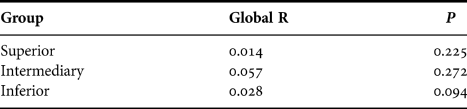
The superior, intermediate and inferior groups pre-defined in the MDS method did not differ significantly between the study periods (Table 4). The intermediate group included only the Q5 quadrat, presenting a low permutation possibility (N = 35) that can diminish the power of the test (Clarke & Warwick, Reference Clarke and Warwick2001).
ANOSIM results of the pre-defined groups from the MDS method between equivalent groups in the different studied periods (P > 0.05: not significant).

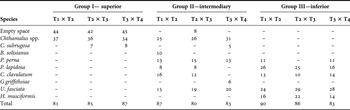
The SIMPER analysis defined the contribution percentage of the species for the formation of the superior, intermediate and inferior groups in each period defined a priori in the MDS. In relation to the higher group, the main contributors for the difference between the study periods were ‘empty space’, Chthamalus spp. (about 80%) and C. subrugosa (Table 5). The intermediate group differed between the periods in about 70% mainly due to Chthamalus spp., U. fasciata, P. perna and C. clavulatum (Table 5). In the lower group, the species that contributed the most to the differences between the four periods were respectively in a sequence of importance U. fasciata, P. lapidosa, H. musciformis, C. clavulatum and P. perna (Table 5).
SIMPER analysis with the species percentage contribution to the dissimilarity between periods on each group of the MDS method (T1, May 2005; T2, July 2005; T3, October 2005; T4, February 2006).

DISCUSSION
Breakwater offers an irregular and discontinuous substrate, which reflect on variations of the intertidal assemblages and make it difficult to identify the real image of the typical association for that band of the substrate. The observation of such natural variability can be verified in several scales, and probably results in particular pattern variations in time and space (revision by Benedetti-Cecchi et al., Reference Benedetti-Cecchi, Maggi, Bertocci, Vaselli, Micheli, Osio and Cinelli2003); therefore, correlations of environmental and biotic data in heterogeneous environments must be observed with caution.
Intertidal assemblage studies focus primarily on the abundance and the distribution of common or dominant species, which according to Davidson et al. (Reference Davidson, Crook and Barnes2004) might affect comparisons of species diversity. In this study, low abundance species such as Littorina ziczac and Centroceras clavulatum contributed to the main differences between the study sites. Independent of the zonation scheme it is not only the important dominant species but also the largest number of possible species (Coutinho, Reference Coutinho, Pereira and Soares-Gomes2002).
The periodic oscillation of the tide favours the coexistence of organisms in the intermediate levels, where maximum richness is reached. In the lower portion of the intertidal zone, the lower richness values can be attributed to elevated local turbidity, given the proximity to the mouth of the Paraiba do Sul River (63.4 km). Amongst the most representative species of lower band at both sites, the rhodophytes were distinguished. Evidences of positive and/or negative direct relations between pigmentation, performance and algae were reported by Kirk (Reference Kirk1994).
It is important to indicate the large variations in richness values at the Barra site between the profiles of the same height band, which might have occurred due to the topographical irregularity of the pier, providing distinct environment conditions at small spatial scale and favouring the formation of patches with different assemblages at the same height. Patches forming a mosaic pattern distribution are also commonly observed at south-eastern Rio de Janeiro, occurring in scales from centimetres to metres (Yoneshigue, 1985 cited in Sauer-Machado et al., Reference Sauer-Machado, Chapman and Coutinho1992).
The tidal oscillation and the wave exposition degree may define the community structure in the intertidal zone (Lewis, Reference Lewis1964; Underwood, Reference Underwood1981). The tide provides alternating periods of immersion/emersion, whereas the wave exposition degree can vary in accordance with their height and periods, making the duration and frequency of wave exposition two important factors. In protected sites, the dependence on salt-water spray is a relevant factor in the survival of organisms and consequently for the formation of the different bands. At the Pier site, which is a less exposed environment, the bands of the intertidal zone were more evident than at the Barra site, especially due to tidal variation.
At Barra all the species occupied higher levels in relation to the Pier, reflected by the intense wave action at the former one. This effect, called uplift, indicates a greater degree of wave exposition, where the spray keeps the rocky surface permanently humid, above the level normally reached by the tide (revision by Little & Kiching, Reference Little and Kiching1996).
The observed vertical distribution pattern at the two sites indicated the presence of four bands of organisms in the intertidal zone of the respective piers. The littoral edge was the one that did not show differences between sites. Good (Reference Good2004) in the Caribbean, when comparing the superior band between exposed and protected sites did not register differences in the sessile assemblages, and observed that the higher stress was related to extreme air exposure. At Barra, the littoral edge was revealed to be larger (2.6–3.8 m) than at Pier (1.8–2.2 m), and the organisms distribution was 0.8 m above of the starting point in the first one in relation to Pier, a more protected site.
In the superior eulittoral band, the organisms need to support long emersion periods, and therefore empty space still is very representative. In the exposed site, the amplitude of the band (1.8–2.6 m) was identical to the protected site (1.2–2.0 m), but it was located in a higher level. In Barra, the bivalve Perna perna and the chlorophyte Chaetomorpha sp. had an important role in the definition of this zone, stressing the importance of studying a large number of species, including those that are exclusive, such as the referred macroalgae. As mentioned Chaetomorpha is commonly cited as restricted to places exposed to waves (Oliveira & Paula, Reference Oliveira and Paula1984; Coutinho, Reference Coutinho, Pereira and Soares-Gomes2002) indicating that its filamentous morphology provides a smaller contact surface. The higher abundance of the bivalve P. perna in the exposed site can be a result of lower predation by Stramonita haemastoma (Linnaeus, 1758), a carnivorous gastropod very common in cracks at the exposed site (personal observation). However, according to Good (Reference Good2004), the addition of the wave action factor makes predation less important than the physical factors in the intertidal community organization.
In the inferior eulittoral band, where stress by desiccation is less intense in relation to the other bands, the benthic assemblage has been characterized by common species of both sites, however with different relative abundance, as Chthamalus spp., C. clavulatum, Ulva fasciata and Phragmatopoma lapidosa are predominant species at Pier, and P. perna is a predominant species at Barra. At this last site, the inferior band occupied a large amplitude of the intertidal zone (0.4–1.8 m), whereas at Pier it was a transition one of 20 cm in amplitude (1.0–1.2 m).
In the subcoastal fringe the immersion period is longer and usually it is occupied by macroalgae (sensu Lewis, Reference Lewis1964), which were more abundant at the protected site while the exposed one was covered by sandy reefs of P. lapidosa. Sauer-Machado et al. (Reference Sauer-Machado, Chapman and Coutinho1992) cite this polychaete in moderately protected rocky coasts in Buzios, south-eastern Rio de Janeiro. In this lower band, differences between sites were related to the mussel P. perna, predominant in the more exposed site and to the macroalgae Hypnea musciformis and U. fasciata, which were more abundant in the protected site. Along the Portuguese coast, these mussels also occurred in the inferior portion of the midlittoral (=eulittoral region) of more exposed coasts (Boaventura et al., Reference Boaventura, Ré, Fonseca and Hawkins2002).
The differences in the intertidal zonation patterns at the studied piers were mainly attributed to distinct wave exposition degrees, which reflected on a variable height for the representative species as well as on the extension of its respective band. The uplift effect related to the magnifying of the intertidal zone was identified in the more exposed site, where the littoral edge was three times more extensive. Besides, in the other intertidal bands the benthic assemblage differences were mainly related to the relative abundance of the common species. These differences in the vertical distribution in both breakwaters highlight a distinct wave exposure condition, which probably reflects the breakwater orientation and the wave swell at each site.
The quantification of the hydrodynamic forces that act on the organisms and how they vary in the time and space is basic for the understanding of the intertidal ecosystem dynamics (Helmuth & Denny, Reference Helmuth and Denny2003). Several organisms are incapable of adjusting to new environment situations that directly influence their tolerance in specific levels of the substrate. Temporal fluctuations in the environmental parameters (e.g. temperature, luminosity and wave exposure degree) are probable causes of different benthic communities on rocky intertidal shores throughout time, from months to decades (Underwood, Reference Underwood1981; Dye, Reference Dye1998; Brito et al., Reference Brito, Széchy and Cassiano2002; Chapman, Reference Chapman2002; Porri et al., Reference Porri, McQuaid and Radloff2006).
The annual fluctuations in the tide level and the interactions of the environmental parameters air temperature, wave period and height showed a direct correlation with the annual variation of the benthic assemblages in the studied breakwater. Besides the studied environmental parameters it is important to point out that the supplement of seaweed propagules can be one of the limiting factors for the macroalgae development (Hutchinson & Williams, Reference Hutchinson and Williams2001).
The main difference between the benthic assemblages of the four investigated periods is related to the intermediate band of the substrate. In May 2005, the intermediate assemblage resembled more to the inferior band, due to the seaweed co-dominance, and in February 2006 to the superior band, which was predominated by the macrofauna. Such increases or reductions in the organisms recovery might reflect environment conditions (e.g. waves and tides) and/or biological processes (e.g. behaviour and predation), including the availability of larvae or propagules, which vary in space and time, and have great influence on the recruitment and settlement processes of the benthic species (Dye, Reference Dye1998; Pineda et al., Reference Pineda, Riebensahm and Medeiros-Bergen2002; Jenkins & Hawkins, Reference Jenkins and Hawkins2003; Forde & Raimondi, Reference Forde and Raimondi2004).
A central objective in the determination of the consequences of global climatic changes is to accurately foresee the thermal stress alteration on the organisms and the subsequent stress impact on the species distribution patterns (Helmuth et al., Reference Helmuth, Harley, Halpin, O'Donnell, Hofmann and Blanchette2002). The shorter emersion time in the Q5 quadrats (1.0 the 1.2 m) in May 2005 and the higher values of the wave height and period might have favoured a less limiting environment, reducing stress caused by heating and desiccation. In this period the benthic assemblages in the intermediate square Q5 were similar to the lower quadrats. In February 2006, the higher emersion time along with higher air temperature and the lower values of wave height and period suggest a greater stress for desiccation, and might explain the assemblage similarity of Q5 with the superior quadrats.
The hypothesis of annual variation in the intertidal benthic community zonation related to the seasonal variability of the tides, air temperature and wave height and period was accepted for the intermediate band, due to the differences in the taxonomic composition and the species coverage at the four investigated times.
The specific composition of the marine communities and its relative abundance, especially in the intertidal zone suffer diverse variations, which are influenced by typical natural environment conditions and by anthropogenic factors. The quantitative evaluation of such variations is basic to interpret the potential role of physiological stress in the establishment of the distribution intertidal limits, and particularly important if we desire to foresee the effect of the climatic changes in the communities of the intertidal region.
ACKNOWLEDGEMENTS
Thanks to the Brazilian Research Foundation (FAPERJ); Dr Ronaldo Novelli (University Estadual do Norte Fluminense: Mollusca) and Dr Renato Crespo Pereira (University Federal Fluminense: algae) for the taxonomic identification; Dr Helena Passeri Lavrado (University Federal of Rio de Janeiro), Dr Ricardo Coutinho (IEAPM—Brazilian Navy) and Dr Luis Felipe Skinner (University Estadual do Rio de Janeiro) for their critical suggestions.