Hospital-based health technology assessment (HB-HTA) involves a multidisciplinary team working to develop methodologies to turn the healthcare system more efficient, innovative and value-oriented (Reference Sampietro-Colom, Lach and Wasserfallen1;Reference Pereira, Rabello and Elias2). In 2016, Porter et al. asserted that the overarching goal of healthcare organizations should be achieving higher value in healthcare. Value increases when organizations focus on outcomes, such as by adopting systematic processes to improve efficiency (Reference Porter, Larsson and Lee3).
However, to prospect value, it is necessary to involve all the patient value chain that starts at the strategic level and demand teams with specific background to develop robust analysis to guide decisions. The HB-HTA team must have the capability to guide proactive decisions for C-suite and operational/clinical managers, making it strategically and economically sustainable when considering the value creation demand (Reference Attieh and Gagnon4).
Another important process that contributes to value creation capability in hospitals is enterprise risk management (ERM) (Reference Bromiley, McShane, Nair and Rustambekov5). ERM programs facilitate strategy selection and choosing a strategy calls for a structured decision-making process that analyzes risks and aligns an organization's resources with its mission and vision (Reference Damodaran6). Effected by the entity's board of directors and managers, ERM is designed to identify potential events that may adversely impact the organization (Reference Aven and Aven7). Likewise, ERM seeks to manage and monitor risks within a defined risk appetite, and to provide reasonable assurance that the entity's strategic objectives can be achieved (8). ERM enables a robust, quantitative understanding of risks and communicates the impact of those risks at all the organization levels (Reference Bromiley, McShane, Nair and Rustambekov5;8). For the specific healthcare business environment, Etges et al., after a systematic review and case studies with eight hospitals, suggested a theoretical framework to implement ERM (Reference Etges APB da, Souza, Kliemann Neto and Felix9).
HB-HTA and ERM are processes implemented by hospitals to increase efficiency and patient safety, and to orient the decision-making process respecting budget restrictions and the organization financial objectives (Reference Etges APB da, Souza, Kliemann Neto and Felix9–11). The HB-HTA process does this by assessing health technologies (10), while ERM contributes by engaging employees with the hospital's strategic principles, identifying opportunities for continuous improvement without exposing the organization too much (Reference Bromiley, McShane, Nair and Rustambekov5;8;Reference Etges, Grenon and Lu12).
The advance in researches that contribute to explain in a framework how ERM and HB-HTA can contribute to healthcare operation effectiveness and value-oriented management is a motivation for the current research. Effective and practical ERM and HB-HTA implementation is hardly straightforward. The complexity of health organization environments, including technology, multiple stakeholders, multidisciplinary employees, and high volume of people and laws, demands careful implementation (Reference Carroll13). The operationalization is also a challenge because it demands a transparent organizational culture, one that is open to change and prepared for cooperative process improvement between departments (Reference Bromiley, McShane, Nair and Rustambekov5). Another barrier expressed by authors (Reference Pereira, Rabello and Elias2) is approving enough investment to hire the right human capital with the required background to develop the activities expected by ERM and HB-HTA. Both are emergent processes or units in healthcare. In a recent research that interviewed fifteen chief risk officers from United States and Brazil, ERM was identified as process that started to be explored inside the hospital after 2012 by fourteen of the respondents interviewed (Reference Pereira, Rabello and Elias2;Reference Etges, Grenon, Souza, Kliemann and Felix14).
Sampietro-Colom et al. (Reference Sampietro-Colom, Lach and Wasserfallen1) suggested fifteen guiding principles for HB-HTA good practices. Using their research as a reference for HB-HTA principles, it is possible to make an association with ERM healthcare literature (Reference Etges APB da, Souza, Kliemann Neto and Felix9), for example the necessity to hire the correct professionals, to align the unit with hospital strategy and to allocate financial resources. Moreover, both demand a multidisciplinary team working to guide strategic decisions to increase value. Despite common points, studies that explore the possibility of both teams sharing results, methods, and resources could not be found in the literature.
This study proposes to identify how HB-HTA and ERM processes can share resources and skills to achieve principles with more efficiency, allowing value-oriented results.
Research Methodology
This study is exploratory in nature. It aims to demonstrate how HB-HTA and ERM teams can work in integration, contributing to the health organization value creation process. The research methodology is comprised of three data sources: data from semi-structured interviews with healthcare organizations’ Chief Risk Officers or Chief Operational Officers from the United States and Brazil used by Etges et al. (Reference Etges, Grenon, Souza, Kliemann and Felix14), data from the papers used by the systematic review about ERM in healthcare published by Etges et al. (Reference Etges APB da, Souza, Kliemann Neto and Felix9), and a literature review about previous HB-HTA application conducted for this study.
The ERM data considered in this research were selected because one represents the first systematic review about ERM in healthcare (Reference Etges APB da, Souza, Kliemann Neto and Felix9), while the other represents the union of this systematic review with the practical expertise of chief risk officers from the two countries (Reference Etges, Grenon, Souza, Kliemann and Felix14). Regarding the data on HB-HBA, the study developed by Sampietro-Colom et al. (Reference Sampietro-Colom, Lach and Wasserfallen1) was identified as fundamental literature. However, the authors looked for additional articles that explained how HB-HTA processes are performed and contribute to hospital value-oriented management, so all the literature about the subject could be used on the content analysis.
The search about HB-HTA best practices and guidelines was conducted on PubMed using the keywords: “HB-HTA” or “hospital-based health technology assessment.” Twenty-five papers were identified and reviewed. The twenty-five full papers were analyzed by the first author of this research to identify the main objectives, requirements and challenges expressed by authors when detailing HB-HTA implementations. For that reason, only studies that reported results from HB-HTA practical applications were considered. At the end, seven papers were included in the data. The results were extracted from the articles to find common points with ERM.
After that, a qualitative content analysis was performed using Nvivo to cross the data on ERM and HB-HTA. Three nodes were defined on the software to guide the content analysis: sentences defining how ERM and HB-HTA contribute to value creation; sentences describing the background of professionals who work in both teams; and the main principles contained in ERM and HB-HTA. With the sentences classified and grouped by nodes, the researchers performed the content analysis, which had three results: (i) the association between (Reference Etges APB da, Souza, Kliemann Neto and Felix9) ERM framework and HB-HTA application, (ii) the identification of HB-HTA and ERM common principles, and (iii) proposing a matrix of the possibility to share resources between HB-HTA and ERM teams.
To perform the association between the (Reference Etges APB da, Souza, Kliemann Neto and Felix9) ERM framework and orientations for HB-HTA application, first, the E2RMhealthcare levels were detailed. Afterward, the literature on HB-HTA was used by researchers to identify the activities and professional backgrounds in each level that could be shared by both processes. An updated definition of each level was proposed, suggesting the breakdown of the shared structure between ERM and HB-HTA.
The third analysis identified common principles of ERM and HB-HTA teams in the data sources from the literature. A matrix was proposed identifying the literature from HB-HTA and ERM that suggested each principle and how the principles can be associated.
Finally, the fifteen principles to perform HB-HTA suggested by Sampietro-Colom et al. (Reference Sampietro-Colom, Lach and Wasserfallen1) and the E2RMhealthcare guide framework of Etges et al. (Reference Etges, Grenon, Souza, Kliemann and Felix14) were joined in a matrix, identifying the common personal background that can be used by health organizations to operationalize HB-HTA and ERM with more sustainability. Investigating the data on professional backgrounds and positions of those who performed both processes was crucial to build this matrix.
HB-HTA Application Literature Review
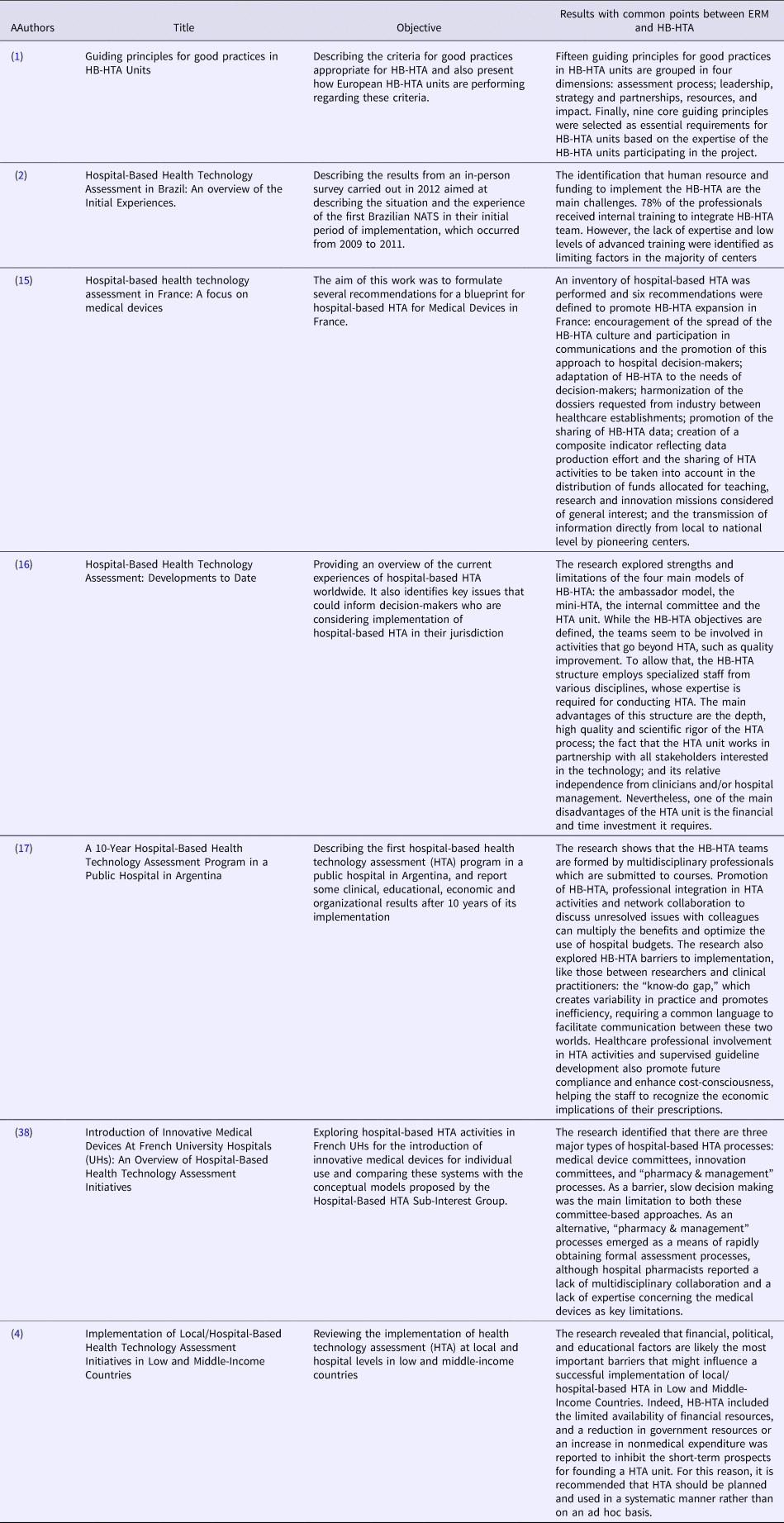
Seven papers focused on HB-HTA were analyzed (Table 1). After analyzing the papers, it is possible to highlight that the authors agree that the HB-HTA contribution to the decision-making process is essential and its alignment with the organizational values and strategies is fundamental. The use of a systemic HB-HTA process is important so it will be engaged with the hospital culture and routine, and educating employees about the subject, its importance, and responsibilities is essential to add HB-HTA to the hospital culture. Economics, clinical, and management background are important to conduct the activities; accessing money to implement it is an important barrier and the stakeholders’ engagement in the process to assess it is extremely important.
HB-HTA Literature Review

Framework to Guide E2RMhealthcare Application and Its Association with HB-HTA Application Orientations
HB-HTA and ERM have their own processes with different goals, but they share some activities and principles. With the objective of making processes more effective and sustainable, collaborative points exploring the previous ERM and HB-HTA literature were identified. Considering the ERM model differential proposed by Etges et al. (Reference Etges, Grenon, Souza, Kliemann and Felix14), which suggests activities to apply ERM fragmented in four levels (baseline, education, quantitative, and governance), this research highlights opportunities to integrate ERM with HB-HTA in each level.
Baseline
At the baseline level, a healthcare organization focuses on the identification, analysis, and ranking of its risks by using multi-criteria decision analysis (MCDA), such as analytical hierarchy process (AHP). This methodology allows for the ranking of risk events relative to each other. It contrasts with a more common approach of ranking risks individually using an ordinal scale. The advantages of multi-criteria decision analysis include a more accurate risk analysis and more consistent results.
The use of AHP to prioritize factors, risks, or important criteria in healthcare has been applied by different authors (Reference Abbasi, Khorasani, Etminani and Rahmanvand18–Reference Sun, Tong and Li20). In addition, different MCDA are receiving more attention in healthcare during the past years with different success applications as it is suggested on the systematic review developed by Wahlster et al. (Reference Wahlster, Goetghebeur, Kriza, Niederländer and Kolominsky-rabas21) and present on the discussion developed by Morton (Reference Morton22). Our different approach here is to apply MCDA oriented to enterprise decision-making process in healthcare, associating risks with strategic and technological goals and actions, and using a managers-friendly interface. Through this application, health organizations create an opportunity to manage enterprise risks oriented to achieve the strategic goals successfully, contributing with organization value creation flow. The HB-HTA team usually is able to incorporate these methodologies during the technology assessment process and can share knowledge and resources to conduct these activities.
The baseline level also includes the formulation of action plans for certain risks and communication with the Board of Directors. Risks heat-maps are developed to contribute with the organization capability to transmitting and involving employees on a risk management culture. All the organization context, strategic objectives, and value should be included on the ERM process to make it align with the hospital culture. For the HB-HTA team, this need is not different (Reference Sampietro-Colom, Lach and Wasserfallen1;Reference Grenon, Pinget and Wasserfallen23). This is an important moment of cooperation between teams, which can make the use of board agendas more effective, performing advanced methods and especially fostering employee recognition due to the value represented by these teams to the hospital.
Education
At the Education level, a healthcare organization focuses on developing material and tools to increase the level of ERM knowledge amongst all employees and the Board of Directors. One of the studied healthcare institutions recommended the elaboration of a risk inventory. A risk inventory that contains a detailed description of risk events and specific examples should contribute to create a shared understanding of risks and improve communication between departments (Reference Etges, Grenon and Lu12).
With the objective of becoming educated, the HB-HTA and ERM teams may work together. HB-HTA units should be willing to improve from their experience and should be open to learn and innovate (Reference Sampietro-Colom, Lach and Wasserfallen1). Using the vision and the education and research capabilities of the HB-HTA team to engage employees on risk management can make the education process easier. In addition, HB-HTA increase its own capability of always being updated about the strategic risks being discussed, aligning the technology assessment with the hospital board plans.
Quantitative
At the quantitative level, the healthcare organization works on determining the economic impact of selected risk events using financial data. Cost management methodologies as activity-based costing (Reference Cooper and Kaplan24) or time-driven activity-based costing (Reference Kaplan and Anderson25) can be considered to measure the direct and indirect impact of risk events on the healthcare organization. Economic indicators as value at risk (VaR) or cash flow at risk (CFaR) and the use of simulation techniques, as Monte Carlo simulation, can be applied to estimate the variability in cost and revenue. Budget for risk treatment should be developed and include return of investment analysis.
At this level, the interaction with HB-HTA team can be strongly positive. The cost analysis and the economic valuation background focused to healthcare business are essential to develop the quantitative level focused on economic risk assessment. HB-HTA professionals are usually prepared to apply those economic methods (10), while the risk management professionals are prepared to analyze the economic results from a systemic and strategic perspective (Reference Bromiley, McShane, Nair and Rustambekov5). Joining the teams for these economic analyses contributes for the decision-making process to be based on advanced methods and connected with the organizational strategic position.
Governance
Lastly, at the governance level, the healthcare organization focuses on the quality of information transmitted to its stakeholders to improve the corporate governance process. The enterprise risk manager may work near to the organizational C-level, being able to communicate them weaknesses at different corporate levels and improve the strategic decision-making process. Therefore, establishing leadership is important in both teams (8;10;Reference Etges, Grenon, Souza, Kliemann and Felix14;Reference Martelli, Puc and Szwarcensztein15). The HB-HTA and ERM leaders must guide the pace of employee engagement. Compliance is also a goal of the board directors and is related to ERM and HB-HTA activities that promote more engagement, considering legal requirements and information transparency (Reference Attieh and Gagnon4;Reference Aven and Aven7;Reference Fraser and Simkins26).
Sharing resources and innovation with the HB-HTA process contributes to the quality governance that can be achieved. Another important achievement is cooperation with the value-oriented health organization management and its efficiency.
HB-HTA and ERM Common Principles
By understanding how ERM and HB-HTA share common objectives, it is possible to highlight that guiding a better decision-making process through technical analysis is the main objective of both processes. At the more embracing ERM perspective, it is achieved by using internal and external information; at the more focused HB-HTA perspective, it is achieved by improving decisions oriented to increase efficiency of care with technology and support health policies about technology incorporation.
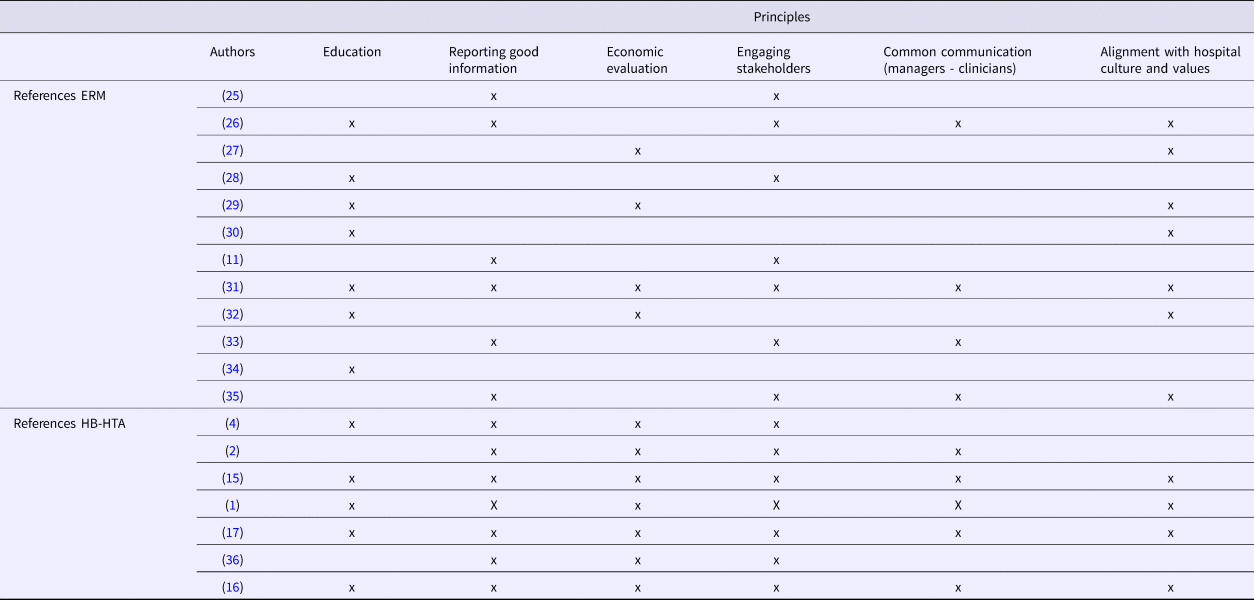
In addition, authors from both sides and especially interviewed managers expressed that one important barrier is accessing enough money to invest and operationalize those teams in the hospital (Reference Attieh and Gagnon4). This last issue contributes to one of this research's objectives focused on identifying activities where ERM and HB-HTA teams can share background and effort to contribute to hospital value creation. Table 2 illustrates common ERM and HB-HTA principles that are expressed in literature.
ERM and HB-HTA Literature Analysis to Identify Common Principles
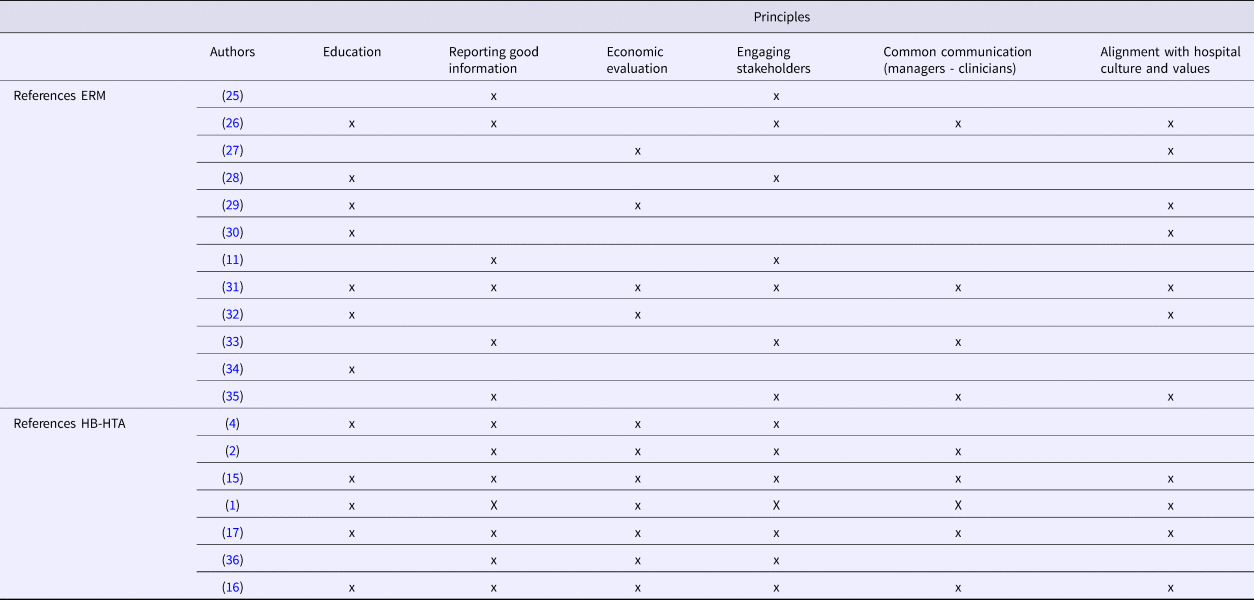
Based on Table 2, it is possible to assume that education, reporting good information, economic evaluation, engaging stakeholders, common communication, and alignment with hospital culture and values are highlighted for more than 50 percent of HB-HTA and ERM authors. Engaging stakeholders is mentioned by 80 percent of authors. These results confirm that, although ERM and HB-HTA teams have different positions and functions in the hospital, they need to develop similar activities to achieve their specific objectives with the vision to contribute to hospital decision-making process. Exploring these common points and sharing personal resources may contribute to the hospital sustainability to develop both processes in its own structure.
Capability to Share Personal Resources between HB-HTA and ERM Teams
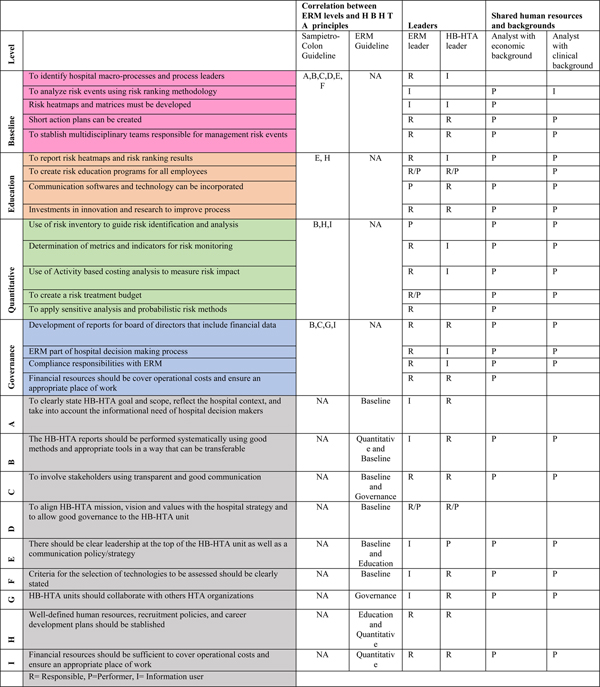
The manner in which ERM and HB-HBA processes can work sharing responsibilities, professionals and activities, making both units more effective and sustainable, was consolidated in the following analysis. The guiding framework of E2RMhealthcare and the nine prerequisites for setting-up and running HB-HTA suggested by Sampietro-Colom et al. (Reference Sampietro-Colom, Lach and Wasserfallen1) were inter-associated. In addition, the common personal resources to perform the processes activities were detailed, identifying how the personal background can be shared by them and elucidating when each professional is a responsible, a performer or an information user of each activity. Figure 1 expresses the results.
Guidelines to implement E²RMhealthcare and HB-HTA

Considering the personal resources identified, the literature, and interviews, it stands out that there is not a unique profile. The economic analyst may have different academic education (economics, engineering, account, others), but needs to be introduced to the healthcare business and needs to be able to build economic models and perform HTA and risk analysis. For the clinical analysts, independently of base university background, it is expected that they can be educated to conduct HTA, engaging in the enterprise management activities and acquainting with quality, safety, and risks programs.
As a last common characteristic, engaging in research processes and activities is also expected for both processes. This is essential for HB-HTA, considering the responsibility of publishing and validating new technologies outside the hospital. The ERM team is expected to share risk-innovation findings with other centers, to develop risk benchmarking studies, and to advance jointly with solutions to avoid and explore risks.
Advances in technology systems also consider the inclusion of the patient at all times and quick transmission of patient information to the employees who are involved with patient care, thus making the healthcare process more efficient. The ERM and HB-HTA teams can contribute to the health culture, improving the institutional capability to deliver better quality, safety and technology to the patient.
Considering the opportunity to innovate and to improve the organizational technology capability, it is understood that the use of this integrated structure can be useful on organizations composed by multiples business units (group of: hospitals, clinics, insurers, others). For these organizations, the implementation of ERM and HB-HTA processes working in integration contributes to maintaining the investments of all the organization aligned with financial responsibility and oriented to create value to the group.
Conclusions
This research identified and explored how HB-HTA and ERM processes can share resources and skills to achieve principles with more efficiency, allowing value-oriented results. The identification of common principles, objectives, and capabilities between ERM and HB-HTA processes found in this study suggests advances for the literature on both research areas. Its application in a health organization with multiple business units opens an opportunity to use the guidelines in a practical case study to analyze the economic impact of having these processes integrated. In addition, the principles and guidance to implement E2RMhealthcare are presented in four levels, making its implementation a systemic process that can be crossed with the HB-HTA previous principles known in the literature.
Educational programs shared by all employees, financial data, and the ability to routinely report risks and technology information to stakeholders are identified as common objectives for both processes. The opportunity to share human capital between HB-HTA and ERM also contributes to the implementation of these processes in hospitals with less financial resources, approaching its own management to be more efficient with the care chain.
As a continuity for this research, to develop a case study of an application of HB-HTA and ERM processes considering a sharing of skills and principles discussed is recommended to validate this integrated model.
Acknowledgements
We acknowledge The Risk Authority Stanford by providing the opportunity to contact managers from North American health organizations and The Federal University of Rio Grande do Sul by providing the orientation for the PhD research behind this paper. In addition, we acknowledge all the respondents
Funding
This research did not receive any funding. A.P.B.S.E. selected the sample of respondents, conducted the interviews, conducted the data transcriptions, analyzed the papers, analyzed the data, has been involved with all the writing process. V.G. selected the sample of respondents, conducted the interviews, analyzed the data, and reviewed the paper. E.A.F. reviewed the methods, results, and the paper. J.S.S. reviewed the methods, results, and the paper. K.F.N. reviewed the methods, results, and the paper. C.A.P. reviewed the methods, analysis, results, and the paper, in addition to conducting the discussion and conclusions orientation.
Conflicts of interest
None of the authors have any competing interests.