




No CrossRef data available.
Article contents
Distinguishing African American English from developmental errors in the language production of toddlers
Published online by Cambridge University Press: 01 November 2005
Abstract
This study examined the use of nonstandard forms in the language production of typically developing toddlers. Forty-four African American and White children, ages 2.5 and 3.5 years, were assigned to one of four groups based on their chronological age and linguistic background. Language sample analysis and a listener judgment task were used to evaluate nonstandard speech. Results indicated that 2.5- and 3.5-year-old toddlers from African American English backgrounds produced similar amounts of nonstandard speech. However, 2.5-year-old toddlers from standard American English backgrounds produced greater amounts of nonstandard speech than their 3.5-year-old peers.
Information
- Type
- Articles
- Information
- Copyright
- © 2005 Cambridge University Press
Previous studies that have documented the language development of children learning to speak English have focused too narrowly on the acquisition of standard American English (SAE), paying only minor attention to the language development of children from culturally and linguistically diverse backgrounds. Subsequently, this oversight produced descriptions of language behaviors and milestones that seldom examined linguistic variability and variation within the developing English linguistic system. Given this trend, there is scant information available about the development of language in children who may have been acquiring another dialect such as African American English (AAE).
For the purposes of this study, AAE will be defined as a social dialect in which optional variability is accepted and unique lexical, grammatical, and phonological features are used during language production (Wolfram, Adger, & Christian, 1999). Currently, AAE is one of the most frequently studied “nonstandard” varieties of the English language (Baugh, 1997; Crystal, 1999). In contrast, SAE will be defined as the standard language variety used by educated, mainstream Americans. Within the SAE dialect there is minimal use of socially marked forms (Wolfram, 1991). This distinction between standard and nonstandard varieties of a language is primarily based on sociological judgments, rather than linguistic ones. For that reason, many of the features associated with AAE have been labeled as socially stigmatizing forms and it is these nonstandard forms that are of interest for the current study. Children from both SAE and AAE backgrounds produce a number of nonstandard forms that do not follow the standard language variety spoken by mainstream adults. The focus of the present investigation is to determine whether it is possible to distinguish between developmental errors that are common across children from different dialectal backgrounds and the early use of AAE vernacular.
To date, there have been few reports that examine the development of the features associated with AAE use in children. This problem persists even though it has been reported that a large segment of African American adults and children use AAE (Dillard, 1972; Rickford, 1999; Wolfram et al., 1999). The examination of variations within and across linguistic systems is especially important for research concerned with documenting the language development of children from linguistically diverse backgrounds. Inquiry about the course and sequence of dialect development will play a significant role in future research that focuses on the evaluation and treatment of language disorders in populations who use a dialect other than SAE.
There are a substantial number of gaps in the literature on AAE use. The majority of descriptions concerning the development of AAE forms have focused primarily on preschoolers and school-age children (Isaacs, 1996; Stockman, Vaughn–Cooke, & Wolfram 1982; Washington & Craig, 1994; Wyatt, 1991). The most frequently cited studies of AAE use in toddlers or children below the age of four remain unpublished (Blake, 1984; Cole, 1980; Reveron, 1978; Steffensen, 1974). Many of the early investigations that did examine the use of AAE in children primarily sought to discredit claims that described the language development and production of African American children as deficient and inferior. In discrediting these claims it was necessary to highlight findings of similar linguistic behaviors between African American and White children from SAE backgrounds; any differences that did appear were considered to be a simple byproduct of early developmental changes (Cole, 1980; Kovac, 1980; Stockman, 1986). Today it is recognized that differences are not the same as deficits, and that linguistic and cultural differences do impact the development of language in a variety of ways.
Recently, it has been suggested that children's linguistic systems, however incomplete, are already adapted to the structural or statistical regularities of their parent language by 24 months of age (Boysson–Bardies & Vihman, 1991; Ingram, 1995). This incomplete, yet “culturally specific,” system is believed to provide the foundation for later grammatical development (Valian, 1999). A substantial number of African American parents and caregivers, who shape the linguistic environment of their children, use an adult form of AAE that differs in varying degrees from SAE. As a linguistic system in its own right, AAE tends to vary along lexical, grammatical, phonological, prosodic, and discourse dimensions. This means that it is likely that children do demonstrate some dialect specific characteristics even during the earliest stages of language development.
During the early years of development, children from AAE and SAE backgrounds have a tendency to produce similar unmarked forms that indicates a common language-learning process. However, this common language-learning process does not nullify the possibility of differences. There are very few reports on the use of developmental errors that are similar to the features of AAE, such as variable copula absence (e.g., “He fat”), that occur during the language production of typically developing children who are from SAE backgrounds (Berko, 1958; Menyuk, 1964). In addition, there are no reports that have examined the use of AAE-like features, which have no equivalent SAE contrast (i.e., aspect and tense markers such as habitual be, go as copula) in young SAE speakers. The primary focus of most investigations has been on the acquisition of adultlike SAE forms (Brown, 1973; deVilliers & deVilliers, 1973; Lahey, Liebergott, Chesnick, Menyuk, & Adams, 1992). In essence, there are relatively few data concerned with the study of AAE-like forms produced by young SAE speakers to support the notion of similar developmental patterns and few differences in the early language productions of young AAE and SAE speakers. Given that there is such a limited amount of research concerning the use of AAE forms during the toddler years it would be premature to conclude that the use of linguistic forms typically associated with AAE are simply developmental errors.
Lack of sufficient data on the language of young dialect users has a number of implications. Clinically, the assessment and treatment of language disorders in speakers who use a dialect such as AAE is compromised when empirical data are limited (Seymour, Bland–Stewart, & Green, 1998; Stockman, 1996; Washington, 1996). In addition, expanded descriptions of the language behaviors of young AAE and SAE speakers can provide researchers with more information on the variability of linguistic forms. Such information will be extremely useful for individuals concerned with the construction of culturally fair assessment for children. In addition, continued examination of when AAE makes its first appearance in the language of children can provide the field with more information regarding cultural influences upon the development of language (Stockman, 1996). If there is evidence of early use of AAE, this might also suggest that there needs to be some specific and uniform resolution of public policy and educational practices regarding the language of instruction for speakers for whom SAE is not their mother tongue.
RESEARCH QUESTIONS
AAE and SAE dialects develop through children's interactions with the ambient language in their speech community. The purpose of this study was to determine the point at which a distinction can be made between AAE and developmental errors, given that the use of many “nonstandard” forms in early SAE mimic features of AAE. To determine if the use of these nonstandard forms was influenced by dialectal background or developmental factors the following questions were posed:
- Do toddlers from AAE backgrounds demonstrate quantitative differences in their production of nonstandard forms compared to peers from SAE backgrounds?
- How does age influence production of nonstandard forms across backgrounds?
- Is there evidence of AAE use in the language production of 2.5- and 3.5-year-old toddlers based on listeners' perceptions of their speech?
- What is the relationship between the production of nonstandard forms in spontaneous conversation and listeners' perceptions of dialect usage?
A comparative framework was employed to answer the questions about dialectal influences. Comparative frameworks used for the study of dialect in child language have been justifiably criticized. Earlier investigations examining the language abilities of African American children often characterized their language and environmental input as deficient and inferior to that of their White peers or compared groups in which a large number of factors, such as socioeconomic status (SES), may have influenced the findings (Bereiter & Engelman, 1966; Orr, 1984). As a result, an increasing number of studies have utilized designs in which intragroup comparisons are made (Cole & Taylor, 1990; Stockman et al., 1982; Washington & Craig, 1994) when examining the language abilities of African American children.
However, it can be argued that comparative frameworks provide an effective model for examining language variability and change. Empirical data from cross-dialectal comparisons may even prove to be beneficial in learning more about language universals (Stockman, 1996). In particular, it has been asserted that many of the children who use AAE receive or will receive exposure to mainstream SAE, so the use of a group of children who receive the maximum amount of exposure to SAE is ideal for the purposes of this investigation.
For the current study, it was predicted that effects for age and dialect status would influence the dialect measure obtained from language sample analyses. It was also expected that there would be a significant interaction between age and dialect status, such that as age increases children in the SAE dialect status group would demonstrate less use of the nonstandard forms typically associated with AAE. However, this trend was not expected for toddlers from the AAE dialect status group; in fact, their use of AAE dialectal features was expected to increase with age. It was predicted that listeners would be able to accurately identify race and dialect status for the majority of excerpts. In addition, it was expected that the mean ratings for AAE usage would be higher for toddlers from AAE backgrounds than for toddlers from SAE backgrounds. Listener judgments were expected to correspond to the production of AAE vernacular forms in the spontaneous language samples. Confirmation of one or more of these predications would suggest that, in addition to developmental processes, dialectal background does influence the production of nonstandard speech during the toddler years.
METHOD
Participants
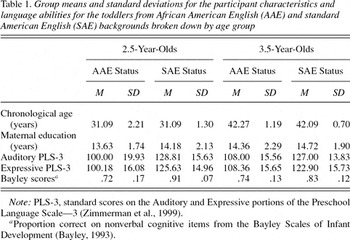
Forty-four typically developing African American and White toddlers participated in this investigation. Children were assigned to one of four groups based on chronological age and dialect status. Group 1 consisted of 11 2.5-year-old African American toddlers from AAE backgrounds (M=31.09 months, SD=2.21), and Group 2 consisted of 11 2.5-year-old White toddlers from SAE backgrounds (M=31.09 months, SD=1.30). Group 3 consisted of 11 3.5-year-old toddlers from AAE backgrounds (M=42.27 months, SD=1.19), and Group 4 consisted of 11 3.5-year-old toddlers from SAE backgrounds (M=42.09 months, SD=.70).
Each child's primary caregiver completed a background form that elicited information about medical and developmental history. Children with a suspected history of hearing loss, chronic otitis media, or developmental disabilities were excluded from this study. All children who participated in this investigation passed the required hearing screening. Hearing was screened using distortion product otoacoustic emissions guidelines set forth by the Joint Committee on Infant Hearing (2000). Cognitive functioning was assessed based on children's performance on nonverbal items from the Bayley Scales of Infant Development, second edition (Bayley, 1993). Language ability was assessed using the Preschool Language Scales—3 (PLS-3) developed by Zimmerman, Steiner, and Pond (1992). All children participating in this study scored no lower than 1.25 SD below the mean for their age on both portions of this measure. Given the potential for cultural and linguistic bias, a score no lower than 1.25 SD below the mean was considered to be an adequate determination of normal range language performance.
Each of the linguistic groups was matched as closely as possible within and across age levels based on the distribution of maternal level of education, as measured by the number of years of schooling; this is an index of SES that has been shown to be related to language development (Chapman, Schwartz, & Kay–Raining Bird, 1995; Hoff–Ginsberg, 1991). See Table 1 for a complete description of participant characteristics and language ability. To ensure that differences in SES and chronological age were not responsible for differences in the amount and appearance of AAE features, group comparisons using independent sample t tests were carried out on these two variables among the four groups. The differences in chronological age for the 2.5-year-old AAE and SAE groups and 3.5-year-old AAE and SAE groups were not significant, t(20)=0, p=1, and t(20)=−436, p=.667, respectively. Differences in maternal level of education between the 2.5-year-old AAE and SAE toddlers were not significant, t(20)=.655, p=.520, and the differences between the 3.5-year-old AAE and SAE toddlers were not statistically significant, t(20)=.405, p=.690. In addition, there were no significant differences in maternal level of education among those 2.5- and 3.5-year-old toddlers from AAE backgrounds, t(20)=−.837, p=.413; or those 2.5-year-old and 3.5-year-old toddlers from SAE backgrounds, t(20)=−.632, p=.534.

Dialect status group, as assigned by the first author, was based on exposure to AAE and SAE, and determined by the following factors: parental dialect use; peer language use; and daycare provider language use. Parents who demonstrated use of at least four AAE features (across phonological, morphological, and syntactic areas) during a 15-min parent–child language sample were considered to be AAE users and their toddlers were assigned to the AAE status group. Parents who demonstrated use of no more than one feature associated with AAE and their toddlers were assigned to the SAE status group.
Within the context of this investigation, at least half of the children did attend daycare, so a brief description of each daycare where these participants were recruited is in order. The first daycare facility comprised African American staff members who were heavy AAE users with only the directors demonstrating code-switching abilities once they were interacting with “outsiders” or visitors. The second daycare facility from which some of the participants were recruited was made up of a diverse group of White families from a variety of social backgrounds, with working class families being well represented.
Data collection
A 15–20-min language sample was collected from each child during a semistructured free-play context. These samples involved interaction between each child and the examiner. The examiner who elicited language samples from children with AAE backgrounds in the present study was an African American examiner who used AAE. This same examiner “code switched” to the use of SAE while eliciting language samples from children who were from SAE backgrounds. Code switching, in this instance, means that an SAE register was adopted and the examiner's speech included SAE grammatical and phonological forms, in addition to prosodic and acoustic characteristics. Materials for the free-play context consisted of a standard set of toys, including a dollhouse, its accessories, and family member play figures. Language samples were recorded using a Marantz audio-recorder, a SONY video recorder, lapel microphone worn by the examiner, and a PZM microphone placed at floor level (next to the participant) to enhance video sound recording.
Procedure
Language sample analysis
Language samples were orthographically transcribed from audiotapes using Systematic Analysis of Language Transcripts (SALT; Miller & Chapman, 2000). The transcribers involved with this project were graduate students in communicative disorders who had received training in the use of language sample analysis using SALT and had completed graduate coursework in clinical phonetics. Prior to this investigation, these individuals had transcribed a substantial number of language samples involving toddlers and preschoolers (ages 2–4 years). The transcribers were not apprised of the research questions for this study; furthermore, they were not familiar with the speakers and were only given information related to age and gender of the child. Utterance segmentation was based on standard SALT procedures, which define an utterance as a verbal production typically separated by pauses and/or intonation cues and allowing no more than two independent clauses.
Coding for features of AAE
Coders examined each of the completed samples and assigned a feature type to each of the nonstandard forms based on a compiled list of features typically associated with use of AAE that have been previously observed in children 4 years of age or younger (see Appendix A). Coders were trained in assigning AAE type codes by the first author during an earlier project examining AAE use in children (Horton–Ikard, Weismer, & Evans, 2001). Other features of AAE that appeared in the children's language sample but had not been previously examined for this age group were also noted (go as copula, got/has, and existential it/they). Frequencies of the various types of AAE features were obtained to aid in the calculation of total number of features and dialect density for each child's sample and transferred into a database for later statistical analyses.
As samples were transcribed, each child's transcript was marked for instances of AAE morphosyntax and phonological form usage. Although there was no comprehensive phonological analysis completed for these samples, selected phonological transcription was undertaken (orthographic transcripts were examined for words originally selected as demonstrating AAE phonological form usage, as well as opportunities for occurrence of the phonological features under investigation; see Appendix A). These utterances were then transcribed using broad phonetic transcription (IPA; Shriberg & Kent, 1995). The first author, who has clinical experience in the phonetic transcription of children's conversational speech, then listened to each sample using the original orthographic transcript with the broad representation as a guide and completed a more narrow transcription for words containing the phonological features under investigation using procedures from Pollock and Meredith's (2001) system for transcribing AAE phonological features.
Language sample variables
Standard SALT measures and a dialect density rate were obtained for each sample. Standard SALT measures include the calculation of mean length of utterance in words (MLUW), type-token ratio, and mean turn length. The calculation of MLU involved the use of an analysis set that eliminated single morpheme responses, yes/no acknowledgments and answers to questions, and responses to intonation prompts. Calculating utterance length in this fashion controlled for possible pragmatic and discourse variables that have been shown to influence MLU values (Johnston, 2001; Klee & Fitzgerald, 1985).
Dialect density rate (DDR) was calculated by dividing the number of AAE tokens by the number of words appearing in the child's sample (Oetting & McDonald, 2002; Washington & Craig, 2002). It should be noted that the dialect density measure does not imply that the children from SAE backgrounds are using AAE dialect. This measure simply indicates how much of their talk contains those developmental errors that tend to mimic forms associated with the AAE dialect.
Transcription and coding reliability
The reliability procedures for the orthographic transcription of language samples using the SALT program were as follows. One person initially transcribed and entered each sample into the program. A second person then listened to and reviewed the same sample to note and correct errors or disagreements about coding decisions and actual transcription of utterances with the first transcriber. Eight out of 44 of the participant samples (22%) were selected to examine agreement for utterance segmentation and morpheme by morpheme transcription. Initial agreement for utterance segmentation was 96% (760 agreements, 792 total judgments); morpheme by morpheme transcription agreement was 90% (3647 agreements, 4052 total judgments). Point by point agreement on the identification of AAE morphosyntactic features was 88% (246 agreements, 279 total judgments).
Reliability of phonetic transcription was completed on 4 out of 44 (11%) of the samples. Using Shriberg and Kent's (1995) guidelines for reliability of phonetic transcription, rates of agreement between transcribers for broad phonetic transcription were determined to be 89% (883 agreements, 992 total judgments) for consonants and 81% (498 agreements, 617 total judgments) for vowels. An independent transcriber, a graduate student in communicative disorders with numerous hours of research experience transcribing children's language samples, transcribed four randomly selected samples from the original samples of the 44 participants, using the suggested procedures of Pollock and Meredith (2001) for phonetic transcription in a similar manner as the first author. The independent transcriber's samples were then compared to the original samples to determine what percentage of the time the two transcripts matched. Agreement between the independent transcriber and the first author was 83% (187 agreements/220 total judgments). In addition, the independent transcriber was asked to identify opportunities for occurrence of the phonological features under investigation; agreement was at or above 90% for all features.
Listener judgment task
Stimuli
For each participant, the first 12 multiword child utterances were extracted from the larger language sample to create the stimuli used to make judgments. In other words, no examiner utterances were incorporated into the stimuli. Once the first 12 consecutive, multiword utterances were identified for each of the participants, the children's samples were dubbed onto an audiotape in random order.
Listening Task
Five African American graduate students from the University of Wisconsin campus were selected to participate in this portion of the study. Four out of five of the listeners were former early childhood and elementary school teachers who were familiar with children's use of AAE given that they had taught in major urban centers where AAE was the home language of their school population. The fifth listener was an African American doctoral student who had served as a coach and mentor to various community organizations serving African American children. Although this study does not examine the dialect usage of listeners, it was imperative that listeners be familiar with AAE to make accurate judgments about dialect usage.
Listener dialect status and familiarity with AAE was assessed using a 5-min conversational interview to detect the use of AAE features. In addition, listeners were given a training period and brief survey to assess their ability to evaluate various dimensions/areas of dialect use. The training materials and audio survey, used to assess listener's ability to evaluate pronunciation, grammar, stress/intonation, and vocabulary, was adapted from the Dialect Awareness Task developed by Wolfram et al. (1999). As a part of this task, the listeners were also exposed to 5-min excerpts from two child AAE speakers and two SAE speakers (who were not participants in this study) so that they could become familiar with children's use of AAE. Once it was established that the listener was familiar with AAE and able to accurately evaluate dimensions of dialect use (a score of 80 or better on the survey), a practice task that included excerpts from three different children was administered in which listeners were able to ask questions regarding the instructions. The formal judgments began following completion of the practice task.
For each excerpt, listeners were asked to make decisions about the child's use of dialect and identify the child's race. A listener-rating sheet with the use of a bipolar adjectival scale labeled “Standard English Dialect Use” and “Nonstandard English Dialect Use” for judging a child's speech was used to measure the responses for each excerpt (see Appendix B). The term “Nonstandard Dialect Use” rather than “AAE Dialect Use” was employed for a variety of reasons. Dialect use tends to operate on a continuum for most speakers (Baugh, 1999). It was imperative that the scale reflected this, while at the same time recognizing that the listeners' perceptions of AAE dialect use were our primary area of interest. In addition, during the initial piloting of the task, listeners were unsure of how to rate the speech of children whose usage of AAE or SAE features did not seem to correspond to their perceptions of the child's race; therefore, it was necessary to remove racial identification from potential linguistic determination. Interrater agreement between the judges was calculated for judges' ability to rate dialect use. The relative strength of agreement was evaluated using kappa statistics. Kappa values for the judges ranged from .45 to .72, indicating moderate to substantial agreement in judgments.
RESULTS
Language sample data
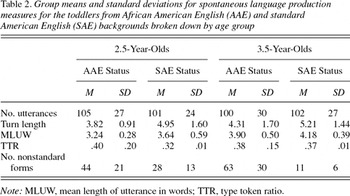
Preliminary analyses were conducted to establish that the language samples obtained across the groups of toddlers were roughly equivalent with respect to standard language production measures based on SALT analyses (see Table 2). Table 2 also summarizes the mean number of AAE forms produced by each of the groups. The mean number of utterances produced by the children was comparable across all groups. There were no significant differences in MLUW between the 2.5-year-old AAE and SAE toddlers, t(20)=2.07, p=.062. In addition, there were no significant differences in MLUW between the 3.5-year-old AAE and SAE toddlers, t(20)=1.35, p=.194. As expected, there were significant differences in MLUW for the 2-5- and 3.5-year-old AAE toddlers, t(20)=−2.48, p=.02, such that the older group of AAE toddlers demonstrated significantly longer MLUW values. In addition there were significant differences between the 2.5- and 3.5-year-old SAE toddlers, t(20)=−3.16, p=.005, such that the older group of SAE toddlers also demonstrated significantly longer MLUW values.

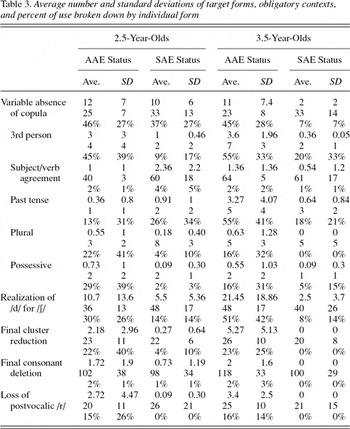
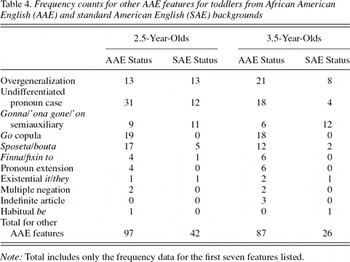
A two-part descriptive analysis of the forms produced was conducted to determine if the production of these individual forms was similar across all groups. The AAE forms were separated into two categories. Category 1 included those forms with an explicit SAE obligatory context. Category 2 was comprised of those forms without an explicit obligatory context. Table 3 provides a summary of descriptive data for each groups' production of the Category 1 forms and opportunities for use. Table 4 provides frequency data for the Category 2 AAE forms.


Part 1 of the descriptive analysis examined the percentage of use in possible contexts for the Category 1 forms listed in Table 3. This type of examination revealed two primary findings. First, there were very few differences across groups in the average number of obligatory contexts for each of the individual forms across the groups. Second, the average percentage of feature use in contexts for the AAE forms listed in Table 3 tended to be greater for both groups of AAE toddlers.
Part 2 of the descriptive analysis examined the frequency data for the Category 2 features listed in Table 4, those features without an explicit SAE obligatory context. Combining the frequency data for the first seven of these forms resulted in a composite value referred to as “other AAE features.” These seven features were selected because they occurred in at least one of the four groups a minimum of five times. Examination of these data indicated that the other AAE features occurred two times more frequently for AAE toddlers than for SAE toddlers.
Tables 3 and 4 also revealed several interesting trends for individual form production within the two linguistic groups. For example, within the group of AAE toddlers the use of variable copula absence is virtually the same regardless of age but phonological realization of /d/ for /

/ was greater for the 3.5-year-old AAE toddlers. In addition, for the other AAE features there was very little difference in the production of the go copula for both age groups of AAE toddlers. However, the 3.5-year-old AAE toddlers demonstrated less use of undifferentiated pronoun case. The 3.5-year-old AAE toddlers also demonstrated greater use of overgeneralization than their 2.5-year-old peers. These findings are very different from the developmental trend that seems to occur for the SAE toddlers. The 3.5-year-old SAE toddlers used variable copula absence and phonological realization of /d/ for /
/ with less frequency than their 2.5-year-old peers. In regard to the other AAE features, the older SAE toddlers produced a smaller number of the go copula, undifferentiated pronoun case, and overgeneralizations when compared to their younger peers.
Examination of both Tables 3 and 4 revealed that a very large proportion of the frequency data was comprised of primary use of the following six forms: variable copula absence, go copula, phonological realization of /d/ for /
/, supposedta, undifferentiated pronoun case, and overgeneralization. Essentially, these six features accounted for 55–70% of the total amount of nonstandard forms used by all four groups. Using the frequency data for these six forms, mean DDRs for each of the groups was calculated given that the frequencies of the other forms were too low to support any meaningful analysis (see Table 5).

To answer the questions regarding the effects of dialect status and age on the use of nonstandard speech production, a 2×2 between-subjects analysis of variance (ANOVA) was used to analyze the data. The dependent variable was DDR and the independent variables were Age and Dialect Status. The analysis revealed a significant effect for dialect status, F(1, 40)=17.16, p=.00, ηp2=.30. However, the ANOVA also revealed a significant interaction effect for Dialect Status×Age Group, F(1, 40)=4.82, p=.034, ηp2=.108. Simple main effects indicated that differences between the 2.5-year-old AAE and SAE toddler groups were not significant, F(1, 20)=1.43, p=.245, ηp2=.067, while differences between the 3.5-year-old AAE and SAE toddler groups were significant F(1, 20)=29.6, p=.0, ηp2=.597. As can be seen from Table 5, the 3.5-year-old AAE toddlers demonstrated greater DDRs than their same age peers. Table 5 also indicates that there were no significant differences in DDRs for the 2.5- and 3.5-year-old AAE toddlers, F(1, 20)=.57, p=.46, ηp2=.03. However, this was not the case for the SAE toddlers. The 2.5-year-old SAE toddlers demonstrated greater DDRs than their older SAE peers, F(1, 20)=7.54, p=.012, ηp2=.27. The main effect of dialect status and the effect involving differences between the 3.5-year-old AAE and SAE toddlers were relatively large, accounting for more than 50% of the variance. The remaining effects were small to modest, accounting for 4–18% of the variance. Pearson correlation coefficients were also examined to determine if there was a relationship between dialect density and MLU for both linguistic groups. This analysis revealed nonsignificant coefficient values for the group of AAE toddlers (r=.118, p=.602) and the group of SAE toddlers (r=.067, p=.767).
Listener judgment task
The five judges who participated in this investigation evaluated a total of 44 excerpts on a scale of 1–7, where 1=heavy use of Standard English and 7=heavy use of nonstandard English. Descriptive data pertaining to judges' mean ratings are presented in Table 6. The minimum rating value assigned was a 1 and the maximum value assigned was a 6. For each excerpt used in the task, a mean rating was obtained by dividing the sum of the judges' ratings for nonstandard usage by the total number of judges. Group comparisons were then based on the mean rating.

To investigate additional evidence of AAE feature use in the language production of toddlers, data from the listener judgment task was examined for agreement across listeners for correct identification of dialect and race of the excerpts. A two-way between-subjects ANOVA was used to compare the mean ratings of nonstandard usage with age and dialect status as the independent variables. The ANOVA revealed significant effects for dialect status, F(1, 40)=31.672, p=.000, ηp2=.442, age group, F(1, 40)=4.665, p=.037, ηp2=.104, and the Dialect Status×Age interaction, F(1, 40)=7.004, p=.012, ηp2=.149. Simple main effects were used to evaluate the interaction. Differences between mean ratings for the 2.5-year-old AAE and SAE toddlers were significant, F(1, 40)=4.444, p=.041, ηp2=.100, such that the AAE toddlers received higher ratings of nonstandard dialect use (M=4.582, SD=1.18) than their SAE peers (M=3.691, SD=1.132). Furthermore, differences between the judges' mean rating of 3.5-year-old AAE and SAE toddlers was significant, F(1,40)=34.233, p=.000, ηp2=.461, with AAE toddlers receiving higher ratings (M=4.727, SD=0.826) for nonstandard dialect use than their peers from SAE backgrounds (M=2.255, SD=0.844). Differences between the judges' mean ratings for the two AAE status groups were not statistically significant, F(1, 40)=.118, p=.733, ηp2=.003. However, 2.5-year-old toddlers from the SAE status group received significantly higher mean ratings for nonstandard dialect usage than 3.5-year-old toddlers from the SAE status group, F(1, 40)=11.551, p=.002, ηp2=.224. Similar to the language sample analysis, the largest effect sizes for the listener judgment task were for the main effect of dialect status and the comparison between AAE and SAE groups at 3.5 years. The remaining effects were modest (accounting for 10–22% of the variance).
The accuracy rate for the identification of race was at least 70% for all five judges. The judges' ability to evaluate race with at least 70% accuracy, although not the primary area of focus, indicates that listeners were able to accurately identify the race of the speaker in the participant samples at a rate greater than chance. Other studies have reported accuracy rates for the identification of race to be between 60 and 85% (Oetting & McDonald, 2002; Purnell, Idsardi, & Baugh, 1999). Pronunciation was ranked most frequently as the primary area of dialect that judges used to make their decisions, with stress/intonation being the second area of importance.
To determine if there was an association between the participant's age and the listener's identification of race, the judges' responses were collapsed into a 2×2 contingency table for each of the dialect status groups. There were 11 children per group and five judges. This yielded a total of 55 responses per age group; see Table 7 for distribution of responses based on dialect status group. Statistical analysis yielded a chi-square value of .269 (p=.025) for the children from AAE backgrounds. A chi-square value of .293 (p=.041) was obtained for toddlers from SAE status groups. These findings indicate that listener identification of race was independent of the participants' age, regardless of dialect status.

To determine if there was a relationship between listeners' perception of dialect usage as evaluated by judges' ratings and the DDR, data were screened for linearity among these two variables and correlation coefficients were calculated for each of the groups. Coefficient values for the groups ranged from .367 to .879. The only significant correlations were for the 2.5-year-old AAE and SAE toddlers. For these two groups, dialect density was positively correlated with mean rating scores from the listener judgment task (2.5-year-old AAE group: r=.561, p=.001, r2=.315; 2.5-year-old SAE group: r=.879, p=.000, r2=.773). These values reflect moderate to high levels of association between the listener ratings and dialect density measures for the youngest age range examined in this study.
DISCUSSION
This study examined the production of certain nonstandard forms produced by toddlers from AAE and SAE backgrounds to determine whether it is possible to distinguish early use of AAE from developmental errors that commonly occur for young English speakers. Discussion of the findings is organized in accordance with the four major questions that guided the study.
It was predicted that the effects for age and dialect status would influence the dialect measure obtained from the language sample analyses. The results from the language sampling data suggest that there are both dialectal and developmental factors that seem to be influencing these children's early language production. The fact that the 2.5-year-old AAE and SAE toddlers produced comparable amounts of nonstandard speech indicates that at this age, developmental factors impact production of nonstandard speech regardless of linguistic background. However, the differences in the amount of nonstandard speech produced by the 3.5-year-old AAE and SAE toddlers also indicates that there are early quantitative differences in the use of nonstandard forms between toddlers from different linguistic backgrounds. It may be the case that not only do 3.5-year-old AAE toddlers produce these nonstandard forms because of their linguistic immaturity, but also because they have already begun to internalize the rules and constraints of their adult linguistic models, and this is evidenced in their greater production of nonstandard speech.
Furthermore, the evidence provided by the descriptive analysis highlights two significant points. The first point is that the examination of only those features with the SAE obligatory context (listed in Table 3) may mask some very important differences. The second point is that the quantification of the other AAE features reveals a very specific pattern of linguistic behaviors that can only be attributed to the AAE toddlers. Recall that variable copula absence was similar for both age groups of AAE toddlers, yet the older SAE toddlers were producing smaller occurrences of the copula absence. In addition, for the phonological realization of /d/ for /
/, 3.5-year-old AAE toddlers produced greater instances of this form than their 2.5-year-old peers while the opposite trend occurred for the group of SAE toddlers. This suggests that the developmental trend for these two features is markedly different for children from AAE backgrounds. The data for the other AAE features are somewhat mixed. The trends for the use of undifferentiated pronoun case and sposeta decreased with age across both groups, suggesting that developmental factors are playing a role in the production of these two forms. However, both of these features, in addition to use of the go copula, occurred with greater frequency in both groups of AAE toddlers. The production of the other AAE features cannot be characterized as merely common developmental errors if the SAE toddlers are not demonstrating somewhat comparable production of these forms.
It was also predicted that there would be an interaction between Age and Dialect Status. The findings revealed that although the older AAE toddlers are producing greater amounts of nonstandard forms, the older SAE toddlers are beginning to decrease their use of developmental errors that mirrored AAE feature use. Previous investigations concerned with the use of these features in school-age children suggest that there will be a decrease in the use of such forms as children develop their language (Isaacs, 1996). The current study's use of a younger group of AAE children and significant findings of differences between the two age groups of AAE toddlers, suggest that there are early indicators of a developmental trend regarding the use of AAE. Isaacs (1996) failed to find differences in the use of nonstandard dialect forms between her sample of school-aged African American and White children. It is possible that by the time these children reach their school-age years this trend would not exist. However, many of the previous findings regarding age-related differences in the use of nonstandard forms by African American and White children should be interpreted cautiously, as dialect status was never reported.
The predictions regarding the listener judgment task were also confirmed. Data from the listener judgment task, based on the judges' mean ratings of nonstandard dialect use suggest that again dialect and developmental factors may be simultaneously impacting the production of nonstandard forms. Recall that for children who are 2.5 years of age, the perceived production of nonstandard speech was different across toddlers from different dialect backgrounds, such that AAE toddlers received higher ratings than SAE toddlers. Similarly, for toddlers who were a year older, judges determined that those children who were from AAE backgrounds used more nonstandard forms than their same age peers from SAE backgrounds. The judges did not perceive any difference in the amount of nonstandard speech for 2.5-year-old and 3.5-year-old toddlers from AAE backgrounds. However, among the toddlers from SAE backgrounds the judges were able to detect that the younger group produced more nonstandard forms. These findings are in concurrence with the language sampling data.
Data from the listener judgment task also indicated that listeners were able to accurately identify the race of toddlers for a majority of the excerpts. Dialect is a perceptual phenomenon, and as such, its use can occur along several dimensions. Within the context of this study, the phonological features seemed to have played a significant role in assigning dialect status and identifying the toddler's race. Once the descriptive data of the features produced during the language sampling context were examined it becomes quite clear that the use of phonological realization of /d/ for /
/ may have been the primary cue that the judges unknowingly used to identify dialect use and racial background.
The probable use of AAE by children as young as the ones in this study suggests that even while learning the same language as their peers from SAE backgrounds, cultural influences and linguistic experience work together, so that noticeable differences in the production of language by children and in the perception of their language by adults are occurring. AAE-speaking toddlers are experiencing a distinctly different developmental pattern that can be attributed to their dialect status. It seems then that educational practices that utilize basic principles associated with second language learning to teach SAE are theoretically sound, if we assume that the learning of a new dialect will be a similar process. Advocates of this approach might begin to address optimum periods or stages of development where Standard English instruction should be introduced.
Generalization of findings from this investigation should be interpreted with caution, given some of the limitations of this study. The current study did not attempt to take into account geographic variation associated with AAE use. Although specific information related to local features of AAE is not available, we would suggest that the types of features under examination are similar to those described for other northern midland areas such as Chicago or Detroit (Schneider, 1996; Wolfram & Schilling–Estes, 1998).
Although the use of language sample analysis for the evaluation of language performance has been well documented within the literature, there is relatively little information available on adequate sample sizes to examine dialect use. It may be the case that a longer language sample would have made a difference in the amount or range of particular nonstandard forms produced. However, other studies of children's use of nonstandard forms have been able to successfully evaluate dialect use with 15–20 min samples (Oetting, Cantrell, & Horohov, 2000; Washington & Craig, 1994). On average, a 15-min language sample yielded close to 100 utterances by the toddlers in this study, with a range of different types of nonstandard forms appearing during production. Furthermore, the fact that significant group differences were found on the dialect density measure obtained from the language samples, suggests that these samples were adequate to detect distinct patterns of productions based on dialect status. Nevertheless, it is important to note that more extensive language samples may have produced different findings.
The effect sizes obtained for dialect status were consistently larger when examining data from the language sample analysis and the listener judgment task. Further analysis of the interaction verified that the largest effects occurred primarily with the groups of older toddlers from different dialect backgrounds. It is rather difficult to interpret these effect sizes outside of the context of the current investigation given that previous studies concerning use of AAE seldom reported this information. However, the replication of similar effect sizes in future studies would suggest that the developmental trends of AAE form use demonstrated by the toddlers in this investigation are not coincidental.
CONCLUSION
There is still a great deal of information that we do not know about child use of AAE. The present investigation examined the use of dialect in two different age groups in an attempt to answer questions about the development of AAE. The findings suggest that the production of nonstandard forms by toddlers from AAE backgrounds is not merely a result of normal developmental processes. Toddlers from different dialect backgrounds are not necessarily learning a general form of English that is free from dialect-specific influences, and their linguistic productions reflect this phenomenon. Future research will need to clearly address how this will impact young AAE speakers' transition to the use of SAE for academic purposes.
At a fairly young age, adult listeners are able to discern that AAE and SAE toddlers talk differently. Additional research should begin to examine if use of AAE appears at an earlier age when examining factors such as stress, rate, and intonation, which are frequently perceived as different by listeners but seldom examined in child use of AAE. Cross-sectional approaches such as the one employed here provide us with important data about child use of AAE. However, more longitudinal investigations are necessary if we are to determine the pattern and sequence of development for AAE and definitively distinguish between variations in language due to dialect versus development at these early ages.
APPENDIX A
AAE FEATURES
The descriptions are based on Baugh (1983), Mufwene, Rickford, Bailey, and Baugh (1998), Rickford (1999), Smitherman (1977), Washington and Craig (1994), and Wolfram et al. (1999).
Grammatical
Completive done
- Marks a completed action or event, intensification (I done forgot what you said already.)
Habitual be
- Signifies an event taking place over time (She be at church on Tuesday evenings.)
Remote time been
- Event took place in the distant past or indicates went (I been known her. I been over her house.)
Variable copula absence
- Forms of is/are (including contractibles) do not appear in certain contexts (She a nice teacher.)
Third person singular
- Habitual action of present tense verbs is not marked by -s/-z inflectional forms (He cook every day.)
Subject verb agreement
- Encompasses a variety of grammatical differences in which subject and verb are noncomplementary (The girls was walking home from school.)
Absent past tense
- Specific past tense forms (irregular or not) are variably absent (He say it to me yesterday.)
Go copula
- Used in the context of static event to refer to an object (Here go the book.)
Gonna/Gone semiauxiliary
- May take the form of gonna, gone, ona/on (I/mon do my homework after school.)
Absence of plurals
- Plural suffixes/Irregular forms are not present (They got two cent.)
Absence of possessive
- Possessive form of 's is not included (She went over Carol house.)
Overgeneralizations
- Applying a morphological rule to a word which makes the irregular part of the structure regular or adding inflections where standard English does not use the same form (I helpted him.) (The mens are daddies.)
Pronoun extension
- Object forms are extended to coordinate subjects (My sister and them do too.)
Finna/bouta/sposeta
- Shortened form of about to, suppose to, and fixing to.
Existential it/they
- The use of the pronouns “it” or “they” to indicate the existence of something. (It's a bed upstairs.)
Undifferentiated pronoun case
- No differential use of demonstrative, objective, and nominative pronoun forms. (her crying and her too).
- Use of an object pronoun form with a noncoordinate subject. (Him in the bed) (Her gone go upstairs.)
Multiple negation
- Negative marking of auxiliary verbs and indefinites within a single utterance or multiple negative markings across different clauses. (Can't nothing go up there.) (This ain't no boy!)
Indefinite article
- Article “a” is used regardless of the appearance of vowel. (He got a owie.)
Phonological
Final consonant cluster reduction
- Such as when last becomes las (She be las.)
Realization of /d/ for /
/ in word initial position
- Such as when this becomes dis (Dis is the mama.)
Loss of postvocalic /r/
- Such as when door becomes doe, more becomes mo (She close the doe.) (He want some mo.)
Final consonant deletion
- Such as when right becomes righ (This one go righ_ here.)
APPENDIX B

ACKNOWLEDGMENTS
This project was funded by a Minority Supplement to Grant R01 DC03731 from the National Institutes of Health (NIH), National Institutes on Deafness and Other Communication Disorders, and by The University of Wisconsin's Department of Communicative Disorders Fredric Gruber Award. The authors extend their thanks to the parents, children, and daycare staff of the Early Childhood Learning Centers and the Kids First Daycare Center, who participated in this project; to Jim Kessenich, Jennifer Mulder, Jenny Williamston, Melanie Combs, and Kristen Cameron for the transcription, analysis, and coding of the language samples; and to Chris Hollar for her assistance throughout the data collection process.
References
Baugh J.
1983.
Black street speech.
Austin, TX:
University of Texas Press.
Baugh J.
1997.
Linguistic discrimination in education.
In R. Wodak &
D. Corson (Eds.),
Language policy and political issues in education
(pp. 33–
41).
Boston:
Kluwer Academic.
Baugh J.
1999.
Linguistic perceptions in black and white.
Out of the mouth of slaves
(pp.137–
147).
Austin, TX:
University of Texas Press.
Bayley N.
1993.
Scales of Infant Development
(2nd ed.).
New York:
Cambridge University Press.
Bereiter K., &
Engelman S.
1966.
Teaching the disadvantaged child in the preschool.
Englewood Cliffs, NJ:
Prentice–Hall.
Blake I.
1984.
Language development in working class black children: An examination of form, content, and use.
Unpublished doctoral dissertation,
Columbia University,
New York.
Boysson–Bardies B., &
Vihman G.
1991.
Adaptation to language: Evidence from babbling and first words in four languages.
Language,
67,
297–
319.Google Scholar
Brown R.
1973.
A first language: The early stages.
Cambridge, MA:
Harvard University Press.
Chapman R.,
Schwartz S., &
Kay–Raining Bird E.
1991.
Language skills of children and adolescents with Down syndrome: Comprehension.
Journal of Speech and Hearing Research,
34,
1106–
1120.Google Scholar
Cole L. T.
1980.
Developmental analysis of social dialect features in the spontaneous language of preschool black children.
Unpublished doctoral dissertation,
Northwestern University,
Evanston, IL.
Cole P., &
Taylor O.
1990.
Performance of working class African–American children on three tests of articulation.
Language, Speech, and Hearing Services in Schools,
21,
171–
176.Google Scholar
Crystal D.
2001.
A dictionary of language.
Chicago:
University of Chicago Press.
deVilliers J., &
deVilliers P.
1973.
A cross-sectional study on the acquisition of grammatical morphemes in child speech.
Journal of Psycholinguistic Research,
2,
127–
139.Google Scholar
Dillard J.
1972.
Black English: Its history and usage in the United States.
New York:
Random House.
Hoff–Ginsberg E.
1991.
Mother–child conversation in different social classes and communicative settings.
Child Development,
62,
782–
796.Google Scholar
Horton–Ikard R.,
Ellis Weismer S., &
Evans J.
2001, February).
AAE usage in mono-racial and biracial parent-toddler dyads.
Poster presented at the Third Biennial Texas Research Symposium on Linguistic Diversity,
Austin, TX.
Ingram D.
1995.
The cultural basis of prosodic modifications to infants and children: A response to Fernald's universalist theory.
Journal of Child Language,
22,
223–
233.Google Scholar
Isaacs G.
1996.
Persistence of non-standard dialect in school-age children.
Journal of Speech and Hearing Research,
39,
434–
441.Google Scholar
Johnston J.
2001.
An alternate MLU calculation: Magnitude and variability effects.
Journal of Speech Language, and Hearing Research,
44,
156–
164.Google Scholar
Joint Committee on Infant Hearing.
2000.
JCIH year 2000 position statement: Principles and guidelines for early hearing detection and intervention programs.
American Journal of Audiology,
9,
9–
29.
Klee T., &
Fitzgerald M.
1985.
The relation between grammatical development and mean length of utterance in morphemes.
Journal of Child Language,
12,
251–
269.Google Scholar
Kovac C.
1980.
Children's acquisition of variable features.
Unpublished doctoral dissertation,
Georgetown University,
Washington, DC.
Lahey M.,
Liebergott J.,
Chesnick M.,
Menyuk P., &
Adams J.
1992.
Variability in children's use of grammatical morphemes.
Applied Psycholinguistics,
13,
373–
398.Google Scholar
Menyuk P.
1964.
Syntactic rules used by children from preschool-first grade.
Child Development,
35,
533–
546.Google Scholar
Miller J. F., &
Chapman R.
2000.
Systematic analysis of language transcripts [Computer software].
Madison, WI: Waisman Center,
Language Analysis Laboratory.
Mufwene S.,
Rickford J.,
Bailey G., &
Baugh J.
1998.
African–American English: Structure, history, and use.
New York:
Routledge.
Oetting J.,
Cantrell J., &
Horohov J.
2000.
A study of specific language impairment (SLI) in the context of non-standard dialect.
Clinical Linguistics and Phonetics,
13,
25–
44.Google Scholar
Oetting J., &
McDonald J.
2002.
Methods for characterizing participants' nonmainstream dialect use in studies of specific language impairment.
Journal of Speech, Language, and Hearing Research,
45,
505–
518.Google Scholar
Orr E. W.
1984.
Twice as less: Black English and the performance of Black students in mathematics and science.
New York:
Norton.
Pollock K., &
Meredith L.
2001.
Phonetic transcription of African–American Vernacular English.
Communication Disorders Quarterly,
23,
47–
54.Google Scholar
Purnell T.,
Idsardi W., &
Baugh J.
1999.
Perceptual and phonetic experiments on American English dialect identification.
Journal of Language and Social Psychology,
18,
10–
31.Google Scholar
Reveron W.
1978.
The acquisition of four Black English morphological rules by Black preschool children.
Unpublished doctoral dissertation,
Ohio State University,
Columbus.
Rickford J.
1999.
African American vernacular English.
Malden, MA:
Blackwell Publishing.
Schneider E.
1996.
Varieties of English around the world: Focus on the USA.
Philadelphia, PA:
John Benjamins.
Seymour H.,
Bland–Stewart L., &
Green L.
1998.
Difference versus deficit in child African–American English.
Language, Speech, and Hearing Services in Schools,
29,
96–
107.Google Scholar
Shriberg L., &
Kent R.
1995.
Clinical phonetics
(3rd ed.).
Boston, MA:
Allyn & Bacon.
Smitherman G.
1977.
Talkin' and testifyin': The language of Black America.
Boston, MA:
Houghton Mifflin.
(Reprinted in 1986 by Wayne State University Press).
Steffensen M.
1974.
The acquisition of Black English.
Unpublished doctoral dissertation,
University of Illinois,
Urbana–Champaign, IL.
Stockman I.
1986.
Language acquisition in culturally and linguistically diverse populations: The Black child as a case study.
In O. Taylor (Ed.),
Nature of communication disorders in culturally and linguistically diverse populations
(pp. 73–
116).
Austin, TX:
Pro-Ed.
Stockman I.
1996.
Phonological development and disorders in African–American Children.
In A. Kamhi,
K. Pollock, &
J. Harris (Eds.),
Communication development and disorders in African–American children: Research, assessment, and intervention
(pp. 117–
154).
Baltimore, MD:
Paul H. Brookes.
Stockman I.,
Vaughn–Cooke F., &
Wolfram W.
1982.
Center for Applied Linguistics & National Institute of Education (U.S.),
A developmental study of Black English—Phase I (final report).
Washington, DC:
Center for Applied Linguistics.
Valian V.
1999.
Parental replies: Linguistic status and didatic rules.
Cambridge, MA:
MIT Press.
Washington J.
1996.
Issues in assessing the language abilities of African–American Children.
In A. Kamhi,
K. Pollock, &
J. Harris (Eds.),
Communication development and disorders in African American children
(pp. 35–
55).
Baltimore, MD:
Paul H. Brookes.
Washington J., &
Craig H.
1994.
Dialectal forms during discourse of urban, African–American preschoolers living in poverty.
Journal of Speech and Hearing Research,
37,
816–
823.Google Scholar
Washington J., &
Craig H.
2002.
Morpho-syntactic forms of African–American English used by young children and their caregivers.
Applied Psycholinguistics,
23,
209–
231.Google Scholar
Wolfram W.
1991.
Dialects and American English.
Englewood Cliffs, NJ:
Prentice–Hall.
Wolfram W.,
Adger C., &
Christian D.
1999.
Dialects in schools and communities.
Mahwah, NJ:
Erlbaum.
Wolfram W., &
Schilling–Estes N.
1998.
American English: Dialects and variation.
Oxford:
Basil Blackwell.
Wyatt T.
1991.
Linguistic constraints on copula production in Black English child speech.
Unpublished dissertation,
University of Massachusetts,
Amherst, MA.
Zimmerman I.,
Steiner V., &
Pond R.
1992.
The Preschool Language Scale—3.
Chicago:
Psychological Corporation.
Group means and standard deviations for the participant characteristics and language abilities for the toddlers from African American English (AAE) and standard American English (SAE) backgrounds broken down by age group
Group means and standard deviations for spontaneous language production measures for the toddlers from African American English (AAE) and standard American English (SAE) backgrounds broken down by age group
Average number and standard deviations of target forms, obligatory contexts, and percent of use broken down by individual form
Frequency counts for other AAE features for toddlers from African American English (AAE) and standard American English (SAE) backgrounds
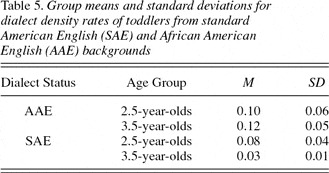
Group means and standard deviations for dialect density rates of toddlers from standard American English (SAE) and African American English (AAE) backgrounds
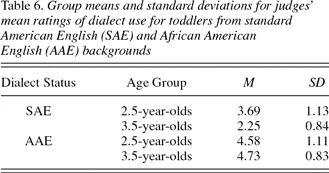
Group means and standard deviations for judges' mean ratings of dialect use for toddlers from standard American English (SAE) and African American English (AAE) backgrounds
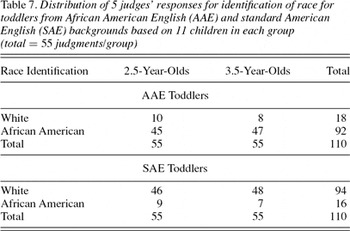
Distribution of 5 judges' responses for identification of race for toddlers from African American English (AAE) and standard American English (SAE) backgrounds based on 11 children in each group (total=55 judgments/group)
 You have
Access
- 19
- Cited by