


%20--%3e%3c!DOCTYPE%20svg%20PUBLIC%20'-//W3C//DTD%20SVG%201.0//EN'%20'http://www.w3.org/TR/2001/REC-SVG-20010904/DTD/svg10.dtd'%3e%3csvg%20version='1.0'%20id='Layer_1'%20xmlns='http://www.w3.org/2000/svg'%20xmlns:xlink='http://www.w3.org/1999/xlink'%20x='0px'%20y='0px'%20width='64px'%20height='64px'%20viewBox='5.5%20-3.5%2064%2064'%20enable-background='new%205.5%20-3.5%2064%2064'%20xml:space='preserve'%3e%3cg%3e%3ccircle%20fill='%23FFFFFF'%20fill-opacity='0'%20cx='37.785'%20cy='28.501'%20r='28.836'/%3e%3cpath%20fill='%23595959'%20d='M37.441-3.5c8.951,0,16.572,3.125,22.857,9.372c3.008,3.009,5.295,6.448,6.857,10.314%20c1.561,3.867,2.344,7.971,2.344,12.314c0,4.381-0.773,8.486-2.314,12.313c-1.543,3.828-3.82,7.21-6.828,10.143%20c-3.123,3.085-6.666,5.448-10.629,7.086c-3.961,1.638-8.057,2.457-12.285,2.457s-8.276-0.808-12.143-2.429%20c-3.866-1.618-7.333-3.961-10.4-7.027c-3.067-3.066-5.4-6.524-7-10.372S5.5,32.767,5.5,28.5c0-4.229,0.809-8.295,2.428-12.2%20c1.619-3.905,3.972-7.4,7.057-10.486C21.08-0.394,28.565-3.5,37.441-3.5z%20M37.557,2.272c-7.314,0-13.467,2.553-18.458,7.657%20c-2.515,2.553-4.448,5.419-5.8,8.6c-1.354,3.181-2.029,6.505-2.029,9.972c0,3.429,0.675,6.734,2.029,9.913%20c1.353,3.183,3.285,6.021,5.8,8.516c2.514,2.496,5.351,4.399,8.515,5.715c3.161,1.314,6.476,1.971,9.943,1.971%20c3.428,0,6.75-0.665,9.973-1.999c3.219-1.335,6.121-3.257,8.713-5.771c4.99-4.876,7.484-10.99,7.484-18.344%20c0-3.543-0.648-6.895-1.943-10.057c-1.293-3.162-3.18-5.98-5.654-8.458C50.984,4.844,44.795,2.272,37.557,2.272z%20M37.156,23.187%20l-4.287,2.229c-0.458-0.951-1.019-1.619-1.685-2c-0.667-0.38-1.286-0.571-1.858-0.571c-2.856,0-4.286,1.885-4.286,5.657%20c0,1.714,0.362,3.084,1.085,4.113c0.724,1.029,1.791,1.544,3.201,1.544c1.867,0,3.181-0.915,3.944-2.743l3.942,2%20c-0.838,1.563-2,2.791-3.486,3.686c-1.484,0.896-3.123,1.343-4.914,1.343c-2.857,0-5.163-0.875-6.915-2.629%20c-1.752-1.752-2.628-4.19-2.628-7.313c0-3.048,0.886-5.466,2.657-7.257c1.771-1.79,4.009-2.686,6.715-2.686%20C32.604,18.558,35.441,20.101,37.156,23.187z%20M55.613,23.187l-4.229,2.229c-0.457-0.951-1.02-1.619-1.686-2%20c-0.668-0.38-1.307-0.571-1.914-0.571c-2.857,0-4.287,1.885-4.287,5.657c0,1.714,0.363,3.084,1.086,4.113%20c0.723,1.029,1.789,1.544,3.201,1.544c1.865,0,3.18-0.915,3.941-2.743l4,2c-0.875,1.563-2.057,2.791-3.541,3.686%20c-1.486,0.896-3.105,1.343-4.857,1.343c-2.896,0-5.209-0.875-6.941-2.629c-1.736-1.752-2.602-4.19-2.602-7.313%20c0-3.048,0.885-5.466,2.658-7.257c1.77-1.79,4.008-2.686,6.713-2.686C51.117,18.558,53.938,20.101,55.613,23.187z'/%3e%3c/g%3e%3c/svg%3e)
%20--%3e%3c!DOCTYPE%20svg%20PUBLIC%20'-//W3C//DTD%20SVG%201.0//EN'%20'http://www.w3.org/TR/2001/REC-SVG-20010904/DTD/svg10.dtd'%3e%3csvg%20version='1.0'%20id='Layer_1'%20xmlns='http://www.w3.org/2000/svg'%20xmlns:xlink='http://www.w3.org/1999/xlink'%20x='0px'%20y='0px'%20width='64px'%20height='64px'%20viewBox='5.5%20-3.5%2064%2064'%20enable-background='new%205.5%20-3.5%2064%2064'%20xml:space='preserve'%3e%3cg%3e%3ccircle%20fill='%23FFFFFF'%20fill-opacity='0'%20cx='37.637'%20cy='28.806'%20r='28.276'/%3e%3cg%3e%3cpath%20fill='%23595959'%20d='M37.443-3.5c8.988,0,16.57,3.085,22.742,9.257C66.393,11.967,69.5,19.548,69.5,28.5c0,8.991-3.049,16.476-9.145,22.456%20C53.879,57.319,46.242,60.5,37.443,60.5c-8.649,0-16.153-3.144-22.514-9.43C8.644,44.784,5.5,37.262,5.5,28.5%20c0-8.761,3.144-16.342,9.429-22.742C21.101-0.415,28.604-3.5,37.443-3.5z%20M37.557,2.272c-7.276,0-13.428,2.553-18.457,7.657%20c-5.22,5.334-7.829,11.525-7.829,18.572c0,7.086,2.59,13.22,7.77,18.398c5.181,5.182,11.352,7.771,18.514,7.771%20c7.123,0,13.334-2.607,18.629-7.828c5.029-4.838,7.543-10.952,7.543-18.343c0-7.276-2.553-13.465-7.656-18.571%20C50.967,4.824,44.795,2.272,37.557,2.272z%20M46.129,20.557v13.085h-3.656v15.542h-9.944V33.643h-3.656V20.557%20c0-0.572,0.2-1.057,0.599-1.457c0.401-0.399,0.887-0.6,1.457-0.6h13.144c0.533,0,1.01,0.2,1.428,0.6%20C45.918,19.5,46.129,19.986,46.129,20.557z%20M33.042,12.329c0-3.008,1.485-4.514,4.458-4.514s4.457,1.504,4.457,4.514%20c0,2.971-1.486,4.457-4.457,4.457S33.042,15.3,33.042,12.329z'/%3e%3c/g%3e%3c/g%3e%3c/svg%3e)
Introduction
Multiplexed stool polymerase chain reaction (PCR) gastrointestinal panels (GIPs) allow for rapid detection of common enteric pathogens and have been shown to have a higher sensitivity for pathogen detection than stool culture and other conventional microbiologic testing. Reference Cybulski, Bateman and Bourassa1,Reference Rogers, Westblade and Soave2 However, most targets on multiplexed GIPs are community-acquired pathogens, and GIP yield is low for detection of non-Clostridioides difficile targets in the general population with hospital-onset diarrhea. Reference Hitchcock, Gomez and Banaei3,Reference Campodonico, Hanlon and Mikula4 Even with implementation of GIP ordering guidelines and clinical decision support to discourage low-value tests, guideline-discordant GIP testing remains common and highlights a need for additional diagnostic stewardship to optimize use of these tests. Reference Saif, Dooley, Baghdadi, Morgan and Coffey5,Reference Alhothli, Payne and Stefanovic6
A few single-center studies have evaluated diagnostic yield of GIPs specifically among patients with cancer, a population with high prevalence of diarrhea that often occurs in the setting of immunosuppression. Reference Andreyev, Ross and Donnellan7,Reference Castillo Almeida, Cichon and Gomez8 Most existing studies focus on GIP use in patients with hematologic malignancies and hematopoietic cell transplant (HCT) recipients. Reference Rogers, Westblade and Soave2,Reference Ford, Lopansri, Hunter, Asch and Hoda9,Reference Ford, Lopansri, Hunter, Wilkes, Asch and Hoda10 Only one other study to date has examined GIP yield in the broader oncology population, finding that overall utility of the GIP was low even among hospitalized immunosuppressed patients at a large cancer center. Reference Laracy, Yan and Kodama11 Understanding the optimal use of GIPs in the oncology population is important because these patients often have multiple possible causes of diarrhea occurring simultaneously and frequent exposure to antibiotics, factors that make it challenging for clinicians to distinguish infection from colonization or prolonged pathogen shedding. Reference Rogers, Westblade and Soave2,Reference Castillo Almeida, Cichon and Gomez8–Reference Ford, Lopansri, Hunter, Wilkes, Asch and Hoda10,Reference Liesman and Binnicker12
In this cross-sectional study, we compare GIP ordering patterns before versus after hospital day (HD) 3 and characterize the added diagnostic yield of the GIP for detection of non-C. difficile targets among hospitalized patients with cancer to identify future opportunities for GIP diagnostic stewardship on oncology units.
Methods
Study design
This is a single-center, cross-sectional study of stool tests (GIPs and stand-alone C. difficile [SACD] tests) between July 1, 2021 and May 23, 2025. Tests were included from adults (age ≥18 yr) with a cancer diagnosis who were hospitalized at the time of test order. Date of admission was defined as HD 1. The primary outcome was detection of ≥1 non-C. difficile target by GIP. This study was approved by the Fred Hutch Institutional Review Board.
Stool testing procedures
All inpatient stool testing is entered through an order set that contains a nudge to providers to order a GIP for community-onset diarrhea (defined as onset on or before HD 3) and SACD testing for hospital-onset diarrhea (onset after HD 3), with exceptions that a GIP may be considered after HD 3 for prolonged (>7 d), unexplained, or bloody diarrhea. There is no “hard stop” restricting orders discordant with the above institutional guidelines, and providers are not required to specify an indication for stool tests at time of ordering. There are no restrictions on ordering repeat GIP tests.
Our laboratory uses the BIOFIRE® FILMARRAY® Gastrointestinal Panel (BF-GIP) which detects 22 targets by PCR (5 viruses, 13 bacteria including C. difficile, and 4 parasites), and this was the only GIP used during the study period. For GIP tests detecting Salmonella, Shigella, Campylobacter and/or Vibrio species, the laboratory performs a reflex stool culture with susceptibility testing. Any of the 22 GIP targets detected are reported in the patient’s medical record (ie, no positive targets are hidden in the result report).
SACD testing includes a toxigenic C. difficile PCR (Cepheid Xpert®). On February 28, 2024, a 2-step C. difficile testing algorithm was adopted for hospitalized patients where any positive C. difficile PCR (detected either by GIP or SACD testing) reflexes to a C. difficile toxin A/B enzyme immunoassay. Because this study includes data both before and after implementation of 2-step C. difficile testing and because this study focuses on detection of pathogens other than C. difficile, only C. difficile PCR results were included.
Data collection
Stool test results and patient demographics were retrospectively extracted from the electronic medical record. Chart review was performed for GIPs ordered after HD 3 that detected a non-C. difficile target to identify GIP order indications and whether the patient received intentional antimicrobial therapy for the target(s) detected by GIP. Treatment was defined as intentional only when provider documentation indicated that antimicrobial therapy was directed at the organism identified by GIP.
Statistical analysis
Descriptive statistics are reported as frequencies and percentages or median and interquartile range (IQR). To estimate the prevalence ratio (PR) of detection of ≥1 non-C. difficile target by GIP after HD 3 versus on HD 1–3, we used Poisson regression with generalized estimating equations (GEE) to account for correlation among tests for the same patient within the study period. HD >3 versus HD 1–3 was the primary explanatory variable. Covariates included age (≥65 yr), sex, simultaneous detection of C. difficile by GIP, and a variable for categories of oncology diagnosis type and HCT status within the preceding 30 days, as these factors may influence the gut microbiome. Reference Kar and Freedberg13–Reference Ghaffar, Valeriani and Romano Spica19
Due to the 2024 FDA recall of the BF-GIP warning about an increased risk of false positive norovirus results 20 and recent data showing a norovirus false discovery rate of 31%–74% by BF-GIP, Reference Reed, Mauer and Mack21 we performed a sensitivity analysis to estimate the PR of detecting ≥1 non-C. difficile, non-norovirus target by BF-GIP based on the hypothesis that a significant number of norovirus detections in our data set may be false positive results. Analyses were performed using STATA SE v18.
Results
Summary of stool testing by test type and cancer diagnosis
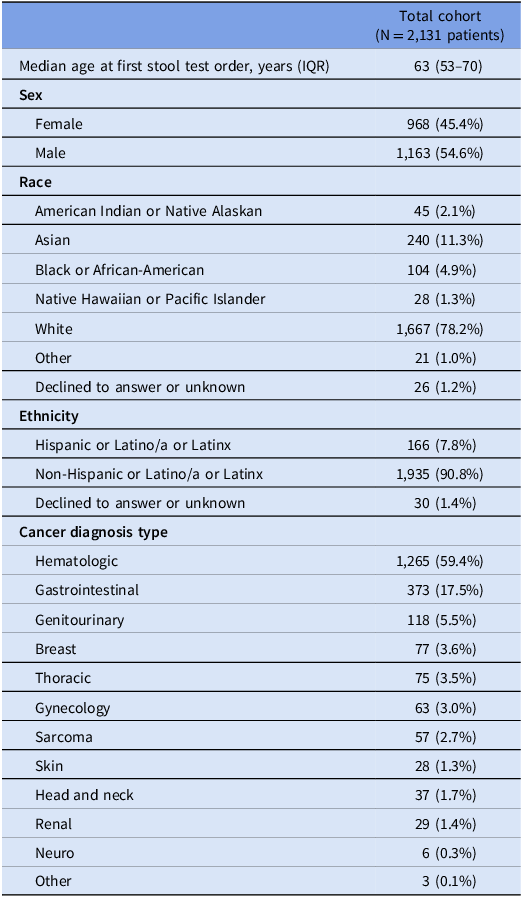
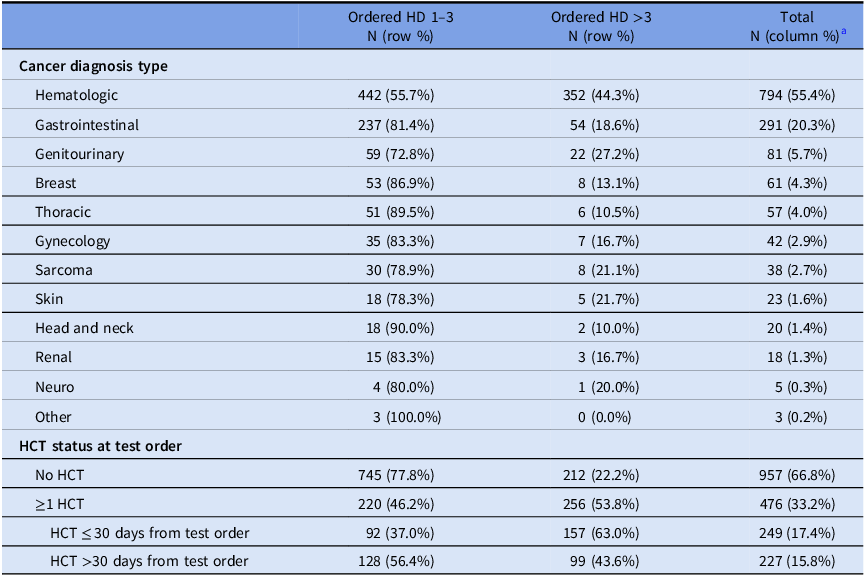
A total of 3,338 stool tests (1,433 GIP; 1905 SACD) were performed among 2,131 hospitalized patients with cancer during the study period. Median age at the time of first stool test order was 63 years (IQR 53–70) and 55% of patients were male (Table 1). Among SACD tests, 1621/1905 (85%) were ordered after HD 3 while 468/1,433 (33%) of GIPs were ordered after HD 3. Patients with hematologic malignancies had the highest number of GIP orders (794/1,433; 55%) and among those 794 tests, 352 (44%) were ordered after HD 3, a higher proportion compared to other cancer diagnoses. The proportion of GIPs ordered after HD 3 among hematopoietic cell transplant (HCT) recipients was 54%, compared to 22% among non-HCT recipients (Table 2).
Cohort characteristics (patient-level) a

Table 1. Long description
A table summarizing the characteristics of a cohort of 2,131 hospitalized patients with cancer. The table has 15 rows and 2 columns. The first column lists various characteristics, and the second column provides the corresponding data for the total cohort. Row 1: Median age at first stool test order, years (IQR), 63 (53-70). Row 2: Sex, Female, 968 (45.4 percent). Row 3: Sex, Male, 1,163 (54.6 percent). Row 4: Race, American Indian or Native Alaskan, 45 (2.1 percent). Row 5: Race, Asian, 240 (11.3 percent). Row 6: Race, Black or African-American, 104 (4.9 percent). Row 7: Race, Native Hawaiian or Pacific Islander, 28 (1.3 percent). Row 8: Race, White, 1,667 (78.2 percent). Row 9: Race, Other, 21 (1.0 percent). Row 10: Race, Declined to answer or unknown, 26 (1.2 percent). Row 11: Ethnicity, Hispanic or Latino/a or Latinx, 166 (7.8 percent). Row 12: Ethnicity, Non-Hispanic or Latino/a or Latinx, 1,935 (90.8 percent). Row 13: Ethnicity, Declined to answer or unknown, 30 (1.4 percent). Row 14: Cancer diagnosis type, Hematologic, 1,265 (59.4 percent). Row 15: Cancer diagnosis type, Gastrointestinal, 373 (17.5 percent). Row 16: Cancer diagnosis type, Genitourinary, 118 (5.5 percent). Row 17: Cancer diagnosis type, Breast, 77 (3.6 percent). Row 18: Cancer diagnosis type, Thoracic, 75 (3.5 percent). Row 19: Cancer diagnosis type, Gynecology, 63 (3.0 percent). Row 20: Cancer diagnosis type, Sarcoma, 57 (2.7 percent). Row 21: Cancer diagnosis type, Skin, 28 (1.3 percent). Row 22: Cancer diagnosis type, Head and neck, 37 (1.7 percent). Row 23: Cancer diagnosis type, Renal, 29 (1.4 percent). Row 24: Cancer diagnosis type, Neuro, 6 (0.3 percent). Row 25: Cancer diagnosis type, Other, 3 (0.1 percent).
IQR, interquartile range.
a For patients with multiple stool tests during the study period, demographic data associated with the patient’s first stool test of any type (multiplexed gastrointestinal panel or stand-alone C. difficile test) was used to compile this table.
GIP orders by diagnosis type and HCT status

Table 2. Long description
A table comparing GIP orders by cancer diagnosis type and HCT status. The table has 15 rows and 5 columns. Column headers are ‘Cancer diagnosis type’, ‘Ordered HD 1-3 N (row %)’, ‘Ordered HD >3 N (row %)’, and ‘Total N (column %)’. Row labels include various cancer diagnosis types and HCT statuses. Row 1: Hematologic, 442 (55.7 percent), 352 (44.3 percent), 794 (55.4 percent). Row 2: Gastrointestinal, 237 (81.4 percent), 54 (18.6 percent), 291 (20.3 percent). Row 3: Genitourinary, 59 (72.8 percent), 22 (27.2 percent), 81 (5.7 percent). Row 4: Breast, 53 (86.9 percent), 8 (13.1 percent), 61 (4.3 percent). Row 5: Thoracic, 51 (89.5 percent), 6 (10.5 percent), 57 (4.0 percent). Row 6: Gynecology, 35 (83.3 percent), 7 (16.7 percent), 42 (2.9 percent). Row 7: Sarcoma, 30 (78.9 percent), 8 (21.1 percent), 38 (2.7 percent). Row 8: Skin, 18 (78.3 percent), 5 (21.7 percent), 23 (1.6 percent). Row 9: Head and neck, 18 (90.0 percent), 2 (10.0 percent), 20 (1.4 percent). Row 10: Renal, 15 (83.3 percent), 3 (16.7 percent), 18 (1.3 percent). Row 11: Neuro, 4 (80.0 percent), 1 (20.0 percent), 5 (0.3 percent). Row 12: Other, 3 (100.0 percent), 0 (0.0 percent), 3 (0.2 percent). Row 13: No HCT, 745 (77.8 percent), 212 (22.2 percent), 957 (66.8 percent). Row 14: >=1 HCT, 220 (46.2 percent), 256 (53.8 percent), 476 (33.2 percent). Row 15: HCT <= 30 days from test order, 92 (37.0 percent), 157 (63.0 percent), 249 (17.4 percent). Row 16: HCT >30 days from test order, 128 (56.4 percent), 99 (43.6 percent), 227 (15.8 percent).
GIP, gastrointestinal panel; HCT, hematopoietic cell transplant; HD, hospital day.
a Column percents are calculated among total GIP tests (N = 1,433).
Overall GIP yield
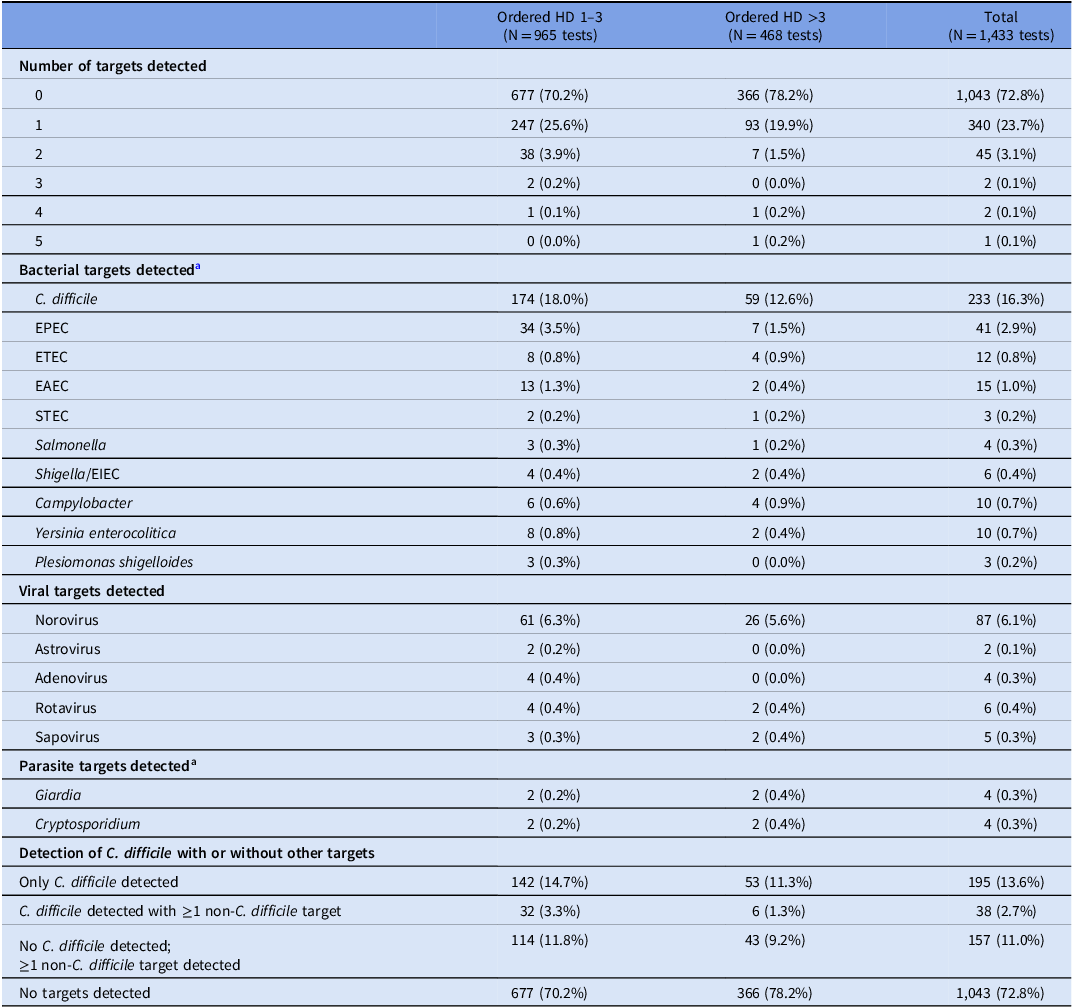
During the study period, 1,433 GIPs were performed among 1,127 hospitalized patients. At least 1 target was detected on 390 (27%) tests; among those tests, 340 (87%) detected 1 target whereas 50 (13%) detected multiple targets (Table 3). Yield of GIPs for detection of ≥1 target was higher for tests ordered on HD 1–3 compared to tests after HD 3 (288/965 [30%] vs 102/468 [22%], respectively). Among all tests, the GIP targets detected most often were C. difficile (233/1,433 tests; 16%) and norovirus (87/1,433 tests; 6%); frequency of individual GIP target detection on HD 1–3 versus after HD 3 is summarized in Table 3.
GIP yield among hospitalized patients with Cancer

Table 3. Long description
The table presents the number and percentage of targets detected in tests ordered on hospital days 1-3 and hospital days greater than 3. It includes data on the number of targets detected, specific bacterial, viral, and parasite targets detected, and the detection of C. difficile with or without other targets. The table has 18 rows and 5 columns, with column headers being ‘Ordered HD 1-3 (N = 965 tests)’, ‘Ordered HD >3 (N = 468 tests)’, and ‘Total (N = 1,433 tests)’. Row labels include categories such as ‘Number of targets detected’, ‘Bacterial targets detected’, ‘Viral targets detected’, ‘Parasite targets detected’, and ‘Detection of C. difficile with or without other targets’. Notable trends include the higher detection of C. difficile and norovirus compared to other targets, and a higher yield of tests detecting at least one target on hospital days 1-3 compared to later days.
Values are N (column %) unless otherwise indicated.
GIP, gastrointestinal panel; HD, hospital day; EIEC, Enteroinvasive E. coli; EPEC, Enteropathogenic E. coli; ETEC, Enterotoxigenic E. coli; EAEC, Enteroaggregative E. coli; STEC, Shiga toxin-producing E. coli.
a Bacterial and parasite targets on the GIP that were not detected on any GIPs among the study cohort include Vibrio species, Entamoeba histolytica, and Cyclospora cayetanensis.
Detection and treatment of non-C. difficile targets
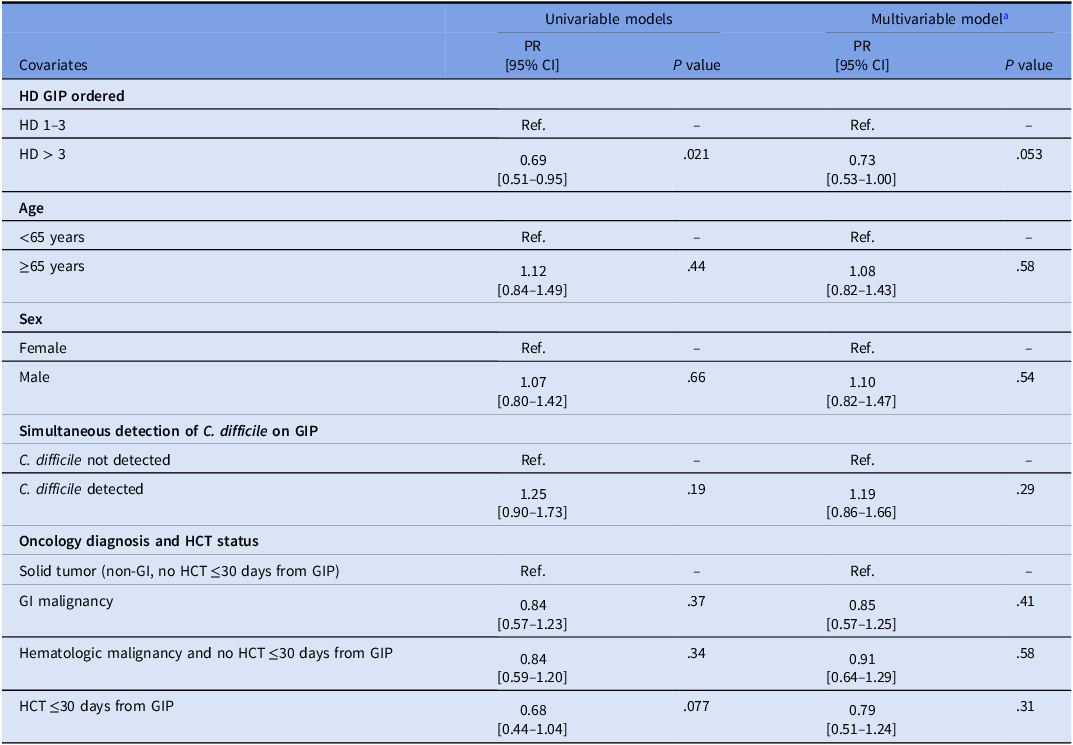
At least 1 non-C. difficile target was detected on 49/468 (10%) GIPs ordered after HD 3 compared to 146/965 (15%) GIPs ordered on HD 1–3. In a univariable GEE Poisson regression model, prevalence of detecting ≥1 non-C. difficile target by GIP after HD 3 was significantly lower compared to HD 1–3 (PR 0.69, 95% CI [0.51–0.95], P = .021). This difference did not retain statistical significance in the multivariable model adjusted for age, sex, co-detection of C. difficile, and oncology diagnosis and/or HCT within 30 days prior (PR 0.73, 95% CI [0.53–1.00], P = .053; Table 4). However, in a sensitivity analysis, the PR of detecting ≥1 non-C. difficile, non-norovirus target by GIP after HD 3 versus HD 1–3 was 0.62 in the multivariable model (95% CI [0.40–0.94], P = .026; Supplemental Table 1).
GEE Poisson regression model estimates for prevalence ratios of detecting ≥1 non-C. difficile target by GIP

Table 4. Long description
A table comparing prevalence ratios of detecting non-C. difficile targets by GIP using univariable and multivariable models. The table has 13 rows and 4 columns. Columns are labeled ‘Covariates’, ‘Univariable models PR [95% CI]’, ‘Univariable models P value’, ‘Multivariable model PR [95% CI]’, and ‘Multivariable model P value’. Row labels include ‘HD GIP ordered’, ‘Age’, ‘Sex’, ‘Simultaneous detection of C. difficile on GIP’, and ‘Oncology diagnosis and HCT status’. Each row provides prevalence ratios and P values for different covariates. Notable trends include a lower prevalence ratio for HD > 3 in both univariable and multivariable models.
GEE, generalized estimating equations; GIP, gastrointestinal panel; PR, prevalence ratio; CI, confidence interval; HD, hospital day; GI, gastrointestinal; HCT, hematopoietic cell transplant.
a Adjusted for all covariates listed in the table.
Among the 49 GIPs ordered after HD 3 that detected ≥1 non-C. difficile target, median order day was HD 11 (IQR 7–16). New-onset diarrhea was the most common indication for these test orders (19/49; 39%; Supplemental Table 2), which is discordant with institutional GIP ordering guidelines. Notably, 17/19 (89%) of these tests were ordered in patients with hematologic malignancies. Among the 19 tests ordered for new-onset diarrhea after HD 3, 4 (21%) detected C. difficile with another target. The remaining 15 tests detected a single non-C. difficile target (Supplemental Table 3). Other common reasons that GIPs positive for ≥1 non-C. difficile target were ordered after HD 3 included diarrhea that was prolonged (13/49; 27%), worsening (10/49; 20%), or unexplained (10/49; 20%). Bloody diarrhea was the order indication in 4/49 (8%) tests (Supplemental Table 2).
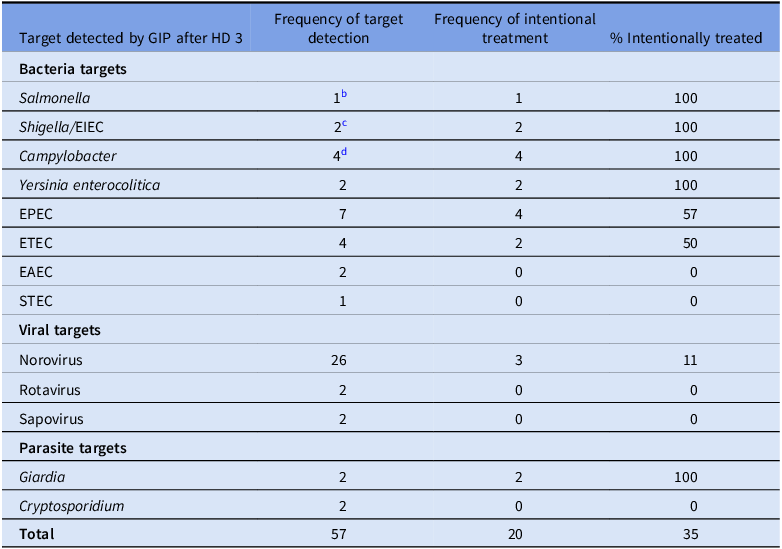
In total, 57 non-C. difficile targets were detected on 49 GIPs ordered after HD 3 among 46 patients (one patient had 4 GIPs ordered after HD 3, all of which were positive for norovirus only). Overall, 20/57 (35%) of the non-C. difficile targets detected after HD 3 were intentionally treated; the frequency of intentional treatment for each non-C. difficile target varied by organism and is summarized in Table 5. Among the 19 GIPs ordered for new-onset diarrhea after HD 3 that detected ≥1 non-C. difficile target, 5 patients received intentional treatment for a non-C. difficile target (1 patient each treated for Campylobacter, Yersinia enterocolitica, Giardia, enteropathogenic Escherichia coli [EPEC], and norovirus).
Intentional treatment of non-C. difficile targets detected by GIP ordered after HD 3 a

Table 5. Long description
A table comparing the frequency of target detection and intentional treatment for various bacteria, viral, and parasite targets detected by GIP after HD 3. The table has 15 rows and 4 columns. Column headers are: Target detected by GIP after HD 3, Frequency of target detection, Frequency of intentional treatment, and % Intentionally treated. Row labels include different bacteria targets (Salmonella, Shigella/EIEC, Campylobacter, Yersinia enterocolitica, EPEC, ETEC, EAEC, STEC), viral targets (Norovirus, Rotavirus, Sapovirus), and parasite targets (Giardia, Cryptosporidium). The table also includes a total row. Each row provides the frequency of target detection, frequency of intentional treatment, and the percentage of intentionally treated targets for each organism. Notable trends include high intentional treatment percentages for Salmonella, Shigella/EIEC, Campylobacter, Yersinia enterocolitica, and Giardia, all at 100%, and lower percentages for Norovirus at 11%, EPEC at 57%, and ETEC at 50%.
GIP, gastrointestinal panel; HD, hospital day; EIEC, Enteroinvasive E. coli; EPEC, Enteropathogenic E. coli; ETEC, Enterotoxigenic E. coli; EAEC, Enteroaggregative E. coli; STEC, Shiga toxin-producing E. coli.
a 57 non-C. difficile targets were detected on 49 GIPs from 46 patients (all patients had 1 test each except for 1 patient with 4 GIPs after HD 3, all of which were positive for norovirus only); 6/49 tests detected C. difficile with a non-C. difficile target.
b Salmonella also isolated in reflex stool culture.
c Shigella was not isolated in reflex stool culture for either sample.
d Campylobacter was isolated in 1/4 reflex stool cultures.
Discussion
Among hospitalized patients with cancer, we observed that despite internal guidance to order GIPs primarily for community-onset diarrhea (on or before HD 3), approximately one-third of GIPs were ordered after HD 3. Prevalence of detection of ≥1 non-C. difficile target after HD 3 was lower compared to GIPs ordered on HD 1–3. These findings suggest that GIP yield for the detection of non-C. difficile pathogens in patients with cancer and hospital-onset diarrhea is limited, similar to another study in oncology patients Reference Laracy, Yan and Kodama11 as well as studies evaluating broader hospitalized populations. Reference Hitchcock, Gomez and Banaei3,Reference Campodonico, Hanlon and Mikula4,Reference Alhothli, Payne and Stefanovic6
In our study, BF-GIP yield for detection of ≥1 non-C. difficile target after HD 3 was 10%, which is nearly identical to the overall BF-GIP positivity rate reported by Laracy et al among inpatients at a cancer center after the third HD. Reference Laracy, Yan and Kodama11 Hitchcock et al reported a 6.0% BF-GIP yield in all hospitalized adults >3 days after admission (6.6% yield in the subset who were immunosuppressed); however, targets frequently detected in asymptomatic individuals (enteropathogenic, enteroaggregative, and enterotoxigenic E. coli) were excluded from their analyses. Reference Hitchcock, Gomez and Banaei3 Ford et al found that only 3% of BF-GIP tests detected non-C. difficile targets in hospitalized patients with acute leukemia and allogeneic HCT recipients with hospital-onset diarrhea. Reference Ford, Lopansri, Hunter, Asch and Hoda9,Reference Ford, Lopansri, Hunter, Wilkes, Asch and Hoda10 Differences in BF-GIP yield among studies could be explained by variations in stool testing practices and pathogen prevalence across centers.
Aside from C. difficile, norovirus was the second most common target detected by GIP both before and after HD 3, which is similar to other studies evaluating the BF-GIP. Reference Rogers, Westblade and Soave2,Reference Hitchcock, Gomez and Banaei3,Reference Ford, Lopansri, Hunter, Asch and Hoda9,Reference Ford, Lopansri, Hunter, Wilkes, Asch and Hoda10,Reference Shu, Wang and Misra22 Following the 2024 FDA recall of the BF-GIP due to an increased risk of false positive norovirus results, 20 several studies have reported that >25% of norovirus detections by BF-GIP were likely false positives based on alternative molecular testing and/or melting curve analysis. Reference Caza, Kuchinski and Locher23–Reference Matic, Lawson and Young25 Additionally, recent data from our microbiology laboratory demonstrated that the BF-GIP Noro-1 assay has a false discovery rate as high as 74%. Reference Reed, Mauer and Mack21 It is therefore likely that a significant portion of norovirus detections in the present study may represent false positive results. In a sensitivity analysis, we found a significantly lower prevalence of detecting ≥1 non-C. difficile, non-norovirus target after HD 3, representing a 38% reduction compared to HD 1–3. We speculate that false positive norovirus results may have inflated the yield of the GIP for detection of ≥1 non-C. difficile target in our primary analysis, thereby over-estimating GIP yield after HD 3. Understanding the clinical implications of false positive norovirus results on the BF-GIP is an important area for future study.
In the present study, detection of a non-C. difficile target in the context of hospital-onset diarrhea infrequently led to changes in clinical management, consistent with a prior evaluation of GIPs in hospitalized patients with leukemia Reference Ford, Lopansri, Hunter, Wilkes, Asch and Hoda10 and another report in a general acute care population. Reference Alhothli, Payne and Stefanovic6 In our study, positive guideline-discordant GIPs (tests detecting a non-C. difficile target that were ordered for new-onset diarrhea after HD 3) led to intentional antimicrobial therapy in only 5 patients, 2 of whom may have received unnecessary treatment for EPEC and norovirus, where antimicrobials have little or uncertain benefit. Reference Olvera, Carter and Rajan26–Reference Hu and Torres28
Three patients with hospital-onset diarrhea were treated for Campylobacter, Yersinia enterocolitica, and Giardia, and these detection events are more likely clinically significant infections. However, highly sensitive stool PCR panels cannot distinguish active infection from colonization or prolonged pathogen shedding following a previous infection. Reference Castillo Almeida, Cichon and Gomez8–Reference Ford, Lopansri, Hunter, Wilkes, Asch and Hoda10,Reference Liesman and Binnicker12,Reference Berdal, Follin-Arbelet and Bjornholt29,Reference Liu, Rosen and Stohs30 This challenge commonly arises in oncology patients, who often have multiple concurrent causes of diarrhea and frequent exposure to antibiotics for prophylaxis or treatment. Reference Liu, Rosen and Stohs30,Reference Gottesdiener and Satlin31 While GIPs may enable early, targeted therapy or antibiotic de-escalation in some cases of acute gastroenteritis, Reference Cybulski, Bateman and Bourassa1 use of GIPs has also been associated with increased or unnecessary antibiotic use. Reference Brendish, Beard and Malachira32,Reference Robilotti, Powell, Usiak, Taur, Babady and Kamboj33 Further studies are needed to understand how GIP results impact clinical outcomes and appropriate versus inappropriate antibiotic use.
Additionally, false positive results or detection of targets with unclear clinical significance by GIP, such as non-Shiga toxin-producing E. coli, Reference Shu, Wang and Misra22,Reference Hu and Torres28,Reference Berdal, Follin-Arbelet and Bjornholt29 could lead to premature diagnostic closure or unnecessary isolation and infection prevention resource utilization. Reference Robilotti, Powell, Usiak, Taur, Babady and Kamboj33 Misdiagnosis may be of particular concern in HCT recipients, who are at risk for several diarrheal syndromes associated with significant morbidity and mortality, including gastrointestinal graft-versus-host disease, cytomegalovirus disease, and adenovirus. Reference Castillo Almeida, Cichon and Gomez8 Furthermore, GIPs that detect only adenovirus serotypes F40/41 have demonstrated low yield for diagnosis of adenovirus infections in patients with hematologic malignancy and HCT recipients. Reference McMillen, Lee, Kamboj and Babady34
Limitations of this study include the potential for confounding due to the retrospective design and lack of prior antibiotic exposure data for inclusion as a covariate in the GEE model. Additionally, GIPs ordered after HD 3 did not occur randomly, as our institutional recommendations and a provider nudge discourage use of GIPs for hospital-onset diarrhea. Because our guidelines also allow GIPs to be considered after HD 3 for prolonged, unexplained, or bloody diarrhea, not all GIPs ordered after HD 3 necessarily represent true, hospital-onset diarrhea. Furthermore, since we only reviewed order indication and intentional treatment for the subset of GIPs that detected a non-C. difficile target after HD 3, we could not directly compare these characteristics between GIPs ordered on HD 1–3 versus after HD 3. Finally, this is a single-center study thus results may not be generalizable to other centers or clinical settings where pathogen prevalence and stool testing practices may differ.
Overall, this study builds on existing literature demonstrating low yield of GIPs after HD 3 and indicates that GIPs provide limited additional value beyond SACD testing for evaluation of hospital-onset diarrhea in patients with cancer. Our findings support our center’s guideline to reserve GIPs primarily for patients with community-onset diarrhea, even among those with cancer and HCT recipients. At our cancer center, future GIP diagnostic stewardship efforts may have the most potential for impact in the hematologic malignancy and HCT populations, where GIP utilization is highest and positive results after HD 3 rarely affect antimicrobial management.
Additional diagnostic stewardship interventions, such as requiring providers to specify a clinical indication for GIPs ordered after HD 3, could be employed to limit ordering of low-value GIPs for hospital-onset diarrhea. Evaluation of the efficacy and safety of more restrictive approaches, such as implementation of a “hard stop” with laboratory approval for any GIP orders after HD 3, could be investigated with future prospective studies. Though yield after HD 3 may be low, further studies are needed to better define which subsets of oncology patients are most likely to have a clinically significant GIP result after HD 3 and how these tests impact clinical outcomes.
Supplementary material
The supplementary material for this article can be found at https://doi.org/10.1017/ash.2026.10949.
Financial support
None.
Competing interests
E.A.R. reports research support from Delve Bio. S.A.P participates in clinical trials with F2G, Elion, and Symbio. C.L. has received research support (paid to institution) from SNIPR Biome and AstraZeneca. All other authors report no conflicts of interest.
The REDCap instance used for data collection in this study is supported by the Institute of Translational Health Sciences (ITHS). National Institutes of Health awards to ITHS did not directly fund this project.


 Open access

