


Sex-based equality and biological sex difference: the paths and paradoxes of reproductive rights rhetoric and law
While American society idealises individual freedom and equal access to opportunity, it has also historically subordinated women, as compared to men, in psychological and substantive ways (Law, Reference Law1984, p. 956). This conflict between ideals and tradition propelled several of the largest and most intensely controversial movements in United States history – movements that we popularly term today under headings like ‘women's rights’ or ‘women's liberation’.
These ‘women's rights’ campaigns, however, have actually proceeded along two separate paths, one being a motivation toward sex-based equality and the other an assertion of female bodily agency and procreative control. The rhetoric of these initiatives reveals their distinctions, as arguments for sex equality typically emphasise political and economic fairness by removing sex classification from the law, while campaigns for women's reproductive control largely concern the sex-specific impact of pregnancy and child-rearing on women. That is, these efforts for what we refer to today as ‘reproductive rights’ generally ignore issues of sex-based equality because their rationale is centred on the realities and implications of biological sex differences. Yet, at the same time, they promote the empowerment and fair treatment of women and thereby significantly relate and even contribute to sex equality. Accordingly, these two trajectories have maintained a complex relationship, as they seem to meet and rupture alongside a paradox between sex comparability and sex difference. In order better to understand this relationship, let us briefly consider a general history of sex equality and reproductive rights developments in the United States.
Feminist philosophies emerged in Europe and America during the later eighteenth century with the secular intellectual reasoning of the Enlightenment. During this time, ideological and religious precepts about male and female differences justified a separate and subordinate legal status for women (Law, Reference Law1984, p. 958). Women were marginalised from public life, denied opportunity in the workplace and obligated, by their government and society, to care for men and children (p. 959). Men further maintained their ascendancy by controlling women's procreative capacities (p. 960). At this time, extra-marital sex, contraception and abortion were illegal (p. 960). Unmarried fathers were not legally mandated to assume responsibility for their ‘bastards’, while their entirely liable female counterparts were subject to legal disabilities, social condemnation and economic dependency (p. 962).
While women operated within this oppressive climate, privileged men put forth equality rhetoric to articulate their individual and collective rights. For example, the United States Constitution, its Bill of Rights, and France's Declaration of the Rights of Man and of the Citizen established doctrines of equal opportunity and individual freedom. However, these documents did not mention women, who, in turn, began to adopt men's equality rhetoric in order to contest their economic and political disadvantages. They were, in a sense, holding this male rhetoric accountable for its messages and ideals, calling upon it to advance sex-based equality. Mary Wollstonecraft's Vindication of the Rights of Woman (1792) largely initiated these efforts, as it argues that women must redefine their position in society in order to attain rights as sovereign individuals. Though Wollstonecraft's text does not explicitly assert that men and women are equal, it and other developing feminist philosophies propelled many ‘women's rights’ activists to foreground a principle of sex-based equality with hopes of eliminating sex classification from the law. The Women's Suffrage Movement of the nineteenth and twentieth centuries successfully applied this principle in its effort to seize women's voting rights by advocating that sex be removed as a criterion for enfranchisement. The Nineteenth Amendment to the United States Constitution was ratified to this effect in 1920, and within less than three years women's rights activists advanced another, though less well-known, measure for sex-based equality (Babcock, Freedman, Norton and Ross, Reference Babcock, Freedman, Norton and Ross1975, p. 54). The Equal Rights Amendment (ERA) has been introduced in every session of Congress since 1923 and is possibly the most explicit and directive attempt to assure sex-based equality in US law (p. 129). The ERA proposes that ‘[e]quality of rights under the law shall not be denied or abridged by the United States or by any State on account of sex’ (p. 129). It is, in short, a measure to make sex a legally irrelevant and proscribed categorization (Law, Reference Law1984, p. 976). The amendment finally reached the states for ratification in 1972, but then fell to severe scrutiny and debate for nearly a decade. Ultimately, the ERA failed to be ratified in June 1982 (Babcock et al., Reference Babcock, Freedman, Norton and Ross1975, p. 129).
At the same time that women's suffragists and early ERA activists attempted to bar sex as a lawful classification, efforts surfaced to garner reproductive control for women by securing their access to birth control. In order to argue for birth control as a mode for female empowerment, birth control activists employed rhetoric that strongly emphasised the uniqueness of the female social and procreative experience. Margaret Sanger, one of the movement's most influential advocates, asserted that a woman must be able to choose whether, and the circumstances under which, to bear a child. In her paper ‘Woman's Error and Her Debt’, Sanger argues that women's extraordinary biological capacity to bear children disables their social mobility and ‘b[inds] [them] to [their] lots as brood animal[s] for the masculine civilizations of the world’. This focus on the nature of maternity and the implications of motherhood propelled Sanger's polemic that reproductive control ‘is for the woman the key to the temple of liberty’ (Sanger, Reference Sanger1921).
The sex-specific dimension of the early reproductive rights agenda is not its only point of departure from sex-based equality efforts, as the birth control movement largely ignored issues of equality in general. This disregard is evident in the ways that Sanger and several other like-minded activists promoted eugenic control, advocating for female sterilisation based on racist precepts of parental fitness (Franks, Reference Franks2005, p. 8). Thus, we see that the birth control movement's concentration on ‘the mother’ and ‘the woman’ was not meant to equally treat all mothers and all women. Furthermore, birth control advocates had to present their arguments in socially palatable ways, which often required that they preserve sexist female social scripts in their rhetoric. Sanger's speech on ‘The Morality of Birth Control’ exemplifies this point, as Sanger works birth control into the Christian moral framework of her time. In the speech, she addresses Roman Catholic objections to birth control by advancing the idea of a ‘morality of knowledge’ (Sanger, Reference Sanger2001–2008). She seeks to demonstrate how the empowerment that women access through birth control will safeguard and even nurture their purity. She states:
‘We know that every advance that woman has made in the last half century has been made with opposition, all of which has been based upon the grounds of immorality. When women fought for higher education, it was said that this would cause her to become immoral and she would lose her place in the sanctity of the home. When women asked for the franchise it was said that this would lower her standard of morals, that it was not fit that she should meet with and mix with the members of the opposite sex, but we notice that there was no objection to her meeting with the same members of the opposite sex when she went to church.
The church has ever opposed the progress of woman on the ground that her freedom would lead to immorality. We ask the church to have more confidence in women. We ask the opponents of this movement to reverse the methods of the church, which aims to keep women moral by keeping them in fear and in ignorance, and to inculcate into them a higher and truer morality based upon knowledge.’
In this way, we see again that the rhetoric surrounding birth control activism did not impart a motivation towards equality. Rather, it attempted to empower women by recognising the relationship between their biological and social realities, and aimed to reconcile that empowerment with the assumptions of a sexist ideology and religion.
The reproductive rights campaign expanded in the mid-twentieth century to include abortion as one of its primary issues. Its efforts to legalise contraception and abortion proved successful with monumental Supreme Court decisions in the late 1960s and early 1970s. Interestingly, these decisions came at nearly the same time that the ERA was gaining Congressional attention. However, the two efforts remained rhetorically divided, as reproductive rights rhetoric still emphasised the uniqueness of motherhood rather than a principle of sex-based equality. Furthermore, like Sanger and other birth control advocates, this generation of reproductive rights activists had to couch their cause in terms of an existing framework, this time approaching a constitutional doctrine that does not confront the reality of biological sex difference.
Accordingly, the legalisation of contraceptives and abortion unfolded in the contexts of personal privacy and equal protection rather than out of consideration for their exceptional ramifications on women. For example, the Supreme Court case Griswold v. Connecticut (1965)Footnote 1 legalised contraception in marriage by establishing a constitutional right to privacy and interpreting it to include a married individual's right to use contraceptives. Similarly, in 1972, Eisenstadt v. Baird Footnote 2 extended that right to unmarried individuals. Scholars vary in their interpretations of this decision as being based on either or both the right to privacy and/or the Equal Protection Clause of the Fourteenth Amendment (Law, Reference Law1984, p. 977). However, it is clear that the decision did not acknowledge what scholar Sylvia Law refers to as the ‘differential burden that denying access to contraceptives imposes upon women’ (p. 978). Furthermore, Roe v. Wade (1973)Footnote 3 most famously cited an individual's right to privacy as grounds to federally legalise abortion. This decision, which was delivered by Justice Blackmun on 22 January 1973, does recognise the sex-specific impact that abortion laws have on women and even cites several such implications:
‘The detriment that the State would impose upon the pregnant woman by denying this choice altogether is apparent. Specific and direct harm medically diagnosable even in early pregnancy may be involved. Maternity, or additional offspring, may force upon the woman a distressful life and future. Psychological harm may be imminent. Mental and physical health may be taxed by child care. There is also the distress, for all concerned, associated with the unwanted child, and there is the problem of bringing a child into a family already unable, psychologically and otherwise, to care for it. In other cases, as in this one, the additional difficulties and continuing stigma of unwed motherhood may be involved. All these are factors the woman and her responsible physician necessarily will consider in consultation.’ (Babcock et al., Reference Babcock, Freedman, Norton and Ross1975, p. 953)
However, despite this acknowledgement, the actual determination to legalise abortion is justified by the conclusion that a ‘right of privacy, whether it be founded in the Fourteenth Amendment's concept of personal liberty and restrictions upon state action, as [the Supreme Court] fe[lt] it is, or, as the District Court determined, in the Ninth Amendment's reservation of rights to the people, is broad enough to encompass a woman's decision whether or not to terminate her pregnancy’ (Babcock et al., Reference Babcock, Freedman, Norton and Ross1975, p. 953). The court's decisions in Roe v. Wade and in the earlier contraception cases epitomise how the ratification of reproductive rights is not based on the principles most emphasised in the rhetoric of their movement.
As we consider how reproductive rights rhetoric has unfolded since these ratifications, a new complication emerges in its relation to the goals and language of sex equality. Because reproductive laws do not necessarily confront the specialness of motherhood, yet pertain specifically to women's biological realities, it becomes difficult to locate men's procreative rights within this doctrine and to define them outside it. For this reason, ‘male-affirmative’ perspectives on reproductive rights find fault in the ways that court decisions like Roe v. Wade apply only to a woman's privacy in pregnancy and not to a person's choice in parenthood.
‘Male-affirmative’ approaches to reproductive rights centre on ‘masculist’ social thought. According to Wikipedia,Footnote 4 ‘masculism’ refers to a body of ‘social theories, political movements, and moral philosophies primarily based on the experiences of men’.Footnote 5 It critiques social relations, analyses gender inequality, and advances men's rights, interests and issues.Footnote 6 The masculist movement developed over the last century, gaining momentum in the 1940s and 1960s with an emphasis on men's issues in divorce.Footnote 7 However, in the mid–late 1970s masculist thought responded to a rising feminist influence in American culture and law and began to focus on broader issues like violence against men, oppressive male social scripts, men's education and employment, and parenthood.Footnote 8 As feminism criticised the social and legal conditions of American women to illuminate their limitations and prejudices, masculism ‘applied analogous methods’ to evaluate men's roles and legal rights.Footnote 9
Organisations that identify as ‘masculist’ significantly vary in their perspectives on sex equality. For example, there are traditional and patriarchal approaches to masculism. In her article ‘The Diverse and Growing Men's Movement: A Fight against Feminism or Traditional Notions of Masculinity?’, Haley Swenson cites Tom Smith, of the American Union of Men, one of the nation's first ‘anti-feminist men's groups’, who asserts that masculism should seek to abolish ‘political and cultural assumptions of equality between the sexes’. Smith believes that America's legal system has created a ‘matriarchy’ and advocates for ‘the establishment of a modern patriarchy’ (Swenson, Reference Swenson2006). There are also more moderate masculist organisations. Chief among them is the National Center for Men. Swenson explains that the National Center for Men ‘focuses mainly on women as men's oppressors … but … also works to fight the legal system's oppression as well, like the lack of opportunity for men to decide when to become and when not to become fathers’ (2006). The National Center for Men and several other allegedly moderate and equality-oriented ‘masculist’ organisations approach reproductive rights with the claim that America's current doctrine systematically disadvantages men by setting womanhood as a criterion for controlling parenthood. In this way, male-oriented concerns are beginning to find a place in the discourse surrounding reproductive rights through a theory of sex-based equality; and an effort that once emphasised sex differences in order to promote female empowerment now faces criticism from the sex-equality rhetoric of masculists.
This investigation cannot comprehensively analyse the discourse surrounding reproductive rights and sex-based equality issues in contemporary American society. Nor can it reconcile, for either language or law, the ideal of human equality with the physical distinctions between men and women. Its purpose is to offer a detailed analysis of the public rhetoric of today's reproductive rights movement. It aims to uncover systematically how the complexities of this movement surface in its subtle linguistic manipulations and grammatical choices and to highlight how such strategies contribute to an ongoing debate between feminist and masculist perspectives on the current and future state of reproductive freedom.
Rhetorical analysis and Systemic Functional Grammar
An introduction to Systemic Functional Grammar
As an individual attempts to articulate an idea, he or she encounters a range of relevant grammatical options. Interpreting the choices a speaker makes upon encountering these options becomes especially important when analysing rhetoric. That is, in understanding rhetoric as an art of decision-making, we can focus on a given speaker's grammatical choices to comment on his or her rhetorical purposes and effects. In suggesting that we rely on grammatical choices to analyse rhetoric, I am not referring to the sort of traditional grammar we learn in middle and secondary school, the sort which present rules about Subjects, Predicates and Prepositional Phrases. That kind of rule-based grammar merely allows us to interpret the organisation of language, rather than the meaning construed through that organisation (Matthiessen and Halliday, Reference Matthiessen and Halliday1997, p. 1; hereafter M&H). Rhetorical analysis, however, requires that we employ a theory of grammar that exposes how meaning is imparted and manipulated. We must use a theory of grammar that explains how, why, to what degree and for what effects grammar functions. Christian Matthiessen and M. A. K. Halliday's Systemic Functional Grammar is such a theory, since it treats language as an action, a dynamic and complete system with specific intentions and utilities.
Systemic Functional Grammar allows us to understand grammar as an instrument for ‘creating meaning in the form of wordings’ (M&H, p. 2). It classifies dimensions of lexicogrammatical space, or layers for identifying and interpreting language and grammar. One such dimension is the metafunction, which refers to the various modes of meaning that grammar can construe (p. 9). This dimension is partitioned into three distinct but simultaneous modes, the ideational, the interpersonal and the textual, each of which consists of its own grammatical systems. These three metafunctions will provide the foundation of my analysis of reproductive rights rhetoric by elucidating how and why the feminist and masculist factions of reproductive rights advocacy use and structure language for specific functions and whether they do so effectively. That is, each metafunction offers a lens or framework of systems through which I can functionally compare the rhetorical strategies of concurring or conflicting groups by exposing how these positions vary in their construal of the principal referents of the metafunctions: the ‘natural’ world, their enactment of the social world and their contextualisation of meaning as information to be shared (p. 10).
According to Systemic Functional Grammar, the ideational and interpersonal metafunctions pertain to ‘extra-linguistic’ phenomena, or ‘phenomena outside of language’ (M&H, p. 10). The ideational metafunction is concerned with how grammatical choices represent the ‘natural’ world (M&H use ‘natural’ when referring to the entire world of observable phenomena, including actions, events and the fabricated environment; p. 11). The interpersonal metafunction, however, reveals how language enacts the social world (p. 11). That is, the interpersonal metafunction focuses on the interactions between speaker(s) and addressee(s) and highlights how social and speech roles are manifested and performed in a communicated interaction (p. 10). The third metafunction, the textual, is oriented within language rather than outside it. The textual metafunction concerns that which is fundamental to language, the phenomena which language itself generates through meaning (p. 10). Thus, it emphasises how ideational and interpersonal meanings function as information that can be shared between speaker and addressee, specifically focusing on the context in which that information is relayed and the strategies a speaker employs to guide an addressee through the text (p. 11).
These three metafunctions are simultaneous, both systemically and structurally. Each metafunction has its own particular systems, or categories, for representing the paradigmatic organisation of grammar. However, these systems operate as simultaneous fibres or elements in the network of a clause, which is the grammatical unit or rank I will be working with in this article. That is, they work as components of a clause's overall system of functioning. Similarly, metafunctions are structurally simultaneous within a clause, such that the structural functions they designate can be mapped onto one another, and often become conflated (M&H, pp. 11–12). That is, each metafunction identifies specific structural components within a clause; yet, because of metafunctional simultaneity, these components often merge or overlap such that the ideational mode will identify one aspect of a clause in one way, while the interpersonal and textual modes will identify the same aspect in different ways.
In the following section, I will outline the systems and structures of each metafunction to explain how they are applied to analyse grammar and subsequently to interpret rhetoric. However, for the purposes of this study, I will offer a fairly detailed but by no means comprehensive account of these metafunctions.
Ideational metafunction
At the level of the clause, the ideational metafunction produces means of representing, understanding and apprehending information from our experiences of the world. Its primary system at the clausal level is transitivity, which construes events. The ideational system of transitivity identifies how the grammar configures a given process and what kind of participants engage in that process (M&H, p. 12). Thus, transitivity involves two components of structural identification: the type of process and the type of participant in that process (p. 12).
The ideational metafunction posits four general process types: material, verbal, mental and relational, each of which corresponds to a specific type of participant.
A clause is identified as material if it construes acts and events, usually resulting in a change (M&H, p. 14). Systemic Functional Grammar characterises such a clause by a particular structural configuration: Actor + Process + Goal/Recipient. The Actor is the participant or agent that commits or brings about a given pursuit, deed or event. A material process can either be directed, such that there is a Goal as well as an Actor (Actor: The cat + Material Process: ate + Goal: the mouse), or it can be undirected, such that there is no Goal or an unspecified Goal. If directed towards a Goal, a material process may also identify a Recipient of that Goal.
The verbal process type creates clauses which construe saying and expression. They follow a structural configuration of: Sayer + Process + Verbiage + Receiver. A verbal clause, like a material clause, may be benefactive insofar as it identifies a Receiver of the Verbiage. For example, in the clause ‘Polly repeated the warning to Hudson’, ‘Polly’ operates as the Sayer because she enacts the Verbal Process (i.e. ‘repeated’). ‘The warning’ is the Verbiage that ‘Polly repeated’ and ‘Hudson’ is the Receiver of that Verbiage.
Mental clauses construe sensation, perception, cognition, intention and emotion (M&H, p. 15). The structure of a mental clause takes the following configuration: Sensor + Process + Phenomenon. Like material and verbal clauses, a mental clause will include an agent or participant, which is the Sensor. The Sensor is a nominal group endowed with the particular consciousness imparted through the process. M&H note that the Sensor is the most ‘constrained’ of participants in any process type configuration, as it does not do or say; it merely senses (p. 15). However, like the Verbiage in a verbal clause, the Phenomenon is considerably unconstrained, as it can be any thing, macro-thing or meta-thing (e.g. ‘she knew this’, ‘she knew this would fall apart’, ‘she knew that this had fallen apart’). According to M&H, mental processes lead to a system of projection, such that a mental clause can ‘project the content of consciousness, thought or, ideas, as another separate clause’ (p. 15). For example, in the sentence ‘She sensed/ the sky was empty’, the latter clause (‘the sky was empty’) is not a participant within the mental clause (‘she sensed’); it cannot be the Subject in a passive variant like ‘That the sky was empty was sensed by her’ (p. 15). Furthermore, a mental process cannot be benefactive (e.g. ‘she thought him the sky was empty’), and if such a construction occurs, as in ‘She thought to herself the sky was empty’, Systemic Functional Grammar identifies ‘thought’ as a verbal process of inner speech, rather than a mental process.
Relational processes construe types of being, which can either be existential or truly relational. The structural configuration of a relational clause entirely depends on the type of being it construes. That is, Existential–Relational clauses, which represent how or in what way an entity or concept exists, fit the following configuration: Existent + Process (be) + Posture/Emergence/Location. In such a case, the Existent can be identified as that which exists in a certain way, manner or place; the Existential–Relational Process can be identified as that which construes the Existent as existing in that way, manner or place; and the Posture, Emergence or Location can be identified as the actual way, manner or place, respectively. For example, consider the following clause: ‘She comes here’. In this case, ‘she’ structurally functions as the Existent, ‘comes’ functions as the Existential–Relational Process, and ‘here’ functions as the Location. In a similar way, the structural configuration of the clause ‘She comes prepared’, identifies the adverb ‘prepared’ as the Posture rather than the Location.
True-relational processes juxtapose two or more concepts or entities, which are related to, set up in tandem with, pitted against or identified with each other. The true-relational process type can be further subdivided into Ascriptive, Identifying and Possessive relationships. Ascriptive relationships are configured as: Carrier + Attributive Process + Attribute. In such clauses, the Attribute is ascribed to or retained by the Carrier, which functions as a sort of participant, via the Ascriptive Process. Consider the following example: This bread (Carrier) is (Process) stale (Attribute). In Identifying clauses, the process does not ascribe a quality but identifies one concept or entity in terms of another, as in the clause ‘My name is Hudson’. That is to say, the Identifying function is one of equivalency rather than ascription. Identifying clauses are structurally configured as: Identified + Identifying Relational Process + Identifier.
Possessive relationships in clauses indicate ownership (Thompson, 2004, p. 121).Footnote 10 They can function like Attributive relationships. For example, if structured from the point of view of the Possessor, the Possessor functions like the Carrier of the thing possessed (i.e. the Attribute) (p. 122). A speaker can also encode a Possessive–Attributive relationship from the point of view of the thing possessed by using the verb ‘belong to’; doing so constructs the state of being possessed as an Attribute (p. 122). Thus, there are two structural possibilities for a Possessive-Attributive clause:

Possessive relationships can also exist in Identifying clauses. This occurs when possession is implied in the meaning of the verb (e.g. ‘contain’, ‘comprise’, ‘encompass’) (p. 123). The structure in Identifying–Possessive clauses is: Identified (e.g. the university) + Identifying–Possessive Relational Process (e.g. contains) + Identifier (e.g. a separate language school).
In addition to identifying the type of process and participant in a particular clause, the ideational metafunction also acknowledges the circumstances that surround such a process and participant. That is, in attempting to construe experience, the ideational metafunction must attend to mentions of the time, place, manner, location, role, modality, content, contingency or causes pertaining to a process or participant. Circumstances encode these factors and help to qualify or develop the information presented in a given clause. Consider the following example: ‘the law, while greatly significant, is only a small step in this nation's quest toward racial equality’. In this clause, ‘the law’ operates as the Identified. The first Circumstance is ‘while greatly significant’, which precedes the True-Relational Process ‘is’. ‘Only one small step’ functions as the Identifier and ‘in this nation's quest toward racial equality’ operates as another Circumstance. In this case, both Circumstances describe the role of the Identified (i.e. the law).
Interpersonal metafunction
As a speaker and addressee interact, they enter into a series or continuum of interpersonal relations; and in this interaction, they can engage in a range of semantic strategies (M&H, p. 2). That is, a speaker can enact a variety of speech functions; he or she can attempt to convince, deceive, flatter, appeal, demand, hint, affirm, hesitate, etc. when interacting with an addressee (p. 2). The interpersonal metafunction pertains to these semantic strategies, as it focuses on the economic purposes and social roles of a spoken or written interaction. Specifically, the interpersonal metafunction emphasises how grammatical choices function as resources for initiating, maintaining or changing interpersonal relations and as means of enacting the social and speech roles established in an interaction (p. 10). In this way, the interpersonal metafunction charts how information is imparted or how goods or services are distributed during a written or spoken dialogue. Additionally, it exposes how the participants involved in that interaction execute their given roles and convey their attitudes or modality towards the matter at hand.
When analysing grammar on the clausal level, the primary system of the interpersonal metafunction is referred to as Mood. There are two fundamental moods: indicative or imperative. Indicative clauses can be further subcategorised as either declarative (clauses conveying a statement) or interrogative (clauses asking a question), while imperative clauses function as commands. Thus, the basic Mood system of the interpersonal metafunction identifies these categories of clauses in the following way: declarative clauses impart information, interrogative clauses request information, goods or services, and imperative clauses demand goods or services. Thus, the Mood system pertains to grammar as a resource, as it is first concerned with the nature of what is being exchanged in the clause (i.e. information versus goods and services) and then with the course of the exchange (e.g. giving, requesting or demanding) (M&H, p. 7).
In addition to identifying grammar as a resource, the interpersonal metafunction offers a detailed structural configuration of a clause beyond the identification of its mood type. It is through the classifications and implications of this configuration that we can account for the nature of speaker–addressee relations within a dialogic interaction. For example, when deconstructing the grammar of a clause through the interpersonal lens, one first identifies its Subject, or the entity that the speaker makes responsible for the validity of the clause's content. That is, a Subject is not an agent or participant as identified within the ideational metafunction, as it does not necessarily do, say, sense or undergo ascription or identification. It merely assumes responsibility for what is being said because the speaker has attributed that accountability to it. Please see Example 1 at the end of this section for an illustration of how a clause's Subject differs from its participant. Because a speaker attributes responsibility to the Subject, a clause's subject reveals, at least in part, the speaker's attitude towards or commitment to the content of his or her language, and thus can be used to evaluate the speaker's semantic strategies and enactment of social roles within the interaction. In indicative clauses, the Subject is explicit, while in imperative clauses, the subject is implied to be the addressee. For example, in the declarative clause ‘the cat ran’, ‘cat’ functions as the Subject; while in the imperative clause ‘Run!’, ‘you’, which is implied rather than explicit, functions as the Subject.
In attempting to label a clause's verbal elements and identify the functional effects of those elements, the interpersonal metafunction differentiates between the Finite and Predicator of a verb. The Finite of a verb can either be explicit or implicit, and its functions are to indicate the verb's tense and modality. The Predicator is the actual verb, that is, the action or state of being represented in the clause. Consider the following example: ‘Hudson smiled at the children’. In this case, an interpersonal configuration of this clause would deconstruct the verb ‘smiled’ into its Finite ‘did’ and its Predicator ‘smile’, as if it were the variant ‘Hudson did smile at the children’. In deconstructing the verb ‘smiled’ and making this distinction, the interpersonal metafunction allows us to understand the qualities of the verbal element and the speaker's commitment to it. That is, we can understand its degree of definitiveness or possibility. In extracting the Finite ‘did’ from ‘smiled’, we can be certain that the speaker is asserting that Hudson indeed committed the act of smiling. Although ‘did’ also indicates past tense, the finite is not equivalent to inflection for tense. For example, had the clause stated ‘Hudson smiles at the children’, the Finite would be implied as ‘does’ and the Predicator as ‘smile’. This example, without further contextual information, would leave us uncertain of when Hudson committed or will commit the act of smiling. Similarly, other versions of the clause, like ‘Hudson can smile at the children’ or ‘Hudson should smile at the children’, would convey the speaker's modality, or sense of commitment to or attitude towards the issue of Hudson smiling. In this way, Finites can attest to significant aspects of the interpersonal interaction between speaker and addressee.
In order to place further emphasis on the speaker's attitude towards and the context surrounding a clause's essential content, the interpersonal metafunction also identifies Adjuncts. Adjuncts are typically adverbial groups or prepositional phrases that qualify, amplify or modify the essential components of a clause (i.e. its Subject and Verb). Like Finites, Adjuncts can be especially helpful when attempting to determine not only when or how an event occurred but also how the speaker understands and wants to represent the event. In general, there are three kinds of Adjuncts. A Circumstantial Adjunct functions like but is not analogous to the Circumstance as identified by the ideational lens. That is, it explains the manner in and time during which an event happened. For example, in the clause ‘Heather only watches documentary films’, ‘only’ is a Circumstantial Adjunct under the interpersonal lens and a Circumstance under an ideational lens. However, as we will see in Example 3 at the end of this section, Circumstantial Adjuncts and Circumstances are not functionally equivalent. Conjunctive Adjuncts, like ‘and’, ‘also’, ‘however’, ‘but’, ‘furthermore’, etc., express relationships between the components of a clause, relate a clause to the preceding text, or present points of departure within a clause. Modal Adjuncts, which often appear at the beginning of clauses, work to modify clauses. They frequently express the speaker's outlook on the possibility, necessity or contingency of an event. For instance, adverbs like ‘hopefully’, ‘maybe’, ‘possibly’, ‘luckily’ often function as Modal Adjuncts. To better illustrate how these distinct kinds of Adjuncts differ from one another and how the ideational and interpersonal metafunctions differ in their structural configurations of clauses, I will offer examples at the end of this segment integrating these concepts.
However, before I can begin to compare ideational and interpersonal clausal configurations, I must discuss one more structural component identified by the interpersonal metafunction: the Complement. In most cases, Complements are nominal groups, which often complete the clause, add information to the Subject, or add information to the Direct Object of a Verb. In certain cases, Complements can operate as self-contained sentences; in others, they can merely function as an Attribute. For example, in the clause ‘Their party should be fun tomorrow’, ‘their party’ is the Subject, ‘should’ is the Finite and ‘be’ is the Predicator, ‘fun’ is the Complement and ‘tomorrow’ is the Circumstantial Adjunct. In this case, the purpose of ‘fun’ is simply to amplify the Subject.
Let us now consider some examples of clauses under both the ideational and interpersonal lenses.
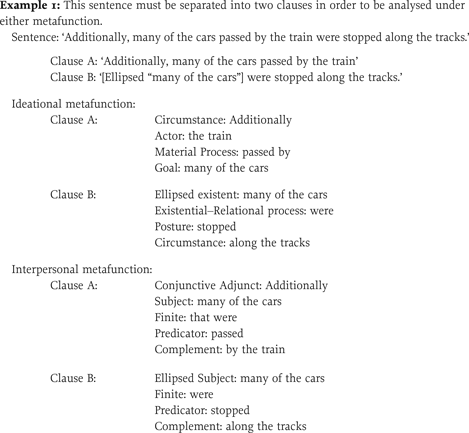
This example dissociates the Subject and the Participant in a clause. The ideational metafunction identifies ‘the train’ as the Actor in the first clause because it is the agent engaging in or carrying out the Material Process of ‘pass[ing]’. The interpersonal metafunction, however, identifies the phrase ‘many of the cars’ rather than ‘the train’ as the Subject in this clause because it, not ‘the train’, is responsible for what occurs in the clause. The subsequent clause exemplifies how the Subject and Participant do not necessarily differ. In this case, ‘many of the cars’ operates as both the Ellipsed Existent and the Ellipsed Subject because it engages in the process ‘were stopped’ and is responsible for the validity of the clause.

This clause identifies each of the three different types of Adjuncts: Modal, Conjunctive and Circumstantial. ‘Hopefully’ is a Modal Adjunct because it conveys the speaker's attitude towards the possibility that the participant ‘will wash the pillow tomorrow’. The Conjunctive Adjunct ‘also’ functions to connect the clause to a previous text, which perhaps specifies other processes the participant plans to carry out tomorrow or other entities that she plans to wash. The Circumstantial Adjunct in this clause is ‘tomorrow’ because it provides a temporal context for the process ‘will wash’. Here ‘tomorrow’ operates as both the Circumstance under the ideational metafunction and as a Circumstantial Adjunct under the interpersonal metafunction, but the next example will distinguish Circumstance and Circumstantial Adjunct.

This example again illustrates the distinction between Actor and Subject. Additionally, it demonstrates how the ideational and interpersonal metafunctions treat ‘after lunch’ in Clause A and ‘and’ in Clause B differently. That is, they are both Circumstances through the ideational lens but both Adjuncts (Circumstantial and Conjunctive, respectively) through the interpersonal. This difference occurs because ‘after lunch’ and ‘and’ are not essential to what is being represented ‘in the world’. Accordingly, the ideational analysis treats them as ancillary. However, because they convey the speaker's sense of relationships among events, the interpersonal metafunction identifies them as connecting elements of the clause. A similar explanation applies to the different treatments of ‘only’ in Clause B. Under an ideational view, ‘only’ is either an additional Circumstance, as I have identified it above, or part of the material process itself, while it illustrates the speaker's attitude through an interpersonal analysis.
Textual metafunction
While the ideational and interpersonal metafunctions pertain to such ‘extra-linguistic’ phenomena as representations of the ‘natural’ world and enactments of the social world, the textual metafunction concerns the presentation of meaning or how meaning can be imparted by a speaker to an addressee in ‘a text unfolding in context’ (M&H, pp. 10–11). That is, the textual metafunction exposes how information can be contextualised in a way that allows for an ongoing exchange between speaker and addressee. In this way, it is focuses on where a given clause fits in its textual environment. The primary system for analysing grammatical choices under the textual metafunction is Theme, which is a resource for establishing an immediate environment for a clause by fixing a starting point or ‘local point of departure’ in the flow of the to-be-shared information (p. 11). In doing so, the system of Theme provides a reference point for the addressee to interpret the message (p. 18). Based on this system, the textual metafunction specifies two components to a clause's structural configuration, the Theme and the Rheme, which are identified by position in sequence. The Theme typically is the information preceding the verb in a clause (p. 18). The Rheme is the verb and all information thereafter and includes the content presented in the local environment established by the Theme.
In identifying a clause's Theme and Rheme, we analyse its thematicity (i.e. how information is contextualised and established as relevant in the clause). According to M&H, thematicity concerns the gradual shift in thematic prominence in the beginning of a clause to thematic non-prominence at its end (p. 18). For example, in the clause: ‘James always wants to wash the dishes’, the Theme is ‘James always’, while the Rheme is ‘wants to wash the dishes’. In this way, ‘James always’ functions as the more prominent information in the clause; it is the information that the speaker wants the addressee to receive and attend to immediately. Thus, a textual interpretation of this clause may conclude that the speaker's greatest focus is on James, or rather imparting to the addressee that the approaching information will pertain to James. The following word in the clause, ‘always’, suggests that the speaker's next concern is to establish the frequency or consistency of James's action, regardless of what that action is. Therefore, the speaker seems to emphasise that James always does something rather than what James does. Similarly, based on the ‘flow’ of thematic prominence in the clause, it appears that the speaker focuses more on the fact that James wants to wash than that James does wash or even what James wants to wash (i.e. the dishes).
While thematicity offers one lens for assessing prominence, newsworthiness, another aspect of the textual metafunction, provides a complementary perspective on prominence: a continuum between given information and new information (M&H, p. 19). Newsworthiness, like thematicity, allows us to understand a clause as assigning different textual statuses to its different parts. Both also approach a message as ‘unfolding in a text’ and attempt to map how that message adjusts to and fashions the ‘flow of information’ in the text (M&H, p. 19). However, unlike thematicity, newsworthiness focuses on how information is organised in relation to previous information to create coherency and lucidity. In this way, the structural configurations under labels of newsworthiness and thematicity can exist simultaneously and almost on top of each other (p. 19).
Like thematicity, newsworthiness offers two structural components for a clause: the Given and the New. Given information shades into New information, as the Theme shades into the Rheme, and both the Given and the New can be identified in relation to the Theme and the Rheme (M&H, p. 19). That is, the New can be identified as the last element of information within the Rheme that has a lexical content, while the Given is all information appearing before the New (p. 19). Thus, the Given can be thought of as information relating to that which has been previously presented or information with an identifiable referent. In this way, positioning the Given at the beginning of a clause creates grammatical cohesion by connecting the clause to past or assumed content, while presenting the New towards the end of a clause creates a lucid flow of information into the subsequent clause. M&H describe the continuum between the Given and the New as one which offers the addressee ‘guidance as to where to integrate the message with his or her interpretation of the text so far’ (p. 19).
In its considerations of cohesion and lucidity, the textual metafunction also pertains to grammatical mechanisms that connect information and create presuppositions within a clause. For example, the textual metafunction identifies how pronouns and conjunctions are used. It will address whether these mechanisms forge or disrupt the lucidity and flow of information within the message and comment on the speaker's strategies for creating a coherent text. Furthermore, in addition to focusing on where the Given and the New appear in a clause, the textual metafunction also considers what grammatical choices present information as that which is familiar or presupposed versus that which is unfamiliar. Thus, the textual metafunction looks both at where the Given and the New appear and how they operate. For example, pronouns often operate as ‘given’ information, as they are presupposed as references to previously established information. If a particular pronoun lacks an antecedent, and is therefore ‘new’ or unfamiliar, a textual analysis will focus on the effects of and reasons for this grammatical choice. Likewise, articles often pertain to presupposition in a clause by imparting knowledge about a noun's distinctiveness. For instance, if a clause states ‘she went to the university’, the addressee can presuppose, based on the article ‘the’, that there is a distinctive university to which the speaker is referring and perhaps that this university has been previously discussed or should be familiar. Contrarily, if a clause states ‘she went to a university’, the article ‘a’, as opposed to ‘the’, does not presuppose prior knowledge of or an element of distinctiveness to the noun ‘university’. As the examples demonstrate, the textual metafunction addresses how subtle grammatical choices can affect the presentation of meaning as information to be shared between speaker and addressee.
As a framework for rhetorical analysis, Systemic Functional Grammar exposes the power and purpose of each word in a clause. It recognises how meaning is made and locates that meaning to specific grammatical choices. As I use it to dissect the rhetorical strategies of different reproductive rights organisations, Systemic Functional Grammar allows me to deconstruct the dialogue unfolding within today's reproductive rights movement and assess the efficacy of feminist and masculist rhetoric as it engages in that dialogue.
Gynocentricity and gender-neutrality in feminist reproductive rights rhetoricFootnote 12
Abortion is the most controversial and publicised reproductive rights issue in contemporary American culture. In turn, we often conceptualise the public rhetoric surrounding reproductive rights in terms of the ‘pro-choice’ and ‘pro-life’ movements. However, this dichotomisation fails to acknowledge the multidimensional spectrum of viewpoints and agendas operating within these two general ‘camps’. For example, traditional pro-choice advocacy is frequently associated with mainstream organisations like the Planned Parenthood Federation of America, the Center for Reproductive Rights, the American Civil Liberties Union (ACLU) and NARAL Pro-Choice America. Because these agencies support the legalisation of abortion and advocate for other reproductive rights, they are easily linked to one another. Yet a cursory view of their rhetoric reveals potential differences in the scope and objectives of these organisations, as some, like the Center for Reproductive Rights, Planned Parenthood and NARAL, seem particularly female-oriented; while others, like the American Civil Liberties Union, assume what appear to be gender-neutral perspectives on reproductive freedom. A closer analysis of their rhetoric reveals that despite this seeming distinction, mainstream reproductive rights organisations are strongly tied to their feminist heritage and largely focused on the female experience. This gynocentricity in traditional reproductive rights rhetoric becomes even more apparent as we consider the stances of emerging alternative pro-choice organisations like the National Center for Men.
The National Center for Men is a male-affirmative or masculist organisation which aims to secure men's reproductive rights and asserts that the current legal doctrine systematically disadvantages males because it gives authority over parenthood to women. Just as Wollstonecraft and feminists of her time summoned male equality rhetoric to liberate their sex, the National Center for Men relies on the feminist principle of sex-based equality to garner reproductive rights for men. In this way, masculist reproductive rights organisations seem to stand in opposition to more traditional pro-choice agencies, which do not attempt to rectify or even acknowledge the ways in which reproductive laws allegedly disadvantage men. In turn, this male-affirmative outlook accuses the traditional pro-choice movement of advancing goals for reproductive freedom that only apply to women.
Explicit feminism in traditional reproductive rights rhetoric
Much of today's traditional reproductive rights rhetoric undeniably emphasises the female reproductive experience and women's legal rights. I will consider this gynocentricity in the language of today's most prominent pro-choice organisations: Planned Parenthood, the Center for Reproductive Rights, the ACLU and NARAL Pro-Choice America.
Planned Parenthood claims to have offered progressive approaches to reproductive issues and family planning for over ninety years.Footnote 13 It is one of the most popular, well-known and relied upon reproductive rights organisations in the world. As such, Planned Parenthood's language becomes especially important as we consider the feminist rhetoric of the reproductive rights movement as a whole.
The gynocentricity of Planned Parenthood's language is immediately apparent in the ‘Abortion’ section of its website, as it consistently emphasises the female experience in reproductive decision-making. In fact, most of its language is clearly aimed at a female audience, and any gender-neutral language included in this section solely functions to define or identify inanimate entities, as when relational processes identify medical procedures or terms. Furthermore, this text not only emphasises women, it relies on rhetorical patterns that empower women in relation to other gender-neutral agents. These rhetorical strategies demonstrate the organisation's feminist agenda.
The language in this ‘Abortion’ section describes potential courses for action that a woman can take should she experience an unintended pregnancy. This section begins with the following sentence: ‘[m]ost women look to their husbands, partners, families, health care providers, clergy, or someone else they trust for support as they make their decision about an unintended pregnancy’.Footnote 14 Here, Planned Parenthood presupposes that one, chief decision is made when an unintended pregnancy occurs and asserts that this decision, which we can assume to be the choice of whether or not to abort a foetus, belongs to the pregnant woman. The language that follows this sentence reflects its structure: ‘[a]nd many women go to the clinic with their partner’.Footnote 15 Accordingly, the text employs an evolving rhetorical pattern that works to empower women in these situations. This pattern begins with ‘women’ functioning as a quantified agent (e.g. ‘most women’, ‘some women’ or ‘many women’) enacting a material or verbal process (e.g. ‘look to’), which is preceded by a concrete and absolute finite (e.g. ‘do’) and followed by a goal, verbiage or circumstance involving some sort of gender-neutral party (‘their husbands’, ‘partners’, ‘families … for support’).Footnote 16 This pattern then evolves in the text such that the second-person ‘you’ functions as the agent committing a material or verbal process (e.g. ‘have to tell’), preceded by a finite with limited modality (e.g. ‘do not’) and followed by a goal, receiver or circumstance involving a gender-neutral party (‘anybody’).Footnote 17
The first form of this pattern tempers generalisations across females with quantifiers like ‘some’ or ‘many’ before a concrete verbal or material process is described.Footnote 18 In this way, the gender-neutral party mentioned as the receiver or in the goal or circumstance of each clause maintains its status in these situations for only ‘some’ or ‘many’ women. This is the case in the following sentence: ‘[a]nd many women go to the clinic with their partner’.Footnote 19 In this way, the language does not force a particular action or idea on to women in these situations by generalising across their sex or presupposing their conformity. Instead, it implies that, in some cases, these gender-neutral agents are not involved in a woman's actions and choices surrounding an unintended pregnancy.
As this pattern evolves into using the second-person ‘you’ as the agent, it reveals that the text not only focuses on the female experience in these situations, but is directed at a female audience. Furthermore, in coupling limited finites (e.g. ‘may’, ‘can’, ‘do not’) with concrete material processes, this evolved pattern suggests that the gender-neutral receiver or party in the goal or circumstance of each clause does not need to exist in the decision-making process. For example, the sentence ‘[y]ou may bring someone with you’ suggests that the female actor (‘you’) controls whether or not to include a gender-neutral party (‘someone’) in the management of an unintended pregnancy.Footnote 20 This structure empowers women to determine the status or involvement of other individuals, regardless of their sex, in their reproductive decision-making. According to this rhetoric, women determine to what degree to construct abortion as a gender-neutral issue.
The Center for Reproductive Rights also articulates its focus on the female experience in its Mission and Vision Statements. According to its Mission Statement, the Center ‘is dedicated to promoting and defending women's reproductive rights worldwide’.Footnote 21 This statement unambiguously emphasises women in its identification of the Center for Reproductive Rights. Furthermore, in a later sentence, the Center constructs ‘reproductive rights’ as fundamentally and exclusively female. It positions the phrase ‘reproductive rights’ as the identifier in two consecutive relational clauses: ‘[r]eproductive rights, the foundation for women's self-determination over their bodies and sexual lives, are critical to women's equality and to ensuring global progress toward just and democratic societies’.Footnote 22 Here, ‘women's self-determination’ and ‘women's equality’ are focal points in the identified information. Furthermore, the Center also uses relational processes when referring to the phrase ‘reproductive freedom’. In the following sentence, ‘reproductive freedom’ functions as an existent: ‘[r]eproductive freedom lies at the heart of the promise of human dignity, self-determination and equality embodied in both the U.S. Constitution and the Universal Declaration of Human Rights’.Footnote 23 This language reifies ‘reproductive freedom’ from an abstract idea to a tangible and existing entity. In doing so, the Center not only presents ‘reproductive rights’ as female rights, but it also presents ‘reproductive freedom’ as a material and achievable status. This strategy empowers women to understand reproductive rights as phenomena that solely pertain to them and are attained by them.
The feminist objectives of the Center for Reproductive Rights are also apparent in its rhetorical construction of the law. In its opening statements, the Center positions ‘the power of law’ and ‘laws and legal norms’ as the actors of material processes. In this way, laws are enlivened, activated and made dynamic in these sentences. They also become the determinants of reproductive rights. For example, consider the following clauses: ‘[t]he power of law, in turn, ensures that this promise will not ring hollow’ and ‘[l]aws and legal norms will, in the end, determine whether women will be free to’.Footnote 24 In these sentences, the law functions as the agent, the ultimate controller, of whether and how reproductive freedom will be realised.
However, after these clauses construct the law in this way, the Center explicitly states that laws do not determine ‘the reality of women's lives’. This statement reads: ‘[c]hanging laws and legal norms does not immediately change the reality of women's lives, of course.’ In consideration of this rhetoric, we must first identify its presupposition that the ‘reality of women's lives’ must undergo change.Footnote 25 Subsequently, we must understand its conceptualisations of reproductive rights as reactions to a larger system of sexism and injustice, which ultimately determines the ‘reality of women's lives’. Accordingly, this rhetoric suggests that to secure reproductive rights through the law is merely to tackle a symptom or component of this larger system of oppression, it is not to amend the system itself. In her article ‘Rethinking Sex and the Constitution’, Sylvia A. Law concedes to a similar idea, explaining that ‘no constitutional principle mandates or allows courts to effectuate the range of changes needed to allow actual equality between men and women’ (1984, p. 956). She asserts that ‘[a]chieving sex-based equality requires social movement for transformation of the family, child rearing arrangements, the economy, the wage labor market, and human consciousness’ (p. 956). It seems that the Center's language articulates the need for a similar transformation. Though this rhetoric does not explicitly mention goals for ‘sex-based equality’ or even fair treatment between the sexes, it implicitly commits to these feminist ideas. In this way, the Center for Reproductive Rights is not solely concerned with reproductive rights or their sex-specific impact on women; it is also concerned with women's larger social mobility and societal status. Moreover, because this language does not locate the mechanism for ‘chang[ing] the reality of women's lives’ in the law, it suggests that we, as civic participators and members of society, should not view the law as an ultimate solution.Footnote 26 The sentence presupposes the existence of other strategies for change, which the next sentence overtly, but not specifically, addresses: ‘But, when integrated with other strategies, the law is a catalyst for fundamental social change’.Footnote 27 Thus, the Center for Reproductive Rights maintains a feminist focus on improving the ‘reality of women's lives’ by endorsing strategies for ‘fundamental social change’ other than reproductive rights law.
While the gynocentricity and feminism of this reproductive rights language are explicit, rhetoric of the same and like-minded organisations maintains a gender-neutral stance on reproductive rights advocacy. Thus, we must carefully consider the gender-neutrality in this language (i.e. its contexts and purposes) in order to determine to what degree the mainstream reproductive rights movement puts forth a gynocentric and feminist agenda.
The nature of gender-neutrality in feminist reproductive rights rhetoric
Traditional reproductive rights agencies frequently rely on language that seems to apply to both men and women. However, careful grammatical analyses of this language and of that surrounding it expose its concurrence with traditional feminist objectives, as it does not advocate for male reproductive freedom or meaningful gender-neutrality within the reproductive rights movement. Specifically, these analyses demonstrate that gender-neutral language does not commit to or even acknowledge male agency in decisions about unwanted pregnancies; or it pertains to issues like general health or sex education, which do not threaten female empowerment in reproduction.
In a January 2006 article, Louise Melling, Director of the ACLU Reproductive Freedom Project, presents the ideals and objectives of the project. The language in this article begins with an explicit focus on the female experience. The opening sentence reads: ‘Thirty-four years ago, the U.S. Supreme Court handed down its decision in Roe v. Wade, significantly expanding the ability of women across the country to decide when and whether to become a parent’.Footnote 28 However, after this initial sentence, Melling presents a gender-neutral image of the ‘the world we want’ in a series of clauses.Footnote 29 She relies on the first-person plural ‘we’ as the agent in many of these clauses. The antecedent to the ‘we’ agent is unspecified, and consequently its sex is ambiguous. In nearly every clause in which it appears, ‘we’ functions as an agent external to ‘the world we want’; its unnamed antecedent envisions that world from outside it. In this way, ‘we’ remains gender-neutral. However, there are several exceptions where ‘we’ becomes complicit in the envisioned world. For example, consider the following series of sentences:
Sentence 1: ‘The world we want includes access to safe and legal abortion care, secures our right to have children when we are ready, and supports programs that foster healthy families and healthy lives for all.’Footnote 30
Sentence 2: ‘The decision when and whether to become a parent is one of the most private a person can make and one that has a profound effect on all aspects of our lives.’Footnote 31
Sentence 3: ‘To participate fully in society, we must be free to answer for ourselves whether we are ready and capable of being parents.’Footnote 32
In Sentences 1 and 3, the first-person plural ‘our’ and ‘we’ no longer merely envision this world; they are included within it. However, it is still difficult to assess whether the sensor envisioning and apparently comprising ‘the world we want’ is gender-neutral.
Let us consider several sentences appearing later in Melling's article. The language externalises the ‘we’ sensor and appears to be gender-neutral: ‘[i]n the world we want, women, men, and families have the support they need to maintain healthy lives, healthy pregnancies, and healthy families’.Footnote 33 Here, men are clearly included as intended carriers of the attribute ‘healthy lives, healthy pregnancies, and healthy families’.Footnote 34 However, in a subsequent sentence, Melling positions women as the actors of the goal to be ‘able to obtain an abortion’.Footnote 35 The sentence reads: ‘[i]n the world we want, all women have meaningful access to birth control and are able to obtain an abortion if and when they need one’.Footnote 36 This sentence appears in a section of the article subtitled ‘Ensuring the right not to have children’, in which nearly all of the sentences are explicitly female-gendered.Footnote 37 In this way, ‘ensuring the right not to have children’ becomes an exclusively female concern. Therefore, the language in this article seems to be gender-neutral when referring to an individual's general health, but becomes gynocentric in equating the right to abortion with the right not to have children. Accordingly, Sentences 1 and 3, in which the ‘we’ and ‘our’ are complicit in the ‘world we want’, become female-gendered as well.Footnote 38 For example, in Sentence 1, ‘access to safe and legal abortion’ is now a female concern and so the ‘our right to have children when we are ready’ is female-gendered.Footnote 39 The final clause, ‘and supports programs that foster healthy families and healthy lives for all’ is overtly gender-neutral.Footnote 40 However, gender-neutrality in this case does not undermine the gynocentricity of the reproductive rights movement, as individual health applies to both sexes without threatening female reproductive choice or advocating for male reproductive choice. Moreover, we now see that ‘we’ in Sentence 3 refers solely to women and so implies that Melling speaks only of a female freedom to ‘answer for [them]selves whether [they] are ready and capable of being parents’.Footnote 41 The use of ‘our’ in Sentence 2 reinforces this female-exclusivity, as the article again constructs ‘the decision when and whether to become a parent’ as a woman's decision.Footnote 42 These findings demonstrate that Melling's seemingly gender-neutral language is largely female-oriented and only truly gender-neutral when it pertains to health. These interpretations also become especially relevant to masculist pro-choice rhetoric surrounding men's rights to voluntarily enter into parenthood, as the language in this article does not conceptualise that right as one belonging to men.
The false gender-neutrality of ACLU's Reproductive Freedom Project is also evident in its general Mission Statement. The first sentence of the statement reads: ‘[t]he ACLU's Reproductive Freedom Project protects everyone's right to make informed decisions free from government interference about whether and when to become a parent’.Footnote 43 Because we are concerned with how the grammatical choices in this sentence construe or represent the reality of this project, we should regard it through the ideational lens. An ideational analysis of this sentence reveals that the ACLU's ‘Reproductive Freedom Project’ functions as the actor and ‘protects’ functions as the material process. The goal of ‘protects’ suggests that the ACLU's Reproductive Freedom Project maintains a gender-neutral objective, as it ‘protects everyone's right to make informed decisions free from government interference about whether and when to become a parent’.Footnote 44 However, the ACLU denotes this gender-neutral ‘right’ in such a way that it does not commit to meaningful gender-neutrality. That is, the ACLU does not claim to ‘protect everyone's right to freely’ decide, control or determine ‘whether or when to become a parent’.Footnote 45 In fact, the project's mission statement does not claim to secure either sex's ability to affect materially any component of reproduction. It only protects an individual's ability to ‘make informed decisions’ with respect to parenthood.Footnote 46 But, what exactly does ‘protect everyone's right to make informed decisions … about whether and when to become a parent’ mean?Footnote 47 It could mean that the project educates men and women about the factors and circumstances that may affect their choice to become parents and informs them of what their options are with respect to parenthood. It could also mean that the project secures men's and women's legal access to information about these issues. However, it does not mean that the project secures men's and women's legal rights to decide whether and when to become parents. In this way, the ACLU's language in this first sentence is carefully gender-neutral, as its project does not pledge much to either sex, though it seems to apply to both.
Let us compare the ACLU's empty and vague gender-neutral language to the powerful gynocentric rhetoric in the opening statement of the Center for Reproductive Rights. While the ACLU states that it ‘protects everyone's right to make informed decisions … about whether and when to become a parent’,Footnote 48 the Center for Reproductive Rights defines itself as ‘dedicated to promoting and defending women's reproductive rights worldwide’.Footnote 49 The process modalities in each sentence emphasise how gender-neutrality and gynocentricity function in the feminist reproductive rights rhetoric. For example, to ‘protect’ is a broad action; it could encompass advocacy, defence and maintenance; while ‘promoting and defending’ are more specific processes that presuppose the existence of friendly outlets and antagonistic forces. Furthermore, the goal of the Center For Reproductive Rights is overtly female-gendered and very specific in that it defines whose and what ‘rights’ it seeks to ‘promote’ and ‘defend’. As previously mentioned, the Center goes on to specifically define reproductive rights for its audience as ‘the foundation for women's self-determination over their bodies and sexual lives’ and ‘critical to women's equality and to ensuring global progress toward just and democratic societies’.Footnote 50 This specificity differs from the vagueness of the ACLU's language. These distinctions demonstrate the feminism of today's mainstream reproductive rights movement by exposing how an organisation that employs gender-neutral language does not offer meaningful or promising statements about its goals because they must apply to both sexes without threatening women's reproductive rights or advocating for men's; while an organisation that relies on overtly gynocentric rhetoric can make definite statements about its objectives because they apply only to women. Later in this article, I will explore the efficacy of these rhetorical techniques with respect to larger feminist agendas and discuss whether the reproductive rights movement can and should offer more meaningful commentary and information on men's procreative liberties.
The second sentence in the ACLU's mission statement also exposes how gender-neutral language can apply to either sex without empowering or advocating for it. This sentence invites readers to: ‘[l]earn more about our work in reproductive health and take action to protect rights guaranteed to all Americans’.Footnote 51 The language in this sentence is overtly gender-neutral because ‘you’ operates as its ellipsed sensor and ‘all Americans’ appears in the goal of the second clause. In this clause, the ACLU encourages its audience to protect ‘rights guaranteed to all Americans’, yet it does not narrow those rights for its audience. For example, it does not define these rights as ‘reproductive rights’ or even presuppose their existence with a definite article like ‘the’. In this way, ‘rights guaranteed to all Americans’ consists of an undefined set of ideas, and like ‘the right to make informed decisions … about whether and when to become a parent’, does not commit the ACLU to reproductive rights advocacy for either men or women.Footnote 52
Additionally, this second sentence further exemplifies the way in which feminist reproductive rights rhetoric uses gender-neutral language when discussing general reproductive health. Like Melling's article on ‘The World We Want’, this sentence refers to a gender-neutral entity like ‘all Americans’ in the context of reproductive health. In this way, the ACLU's project seems to rely on the benign inclusiveness of human health as a way of incorporating men in the introduction of their reproductive freedom project without committing to male reproductive rights advocacy.
As these feminist pro-choice agencies employ false or empty gender-neutral rhetoric, maintaining their female-oriented agendas without excluding a male audience, they also infuse gender-neutrality into their rhetoric when it otherwise appears female-gendered. This rhetorical strategy allows organisations that are fundamentally concerned with women's rights to seem as though they are concerned with universal reproductive rights. Topics pertaining to general reproductive health create ideal contexts for gender-neutral language, as they construct a false element of universality and impartiality within these organisations. For example, in its introductory statement, the NARAL Pro-choice America website subtly maintains a gender-neutral standpoint. It does so with the first sentence: ‘[t]he right to choose is about more than a woman's right to safe, legal abortion’.Footnote 53 Though it defines the ‘right to safe, legal abortion’ as a woman's right, and is therefore largely gynocentric, this sentence can support a gender-neutral construction of ‘the right to choose’ by implying that the phrase is not adequately identified with ‘a woman's right to safe, legal abortion’. Thus, this first sentence suggests that later language may focus on gender-neutral reproductive issues, particularly because it has included ‘women’ in an insufficient definition of ‘the right to choose’. Furthermore, NARAL may include more personal choices surrounding parenthood in its construction of ‘the right to choose’, such as the right to decide whether or when to become a parent, as opposed to the more medical choice of obtaining an abortion.
The subsequent language in NARAL's opening statements appears to maintain this initial gender-neutral focus as it offers a new definition of ‘freedom of choice’. This revised definition includes four key points, the first three of which rely on gender-neutral language.
The first new component of this definition states that ‘freedom of choice’ includes ‘preventing unintended pregnancy through sex education and improved access to birth control’.Footnote 54 This language does not limit ‘sex education’ or ‘improved access to birth control’ to women; instead it remains gender-neutral and suggests that ‘the right to choose’ is relevant to both sexes. However, we have observed that feminist pro-choice texts employ gender-neutral rhetoric when discussing health-related issues because doing so does not promote men's reproductive rights or detract from women's. Gender-neutral language operates in a similarly benign manner in the context of sex education or pregnancy prevention. The second component of the new ‘right to choose’ definition is ‘the independence of our nation's courts’.Footnote 55 Gender-neutrality in the context of judiciary independence is not meant to include or empower men in reproductive rights law. It is merely a function of language referring to inanimate entities and does not put forth a gender-neutral conception of ‘the right to choose’. The third point in NARAL's new definition states that ‘freedom of choice’ includes ‘addressing the inequities in reproductive health care’.Footnote 56 This point like the first, includes males and females in ‘the right to choose’, as it does not specify that one sex is uniquely subject to ‘inequities in reproductive health care’. However, as with the rhetoric referring to health care, while the contexts of gender-neutral language in these statements are consistent with previous analyses of mainstream reproductive rights rhetoric, NARAL still seems to rely on gender-neutrality in its new definition of ‘the right to choose’. Perhaps, this serves to invite men into reproductive rights discourse, as the definition now pertains to men's experiences with sex education, pregnancy prevention, laws and health care.
The fourth point in NARAL's new definition of ‘freedom of choice’ states that this freedom encompasses ‘defending a woman's right to bear healthy children’.Footnote 57 That statement and the original identification of ‘the right to choose’ as ‘more than a woman's right to safe legal abortion’ are the only references in NARAL's opening statements to women and to pregnancy. But even while mentioning women and pregnancy, it fails to clarify what ‘choice’ means or entails with respect to pregnancy. This statement is simply another reference to reproductive health. Thus, NARAL's revised identification of ‘reproductive freedom’ only includes health, sex education and judiciary issues, which surround or complicate ‘freedom of choice’ in pregnancy or parenthood but do not directly address these ‘choices’ themselves. Furthermore, while these clauses are largely gender-neutral, they do not include men as agents in the decisions surrounding pregnancy. Thus, when one looks to locate the aspects of NARAL's definition that pertain to ‘choice’, he or she must turn back to the original and allegedly insufficient definition of ‘a woman's right to safe, legal abortion’.Footnote 58 Though this seems to represent the inefficacy of NARAL's language, it may actually point to purposeful and well-executed omissions in the language. That is, one of the more problematic identifications of ‘the right to choose’, which I will analyse closely when considering masculist language, relates to male ‘choice’ in parenthood. That is, there seems to a problematic rhetorical and legal distinction between a man's or woman's decision of whether and when to become a parent and a woman's decision of whether or not to abort a foetus. Because NARAL only mentions a woman's right to ‘a safe, legal abortion’, it seems to exclude the gender-neutral choice regarding parenthood from its definition.Footnote 59 Accordingly, NARAL identifies ‘freedom of choice’ as the combination of a woman's medical decision and the key issues, particularly health related ones, which may complicate or surround that decision. Therefore, its gender-neutral language does not meaningfully articulate any intention on the part of the organisation to advocate for male ‘choice’ in parenthood.
Education, asymmetry and antagonism in masculist rhetoric
The rhetoric of today's mainstream ‘pro-choice’ organisations reveals that the reproductive rights movement addresses women and focuses on their experiences and freedoms in reproduction. While it often appeals to both sexes as if to appear universally applicable and accessible, feminist reproductive rights rhetoric does not articulate any meaningful goals or ideas about male agency and legal rights with respect to reproductive choice. However, this tendency is not without justification, as the reproductive rights movement developed as a response to institutionalised misogyny and female oppression. In acknowledgement of the biological differences between men and women, it sought to legally attend to the sex-specific impact that procreation has on women and ensure that such an impact does not systematically disadvantage or subjugate the female sex.
Groups that identify as ‘masculist’ maintain that this inherently feminist movement has produced a feminist constitutional doctrine of reproductive freedom. Masculists assert that legal applications of reproductive freedom systematically disadvantage men, who lack biological control over pregnancy and, as their argument follows, over parenthood. Accordingly, masculist reproductive rights organisations advocate that reproductive laws should function on a principle of sex-based equality to preserve men's procreative control despite their biological realities.
The rhetoric they use to communicate these points is antagonistic and accusatory. It often presupposes others' ignorance about and objections to masculist positions on reproductive rights and assumes an overtly hostile tone when discussing female procreative choice. It relies on strategies to contrast male and female procreative liberties, suggesting that the legalisation of abortion provides women with special freedoms and advantages. According to this contention, current abortion law not only gives women choice in pregnancy but also choice in parenthood, which masculists argue offers women unique sexual freedoms, such as the ability to engage in sexual intercourse while fully controlling its material consequences. In this way, masculist language focuses on the sex-specific impact of today's reproductive rights climate on men, suggesting its multidimensionality and locating it in the most intimate of situations.
With this construction as well as specific rhetorical strategies, the masculist language puts forth an image of male victimhood. Men become victims of their biology, the law, other mechanisms of institutionalised subjugation and, ultimately, of women. In turn, women become aggressors, oppressors, manipulators and liars in their reproductive relationships with men. Moreover, as the language positions men as victims and women as victimisers with respect to reproductive issues, it also implants those gender constructions into other contexts applicable to heterosexual relationships. For example, masculist reproductive rights rhetoric frequently discusses divorce and preserves its antagonistic representation of women within this context. While such hostile constructions of females seem inappropriate in any setting, one can at least acknowledge how divorce is a relevant topic to reproduction because of issues like custody rights. However, this rhetoric also maintains an accusatory stance towards women when discussing the economics of divorce and other issues that have nothing to do with parenthood or childrearing. That is, masculist rhetoric focusing on reproductive rights will frequently interject unrelated criticisms of women. For example, when discussing its ‘Voluntary Fatherhood Project’, the National Center for Men accuses women of financially exploiting men, decadently consuming goods and resources, and not financially contributing to their families or society. Not only is this rhetoric sexist in its categorical derogation of women; it is also irrelevant to reproduction and thus fails to advance the organisation's stated goals for reproductive rights advocacy.
I will now turn to specific examples of these masculist rhetorical strategies in order better to comment on their purposes and effects and to understand the relationship unfolding between today's masculist reproductive rights movement and its feminist counterpart. I will interpret Systemic Functional Grammatical analyses of texts cited from the National Center for Men. Founded in 1987, the National Center for Men claims to be ‘the first men's rights group in the United States to address the full range of men's issues, from conscription to circumcision, from fathers' rights to sexist dress codes’. Moreover, it recently created a public controversy with the so-called ‘Roe v. Wade for Men’ lawsuit, as the organisation sought to garner legal rights for men to refuse paternity in the case of an unintended pregnancy (Swenson, Reference Swenson2006). I focus on this source because, among masculist organisations, it offers a moderate perspective on a broad range of reproductive issues. My Systemic Functional Grammar analyses of the National Center for Men's opening statements relies on both the ideational and interpersonal lenses.
A masculist education: informing the public about male disadvantages in reproduction
The National Center for Men (NCFM) implies, through rhetorical effects, that the American public is ignorant of the ways in which reproductive law allegedly discriminates against men. When this language positions the NCFM as the actor in a clause, the process that follows tends to focus on education. The process is often verbal, such as ‘educate’, ‘argue’ and ‘ask’, or material, such as ‘counsel’ and ‘expose’.Footnote 60 The subsequent language appearing in the complement, verbiage or goals of the clauses is frequently antagonistic. It presupposes that men are systematically and institutionally subjected to inequality, discrimination and other negative conditions. For example, clauses state that men are being ‘lied to’, ‘victimized’, ‘forced’ or ‘hurt’.Footnote 61 Additionally, in clauses with verbal processes, the beneficiary of the verbiage is ‘the public’.Footnote 62 For example: ‘[w]e have educated the public about male victims of domestic violence, men's health concerns and how men are often victimized by false accusation, particularly during divorce’.Footnote 63 Another sentence reads: ‘[w]e educate the public about how men have been hurt by sex discrimination.’Footnote 64 These sentences follow a grammatical pattern suggesting that the NCFM combats a sort of pervasive ignorance about male victimisation in reproduction. They suggest that while the public is unaware of and unsympathetic to sex discrimination against men, the NCFM can educate it to become more sensitive to and supportive of masculist views. Accordingly, the Center's rhetoric attempts to motivate masculists toward educating the public. It approaches public ignorance and unconcern about men's reproductive freedoms as surmountable obstacles. Consider the following sentence: ‘[w]e might have successfully exposed the inequality and sexism of child support enforcement’.Footnote 65 In this example, the finite ‘might have’, circumstantial adjunct ‘successfully’ and predicator ‘exposed’ convey that the NCFM failed to reveal the ‘inequality and sexism of child support enforcement’. However, the language also suggests that masculists can potentially expose inequality and sexism and in turn educate the public and promote its acceptance of masculist views.
The Center's emphasis on educating the public also insinuates that females are complicit in or contributors to a system that disadvantages males. That is, its language also works to ‘out’ women or expose the ways in which they allegedly manipulate men and exploit their reproductive rights. For example, the above sentence states: ‘[w]e have educated the public about … how men are often victimized by false accusation, particularly during divorce’.Footnote 66 The ideational lens identifies ‘men’ as the subject of the latter clause; however, ‘false accusation’ acts as the agent under the interpersonal metafunction. Thus, it is important to consider the interpersonal metafunction in this case, rather than the ideational, as it identifies the literal actor in the latter clause and points to an unidentified human agent. That is, while ‘false accusation’ functions as an inanimate agent, the Center's language indirectly posits a human agent who implements or carries out ‘false accusation’. This agent is implicitly yet obviously women. In this way, ‘educating’ the public becomes a matter of exposing female corruption or misuse of reproductive authority.
Differences in presupposed credibility and stages of development
As the NCFM's language focuses on education and other activities directed towards the public, it works to establish the credibility of masculist perspectives on reproductive rights. In doing so, it anticipates public objection and disparagement. The feminist language, however, is confident in its credibility. Whereas masculist clauses rely on verbal processes like ‘educating’ when positioning themselves (‘we’) as agents, the feminist language relies on mental processes like ‘examine’, ‘study’ and ‘want’ when positioning themselves (‘we’) as clausal agents. For example, the Center for Reproductive Rights states: ‘[w]e study national laws and policies that affect contraceptive access for women around the world’.Footnote 67 As the NCFM focuses on how the public will receive it, the organisation seems to presuppose that its ideas are controversial and that it must establish credibility before implementing its objectives. Contrarily, feminist organisations seem to presuppose the legitimacy and justification of their ideas. This distinction in clausal processes may also represent a difference in the stages of establishment or development of the masculist and feminist movements. That is, because masculism is a younger and less prominent social theory and movement, the NCFM may confront the public in order to gain momentum and notoriety. Feminist reproductive rights organisations share a long-standing and prominent history, and so can be more proactive in their scope. With this more established credibility, they can focus on, fine tune and begin to execute their ideas and strategies.
Establishing male victimhood and disempowerment in the elements of a phrase
As seen in the ways it constructs educational processes, the National Center for Men frequently uses language that represents male victimhood and disempowerment with respect to reproductive rights. The language achieves this effect in both clausal structures and elements of clausal phrasing, particularly with respect to quantifiers and finites. When feminist clauses refer to discrimination against women, they often rely on quantifiers like ‘some women’ and ‘many women’. However, the masculist rhetoric does not include such quantifiers, unless it refers to specific types of discrimination against men in reproduction (e.g. forced paternity). Accordingly, discrimination against men often becomes absolute and all-inclusive. For example, the clause, ‘[w]e educate the public about how men have been hurt by sex discrimination’, suggests that all men are victims of sex discrimination.Footnote 68
Masculist clauses also represent male victimhood by using concrete and present tense finites when positioning ‘men’ as the goal or beneficiary of a negative material or negative verbal process. For example:
A. ‘men have been hurt by …’Footnote 69
B. ‘when men are lied to about birth control …’Footnote 70
C. ‘men are routinely forced to give up control, forced to be financially responsible …’Footnote 71
In these sentences the ‘have been’ and ‘are’ finites use absolute modality and present tense to establish a legacy and immediacy of male victimhood. This effect provides the NCFM with rhetorical leverage, as men become the current and historical victims of systematic and institutionalised oppression. These clauses also construct men in the passive, such that external forces immobilise men and remove their agency. Additionally, the agents in these clauses are either unspecified or inanimate (e.g. false accusation). However, because all three material processes generally have animate agents, the sentences evoke an unstated human actor. As with the NCFM's educational processes, the human agent cannot be ‘men’; plausible alternatives are women or law-makers, or perhaps both, such that law-makers allow or facilitate women to commit these negative processes against men.
Furthermore, the absolute and present tense finites of many masculist clauses focus on what men lack rather than what they possess. This rhetorical effect differs from feminist constructions of female agency. When the feminist language refers to the future, it relies on absolute and present tense finites to establish the certainty of a given event or outcome. Louise Melling of the ACLU uses this grammatical effect in her construction of the ‘world we want’. Consider a previously cited example, ‘[t]he world we want includes access to safe and legal abortion care’, in which the finite ‘does’ and the predicator ‘include’ suggest that ‘access to safe and legal abortion care’ will occur with the actualisation of the ACLU's goals (Melling, Reference Melling2007). The NCFM also uses absolute and present tense finites, as in the above cases (e.g. ‘men are lied to’, ‘men have been hurt by’ and ‘men are routinely forced to give up control’). However, the masculist language does not use the finites ‘are’, ‘have been’ and ‘are’, respectively, in reference to the future or to positive outcomes. Instead, the finites establish men's current deficits.
Male disadvantage and female advantage in oppositional clausal structures
The NCFM language demonstrates a reliance on contrast between men and women with respect to reproductive issues, as it often constructs women and the laws benefiting them as sources of male victimisation. In doing so, it implicitly relies on a principle of sex-based equality; however, its language often negates that principle by becoming particularly hostile, accusatory and antagonistic.
The NCFM's language uses passive and active voice in ways that contrast male victimhood to female agency. As demonstrated in examples A, B and C in the previous section, men are often passive in the NCFM's clauses. They function as the goals, receivers or phenomena in the cited clauses, while the actors, carriers, sensors or sayers are generally unspecified agents, malevolent concepts (e.g. discrimination, false accusation or ‘mean-spirited opposition’), women or laws. These agents often engage in processes with present tense and concrete finites like ‘can’, ‘do’ or ‘is’. However, in clauses where men appear in the active voice, finite modality limits their agency. For example, in a clause that positions a male reference as the sensor, the process finite ‘should’ or ‘could’ limits his agency in sensing the phenomenon. This effect differs from the ways in which feminist clauses use limited finites like ‘can’, ‘may’ and ‘do not’ to empower female agents. For example, as previously mentioned, the Planned Parenthood clause ‘you may bring someone with you’, empowers the female agent ‘you’ with the finite ‘may’.Footnote 72 Contrarily, when the masculist rhetoric uses similar finites with limited modality, it does so to emphasise men's reproductive disempowerment. For example, ‘a man's life can be held hostage to an unplanned pregnancy’.Footnote 73 This clause has an unusual structure, because the ‘unplanned pregnancy’ does not function as the actor, but as the circumstance. Thus, the actor remains unspecified, and is possibly the pregnant female or the laws requiring paternal responsibility. Similarly, the Center may state that a male agent ‘can't’ engage in a given process. Thus the modality surrounding men as agents is either entirely negative or limited. Moreover, even when the Center constructs females in the passive voice, including them in the goal, phenomenon or attribute of a clause, it positions a law or legal reference that favours women as the agent.
Several common grammatical configurations in masculist clauses and in series of clauses exemplify the ways in which the NCFM's language represents male disadvantages in reproduction. Let us consider the frequent structures of two adjacent clauses in the masculist language. In the first of these clauses, men, an implied male ‘you’ or the NCFM function as the goal, a negative material process follows (e.g. ‘forced’) and a negative state (e.g. ‘into paternity’) operates as the circumstance. This clause (e.g. ‘you are forced into paternity’) connects to a second clause with a contrasting circumstantial adjunct like ‘but’ or ‘while’. The second clause positions women as the agent of a material process (e.g. ‘enjoy’) or a relational process (e.g. ‘has/have’). The goals or attributes of these processes are positive concepts or states (e.g. ‘sexual intimacy’, ‘lovemaking’, ‘right’, ‘freedom’, etc.). A circumstance frequently follows this goal or attribute. The circumstance begins with a circumstantial adjunct like ‘without’ or ‘free from’ and includes the negative attribute or goal constructed in the first clause as plaguing men. Consider an example of this second type of clausal configuration: ‘[w]omen now have the freedom and security to enjoy lovemaking without the fear of forced procreation’.Footnote 74 This structure maintains female agency over positive conditions denied to men.
Furthermore, as these grammatical patterns imply that women possess power, either explicitly or implicitly, they also portray an underlying antagonism towards that alleged female control. Clauses following these grammatical structures do not advocate for male empowerment. Instead, they contrast male and female reproductive experiences in ways suggesting that the NCFM would prefer laws to refuse reproductive rights to both sexes rather than only to men. That is, the Center would find laws less discriminatory if they removed power from women than if they allowed men to remain without power. In this way, it becomes difficult to assess whether the NCFM finds fault in men's relative disempowerment or in female empowerment. Accordingly, representations of contrast within the NCFM's language are hostile, accusatory and illogical in the light of the Center's purported goals of sex-based equality and fairness. Let us consider several masculist clauses and possible alternatives to the Center's language in order better to understand this point:
Example 1: Masculist Clause: ‘Thousands of men forced into parenthood but no women?’Footnote 75
The structure of this clause is counter-intuitive because the author suggests that if men experience a negative process and circumstance, then women should as well. The clause would be less antagonistic toward female empowerment and more proactive with respect to male empowerment if it relied on a positive material process. Consider an alternative structure to this sentence: ‘Thousands of women are able to freely choose to be parents, but no men?’
Example 2: Masculist Clause: ‘He can't force motherhood on her but she can certainly force fatherhood on him, even if she has defrauded him about contraception.’Footnote 76
This sentence antagonistically contrasts male and female experiences to represent male disadvantages in reproduction. The language suggests that it is unfair that women can negatively affect men but men cannot negatively affect women. Moreover, it implies that women negatively affect men under false pretences. In this way, the language is hostile and accusatory and does not work towards a positive principle of sex equality. An alternative sentence structure might read: ‘Men and women should not be able to force parenthood on each other, particularly in light of circumstances in which one partner defrauds the other about contraception.’
Example 3: Masculist Clause: ‘Only women have the extraordinary freedom to enjoy sexual intimacy free from the fear of forced parenthood.’Footnote 77
This sentence constructs the ‘freedom to enjoy sexual intimacy free from the fear of forced parenthood’ as an ‘extraordinary’ female attribute by using the circumstantial adjunct ‘only’ and the relational process ‘have’. In doing so, it presents that freedom as an exclusive privilege because only one sex possesses it. However, this implication is somewhat ambiguous in that one cannot assess whether the clausal structure suggests that men should also possess this privilege or that women should not possess it. Moreover, this clause and those surrounding it in the original document do not suggest how or even that both men and women can simultaneously ‘enjoy sexual intimacy free from the fear of forced parenthood’. Any clauses in the Center's rhetoric that focus on males and females as they simultaneously share in an experience do so with regard to their obligations, not to their privileges.
As it contrasts male and female procreative liberties and foregrounds male disadvantages in reproduction, the Center's language accuses women of exploiting their reproductive control and manipulating men. Consider the following sentences:
Sentence 1: ‘Only women have the extraordinary freedom to enjoy sexual intimacy free from the fear of forced parenthood.’
Sentence 2: ‘This is an incredible power, taken for granted by most women and denied, by law, to all men.’Footnote 78
The antecedent to the identifier ‘this’ in the second sentence is ‘the extraordinary freedom to enjoy sexual intimacy free from the fear of forced parenthood’. Interestingly, the Center identifies ‘this’ and its corresponding antecedent as ‘an incredible power’, as opposed to an incredible right or liberty. Because the term ‘power’ connotes control, authority and dominance, this example subtly accuses women of abusing or exploiting their reproductive rights. Furthermore, the second sentence states that ‘most women’ take this power for granted. In doing so, the Center contrasts itself to most women: while it has demonstrated an awareness of women's developing reproductive freedom, as discussed in previous sections, the Center presents women as oblivious to the importance and evolution of their procreative liberties, such that ‘most’ contemporary women take them for granted. Accordingly, the language constructs men as societally and politically aware, perhaps because they do not benefit from these developing reproductive laws.
Because the Center identifies reproductive laws as the sources of reproductive injustice against men and antagonistically responds to women's reproductive control, it becomes difficult to assess whether its language blames the law for forcing men to assume paternal responsibility or blames the law for empowering women to force paternal responsibility onto men. Consider the following examples:
Sentence 1: ‘You are being forced into paternity and/or unfair child support obligation against your wishes.’Footnote 79
Sentence 2: ‘But men are routinely forced to give up control, forced to be financially responsible for choices only women are permitted to make, forced to relinquish reproductive choice as the price of intimacy.’Footnote 80
Sentence 3: ‘Thousands of men forced into parenthood but no women.’Footnote 81
In each of these three cases, the language does not specify a particular actor. However, it does imply that reproductive laws are largely responsible for forcing paternity onto men. As discussed earlier, analyses of quantifiers and modality in the Center's sentences suggest that the NCFM presents women as the empowered reproductive rights agents such that they choose how men become involved in parenthood. Thus, the Center opposes male and female experiences when becoming parents such that male involvement in parenthood is a repercussion of female choice. In this way, the Center seems to suggest that reproductive laws must negotiate how female choice affects men, and arguably implies, based on overt accusations of female dishonesty in reproduction, that laws are necessary to restrain women or prevent them from unjustly affecting men.
The National Center for Men also contrasts male and female reproductive control by suggesting that men have been deprived of their power in reproduction, while women have gained it. For example: ‘[m]ore than three decades ago Roe vs. Wade gave women control of their reproductive lives but nothing in the law changed for men’.Footnote 82 Also, the NCFM's language often constructs male disempowerment as a by-product of female empowerment, thereby suggesting that reproductive laws disadvantage men. For example, the Center states: ‘[b]ut men are routinely forced to give up control, forced to be financially responsible for choices only women are permitted to make, forced to relinquish reproductive choice as the price of intimacy.’Footnote 83 This sentence neither implies that men have historically lacked power nor that women have historically retained it. In fact, it suggests that men once possessed power and have since lost it or at moments possess power and then lose it. In constructing a pre-existing male power, this clause points to differences between feminist and masculist reproductive rights agendas, as the masculist movement focuses on how reproductive laws disadvantage men by removing their reproductive control, while the feminist movement focuses on the way in which women need such laws in order to possess reproductive control. Furthermore, though this clause does not directly identify the cause of male disempowerment, we can infer two possible sources. First, it may imply that with the advent of Roe v. Wade and other reproductive rights laws, women have gained control of their reproduction and men have lost control because of that female gain. Or, the sentence could suggest that heterosexual men retain control over their reproduction until their female partners become pregnant. That is, the language insinuates that a man loses his reproductive rights upon impregnating a woman.
The NCFM frequently addresses sexual intercourse in its rhetoric, suggesting that reproductive laws ultimately fetter men's sexual freedom by excluding male reproductive rights. This language constructs a ‘fear of forced procreation’ or ‘sacrifice of reproductive choice’ as the ‘price’ of ‘sex’, ‘intimacy’ and ‘lovemaking’. For example:
Clause 1: ‘Women can now have sexual intimacy without sacrificing reproductive choice.’Footnote 84
Clause 2: ‘Women now have the freedom and security to enjoy lovemaking without the fear of forced procreation.’Footnote 85
Clause 3: ‘Women now have control of their lives after an unplanned conception.’Footnote 86
Often, sentences that put forth this view also emphasise the ways in which reproductive laws have changed. Specifically, these sentences suggest that female reproductive rights have progressed, most notably with the Roe v. Wade Supreme Court decision. They do so by referring to women's current reproductive rights with present tense finites (‘do’ and ‘can’) and relational possessive processes (‘have’). Also, they use the circumstantial adjunct ‘now’, which suggests that women used to lack procreative liberties and now possess them. In doing so, these sentences suggest that men's procreative liberty, and its corollary, sexual freedom, can undergo similar progress. Accordingly, the NCFM constructs women's advancements in reproductive rights laws as both the source of men's disempowerment and the template for men's potential power.
Masculist rhetorical transitions: when rights mean money
The National Center for Men's reproductive rights rhetoric frequently and abruptly transitions from discussing reproductive rights issues, like abortion, to discussing men's legal rights in divorce. This transition relies on language that reinforces the Center's focus on gender-asymmetry and antagonism toward women. For example, just as the Center suggests that women ‘defraud’ men in reproductive contexts, it applies the same allegation in the context of divorce: ‘[a] father who seeks custody often finds himself the target of numerous false accusations, an apparently routine feature of modern divorce’.Footnote 87 Though a male actor commits the process in this example and the language does not position women as agents, an almost exact synonym of this sentence would position men as the goal of ‘false accusations’. That is, the language implies that men are subject to false accusations. Furthermore, readers can assume that women are the agents of these false accusations, as men and women are the only two parties in divorce and the Center's language alleges that women defraud men in other contexts. Also, while the sentence does not define these ‘false accusations’, it identifies them as ‘an apparently routine feature of modern divorce’. In this way, the language suggests that women systematically make false accusations against men in divorce. In turn, female corruption becomes pervasive, as women act unjustly in multiple contexts; and the Center again points to a need for legal restrains on female agency and control.
As the NCFM infuses divorce into its reproductive rights rhetoric, its language merges men's reproductive concerns with their economic ones. Consider the following sentence: ‘[a]fter divorce, men lose custody of their children about ninety percent of the time and seldom receive child support when they win custody’.Footnote 88 This sentence pertains to both paternity and male finances and implies that women gain custody and withhold child support from men. In doing so, the language correlates male reproductive disadvantages with financial disadvantages and subtly identifies women as the source of both.
The Center's reproductive rights rhetoric even abandons reproductive issues in many sentences to emphasise its masculist ideas about financial inequities in divorce. For example, the Center states: ‘[t]he economics of divorce is one reason why, according to the United States Census Bureau, female householders have a net worth 141% that of male householders.’Footnote 89 As with ‘false accusations’, the Center does not explicitly define ‘the economics of divorce’. Thus, it presupposes that readers understand that ‘the economics of divorce’, in general, fundamentally discriminate against men. The NCFM then states: ‘[f]urthermore, most of the money spent by consumers is spent by women, not by men’.Footnote 90 Here, the language never mentions divorce; however, the conjunctive adjunct ‘furthermore’ implies that the content of the clause contributes to or supplements that of the previous sentence. Thus, this clause suggests that men are economically disadvantaged as compared to women in general (i.e. not solely during divorce). In this way, the NCFM engages a subsequent transition in its rhetoric, as it shifts from discussing male disadvantages in reproduction and relating them to male economic disadvantages in divorce to asserting that men are economically disadvantaged in a broad and general sense. The language in the next sentence expands upon this idea: ‘[w]hile men have the burden of earning more money, women spend most of it’.Footnote 91 Here, women not only spend more money than men and enjoy better financial situations after divorce, but they also are not ‘burden[ed]’ to earn the money they enjoy. In this case, the Center makes a sexist accusation about women without referencing either divorce or reproduction.
In sum, the National Center for Men accuses women of committing a series of injustices against men that span from reproduction, to divorce, to everyday life. It portrays women as spending money that men earn, withholding money after divorce that rightfully belongs to men, making decisions about their reproductive futures without appreciating their ability to do so, and using false accusations to force paternity and financial responsibility on to men who lack control and defence.
Evaluating efficacy: the dos and don'ts of masculist and feminist rhetoric
When evaluating the efficacy of either the feminist or the masculist rhetoric, we can assume that each faction addresses two separate audiences: its internal supporters and the general public. That is, each movement must relate to and interest its existing followers while engaging a larger audience in order to sustain old and garner new support. I will evaluate the masculist and feminist rhetorical techniques in light of these two general audiences, assessing how the rhetoric of each faction, as a whole, works to promote and maintain the credibility of its agenda for reproductive freedom without alienating either its internal or general audience.
The inefficacies of masculist antagonism
The National Center for Men largely relies on antagonistic and hostile rhetoric, particularly when discussing the public, the United States legal system and most notably women. While this approach may appeal to like-minded supporters, these rhetorical hostilities potentially offend and deter public readers, especially women and those who find fault in its attacks on women, law-makers and unsympathetic or uninformed others. Consider the way in which the Center's language promotes readers to educate the general public about male reproductive rights. As previously discussed, this language constructs such an ‘education’ as a means of exposing women's allegedly exploitative treatment of reproductive control. This language forces any interested or uninformed readers seeking education from the Center to subscribe to its derogation of women. It also imposes hostile views of women onto its internal audience, requiring that existing exponents disparage females in their support of male reproductive freedom.
The National Center for Men's rhetorical hostility toward women and excessive construction of gender asymmetry are also ineffective because they undermine the masculist ideal of sex-based equality. For example, the Center's rhetoric suggests that the NCFM would prefer a legal system in which both sexes suffer from social injustice to one in which only women benefit from social progress. The language often suggests that reproductive laws must remove rights from women, again accusing women of exploiting or abusing their procreative freedoms. As the Center implies and often states that laws must regulate women in order to protect or safeguard men, its rhetoric contradicts progressive notions of sex equality and legal development. Moreover, in its promotion of female disempowerment, the NCFM's antagonistic rhetoric frequently fails to advocate for male empowerment, which is inconsistent with the goals of masculist advocacy. Furthermore, like the Center's approach towards education, these rhetorical effects impose antagonistic attitudes onto its audiences.
As it negates principles of sex-based equality and fails to advocate for male empowerment, the Center's oppositional and antagonistic rhetoric also fails to present an even-handed masculist argument against female reproductive rights. The organisation generally argues that women's procreative liberties often ‘force”’paternity and its many responsibilities (particularly financial ones) onto men; however, it never addresses cases in which a woman's reproductive freedom ‘forces’ paternity away from men. Consider the previously discussed examples:
Example 1: ‘You are being forced into paternity and/or unfair child support obligation against your wishes.’Footnote 92
Example 2: ‘He can't force motherhood on her but she can certainly force fatherhood on him, even if she has defrauded him about contraception.’Footnote 93
Example 3: ‘But men are routinely forced to give up control, forced to be financially responsible for choices only women are permitted to make …’Footnote 94
Example 4: ‘Only women have the extraordinary freedom to enjoy sexual intimacy free from the fear of forced parenthood.’Footnote 95
The Center's dominant argument against today's reproductive laws is that they grant women complete procreative authority, allowing them to make decisions about issues by which men are materially affected. However, as these examples demonstrate, the Center's argument only concerns cases in which those material effects relate to ‘forced’ paternity (i.e. a woman chooses to carry a foetus to term against its father's wishes, thereby forcing parental obligations onto him). It does not put forth a ‘paternity-positive’ view against today's reproductive laws. For instance, the Center never uses its oppositional rhetoric to address the problematic scenario in which a woman aborts her foetus against the wishes of its father, though he offers to be its sole caregiver. The Center's rhetoric promotes fatherhood or male inclusion in parenthood only when discussing divorce. As previously mentioned, the NCFM states: ‘[a]fter divorce, men lose custody of their children about ninety percent of the time and seldom receive child support when they win custody.’Footnote 96 The implied desirability of fatherhood in this example starkly contrasts with the Center's emphasis on preventing paternity and avoiding responsibility in the context of abortion rights. In this way, the Center's oppositional rhetoric compromises the credibility of its views by presenting an inconsistent and unilateral argument for female reproductive disempowerment.
The Center also threatens its trustworthiness as a focused, logical and objective resource by contextualising its rhetorical attacks on women in ways that either loosely relate to reproduction or fail to address reproduction entirely. That is, the NCFM repeatedly attempts to establish rhetorically its integrity as an organisation and constituent of a larger movement by representing itself as source of information and catalyst of education. Yet, the Center appears petty, ill-informed and even manipulative as it degrades and misrepresents women, especially in contexts irrelevant to reproductive issues. Furthermore, as described earlier, it relies on outlandish statistics and illogical generalisations about women regarding topics like divorce and finances, and thus the Center's reproductive rights rhetoric fails to benefit or promote men's reproductive freedoms. Therefore, its rhetoric seems to maintain an underlying and inappropriate agenda to offset or criticise female social progress without regard to the very issue it allegedly seeks to foreground (i.e. male reproductive freedom).
The efficacy of contrast: masculist motivations and a male-affirmative concept of reproductive freedom
While both masculist supporters and the general public may object to ways in which the National Center for Men uses oppositional and antagonistic rhetoric to degrade women and emphasise irrelevant and/or misleading information, these rhetorical strategies probably work to motivate the Center's most like-minded followers. The NCFM's clearest rhetorical attempt to motivate its internal audience is in its emphasis on education. As mentioned, the Center's language refers to public ignorance and unconcern about men's reproductive rights, contrasting the NCFM and its followers with an uneducated public. While such a technique could distance public readers, this rhetoric functions effectively because it represents public ignorance as surmountable. In doing so, the Center empowers its existing supporters, suggesting that they can successfully educate a vastly uninformed public. In fact, this rhetorical strategy is even moderately efficacious for the general public, as it implies to sceptical or new audience members that they should become educated about pressing instances of social injustice.
The National Center for Men also motivates readers by contrasting male and female reproductive experiences and establishing male victimhood. Though these contrasts are often accusatory and hostile, they are efficacious in their construction of men as categorically disadvantaged as compared to women. Consider the following examples: ‘[o]nly women have the extraordinary freedom to enjoy sexual intimacy free from the fear of forced parenthood’Footnote 97 and ‘thousands of men forced into parenthood but no women?’Footnote 98 In these sentences, the NCFM claims that reproductive laws are systematically unjust; accordingly, the Center rhetorically presupposes that righteous and fair-minded readers will recognise and favourably respond to its ideas. In this way, the Center's emphasis on male disadvantage, like its construction of education, catalyses a sort of social imperative and exposes an ethical obligation on the part of private and public readers to learn more about the Center's views and work towards changing reproductive laws.
Contrasts between male disempowerment and female agency in reproduction also construct a masculist concept of reproductive freedom that appropriates a principle of sex-based equality for male abortion rights advocacy. Consider the following NCFM sentences: ‘[w]hen it comes to unwanted, unborn children, men have responsibilities without rights. A man's life can be held hostage to an unplanned pregnancy, but his female partner will have complete control over her reproductive life and future.’Footnote 99 In these two sentences, the author uses the relational process ‘to have’, which is a fundamental and basic process, to demonstrate the differences between men and women with respect to their reproductive freedoms. The language implies that when one has responsibilities without rights, he or she lacks complete control over his or her reproductive life and future. This emphasis on lacking control over one's life and future is a recurrent theme in the Center's language and becomes particularly important to its construction of male abortion rights. That is, the Center cannot argue for male reproductive control via medical abortion, as a medical abortion is not a biological reality for men. Accordingly, the Center argues for male reproductive control via laws that relinquish men from paternal responsibility. Under this view, sex-based equality applies to abortion if reproductive freedom becomes a matter of controlling when one becomes a parent rather than of controlling one's body, as women's bodily reality affords them control over parenthood while men's does not.
In order for the National Center for Men to motivate and garner support from private and public readers, establish male reproductive freedom as a crucial social issue, and construct reproductive rights in ways that apply to men, it is imperative that the Center relies on oppositional rhetoric. Contrasting male and female experience is fundamental to advocating for a principle of sex-based equality. However, when this oppositional rhetoric becomes antagonistic and accusatory, it can marginalise public readers and even masculist supporters, detract from the movement's ethos and rationale, and counteract the very principles upon which the movement is founded. Accordingly, the National Center for Men's reproductive rights rhetoric would be most efficacious, appealing to both the general public and existing supporters and even potentially convincing sceptics, if it maintained constructions of contrast without infusing them with hostile and irrelevant content.
The feminist agenda: re-evaluating gender-neutrality
Feminist reproductive rights rhetoric often foregrounds women's biological reality and the practical consequences of that reality in its championship of reproductive freedom. Its strategies for doing so are efficacious, as it relies on clausal structures and phrase elements that continually emphasise the specialness of the female reproductive experience and actively empower women to become the primary agents of their procreative decisions. Even when incorporating gender-neutral language, this rhetoric constructs reproductive control as a matter of female bodily control, to which other elements of reproduction and parenting are treated as incidental.
However, as they develop visions of ‘the world we want’ (Melling, Reference Melling2007) and work to ‘change the reality of women's lives’,Footnote 100 these prominent and ambitious organisations must also appeal to a large public audience, particularly one that includes men. Therefore, these agencies must appear unbiased and fair-minded, especially because they often emphasise equality and social justice in their rhetoric. Accordingly, many feminist reproductive rights organisations integrate gender-neutral language into their rhetoric. Perhaps this rhetorical strategy is their attempt to assume a universal relevance and reflect the principles of freedom and fairness on which they are founded. Despite this apparent attempt, the gender-neutral language of today's feminist reproductive rights rhetoric does not successfully achieve those effects. For instance, most examples of gender-neutrality in feminist rhetoric do not relate or connect women's reproductive issues to men's lives; nor do they discuss why women's reproductive control is critical to the human condition in general. Instead, they vaguely and intermittently include men as general beneficiaries of the movement's reproductive advocacy; and, as previously discussed, they do so without meaningfully addressing men's sex-specific reproductive concerns. This false or vague gender-neutrality is an ineffective rhetorical strategy because it does not adequately assume an equality-oriented and fair-minded stance, nor does it invite male readers to relate to or find support in the traditional reproductive rights movement.
Furthermore, because this gender-neutrality is functionally gender-exclusive, the rhetoric seems to purposefully avoid including men. That is, language intended to include men works to preserve their marginalisation, as if that marginalisation is critical to the feminist rhetorical agenda. Perhaps this contradictory rhetorical strategy speaks of a presupposition within the feminist reproductive rights movement that its members cannot focus on meaningful male reproductive issues without de-emphasising and even detracting from female reproductive control. If feminist reproductive rights organisations critically re-evaluate the presuppositions and effects of their rhetoric, they may consider revising their focus areas and even including men's reproductive issues, like male birth control, in their language. They may employ new rhetorical strategies allowing them to embrace male procreative concerns without compromising women's interests or reproductive authority. Perhaps these organisations could even candidly acknowledge how a legal doctrine that grants women reproductive control materially affects men's procreative liberties, explaining the relationship so frequently addressed in the masculist rhetoric between biological reproductive choice and personal choice in parenthood. Such an open acknowledgement of these issues may invite a healthy dialogue in the reproductive rights movement. This dialogue could engage and respond to men's procreative concerns in constructive and explorative ways. In doing so, the stances of reproductive rights organisations may appear more meaningfully relevant to men and to the whole of humanity.
Today's feminist reproductive rights agencies should also re-evaluate techniques for neutralising the gynocentricity of their language because an exclusive rhetorical emphasis on women could threaten their movement's established goals of improving the female condition and expanding women's reproductive and social possibilities. That is, as the rhetoric functionally ignores male procreative rights yet fronts a false sense that it encompasses reproductive freedom at large, it may subtly and even unintentionally suggest to readers that men do not have a necessary or consequential place in parenthood. In doing so, these rhetorical strategies may be implicitly re-relegating women to the traditional role of primary parental agent by leaving them as the only reproductive agents worthy of meaningful discussion.
This potential for the feminist movement to reinforce traditional sex stereotypes appears in a passage in the ‘Birth Control & Pregnancy’ section of the Planned Parenthood's website.Footnote 101 The following citation labels each of the statement's sentences according to the textual metafunction:

The first sentence begins with a gender-neutral plural agent, which transitions into a first-person plural agent (‘we’ or ‘our’) in the next three sentences. This gender-neutrality ends with Sentence 5, which focuses on female biology. In this way, we can clearly interpret that the ‘our’ agent (i.e. both the speaker and readers) in Sentence 5 is female. A textual analysis of these sentences also demonstrates that Sentence 5 marks a point of rhetorical departure within the entire statement, distinguishing the sentences preceding it from those following it. Each of the first four sentences in the statement addresses information appearing in the Rheme of the preceding sentence. This strategy creates cohesion among these four sentences, linking old and new material (i.e. sexual pleasure to pregnancy between Sentences 1 and 2, pregnancy to planning between Sentences 2 and 3, and planning to personal pleasure between Sentences 3 and 4). This sort of tight textual interconnectedness loosens after the fourth sentence, as Sentence 5 builds off only part of the Theme in Sentence 4. That is, Sentence 5 still addresses pregnancy but no longer mentions the family. In doing so, it becomes the starting point for a new block of material that centres on the female experience, as the thematised information in Sentence 6 links back to the Rheme of Sentence 5 and the Theme of 7 refers to the Rheme of Sentence 6. Specifically, as Sentence 5 connects women's biology to unintended pregnancy, Sentence 6 depicts unintended pregnancy as a problem, and Sentence 7 relays responses to that problem. Accordingly, Sentences 6 and 7, in their relation to Sentence 5, are gynocentric.
The interpretation that Sentence 7 is gynocentric becomes especially important to my critique of the feminist rhetoric, as the sentence offers a reductive and arguably sexist response to the ‘problem’ of unintended pregnancy. Sentence 7 states that individuals facing unintended pregnancies retain exactly three options: raising the child, placing the child for adoption or aborting the foetus. However, as seen in the masculist analyses, there are more options available. For instance, the National Center for Men frequently discusses the general case in which a father does not want to raise or have custody of his child but legally must provide some financial support for it. This is an option for any parent, male or a female. However, Sentence 7 does not mention non-custodial financial support as a possible choice. In turn, my textual interpretation that this sentence is gynocentric seems even more justifiable because it excludes a decision regarding unintended pregnancy that the masculist rhetoric frequently addresses as relevant to men. This conclusion is fundamentally problematic from a feminist perspective because it suggests that women cannot relinquish full parental custody of an unintended child to its father. Accordingly, the sentence offers a reductive conception of female options in pregnancy, preserving sexist definitions of womanhood that relegate women to motherhood and stigmatise women who voluntarily relinquish or lose custody of their children. I concede that the Planned Parenthood author may have intended for ‘raising a child’ to encompass a full range of custodial options; however, actually raising a child connotes so much more responsibility and involvement than other custodial alternatives that it seems almost inaccurate or inappropriate to implicitly incorporate them in the identification of ‘raising a child’. Furthermore, it is important to note that the first four sentences in this statement position parenthood and the family as goalsFootnote 102 of positive material processes (i.e. ‘want to have children’). While these sentences may be gender-neutral, they construct a positive image of childrearing and families as the precursor or backdrop to statements that implicitly limit women to childrearing and families. In this way, the language may intimate or presuppose that women ‘want’ or should ‘want’ to nurture families and children.
While my interpretations here refer to an isolated example of a sexist assumption within Planned Parenthood's language, they highlight how symptoms of sexist oppression can unfortunately materialise within the feminist reproductive rights movement itself. In fact, traditional constructions of maternity are so indoctrinated and imbedded in Western culture that the discourse surrounding reproductive rights seems particularly susceptible to artefacts of the sexist ideology that reproductive rights oppose. Accordingly, it is imperative that feminist reproductive rights rhetoric resist antiquated and reductive conceptions of motherhood or women's social roles. A strategy for such resistance is to meaningfully address men's reproductive issues and concerns while showcasing the need for women's ultimate procreative control. In doing so, feminist reproductive rights rhetoric will foreground the reality of women's biological and social experiences without constructing them as lone reproductive agents or devaluing or discouraging men's reproductive participation.
Working toward a larger purpose
Both feminist and masculist reproductive rights efforts seem to ground themselves on a principle of equality. However, each faction's pursuit of sex-based equality in reproductive law is much more a pursuit of fairness than of true equality, as both the feminist and masculist rhetoric construct biological sex difference as fundamental to reproductive laws. That is, the cited feminist reproductive rights organisations and the National Center for Men stress the reality of sex incomparability in order to argue for female and male reproductive rights. Feminist agencies do so by emphasising the differential impact that reproduction has on women; while the National Center for Men relies on oppositional rhetoric to articulate a need for men's procreative freedoms. Despite their different perspectives and rhetorical strategies, these two factions maintain nearly equivalent goals: they aspire to advance reproductive rights in order to achieve sex-based fairness in the law. The conflict between them unfolds largely because it is difficult to objectively gauge and administer ‘fairness’ in this context. This difficulty, however, may not need to partition the reproductive rights movement. Perhaps, reproductive rights organisations can re-evaluate their goals and conclude that feminist and masculist interests are not necessarily mutually exclusive and can be approached as complicated subcomponents of the same effort, rather than as independently competing efforts.
In fact, feminist and masculist reproductive rights advocates could even acknowledge their common goals to improve reproductive laws and expand proactive liberties, and reflect that acknowledgement in their rhetoric. Their doing so seems to be particularly important as we consider the contribution of their rhetoric to reproductive rights debate at large. Opponents of reproductive freedom – those who strive to limit female and male reproductive rights and even to ban abortion entirely – frequently threaten both the feminist and masculist agendas. Often, their policies and platforms directly oppose those of organisations like NARAL, the Center for Reproductive Freedom, Planned Parenthood and the ACLU. Likewise, as the National Center for Men works to establish a ‘second Roe v. Wade’, this one applying to men's procreative choices, many reproductive rights detractors work to overturn the original decision.
As it faces this mobilised opposition, the reproductive rights movement may disadvantage itself by remaining rhetorically divided. Perhaps, the NCFM's hypocritical and hostile rhetoric not only threatens the Center's credibility and agenda, but also compromises those of the entire reproductive rights movement by making reproductive advocacy at large appear antagonistic. Furthermore, an inefficacy of the feminist language may provide a potential point of rhetorical leverage for reproductive rights opponents. Consider a statement from the ‘Father's Rights’ section of ProLifeBlogs.comFootnote 103: ‘[f]athers often find they have no say when it comes to the life of their unborn child. At best they can try to persuade the mother to have the baby, but that's the extent of their involvement.’ While this statement appears on a ‘pro-life’ website as part of an argument against abortion (i.e. that many fathers of aborted foetuses resist the abortions), it is very much in keeping with masculist ‘pro-choice’ sentiments. In fact, it addresses an issue that I previously highlighted as important to the NCFM's rhetoric, though the Center fails to address it. Because neither the cited feminist nor masculist reproductive rights organisations adequately deal with this ‘father's rights’ issue in their rhetoric, they are possibly allowing reproductive rights opponents to appropriate the issue for their own arguments. The feminist rhetoric may be particularly at fault here. Its functional neglect of male reproductive concerns could potentially allow this masculist issue to become an argument against abortion entirely. This potential demonstrates another need for the feminist and masculist factions of today's reproductive rights movement to re-evaluate their rhetorical relationship. It seems that masculist and feminist advocates would better defend their movement and pursue its objectives by forming a sort of rhetorical alliance than by preserving their rhetorical isolationism and antagonism.
In making this suggestion, I do not claim that it will solve the legal paradox of sex equality and sex difference; nor do I dismiss the significant differences in scope, history, agenda and perspective between feminist and masculist reproductive rights advocacy. The feminist and masculist debate is important; however, each faction may be able respectfully and meaningfully to acknowledge the other without retreating from its sex-specific position on that debate. Doing so may create rhetorical cohesion and strength within the reproductive rights movement. And, establishing this cohesive core may also make the movement more approachable.
While presenting my research on reproductive rights rhetoric to an audience of undergraduate students and their professors, one professor explained that he forbids students to analyse abortion rhetoric in his introductory course on writing composition. He asserted that reproductive rights rhetoric is so factional, and each faction's rhetoric is often so inflammatory and one-sided, that the rhetoric as a whole does not easily lend the sort of even-handed analysis that he encourages in his course. This professor's comment touched upon the seeming inapproachability of today's reproductive rights rhetoric. Though my research only pertains to the language of reproductive rights advocacy, it confirms the professor's view that reproductive rights rhetoric at large is so biased and disjointed that it becomes difficult to untangle and think about in a fair-minded and organised way. This inapproachability may threaten or weaken the reproductive rights movement. If its rhetoric is unreliable and unnecessarily divided and complicated, audiences may not approach or trust the movement. Thus, rhetorical cohesiveness and even explicit but respectful debate between the feminist and masculist factions may not only unite the reproductive rights movement and strengthen it against detractors, but also create social momentum for the movement, whereby audience members throughout the United States gain a clearer understanding of reproductive rights advocacy and approach it as an effort worth supporting.


