Introduction
In Senegal, cabbage Brassica oleracea L. var capitata is one of the most cultivated vegetables with nearly 60,000 tonnes from an area of about 3500 ha (FAO, 2015). Cabbage production has experienced an annual growth of 10% over the past decade, whereas the yields have remained stable (FAO, 2015). Damage caused by insect pests is a major obstacle to increasing productivity and seasonal stability of cabbage production. Collingwood et al. (Reference Collingwood, Bourdouxhe and Defrancq1981) and Bourdhouxe (Reference Bourdhouxe1983) have inventoried insect pests of cabbage, with a particular focus on Lepidoptera such as the diamondback moth Plutella xylostella (L.) (Lepidoptera: Plutellidae) and the cabbage webworm Hellula undalis (F.) (Lepidoptera: Crambidae). These two species are the most destructive insect pests of brassica vegetable crops in many parts of the world, and are particularly damaging in the tropics and subtropics (Ayalew, Reference Ayalew2006; Grzywacz et al., Reference Grzywacz, Rossbach, Rauf, Russell, Srinivasan and Shelton2010; Furlong et al., Reference Furlong, Wright and Dosdall2013). Aphids Brevicoryne brassicae L. have also been mentioned, as they can significantly affect cabbage growth soon after transplanting (Collingwood et al., Reference Collingwood, Bourdouxhe and Defrancq1981). In Senegal, growers use broad-spectrum insecticides as the main method to control insect pests of cabbage, which is having a negative impact on biological control provided by natural enemies (Labou et al., Reference Labou, Brévault, Bordat and Diarra2016). In addition to putting human and ecosystem health at risk (Williamson et al., Reference Williamson, Ball and Pretty2008; De Bon et al., Reference De Bon, Huat, Parrot, Sinzogan, Martin, Malézieux and Vayssières2014), such reliance on chemical insecticides can lead to field-evolved resistance among pest populations and decrease the growers’ income (Talekar and Shelton, Reference Talekar and Shelton1993; Zalucki et al., Reference Zalucki, Shabbir, Silva, Adamson, Shu-Sheng and Furlong2012; Furlong et al., Reference Furlong, Wright and Dosdall2013). Severe cases of field-evolved resistance to insecticides recently came to light in some P. xylostella populations sampled from Benin and Togo in West Africa (Agboyi et al., Reference Agboyi, Ketoh, Martin, Glitho and Tamò2016). Accordingly, finding new approaches of crop protection for reducing reliance on insecticides in cabbage production systems is a major challenge.
The design of ecologically based strategies requires a better understanding of the main biotic and abiotic factors driving the dynamics of pest populations. In Senegal, Sall-Sy et al. (Reference Sall-Sy, Diarra, Toguebaye, Kirk and Bordat2004) and Sow et al. (Reference Sow, Diarra, Arvanitakis and Bordat2013) showed that P. xylostella populations can persist year round on cabbage crops, with outbreaks during the dry season as a function of the abundance of the cruciferous crop. More recently, Labou et al. (Reference Labou, Brévault, Bordat and Diarra2016) showed that parasitoids, especially Oomyzus sokolowskii (Kurdjumov), have a promising role to play as biocontrol agents of P. xylostella populations in Senegal. The present study was carried out to: (i) give an update of insect pests observed in cabbage farmers’ fields in Senegal; (ii) map the spatial and temporal distribution of key pests; and (iii) identify environmental factors (temperature, insecticide use and proportion of cruciferous crops in the surrounding landscape) affecting their incidence. Results are discussed in light of the need for more environmentally sound (and smart) pest management strategies.
Materials and methods
Study sites
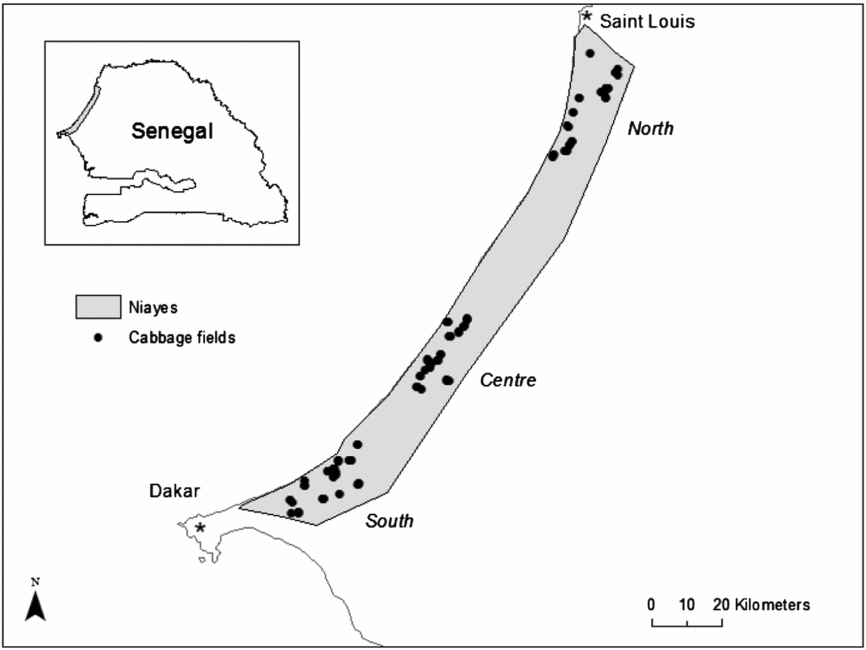
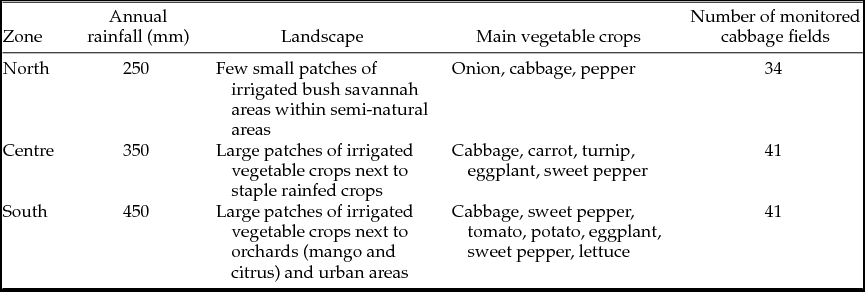
The study was carried out during the dry season (October to May) in the Niayes area (from 14°48′N/17°17′E to 15°52′/16°28′E), the main vegetable-producing area in Senegal (Fig. 1). This area is a 180 km long and 10–30 km wide coastal strip that runs from Dakar to Saint Louis. The environment is characterized by dunes and often-flooded depressions, and has an alternating short rainy season (July-September, 400–500 mm rainfall) and a long dry season (October--June) during which cabbage (Brassica oleracea L. var. capitata) crops are grown under irrigation. A set of 116 farmer fields (mean size 0.4 ha, 0.01--3.6 ha) was selected in three zones (South, 14°50′N/17°08′E, n = 41; Centre, 15°09′N/16°52′E, n = 41; North, 15°50N/16°27′E, n = 34) in the Niayes area (Fig. 1). These zones are situated along a rainfall gradient from 450 mm in the South to 250 mm in the North, which shapes the landscape structure as described in Table 1. Cabbage is the main cultivated vegetable in the South and Centre zones, whereas onion is the main crop in the North zone.
Spatial distribution of monitored cabbage fields over two cropping seasons, from October 2012 to May 2014, in the Niayes area in Senegal (black dots represent cabbage fields, n = 116).

Main agricultural and environmental attributes of the study sites located in the ‘Niayes’, the main vegetable-producing area in Senegal

Field monitoring
Cabbage fields were monitored over two dry seasons (Season 1, October 2012 to May 2013; Season 2, October 2013 to May 2014), namely four crop cycles (1 October 2012 to January 2013; 2 February to May 2013; 3 October 2013 to January 2014; 4 February to May 2014). For one given crop cycle, fields were separated from each other by at least 2 km. Density of cabbage plants per m² in farmers’ fields ranged from 5 to 20 (mean = 11). Every three weeks from transplanting to harvest (thus 4–5 samplings per field), 24 randomly selected cabbage plants were carefully inspected for insect pests and related damage. Lepidopteran species (larvae and pupae) were counted on the whole cabbage plant. Hemipterans were counted on three leaves per plant (from the inner, intermediate and outer crown). [‘Occurrence’ and ‘incidence’, respectively, refer to ‘proportion of infested fields’ and ‘proportion of infested plants (or leaves)’.] ‘Abundance’ refers to the number of individuals per plant (or leaf). Insect samples were collected and conserved in 70% ethanol for further identification in the laboratory, with the help of fact sheets and taxonomic keys for arthropod identification (Delvare and Aberlenc, Reference Delvare and Aberlenc1989; James et al., Reference James, Atcha-Ahowé, Godonou, Baimey, Goergen, Sikirou and Toko2010) and insect taxonomists (G. Delvare and D. Bordat, Cirad, France). Temperature was recorded by placing HOBO data loggers (Hobo, Prosensor) in two randomly selected fields per zone. A growers’ survey on the number of insecticide applications, trade name and active ingredients, was recorded for each cabbage field at every sampling date during the crop cycle. A GPS (global positioning system) was used to map crops across four 500 m transects (S, N, E and W directions) originating from the centre of each selected field. Length of cabbage and turnip fields encountered on transects was totalled then divided by total transect length (2000 m), to estimate host crop proportion in the landscape surrounding each selected field within a 500-m radius.
Statistical analyses
Chi-square tests were used to assess the effect of zone and time of season on pest occurrence, independently of the crop cycle. Linear mixed effect models were used to examine: (1) the effect of zone (South, Centre, North of Niayes) and time of season (early vs. late season) on pest incidence and abundance; and (2) the effect of temperature, insecticide use (number of applications), and abundance of host crops (cabbage and turnip) in the surrounding landscape, on key pest incidence. Each model was fit using the appropriate distribution type and link function: binomial for pest incidence (proportion of infested plants over the sampling dates) and Poisson for abundance (count data). For each model, season was considered as a random effect, because infestation rates were different and some fields were selected in both seasons. Linear effect models were used to examine the relationship between Lepidoptera incidence and crop phenology. Models were fitted by maximum likelihood (ML) and their suitability assessed by checking normality and randomness of residuals. Mean comparisons were done using Tukey's pair-wise comparisons. Pearson's correlation was used to assess the relation between proportion of infested plants and number of P. xylostella larvae per plant (log(x+1) transformed). All statistical analyses were carried out using ‘lme4’ and ‘car’ packages for mixed models, ‘multcomp’ for multiple comparisons of means and ‘stats’ for comparison of multiple proportions in R version 3.2.3 (R Core Team, 2015).
Results
Insect pests of cabbage and their spatio-temporal distribution
Cabbage pests identified during field monitoring belonged to the orders Lepidoptera and Hemiptera. Insect taxa with incidence (proportion of infested plants or leaves) less than 0.1 were not presented, though the low density of disease vectors could be of economic significance.
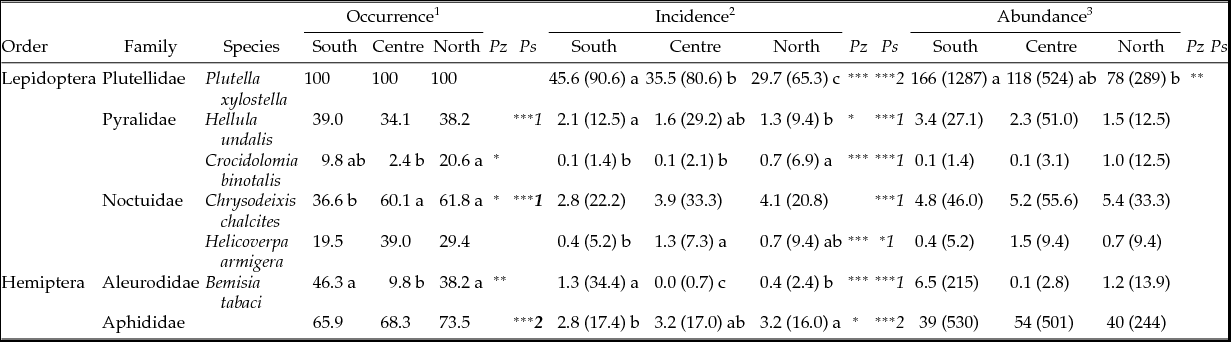
The diamondback moth was observed in all the monitored fields (Table 2, Fig. 2). Its mean abundance and incidence in cabbage fields (proportion of plants infested by larvae or pupae) significantly increased southward, with a maximum of 91% in the south of Niayes. A positive significant correlation (Pearson, r = 0.94, P < 0.001) was observed between proportion of infested plants and mean number of P. xylostella larvae per plant. The cabbage webworm, H. undalis, was detected in 37% of the monitored fields, with no difference among zones. Incidence was generally low, but greater in the South zone than in the North zone (Table 2, Fig. 2). However, high incidence was observed in some fields, with up to 29% in the centre. Abundance of the cabbage webworm did not significantly differ across zones or time of season. Occurrence and incidence of the larger cabbage webworm, Crocidolomia pavonana Zeller (Lepidoptera: Crambidae) were low, being predominant in the North zone. There was a high occurrence of the green looper, Chrysodeixis chalcites (Esper) (Lepidoptera: Noctuidae), particularly in the North and Centre zones, but its incidence was generally low and did not vary significantly across zones, and a maximum of 33% was recorded in the Centre of Niayes. The tomato fruitworm Helicoverpa armigera (Hübner) (Lepidoptera: Noctuidae), was observed in about one-third of cabbage fields (29.3%), with no significant difference across zones; and its incidence was generally low, except for a maximum incidence of 9.4% infested cabbage heads in one field in the North zone (Table 2; Fig. 2). Sucking pests such as whiteflies Bemisia tabaci (Gennadius) (Hemiptera: Aleyrodidae) or aphids Lipaphis pseudobrassicae (Davis), Brevicoryne brassicae (L.) or Myzus persicae (Sulzer) (Hemiptera: Aphididae) were common in cabbage fields; but generally, with low incidence (Table 2).
Occurrence, incidence and abundance of insect pests in cabbage fields (n = 116) in three zones (South, Centre, North) of the Niayes area in Senegal

Insect pests were sampled over two cropping seasons, from October 2012 to May 2014.
1 Occurrence: Proportion of infested fields.
2 Incidence: Proportion of infested plants: larvae or pupae for Lepidoptera, larvae or adults for Aphididae (Lipaphis pseudobrassicae, Myzus persicae or Brevicoryne brassicae), only adults for Aleyrodidae.
3 Abundance: Mean number of individuals per 100 plants (Lepidoptera) or 100 leaves (Hemiptera).
Values within parentheses indicate the maximum values (field as an observation unit).
Pz: P-value for the effect of zone. Ps: P-value for the effect of time of season (1 for higher value in the first part of dry season, 2 for higher value in the latter part of the dry season).
***P < 0.001, **P < 0.01, *P < 0.05.
Values in a row with the same letter are not significantly different by Tukey's test (P < 0.05).
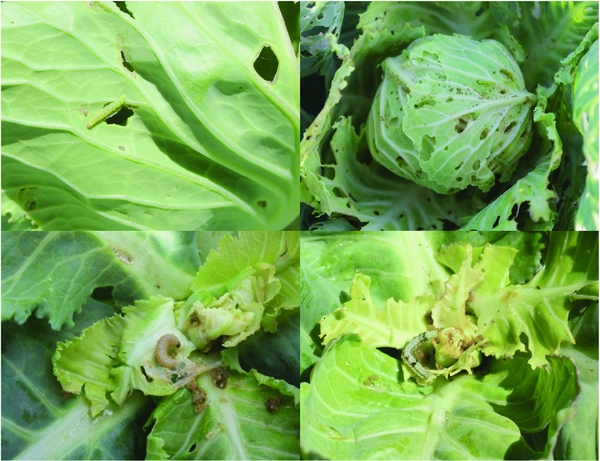
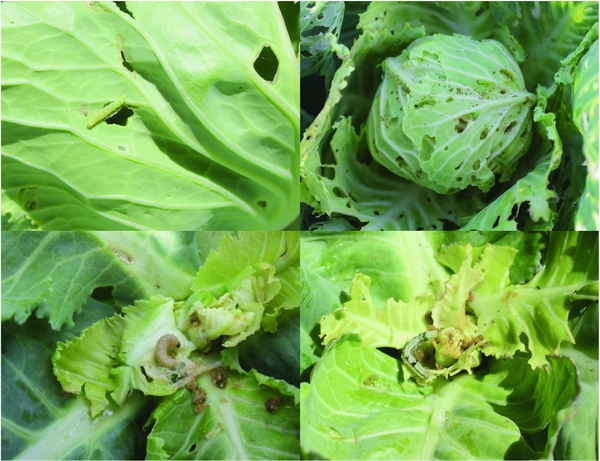
Plutella xylostella (top left and top right), Hellula undalis (bottom left) and Helicoverpa armigera (bottom right) larvae and damage (Photos T. Brévault).
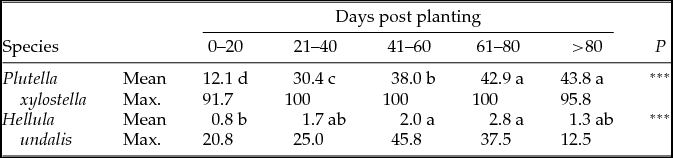
The incidence of H. undalis, C. pavonana, C. chalcites and B. tabaci was greater in the first part of the dry season, whereas the incidence of P. xylostella and aphids was greater in the second part of the dry season (Table 2). Incidence of P. xylostella larvae per plant significantly increased with crop age, reaching a maximum from 61–80 days after transplanting (Table 3). The incidence of H. undalis significantly increased during the crop cycle but remained low, except for one field with 45.8% infested plants at 41–60 days after transplanting.
Incidence of key lepidopteran pests as a function of crop age

0–20 days post planting corresponds to the pre-heading stage. Cabbage plants are usually transplanted after 3–4 weeks in the nursery.
***P < 0.001.
Values with the same letter are not significantly different by Tukey's test (P < 0.05).
Factors affecting key pest incidence
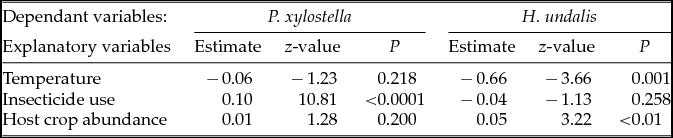
Mean temperature during field monitoring was representative of recorded temperatures in the past 5 years, with 24.3, 22.4, 22.7 and 21.7 °C for crop cycles 1, 2, 3 and 4, respectively, over two cropping seasons. The first part of the dry season (crop cycles 1 and 3) was warmer (+1.3 °C) than the latter part (crop cycles 2 and 4) of the dry season, but no significant temperature difference was recorded among zones. The mean number of insecticide treatments was 4.5 applications over the cycle of the cabbage crop, with up to 19 insecticide applications in one field in the South zone. Most treatments (79%) were made with broad-spectrum insecticides, including organophosphate (OP) (profenofos, WHO Class II), pyrethroid (cypermethrin and deltamethrin, WHO Class II) and avermectin-based formulations (abamectin, WHO Class Ib) (Ib = Highly hazardous; II = Moderately hazardous). Cabbage and turnip host crops accounted for 9.3% of the surrounding landscape (from 1.2 to 26.4%) of selected cabbage fields. The incidence of P. xylostella increased significantly with the number of insecticide applications, but was not affected by host crop abundance or temperature (Table 4). Conversely, the incidence of H. undalis did not depend on the number of insecticide applications, but significantly increased with host crop abundance and decreased with temperature increase (Table 4).
Effect of explanatory variables on the incidence of Plutella xylostella and Hellula undalis in cabbage fields. Explanatory variables include ‘temperature’ (mean temperature during field monitoring), ‘insecticide use’ (number of insecticide applications) and ‘host crop abundance’ (proportion of cabbage and turnip crops around selected fields)

Discussion
This study gives a comprehensive update of key cabbage pests, among which the diamondback moth was predominant. Preimaginal stages of P. xylostella were observed in all the selected fields, with variable incidence ranging from 0 to 91%. The semi-logarithmic relationship between incidence and abundance of P. xylostella larvae indicates that the number of larvae per plant exponentially increased with the proportion of infested plants in the field. Incidence of P. xylostella significantly increased southward of the Niayes area and was greater in the second half of the season. It is probable that populations decreased during the rainy season, due to low resource availability (few cruciferous crops) and rainfall (Campos et al. Reference Campos, Schoereder and DeSouza2006; Ayalew et al., Reference Ayalew, Sciarretta, Baumgartner, Ogol and Löhr2008; Zalucki et al., Reference Zalucki, Shabbir, Silva, Adamson, Shu-Sheng and Furlong2012). Incidence of P. xylostella populations was highly variable among fields in the same zone. This suggests an effect of crop management (including insecticide use, but possibly also landscape context), which would favour bio-control by natural enemies (Bianchi et al., Reference Bianchi, Goedhart and Baveco2008). The mean proportion of plants infested by P. xylostella larvae increased significantly with crop age, reaching a maximum from 61 to 80 days after transplanting. In a previous field experiment conducted in Senegal on a single and unsprayed crop cycle, Sow et al. (Reference Sow, Diarra, Arvanitakis and Bordat2013) showed that the abundance of preimaginal P. xylostella decreased as the plant aged (from 40 days after transplanting), supposedly due to: (i) the decrease of oviposition as a consequence of decreasing glucosinolate content in plants; or to (ii) the decrease of pre-imaginal survival (Campos et al., Reference Campos, Schoereder and Picanço2003; Badenes-Perez et al., Reference Badenes-Perez, Gershenzon and Heckel2014). In the present monitoring, this was observed in only 13% (15/116) of fields. The high infestation and subsequent damage observed by Sow et al. (Reference Sow, Diarra, Arvanitakis and Bordat2013) in the unsprayed field experiment could have deterred moths from ovipositing, or enhanced further suppression by natural enemies (Bopape et al., Reference Bopape, Nofemela, Mosiane and Modise2014).
Larvae of H. undalis were detected in 37.1% of fields, but with a mean incidence of only 1.7% of infested plants. However, significant damage was observed in some fields, with a maximum up to 37.5% of damaged cabbage buds. Major damage occurs on seedlings when early-instar larvae bore the cabbage shoot (terminal bud) during the pre-heading stage, which can lead to either death of the cabbage plant or production of multiple, smaller cabbage heads that are unmarketable (Mewis et al., Reference Mewis, Ulrichs and Schnitzler2001). Incidence was generally low but with high variability among fields, especially in the Centre zone. Unlike P. xylostella, incidence of H. undalis was significantly higher in the first part of the dry season. One may hypothesize that competition with P. xylostella larvae could partly explain this spatio-temporal distribution pattern. Fields (7) with a significant proportion of cabbage plants with damaged buds (>10%) were poorly infested (14.8%) by P. xylostella. The incidence of H. undalis was unaffected by the number of insecticide applications, indicating that control was ineffective. Unlike P. xylostella, the incidence of H. undalis was affected by the abundance of host crops in the surrounding landscape, which might suggest that H. undalis moths are less mobile than P. xylostella moths, as pointed out by Shirai and Yano (Reference Shirai and Yano1994).
The incidence of other expected lepidopteran pests of Brassicaceae, such as the larger cabbage webworm C. pavonana and the green looper C. chalcites, was generally low. Already reported by Collingwood et al. (Reference Collingwood, Bourdouxhe and Defrancq1981) as a cabbage pest, the tomato fruit worm, H. armigera, was observed in about one-third of the fields, with damage of up to 9.4% of heads in one field. Possible changes in the ecological niche of this highly polyphagous and pesticide-resistant-prone pest, usually a key pest of cotton and tomato, should be carefully monitored.
Incidence of sucking pests such as whiteflies or aphids was generally low, but they were observed in at least 10% of cabbage fields. Sporadic outbreaks can, however, cause significant damage on young plants through feeding or disease transmission.
The present study showed that the number of insecticide applications in fields was moderate. However, overuse of insecticides was sometimes observed. In a survey of pest management practices of farmers, Badenes-Perez and Shelton (Reference Badenes-Perez and Shelton2006) reported 5.8 applications per crop in the Kenya highlands and 4.8 in the Kullu valley of India, but indicated that the treatments that the interviewed farmers made were likely to be higher than those estimated in the study. In Zimbabwe, one to two treatments a week (roughly 16–20 applications during the crop cycle) was reported by Tibugari et al. (Reference Tibugari, Jowah, Mandumbu and Karavina2012). In India, Weinberger and Srinivasan (Reference Weinberger and Srinivasan2009) reported excessive use of pesticides in cabbage (5.4--12.8 applications per crop) and reliance on pesticides as the only pest management strategy. In another study conducted in Malaysia, Mazlan and Mumford (Reference Mazlan and Mumford2005) showed that the majority of farmers (96%) depend on pesticide applications, based on a calendar spray pattern with spraying every 7–9 days in most cases (roughly 8–10 pesticide applications) and quantities applied often being independent of infestation levels. Most growers worldwide use synthetic insecticides to protect Brassica crops, mostly non-selective insecticides (Grzywacz et al., Reference Grzywacz, Rossbach, Rauf, Russell, Srinivasan and Shelton2010; Furlong et al., Reference Furlong, Wright and Dosdall2013). Results from the present survey show that most treatments were made with broad-spectrum insecticides including OP, pyrethroid-based preparations or avermectins (Abamectin). Such insecticides likely have detrimental impacts on natural enemies and their regulatory function (Furlong et al., Reference Furlong, Shi, Liu, Guo, Lu, Liu and Zalucki2004; Desneux et al., Reference Desneux, Decourtye and Delpuech2007; Bommarco et al., Reference Bommarco, Miranda, Bylund and Björkman2011). In addition, P. xylostella populations have evolved resistance to numerous classes of insecticides worldwide (Grzywacz et al., Reference Grzywacz, Rossbach, Rauf, Russell, Srinivasan and Shelton2010; APRD, 2015). The significant positive relationship observed between the number of insecticide applications and the incidence of P. xylostella larvae indicates that control programmes deployed by growers were generally ineffective, probably because they had a detrimental effect on natural enemies (Labou et al., Reference Labou, Brévault, Bordat and Diarra2016), or P. xylostella populations might have evolved resistance. Biological insecticides (including entomopathogenic fungi, nematodes and viruses, reviewed by Gryzwacz et al., Reference Grzywacz, Rossbach, Rauf, Russell, Srinivasan and Shelton2010) and plant-extract products have shown effectiveness against P. xylostella (Goudegnon et al., Reference Goudegnon, Kirk, Schiffers and Bordat2000; Javaid et al., Reference Javaid, Saifudine, Tombolane and Rafael2000; Liang et al., Reference Liang, Chen and Liu2003; Charleston et al., Reference Charleston, Kfir, Dicke and Vet2006; Furlong et al., Reference Furlong, Ju, Su, Chol, Il and Zalucki2008; Godonou et al., Reference Godonou, James, Atcha-Ahowé, Vodouhè, Kooyman, Ahanchédé and Korie2009; Ayalew, Reference Ayalew2011; Sow and Diarra, Reference Sow and Diarra2013). They should be steadily integrated into pest control and insect-resistant management programmes as an appropriate alternative, provided they are not harmful to natural enemies (Amoabeng et al., Reference Amoabeng, Gurr, Gitau, Nicol, Munyakazi and Stevenson2013; Srinivasan et al., Reference Srinivasan, Lin, Hsu, Srinivasan, Shelton and Collins2011).
Conclusion
This study provides important information to improve management of cabbage pests in Senegal in the framework of sustainable vegetable production systems. The key pest P. xylostella is present everywhere throughout the growing season. More research should be conducted at the field (host plant resistance, trap crops, insect nets, etc.) and landscape (conservation of indigenous natural enemies) scales to move towards integrated management Brévault et al. (Reference Brévault, Renou, Vayssières, Amadji, Assogba-Komlan, Dalanda Diallo, De Bon, Diarra, Hamadoun, Huat, Marnotte, Menozzi, Prudent, Rey, Sall, Silvie, Simon, Sinzogan, Soti, Tamo and Clouvel2014). Capacity building should be deployed (farmer field schools) to encourage small-scale farmers to use threshold-based treatments (spraying only when necessary) and more selective insecticides or biological pesticides to complement the action of key natural enemies in brassica production systems.
Acknowledgements
We thank Alima Niang Fall, Abdourahmane Dabo, Etienne Tendeng and Abdrahmane Dia (Masters students) and FPMN (Fédération des Producteurs Maraîchers de la zone des Niayes) for helping with farmers’ survey, field monitoring and insect collection. This work was supported by IRD (Institut de Recherche pour le Développement) under Grant ‘Programme d'Excellence Scientifique’ (PEERS-BIOBIO-2013).