At approximately 7 AM on November 30, 2012, a freight train derailed while crossing a railroad bridge at the edge of a New Jersey town of just over 6000 residents. 1 Seven rail cars derailed, and 4 fell into the creek. One tanker car in the creek was breached, leading to the release of approximately 20,000 gallons of vinyl chloride.
Vinyl chloride is a sweet-smelling gas used for the production of plastic goods, namely, polyvinyl chloride, or PVC. Inhalation of vinyl chloride is associated with respiratory symptoms, 2 - Reference Greenfield, Slater and Bronze 4 including cough, shortness of breath, and exacerbation of asthma, as well as neurological symptoms like headaches, dizziness, and drowsiness. 2 Exposure to high concentrations of vinyl chloride can lead to nervous system depression and cardiac dysrhythmia and can be fatal. 2 , Reference Langauer-Lewowicka, Kurzbauer and Byczkowska 5 - Reference Oster, Carr and Krantz 8 Occupational exposure to vinyl chloride over numerous years is associated with increased risk of cancer, particularly of the liver. 9 - Reference Gennaro, Ceppi and Crosignani 11 Long-term effects resulting from acute exposure to high levels of vinyl chloride are not well studied. 9
In response to the vinyl chloride release, authorities issued a shelter-in-place order. Around 4 PM on the day of the release, the city street along the creek was evacuated. Later that evening, the evacuation order was extended. Over the next 4 days, the shelter-in-place order was lifted and reestablished as vinyl chloride levels in the air fluctuated as the result of weather conditions. Four days after the derailment, the evacuation zone was extended further in response to rising levels of vinyl chloride in the air.
Residents, those present in local businesses, and responders expressed concern about health effects associated with the exposure. Over 250 people sought medical care at local hospitals.
In response to the incident, the New Jersey Department of Health (NJDoH) initiated an investigation with the assistance of the Agency for Toxic Substances and Disease Registry (ATSDR) and the Centers for Disease Control and Prevention (CDC). As part of the investigation, hospitals close to the site of the derailment were contacted to determine if they had treated patients from the incident and to summarize their experiences, and medical charts were reviewed for patients seeking care at hospitals. The hospital component of the investigation was undertaken to determine the impact of this acute chemical exposure on the medical community and to describe the health effects experienced by the population following the incident.
Chemical releases can cause serious mass casualty incidents that stress an area’s emergency medicine resources and test communication and coordination capabilities among emergency responders, emergency managers, hospitals, and the poison center. When such an incident occurs, it is important to learn as much as possible about how the medical surge and communication among partners were handled and to help to develop and improve best practices for responding to mass casualty events.
This report describes the communication among partners and the impact of the surge on local hospitals after the November 2012 derailment and vinyl chloride release in a small New Jersey town. It also characterizes the health effects experienced by a large group of patients who sought hospital care after the acute vinyl chloride release.
METHODS
Hospital Interviews
The 7 closest hospitals in New Jersey, all within 20 miles of the incident, were contacted, and interviews were attempted with hospital representatives with a version of ATSDR’s Assessment of Chemical Exposures (ACE) Hospital Survey. 12 Interviews were completed at 5 hospitals; 2 hospitals chose not to complete the interview because the hospital representatives did not feel that their facility was impacted by the incident. Hospital representatives came from among the following positions: emergency department director, emergency department nurse manager, emergency medical services director, disaster medicine division chief, and emergency preparedness manager. Hospital interviews collected information from hospital representatives about communication within their facility and with other partners involved in the response. Representatives were asked the number of patients, if any, that were seen at the hospital in relation to the incident. At hospitals where patients were treated, representatives were asked about the surge and how it was managed; decontamination procedures used, if any; level of care patients required; and lessons learned during the response.
Chart Review
Four of the 7 closest hospitals in New Jersey, as well as 2 additional hospitals nearby in Pennsylvania, were confirmed to have treated patients in relation to the incident. Treating hospitals were identified during key informant interviews, interviews with other area hospitals, and resident interviews during a community survey conducted by NJDoH with assistance from CDC/ATSDR during the investigation following the incident 13 and through reports in the news media. Medical charts were abstracted for individuals who reported seeking care at a hospital during the community survey and for additional patient encounters identified by hospitals through consultations with clinical staff and by searching for chief complaints and discharge diagnoses with incident-related terms. These terms included, but were not limited to “vinyl chloride,” “HAZMAT,” and “chemical exposure.” Medical records were examined for incident-related patient encounters occurring during the 1-month period after the incident between 7:00 AM on Friday, November 30, and midnight Monday, December 31, 2012. Patients with symptoms beginning prior to the incident date and with no specific evidence of symptom worsening were excluded from the analysis. The investigation team abstracted information from the medical records and recorded it on the ACE Medical Record Abstraction Form, 12 which had been tailored for the incident. Abstracted information included demographic background, mode of transport, chief complaint(s), past medical history, current medications, presenting symptoms, imaging and laboratory results, treatments and medications prescribed, and discharge diagnoses. Extended information on hospital course was obtained for patients who were admitted to the hospital.
Medical chart data were entered into an Epi Info 7 database. 14 Data were analyzed by using Microsoft Excel 2010 15 and Epi Info 7. Frequencies were determined for each symptom on the abstraction form and also for having at least one symptom from any of the following symptom groups: general, ocular, cardiovascular, respiratory, gastrointestinal, neurological, and dermal. Frequencies were determined for discharge diagnoses grouped as follows: exposure, acute illness/injury/disease related to the incident, chronic disease exacerbation, and other.
RESULTS
Hospital Interviews
Internal communication varied among the 5 hospitals for which interviews were conducted. Emergency preparedness managers were often identified as key role players in the dissemination of information within a hospital. One hospital activated its emergency operations center (EOC) after being notified by emergency medical services that multiple incident-related patients were en route via ambulance. Other hospitals did not activate EOCs. Some hospitals were part of the same network and reported interhospital communication, such as sharing of information regarding the incident.
External communication varied. Hospitals did not report receiving information from incident command that a mass casualty incident had occurred. They stated that they would like to have received timely information about the incident and whether they would need to decontaminate patients. All 5 hospitals reported obtaining some information from local news media. Two hospitals received initial notification about the incident from another group; in one case information was received from a local responder group, and in the other case from an urgent care center near the site of the derailment. Two hospitals contacted the poison center for information and, following the recommendation they received, utilized the Medical Management Guidelines for vinyl chloride developed by ATSDR. 2 Respondents from all 5 hospitals reported a desire for more thorough and timely incident-specific information from the scene.
One of the hospitals had previously been designated as the medical coordination center for the region and compiled incident-related information for dissemination as part of its role. Its resources also included toxicologists, plume modeling, monitoring of health care system capacity, and the ability to support health care system logistic requests. The hospital where most patients sought care contacted the medical coordination center for information about patient decontamination and clinical management, but no other medical coordination center information or resources were accessed. Incident command obtained health-related information from an environmental emergency response company contracted by the railroad and did not consult with the regional medical coordination center for toxicology or plume modeling, but only to discuss potential deployment of a medical needs shelter.
Representatives from 4 of the 5 hospitals reported that emergency department capacity was never exceeded during the response. In the hospital that treated the majority of incident-related patients, the number of emergency department patients at the peak surge was approximately twice the number of emergency department beds. Seventy-seven patients presented to this hospital with incident-related complaints on the day it occurred; 49 of these patients (63.6%) arrived in the first 4 hours after the incident occurred, and 20 (26.0%) arrived in the subsequent 4 hours. This hospital managed the surge without compromising other duties by assigning a nurse in the emergency department to triage these patients. This hospital attributed their level of preparedness to biannual employee training in mass casualty response activities.
Two hospitals performed patient decontamination prior to emergency department entry on the day of the incident; at least one of these facilities initiated decontamination because the first patients arrived before the hospital obtained information on the identity of the chemical released. One of those hospitals discontinued decontamination after consulting with the poison center about the management of vinyl chloride exposure. Respondents from this hospital reported that they would consult poison centers in the future for information regarding chemical release events.
Chart Review
A total of 266 hospital visits at 6 hospitals related to the incident were identified; 256 (96.2%) of these visits were at the hospital closest to the site of the derailment. Patients sought hospital care for a wide variety of reasons, such as experiencing symptoms, having fear associated with the incident, and being given instructions to visit a hospital from a third party (eg, a lawyer).
Identification of Related Hospital Visits
Hospital visits related to the incident were identified by use of 2 methods. Forty potential hospital visits were identified during the in-person community survey, and hospital records for these reported visits were sought for review; 15 potential visits were excluded because there was either no documented encounter in the hospital records or the medical visit was deemed unrelated to the incident. This resulted in 25 initial records for inclusion in the medical chart review that were identified through the community survey. Two hundred forty-nine additional visits were identified after contacting hospital clinical staff and examining chief complaint and discharge diagnoses for exposure-related terms. Eight of these visits were excluded because the chemical exposures listed in the medical charts were unrelated to the incident, resulting in a combined total of 266 hospital visits related to the incident.
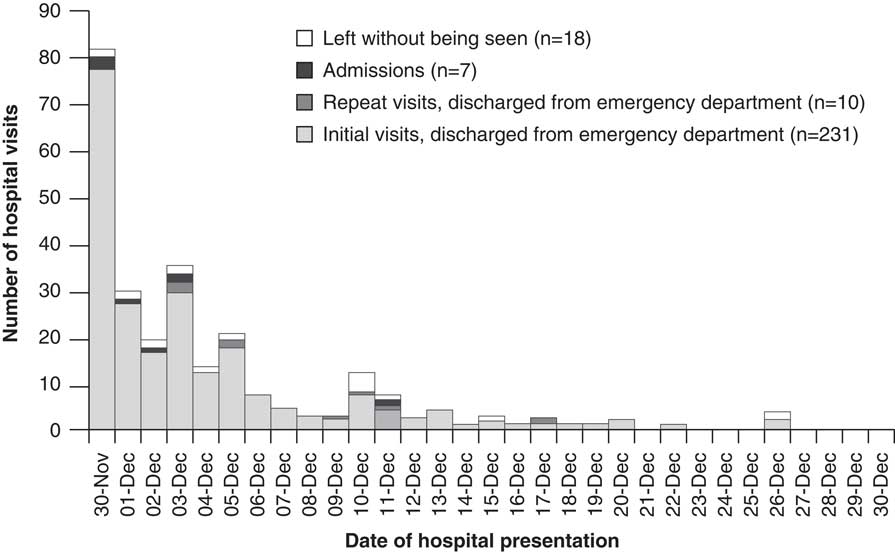
Two hundred forty-one of the 266 patient visits (90.6%) led to discharge from the emergency department, and 7 visits (2.6%) resulted in a hospital admission, including 1 patient who was readmitted after a repeat visit. Eighteen patients (6.8%) initially presented to the emergency department but left the hospital without being seen by a medical provider. Thirteen of the patient visits (4.9%) were repeat visits, with 10 leading to discharge from the emergency department, 1 resulting in a second admission to the hospital for that patient, and 2 in which the patient left without being seen by a physician during that visit. Eighty-one of the hospital visits (30.5%) occurred on the first day; visits continued for 4 weeks at a decreasing rate (Figure 1).
Hospital Visits for Vinyl Chloride Exposure on the Day of the Incident and in the Month Immediately Following, By Day of Presentation (N=266).

Patient Demographics
The 266 hospital visits to emergency departments for evaluation following the vinyl chloride release were made by 253 persons during the 1-month period following the incident; 12 of them made at least 1 return visit to the hospital, and 1 returned twice for follow-up visits. One hundred fifty-two patients (60.1%) had private insurance at the time of their hospital visit. Government insurance programs, like Medicaid and Medicare, were the primary insurance for 27 patients (10.7%), and 42 patients (16.6%) reported no health insurance at the time of their hospital visit. Other insurance programs, most often the worker’s compensation program, were the primary insurance coverage for 14 patients (5.5%). Insurance coverage was not listed on 18 (7.1%) of the hospital records.
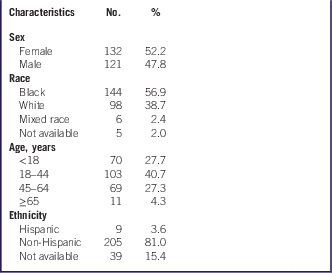
Patient demographics are shown in Table 1. The sex distribution was approximately equal. Patients were aged 8 weeks to 80 years. More than one-quarter of patients were under age 18 years and 4.3% were older than 65 years. The majority (56.9%) of patients seeking hospital care following the incident were African American and only a small percentage of patients seeking hospital care were identified as Hispanic (n=9, or 3.6%).
Patient Demographics (n=253)

Transportation
Mode of transportation to the hospital was recorded for 237 of the patient visits. Patients arrived by privately owned vehicles for 195 hospital visits (82.3%). Ambulance was the second most common mode of transport, with 39 patients (16.5%) using emergency medical services for transportation. Three patients (1.3%) walked to the hospital.
Preexisting Medical Conditions
There were 237 patients who were examined by a physician at least once during a hospital visit after the incident; among the 231 who were discharged from the emergency department, 96 (41.6%) did not have any preexisting medical conditions, 120 (51.9%) had between 1 and 4 medical conditions, and 15 (6.5%) had 5 or more chronic conditions. Two patients were pregnant. Among the 6 patients admitted to the hospital, there was 1 pediatric patient who had no preexisting conditions and 5 patients over the age of 55 years with at least 2 preexisting medical conditions. Sixty-one of the patients (25.7%), including 3 of those hospitalized, were current smokers.
Signs and Symptoms
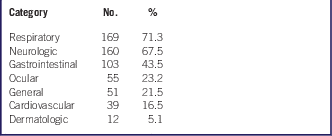
During the 237 initial visits in which patients were examined by a physician, 14 patients (5.9%) were asymptomatic at the time of the hospital visit; 13 of the asymptomatic patients (93%) were children under the age of 10 years. Table 2 lists number of patients experiencing signs and symptoms by body system. One hundred fifty-five patients (65.4%) had between 1 and 5 signs and symptoms. Between 6 and 10 signs and symptoms were observed in 63 patients (26.6%), and 11 to 15 signs and symptoms were observed in 5 patients (2.1%).
Signs and Symptoms, by Body System, Experienced by 237 Patients Upon Their Initial Visit to the Emergency Department.

Respiratory signs and symptoms were the most commonly charted symptoms during the initial hospital visits, recorded on 169 patient charts (71.3%); these included upper respiratory pain (n=96, or 56.8%) and cough (n=82, or 48.5%). Among the 66 chest X-rays ordered during these visits, acute findings were observed in 2 (3.0%). Six X-rays and 1 computed tomography (CT) scan of the chest performed on follow-up visits did not show acute findings. Treatments prescribed for respiratory symptoms included nebulizer treatments with bronchodilators such as albuterol and oxygen therapy.
Nervous system signs and symptoms were the second most common symptom type recorded in medical charts during the initial visits (n=160, or 67.5%). Headache was most common among them (n=126, or 78.8%). Other commonly reported nervous system symptoms were dizziness (n=62, or 38.8%) and lightheadedness (n=32, or 20.0%). There were no acute findings observed among 13 head CT scans and 1 magnetic resonance imaging scan of the brain. New prescriptions were provided to 26 patients for headache, mainly acetaminophen or ibuprofen.
Diagnoses
Discharge diagnoses were available for all of the 231 nonadmitted patients seen by a physician except one. One hundred forty-five patients (62.8%) were discharged from the emergency department with the single diagnosis of exposure to vinyl chloride; of these, 92 patients (63.4%) did not receive any new medications for their symptoms. Nine patients (3.9%) were diagnosed with vinyl chloride exposure plus a potentially related acute finding such as chemical conjunctivitis. Thirty-five additional patients (15.2%) were diagnosed with exposure to vinyl chloride along with another chronic or acute condition. Thirty-nine patients (16.9%) had discharge diagnoses that appeared to be unrelated to the exposure, including hypertension and upper respiratory infections. Additionally, 2 pediatric patients had discharge diagnoses of “well child exam.”
Two of the 6 hospitalized patients, accounting for 3 admissions, were discharged with diagnoses related to vinyl chloride exposure, including exposure-induced respiratory distress and abdominal pain and exposure to a potentially hazardous chemical. Four of these patients had discharge diagnoses for acute disorders (respiratory syncytial virus bronchiolitis and acute kidney failure) or chronic disorders (esophageal reflux and migraine headache).
DISCUSSION
While internal communication and the actions taken varied among the 5 hospitals at which interviews were conducted, internal hospital responses appeared to function as needed. However, better external communication could have assisted hospitals, as has been found in other similar incidents.Reference Christensen, Duncan and King 16 Ideally, this would include notification from emergency management that a mass casualty incident had occurred, the approximate number of individuals needing emergency care, the suspected identity of the chemical released, and whether patient decontamination at the hospitals would be needed. Communication among partners involved in the response would have made the information and expertise concentrated at the poison center and the medical coordination center more readily available to all partners so that their expertise could have been better utilized. This would have aided hospitals seeking rapid answers about topics such as decontamination and provided available expertise in plume modeling to the incident managers at the scene.
Additionally, the majority of hospital visits (96%) were at the hospital closest to the derailment. While this hospital was able to triage the patient surge that exceeded its emergency department bed capacity, it is important to note that slightly less than one-third of patients presented on the day of the incident. Had the immediate patient surge been larger, communication between the incident scene, responders, and area hospitals would have been necessary in order to distribute patients among area hospitals to ensure timely care.
Although life-threatening acute signs and symptoms were not observed in hospital emergency departments after this chemical release, symptoms appeared to be persistent; patients continued to seek hospital care for 4 weeks after the incident. The observed symptoms were in keeping with self-reported symptoms experienced by other groups of individuals exposed in this incident who did not seek medical care, 17 , Reference Wilken, Graziano and Vaouli 18 as well as with a previous report of acute vinyl chloride exposure from a train derailment, with a majority of patients experiencing respiratory and neurologic symptoms.Reference Thriene, Benkwitz and Willer 19 Although a small subset of the patients were admitted to the hospital, over half of those admissions were for conditions that may not have been related to the chemical exposure. Additionally, a number of patients presented at the emergency department with mild or—most often in the case of children—no symptoms. This is consistent with findings from past chemical exposuresReference Wenck, Van Sickle and Drociuk 20 and suggests a potential role for early risk communication regarding when to seek medical care.
Limitations
Our investigation had several limitations. We were unable to complete interviews with all hospitals in the area of the incident. In addition, the hospital staff interviewed may not have been able to give a complete account of the experiences of their hospitals during this response.
In evaluating symptoms reported in the medical charts, it must be kept in mind that the incident occurred in late fall, which overlapped with the annual cold and influenza season; some of the respiratory symptoms experienced by the patients could have been caused by these viruses. Additionally, this analysis is the result of a case series and did not include a control group. Despite these limitations, a formal medical chart review did provide more information on health effects than what was self-reported during the community survey performed by the NJDoH after the incident.
CONCLUSIONS
Our investigation regarding this mass casualty chemical release incident provides important information that can be used to improve planning for future events. The combined approach of interviewing hospital staff and reviewing medical charts also allows for insights that might otherwise be overlooked.
Continuous emergency response planning on a regional level can familiarize all partners with the resources available within their region and help to establish communication channels among incident responders, area hospitals, and resources such as the poison center and any other centers of expertise like the medical coordination center in this incident. Hospitals took different approaches to this incident in how they designated their emergency manager and whether the hospital EOC was activated; planning and drills might make all hospital staff who serve in a coordinating role during an emergency response aware of the resources available regionally and how to draw on them. Additionally, hospitals require timely and accurate information from incident managers so that they may best serve the needs of the exposed community; drills involving all response partners may increase this communication during mass casualty responses.
Emergency response planning might incorporate plans to triage patients to different hospitals based on symptom acuity when possible in order to distribute the surge across hospitals and minimize wait time. Patient surge in the above response was likely complicated by the fact that most patients transported themselves in privately owned vehicles. In such situations, public communication strategies could be used to direct the public to seek care at the appropriate hospitals.
While no patients were observed with life-threatening signs and symptoms, vinyl chloride exposure as a result of this chemical release led to persistent symptoms in some patients, and this investigation provides insight into target groups for risk communication. Three of the 6 patients admitted had at least 5 chronic medical conditions, and 58% of patients discharged from the ED had chronic medical conditions. Individuals with multiple medical conditions represented a majority of admitted patients and may serve as a target group for risk communication during acute chemical releases. Likewise, numerous asymptomatic children were seen at the ED. Parent comments, noted in the chief complaint section of ED charts, indicates that many parents were particularly anxious about risks of exposure for their children, even in the absence of obvious symptoms. Parents and caretakers might also serve as a target group for risk communication about signs and symptoms to watch for in children.
Disclaimer
The findings and conclusions in this report are those of the authors and do not necessarily represent the views of the Centers for Disease Control and Prevention or the Agency for Toxic Substances and Disease Registry.