The balance of ignorance
The beginnings of the Portuguese presence in the Indian Ocean remain somewhat shrouded in the mists of time, leading to various speculations regarding both events and human motives. To be sure, much is known regarding the personnel, fleets, and cargoes, but a great deal still remains to be grasped regarding those momentous expeditions of the turn of the sixteenth century. Here historians are faced with the recurring and delicate problem of a ‘balance of ignorance’ when dealing with almost any subject, and above all one that takes us back some five hundred years. On the one hand, the historical actors we are concerned with certainly knew things that today’s historian does not and, indeed, cannot know; and, on the other hand, the historian, with the benefit of both hindsight and erudition can, and often actually does, know things that the historical actors were in the dark about. This matter is especially troubling because we are frequently concerned with the motives behind actions, and these are difficult to reconstruct in the situation of asymmetry described above. The problems posed by the history of the first ‘long decade’ of the Portuguese presence in the Indian Ocean, from 1498 to 1509, can be looked at afresh today, I believe, by reflecting on this ‘balance of ignorance’ between ourselves, historians in the early twenty-first century, and a diversity of actors, both Portuguese and others, who inhabited the canvas of the period. This balance concerns both issues that may be understood under the head of ‘information’ (or the objects of the Portuguese verb conhecer), and more seriously perhaps, those which must be comprehended as ‘knowledge’ (saber).
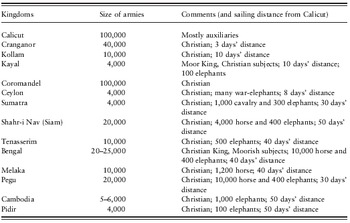
It is well known that the Portuguese arrival in western India in May 1498 was the occasion for a great misunderstanding.Footnote 2 The Portuguese, we know from the manuscript sometimes attributed to a vague figure called Álvaro Velho, initially understood that there were only two religious groups in the maritime Asia they encountered, namely Muslims and Christians. The Muslims in their view dominated the northwest quadrant of Asia leading to Arabia, and the Christians the southeast one, with Kerala lying at the cusp of the two. This would explain why the port and kingdom of Calicut had a notionally ‘Christian’ king but was so strongly dominated by traders from ‘Mecca’. The Portuguese of Vasco da Gama’s fleet thus brought back to Portugal in 1499 a geopolitical vision of Asia which was largely false, and which consisted of enumerating a huge number of Christian kingdoms that could be their potential allies in a binary scheme, when ranged against Muslim traders and rulers. This vision, which the anonymous author assures us he had from ‘a man who spoke our language and who had come to those parts from Alexandria thirty years before’ (which is to say the celebrated Jewish trader and spy later known as Gaspar da Índia) did not last long, and was substantially transformed by 1501, when Pedro Álvares Cabral returned with his fleet to Portugal and a new tripartite scheme involving Christians, Moors and Gentiles.Footnote 3 In other words, an erroneous vision was corrected with the accumulation of empirical information, which allowed Christians to be distinguished from the bulk of the other ‘Hindu’ residents of Kerala (see Table 1Footnote 4).
How Asia was imagined in Portugal, c. 1500.

In the next decade, the categories would further multiply, as it became clear that the Muslims were for their part divided into at least two groups (those of ‘Xeque Ismael’, that is to say the Shi‘i supporters of the Safavids; and the dominant Sunnis), and that the Christians of Kerala too were not of exactly the same persuasion as the Portuguese. However, unless one takes seriously the possibility that the actors of the early sixteenth century both knew, and did not know, things that we know today, we run the risk both of passing abrupt judgements on their actions, and of rendering a portrait of them in which they appear far more naïve than they probably were.
The problem is vastly magnified by the fact that the societies of the time were composed of agents who were often not literate, or when literate, did not consider it important to put their knowledge into a written form. The astonishing paucity of sources on the Indian Ocean in the fifteenth century confirms this. The Chinese texts associated with the Ming voyages (such as Ma Huan’s account) are primarily the product of the pressures of official record-keeping.Footnote 5 The text of the fifteenth-century Italian traveller Niccolò de’ Conti again finds written form because of the intervention of a humanist ‘co-author’; the tortured account of the Russian Afanasii Nikitin seems to be a desperate measure to keep its author sane in a land of infidels whom he detests; and ‘Abdur Razzaq Samarqandi’s account of his travels in the 1440s to Kerala and Vijayanagara is an erudite chronicler’s first-person narrative inserted into a high literary text.Footnote 6 In other words, nowhere do we find amongst these a text that represents a simple and unvarnished merchant narrative (in the Cairo Geniza tradition), or an itinerary involving practical information on coins, weights, goods available in the bazaar, or the like. The reasons for this are obvious. Commercial information was valuable, and not to be divulged in a profligate manner; indeed, the Geniza records were not meant to be widely shared either.Footnote 7 But this does not mean that oral knowledge and valuable information did not circulate in merchant milieux, quite to the contrary. By 1498, when Vasco da Gama arrived in India, there were surely a few dozen Mediterranean traders in different ports of the Indian Ocean who carried about knowledge with them that considerably outweighed what Gama was able to gather in three rapid months in Kerala. We do not know exactly what they knew, but we can sometimes hazard a guess, as with the case of Gaspar da Índia, or Ibn Tayyib (‘Bontaibo’ or ‘Monçaide’), a Tunisian Muslim encountered by the Portuguese in Calicut in 1498.
A lesser-known example should bring home the point. In 1502, when João da Nova’s small fleet returned to Lisbon, it was reported by the celebrated Florentine merchant Bartolemeo Marchionni (then resident in Lisbon) that he brought back ‘a Venetian, who has been there [in Asia] twenty-five years’.Footnote 8 This man, by name Bonajuto d’Albano (or Benevenuto del Pan), was from the Campo San Bartolomeo near the Rialto, where his brother still resided; he was some seventy (or in some versions sixty) years of age at that time, lame (zoto da una gamba), and currently rather poor, having allegedly lost the considerable sum of 20 or 25,000 ducats in a ship that had been wrecked in the Indian Ocean.Footnote 9 Albano claimed that he had travelled extensively in Persia and Hurmuz, Gujarat (or ‘Combait’), as well as ‘Cholocut and all those lands’ including Melaka. He had unfortunately been unable in these peripatetic circumstances to bring up his sons as Christians, and had hence taken the opportunity to return with the Portuguese to ‘make his two sons and his wife into Christians’, even if they were almost totally unclad and appeared rather uncouth to observers in Lisbon. Nor was he alone, for the same fleet brought back a native of Valencia, and another man from Bergamo, both of whom had been in India some years. Albano was promptly taken to Sintra, where Dom Manuel was at the time, and was apparently interrogated on matters relating to commerce in Asia regarding which we might imagine he was knowledgeable. Some authors have speculated that the knowledge he brought back may have encouraged Dom Manuel in the direction of exploring trade in Southeast Asia, resulting in the first direct Portuguese contacts with Melaka in 1509 (though Melaka already features in the anonymous text of 1498–99).
The Venetian perspective
Yet, information on Asia, and knowledge concerning both economic geography and geopolitics remained hard to come by for those concerned with maintaining written records. The massive public diary of the historian Marino Sanuto in Venice reveals this clearly enough, since his two main sources – both fragmentary – are correspondents in Egypt and in Iberia. The picture they presented was often a confusing and contradictory one. Thus, in 1506, eight years after the arrival of Vasco da Gama’s fleet in Kozhikode (Calicut), the returning Venetian envoy from the court of Philip I in Castile, Vicenzo Quirini, announced to the Senate of the Serenissima that things were really not as gloomy for the denizens of the lagoon as might have been thought. To be sure, many – including that notoriously cantankerous public figure and diarist Girolamo Priuli – had been shouting from the rooftops of Venice that the end was near on account of the discovery of the Cape route.Footnote 10 Priuli had been amongst those who believed that the Portuguese would effectively be able to blockade the Red Sea, causing the prices of pepper and spices in the eastern Mediterranean to soar, at the same time that Lisbon would be inundated with cheaper spices brought back on the Carreira da Índia. Quirini argued otherwise, influenced no doubt by his Castilian informants, who seem to have been rather dismissive regarding the real power and capacity of their Portuguese neighbours. The Portuguese enterprise in Asia, he sagely informed his principals, could not long outlast the reign of the current monarch, Dom Manuel, who had imposed it on his rather reluctant subjects. Quirini concluded:
Therefore the death of the king of Portugal, it is believed, will be the occasion for the ruin of this voyage [to Asia], and if not the death of this king, then that of his successor, and on that account many people think that in future times, the said voyage is not destined to be firm. And in this thought, they are comforted by the many accidents that have overcome the ships and the mariners, in this so very long route that the Portuguese pursue, which accidents are such that already there are few who are willing to volunteer to go on it, both on account of the diseases and on account of the great perils of shipwreck, which have been such that from 114 ships which have been on this voyage between 1497 and 1506, only 55 have returned, and 19 are lost for certain, almost all of them laden with spices, and of another 40 nothing is known as of now.Footnote 11
Famous last words, one might say, save that the same opinion was to be repeated some two decades later by another returning Venetian envoy to Spain, Gasparo Contarini. However, Contarini’s reasoning was not quite the same as that of Quirini, even if certain persistent themes may be found in the two, notably the relative poverty of Portugal, and the hatred of the Asians towards them. Contarini referred instead to the unfortunate outcome of early Portuguese contacts with Ming China, in which they had lost five ships; the increasing tendency of Asians to ‘make themselves expert in navigation and warfare’; the fact that Dom João III, on account of his youth, was not as able as his father; and also to the internal struggles amongst the Portuguese captains in Asia.Footnote 12
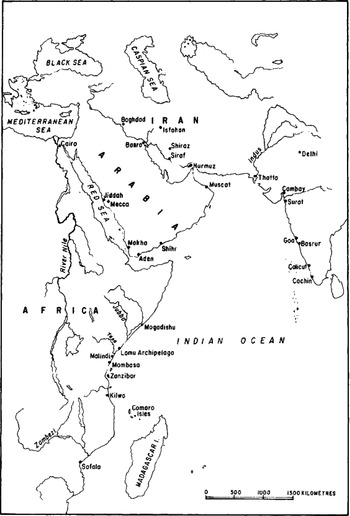
But Quirini, two decades earlier, probably knew little or nothing of China beyond what he had read in Marco Polo; and the notorious problem of factions (or bandos) amongst the Portuguese in Asia, already evident in 1507 in the incidents around Afonso de Albuquerque’s expedition to Hurmuz, also did not form a part of his analysis. Rather his was a view which, like that of most Portuguese writers in 1506, still focused essentially on the geopolitics of the western Indian Ocean, in the triangle defined by East Africa, the so-called estreitos (meaning the Red Sea and Persian Gulf), and western India (see Figure 1). Of these three, he naturally focused most of his attention on western India, the area from which the bulk of the pepper originated. He was also aware that there were two sub-loci of interest here, the first of these being the stretch between Cochin, Calicut and Cannanore, the areas with which Gama and the Cabral had made extensive contacts in their initial voyages. But he had also been informed that another great centre existed, namely ‘a place called Batacala [Bhatkal], which is the first belonging to the Gentiles on that coast, where some 3000 cantara of pepper is produced, all of which goes into the hands of the Moors’. The term ‘first’ (il primo) is used here because Quirini’s mental itinerary takes him from north to south along the Indian coast, and he has in mind the transition between the Muslim Deccan Sultanates (which he imagines are one kingdom, il regno di Cane), and a Gentile Vijayanagara, which he refers to as il regno di Narsi (from the name of the fifteenth-century king Narasimha).Footnote 13 To Quirini, the future of Portuguese trade in Asia would depend crucially on the equilibrium between these two states, both of which he imagines are far larger than their real dimensions. For the Deccan kingdom, in his view, ‘begins in the Mar Persico and runs to the kingdom of Calicut by land’, while Vijayanagara for its part ‘begins in the kingdom of Calicut and extends by land to the edges of Malacca’. Moreover, it is Vijayanagara, or ‘Narsi’ which is crucial in his view to the supply of pepper, for it ‘borders on three sides the mountain where pepper is grown, and has a common border for more than a hundred miles with the king of Calicut, with whom they have great kinship and friendship, as the Portuguese affirm’. A firm alliance between Calicut and Vijayanagara against the Portuguese could thus entirely put paid to the supply of pepper. For, writes Quirini:
Although the owners of the pepper with the greatest of ease transport it by river to Cannanore and Cochin, nothing would be easier than for the king of Calicut, both for his own benefit and to hurt the Portuguese whom he hates greatly, to move the king of Narsi, who is a great lord, his neighbour, friend and relative, as everyone states, not to allow the pepper to be carried by this new route, and force it to go instead to Calicut, as it used to go before; which would be quite easy for the king of Narsi to do, as he surrounds the mountain where the pepper is produced on three sides, and the king of that mountain (il re di quella montagna) is subject to him. And this is what the king of Portugal fears more than anything else, and hence tries by all possible means to keep this king contented, and keep him as his friend, so that he does not divert the pepper to Calicut, from where he [Dom Manuel] can expect to have not a single grain. And for this reason it is believed that the voyage of the Portuguese (il viaggio de’ Portughesi) is not very firm, for it rests solely on the head of the king of Narsi (per esser solamente fondato in testa del re di Narsi), who with a small effort could snatch the pepper from their hands, and totally ruin their voyage.Footnote 14
Map of the western Indian Ocean, c. 1500.

This is again a rather enchanting vision, somewhat literally translating the Portuguese term serra (meaning the Western Ghats) as montagna, and making pepper production out to be a far more geographically limited activity than it really was. The question naturally arises in this context of the extent to which this was Quirini’s own reading, as opposed to a view that the Portuguese Crown and its agents shared. Was it indeed the case that they saw Vijayanagara as holding the key to the pepper trade, and by the same logic, to the survival of the Cape route itself? We are fortunate to have a remarkable document that sheds light on Dom Manuel’s priorities at the time, which is to say his instructions (regimento) for Dom Francisco de Almeida, sent out in 1505 as Captain-Major (capitão-mor) and eventually viceroy to the Indies. The text of this document begins with the details of the voyage, supplies, the peril of shipboard fires, and the like. However, what then follows regarding the Indian Ocean is significant: a project to construct a fortress in Sofala, extensive details regarding dealings with Kilwa, further instructions regarding a fortress in the Anjedive Islands, matters having to do with pepper supplies and shipping in Cochin, the Red Sea, and a whole host of other topics. Where then is the key role of Vijayanagara in all this, if Quirini is indeed to be trusted? The matter is relegated to a small and rather laconic section, which runs as follows.
For the King of Narcingua, you carry our letter, with which and together with any other messages in keeping with what you come to know of him and his lands, and the things there are there, you may send the person who has been named to this end, if this seems necessary to you, because, if it seems to you that this is not all that important for our service, you need not send him. And in sending the person who has been named, or any other person whom you name for this end, you may give him the dress that seems appropriate to you, made of silk and linen, which is sent over in this very fleet. And regarding the one whom you send, besides what we have written here, let him know what seems best to you and seems most appropriate in our service, since we leave it to you to act in this as seems best to you.Footnote 15
This hardly seems a key priority in Dom Manuel’s policy then, though matters were to take a rather complex turn when Dom Francisco de Almeida actually arrived in India. We are aware that on his arrival in Cannanore, the new viceroy immediately went about constructing a fortress (uma forte e formosa fortaleza). It was here too that he received an unexpected embassy from Vira Narasimha Raya, who had newly ascended the Vijayanagara throne, after a period of considerable confusion in that peninsular kingdom due to struggles between a series of powerful warlords.Footnote 16 The ambassador came accompanied by a hundred or more horsemen, and carried rich presents of textiles as well as jewels. The earlier semi-official mission of a Franciscan priest, Frei Luís de Salvador, to the city of Vijayanagara, had obviously had a positive effect.Footnote 17 Most surprisingly, the Vijayanagara ruler proposed a wide-ranging alliance between his kingdom and Portugal involving not merely a substantial Portuguese presence in a port such as Mangalore, but a reciprocal marriage alliance between his family and the House of Avis.Footnote 18 This clearly left the Portuguese rather nonplussed, for while they might have imagined a Vijayanagara princess in Portugal (after suitable rites of conversion), they could never have contemplated a Portuguese princess in a ‘Gentile’ court such as that of Vijayanagara.Footnote 19 In any event, Almeida showed little interest in this offer, or indeed in pursuing further relations with Vijayanagara. When, in 1508, under severe pressure from Lisbon, he was eventually obliged to send an envoy, a certain Pêro Fernandes Tinoco, he took the occasion to express his total disapproval for this aspect of royal policy.
Quirini’s notion that the key to the pepper trade lay in an alliance with Vijayanagara thus does not seem to be confirmed by our documents. What then were the other options that the Portuguese Crown and its agents in India actually contemplated? Reading the instructions to Dom Francisco de Almeida, it is evident that the chief plank of Portuguese official strategy lay at this time in building a fortress that would allow a blockade of the Red Sea. Here is how the regimento puts matters.
And as it appears to us that nothing could be more important for our service (nenhuma cousa poderya mais importar a nosso serviço) than to have a fortress at the mouth of the Red Sea, or close to it, either inside or outside as seems best as a location, since by this means it would ensure that no more spices pass into the lands of the Sultan [of Egypt], and all those who are in India will then lose the illusion (fantesya) that they can trade with anyone else but us; and further since it is close to the land of Prester John, on account of which it seems to us that very great profits could result, first to the Christians there, and then by way of an augmentation in our treasury.Footnote 20
The instructions then are that once Dom Francisco has taken care of matters in Cochin and the Anjedives, he should proceed forthwith, taking a fleet to seek out a spot
close to the mouth, inside or outside, or in a place which it seems to you is right, to look over the mouth of the straits and the navigation therein, finding a location where it seems to you that a fortress can be made, sufficiently strong for that place (…) and bearing in mind that it is close to the Sultan, from [whose lands] many men could attack it, and the people in those parts are of more consequence than those of India, and you will be far from your own sources of help (socorro vosso).
So confident was the Portuguese Crown that this could be done in short order, that even the captain and the other officials there (a factor and two scribes) were named in the instructions.
This is a different theatre of action then, yet one that serves much the same end. The Portuguese Crown had conceived by 1505 of various possible ways of competing with the older route by which pepper and spices were carried into the eastern Mediterranean. The three principal strategies were as follows: first, ensuring a sharp decline in departures of ships from the Kanara and Kerala coasts; second, the patrolling by fleets of the mouth of the Red Sea; and third, the construction of a fortress at the mouth of the Red Sea. A related problem, one which contributed to the attack by Afonso de Albuquerque in 1507, was that in order to have effective control of the Red Sea, Hurmuz too would have to be controlled. As we can see, the instructions to Dom Francisco de Almeida focused principally on the third of the strategies. But what of the other two?
The old route and the new
There is a considerable debate on the effects of the Portuguese arrival in the Indian Ocean on the trade on the old ‘overland’ route. However, for a half-century now, it is broadly admitted that the Portuguese did not deal a death-blow to the Venetian spice trade in the sixteenth century. The view sustained variously by Lane, Godinho and Braudel, and later theorized in sophisticated Weberian language by Niels Steensgaard, runs as follows.Footnote 21 The initial Portuguese irruption in the Indian Ocean is alleged to have wreaked havoc on pepper and spice arrivals in the eastern Mediterranean, as supply lines between Kerala on the one hand, and Alexandria and Beirut on the other, were drastically interrupted. However, it is argued that in the second half of the sixteenth century, normal service resumed, and flows through both the Red Sea and the Persian Gulf once more assumed the dimensions they had had a century earlier. Venice breathed again, thanks to the ‘constitutionally determined corruption’ (the terms are Steensgaard’s) of the Portuguese officials, who were happy enough to let contraband pepper and spices flow through so long as they could skim something off the top. These supplies came, it would appear, in part from Kerala and Kanara, and in part from Sumatra, where the Sultanate of Aceh and its Gujarati merchant allies also built up a formidable trading network.Footnote 22
Now it has long been suspected that the chronology proposed here, as well as the geographical reorientations that are assumed to have occurred, cannot be easily defended. Lane, for example, seems to argue that the ‘revival’ of the overland route only took place in mid-century, stating that ‘although the flow of spices through the traditional routes of the Levant was severely checked during the first decades of the sixteenth century, it later found its way through the obstacles raised by the Portuguese’.Footnote 23 Having shown that in the first half of the 1560s, Venetian pepper exports from Alexandria alone were annually of the order of 1.3 million (English) pounds, Lane went on to suggest through a reading of both Portuguese and Venetian sources that some 30,000 to 40,000 quintais (each weighing about 51 lb) of pepper and spices were annually brought there via the Red Sea. These goods arrived via Tur and Jiddah, with the chief ports of origin of the ships that brought them being Dabhol, Surat, Bhatkal and Aceh. Lane was thus led to conclude that ‘the importation of spices from Alexandria to Europe about 1560 was as large or larger than it had been in the late fifteenth century’, and he went on to speculate that even if ‘for some decades after 1500 the Portuguese put serious obstacles in the way of the Red Sea trade (…) later the Portuguese officials in India became so inefficient, or so easily corrupted, that they no longer placed costly obstacles in the way of trade through the Red Sea and the Persian Gulf’.
It is quite difficult however to pinpoint when Lane believes this revival actually began. At one point, he notes that ‘spices from the Levant were already affecting Antwerp prices in 1540’, but in a footnote, he also states that ‘the imports of Venice from Alexandria picked up enormously, and from a low level, between 1550 and 1554’. Further, his underlying theory of Portuguese corruption, later elevated to a grand status by Steensgaard, is in fact a paraphrase of a topos set out by contemporary observers such as Lorenzo and Antonio Tiepolo, the first of whom had stated as early as 1556 that the spices were deliberately allowed to pass by ‘the Portuguese soldiers who govern India in the Red Sea, for their profit against the commands of their king’. Indeed, in the early 1560s, the Venetians went so far as to claim that the viceroy of the Estado da Índia, Dom Constantino de Bragança, was in open revolt, and hence had decided to send spices to the Red Sea as a measure of his disaffection with the court in the aftermath of the death of Dom João III.Footnote 24
The point however is that while sixteenth-century Venetians were quite adept both at reporting numbers and at spinning theories, modern historians may deftly use their numbers but are not obliged to believe their theories. The new orthodoxy that developed in the aftermath of Lane’s important revisionist work seems also to have taken such Venetian observations rather too literally. We see this most notably in the work of Magalhães Godinho, with his claim that new sources of pepper-production arose in Kanara in the 1560s, in order to supply the joint demand of the Cape route and the overland route. This view ignores plentiful evidence that a substantial pepper crop was produced in Kanara already in 1500, and that the pepper exports of Bhatkal were well known even to writers such as Quirini in 1506. Godinho’s own position also seems to posit a two-phase cycle: an initial, quite massive, Portuguese impact on pepper and spice supplies to the eastern Mediterranean region, followed by a loosening, again dating from a somewhat indeterminate moment in the mid-century, leading to a revival of Venice in opposition to Lisbon. Godinho, and following him Braudel, seem to favour 1550 as the date when the ‘traditional’ route revived, thus supporting one of the various dates that Lane proposed. He thus writes that ‘from 1503 to the middle of the century, the Portuguese seriously impeded the spice trade through the Red Sea’, and also that ‘the Portuguese blockade was efficient above all in relation to pepper’.Footnote 25
Recent work by the economic historians Kevin O’Rourke and Jeffrey Williamson has dealt a major blow however to a significant part of the Lane-Godinho-Steensgaard vision of how the Cape route and the overland route worked relative to one another in the sixteenth century.Footnote 26 They support a view that is far closer to the model proposed by C. H. H. Wake, but whereas Wake’s work focused on the quantities of pepper and spices imported into Europe on the two routes, O’Rourke and Williamson focus on evidence regarding pepper and spice prices over the course of the sixteenth century.Footnote 27 Their major conclusions are two in number. First, they argue that if one calculates real (that is deflated) prices in the period, ‘the opening of the Cape route was followed by a dramatic decline in the cost of Asian spices in Europe, which (…) continued for the remainder of the century’. Second, they argue that by virtue of the coexistence of two routes by which pepper and spices arrived in Europe, a situation of an eastern Mediterranean monopoly was replaced by one of an effective duopoly, with a resultant increase in aggregate European imports as well as lower prices. Thus, their formal exercise using price data in most respects supplements and makes more rigorous the intuition that Wake had put forward using data on quantities.
Nevertheless, this exercise does not address the problem of the short term, and the first impact of the Portuguese arrival in the Indian Ocean for trade on the overland route before 1508. In this respect, the most significant advance has been made in a recent (and posthumously published) work by the late historian of the Islamic and Iberian world Jean Aubin.Footnote 28 Here, Aubin argues that earlier writers such as Godinho have confounded two quite distinct issues: arrivals in the ports of the Red Sea of pepper and spices, and arrivals in the eastern Mediterranean.Footnote 29 Effectively, he demonstrates that in the early years of the sixteenth century, the Portuguese were simply unable to prevent shipping from Kerala and Southeast Asia from arriving in the ports of the Red Sea and Persian Gulf; as late as 1504, he notes that after the expedition of António de Saldanha to the mouth of the Red Sea ‘the result was nil, and the circulation of spices remained untouched’. To be sure, a certain number of dramatic attacks were made, but the shipping resources of the Portuguese were insufficient to seal up the shipping lanes. Aubin hence concludes that contemporary writers such as Girolamo Priuli vastly overreacted when considering the consequences of the Portuguese presence in the Indian Ocean for the trade of the Serenissima; Priuli, we may note, had written as early as February 1502 that ‘one could now consider and be aware of the great harm that the Portuguese caravels have produced by carrying off the spices from India, so that none arrive any more in Syria’.Footnote 30 To be sure, Priuli was reacting to a reality that he perceived, which was the noticeable decline around 1500 of pepper and spice supplies in the eastern Mediterranean. But this was essentially due to troubled conditions in the Hijaz and Yemen, a matter that he did not comprehend. None of the early Portuguese fleets, whether that of Cabral in 1500, João da Nova a year later, or those of the Albuquerques in 1503, was really capable of making a major dent in the trade. The only serious attempt to do so, that by the subordinate commander Vicente Sodré – acting as a maverick while accompanying his nephew Vasco da Gama – in early 1503, ended with disastrous consequences for the Portuguese fleet in the Khurian-Murian islands off the south coast of Arabia. Of the situation in 1502, Aubin thus insists that ‘the difficulties the Sultan experienced in assuring a full supply [of spices] are the backlash, not of Cabral’s stay in Malabar, but because of the disorders in the Hijaz, which was ravaged by the fratricidal wars amongst the Sharifs of Mecca’. Sharif Barakat had sacked Jiddah in 1501, soon after the arrival there of merchant ships from India, while one of his brothers fled to Yanbu ‘under the protection of the Syrian caravan’. He hence concludes firmly: ‘Girolamo Priuli, obsessed by the Portuguese competition was mistaken regarding the reasons for the shortage of spices in the Levant in late 1501–early 1502’.Footnote 31 The next year again, Aubin notes that spice supplies in Jiddah were good enough, but once more Bedouin attacks on the Holy Cities, further attacks on the Syrian caravan, and the direct pillage of both Mecca and Jiddah created enormous chaos. In this case too, he demonstrates convincingly that ‘it was not in the Indian Ocean, but from Jiddah that everything was blocked (…). The paralysis that strikes the Islamic spice route is due to the internal troubles of the Mamluk regime.’ Indeed, when a window of opportunity did open up, with a temporary cessation of the troubles in the Red Sea area in late 1504 and early 1505, the galleys from both Beirut and Alexandria were able to load up and bring back an ‘honourable cargo’ of pepper and spices.
We are hence obliged to reconsider in a rather radical manner the alleged direct impact that the Portuguese had on trade to the Red Sea before 1507. Aubin’s analysis requires us instead to cast a highly sceptical eye on the repeated and paranoid complaints from Priuli and Sanuto: ‘the Portuguese caravels have interrupted everything’; ‘everything is on account of the news from Calicut, which will be the ruin of this land here [viz. Venice]’. However, this still leaves us with an interesting conundrum. Despite the instructions to Dom Francisco de Almeida, no real attempt was made by the Portuguese at this time to build a fortress in either Aden, or any other port near the seventeen-mile-wide Bab-el-Mandeb (or ‘Gate of Tears’), with the possible exception of the island of Soqotra, held by the Portuguese to no great effect from 1507 to 1511.Footnote 32 On the other hand, the years 1507–09 witness a startling counter-offensive mounted by the Mamluk Sultanate of Egypt, in the form of a fleet sent out to challenge the Portuguese attempt to claim a maritime hegemony over the Indian Ocean. If the Portuguese had not in fact posed an immediate threat to spice supplies in the eastern Mediterranean, as Aubin so effectively demonstrates, why would the Sultan of Egypt in those years, Qansuh al-Ghauri (r. 1501–16), have sent an elaborate expedition out to challenge them? One element of a response lies precisely in the possibility that contemporaries may have been mistaken in their diagnosis. This is Aubin’s own reading of Priuli, whom he sees as driven by a paranoid vision in which the Portuguese threat loomed far larger than was reasonable. However, did the decision-makers in the Sultanate of Egypt share such a vision? It is also clear from Aubin’s close reading of Arabic documents that one cannot see Egyptian actions in the Indian Ocean as simply driven by a Venetian motor. On the contrary, Venetian and Egyptian interests may have converged at certain moments and diverged radically at others.
The Mamluk intervention
To be sure, as early as 1502, the Venetians had begun to contemplate the need to influence Qansuh al-Ghauri, recently elevated to the position of Sultan, in the direction of intervening in the Indian Ocean. We may recall that after the extended reign of Qa’it Bay (r. 1468–96), a series of succession struggles had followed with as many as four different Sultans occupying the throne between 1496 and 1501. It was difficult in these circumstances for Venice to deal with a manifestly unstable Mamluk regime. The year after Qansuh’s accession, Benedetto Sanuto, sent as Venetian envoy to Cairo, was instructed to tell the Sultan ‘how important it was for his affairs that the spices should not make their way by the route to Portugal’, and later the same year the authorities of the Serenissima would create the so-called Zonta di Colocut to advise the Council of Ten on how future Indian Ocean affairs were to be handled. By 1504, this body would contemplate proposing to the Sultan (through the envoy Francesco Teldi) that he build a canal between the Mediterranean and the Red Sea, ‘and once this canal is made, one could send as many ships and galleys as one wanted to pursue the Portuguese, who would then in no manner be able to stay in those seas’. The project would be revived later by the Ottomans, but in 1504 it found no takers.Footnote 33 A third embassy from Venice, that of Alvise Sagudino, was then sent to Cairo in the latter half of 1505, with alarming news of further Portuguese successes in the Indian Ocean, based on letters from Venetian spies in Lisbon. In short, there is no lack of evidence of Venetian attempts to provoke the Sultan to act; the Sultan, for his part, seems to have kept his own counsel, and his return envoy to Venice in 1506–07, the dragoman Taghribirdi (himself of Valencian origin), was mostly interested in discussing the affairs of Alexandria with the Venetians.Footnote 34 We are not aware that he asked for any technical assistance or aid from the Venetians in mounting an expedition in the Indian Ocean; as Aubin comments, ‘at the end of the day, Venice did not give the Sultan the aid that she wanted to against the Portuguese, because the Sultan did not want it’.Footnote 35
But despite this fact the Mamluk Sultanate did manage to construct and send out a powerful fleet in 1506, drawing perhaps on the help of the Ottomans for a part of the construction. It was commanded by a Kurdish admiral, Amir Husain Bash al-‘Askar, but carried none of the more prestigious Circassian Mamluks on board, and was instead largely manned by European renegades, blacks, and a number of others (both volunteers and forced recruits) described broadly as ‘Levantine’ in contemporary texts. There are unfortunately few contemporary Arabic sources that report on this expedition in any detail, and we are hence obliged to turn to Portuguese materials, which are naturally much given to exaggerating the Venetian role in the whole matter.Footnote 36 The best of these sources is the so-called Anonymous Chronicle, which seems to have been written during the reign of Dom Manuel; and it is indeed this source which affords us the closest look at the activities of Amir Husain and his fleet between 1506 and 1509.Footnote 37 Amir Husain is described in this text as an elite Mamluk, and it is stated that his fleet initially consisted of six ships and six galleys, manned by nine hundred ‘Mamluks and Venetians, and Turks on pay’ at the time that it set out from the port of Suez in February 1506. The anonymous author insists that the Venetians played a significant hand in preparing the fleet, sending the necessary wood to Alexandria; but this is a claim that can be shown to be unsustainable, as is the impression that many Venetians were in fact on board. The first task of this fleet was, however, not to combat the Portuguese in the Indian Ocean; it was instead to impose some order on the increasingly chaotic conditions in the Red Sea. In this respect, Amir Husain was to anticipate the formula that would be used by the Ottomans time and again in the course of the sixteenth century; for instance, in 1538–39, Hadim Süleyman Pasha not only went out to Gujarat but also imposed a new order on the Red Sea and Aden.Footnote 38
On leaving Suez in 1506, Amir Husain’s fleet seems to have made a brief supply-stop at Tur, close to the mouth of the Gulf of Suez, which was an important point of transhipment on the spice route to Egypt. From there, the next stage was Yanbu‘ al-Bahr (‘Liambão’ to the anonymous author), which, it is noted, was a rather significant way-station for the ‘pilgrims for the house of Mecca’. However, the ruler there had ceased to collaborate in the passage of pilgrims, and Amir Husain apparently carried a warning message from the Sultan for him. Since this warning had no effect, the fleet began to bombard the city, and the troops disembarked; an engagement ensued in which the Mamluk forces were victorious, although at some cost to themselves. A new ruler was installed, and the fleet now moved on to Jiddah, the principal port linked to Mecca. Here, nothing untoward was found, and the fleet was able to move on rapidly southwards to Jizan (‘Sagão’), described as a ‘town of a thousand households, unwalled, with a large and protected bay’.Footnote 39 Here again, the local ruler, a certain Shaikh Al-Darawi was reprimanded for not having paid tribute (páreas) to the Sultan; the town was pillaged, and the spoils were sent back to Cairo. Amir Husain then seems to have spent a long period, perhaps as much as a whole year, in Jiddah, which he left only in August or September 1507. The Portuguese chronicles are unclear as to why he hesitated so long to enter the Indian Ocean, especially since the stay at Jiddah led to a near-mutiny amongst the crews of various ships, of which at least two abandoned him and sailed off independently towards India. There is a suggestion that he awaited further finances from Cairo, but it may also have been the case that the Amir was anticipating fresh news from India. The Egyptian chronicler Ibn Iyas does however help to shed light on the matter. He notes that Amir Husain had been ‘asked to look after the construction of the fortification-walls and the towers of Jiddah; these were excellent works’.Footnote 40 However, he adds that during this period (that is, 1506–07), the Amir had assumed the ‘governorship (niyābat) of Jiddah, and at this time had shown himself to be full of vanity and arbitrariness. The merchants (tujjār) had a tax (‘ushr) of ten percent imposed upon them and the population, which had greatly suffered from his injustice (zulm), had found him unbearable’.Footnote 41 Elsewhere, the chronicler has already condemned the actions of Amir Husain in no uncertain terms: ‘Husain, the governor of Jiddah, levied a tax on the traders from India at the rate of one to ten, and so these traders abandoned the port of Jiddah, the situation of which slid in the direction of ruin; therefore, muslins, rice and leather became rare, and the port was abandoned’. Even if this is exaggerated, we may imagine that Amir Husain’s rapacious reputation preceded him by the time he made his way into the heart of the Indian Ocean.
Amir Husain’s chief correspondents in India at this time included the Gujarat Sultan Mahmud Begarha (r. 1458–1511), and Malik Ayaz, the semi-independent ruler of the major port-city of Diu. It is clear that the Sultan and the Malik did not always perceive their interests as being exactly congruent. The latter was a former royal slave (ghulām-i khāss), whose origins have been variously stated as Dalmatian, Russian, Turkish and Persian (Gilani), and rather more improbably as Malay or Javanese. Once freed, he had accumulated territories and resources in the Kathiawar region, and operating from a centre at Junagarh, used the port of Diu as his maritime base. By 1507, when the Mamluk fleet entered the Indian Ocean, he had helped transform Diu from a port of second rank to the key centre linking West Asia and Southeast Asia. While declaring sometimes that he was no more than a ‘fiscal official of the king of Cambay’ (hum almoxarife del-rey de Cambaya), Malik Ayaz in fact had his own fleet of small vessels (atalaias), and a considerable personal guard, including numerous mercenaries. It was thus logical that the Mamluk fleet and its commander would seek out an alliance with him, and indeed the decision seems to have been made to use Diu as the centre of operations for the Mamluks, rather than any of the ports of the Konkan or Malabar coasts. It is probable that in this matter, Amir Husain’s decision was influenced by the close relations that existed between the Gujarat Sultan and Cairo. We are unable to seize these directly, in the absence of the requisite diplomatic correspondence, but it is clear that the decline of the Delhi Sultanate from the late fourteenth century onwards had left a vacuum in terms of high politics in the area. In the 1440s, ‘Abdur Razzaq Samarqandi, envoy-at-large of the Timurid ruler Shahrukh, had attempted to make the claim that his own master in Herat occupied a position of tutelage with regard to the spaces formerly dominated by the Delhi Sultanate. But there is no indication that such an argument held water by 1500 in Gujarat. On the other hand, we are aware from the account of Ibn Iyas that at the death of Mahmud Begarha, his son – termed Malik Muzaffar Shah, and given no greater dignity than that of Sāhib Kanbāyat – sought a form of investiture for the rule over Khambayat from Cairo and the ceremonial Caliph Al-Mutawakkil (min al-khalīfa taqlīda ba wilāyat ‘ala Kanbāyat).Footnote 42
In any event, the initial reception of the fleet from the Red Sea at Diu appears to have been rather positive. Malik Ayaz agreed to send a fleet of his own small vessels to accompany them, and the fleet began to make its way down the Indian west coast, eventually encountering a fleet commanded by Dom Lourenço de Almeida, son of the Portuguese viceroy, in early March 1508, at the port of Chaul, in the Ahmadnagar Sultanate. In the ensuing engagement, the viceroy’s son was killed and the Portuguese fleet roundly defeated, with a number of Portuguese being taken prisoner. The victorious allies (who had also included some Muslim elements from Calicut) then returned to Diu, but the alliance had already begun to fall apart by now. Malik Ayaz had begun to fear that Amir Husain had rather too draconian a way about him, signs of which had already been evident in Jiddah. Aubin has suggested that the presence in the Gujarat court of the devious interpreter Sidi ‘Ali al-Andalusi may have also been significant, since this Muslim from Granada was much given to exaggerating the power of the Iberian rulers. In any event, it is difficult to escape the conclusion that Aubin draws here: ‘Anxious to preserve the authority he had ably acquired, Malik Ayaz feared, rather more than the wrath of the viceroy, the military superiority of the Egyptians, their prestige and the fact that the importance that was given to them might encourage their temptation to dominate’.Footnote 43 A similar scenario would be played out with the Ottomans in 1538.Footnote 44
News of the grand maritime victory at Chaul reached the court at Cairo by the end of 1508, and it was announced that both a considerable booty and some hundred Portuguese prisoners would be sent to the court. The Venetian consul in Alexandria equally reported this, and mentioned rumours that the Sultan was preparing to construct further ships at Tur, to be sent into the Red Sea, and then as reinforcements to Amir Husain. Ibn Iyas had already noted that the Amir had ‘asked for reinforcements to bring the remainder of the Frankish forces to an end’.Footnote 45 In the event, nothing of the sort transpired. Malik Ayaz chose to throw in his lot with Dom Francisco de Almeida, and entered into secret negotiations with him. The viceroy arrived with his fleet off Diu in early February 1509, and after having sacked the Konkan port of Dabhol (which was weakly fortified), prepared to attack Amir Husain’s fleet. Malik Ayaz for his part refused to enter the combat, and the Egyptian fleet was largely destroyed on the spot.Footnote 46 Amir Husain himself, though wounded, escaped with his life and fled to the Gujarat capital, preferring Sultan Mahmud to the wily Malik Ayaz. He would eventually find his way back painfully to Cairo in December 1512, accompanied by an ambassador from Gujarat; Venetian reports suggest that the Mamluk Sultan had been furious with him for the arrogant behaviour he had displayed in India (i sinistri modi usadi con superbia con quelli signori de India), and had sent various messages and gifts (grandi e belli presenti) to placate the Gujarat Sultan and others.Footnote 47 However, in the few years of existence that remained for the Mamluk Sultanate of Egypt, no further expeditions would be sent into the Indian Ocean.
What then is the balance-sheet we can establish for the first ten or eleven years of the Portuguese presence in the Indian Ocean? One way of looking at the matter would be through the eyes of the first Portuguese viceroy, Dom Francisco de Almeida, himself, since he sent a long letter to Dom Manuel in December 1508, shortly before setting sail for Diu. In this letter, Almeida set out what have become the familiar elements of a certain conception of Portuguese activity in the Indian Ocean. In this view, Cochin and the Malabar coast were to be the true centres of activity, and the pepper and spice trade was to be organized there. The role of the viceroy was, above all, to oversee the efficient procurement of pepper in Cochin and its vicinity, and the patrolling of the Indian coast to prevent rival shipping from exceeding certain dimensions. Southeast Asia was of limited interest, since he saw an establishment in Melaka as far too risky; even if some pepper from Sumatra made its way to the Red Sea, Almeida saw it as of negligible importance. Equally, he argued that the Portuguese had no great interest in attacking or blockading the Red Sea, and even suggested that the newly built fortress in Soqotra be dismantled. ‘It would profit you little’, he informed the king,
if [your fleets] were to reach Tur while here [in India], your cargo ships are seized and your fortresses destroyed. If you are told that by going on the open sea, one can stop a [Mamluk] fleet from arriving here, [in reality] the Venetians and the Sultan’s people are [already] in Diu, constructing the ships and the galleys that we have to combat, where there is all the abundance of wood (…) and a great quantity of metal for artillery and most perfect artisans.Footnote 48
This is a relatively minimalist ambition then, one which shares a great deal with the point of view that would be expressed in later decades by writers such as Dom Aires da Gama and Diogo Pereira.Footnote 49 Yet it is not a pacifist one, and does not suggest that the Portuguese give up their fleets, or their key fortresses (such as Cochin); it takes for granted that the interests of the Portuguese are radically opposed to those of most Muslim merchants in the Indian Ocean, as well as the Mamluk Sultanate (and behind Cairo, the shadow of the conniving Venetians).
Conclusion
This essay began with a brief reflection on the problem of a ‘balance of ignorance’ between modern-day historians and the early modern objects of their study, usually centuries distant in the past. The problem remains acute in relation to even such an ostensibly well-studied period as the first decade of the Portuguese presence in the Indian Ocean. To be sure, there is an explosion of documentary sources in these years when we compare them to the preceding three-quarters of a century, where we face a documentary famine after the Ming withdrawal from the western Indian Ocean. But for all that, the motives and alliances that determined the outcomes of the conflicts we have studied in the early sixteenth century still remain somewhat occult, and require the careful reconstruction of rather dispersed materials. The archives may still hold surprises – both pleasant and unpleasant – for us, and even a small new corpus of documents from the period could well alter fundamental aspects of our perception of both what happened, and of what the motives of the actors were. On the other hand, one of the thrusts of this essay has been to argue that contemporary observers often did not get matters quite right, on account of their myopia, lack of information or the constraints posed by their ideological blinkers. But it would be presumptuous for the historian to assume a position of omniscience in regard to the contemporary writer as well. Some things about the early-sixteenth-century Indian Ocean we shall certainly never know or may only barely glimpse. This is why at least some part of whatever global history we choose to write can only be drafted in the subjunctive mood.Footnote 50