Introduction
Involvement in physical activity as part of daily life has changed during the last decades. This is partially due to automation in many jobs and measures to reduce physically strenuous work. With the rise of the service sector the number of persons working in sedentary jobs has increased during the last 30 years (Brownson, Boehmer and Luke Reference Brownson, Boehmer and Luke2005). At home many technical inventions developed after World War II have made household tasks easier and less tiring (Brownson, Boehmer and Luke Reference Brownson, Boehmer and Luke2005). A vast increase in automobile ownership and use since the 1960s has reduced transportation by foot and bicycle in European countries such as the Netherlands (Harms Reference Harms2003). Besides these examples there have been social and cultural developments that have affected physical activities. These changes contribute to the increase in importance of participation in exercise and sports to achieve a healthy level of physical activity.
After retirement, participation in exercise and sport is especially important for several reasons. Upon retirement, work-related physical activities as well as the exercise involved in commuting end. Yet retirement expands opportunities to participate in physical activities involving sports, because daily routines change and leisure time increases (Chung et al. Reference Chung, Domino, Stearns and Popkin2009; Slingerland et al. Reference Slingerland, Van Lenthe, Jukema, Kamphuis, Looman, Giskes, Huisman, Narayan, Mackenbach and Brug2007; Touvier et al. Reference Touvier, Bertrais, Charreire, Vergnaud, Hercberg and Oppert2010). Consequently, participation in sports is one way for retirees to be physically active, thus contributing to their physical fitness and health (DiPietro Reference DiPietro2001). Regular physical activity is recognised as a major protective factor against the development of several chronic diseases associated with ageing, such as type 2 diabetes, cardiovascular disease, weight gain, as well as cognitive decline and depression (e.g. Dik et al. Reference Dik, Deeg, Visser and Jonker2003; Haight et al. Reference Haight, Tager, Sternfeld, Satariano and Van der Laan2005; Mensink, Ziese and Kok Reference Mensink, Ziese and Kok1999). Besides the potential health benefits of exercise, sport participation offers opportunities for social interaction and adds to retirees' autonomy and self-respect, aspects of life that are often affected by retirement and the process of ageing (Chorus, Van Campen and Den Draak Reference Chorus, Van Campen, Den Draak, Tiessen-Raaphorst, Verbeek, De Haan and Breedveld2010; Strobl, Brehm and Tittlbach Reference Strobl, Brehm and Tittlbach2010).
Previous research has shown that in the general population involvement in leisure-time physical activity and sport has increased since the 1970s and 1980s (Borodulin et al. Reference Borodulin, Laatikainen, Juolevi and Jousilathi2008; Breuer and Wicker Reference Breuer and Wicker2009; Petersen et al. Reference Petersen, Thygesen, Helge, Gronbeak and Schurmann-Tolstrup2010). The few studies among middle-aged and older adults have also demonstrated a trend towards greater sport participation (Agahi and Parker Reference Agahi and Parker2005; Lalive d'Epinay, Maystre and Bickel Reference Lalive d'Epinay, Maystre and Bickel2001). However, these two studies focused on relatively short periods of time whereas the trend over a longer period of time needs to be examined since the changes in society that influence sport participation involve gradual changes over a long period. Moreover, there has been little attention to questions as to why and how sport participation has changed during the last decades.
The objective of the current study is to investigate the trend in sport participation among retirees between 1983 and 2007. Health as well as social benefits are addressed by focusing on three different aspects of sport participation: involvement in sport activities, membership of a sports club and participation in competition. Sport is defined here as a leisure-time physical activity excluding activities like gardening and home repairs (do-it-yourself (DIY)). We chose an age range of 58–67 years because it covers the first years of retirement of most Dutch retirees. Mean effective retirement age ranged between 60 and 62 years for men and between 59 and 61 years for women between 1983 and 2007 (Organisation for Economic Co-operation and Development 2010). Mandatory retirement age in the Netherlands is 65 years. It is especially important to investigate sport participation during the early years of retirement because of the changing opportunities for new activities in this phase of life. If retirees are not participating shortly after retirement it is unlikely that they will become involved later as ageing progresses (Agahi, Ahacic and Parker Reference Agahi, Ahacic and Parker2006).
Sport participation among retirees
Changes in daily routines and the increase in leisure time after retirement offer opportunities to alter activity patterns. The number and type of activities may change as well as the frequency and time spent in particular activities. Previous studies have demonstrated that most retirees maintain involvement in the same activities they were involved in earlier in life (e.g. Agahi, Ahacic and Parker Reference Agahi, Ahacic and Parker2006; Janke, Davey and Kleiber Reference Janke, Davey and Kleiber2006; Rosenkoetter, Garris and Engdahl Reference Rosenkoetter, Garris and Engdahl2001). Some retirees reduce their activities. Others expand their involvement and report a larger number of activities and more frequent participation, indicating that activities are intensified after retirement or new ones are added to the repertoire (Nimrod, Janke and Kleiber Reference Nimrod, Janke and Kleiber2009).
Studies specifically focusing on the impact of retirement on leisure-time physical activity have shown no change in physical exercise (Rosenkoetter, Garris and Engdahl Reference Rosenkoetter, Garris and Engdahl2001; Slingerland et al. Reference Slingerland, Van Lenthe, Jukema, Kamphuis, Looman, Giskes, Huisman, Narayan, Mackenbach and Brug2007) or reported slight increases in various kinds of physical activity involvement like exercise, sports and gardening (Berger et al. Reference Berger, Der, Mutrie and Hannah2005; Evenson et al. Reference Evenson, Rosamond, Cai, Diez-Roux and Brancati2002; Touvier et al. Reference Touvier, Bertrais, Charreire, Vergnaud, Hercberg and Oppert2010). Although retirement increases opportunities to participate in sports, time that is freed by retirement is often reallocated to passive activities (Gauthier and Smeeding Reference Gauthier and Smeeding2003). Overall, there seems to be a substantial variation in sport participation among retirees.
Reasons that people give for their sport participation are often related to health benefits (Taylor et al. Reference Taylor, Cable, Faulkner, Hillsdon, Narcici and Van Der Bij2004), social and emotional benefits (Sport England 2006), or the capacity of exercise for reducing stress levels (Sutherland and Cooper Reference Sutherland and Cooper1990). Furthermore, there are personal resources and circumstances that enhance involvement in sports or form a barrier preventing persons to participate. Education is an important personal resource promoting sport involvement (Hovemann and Wicker Reference Hovemann and Wicker2009). The higher the level of education attained, the more often persons are aware of the health benefits of sport activities which motivates them to become and stay involved (Farrell and Shields Reference Farrell and Shields2002). Therefore, among retirees a higher level of education will increase the likelihood of involvement in sport activities.
Occupational background may prevent retirees from exercising as well as enhance sport participation. Previous research has identified physically strenuous jobs as a factor preventing persons from being involved in sports (Burton and Turrell Reference Burton and Turrell2000; Makinen et al. Reference Makinen, Kestila, Borodulin, Martelin, Rahkonen, Leino-Arjas and Prattala2010; Schneider and Becker Reference Schneider and Becker2005). These jobs are so tiring that little energy is left for participation in sports. Persons with sedentary jobs are likely to compensate sedentary work with sport involvement during leisure time. This pattern often continues after retirement. Chung et al. (Reference Chung, Domino, Stearns and Popkin2009) showed that physical activity decreased following retirement from a physical strenuous job and increased after retirement from a sedentary job. Berger et al. (Reference Berger, Der, Mutrie and Hannah2005) reported similar results and suggest that persons who retire from physically strenuous jobs have less experience with sport involvement to build on after retirement.
Health limitations such as having chronic diseases or physical limitations, hinder sport participation (Downward and Riodan Reference Downward and Riordan2007; Farrell and Shields Reference Farrell and Shields2002). Although retirees often enjoy many years of good health, there is also a large number that suffer from health problems. Poor health is one of the reasons for early retirement (Brockmann, Muller and Helmert Reference Brockmann, Muller and Helmert2009). Therefore many early retirees will not participate in sports despite the increase in free time.
The trend in sport participation among retirees
In recent decades, social change and historical events have affected personal resources and circumstances that in turn have affected sport participation among retirees. The average level of education has risen noticeably in the second half of the last century. This may have contributed to increased awareness of the importance of exercise and resulted in greater involvement in sports. The decline in physically strenuous jobs in favour of sedentary jobs might also have contributed to increased sport participation in the working population as well as among retirees. Changes in health status among persons in middle and old age have occurred in recent years. Although the prevalence of chronic diseases has increased in more recent cohorts of middle-aged and older adults (Ahacic, Parker and Thorslund Reference Ahacic, Parker and Thorslund2003), the number of persons with severe physical limitations in this age group has declined (Lafortune and Balestat Reference Lafortune and Balestat2007). Furthermore, the increased awareness of the benefits of exercise and sport, that also apply to persons with minor health problems, may have a positive effect on sport participation among retirees.
There are thus several reasons to expect an increase in sport participation in successive cohorts of retirees. We hypothesise that the gradual increase in education, the changes in occupational background, and decreases in physical limitations in middle-aged and older adults during the last decades will have had a positive effect on sport participation among retirees of successive cohorts. With an increase in sport involvement the likelihood of sports club membership and participation in training and competition will also have increased, because many sports are practised and organised in clubs and some involve training and competition. We test our hypothesis using data on sport involvement in successive cohorts of retirees, observed between 1983 and 2007.
Method
Respondents
Data were obtained from the Amenities and Services Utilization Survey (AVO). This survey focused on the use of a wide range of social and cultural facilities offered to the Dutch population, which are related to individual and household characteristics. Since AVO uses more or less similar question wording over time, it makes a good source of information on change. Observations have taken place every four years since 1979. For each observation a sample of Dutch households is drawn. We used the personal weights that AVO provides to make the data representative for the population with respect to basic demographics. The survey includes a short face-to-face interview with the head of the household about household characteristics followed by written questionnaires for all household members of six years and older. After a week the completed questionaires were collected by the interviewer. On average information on more than 1,000 variables per respondent were collected which included: involvement in leisure activities, use of social security arrangements, medical services and basic demographics. The survey and data collections are described in detail elsewhere (Netherlands Institute for Social Research 2010).
For the current study we selected data obtained from 4,199 respondents from seven observations between 1983 and 2007. Data from 1979 were excluded because of missing variables compared to later observations. Retired respondents aged 58–67 were included. We excluded 143 respondents (3%) for whom data on exercise and sport were missing. In total, we included 400 retirees from the 1983 observation, 623 from 1987, 504 from 1991, 626 from 1995, 686 from 1999, 634 from 2003 and 583 from the 2007 observation. Analyses pertained to 1,559 women and 2,497 men.
Measurements
For sport participation detailed information was available. First, there was a question on the number of sport activities that respondents had engaged in during the previous 12 months. If a respondent was involved in sports then detailed information about a maximum of seven activities was collected (in 2007 a maximum of three activities in half of the sample). For each activity this included information on type of sport, number of weeks per year involved, whether one was member of a sports club, and whether one was participating in training sessions or competition. Sport participation encompassed all kinds of exercise and sport activities including vigorous, recreational, competitive, organised, unorganised, group and solitary physical exercise. Fishing, gardening and DIY activities were not included in this measure. Between the observations some changes in the description of type of sports activity occurred. In 1983 and 1987 activities were coded into 22 categories including a category for ‘other sport activities’. In 1991 the categories golf, softball, fitness and aerobics were added, followed by squash in 1995 and skating in 1999. Furthermore, in 1991 the category ‘walking’ was replaced by ‘walking for exercise’, likewise the category ‘cycling’ was replaced by ‘cycling sport.’
The highest level of education attained was recoded into years of education. Missing cases (N=370; 9%) were imputed based on year of birth and gender. Educational level ranged between 5 and 18 years (mean=9.9; standard deviation=3.2).
Type of occupation was based on the ‘Standard classification of occupations 1992’ (Statistics Netherlands 2001). This classification distinguishes between 1,211 occupations which are related to one to three work tasks, out of in total 128 defined tasks. We divided these work tasks into physically active, sedentary or mixed work activities. Based on this division we distinguished between three types of occupations: (a) physically strenuous jobs, including most categories of occupations in the agricultural and industry or transportation sectors; (b) sedentary jobs, including most categories of occupations in the scientific, artistic, government, services and commercial sectors; (c) mixed jobs, including categories of occupations that differ widely in physical activity levels or categories for which it was difficult to estimate the degree of physical activity. This third type of occupation includes work of nurses, police officers and surveillance personnel, for example. Data on former job were only available for the observations between 1995 and 2007. Data were missing in a substantial number of cases during these observations (N=624; 25%). Retirees with missing data on occupational background had achieved lower levels of education and were more often women compared to retirees who did report their former type of occupation (t (2527)=−7.0, p<0.001; χ(1)2=37.9, p<0.001, respectively).
Limitations in engaging in physical activity due to poor health were assessed with the question: ‘Do you suffer from a chronic disease or disorder?’ (yes or no). If the answer was affirmative, the next question was: ‘To what extent does this chronic disease or disorder limit you in daily life?’ The answer categories were (1) no limitations; (2) yes, a little; (3) yes, moderately; (4) yes, extensively. Missing cases (N=107; 3%) were imputed based on gender and age. Physical limitations (a little to extensive) were reported by 26 per cent of the respondents.
A number of control variables were included since changes in involvement in exercise and sport over historical time could be associated with characteristics other than educational level, type of job and health limitations. Age, gender and partner status were taken into account.
Analysis
Changes over time in background characteristics were described by observation and tested applying one-way analysis of variance for continuous variables and Chi-square tests for categorical variables. In order to give an impression of the kind of activities retirees were involved in, sport activities most often conducted are presented. We tested our expectation about increases in sport participation over historical time using multivariate logistic regression analysis. We defined three dependent variables. The first concerns ‘involvement’ and indicates whether retirees were participating in sports for at least 12 weeks per year. This is the norm for sport participation according to the Dutch Guideline for Sport Participation Research (Hoyng, Roques and Van Bottenburg Reference Hoyng, Roques and Van Bottenburg2003). The second dependent variable is ‘membership’ and identifies whether retirees were member of a sports club. The third dependent variable is ‘competition’ and identifies whether retirees participated in training or competition.
In a first step of the regression analyses the years of observation were included as dummy variables. Reverse Helmert contrast was chosen as a contrast method. Using this method the effect of each observation except the first observation was compared to the average effect of the previous observations. In this way a time trend becomes visible. Simultaneously, the control variables age, gender and partner status were included in Model 1. In a second step, level of education and physical limitations were included in Model 2. By doing so we aimed to investigate to what extent changes over historical time can be attributed to these factors. In separate analyses we selected the observations between 1995 and 2007 in order to test whether changes in type of occupation can (additionally) account for changes in sport participation over time. The Wald test was adopted to test for differences in the effects of year of observation before and after inclusion of the predictor variables. Based on Model 1 predicted probabilities of involvement, membership and competition were calculated for all seven observations and presented in a graph. In addition, predicted probabilities based on Model 1 and Model 2 were calculated to give an impression of differences in the likelihood of sport participation for retirees with various characteristics.
Results
Sample characteristics
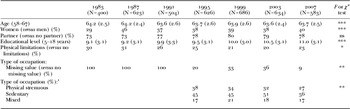
Across the study period, the average age of the retirees decreased from 64.2 years in 1983 to 63.7 years in 2007 (p<0.001; Table 1). The percentage of retired women in the sample fluctuated over time, yet the majority in all observations was men. Changes in partner status were not observed, however additional analysis showed that a majority of the men had a partner and that the percentage of women with a partner increased significantly between 1983 and 2007 (from 33 to 66%). This indicates that the selection of women in our sample changes over time. The women included in the beginning of the study period were mainly women without a partner, because women with a partner often left the labour market earlier in the lifecourse upon marriage or childbirth. More recently, an increasing number of women with a partner experience the transition to retirement, because they have continued employment after marriage or childbirth. Educational level of the successive cohorts of retirees increased significantly from 9.1 years in 1983 to 11.0 years in 2007 (average increase among men 1.8 years and among women 2.1 years). The prevalence of physical limitations decreased from 30 per cent in 1983 to 23 per cent in 2007. This decrease was more pronounced in retired men than in retired women. Changes in type of occupation were observed between 1995 and 2007. The results show that the number of retirees who had previously been working in physically strenuous jobs decreased over time, whereas the number of persons working in sedentary jobs increased over time.
Background characteristics by year of observation

Notes: Values are means (with standard deviations in parentheses) or percentages (N=4,056).
1. Among retirees with data available: 1995: N=503; 1999: N=461; 2003: N=408; 2007: N=533.
Significance levels:
* p <0.05,
** p <0.01,
*** p <0.001, ns: not significant.
The retirees in our study participated in a wide range of sports activities. The most frequently reported activities were cycling, walking, swimming, gymnastics or fitness, and tennis. Some minor variation in the ranking of these activities occurred in successive cohorts of retirees. Some sports have become more popular. Participation in gymnastics or fitness increased predominantly among women. Beginning in 1991 an increase in jogging was observed particularly among men, while playing golf has become an increasingly popular activity since 1999 among both men and women. Men reported participation in ball sports such as volleyball and football more often than women.
The trend in sport participation
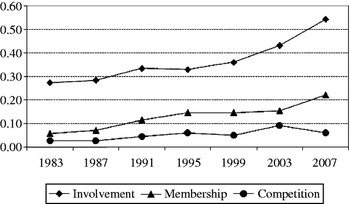
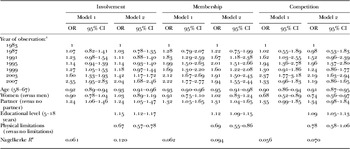
Between 1983 and 2007 participation in sport among retirees has changed significantly. Table 2 (Model 1) shows the results for involvement, membership and competition including dummies for year of observation and controls for age, gender and partner status. The models are an improvement of the intercept-only models (χ 2(9)=181.4, p<0.001; χ 2(9)=142.2, p<0.001; χ 2(9)=94.4, p<0.001, respectively). Figure 1 presents the findings of Model 1 graphically. The results show an increase in involvement in sports over time. The predicted probability that retirees are involved increased from 0.27 in 1983 to 0.54 in 2007 (Figure 1). Changes in sport involvement were most pronounced from 1999 onward. In 1999 the odds of involvement in sport increased significantly compared to the average effect of previous observations; in 2003 and 2007 the odds increased further (Table 2).
Predicted probabilities of sport involvement, sports club membership and participation in competition for 1983, 1987, 1991, 1995, 1999, 2003 and 2007, controlled for age, gender and partner status (N=4,056).

Logistic regression analysis of involvement, membership and competition between 1983 and 2007 (N=4,056)

Notes:
1. Contrast method: Reverse Helmert. OR: odds ratio. CI: confidence interval.
The probability that retirees are members of a sports club and the probability that retirees are participating in competition are much lower compared to the estimates for involvement. Yet, the likelihood of membership of a sports club increased significantly as of 1991 compared to the average effect of previous observations (Table 2). Only between the observations in 1995 and 1999 did this trend temporarily come to a halt. Overall, the predicted probability of being a member of a sports club increased from 0.06 in 1983 to 0.22 in 2007. Changes in the likelihood of participation in competition between 1983 and 2007 did not show a clear pattern. Predicted probabilities ranged between 0.03 and 0.09. In 1991, 1995 and 2003 the likelihood of participation in competition was significantly higher compared to the average effect of the previous observations. However, in 1999 and 2007 the odds ratios were lower and did not indicate significant increases over time.
Results presented in Model 1 (Table 2) furthermore demonstrate that the likelihood of involvement, membership and competition decreases with increasing age. For example, a 58-year-old retiree in 2007 had a probability of 0.66 of being involved in sports compared to a probability of 0.47 for retirees aged 67, when all other characteristics are controlled. The oldest retirees in our sample were less likely to be member of a sports club than the youngest ones (predicted probabilities in 2007 were 0.18 and 0.30, respectively). Age differences were also present with respect to participation in competition. The probability of participation in competition was 0.11 for retirees aged 58 in 2007, whereas the regression estimates revealed a probability of only 0.04 for retirees aged 67. No gender differences were observed for involvement and membership. Men and women were equally likely to be involved in sports for at least 12 weeks per year and to be member of a sports club. Participation in competition was more likely to occur among men than among women. Finally, retirees with a partner were more likely to be involved and more likely to be a member of a sports club. Having a partner did not affect the likelihood of participation in competition.
Model 2 (Table 2) presents the results from the multivariate logistic regression models for involvement, membership and competition including level of education, physical limitations and control variables. The models are an improvement of Model 1 (χ 2(2)=181.3, p<0.001; χ 2(2)=76.6, p<0.001; χ 2(2)=24.8, p<0.001, respectively). The results demonstrate that retirees with a higher level of education are more likely to be involved in sports, to be a member of a sports club, and to participate in competitions than retirees with a lower level of education. For example, in 1995 a retiree who did not complete primary school and had only five years of education had a probability of 0.25 of being involved in sports, compared to a probability of 0.66 for a retiree who had completed university (i.e. 18 years of education). The results furthermore indicate that retirees with physical limitations are less likely to be involved and less likely to be members of a sports club compared to retirees without limitations. Surprisingly, having physical limitations did not influence the likelihood of participation in competition.
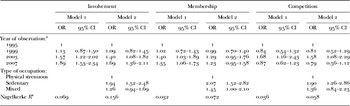
Table 3 presents the findings of the observations between 1995 and 2007. In Model 2 the regression equation is extended with former type of occupation as a predictor. The models are an improvement of Model 1 (χ 2(2)=29.3, p<0.001; χ 2(2)=22.4, p<0.001; χ 2(2)=10.2, p<0.01, respectively). We observed that retirees with sedentary jobs in the past were more likely to be involved in sports, more likely to be sports club members and more likely to be participating in competition compared to those who had physically strenuous jobs (Model 2). No differences in likelihood of involvement, membership and competition were demonstrated between those with mixed jobs and those with physically strenuous jobs.
Logistic regression analysis of involvement, membership and competition between 1995 and 2007 (N=1,905)1

Notes:
1. Model 1 controlled for age, gender, partner status; Model 2 additionally controlled for educational level and physical limitations.
2. Contrast method: Reverse Helmert. OR: odds ratio. CI: confidence interval.
Increases in sport involvement and membership between 1983 and 2007 could be partially attributed to changes in the predictor variables. Comparison of the effects for year of observation before (Model 1 in Tables 2 and 3) and after inclusion of the predictor variables (Model 2 in Tables 2 and 3) showed a decrease for most years. However, there were relative high standard errors in the early years and testing the differences did not show significant results. The observed decreases in combination with the model improvement from Model 1 to Model 2 suggest that to a certain extent increases in sport participation over time can be attributed to an increase in educational level, increases in sedentary work, and a decrease in physical limitations. In other words, increases in educational level and sedentary work and decreases in the number of persons with physical limitations only partially mediate the relationship between year of observation and sport participation.
Discussion
The aim of the current study was to examine the trend in sport participation among retirees aged 58–67 between 1983 and 2007. Due to changes over historical time in factors that influence involvement in sports, we assumed that successive cohorts of retirees would be more likely to be participating in sports. We focused on changes in educational level, type of occupation and physical limitations as predictor variables. In addition, we assumed that participation in organised sport activities, i.e. membership of a sports club and participating in competition, would have increased as well.
The results demonstrate that successive cohorts of retirees are increasingly likely to participate in sport activities. In a time-span of 24 years the likelihood that retirees are involved in sports has almost doubled. Also, retirees in 2007 were significantly more likely to be members of a sports club compared to retirees in 1983.
Our results suggest that the increase in sport participation can partially be explained by changes in educational level and physical limitations. In line with our expectations and results from previous research (Breuer et al. Reference Breuer, Hallmann, Wicker and Feiler2010; Hovemann and Wicker Reference Hovemann and Wicker2009), we observed that retirees with lower levels of education and those with physically strenuous jobs were less likely to participate in sport activities compared to those with higher levels of education and those whose former jobs were sedentary. Furthermore, retirees with physical limitations participated in sports less often than retirees without limitations. Yet, the increase in educational level and number of persons retiring from sedentary jobs, and the decrease in the prevalence of physical limitations in the years between 1983 and 2007 seems to account only partially for the increase in sport participation. That we did not observe stronger effects might be related to changes in the composition of the group of retirees over time. In the 1980s and 1990s pathways into retirement were diverse (e.g. early retirement arrangements, disability and unemployment), but progressively the possibilities for early retirement have been restricted. Moreover, the characteristics of women selected for this study has changed, with more women with a partner included in the study in later observations. As a result the group of retirees in our study has become more homogeneous which is reflected in the relative high standard errors in the early years compared to lower standard errors in more recent observations.
Overall, the results suggest that increases in sport participation have taken place through replacements of old generations of retirees by new generations with characteristics supporting sport participation. Since we were not successful in offering a full explanation of the increase over time, additional explanations need to be considered. A first explanation concerns awareness of the importance of behaviour that promotes health. For example, increases in leisure-time physical activity in the Finnish and Danish population during the last three decades have been attributed to increased health consciousness (Borodulin et al. Reference Borodulin, Laatikainen, Juolevi and Jousilathi2008; Petersen et al. Reference Petersen, Thygesen, Helge, Gronbeak and Schurmann-Tolstrup2010). The awareness of health benefits of sport participation has become more widespread in recent years, possibly resulting in an increase in sport participation rates. Furthermore, social norms with respect to sport participation have changed. A few decades ago, exercise and sports involvement was a male, urban and upper-class activity, whereas today, persons in all layers of society are involved in sports (Lalive d‘Epinay, Maystre and Bickel Reference Lalive d'Epinay, Maystre and Bickel2001). Opportunities for sport participation have also changed considerably during the last decades (De Heer Reference De Heer2000). Since the 1950s the number of sports clubs has risen rapidly in the Netherlands. Saturday afternoons became the moment for sports activities and with the introduction of the five-day work week in 1960, active sport involvement on Saturdays expanded further. From the 1970s onward, recreational sports became an important target for policy makers.
Some of these developments may have affected specific birth cohorts of retirees (cohort effect), others have influenced all persons at some point in historical time (period effect) (Breuer et al. Reference Breuer, Hallmann, Wicker and Feiler2010; Tiessen-Raaphorst Reference Tiessen-Raaphorst, Tiessen-Raaphorst, Verbeek, De Haan and Breedveld2010). The retirees studied in this research belong to successive cohorts born between 1916 and 1949 who are differentially affected by the described developments. Retirees observed in the 1980s were born around 1925. They spent most of their youth and adolescent life in an era of economic hardship when sport facilities were scarce and time was devoted to school and work. When they retired, they probably had not participated much in sports activities earlier in their life, making sport participation after retirement less likely. Retirees in the 1990s might not have benefited from a wide range of opportunities for becoming involved in sports during their youth; however, they might have been affected by changing norms and opportunities that occurred after World War II when they reached early adulthood. Upon their retirement, the awareness of the importance of physical activity was becoming more widespread. Finally, retirees in the early years of the 21st century have grown up in years of rising prosperity. On the one hand, these retirees seem to have developed more unhealthy lifestyles than retirees belonging to previous cohorts (e.g. regarding smoking, food and alcohol consumption) (Visser et al. Reference Visser, Pluijm, Van der Horst, Poppelaars and Deeg2005). On the other hand, they have had ample opportunities for sport participation throughout their life and knowledge about the importance of exercise and sport for healthy ageing (even when their health is suboptimal).
The various developments promoting sport participation in successive cohorts of retirees, for example the increase in the educational level, will be continued for coming generations of retirees. Therefore, sport participation may increase further among retirees in the future. Awareness of the importance of physical activity for healthy ageing and the growing number of initiatives and facilities for sport participation among middle-aged and older adults (Breedveld et al. Reference Breedveld, Hover, Van Kalmthout, Van Lindert, Van Veldhoven, Van der Werff, Wisse, Tiessen-Raaphorst, Verbeek, De Haan and Breedveld2010) will make sport participation more diverse and attractive.
In the current study we also observed a trend of increased involvement in organised sports activities. Among retirees who participated in sports, relatively more retirees in 2007 were member of a sports club compared to 1983. This is in line with previous research that shows increases in organisational involvement among recent cohorts of middle-aged and older adults (Agahi and Parker Reference Agahi and Parker2005; Broese van Groenou and Deeg, Reference Broese van Groenou and Deeg2010). This seems at odds with Putnam's (Reference Putnam2000) observation of decreases in involvement in formal and informal organisations in the baby-boom generation in the United States of America. Possibly, future cohorts of retirees will be more affected by developments proposed by Putnam and will be less engaged in organised sports, resulting in decreases in sports club membership.
Sport participation differed by age, gender and partner status. Within the limited age range of ten years that we included in our study we observed that older retirees were less likely to be involved in sports than younger retirees. This negative effect of age needs to be interpreted with caution, because the results are based on cross-sectional data and could reflect cohort or period effects (Breuer and Wicker Reference Breuer and Wicker2009). However, various longitudinal studies have shown decreases in sport participation with increasing age (e.g. Breuer et al. Reference Breuer, Hallmann, Wicker and Feiler2010; Verbrugge, Gruber-Baldini and Fozard Reference Verbrugge, Gruber-Baldini and Fozard1996). The observed gender differences in participation in competition are in line with previous research. Men are in general more likely to be involved in competitive sports activities than women (Iso-Ahola, Jackson and Dunn Reference Iso Ahola, Jackson and Dunn.1994). No gender differences were observed in participation rates and club membership. Previous studies have suggested that gender differences in sport participation are related to differences in the lifecourse. It might be that the lifecourse of women in our sample is more similar to the typical male lifecourse, because the women identified themselves as being retired indicating that they have experienced the transition from work to retirement. We observed that having a partner promoted sport participation in both men and women. This association was also demonstrated by Pettee et al. (Reference Pettee, Brach, Boudreau, Colbert, Harris, Visser, Richardson and Newman2006) for men. Retirees with a partner were also more likely to be members of a sports club. Probably people in a couple often join a sports club together.
Being able to observe a trend in sport participation among retirees over a long period of time is an important strength of our study. It has enabled us to investigate sport participation among retirees in an era characterised by social changes that affect involvement in sports. There are also some limitations that need to be addressed. One downside of using data with multiple observations over a longer period of time is that some changes have occurred in the data collection. In 1991 ‘walking’ and ‘cycling’ as a category of activity were replaced by ‘walking for exercise’ or ‘cycling sport’. Most likely, this change has suppressed the effect of increasing sport participation. Some retirees reporting involvement in walking or cycling in observations before 1991 would probably not have done so if they had been asked about their involvement in walking for exercise or cycling sport.
Data on occupational background were only available for observations in 1995 and onwards. This might have resulted in an underestimation of the effect of increased sedentary work. Decreases in the number of people employed in physically strenuous jobs started shortly after World War II (Brownson, Boehmer and Luke Reference Brownson, Boehmer and Luke2005). Therefore, the effect of an increase in sedentary jobs would be most noticeable in the earlier cohorts of retirees in our sample. Besides, using one classification for jobs over a time-span of 12 years (1995–2007) does not account for changes over time in the amount of physical activity within a specific job type. Our measure of physically strenuous versus sedentary and mixed jobs could be improved when more detailed information is available.
A further limitation is that the data are based on self-report. Since sport participation is appreciated in society, respondents might have over-estimated their involvement in sport activities. Since the importance of sport participation has increased over time, the report bias might have increased as well. Furthermore, no information was available on intensity of sport participation. Therefore, while we can conclude that sport participation has increased in recent decades, we do not know to what extent retirees have increased their level of physical activity. In order to say something about trends in physical activity levels over time among retirees, detailed information on sport intensity is necessary, as is information on other physical (leisure) activities like household tasks, gardening and DIY tasks around the house (e.g. Berger et al. Reference Berger, Der, Mutrie and Hannah2005).
In conclusion, the current study offers insight in sport involvement among successive cohorts of retirees. Currently, retirees are more likely to have had a sedentary work history and an overall sedentary lifestyle compared to their age peers 24 years ago. Yet, recent retirees are more likely to be involved in sports. From a retirement adjustment perspective this is a positive finding, because sport participation, especially with others, increases life satisfaction (Eime et al. Reference Eime, Harvey, Brown and Payne2010), and helps adjustment to retirement (Coleman and Iso-Ahola Reference Coleman and Iso Ahola1993). Moreover, sport participation has greater beneficial effects than other means of physical activity. Older adults who participate in sport activities more often reach the standard for physical fitness compared to older adults who are not involved in sports (Brach et al. Reference Brach, Simonsick, Kritchevsky, Yaffe and Newman2004; Chorus, Van Campen and Den Draak Reference Chorus, Van Campen, Den Draak, Tiessen-Raaphorst, Verbeek, De Haan and Breedveld2010). Nevertheless, a substantial and heterogeneous group of retirees is not involved in sports. Some of these retirees might not feel the need to be involved, because they are physically active in other ways. Others might not participate because of the risk of injuries. Non-active retirees might benefit from the introduction of new policy strategies aimed at increasing more recreational types of sport participation among middle-aged and older adults, such as the introduction of outdoor fitness parks (Van Lindert et al. Reference Van Lindert2009).
Acknowledgements
This research was partially supported by a grant from the Sluyterman van Loo Foundation.