


Introduction
The US Food and Drug Administration (FDA) is responsible for ensuring that new drugs satisfy requirements for demonstrating safety and effectiveness under the federal Food, Drug, and Cosmetic Act (FDCA). FDA’s “accelerated approval” pathway, codified in the FDCA, flexibly adjusts how the standard for demonstrating efficacy may be met for drugs intended for serious conditions with unmet medical need, which are eligible for approval based on unvalidated surrogate or intermediate clinical endpoints deemed reasonably likely, but not yet proven, to predict clinical benefit.1 Because accelerated approval allows drugs to come to market despite uncertain clinical benefit, the FDCA authorizes FDA to require that drug manufacturers complete confirmatory studies known as postmarketing requirements (PMRs). Beyond accelerated approval, and often in addition to it, the FDCA’s standards also allow FDA the discretion to exercise other types of regulatory flexibility, such as acceptance of non-randomized pivotal trials, single pivotal studies accompanied by confirmatory evidence rather than two “adequate and well-controlled investigations,” and studies that fail to meet prespecified endpoints.Reference Wallach, Ross and Naci2 In all cases, this flexibility seeks to accommodate the desire for speedy access to promising drugs for seriously ill patients without substantially impeding confidence in drugs allowed on the market.
As FDA has demonstrated increasing flexibility, scrutiny of this approach has grown. Internally, in 2021, FDA’s Oncology Center of Excellence began pursuing voluntary withdrawals of several “dangling” accelerated approvals that failed to demonstrate benefit in confirmatory studies.Reference Beaver and Pazdur3 The agency also initiated a procedure to involuntarily withdraw approval of a drug for recurrent preterm birth that had failed to confirm benefit, although that became a drawn-out process extending for several years, clearly indicating the need to improve the withdrawal process following accelerated approval.Reference Gaffney4
Despite these efforts, FDA continued to extend flexibility in the approval of several controversial drugs, leading to heightened external scrutiny. For example, Biogen’s Aduhelm (aducanumab) was granted accelerated approval for Alzheimer’s disease in June 2021 over the objection of an FDA advisory committee and concern regarding the surrogate endpoint used, failure to meet prespecified clinical endpoints, and serious safety issues. The circumstances surrounding Aduhelm’s approval led to two federal investigations and congressional reforms to the accelerated approval pathway adopted under the 2022 Food and Drug Omnibus Reform Act (FDORA).Reference Alexander5 Biogen announced in January 2024 that it would discontinue Aduhelm to “reprioritize resources” to other Alzheimer’s treatments.6 For Amylyx’s Relyvrio (sodium phenylbutyrate/taurursodiol), a treatment for amyotrophic lateral sclerosis (ALS), FDA initially indicated that a second placebo-controlled trial would be needed before considering approval. Nonetheless, the agency granted regular approval in September 2022 based on a single positive Phase 2 study in addition to the company’s “promise” to voluntarily withdraw the drug should a then-ongoing Phase 3 study fail to demonstrate benefit.Reference Lynch and Sachs7 Amylyx announced in April 2024 that its Phase 3 study had failed and that the drug would no longer be available to new patients, with voluntary withdrawal finalized in August 2025.8 Finally, Sarepta’s Elevidys (delandistrogene moxeparvovec) received accelerated approval over internal agency disagreement for four- and five-year-old ambulatory patients with Duchenne muscular dystrophy (DMD) in June 2023, despite failing to meet its primary clinical endpoint. When the confirmatory trial also failed, in June 2024, FDA nonetheless granted Elevidys regular approval for ambulatory patients and accelerated approval for nonambulatory patients, all aged four and older.Reference Rind9 In July 2025, the company briefly paused Elevidys distribution at FDA’s request following three patient deaths.10
Taken together, these and other FDA decisions raise important questions about the proper scope and limits of the agency’s regulatory flexibility.Reference Wallach11 These questions continue to be pertinent given the Trump administration’s further emphasis on regulatory flexibility and accelerating reviews, such as through the new Commissioner’s National Priority Voucher Program, “plausible mechanism” framework for individualized therapeutics, and shift to a default of one pivotal study to support drug approval.Reference Prasad and Makary12 Indeed, previous high-level agency leaders under the Trump administration, including Commissioner Martin Makary and director of the Center for Biologics Evaluation and Research (CBER) Vinay Prasad, were heavily criticized as insufficiently flexible in the context of rare disease drug approvals, reportedly contributing to their departures from the agency.13
While there exists a robust body of descriptive work examining the exercise and impact of FDA’s flexibility, that work has not been sufficiently contextualized through systematic analysis of the broader regulatory reasoning behind these decisions and policy judgments. Understanding how key FDA officials perceive these challenges from a policy perspective is important to understanding their rationales, allowing those rationales to be held up to scrutiny and facilitating assessment of the need for possible reform. It also allows for comparison to new rationales that may be offered by agency officials following changes in FDA administration. However, there are challenges to recruiting current (and sometimes recent former) FDA leaders to participate in academic interviews and surveys designed to study these matters. For example, as part of a recent interview study, we invited 21 then-current FDA officials to participate, of which only 3 agreed.Reference Lynch14
FDA officials are, however, generally willing to discuss their perspectives during public events, such as conferences, congressional testimony, and reporter interviews.15 Public statements are particularly useful in understanding regulatory perspectives when formal policies are vague and leave room for substantial discretion, key features of flexible drug approvals. Moreover, what officials say publicly shapes the expectations of relevant stakeholders including patients, pharmaceutical companies, and payer systems. Although assessment of these statements may be less surprising to close followers of the agency, who may be consistent readers of industry trade press, subjecting them to systematic review can identify the presence of themes, inconsistencies, or other patterns that may not otherwise be obvious. Therefore, we analyzed news coverage of the public statements made by FDA officials, both political and career staff, from 2021–2024 to understand agency rhetoric on regulatory flexibility, including when and why they described it as appropriate and where they indicated adjustments might be needed.
Data and Methods
We relied on two media outlets to identify statements regarding regulatory flexibility. Pink Sheet was our primary source given its status as a leading trade press publication providing comprehensive coverage of regulatory and policy trends relevant to the pharmaceutical industry through reporting of FDA activity, conferences, and press releases.16 STAT News was used to confirm that major public statements were included in the dataset, given its substantial coverage of FDA activity. STAT articles were included only if they identified an FDA official’s statement not covered by Pink Sheet.
We generated a list of relevant FDA officials based on the following criteria: high level FDA leadership responsible for major policy decisions regarding new drug approvals, including in the Office of the Commissioner; center directors and deputies; office directors, with attention to offices closely tied to regulatory flexibility such as neuroscience, cell/gene therapies, and rare disease products; division directors focused on rare diseases, Alzheimer’s, or ALS; and officials involved in patient-focused drug development. Overall, a total of 31 then-current FDA officials were included in the article search; 9 of these officials remained at FDA as of May 2026. (Table 1)
Frequency of Included FDA Officials’ Public Statements on Regulatory Flexibility

Table 1. Long description
The table is organized into three columns: Official/Group, Role at F D A at time of statement, and Number of articles covering official’s statements (n = 272).
Office of the Commissioner:
* Robert Califf, Commissioner: 34 (12.5%).
* Janet Woodcock, Principal Deputy Commissioner and former C D E R Director: 31 (11.4%).
* Namandjé Bumpus, Principal Deputy Commissioner: 1 (0.4%).
* Hilary Marston, C M O: 1 (0.4%).
Center Directors:
* Peter Marks, C B E R Director: 56 (20.6%).
* Patrizia Cavazzoni, C D E R Director: 28 (10.3%).
* Richard Pazdur, Oncology Center of Excellence Director: 11 (4.0%).
* Celia Witten, C B E R Deputy Director: 6 (2.2%).
* Mark Theoret, Oncology Center of Excellence Deputy Director: 6 (2.2%).
* Jacqueline Corrigan-Curray, C D E R Principal Deputy Director: 5 (1.8%).
* Paul Kluetz, Oncology Center of Excellence Deputy Director: 3 (1.1%).
* Douglas Thockmorton, C D E R Deputy Director: 1 (0.4%).
* Julie Tierney, C B E R Deputy Director: 0.
Office Directors:
* Peter Stein, Office of New Drugs Director: 23 (8.5%).
* William (Billy) Dunn, Office of Neuroscience Founding Director: 16 (5.9%).
* Teresa Buracchio, Office of Neuroscience Director: 14 (5.1%).
* Wilson Bryan, Office of Tissues and Advanced Therapies Director: 12 (4.4%).
* Nicole Verdun, Office of Therapeutic Products Director: 11 (4.0%).
* Julia Beaver, Office of Oncologic Diseases Acting Deputy Director: 3 (1.1%).
* Ellis Unger, Office of Cardiology, Hematology, Endocrinology, and Nephrology Director: 2 (0.7%).
* John Concato, Real-World Evidence Analytics Associate Director: 2 (0.7%).
* Sylva Collins, Office of Biostatistics Director: 1 (0.4%).
* Sandra Retzky, Janet Maynard, Kerry Jo Lee, M. Khair El Zarrad, and Gerald J. Dal Pan all have 0 articles.
Division Directors:
* Emily Freilich, Division of Neurology I Director: 2 (0.7%).
* Katie Donohue, Division of Rare Diseases and Medical Genetics Director: 1 (0.4%).
Patient-focused drug development:
* Robyn Bent, P F D D Program Director: 1 (0.4%).
* Theresa Mullin, C D E R Associate Director for Strategic Initiatives: 1 (0.4%).
* Month unknown.
+ Departed as of May 13, 2026
Members of the research team (TEJ, JE, KC, EZ) searched for these 31 names in Pink Sheet and STAT articles published from January 2021 to June 2024, encompassing the controversial approvals described above and recent accelerated approval reforms. Articles were included in the dataset if they contained primary quotations or descriptions of statements from these officials regarding regulatory flexibility, defined as accepting less evidence than FDA ordinarily would require, e.g., fewer studies, smaller or different patient populations for confirmatory studies, design limitations, unmet primary endpoints, reliance on post-hoc analyses or observational data, or lower statistical significance. We excluded articles focused on COVID-19 approvals and emergency use authorizations.
Included articles were uploaded to Dedoose for coding. Two team members (SL, HFL) developed a codebook deductively (Appendix), including topics relevant to regulatory flexibility. The team also tracked disease areas, drugs for which regulatory flexibility was considered or exercised, and FDA official name, role, and category. To ensure consistency, four team members (TEJ, JE, KC, EZ) independently coded a subset of articles (n=37), reconciled discrepancies, and revised codebook definitions accordingly. Once the team established coding alignment, remaining excerpts were double-coded. Misaligned codes were discussed with the broader coding team and arbitrated by SL and HFL.
Dedoose-generated excerpt reports were reviewed and summarized by TEJ. The findings were presented to RR, JR, SL, and HFL for further analysis and contextualization. The team identified salient themes and differences in regulatory perspectives.
Results
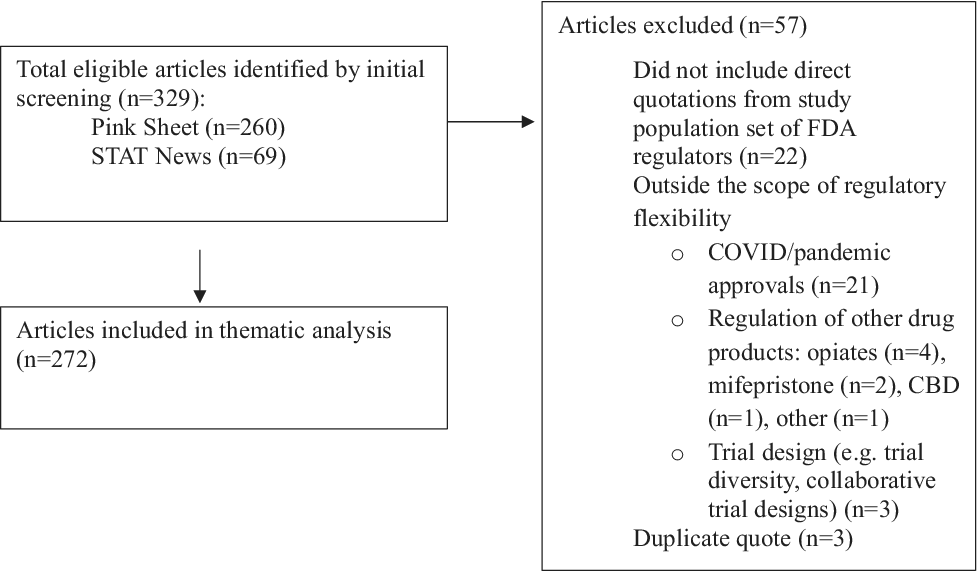
A total of 329 articles were initially identified from Pink Sheet (n=260) and STAT News (n=69). Of those, 57 were excluded on further review because they did not fulfill eligibility criteria (Figure 1); the final sample consisted of 272 articles. The frequency with which each FDA official’s public statements on regulatory flexibility were covered is presented in Table 1. Table 2 presents the frequency of topics arising in these statements.
Included and excluded articles.

Figure 1. Long description
The flowchart consists of three main boxes connected by arrows.
1. Top-Left Box: Total eligible articles identified by initial screening n equals 329. This is broken down into Pink Sheet n equals 260 and S T A T News n equals 69. An arrow points right to the exclusion box and another arrow points down to the inclusion box.
2. Right Box: Articles excluded n equals 57. The reasons for exclusion are listed as:
* Did not include direct quotations from study population set of F D A regulators n equals 22.
* Outside the scope of regulatory flexibility, which includes:
* C O V I D forward slash pandemic approvals n equals 21.
* Regulation of other drug products: opiates n equals 4, mifepristone n equals 2, C B D n equals 1, other n equals 1.
* Trial design e.g. trial diversity, collaborative trial designs n equals 3.
* Duplicate quote n equals 3.
3. Bottom-Left Box: Articles included in thematic analysis n equals 272.
Topical Frequency of FDA Officials’ Public Statements Regarding Regulatory Flexibility

Table 2. Long description
The table presents data from 272 articles. It is divided into three main sections.
1. Regulatory Flexibility Topics (in order of frequency):
- Accelerated approval: 187 (68.8 percent)
- P M R s or confirmatory studies: 96 (35.3 percent)
- Surrogate endpoints: 87 (32.0 percent)
- Withdrawal: 46 (16.9 percent)
- Other: 29 (10.7 percent)
- Payment or coverage for A A: 22 (8.1 percent)
- F D O R A: 8 (2.9 percent)
- Uncertain efficacy: 123 (45.2 percent)
- Clinically meaningful benefit: 82 (30.1 percent)
- Unmet treatment need: 52 (19.1 percent)
- Uncertain safety: 37 (13.6 percent)
- Real world evidence or Real world data: 33 (12.1 percent)
- Role of patients or Patient Advocacy Organizations (P A O s): 32 (11.8 percent)
- Disagreement among reviewers: 27 (9.9 percent)
- Uncertain population: 26 (9.6 percent)
- Other: 24 (8.8 percent)
- Clinical outcomes assessment (C O A): 6 (2.2 percent)
- Expedited programs: 4 (1.5 percent), including Fast Track (2), Breakthrough Therapy (3), and Priority Review (0).
2. Disease Category About Which Regulatory Flexibility Was Discussed:
- Alzheimer’s: 59 (21.7 percent)
- Rare disease (other or unspecified): 59 (21.7 percent)
- Cancer or oncology: 33 (12.1 percent)
- A L S: 25 (9.2 percent)
- Duchenne’s: 21 (7.7 percent)
3. Drug About Which Regulatory Flexibility Was Discussed:
- Gene and cell therapy: 53 (19.5 percent)
- Aduhelm or aducanumab (Alzheimer’s): 48 (17.6 percent)
- Relyvrio or A M X 0 3 5 (A L S): 19 (7.0 percent)
- Makena (premature birth): 12 (4.4 percent)
- Elevidys (D M D, gene therapy): 11 (4.0 percent)
- Leqembi or lecanemab (Alzheimer’s): 9 (3.3 percent)
- Exondys 51 or Vyondys 53 or Amondys 45 (D M D): 8 (2.9 percent)
- Kisluna or donanemab (Alzheimer’s): 4 (1.5 percent)
- Qalsody or tofersen (A L S): 4 (1.5 percent)
Frequency of Officials and Topics
Peter Marks, who approved Elevidys and directed CBER (the center responsible for reviewing cell and gene therapies) during the study period, was the most frequently quoted official, with his comments on regulatory flexibility appearing in 56 articles (20.6%). Robert Califf, then FDA Commissioner, was quoted in 34 articles (12.5%). He was closely followed by Janet Woodcock, who was then Acting Commissioner and subsequently Principal Deputy Commissioner, at 31 articles (11.4%), and Patrizia Cavazzoni, then director of the Center for Drug Evaluation and Research (CDER) when Aduhelm was approved, at 28 articles (10.3%). None of these officials remain at FDA.
No other FDA official was represented in more than 10% of the sampled articles. Notable in their relative absence were Namandjé Bumpus, who was Acting Chief Scientist and later Principal Deputy Commissioner during the study period, and Hilary Marston, then FDA’s Chief Medical Officer, both high-level policy roles; neither is still at FDA. Richard Pazdur’s comments were covered in only 11 articles, also notable given his role during the study period as director of the Oncology Center for Excellence, which is responsible for the bulk of FDA’s accelerated approvals; Pazdur retired from FDA in December 2025.Reference Jenei and Booth17 Leaders working on patient-focused drug development, rare diseases, and real world evidence were included in no more than two articles each, despite these areas reflecting domains in which regulatory flexibility is often raised. However, these frequencies should be interpreted with consideration to the potentially uneven distribution of opportunities to make public statements among FDA officials (e.g., through conference invitations and interview requests), along with authority to do so, with both concentrated higher in the organizational chart. Nonetheless, every official included in our sample held a relatively high-level position.
The most prevalent topic covered in officials’ quotes regarding regulatory flexibility was accelerated approval (n=187 articles, 68.8%), an umbrella category that also included two prevalent topics: post-marketing requirements/confirmatory studies (n=96; 35.3%) and surrogate endpoints (n=87; 32.0%). Uncertain efficacy (n=123; 45.2%) and clinically meaningful benefit (n=82; 30.1%) were also commonly discussed, often in the context of surrogate endpoints used to support accelerated approval. The most frequent disease categories arising in the dataset were Alzheimer’s and rare disease (n=59 each, 21.7%) and the most discussed drugs were gene and cell therapies (n=53, 19.5%) and Aduhelm (n=48, 17.6%).Reference Heidebrink and Paulson18 Among the most represented regulators, Marks’ most frequent topics were gene and cell therapy (n=29/56 articles, 51.8%), a topic directly aligned with his role, as well as uncertain efficacy (n=23, 41.1%), surrogate endpoints (n=19, 33.9%), and rare disease (n=19, 33.9%); Califf’s were post-marketing requirements/confirmatory studies (n=21/34 articles, 61.8%), uncertain efficacy (n=16, 47.1%), and real world evidence (n=9, 26.5%); Woodcock’s were uncertain efficacy (n=16/31 articles, 51.6%), Alzheimer’s (n=13, 41.9%), and Aduhelm/aducanumab (n=13, 41.9%); and Cavazzoni’s were Alzheimer’s (n=12/28 articles, 42.9%), Aduhelm/aducanumab (n=11, 39.3%), surrogate endpoints (n=8, 28.6%), and clinically meaningful benefit (n=8, 28.6%).
The views expressed in FDA leaders’ public statements were largely consistent across FDA officials and disease areas examined, with strong support of regulatory flexibility across the board, with a single exception noted below.
Theme 1: Prioritizing Patient Access Over Certainty
Moving beyond deductive topics to inductive themes emergent in FDA officials’ statements, the most prominent was the view that accepting some uncertainty regarding product benefit at the time of accelerated approval (AA) is appropriate because it facilitates earlier patient access to potentially beneficial drugs. In some instances, FDA officials suggested that requiring higher evidentiary standards would be detrimental to seriously ill patients, even if some approved drugs turn out not to work. Instead, they preferred to err on the side of access and expressed the view that FDA’s current approach largely achieves the right balance:
… we’re probably holding back products that could potentially benefit patients … I’m not going to lose too much sleep about getting it perfectly right, just as long as we get it right 95+% of the time. Reference Gingery19 Peter Marks (on AA)
[T]hose people that are unwilling to voice their support for this program, may one day wake up with a much different regulatory environment, one that may be very ultra-orthodox in its regulatory approaches to the cancer patients and put a p value above the needs of cancer patients. Reference Karlin-Smith20 Richard Pazdur (on AA)
What’s the alternative? You hold back all of these [drugs] until you have definitive evidence? Based on the results you would have a lot of people who wouldn’t be alive. Was that worth it to have all that certainty? Reference Owermohle21 Janet Woodcock (on AA)
Referees don’t always make the right call, and there is more uncertainty in an accelerated approval because an unvalidated surrogate may or may not end up working out in the long run. And there’s judgment involved…. I’m not saying the FDA always gets it right. But I think the current set point, at least in my view, is pretty good. Reference Sutter22 Robert Califf
A prevalent sentiment was that regulatory flexibility reflects an overt policy choice to accept some imperfection and tradeoffs, often depicted as reflecting the patient voice:
If you consider going for an unvalidated surrogate to be getting away with less, the law actually allows that because of a societal decision driven by patients who had diseases that were untreatable…. Reference Gingery23 Robert Califf (on AA)
But it’s a tough dilemma. The families are like the HIV patients back in the day, if you recall, lying in the street, saying, “We don’t care about the trials, we don’t have anything, we’re dying. We want to be able to try something.” That’s how a lot of families feel. 24 Janet Woodcock (on AA)
We’ve heard very clearly from [Alzheimer’s] patients that they’re willing to accept some uncertainty to have access to a drug that can provide meaningful benefit in preventing progression of this disease. Reference Milligan and McCurdy25 Peter Stein (on AA)
Notably, this broad acceptance of regulatory flexibility was also sometimes extended beyond AA to drugs receiving regular approval, even without requiring confirmatory studies that come with AA. However, in the context of Relyvrio, FDA anticipated (but did not require) completion of an ongoing Phase 3 trial despite granting regular approval:26
Our underlying legal authority is clear in not only allowing, but also endorsing and encouraging the application of regulatory flexibility in the setting of serious and life-threatening diseases. Reference Karlin-Smith27 Billy Dunn (on Relyvrio)
While FDA officials overall outwardly expressed confidence in using regulatory flexibility to address unmet need, some acknowledged that residual uncertainty can present challenges, including payer coverage:
If the agency waits until the evidence is very clear on an efficacy endpoint, then you might as well just go ahead and give things your traditional approval…. On the other hand, we don’t want products to be out there that have such dubious efficacy that insurers say we’re not going to cover this … because that doesn’t help the public either. Reference Sutter28 Peter Marks (on AA)
Amid these conversations around uncertainty, there were contrasting views among regulators as to whether accelerated approval reflects a lower evidentiary bar than regular approval given reliance on surrogate endpoints, despite both meeting the FDCA’s “substantial evidence of effectiveness” standard:
Woodcock also responded to criticism that Aduhelm lowered the bar for FDA approval, saying that she’s heard the complaint after nearly every regulatory milestone…. “It goes on and on during the years, particularly around approval based on a surrogate,” she said…. “And I think you’ll see the analyses that were done [for Aduhelm] when they are released. I think they’re very solid[.]” Reference Sandburg29 Janet Woodcock (quote made the day FDA posted Aduhelm’s approval package, 15 days after AA decision)30
Accelerated approval often in the past has been an afterthought when a sponsor couldn’t make it there towards traditional approval. Reference Gingery31 Peter Marks
While arguing accelerated approval development programs were different, not necessarily of lesser quality, [Califf] implied the standard to become available for marketing may be easier. “That’s not necessarily a lower quality study, it’s a different objective…. And I hope we will have many discussions about when it’s appropriate to go for that lower hurdle and when it’s appropriate to go for the clinical outcomes.” 32 Robert Califf
Only one regulator publicly expressed significant concern about FDA’s regulatory flexibility. Toward the end of his tenure at FDA, Wilson Bryan, then director of CBER’s Office of Tissues and Advanced Therapies, noted concern about the application of accelerated approval to gene therapies. He also acknowledged the public and industry pressure on FDA to exercise flexibility:
The confirmatory evidence is going to take five or 10 years, “and that presumes that the confirmatory evidence is clean enough that we can tell it works,” Bryan said of Skysona [a gene therapy granted AA for cerebral adrenoleukodystrophy]. If those postmarketing studies suggest the gene therapy does not work, “or we still can’t tell if it works or not, what has happened to that field? … It’s just been sitting around waiting, because the patients that are getting the gene therapy in a very rare disease, you’re cutting down the population that’s available for the next product. And will somebody else develop the product?” 33 Wilson Bryan
Peter [Marks] was always concerned about how things are going to look in public opinion or pushback from the pharmaceutical company[.] Reference Gingery34 Wilson Bryan (on Elevidys)
Theme 2: Challenges Around Confirmatory Study Enforcement
While regulators highlighted the benefits of regulatory flexibility at the time of approval, they also strongly affirmed that post-marketing requirements (PMRs) are necessary to confirm clinical benefit. However, they did not acknowledge that when regulatory flexibility is exercised outside accelerated approval, confirmatory studies have not been required given current interpretations of the legal authority to impose them.35 Moreover, even when PMRs are imposed for AA, regulators widely agreed that companies are not adequately incentivized to meet them. Instead, regulators described companies as financially motivated to keep their product on the market for as long as possible, which can lead to delay of confirmatory studies, since these may fail to confirm benefit and potentially lead to withdrawal:
I think there’s good reason to be creative in that arena [flexible approvals for non-opioid pain medicines or certain cancer drugs], as long as we fill in the second part. And I think industry by and large has resisted doing a good job with the second part…. You do a net present value calculation, you’re almost always better relying on marketing and not relying on hardcore evidence. Reference Karlin-Smith36 Robert Califf (on AA or a new extension of emergency use authorization)
I worry a lot about gathering that subsequent, postmarket data. It may take many years, it may at the end of the day be difficult to interpret, and in some cases I get the sense the pharmaceutical company is dragging it out. Reference Baghdadi37 Wilson Bryan (on AA)
Once a company gains Accelerated Approval, “they have little incentive to conduct confirmatory trials…. Why should they be in a hurry to do the confirmatory study? What do they have to gain? Not much.” Reference Rawson38 Ellis Unger
At the same time, regulators expressed concern regarding FDA’s effectiveness in PMR enforcement, noting that the agency rarely withdraws accelerated approval drugs that delay or fail to complete PMRs, reducing pressure on industry to complete them. Some expressed similar concerns about FDA’s willingness to respond to PMRs that fail to confirm patient benefit, especially if unmet need remains:
So they might drag their feet, and they also recognize that based on history, FDA is not very likely to remove these drugs from the market. 39 Ellis Unger (on AA)
And does the agency have the willpower to say, okay, the data is ambiguous, it looks like it probably doesn’t work, I’m not sure it doesn’t work, but let’s take it off the market in this rare disease with no treatment available? … I’m not sure the agency has the will to do that…. It’s really unfortunate because … in the setting of cell and gene therapy, you’re making a one-time decision to take a product, and you want to believe with the backing of the FDA that this thing really works. And the FDA doesn’t know and you don’t know. 40 Wilson Bryan (on AA)
Within our dataset, only a few regulators were publicly willing to suggest withdrawal as an appropriate response to a failed confirmatory study, and sometimes only tentatively:
[W]hen a trial is negative, the appropriate thing is usually, maybe not always, to do another trial, or discontinue development[.] Reference Gingery41 Wilson Bryan (on Elevidys)
The goal would be, if a trial fails, we would look at it and see what our interpretation would be, but we’d expect to remove it from the market[.] Reference Feuerstein and Mast42 Celia Witten (on Elevidys)
Although agency willpower was a concern, some regulators acknowledged that FDORA reforms, including a provision explicitly authorizing FDA to require a confirmatory trial be underway at the time of accelerated approval, should facilitate timely PMR completion. Nonetheless, other regulators noted that FDORA will not address ambiguous confirmatory study results or ensure that FDA will act on them when negative:
[FDORA] helps us have some teeth around what we’re doing with accelerated approval in terms of making sure we get the answers to critical questions for ensuring that products are effective. Reference Sutter43 Peter Marks
In the most recent update to our laws … we got more authority now to remove a product if we think it’s the right thing to do … I only wish there was always a binary clear yes or no confirmatory trial. There are results which are in a gray zone…. There are times when the trials don’t get finished. 44 Robert Califf (on AA)
Theme 3: Reticence to Interpret Failed Confirmatory Trials as Failed Drugs
Despite regulators affirming the importance of PMRs after AA, they often shared a pervasive sentiment that failed confirmatory studies do not necessarily mean that a drug does not work, potentially explaining the broader reticence to move to withdrawal described above. Instead, some regulators indicated that failure to demonstrate benefit might be due to faulty trial design, noting how study results could be influenced by choice of study population or endpoints. Accordingly, they sometimes supported doing additional confirmatory trials, as needed.
One can always question the adequacy of the study…. But that doesn’t prove that the drug is not effective, just because you have a negative study. 45 Ellis Unger (on AA)
There’s nothing wrong with having to do a second confirmatory trial if you think it’s the trial design [causing the negative result], and not the product itself. Reference Sutter46 Peter Marks (on AA)
[T]here is the patient here also that needs these drugs. And therefore, we want to make sure and work with the companies. A failed trial does not mean a failed drug. Reference Karlin-Smith47 Richard Pazdur (on AA)
Occasionally, regulators noted that patients may similarly hold out hope for benefit, despite failed confirmatory studies. As with initial approval, this can lead to pressure on FDA not to withdraw:
There are always patients who believe that the drug is beneficial, and they will fight against removal of the drug. 48 Ellis Unger (on AA)
But in fact, it’s still very difficult if we have patients who believe these drugs are really helping them, it’s still very difficult to remove them[.] Reference Karlin-Smith49 Janet Woodcock (on AA)
Discussion
In this thematic analysis of FDA officials’ public statements regarding regulatory flexibility in drug approvals covered in two leading media outlets from 2021–2024, we found that only a few officials had made substantial statements on this topic, often in the domains of accelerated approval, gene therapy, and specific controversial examples of recent approvals, while others were largely silent despite having high-level policy roles or working in the oncology or rare disease space. Overall, despite the central ethical and regulatory challenges that arise in balancing speed and certainty when considering regulatory flexibility, the regulators that made public statements indicated broad confidence in FDA’s approach, at least outwardly, expressing a clear preference for earlier patient access despite uncertainty at the point of product approval and normalizing post-approval uncertainty. Although these regulators acknowledged the importance of confirmatory studies after accelerated approval, they recognized poor company incentives to complete them and weak FDA enforcement, while indicating openness to continued flexibility following failed confirmatory studies.
Together, these findings demonstrate that key FDA leaders serving in the previous administration sought to convey access as the top agency priority in the face of unmet need, both for initial approval and thereafter, justifying examples of expansive and growing regulatory flexibility. Given the importance of FDA approval in serving as a reliable signal to patients, clinicians, and payers that a drug is both safe and effective, this application of regulatory flexibility as a one-way ratchet — offered to allow a drug on the market but with little subsequent course correction, especially in the absence of confirmatory study requirements — seems unduly extreme. Yet it clearly explains FDA’s approach to Aduhelm, Relyvrio, Elevidys, and other controversial approvals, sometimes granted over the objections of advisory committees, FDA reviewers, and even other lower-ranking directors.Reference Belluck and Robbins50 It also explains the agency’s staunch defense of these decisions in the face of substantial public criticism, as well as the broader expansion of regulatory flexibility in recent decades.Reference Gandy51
Recent reforms have focused on timely completion of confirmatory studies, which aligns with officials’ public statements about the importance of these studies, as well as efforts to streamline withdrawal after accelerated approval when FDA initiates involuntary withdrawal proceedings. However, reforms have not addressed what should happen when confirmatory studies fail, i.e., whether and when this should trigger withdrawal and on what timeline. Nor have they addressed the critical matter of how to minimize the likelihood of ambiguous results stemming from inadequate study design, especially given that study parameters are negotiated between FDA and sponsors.52 Reforms have also not addressed the importance of requiring confirmatory studies whenever regulatory flexibility is applied, even outside accelerated approval.53 Although FDA officials in our sample were often willing to publicly justify overlooking negative studies and failed to address why regulatory flexibility should extend beyond accelerated approval without confirmatory study requirements, these should be key areas for future policy development if confirming the benefit of marketed drugs is important, as we think it is.
Although FDA leaders in the previous administration demonstrated a public commitment to substantial flexibility, there have been extensive personnel changes during the second Trump administration and mixed messages on this front. On one hand, the current administration has also asserted a variety of flexible approaches, both in specific cases and broader policy decisions, even while emphasizing a commitment to “gold standard science.”54 For example, in September 2025, FDA granted accelerated approval to elamipretide for the treatment of Barth syndrome, an ultra-rare disease, despite the drug’s failure to demonstrate clinical benefit.Reference Lynch and Ramachandran55 Also in September 2025, FDA on its own initiative launched a process to expand the label for leucovorin, a drug whose branded version had been withdrawn by the sponsor in the late 1990s for financial reasons but remained on the market in generic form for use in the context of chemotherapy.Reference Aaron, Sinha and Cohen56 FDA and HHS leaders touted the drug as a possible treatment for autism or its symptoms based only on “published case reports with patient-level information, as well as mechanistic data.”57 In March 2026, FDA approved expanded use of leucovorin for cerebral folate deficiency in patients with a confirmed gene variant, a condition that can produce similar symptoms to autism but is a separate, unrelated condition.58 Recent FDA policies beyond specific approvals also suggest an ongoing commitment to flexibility, including a new approach to approving individualized therapeutics based on demonstration of a plausible mechanism of action and a new default approach to relax the standard for drug approval to require only one pivotal study in most cases.59
On the other hand, FDA under the second Trump administration has called for additional evidence and issued several complete response letters denying marketing applications for rare disease drugs or drugs for other hard-to-treat diseases, with sponsors sometimes arguing that the agency is reneging on previous agreements about acceptable development plans and failing to exercise appropriate flexibility.60 FDA has also recently announced an intention to tighten standards for CAR-T approvals and for vaccines, with the latter move described by 12 former FDA commissioners as a “threat to evidence-based vaccine policy and public health security at FDA.”Reference Mahat61 Although FDA leaders have stood by these decisions, they have been excoriated by some outside the agency, especially with regard to rare disease rejections.62 Ultimately, Prasad was pushed out of FDA twice in connection with his efforts to impose tighter standards around drug safety and effectiveness, after he first sought to prevent shipments of Elevidys following patient deaths and later after he sought additional evidence to support approval of a gene therapy for Huntington disease.63 Similarly in May 2026, Makary resigned as FDA Commissioner due to a variety of challenges, rejected drug applications among them.Reference Jewett64
Thus, despite an uncertain start, it appears that the Trump administration seeks an FDA that will also advance expansive regulatory flexibility in drug approval, in alignment with the president’s “Right to Try” vision.Reference President Donald65 Although it is premature to assess how this approach will ultimately compare to that of previous administrations (which is why our analysis was limited to officials serving under Biden), what is clear is that questions about how to balance speed and certainty in drug approval are perennial, extending across administrations. Thus, efforts to understand the publicly stated perspectives of key officials over time are useful to identify shifts in reasoning and to support possible reform efforts.
In addition to the fact that most of the FDA officials included in our dataset are no longer at FDA, one limitation of this study is the exclusion of FDA reviewer perspectives, given that these staff are not regularly quoted in the media. Moreover, even several high-level agency officials were poorly represented in public statements. Thus, it cannot be concluded that the preference for expansive flexibility documented in our sample permeated all levels of the agency, and we know that some exercises of flexibility involved overriding other staff.Reference Rhodes, Ramachandran and Lynch66 Nonetheless, the officials covered in our dataset were in the position to drive policy and set the tone for the agency overall, with Center directors bearing ultimate responsibility for drug approval. Another limitation is that given the public contexts in which many of these statements were delivered, regulators may have avoided sharing some detail and nuance regarding their positions on flexibility, as well as possible private misgivings. While public statements are valuable sources for qualitative research, by their nature they may not necessarily reflect an official’s comprehensive thought process or personal perspective in the same way that might be shared in a private interview with promised confidentiality. Yet public statements are what shape industry and public perspectives and therefore must be given due weight. Additionally, our dataset is limited by some selection bias, given that drugs with the most salient evidentiary problems are most likely to receive media reporting. However, these are also the scenarios most relevant to regulatory flexibility and agency policy. Finally, although we did not track the specific context in which these public statements were made (e.g., industry conference, patient advocacy event, published decision letters), the sentiments expressed were consistent across covered comments.
Conclusion
The appropriate level of flexibility in drug approval and continued market availability following required confirmatory studies is an important policy question for each administration. From 2021–2024, public statements by FDA leaders indicated a strong preference for expansive flexibility, both at the point of initial approval and thereafter, even when studies failed to demonstrate benefit. Understanding the perspectives of key regulators can support critical analysis of agency reasoning, provide insights for industry decision-making and patient advocacy, and inform policy reform both inside FDA and through Congress if flexibility extends too far.
Supplementary material
The supplementary material for this article can be found at http://doi.org/10.1017/jme.2026.10290.
Acknowledgments and Disclosures
This research was supported by funding from Arnold Ventures. TEJ, JE, KC, EZ, and SL have no disclosures. JSR receives research support through Yale University from Johnson and Johnson, FDA, NIH, Arnold Ventures, and the Greenwall Foundation. He was an expert witness at the request of Relator’s attorneys, the Greene Law Firm, in a qui tam suit alleging violations of the False Claims Act and Anti-Kickback Statute against Biogen Inc. that was settled in September 2022. RR receives research support through Yale University from Arnold Ventures, the Greenwall Foundation, Stavros Niarchos Foundation, and FDA. She also reports consulting fees for the ReAct-Action on Antibiotic Resistant Strategic Policy Program at Johns Hopkins Bloomberg School of Public Health, funded by the Swedish International Development and Cooperation Agency. She received honoraria from the Innovative Genomics Institute at Berkeley and the Roosevelt Institute, expert fees from Debevoise & Plimpton, and travel support from the National Breast Cancer Coalition. She was board president of Universities Allied for Essential Medicines North America and Chair/Board Member of the Doctors for America FDA Task Force. HFL receives research support through the University of Pennsylvania from NIH, the Greenwall Foundation, and Arnold Ventures. She reports an honorarium from Eli Lilly and travel support from Eli Lilly, the National Breast Cancer Coalition, and Doctors for America. She is a past president of the American Society of Law, Medicine & Ethics, which owns The Journal of Law, Medicine & Ethics.



 Open access

