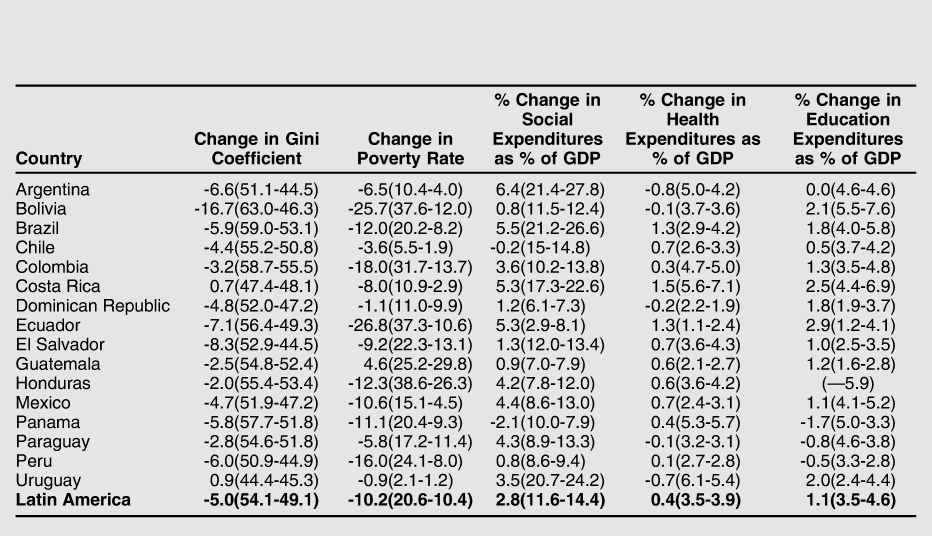
It is not much of an exaggeration to say that the 2000s was one of the best decades in history for the poor in Latin America. Inequality declined in almost every Latin American country. Although Latin America remains the most unequal region in the world, the Gini coefficient fell by five points at a time when it rose in much of the world. Moreover, reductions in inequality came in part from improvements at the bottom of the income distribution. In the 2000s, the proportion of extremely poor people in Latin America—defined as those living on less than $2 per day—dropped by half (from 20.6 to 10.4%).
Much of the reduction in inequality in Latin America occurred due to the expansion in government social policy. Footnote 1 From roughly 1990 to 2010, social spending rose by an average of 6.6% of GDP and came to account for nearly two-thirds of all public expenditures. Footnote 2 Almost every government in the region now runs some form of means-tested income transfer program, such as conditional cash transfers and non-contributory pensions, amounting to a “quiet transformation” of social policy. Footnote 3
It is possible to interpret the large reduction in inequality and poverty as the result of democratization and resulting political competition for the votes of those previously excluded from Latin America’s welfare states. Classic arguments that more unequal societies generate greater electoral pressure for redistribution finally seem to have come to fruition. Several recent works stress that Latin American politicians realized the payoff to aid poor majorities when faced with competitive elections. Footnote 4 Deindustrialization also increased the numeric importance of workers who risk falling into the informal sector, strengthening electoral incentives to appeal to them through social policy. Footnote 5 If political competition over the votes of precarious workers is the driving force behind social-policy investments, then there is reason to expect a continued expansion of Latin American welfare states, especially as economic growth tied to a commodity boom slows and more citizens need social protection.
Other studies link welfare state expansions to partisan ideology. Footnote 6 In the 1990s, Latin American governments introduced market-oriented reforms and cut or privatized social programs. Partly in response, a wave of electoral victories for leftist candidates, dubbed a “left turn” or “pink tide,” then changed the partisan landscape in the 2000s. The defining feature of leftist government was seen as a programmatic commitment to reduce inequality. Footnote 7 With the election of the Right in Argentina, Paraguay, and Peru, as well as the presidential impeachment of a leftist president in Brazil, the 2010s may bring a swing to the Right. According to partisan accounts, as Left governments fall so too should their social-policy achievements.
However, political competition and partisan swings leave much unexplained. Countries governed by both the political Left and Right reduced inequality, expanded social spending, and introduced targeted poverty-relief programs in the 2000s. Footnote 8 Some areas of social policy also changed far less than others. More than half of the increase in social expenditures from 1990 to 2010 (3.5% of GDP) came through monetary transfers, one of the easiest ways to increase social spending. Footnote 9 Spending on public services, such as health care, rose in some countries and the region at large, but fell in others (refer to table 1). Footnote 10 Other social policies remained largely untouched, including the contributory social-insurance system that absorbs substantial budgets and still excludes the majority of workers. Footnote 11
A golden decade for the poor: Change in inequality, poverty, and social spending in Latin America, 2000–2010

Note: The online Appendix provides additional notes on tables and figures.
Sources: World Bank, World Development Indicators, and Economic Commission for Latin America and the Caribbean (CEPAL) (social expenditures).
Our view is that the uneven social-policy progress requires greater attention to how political coalitions vary by reform types. We divide reforms into “easy” (or “exuberant”) and “hard” (or “deep”) redistribution, which have occurred in distinct stages in Latin America. First, in the easy stage, governments move from offering nothing to something to those previously excluded from welfare regimes. Because many Latin American welfare states developed out of truncated regimes in which a small group of insiders received substantial benefits linked to formal employment, governments in the easy stage focused on how to expand benefits to majorities in the informal and rural sectors. Reformers opted to create new social policies on top of the old, such as cash transfers and non-contributory programs. This process of institutional layering, rather than replacement, resulted in wide but not deep benefits, and wide but not deep welfare coalitions. These broad-based benefits logically proved quite responsive to the competitive conditions of electoral democracy. And they faced less political resistance than many observers expected because they left existing contributory systems intact and required few fiscal tradeoffs.
Second, we identify a hard phase of welfare-state construction. Governments that aim to reduce inequality further cannot rely on expanding easy-phase policies due to labor market effects and coalition strains. Further inequality reduction will require governments to introduce or extend new policies (such as unemployment insurance, family assistance, and housing) and improve the quality of existing public services. Reforms in this stage face more difficult coalition-building challenges. While we reinforce work on the obstacles posed by insider-outsider cleavages, Footnote 12 we stress that the difficulties come as much from a lack of support for these policies, as from active opposition. In particular, a coalition hollowing can occur in two different ways: from the bottom, through the exit of lower-income groups who have a weak interest in expanding the contributory system due to their past reliance on informal substitutes, or from the top, through the exit of burgeoning middle-class groups who seek private insurance and services due to the low-quality of the public system.
Our primary goal is conceptual. We lay out types of “easy” and “hard” welfare policies that transcend more standard distributive and redistributive policy divisions. In the case of Latin America, we associate these policies with different stages of welfare-state development and different political coalitions that distinguish Latin America’s trajectory from experiences elsewhere, especially in Europe. Our terms of easy and hard redistribution draw on similar connotations in Albert Hirschman’s classic analysis of the easy versus hard stage of import-substituting industrialization (ISI) in order to emphasize the sequencing and the shifts in political coalitions necessary for reform.
Our second goal is explanatory. We posit that coalitional obstacles better explain welfare reforms across policy areas, as compared to electoral competition, deindustrialization, or partisan ideology alone. The success of welfare efforts depends on the types of political coalitions that can be forged, which are a long-term product of Latin America’s labor market structure, social policy-legacies, and the state capacity required in a given policy area. A coalitional focus underscores that the causes of welfare expansion vary by stage: while electoral competition over poor voters catalyzed broad coalitions and easy-stage reforms, it is insufficient to forge deeper coalitions and hard-stage reforms. We illustrate the coalitional challenges of hard redistribution through original case illustrations of policy reform dynamics around unemployment insurance in Chile (a classic case of insider-outsider cleavages) and housing policy in Colombia (a less studied case of coalition hollowing).
We define coalitions as variable cross-class or cross-sector alliances that form around interests in specific policies. In this sense, we diverge from coalitional analysis that focuses primarily on the behavior of a united working class (i.e., power resource theory) or that looks for stable electoral alliances. Footnote 13 Our focus derives in part from evidence that actors participate in different ways across social-policy arenas. More fundamentally, it recognizes continued divisions within the working class. Informal sectors were relatively small among earlier industrializers, Footnote 14 whereas late industrializers face the novel challenge of building welfare states in contexts in which most workers have no stable, direct employment relationship or encompassing associations. Empirically, we observe political coalitions by considering the interests of different actors and their actual behaviors, rather than relying on public opinion surveys. Footnote 15
The article proceeds in five parts. First we elaborate the core concepts of easy and hard redistribution and the analogy to the stages of ISI. We then review the major policies and the congenial coalition dynamics of the easy phase of redistribution in the 2000s. Third, we analyze the exhaustion of the easy phase, especially the limits to further increasing non-contributory benefits. Fourth, we turn to the challenges of the harder or deepening phase of redistribution and analyze in greater depth how problems in coalition formation have prevented policy deepening in two areas—unemployment insurance in Chile and housing policy in Colombia—as well as health and education more generally. Although the cases emphasize the obstacles to welfare state development, there are reasons for optimism and political possibilities for deepening redistribution. Finally, we discuss how partisan commitments or the transformation of popular interests may yet spur governments to tackle harder stage reforms.
Easy and Hard Redistribution
Theodore Lowi famously attempted to distinguish between classes of policies based on their impact on society and the politics they produced. Footnote 16 On the one hand, distributive policies are inexpensive and “can be disaggregated and dispensed unit by small unit, each unit more or less in isolation from other units and from any general principle.” These policies are ripe arenas for clientelism (at the individual level) and pork (at the community level). Footnote 17 On the other hand, redistributive policies impact social classes. Losers and winners confront each other due to the high policy costs. What makes policies redistributive is not just their incidence, but also their reliance on broad ideological principles to dispense resources.
Like Lowi, we emphasize that different policy arenas produce their own type of politics. However, the classic distinction between distributive and redistributive policy lumps together the fiscal cost (low/high) with the logic of distribution (discretionary/rule-bound). We decouple these dimensions into different types of redistributive policies, easy and hard redistribution. Both easy and hard subtypes constitute redistribution because they involve the distribution of benefits to (or extraction of resources from) broad social classes based on rule-bound principles. They differ in the extent to which they actually take from the rich or give to the poor, as well as the institutional requirements.
Easy redistribution is cheap in fiscal and institutional terms. These social policies consume relatively small fractions of the budget, and do not threaten resource streams reserved for other programs or existing beneficiaries. Easy redistributive policies must be inexpensive enough to be offered to a beneficiary class as a whole, making them seem like distributive policies, but they apply to a broad class, which breaks with a definitional element of distributive policy. They require modest state capacity to reach a large number of beneficiaries in a nondiscretionary manner. Due to the low costs, easy redistribution tends to produce broad political coalitions that straddle ideological cleavages. The iconic examples, which we will discuss, are cash-based transfer programs to the poor and the elderly.
Hard redistribution involves more expensive and institutionally intensive policies. These arenas include “big-ticket” items such as housing, unemployment insurance, and pensions, as well as high-quality public services in health care and education. Given the expense, a rule-based allocation requires either the selection of some beneficiaries from an eligible pool, the removal of benefits from previous beneficiaries, or major fiscal investments to extend benefits more broadly. Hard redistribution also places greater demands on the state to administer benefits. Rather than extend an existing program to new beneficiaries, hard redistributive policies improve program quality and require reforms to the bureaucracy. Due to the fiscal and institutional requirements, the political coalitions that push hard redistributive policies tend to be deep and narrow, meaning that some groups are heavily invested in or resistant to the policy.
Our terms of easy and hard redistribution echo Hirschman’s classic analysis of the easy versus hard stage of import-substituting industrialization (ISI). Footnote 18 To recap, Hirschman thought of ISI in Latin America as a sequential process that began with the manufacture of finished consumer goods and moved on subsequently through “backward linkages” to intermediate and capital goods. Footnote 19 This deepening industrialization required economic transformation but equally important coalitional breaks with the broad support bases developed in the early stages of industrialization. In particular, industrialists producing finished goods, who flourished in the easy phase, then became the main source of political resistance to efforts to deepen. Guillermo O’Donnell similarly highlighted the shifts in coalitions required to deepen ISI, and linked the needed labor repression and technocratic oversight to the breakdown of democracy in the region. Footnote 20
We parallel these classics in Latin American political economy because similar challenges in sequencing and shifts in support coalitions arise with welfare state construction (without any of the theorized regime effects). Since third-wave transitions to democracy, easy and hard redistribution have progressed in rough sequential fashion in Latin America. In broad strokes, we see easy redistribution as a powerful strategy to win competitive elections. Many democratic governments thus invest in an easy stage of redistribution before turning to more costly and institutionally challenging forms of hard redistribution. Like Hirschman, we see that these early stages occurred without the fundamental social and institutional changes that will be required for later stages ahead.
Nevertheless, there is no reason that certain social policies must precede others. Just as easy and hard ISI came in sequence in Latin America but not in earlier industrializers, so too easy and hard redistribution are sequenced in Latin American democracies in ways that they were not elsewhere. And, just as with ISI in the twentieth century, heterogeneity in welfare regimes across Latin America is wide. Some countries with incipient easy-stage reforms (as in Peru and Guatemala) can still expand those programs, and postpone deepening. Other countries with more developed welfare states have already tackled some harder phase reforms (e.g., housing in Chile and unemployment insurance in Uruguay). And some countries in the 2000s failed at harder stage reforms, as our case studies show.
We now turn to how the dictates of political competition sparked an easy stage of redistribution and attracted wide coalitions, before explaining why the hard stage is less likely to follow from electoral competition alone and requires forging deeper political coalitions.
The Easy Stage of Redistribution
Latin America enjoyed an easy stage of redistribution in the 1990s and 2000s because most governments previously had not constructed social safety nets for the poor majority. Much of the welfare-state apparatus in Latin America dates back to the period of labor incorporation in the mid-twentieth century and to the ISI development model. Excellent previous studies have shown how ISI gave rise to what have been called truncated welfare states in which social insurance benefits were provided to a narrow group of salaried workers, often referred to as “insiders.” Footnote 21 Although the system of tying welfare benefits to labor market contracts resembles the conservative Bismarckian welfare regimes of Europe, it had very different effects in the context of a much smaller industrial working class and larger informal sector. Footnote 22 Welfare systems linked to formal labor contract status thus left the majority of workers, or “outsiders,” without social insurance or basic welfare benefits and thus had little or no redistributive effect on most of the poor. In the twentieth century, these truncated welfare states depended on a narrow political coalition between the middle and industrial working classes. Democratization in the late-twentieth century did not automatically lead to benefits for outsiders, and many scholars predicted that welfare regimes would be resistant to change due to the organizational advantages and resistance of insiders. Potential beneficiaries in the informal sector also were locked into clientelistic relations with political patrons, and were unable to organize collectively due to their heterogeneous, fragmented work conditions. Footnote 23 Many secured basic benefits like housing and public services through informal channels, such as forbearance toward legal violations. Footnote 24 Yet with the advantage of hindsight, social-policy reforms in the 2000s confronted fewer coalitional challenges than anticipated. We argue that this success depended on the types of policies pursued, which we label easy forms of redistribution. Governments enjoyed an exuberant phase that involved layered reforms and shallow policies, which posed little threat to insider beneficiaries.
Tax and Transfer Policies in the Easy Stage
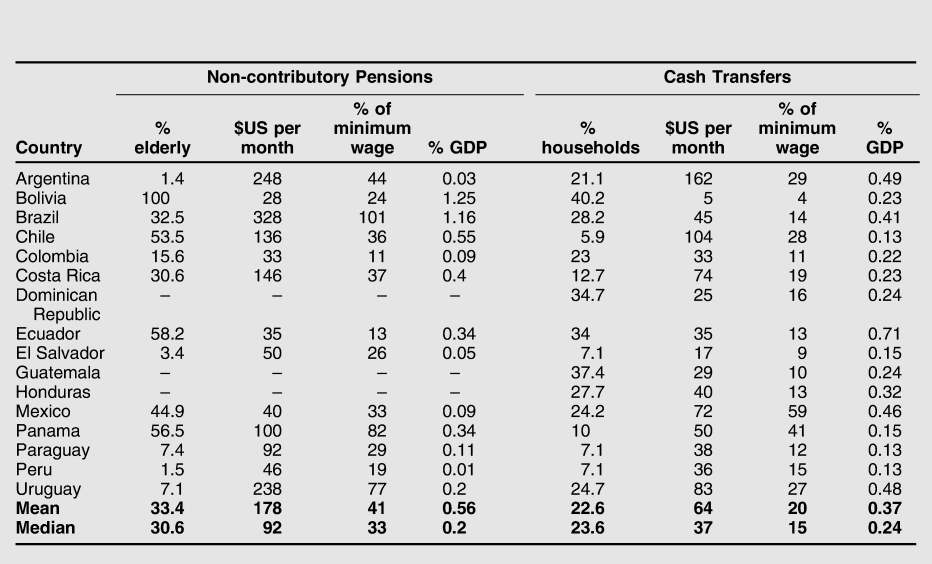
Transfer policies in the easy stage are characterized by wide coverage and low costs. Table 2 provides descriptive statistics on conditional cash transfers (CCTs) and non-contributory pensions (NCPs) that make these two features clear. In terms of breadth, new or expanded means-tested pensions reached huge numbers of previously excluded citizens. Cash transfers went to 29 million families, nearly a quarter of all families in Latin America. Non-contributory pensions reached 13 million seniors or on average one-third of the elderly. While NCPs spread throughout the developing world, as the OECD puts it, “nowhere has [the expansion] been more dramatic than in Latin America.” Footnote 25 In terms of depth, these transfers were relatively small and inexpensive. The average cash transfer was $64 (or on average 20% of the minimum wage) with a total cost of one-third of a percent of GDP, while the average pension was $178 (or on average 41% of the minimum wage) with a total cost of half a percent of GDP. Footnote 26 In contrast, public spending on traditional contributory pensions averaged 3.1% of GDP in the region (or more than five times the cost of NCPs) and exceeded 6% of GDP in Argentina and Brazil. Footnote 27
Advances in non-contributory social policy in Latin America, 2011

Sources: Levy and Schady Reference Levy and Schady2013, 201, and International Labour Organization (ILO) (for % minimum wage).
In addition to widely studied CCTs and NCPs, many Latin American governments expanded social expenditures on health and education (as shown earlier in table 1) that far outstripped the costs of new, cheaper transfer programs. Education was already in principle universal, and health care became so in many countries as governments delinked health care from contributory programs in the formal sector. Healthcare, in particular, has been found to have the biggest in-kind effect on reducing inequality in the region, surpassing tax and transfer programs. Footnote 28 These public goods also became increasingly important because CCTs linked household benefits to keeping children in school and receiving basic health care.
On the revenue side, easy-stage reforms relied on increases in indirect taxes (consumption taxes and some export and payroll taxes). Across the region, total taxes increased from an average of 12.8 to 18.4% of GDP from 1990 to 2008, and the commodities boom of the 2000s further boosted revenues. Yet little of this increase came through progressive income taxes. Income tax collection remains well below “expected” levels for Latin America’s GDP per capita, accounting for just 1.4% of GDP compared to 8.4% in developed countries. Footnote 29
In sum, the easy phase consisted of transfer payments, increases in the coverage of basic public services, and consumption taxes. New non-contributory policies were layered on top of existing contributory systems and funded without major hikes in direct (and therefore more visible and redistributive) tax rates. We now turn to the possible explanations for easy redistributive reforms.
Characteristics of Political Coalitions in the Easy Stage
It may seem as though easy-stage reforms resulted from popular mobilization or the rise of Left parties to power. They did not. Initially, most CCTs and NCPs were extended top-down rather than in response to bottom-up pressures. Take the case of CCTs. They began on a small scale in Brazil and Mexico in the 1990s, under center-right and one-party rule, respectively, and then diffused and expanded rapidly across the region. CCTs appealed to politicians across the political aisle because they target resources to “deserving” poor children, condition benefits on behavior, build human capital, and cost little, as favored by the Right, but they also are instruments of social inclusion, as favored by the Left. Footnote 30 Indeed, CCT adoption is not correlated with ideology. Parties that faced competitive threats or divided governments adopted CCTs sooner, but the policies diffused across the region. Footnote 31
Easy-stage reforms attracted a broad coalition because of their wide coverage and low costs. In many countries, parties across the political spectrum voted in favor of easy redistributive reforms in the legislature. Some studies suggest that NCPs and CCTs have resulted in political rewards in the short run for the politicians who introduced and expanded them, but others find no incumbent advantages. Footnote 32 Public opinion polls show strong policy support. While the support of the poor who receive non-contributory benefits is expected, the support of non-beneficiaries is less so. The wealthy, professional middle class and labor market insiders (i.e., workers with stable jobs in the formal sector) paid most taxes and received few benefits from easy-stage reforms. These groups were expected to mount resistance to the inclusion of outsiders, who by definition do not pay high payroll taxes. Yet there is little evidence that this opposition materialized in policy debates or in public opinion polls. Footnote 33
The limited resistance among the better off in part reflects features of easy redistributive policies. In particular, the low costs of social-policy programs meant that they largely have preserved, and sometimes even expanded, contributory benefits. Reformers grafted low-cost social-policy extensions on top of the existing system. They therefore did not threaten the interests of labor market insiders or wealthy constituents, while reaping greater support from individuals previously excluded from the welfare state. Outsiders were a latent constituency, ripe for benefit inclusion under conditions of heightened political competition. Programs also were introduced during the commodity boom so no new direct taxes were required of insiders to fund benefits. Additionally, elements of program design—particularly the conditionality involved in CCTs and reduced political discretion over beneficiary selection—may have boosted support. For instance, support for transfers to the poor is 16 percentage points higher among wealthy Brazilians when they are given information about the requirements to keep children in school and visit a doctor. Footnote 34
To be clear, these programs did generate controversy and uncertainty. Their targeting to the poor, broad coverage, and attempts to remove discretion squarely put easy-stage policies in the realm of redistributive policies. Reforms to include outsiders did not develop as part of Latin America’s first stage of welfare construction in the twentieth century or even immediately following democratization, and some countries like Peru and Guatemala have been slow to advance and sustain them. Candelaria Garay shows that these policies still represented major changes, and that intense political competition for the votes of outsiders was necessary to prompt politicians to extend policy. Footnote 35 The easy stage required a move to rule-based selection criteria. Politicians empowered bureaucrats and sacrificed discretion over the selection of beneficiaries in adopting means-tested programs to varying degrees across the region. Footnote 36 This transition also required institutional changes: governments needed new information about beneficiaries and improved national coordination. Footnote 37 But the distribution of cash benefits requires less state presence and capacity than in-kind benefits. More individuals also pursued the necessary documents like birth certificates to access welfare programs, as governments extended program coverage. Footnote 38
Our emphasis on the content of policies and the resulting coalitions in the easy stage differs from alternative accounts. Matthew Carnes and Isabela Mares, for instance, emphasize the role of deindustrialization in expanding the number of precarious workers in favor of non-contributory benefits. Footnote 39 From this perspective, deindustrialization reduced formal-sector employment and gave remaining insiders cause to worry about the security of their jobs, which brought their interests closer to those of precarious outsiders. But there are theoretical and empirical reasons to doubt this explanation.
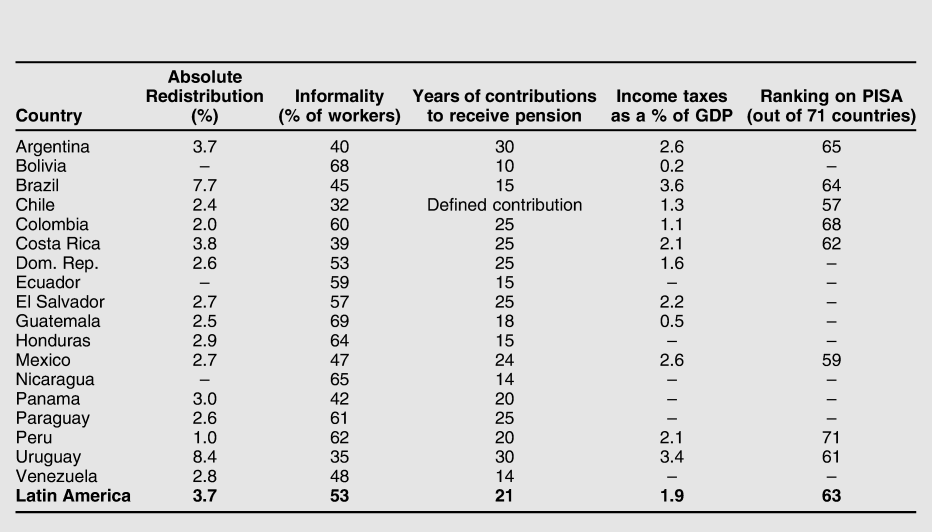
On theoretical grounds, it is unclear why the addition of more precarious workers “tipped” the balance only in the 2000s to favor non-contributory programs. Labor market outsiders in need of social protection already constituted a numeric majority prior to deindustrialization. Moreover, the non-contributory system remains so bottom-targeted (and began through coverage of rural areas) in many countries that it is unlikely to be considered a significant source of protection for most formal workers concerned about job loss. Looking back at table 2, the median NCP was one-third of the minimum wage and the median CCT just 15% of the minimum wage. Footnote 40 Especially in the pension system, much of Latin America’s expanding lower-middle class may find itself in a type of “donut hole,” to use an analogy from the American health system. The contributions required to receive pension benefits from the contributory system are substantial (requiring an average of 21 years of contributions, as shown below in table 3), while in many countries, non-contributory pensions only kick in for those with very limited income and assets. Footnote 41 The lower-middle class thus can get stuck between the two systems, giving them little reason to support extensions to NCPs.
Challenges to achieving more redistribution

Sources: Solt Reference Solt2014 (absolute redistribution), SEDLAC (informality), Mahon, Bergman, and Arnson (2015, 8) (income taxes), and OECD 2014 (pensions) and OECD (PISA scores).
The empirical evidence also is too limited to support a convergence of preferences caused by deindustrialization. Aggregate measures of deindustrialization do not capture changes in the composition of informal and formal employment. Some countries, such as Brazil, created millions of formal jobs in services at the same time that industrial employment declined. Footnote 42 Studies of public opinion also divide on whether insiders and outsiders have different preferences. Footnote 43 Turning to actual behaviors, labor market segmentation remains visible in other policy areas, such as in debates over labor codes, pension benefits, and unemployment insurance. Footnote 44
In sum, favorable global tailwinds in the international economy in the 2000s, coupled with gradually increasing indirect taxes, allowed governments of all stripes to expand non-contributory transfers and basic social services without direct or visible costs to previous beneficiaries. Political competition for the votes of outsiders played a central role in the extension of easy redistributive policies. In coalitional terms, opposition was slight, and—once transfers and coverage expansions began—electoral support ensured their continuation.
The Potential Exhaustion of the Easy Stage
“Then, suddenly the honeymoon was over, and the recriminations began,” wrote Hirschman about the end of the easy stage of ISI. Footnote 45 In much the same way, a small but growing chorus has started to criticize the welfare system constructed in the easy phase and to warn of perils ahead. At the most general level, the sense is that Latin America is apt to get “stuck” after its early successes in reducing inequality. A World Bank study captures a common view that “many of the easy gains have already been achieved, particularly in terms of coverage of eligible populations in the largest countries in the region.” Footnote 46 Indeed, the pace of inequality reduction has slowed since 2010. The slowdown coincides with the end of the commodity boom, but the resulting stall in economic growth is not the main cause of the exhaustion of the easy stage. The problems go deeper.
These problems can first be categorized as challenges inherent to labor markets, and second, related to the fragmentation of political coalitions. A core element of the exhaustion argument is that further increasing non-contributory benefits will encourage workers to remain in, or move to, the informal sector. Santiago Levy, in particular, argues that non-contributory programs subsidize informal workers and firms. Formal-sector workers pay for their contributory benefits indirectly through lower wages or directly through payroll contributions. Thus, if non-contributory benefits become more generous, more workers will choose informal employment (and the coverage of universal and non-contributory programs) to the costly contributions and low expected benefits from formal employment. Footnote 47 This substitution logic stems from the view that informality can be a rational economic choice of higher wages over benefits, and not simply the result of labor market exclusion. In addition, it recognizes that most workers are not deciding between protected, stable formal sector jobs and informal employment. Rather, there are many “bad” jobs in the formal sector without labor stability, which become less attractive as welfare coverage is decoupled from labor status. Footnote 48
Empirical evidence for these claims is preliminary, but so far most studies confirm that non-contributory programs increased informal employment. Levy and Schady review a range of studies that show increases in informality in Colombia, Mexico, and especially Argentina. Footnote 49 Most of the dozen studies of the impact of non-contributory health care in Mexico find a decrease in formal employment, although the effects are small (ranging from 0.4 to 0.7 percentage points). However, non-contributory benefits are still meager in most countries. The concern is that further expansions in the coverage or level of benefits could have larger effects on labor markets. One worrisome finding is that the effects on informality have been greater in countries where non-contributory benefits are more generous, such as Uruguay and Argentina. In Uruguay, the CCT program adopted in 2008 is associated with an 11% decrease in formal employment. Footnote 50
Even if the effects on labor markets are not always large, subjective perceptions of the problem can strain coalitions as programs are expanded. Much like the unresolved debate over the employment effects of raising the minimum wage in advanced economies, concerns about the labor market effects of non-contributory benefits can dampen support among politicians and voters. Benefits targeted to those who do not pay labor taxes can strengthen the popular perception that the poor are lazy or dependent. In a 2011 survey by Holland in Bogotá, Colombia, for instance, 72% of respondents agreed with the statement that targeted social assistance programs “teach the poor to live off the hand of the state,” and in a 2014 LAPOP survey, 56% of Argentine respondents agreed that social assistance recipients are lazy. Footnote 51
A further strain on political coalitions comes from the low quality of public services. For programs that put conditions (such as health clinic visits or schooling) on benefit receipt, the hope was to produce greater inter-generational mobility. Yet given the low quality of schooling and minimal health care entailed, it is unclear that existing programs will achieve their goals of moving poor children into better-paying jobs. Most countries have achieved substantial improvements in public coverage. But, as we return to later, quality problems encourage those with resources to exit the public system and thus weaken political coalitions in favor of continued improvements in public services.
Table 3 provides some descriptive statistics that illustrate the challenges of continuing to redistribute resources through easy-stage policies alone. First, even after the easy phase, welfare states in Latin America do not redistribute much. On average, taxes and transfers reduce the Gini coefficient by 18 points in Europe and North America, but by only 3 points in Latin America. Footnote 52 The second column shows the continued importance of the informal sector to Latin American labor markets. Although informality fell during the boom years in some countries, overall levels remain stubbornly high, and have inched up as growth has stalled in the 2010s. The third column hints at the possible “donut hole” in which pension contributions are substantial, yet non-contributory benefits only kick in for those at the bottom. The fourth column shows the low levels of income tax collection. The final column reveals the low quality of schooling as indicated by the clustering of Latin American countries at the bottom of international rankings for the PISA test.
This section has emphasized the policy and labor market challenges that may make it difficult for Latin American governments to continue to reduce inequality through existing tools. Of course, countries differ in how far they have gone with easy-stage reforms. Some countries, such as Brazil and Uruguay, have come closer to exhaustion due to the greater coverage and generosity of transfer benefits. We now turn to the obstacles for governments that want to, or have attempted to, move to harder redistributive policies.
Challenges to Deepening Redistribution
Deepening redistribution is not inevitable, or driven by a market logic as in the case of ISI. However, the likelihood that governments will have incentives to try to move to the hard stage is increased by the success and political incorporation created by the easy stage of redistribution and by partisan commitments. For reformers who want to continue pushing inequality down for strategic or ideological reasons, more of the same policies of the 2000s will not suffice. This argument rests on both an analysis of structural obstacles to expanding current forms of redistribution in Latin America, as discussed earlier, but also on an examination of how richer, more equal countries manage to redistribute much more through tax and transfer policies. There is no single type of social policy that would push inequality down to the levels in advanced democracies. Most advanced welfare states simply provide a larger array of benefits, such as unemployment insurance, disability programs, housing support, child and family benefits, parental leave, and larger cash transfers. Footnote 53 They also provide higher-quality public services, which can be some of the most effective tools to compress wage inequality in the long run.
Our argument is that hard redistribution has been limited for familiar and unfamiliar coalitional reasons. Conventional wisdom is that redistributive policy creates conflict because winners and losers of policy extensions disagree and mobilize around its provision. Indeed, Latin America’s segmented labor markets create tensions in which protected and unprotected workers have opposing interests; other areas like tax reform divide income groups. These insider-outsider coalition cleavages continue to present problems for policy deepening and attempts to reform contributory systems, even in deindustrialized Latin American economies. In contrast, our more novel argument is that the challenges to deepening welfare states often are less that social groups disagree, but rather that no one—from the bottom or top of the income distribution—seems to offer clear support for the policies in the first place. We call this coalition hollowing.
Coalition hollowing can occur through two different paths, from below and above. One variant occurs as potential lower-income beneficiaries offer weak support for policy extensions. The poor often act politically and economically to maintain their outsider status due to the uncertainty of benefits from the state system. Legacies of how labor markets and welfare states developed, and especially the heavy reliance on informal work and welfare substitutes, have weakened the poor’s interests in some types of redistributive social policy. A second variant involves those closer to the middle and top of the income distribution opting out of the state system. These groups can exit from state public services, diluting the coalition in favor of increased spending and institutional changes to improve quality.
To illustrate these challenges of deepening, we explore two policy areas that often are associated with advanced welfare states, yet are largely absent from Latin American welfare states: unemployment insurance (UI) and housing policy. We provide original evidence of coalition challenges from two cases of reform attempts in Chile and Colombia. Attempts to deepen redistribution, though rare, allow us to trace out the revealed coalitional dynamics and policy legacies. A focus on Chile’s debates about UI illustrates how Latin America’s labor market structure—the insider-outside cleavage—continues to hinder reforms to improve social protection, with the additional twist that outsiders often have not proved strong advocates of UI extension. Colombia’s housing policy, in contrast, illustrates unique path dependencies in how Latin American welfare states developed, especially the exit of core potential beneficiaries—or coalition hollowing. Electoral competition poorly explains these reform trajectories. We conclude with a brief glance at the challenges of improving the quality of education and health care, as a way to emphasize that coalition hollowing also occurs through middle-class exit.
In these and other areas, the pursuit of social-policy reforms requires different political coalitions, narrower in scope but deeper in their investments. Building coalitions requires both the defense of a new system against existing beneficiaries organized to protect the old, and the aggregation of new interests in contexts where actors often have changed their demands and organize in response to the state’s deficiencies. These challenges are compounded by the need to expand or improve welfare bureaucracies to implement hard redistributive policies. For these reasons, hard redistribution is more likely to result from sustained work by parties, courts, and social organizations to forge coalitions, rather than a simple electoral calculus.
Insider-Outsider Cleavages: Continued Coalitional Divisions in the Labor Market
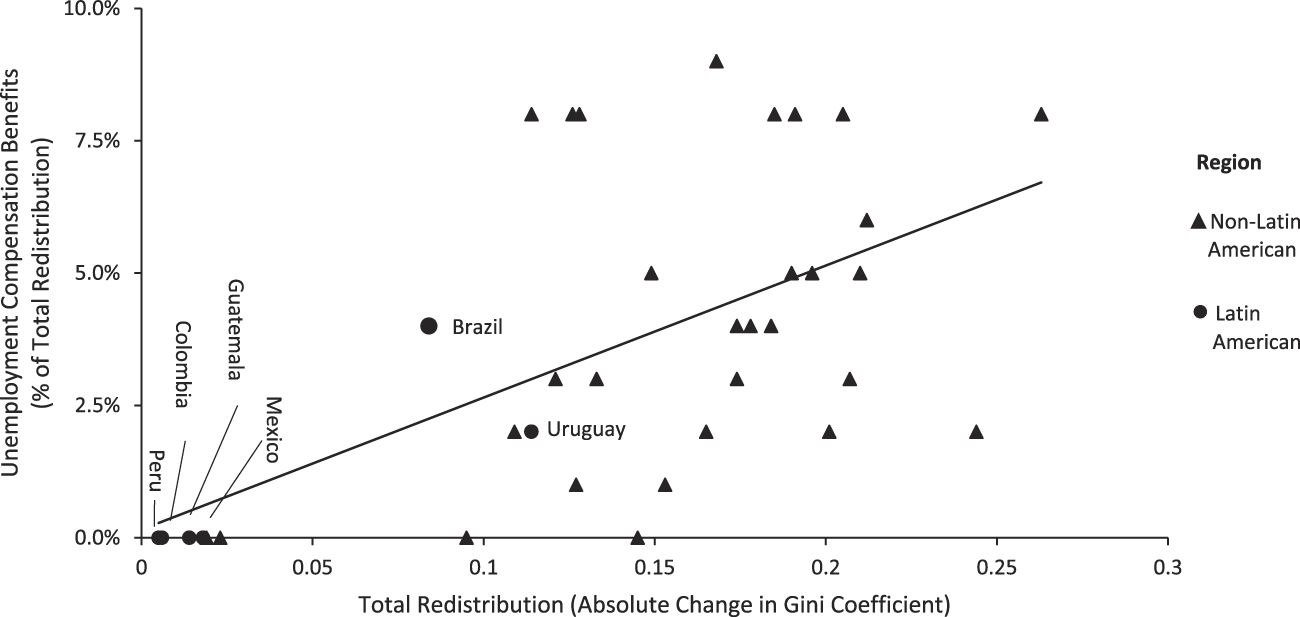
Unemployment benefits are an important aspect of redistribution in most advanced economies, so much so that they have been at the center of most models of redistributive (as opposed to social insurance) spending. Footnote 54 They clearly lag behind in Latin America. Figure 1 shows that governments in advanced economies doing more to reduce inequality also achieve substantial redistribution through UI policies. In the upper-right quadrant, mostly countries of northern Europe, UI accounts for 4–8% of the total reduction in inequality through taxes and transfers. In Latin America, Brazil is the only country that manages a similar level of redistribution through UI (4%), but it does much less redistribution overall. The other Latin American countries cluster in the lower-left quadrant with limited UI and low overall levels of redistribution. Outside Brazil, UI coverage is low: 92% of unemployed workers in Latin America do not receive unemployment benefits, compared to 49% in advanced economies. Footnote 55
The role of unemployment compensation benefits in redistribution in Latin America and the OECD
Source: Data from Wang and Camada 2011, pp. 25-26, from the Luxembourg Income Study (LIS).
Notes: The horizontal axis of overall redistribution is the absolute reduction in the Gini coefficient through government taxes and transfers. The vertical axis shows the percent of total redistribution due to unemployment compensation benefits. LIS data include OECD countries, some from Eastern Europe, and six countries from Latin America (though data are not available for Chile) from around 2004.

Public UI in Europe developed after other social policies and generally involved coalitions including bureaucratic representatives and employers. Footnote 56 In Latin America, both groups have reason to oppose it. First, champions are hard to come by in the bureaucracy due to the practical obstacles to determining who is really unemployed in countries with large informal sectors. Brazil’s pioneering experience with UI should give other governments pause: more than half of UI beneficiaries in Brazil were found to be working, mostly informally, while receiving unemployment benefits, and the UI accelerated an already high level of worker turnover. Footnote 57 Second, in principle business would benefit from substituting UI for the current system of severance pay, which creates numerous rigidities and costs for business. But many businesses offer weak support due to the transition costs (especially if workers covered by severance pay are unwilling to give up their benefits), the informal flexibility allowed by weakly enforced systems of severance pay, and the barriers to worker exit (for firms that invest in training skilled workers). Footnote 58
In Latin America, UI also divides workers. Formal sector workers with stable jobs have an effective substitute for UI in the form of severance pay, and have fought to safeguard these benefits. Footnote 59 In principle, some insiders could benefit from the greater mobility and hiring associated with UI, but they might still worry about losing benefits in the transition between systems. Informal and precarious workers who cycle in and out of the formal sector seem like the greatest potential beneficiaries of a UI system. However, UI programs are unattractive to workers who cycle through short-term contracts because they may not meet minimum contribution periods and face recurring unemployment risks. Footnote 60 This group is large: median job tenure in Latin America is three years (versus seven or more years in most European economies). Footnote 61
An example of the coalitional challenges of enacting UI comes from Chile. After several failed attempts in earlier governments, President Ricardo Lagos (2000–2006) moved early in his term to fulfill his campaign promise to enact UI. As part of the leftist Concertación coalition, Lagos had ideological reasons to support UI. The Left also had strategic ones. An economic downturn in the wake of the Asian financial crisis created strong demand for unemployment assistance. The Left hoped to attract a fast-growing segment of the labor market that lacked stable labor contracts and severance pay protections, and instead worked in temporary or subcontracted positions. Footnote 62 The shifts in the state-run mining company Codelco underscore the potential labor coalition. In 1982, there were 187 permanent mining employees for every subcontracted worker; in 2006, there were two subcontracted workers for every permanent employee. Footnote 63 Lagos proposed replacing severance pay with public UI to provide greater protection to large numbers of precarious workers.
Forming political coalitions around UI proved challenging because labor market insiders were unwilling to overhaul the severance system. When the government presented evidence that only 5% of workers in Chile benefited from the severance-pay system and that firms fired workers to avoid making severance payments, the president of the main Chilean labor confederation (Central Unitaria de Trabajadores de Chile), Arturo Martínez, insisted that the UI scheme could not leave the minority of protected workers worse off than under the existing labor legislation. Footnote 64 Concertación legislators were allied with the union movement, and therefore refused to eliminate the severance system. The labor movement’s objections doomed the introduction of public UI.
The Left instead proposed a system of unemployment protection that added private savings accounts and social insurance through a “solidarity fund” to the existing system. In so doing, the government reduced the level of UI protection provided on the assumption that payments would be supplemented by severance pay. It also limited coverage to workers with fixed-term or indefinite contracts able to make the twelve monthly contributions necessary to be eligible to receive a single month of benefits. Footnote 65 Legislators hesitated to include workers with more precarious contracts because they could not verify whether workers in the informal sector were “truly” unemployed, and also did not want to encourage firms to rely further on flexible labor contracts and then shift the costs to the government. Outsiders had little influence over policy. With the partial exception of subcontracted copper workers, most outsiders were fragmented across worksites, lacked clear employers, and had weaker organizations, compared to labor unions. The result was a relatively small and truncated UI program, covering only one in four unemployed salaried workers. Footnote 66 As Kirsten Sehnbruch concludes, “The more precarious a job is, the less likely it will be covered by [unemployment] insurance.” Footnote 67
The Chilean case illustrates the limits of electoral competition and partisan ideological commitments to explain hard reforms. The Left proposed to merge contributory and non-contributory systems at a time in which it competed to win the support of labor-market outsiders. But unlike easy redistributive benefits that can be layered on top of existing welfare programs, protected workers, who are an organized minority generally tied to Left parties, need to sacrifice the insurance they receive through severance pay to move to a comprehensive UI system. Resistance to change in the existing system shrank the legislative and business coalition in favor of UI, and resulted in a diluted version of the contributory system for precarious workers. UI savings account systems, such as the Chilean one, leave workers with unstable labor trajectories with limited protection. Similar insider-outsider dynamics can be seen beyond UI. Most notably, insiders have used protests, lobbying, and connections to leftist parties to protect social security across the region. Footnote 68
Coalition Hollowing: Exit Due to Informal Welfare and Private Substitutes
A second type of challenge to deepening redistribution comes from the policy feedback effects from informal welfare policies. For much of the twentieth century, the poor expected and received little from Latin American welfare states. Instead, they often received basic services through forbearance toward legal violations, such as squatting, street vending, and theft of services like water and electricity, as well as clientelistic handouts. Footnote 69 The ongoing feedback effect from informal welfare was to shift the attention of the poor away from possible expansions of traditional welfare policies towards expectations of continuing forbearance and legalization policies.
The policy legacies of informal activities are most visible in the case of housing policy. Housing is the single largest item in most household budgets. Many advanced industrial economies intervene to make housing affordable through rental assistance, mortgage subsidies, and state housing provision. In Latin America, housing deficits are substantial: 37% of households, mostly among the poorest, face a housing shortage. Footnote 70 Yet with few exceptions, housing is the one area of social spending that shrank during the easy stage in the 2000s, and that remains focused on middle-income households. Footnote 71 For the urban poor, especially in fast-growing secondary cities, squatting—meaning the occupation of vacant public or private land—and informal sales—meaning the purchase of land with defective titles or zoning for housing construction—have continued to be important ways to access low-cost housing.
Reliance on informal housing markets changes the demands of low-income groups, weakening the potential coalition in favor of public housing expenditures. Once significant numbers of voters have secured housing through squatting, they come to prefer increased spending on policies to improve their informal houses. Indeed, in the 1990s and 2000s, many Latin American governments concentrated their “housing” programs on the provision of property titles, basic infrastructure and services, and construction credits to informal settlements. While many governments simultaneously attempted to run social interest housing programs to address demand from those who lacked land, these programs were small in size. The high costs of public housing programs and limited bureaucratic experience made it difficult for governments to invest at scale.
Colombia is an ideal case to analyze these dynamics because it incorporated a right to housing in its 1991 Constitution, and its ongoing civil war has displaced more than six million people to major cities. Yet despite substantial housing needs, governments have focused on improving existing informal settlements, and have struggled to build and sustain political coalitions for new housing construction. Pressure to deepen redistribution and invest in public housing came from the Constitutional Court, not societal mobilization or leftist political parties. The Court has prodded the state to take a more active role in a range of social-policy areas, including housing those displaced by civil war. Footnote 72
City governments, which share responsibility for housing programs in Colombia, have focused their efforts on “upgrading” informal settlements through the provision of basic services, infrastructure, and legal recognition. In Bogotá, for instance, a huge spike in legalization of informal settlements followed the introduction of direct elections for mayors in 1988. Whereas previous periods saw the legalization of less than a dozen settlements a year, Mayor Enrique Peñalosa (1998–2001) legalized more than three hundred. Top officials call the housing model one of “ex-post planning” in which authorities recognize squatter settlements that already have occurred and then are obligated to dedicate resources to servicing them. Footnote 73 City politicians focus on legalization in part because it is popular: 74% of lower-class (and 48% of middle and upper-class) survey respondents support the provision of property titles to illegal settlements. By comparison, only 52% of the poor support expenditures on state housing programs (and 42% of the nonpoor). Footnote 74 Peñalosa underscores the weak electoral rewards for housing provision: “No one will judge the mayor of Bogotá if he [makes housing available for the poor] or not.” Footnote 75
Several right-leaning presidents have announced ambitious initiatives to build housing for the poor. For instance, President Álvaro Uribe (2002–2010), a right-wing populist, favored massive housing construction to grow the economy, “create a country of homeowners,” and “avoid the formation of new precarious settlements.” Footnote 76 Yet housing policies followed a demand-subsidy model in which the government provided a credit that households then paired with their private savings and commercial mortgages to purchase a house. This model reduced the state’s role to enabling the market, rather than building bureaucracies with the ability to provide housing directly. But less than half of all households in Colombia have the capacity to save, and 70% of workers have no access to commercial mortgage markets due to their unstable or informal incomes. Most demand subsidies thus went unused. Footnote 77
Uribe’s center-right successor, Juan Manuel Santos (2010–2018), also recognized that the state must play an active role in housing policy to stop land invasions and to shift away from a model where the private market builds for the middle class with state subsidization. Footnote 78 To this end, Santos gave away 100,000 houses for free so that the poor could access housing alternatives. Critics considered the program a “populist” electoral ploy because households did not contribute anything to receive a house. But Santos’s then-Housing Minister retorted that providing free houses was the only way to increase access and that the previous model “forced the poor to invade land.” Footnote 79 Construction companies complained that they could not build housing for the prices paid out by the government, while recipients disliked the quality of housing projects and the lack of accompanying services. Footnote 80 The government revived an older model of housing policy that generously subsidizes middle-class purchasers for whom construction companies turn larger profits. Footnote 81 Santos completed his initial promise of 100,000 houses to the poor, but barely dented the housing demand.
In short, “hard” policy areas like housing, which require major expenditures and changes in previous spending patterns, strain political coalitions. While it is clear why the middle class may resist funding these programs, what has gone less recognized is that the poor also tend to be skeptical of the state’s ability to meet their housing needs. Many poor households that have already seized land through informal occupations prefer that the government service and recognize their existing properties. Those without land doubt that they will access the small number of units that housing programs provide. Again, partisan ideology and electoral competition cannot explain the weak development of housing policy. Right-wing parties often are most supportive of housing programs, on the hopes of creating a society of (more conservative) homeowners and of winning votes among the informal sector poor. But when faced with the difficulties of investing in new bureaucracies and a cheaper, quicker way to meet demand through property titling, conservative politicians have favored easier redistributive policies.
Outside of housing, similar dynamics of coalition hollowing are evident around public services, such as education and health care. The difference is that middle- and higher-income groups, who would be the natural constituency for improved state services, have not exerted systematic pressure for reform. Due to the low quality of public services, many richer families have exited public health and school systems. About 40% of the middle class in the region has opted for private schools. Footnote 82 Similar dynamics can be observed in health care: for example, in Brazil, total public spending tripled over the 1990s and 2000s, and coverage expanded dramatically. However, most spending on health care was still private, and the number of people covered by private insurance rose by more than 40%, from 31 million in 2000 to 44 million in 2010. Nearly one-quarter of the population had private health insurance. Footnote 83 In other words, as millions of poorer people entered the public system, millions of richer families exited.
The inter-related challenges are thus to improve quality and to draw the wealthier groups back into a coalition supporting and demanding high-quality services. Easy redistribution involved expanding coverage, while hard redistribution requires improving quality. Quality-enhancing reforms are hard, given that they require long time horizons, investments to build stronger bureaucracies, and in some cases, reforms that run afoul of powerful interest groups like teacher unions. Footnote 84 Yet outside exceptional protests, as first erupted around education in Chile in 2011 and in Brazil in 2013, the collective demand for higher quality public services has been weak. Merilee Grindle reviewed twelve major reform episodes in education in the 1990s and found little evidence of support from business, parents, or other civil society groups. Reform programs were mostly driven by small “change teams” within the bureaucracy. Footnote 85 In part, the possibilities to exit the system mean that parents, and especially the most vocal ones, have an option apart from voicing their discontent with the system.
The low quality of services can gut broader political coalitions in favor of funding increased social expenditures through a tax system financed largely (in absolute terms) by richer sectors. Upper- and middle-class families are unlikely to want to “pay twice,” once privately for their own families and then again through taxes for others. Or, as Evelyne Huber and John Stephens put it, “high levels of private spending on health and education in some countries … have made upper-income groups very resistant to tax increases to improve the public system.” Footnote 86 Indeed, across Latin America, two-thirds of Latin American respondents think that governments should do more with existing funds and are unwilling to pay more taxes to improve education. Footnote 87
In sum, hard redistributive policies are intrinsically difficult. They require greater administrative capacity than cash transfers and non-contributory programs and more resources. But our point is that they also require tricky political coalitions. Efforts to deepen redistribution in neglected policy areas such as unemployment insurance and housing, as well as to improve the quality of existing public services, confront obstacles due to the challenges of building coalitions in support of reform. These challenges include insider-outsider cleavages, but they also can be seen in the ways that social groups cannot agree on the very basics of policy design and thus cannot mobilize for policies. The hollowing out of potential coalitions at the bottom and top of the income scale strains efforts to build the sorts of broader cross-class coalitions that have supported greater redistribution in more advanced democracies and that have characterized easy redistribution.
Conclusions: A Bias for Hope?
Will expansions in the size and progressivity of Latin American welfare states continue in coming decades? Focusing on the political coalitions that have emerged around different types of welfare reforms, we provide some new insights into this important question. On the one hand, it is possible to interpret the large reduction in inequality in the 2000s (table 1) as the result of democratic competition and the growing number of workers with precarious labor contracts. A focus on electoral competition suggests that governments will continue to extend welfare policies to outsiders as long as they need their votes. On the other hand, some scholars emphasize the role of partisan political competition and worry that the pendular ideological swings in the region could bring the Right back to power in the 2010s, and push social-policy deepening off the agenda.
In contrast to both these perspectives, we have stressed the important differences across policy areas, which we divided into easy and hard redistribution. The 2000s showed that the extension of the first non-contributory benefits through CCTs and NCPs were popular and electorally beneficial. These policies are entrenched enough among recipients that few politicians, from the Left and the Right, can afford to revoke them. However, such policy extensions have left the contributory social-insurance system largely untouched, and other important social policies undeveloped. Footnote 88 Theories centered on electoral competition and labor market changes struggle to explain why the majority of workers remain excluded from far more expensive benefits, such as unemployment insurance and affordable housing. Our central point is that there are easy and hard types of redistribution, and most Latin American governments advanced primarily through the former. For governments that want to further reduce inequality, the course ahead—including reforms to the contributory system, improvements in the quality of benefits, and extensions into neglected policy areas—will be fraught due to continued cleavages among workers and hollow support among potential beneficiaries. In pointing to these differences, we echo the point of Mares and Carnes that more needs to be done to understand variation in the direction and magnitude of change across policy areas. Footnote 89
Our emphasis on the challenges of building welfare-state coalitions echoes work on welfare strains in advanced industrial economies, but departs in several ways. An expanding line of research on developed democracies emphasizes growing labor-market segmentation and the resulting dualization of welfare systems that provide different benefits to workers in each segment. Footnote 90 However, the dividing line in OECD countries is not between informal and formal sectors but rather between workers with indefinite contracts and those with “atypical” (temporary or part-time) formal contracts. The formal status of all workers has made it easier for some governments to adjust welfare policies to mitigate the polarizing effects of labor-market segmentation. Effectively bridging the formal-informal divide in Latin America is more challenging, especially given the region’s history of tying benefits to labor status. Beyond insider-outsider cleavages, informal welfare solutions and low-quality public services have reduced pressure for reform. The counterexample to coalition hollowing comes from social democratic welfare states in Europe where the inclusion of the middle class in public services has strengthened a broad coalition supporting and paying for high-quality public services. Footnote 91
While we emphasize the common trends and obstacles across Latin America, it is worth stressing that important differences exist in welfare states. Some countries governed by strong, institutionalized left parties, such as Chile, Uruguay, and Costa Rica, have begun to reform contributory systems, implement more progressive tax codes, strengthen public service provision, and embark on some harder-stage reforms. Political leadership committed to reducing inequality for ideological reasons, and parties capable of socializing citizens with these values, can forge coalitions to deepen redistribution. Footnote 92 Strong parties, however, are a minority in the region. The Left’s ties to the labor movement also can impede reforms to contributory systems, as seen in the Chilean case. A focus on coalition dynamics thus is an important complement to studies primarily focused on the ideational beliefs of elites and parties.
Finally, there are ways in which dynamics set in motion in the easy stage still could spark coalitions to expand and transform existing policies in Latin America. To invoke a more optimistic Hirschman metaphor, one of the key questions is whether politicians can leverage the “unbalanced growth” of welfare states to construct “backward linkages” to the existing contributory system and public services. Footnote 93 Labor-market cleavages forestall some of the simpler horizontal and cross-class alliances that shaped welfare states in Europe, but they may also create possibilities for political entrepreneurs, including those on the Right or under pressure from courts, to cobble together novel coalitions. Compared with an era of exclusionary welfare policies, policy extensions have created a sizable class of low-income beneficiaries who are interested in their continuation. Some research finds a national-level relationship between poverty reduction and preferences for redistribution outside the region, Footnote 94 and that Latin American countries that do more to reduce inequality have higher levels of support for redistribution. Footnote 95 Whether an initial wave of inclusion of labor-market outsiders in Latin America has transformed popular demands and political engagement remains an open question.
It is possible that newly included groups will pressure to increase the size and coverage of benefits, and to create greater parity between contributory and non-contributory systems. New users of health and education systems—and perhaps, as suggested by Garay, those users in countries with inclusive societal incorporation in policy delivery—may start to demand higher-quality services as they gain experience. Footnote 96 If services improve, groups with rising incomes, such as the new middle class, might opt to stay with public health and education, rather than turning to private providers. The easy stage, in other words, may have widened the coalition for greater redistribution and better services. As Hirschman would have warned, one should not read failure into any trouble that a reform encounters. But one also should not predict success based on the past decade. The hard stage in building Latin American welfare states is yet to come.
Supplementary Material
To view supplementary material for this article, please visit https://doi.org/10.1017/S1537592717002122