





No CrossRef data available.
Reappraisal of Shundeagrion cheni Huang, Lia, and Nel (Odonata, Cephalozygoptera, Dysagrionidae): comment on Huang et al., 2024
Published online by Cambridge University Press: 02 February 2026
Abstract
We evaluate the systematic position of Shundeagrion cheni Huang, Lia, and Nel, 2024 and transfer it to the odonate suborder Cephalozygoptera and family Dysagrionidae.
Information
- Type
- Comment
- Information
- Copyright
- © The Author(s), 2026. Published by Cambridge University Press on behalf of Paleontological Society
Footnotes
Handling Editor: Torsten Wappler
References
Archibald, S.B., and Cannings, R.A., 2021, The head of Cephalozygoptera (Odonata): Zootaxa, v. 5047, p. 97–100, https://doi.org/10.11646/zootaxa.5047.1.10CrossRefGoogle ScholarPubMed
Archibald, S.B., Cannings, R.A., Erickson, R.J., Bybee, S.M., and Mathewes, R.W., 2021, The Cephalozygoptera, a new, extinct suborder of Odonata with new taxa from the early Eocene Okanagan Highlands, western North America: Zootaxa, v. 4934, p. 1–133, https://doi.org/10.11646/zootaxa.4934.1.1CrossRefGoogle ScholarPubMed
Archibald, S.B., Ware, J.L., Rasmussen, J.S., Sylvestersen, R.L., Olsen, K., and Simonsen, T.J., 2023, The damselfly genus Furagrion Petrulevičius et al. (Odonata, Zygoptera) from the early Eocene Fur Formation of Denmark and the dysagrionoid grade: Zootaxa, v. 5278, no. 1, p. 1–29, https://doi.org/10.11646/zootaxa.5278.2.4CrossRefGoogle ScholarPubMed
Bechly, G., 1998, New fossil damselflies from Baltic amber with description of a new species, a redescription of Litheuphaea carpenter Fraser, and a discussion on the phylogeny of Epallagidae (Zygoptera, Caloptera): International Journal of Odonatology, v. 1, p. 33–63, https://doi.org/10.1080/13887890.1998.9748092CrossRefGoogle Scholar
Bota-Sierra, C., and Sánchez-Herrera, M., 2023, A new species of bannerwing damselfly, Polythore albistriata sp. nov. (Odonata: Polythoridae): International Journal of Odonatology, v. 26, p. 82–92, https://doi.org/10.48156/1388.2023.1917037CrossRefGoogle Scholar
Cockerell, T.D.A., 1908, Fossil insects from Florissant, Colorado: Bulletin of the American Museum of Natural History, v. 24, p. 59–69, 1 pl.Google Scholar
Cockerell, T.D.A., 1923, Fossil insects from the Eocene of Texas: American Journal of Science, ser. 5, v. 5, p. 397–400, https://doi.org/10.2475/ajs.s5-5.29.397CrossRefGoogle Scholar
Cockerell, T.D.A., 1927, A new fossil dragonfly from the Eocene of Colorado: The Entomologist, v. 60, p. 81, 82.Google Scholar
Fabricius, J.C., 1793, Entomologia Systematica Emendata et Aucta, Secundum Classes, Ordines, Genera, Species, Adjectis Synonymis, Locis, Observationibus, Descriptionibus, Volume 2: Copenhagen, C.G. Proft, 519 p.Google Scholar
Garrison, R.W., von Ellenrieder, N., and Louton, J.A., 2010, Damselfly genera of the New World: an illustrated and annotated key to the Zygoptera: Baltimore, Maryland, Johns Hopkins University Press, 490 p.CrossRefGoogle Scholar
Garrouste, R., and Nel, A., 2015, New Eocene damselflies and the first Cenozoic damsel-dragonfly of the isophlebiopteran lineage (Insecta: Odonata): Zootaxa, v. 4028, no. 3, p. 354–366, https://doi.org/10.11646/zootaxa.4028.3.2CrossRefGoogle ScholarPubMed
Huang, D., Lian, X., and Nel, A., 2024, A new damselfly family from the Paleocene of the Sanshui Basin, South China (Odonata, Zygoptera): Journal of Paleontology, v. 98, p. 1041–1047, https://doi.org/10.1017/jpa.2024.43CrossRefGoogle Scholar
Nel, A., and Zheng, D., 2021, The recently proposed odonatan ‘suborder’ Cephalozygoptera: fact or fiction: Palaeoentomology, v. 004, p. 165–170, https://doi.org/10.11646/palaeoentomology.4.2.5CrossRefGoogle Scholar
Nel, A., Petrulevičius, J.F., Gentilini, G., and Martínez-Delclòs, X., 2005, Phylogenetic analysis of the Cenozoic family Sieblosiidae (Insecta: Odonata), with description of new taxa from Russia, Italy and France: Geobios, v. 38, p. 219–233, https://doi.org/10.1016/j.geobios.2003.10.007Google Scholar
Petrulevičius, J.F., Nel, A., Rust, J., Bechly, G., and Kohls, D., 2007, New Paleogene Epallagidae (Insecta: Odonata) recorded in North America and Europe: biogeographic implications: Alavesia, v. 1, p. 15–25.Google Scholar
Simonsen, T.J., Archibald, S.B., Rasmussen, J.A., Sylvestersen, R.L, Olsen, K.O., and Ware, J.L., 2024, Stolleagrion foghnielseni (Odonata, Cephalozygoptera, Dysagrionidae) gen. et sp. nov.: a new odonatan from the PETM recovery phase of the earliest Ypresian Fur Formation, Denmark: Zootaxa, v. 5415, p. 493–498, https://doi.org/10.11646/zootaxa.5415.3.9CrossRefGoogle Scholar
Ware, J., Simonsen, T., Rasmussen, J., and Archibald, B., 2025, Systematics of the extinct suborder Cephalozygoptera (Odonata): a wing-based analysis comparing its genera with those of extant Zygoptera: American Museum Novitates, v. 4043, p. 1–19.Google Scholar
Zhang, J.-F., 1992, Congqingia rhora gen. nov., spec. nov.—a new dragonfly from the Upper Jurassic of eastern China (Anisozygoptera, Congquingiidae fam. nov.): Odonatologica, v. 21, p. 375–383.Google Scholar
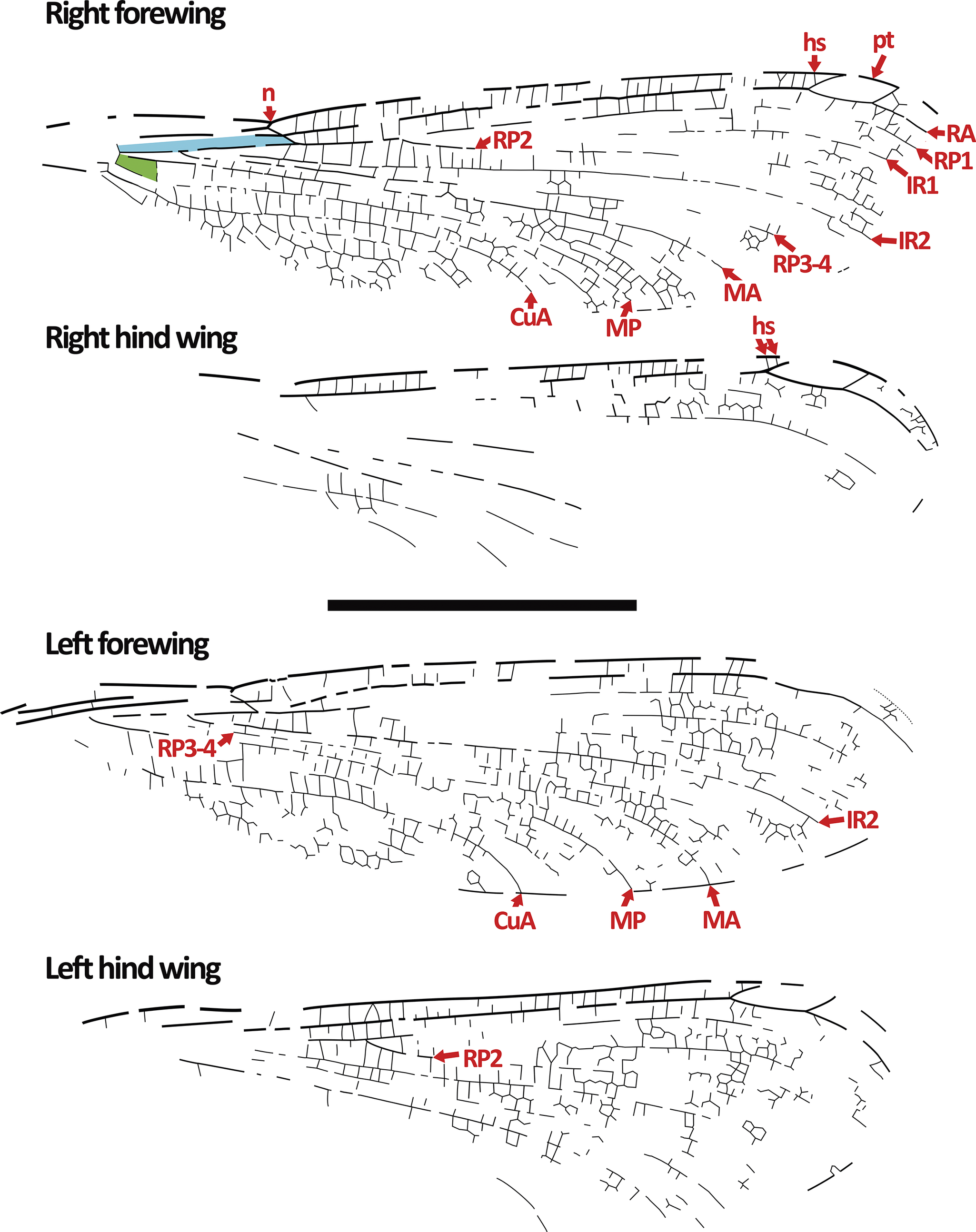
Figure 1. Wing venation of holotype of Huang, Lia, and Nel, 2024, from high-resolution photographs. The quadrangle is shown in green and the antesubnodal space in blue. CuA, anterior branch of the cubitus; hs, hyperstigmal crossveins between the pterostigma and C (costa); IR1, IR2, intercalary veins; MA, anterior branch of the media; MP, posterior branch of the media; n, nodus; pt, pterostigma; RA, anterior branch of the radius; RP1, RP2, RP3-4, branches of the posterior radius. Scale bar = 1 cm.Figure 1. Long description.
 You have
Access
Non-technical Summary
We transfer Shundeagrion cheni Huang, Lia, and Nel, Reference Huang, Lian and Nel2024 to the odonate suborder Cephalozygoptera and family Dysagrionidae.
Introduction
Huang et al. (Reference Huang, Lian and Nel2024) erected the genus and species Shundeagrion cheni Huang, Lia, and Nel, Reference Huang, Lian and Nel2024, the only member of the new family Shundeagrionidae (Zygoptera). From their direct examination of the fossil, they stated that its head shape conforms to the diagnosis of the odonate suborder Cephalozygoptera, and from examination of the original high-resolution versions of their published photographs (Archibald et al., Reference Archibald, Cannings, Erickson, Bybee and Mathewes2021, p. 27, 28), we agree: (1) head width across eyes approximately twice the length from anterior margin of antefrons to posterior of occiput (Zygoptera: usually approximately three to five times as wide); and compound eyes that are (2) more or less adpressed to head, posterolateral corners protruding posteriorly to varying degrees, more or less rounded, sometimes acutely (Zygoptera: distinctly bulging laterally from head capsule); and (3) separated by approximately one eye’s width dorsally (see Archibald et al., Reference Archibald, Cannings, Erickson, Bybee and Mathewes2021, table 1) (Zygoptera: usually more than twice an eye’s width).
However, Huang et al. (Reference Huang, Lian and Nel2024) rejected the designation of Cephalozygoptera following Nel and Zheng (Reference Nel and Zheng2021), who claimed that this head shape is an artifact. Archibald and Cannings (Reference Archibald and Cannings2021) subsequently showed that these arguments were erroneous. Simonsen et al. (Reference Simonsen, Archibald, Rasmussen, Sylvestersen, Olsen and Ware2024) later added support for the suborder using wing venation. The phylogenetic analysis of Ware et al. (Reference Ware, Simonsen, Rasmussen and Archibald2025) provided further strong support for the Cephalozygoptera. Based on the above, here, we reappraise the systematics of Shundeagrion cheni.
Materials and methods
We examined high resolution versions of the photographs used by Huang et al. (Reference Huang, Lian and Nel2024) as figures illustrating the type specimen of Shundeagrion cheni and drew its wing venation using these (Fig. 1).
Wing venation of holotype of Shundeagrion cheni Huang, Lia, and Nel, Reference Huang, Lian and Nel2024, from high-resolution photographs. The quadrangle is shown in green and the antesubnodal space in blue. CuA, anterior branch of the cubitus; hs, hyperstigmal crossveins between the pterostigma and C (costa); IR1, IR2, intercalary veins; MA, anterior branch of the media; MP, posterior branch of the media; n, nodus; pt, pterostigma; RA, anterior branch of the radius; RP1, RP2, RP3-4, branches of the posterior radius. Scale bar = 1 cm.
Figure 1. Long description
The diagram consists of four panels showing fossilized wing structures.
* Right forewing (top): At the proximal base, a green shaded quadrangle and a blue shaded antesubnodal space are visible. Moving distally along the top edge, n points to the nodus. Further right, h s indicates hyperstigmal crossveins and p t indicates the pterostigma. Red arrows along the distal and posterior margins identify R A, R P 1, I R 1, I R 2, R P 3-4, M A, M P, C u A, and R P 2.
* Right hind wing (second from top): Shows a partial wing structure with h s labeled at the top margin.
* A black horizontal scale bar representing 1 cm is positioned in the center of the figure.
* Left forewing (third from top): Labeled veins along the posterior margin include R P 3-4 near the base, followed by C u A, M P, M A, and I R 2 toward the wing tip.
* Left hind wing (bottom): Shows the wing lattice with R P 2 labeled in the upper-middle section.
Terminology of wing morphology follows Garrison et al. (Reference Garrison, von Ellenrieder and Louton2010). See Figure 1 for abbreviations used in the text. The quadrangle was called the discoidal cell by Huang et al. (Reference Huang, Lian and Nel2024). The quadrangle and antesubnodal space are illustrated in Figure 1. The subnodus is the oblique crossvein forming the distal end of the antesubnodal space.
Repository and institutional abbreviation
The type specimen is housed in the Shunde Museum, Shunde, Foshan City, Guangdong Province.
Systematic paleontology
Order Odonata Fabricius, Reference Fabricius1793
Suborder Cephalozygoptera Archibald, Cannings, and Erickson, in Archibald et al., Reference Archibald, Cannings, Erickson, Bybee and Mathewes2021
Family Dysagrionidae Cockerell, Reference Cockerell1908
Shundeagrionidae Huang, Lian, and Nel, Reference Huang, Lian and Nel2024, syn. nov.
Genus Shundeagrion Huang, Lian, and Nel, Reference Huang, Lian and Nel2024
Type species
Shundeagrion cheni Huang, Lia, and Nel, Reference Huang, Lian and Nel2024, by original designation.
Emended diagnosis
Shundeagrion differs from other genera of Dysagrionidae except those of Petrolestinae (Petrolestes Cockerell, Reference Cockerell1927 and Congqingia Zhang, Reference Zhang1992) by the origins of RP3-4 and IR2 close to midway between the arculus and subnodus; it differs from genera of Petrolestinae by crossveins in forewing CuA-A (space posterior to CuA) arranged in at least two sectors (not known in hind wings), by ~ 23 crossveins in postnodal space (C-RA space nodus to pterostigma: Petrolestes ~ 15–17, Congqingia 10–12), by very oblique subnodus (Petrolestes and Congqingia less oblique to almost vertical); further from Congqingia and Petrolestes hendersoni Cockerell, Reference Cockerell1927 by longer quadrangle (quadrangle not known in Petrolestes messelensis Garrouste and Nel, Reference Garrouste and Nel2015); further from Congqingia by pterostigma basal and distal ends with oblique angles (Congqingia vertical).
Occurrence
Paleogene Buxin Formation, Sanshui Basin, South Guangdong Province, China.
Remarks
Huang et al. (Reference Huang, Lian and Nel2024) diagnosed Shundeagrion and Shundeagrionidae by: (1) pterostigma elongate with basal edge very oblique, elongate; (2) two or three crossveins between pterostigma and C; (3) two rows of cells between C and RA distad pterostigma, and two rows between RA and RP1 below pterostigma; (4) bases of RP3-4 and IR2 positioned between arculus and subnodus, far from subnodus; (5) nodus and subnodus very oblique; (6) no lestine oblique crossvein ‘O’; (7) discoidal cell elongate but with MAb (portion of MA forming the distal side of the quadrangle) distally moderately oblique; (8) CuA with a triadic pattern; (9) cubital area very broad; and (10) postnodal crossveins very numerous.
Nothing in this list excludes the Dysagrionidae. Character state 4 is found in its subfamily Petrolestinae (but see below); and the presence of character state 8, a triadic branching pattern of CuA, appears questionable. Although this branching pattern is clear in e.g., Polythore albistriata Bota-Sierra and Sánchez-Herrera, Reference Bota-Sierra and Sánchez-Herrera2023 (Zygoptera, Polythoridae) with strong branches of CuA, the evident thickness of these veins in Shundeagrion cheni indicate that its apparent branch of CuA and intercalated supplementary vein are actually a falsely suggestive net of crossveins. Further, the putative supplementary vein originates two cells distad the putative branching of CuA, which would be unusual, and there is no kink in CuA at the putative branching point.
If this were triadic branching, it would not justify excluding Shundeagrion from Dysagrionidae. Huang et al. (Reference Huang, Lian and Nel2024) were correct that this pattern is not known in Dysagrionidae, but this does not mean that it cannot be. For example, Bechly (Reference Bechly1998) and Petrulevičius et al. (Reference Petrulevičius, Nel, Rust, Bechly and Kohls2007) reported such triadic branching in Eodichroma mirifica Cockerell, Reference Cockerell1923, but not in Labandeiraia carpenter Bechly, Reference Bechly1998, both in the Eodichromatidae (Cephalozygoptera). Triadic branching could appear anywhere as a result of the structural properties of convex and concave veins.
Ware et al. (Reference Ware, Simonsen, Rasmussen and Archibald2025) diagnosed the Dysagrionidae. Within the Cephalozygoptera, it belongs to the Sieblosioid Group (Sieblosiidae, Whetwhetaksidae, Dysagrionidae), distinct from the superfamily Eodichromatoidea (Eodysagrionidae and Eodichromatidae) by: (1) possession of a dysagrionoid quadrangle (see their fig. 2, and see Archibald et al., Reference Archibald, Cannings, Erickson, Bybee and Mathewes2021, p. 17: broad, distal side longer than proximal side, posterior side longer than anterior, distal-posterior angle oblique, proximal-anterior angle usually ~ 90°); and (2) without a discoidal bracket (see their fig. 2). And within this group, it is distinct from Sieblosiidae by: (3) nodus not highly specialized (sieblosiid nodus apparently traversed by ScP (subcostal posterior), terminal kink of CP (posterior costa) shifted basally together with nodal, subnodal veinlets, nodal membrane sclerotization reduced, see Nel et al., Reference Nel, Petrulevičius, Gentilini and Martínez-Delclòs2005, p. 223); (4) without an oblique crossvein ‘O’; (5) CuA ending on margin at, or distad midwing; (6) without accessory convex intercalary vein in CuA-A space curved subparallel to CuA. And it is distinct from Whetwhetaksidae by: (7) arculus near Ax2 (primary antenodal crossvein 2); and (8) pterostigma shorter than seven times the width.
Shundeagrion cheni agrees with all of these character states. Many are found in distantly related odonates, which collectively form a dysagrionid grade of venation (Archibald et al., Reference Archibald, Ware, Rasmussen, Sylvestersen, Olsen and Simonsen2023). They are, however, only found in combination with its diagnostic cephalozygopteran head shape in the Dysagrionidae. By this, we transfer it to the Cephalozygoptera and Dysagrionidae and treat Shundeagrionidae as a junior subjective synonym.
Although Shundeagrion cheni has the origins of RP3-4 and IR2 close to midway between the arculus and subnodus as is diagnostic of the dysagrionid subfamily Petrolestinae, it otherwise differs enough from that subfamily that we treat it as Dysagrionidae subfamily incertae sedis.
Acknowledgments
We thank D. Huang (State Key Laboratory of Palaeobiology and Stratigraphy, Nanjing Institute of Geology and Paleontology) for providing us with high resolution photographs of the Shundeagrion cheni type specimen. Research by SBA was in part funded by Natural Sciences and Engineering Grant 2020-05026 to Rolf Mathewes (Simon Fraser University, Burnaby, Canada).
Competing interests
The authors declare no competing interests.