Reports of horrifically and egregiously brutal violence by ISIS dominate recent headlines. Whether beheading journalists, executing prisoners of war, ethnically cleansing Yazidi communities, or sexually enslaving Yazidi girls and women, the organization states that its violence falls within its strict interpretation of Islamic law. ISIS’s violence has evoked horrified commentary from journalists and policy analysts who often write as though it is something new, unprecedented in its brutality. Indeed, one analyst lamented, “It is not clear whether our culture can ever develop sufficient knowledge, rigor, imagination, and humility to grasp the phenomenon of ISIS. But for now, we should admit that we are not only horrified but baffled.” Footnote 1 Commentary on ISIS has been characterized not only by sensationalism, but also by sweeping and imprecise generalizations about trends—ISIS’s violence has “intensified,” “escalated,” or “spread.” Footnote 2 Although analysts are occasionally more precise—the blog post “ISIS Will Become More Deadly Before It Dies” predicts “an upsurge in violence if ISIS continues to lose territory,” Footnote 3 by which the author means a “ramping up” in the number of attacks and in their geographical range—careful analysis of ISIS violence is far from the norm.
Imprecise statements about violence on the part of armed organizations are also frequent in the scholarly literature on political violence—particularly wartime violence. To take a well-known example, definitions of “terror” and “terrorism” vary sharply in whether its crucial characteristic is its purpose, audience, target, or its frequency. Footnote 4 This imprecision extends beyond contested definitions. Scholars too also write that violence “escalated,” as in “this multi-side violence escalated and spread across Darfur” and “the conflict over Croatian independence was quick to turn violent … and violence escalated quickly.” Footnote 5 These statements can mean many things: violence is spreading across organizations; lethal violence by one organization is becoming more frequent; the form of violence it deploys is becoming more varied; the range of groups it targets is widening; attacks are more frequent; attacks are more dispersed spatially; more units of that organization are engaging in violence; or the techniques that are used are more horrific.
Imprecise statements may conflate variables that are conceptually very different, such as frequency and targeting. Scholars often use “indiscriminate” to refer to violence that is widespread, randomly targeted, or targeted against a particular social group, without clarifying which feature—frequency or targeting—makes the violence “indiscriminate.” Or they may conflate targeting and repertoire, as when violence is said to be “brutal,” meaning that the group exercises several atrocious forms of violence against a broad set of targets, again without distinguishing whether it is the form or targeting or both that is relevant.
Documenting an organization’s pattern of violence is fundamental for analysis and policy. To do so requires an adequate concept of “pattern of violence.” Scholars working on violence necessarily compare patterns of violence across conflicts, across organizations within a conflict, across time and space for each organization, and (sometimes) across sub-units. Such comparison is essential to the evaluation of theories that purport to explain variation in patterns of political violence. Scholars often work with a narrower concept of patterns of political violence—and similarly narrow measures—than the violence that is carried out “on the ground,” yet they make inferences about the overall behavior of armed organizations based on these narrow measures. In particular, violence against civilians during war varies in ways much richer than that emphasized in most of the literature. Many scholars focus on lethal violence without consistently specifying whether the organization engages in non-lethal forms of violence and make statements about the frequency of violence without clearly specifying the measure. Footnote 6 And the particular type of violence measured is often not the form that was theorized. A scholar may compare the number of deaths attributed to each organization, but it may be a different statistic—such as the number of civilian deaths per member of the targeted social group or per member of the armed organization—that is more theoretically relevant.
Works that do analyze non-lethal violence often assume that the variation to be explained is either terror (many forms of violence, targeted broadly with a high frequency) or restraint (only lethal violence, narrowly targeted). Footnote 7 But repertoires vary much more than this. Some recent works analyze variation in particular forms of violence such as rape or suicide bombing, Footnote 8 for example. The insight achieved from the narrow focus on any single form may be misleading, however, without contextualization in the overarching pattern of violence. Repertoires vary in many ways, with some organizations but not others engaging in torture, some but not all in forced displacement, and so on.
Moreover, targeting varies more than is captured by the usual contrast between selective and indiscriminate violence, Footnote 9 which obscures the distinctiveness of targeting based on identity (among other problems). Such violence, sometimes termed “collective” or “categorical” violence, has been well documented in cases of ethnic conflict. However, scholars have generally neglected evidence of identity-based targeting in other contexts. Footnote 10
In short, tools for documenting overall patterns are necessary for comparing across organizations, territories, wars, or time. To be sure, the measurement of violence during war is notoriously difficult. The challenge, however, is as much one of conceptual clarity as measurement. The difficulty of getting the concept of “pattern” right precedes that of measurement both logically and operationally. Clear and precise concepts are essential for identifying observable implications of theory.
A well-founded concept of “pattern of violence” is important for policy as well. Policy discussions and public debate regarding war are inevitably filled with references to patterns of violence. Numerous examples of the politically consequential stakes in identifying patterns of violence can be found in the contemporary Middle East. The UN Human Rights Council recently declared that ISIS engages in genocide against the Yazidi population and targets men, boys, women, and girls with distinct forms of violence. Footnote 11 The Council recommended various actions by the UN Security Council and by other states, particularly those that ratified the Genocide Conventions. To take a contrasting example, current U.S. counterinsurgency policy rests on carefully distinguishing between militants and civilians in the exercise of lethal violence. Footnote 12 International organizations, states, human rights organizations, and militant organizations hotly contest the extent to which casualties nonetheless include civilians—and the extent to which such casualties fuel further militant violence. Footnote 13 To hold leaders of armed organizations accountable for unlawful violence under international law, prosecutors must demonstrate either direct participation or command responsibility for war crimes, crimes against humanity, and/or genocide. To prosecute the latter two crimes, prosecutors must identify particular patterns of violence, as we discuss in our conclusion.
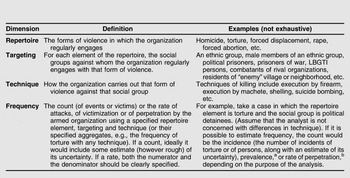
Here we develop concepts for comparing patterns of violence across organizations, time, and space. We define a pattern of violence on the part of an armed organization (state force, rebel group, or militia) as the relatively stable and recognizable configuration of violence in which it engages. This configuration consists of (1) its repertoire of forms of violence (homicide, rape, forced disappearance, etc.), and for each form, the (2) targeting, (3) frequency, and (4) technique (we define each of these dimensions later). We argue that these four dimensions are all necessary for the analysis of political violence; they are also sufficient. We conceptualize patterns as matrices at a specified level of aggregation (spatial, temporal, and for a specified unit of analysis within the organization). We note that the systematic comparison of patterns of violence will frequently be qualitative given the challenges of documenting patterns, particularly during war.
Such systematic comparison of patterns of violence across time, space, and units offers new leverage for the analysis of political violence (particularly but not only against civilians) by adding precision to its documentation, avoiding misleading conclusions, identifying novel observable implications, and thereby enabling the rigorous evaluation of rival theories. For example, our insistence that the analyst consider the full pattern of violence may lead her to assess the observable implications of candidate theories for non-lethal forms of violence, perhaps against hitherto-ignored social groups. We will identify here such implications for two classic works on civil war violence. Moreover, our approach opens up new research questions. For example, if we have a clear concept of pattern of violence, we can ask under what conditions do patterns diffuse from organization to organization? And under what conditions is diffusion so extensive that patterns of violence on the part of competing actors converge over the course of a long war? Footnote 14
We first briefly discuss the theoretical stakes in clearly defining pattern of violence for the documentation and analysis of political violence. Drawing on the literature on violence against civilians during civil war, we argue that patterns of such violence are not reducible in ways often assumed. First, lethal violence is not a good proxy for the overall pattern. Second, targeting is not well captured by the categories “selective” and “indiscriminate.” Third, variation in patterns is not well represented by the dichotomy of “terror” versus “restraint.” We then advance our definition of pattern of violence and its four elements (repertoire, targeting, frequency, and technique), which can be represented as a matrix. We show that the frequency of violence emerges as a well—defined concept when combined with repertoire, targeting, and technique. After suggesting that each dimension is necessary and together they are sufficient, we show that our definition advances analysis in specific ways. In our analysis of patterns of violence in Colombia, we demonstrate the potential and also the challenges of our approach. We also show that the concept of “pattern” helps bring ideology and politics back into the analysis of organized violence. Throughout, we illustrate our argument with examples drawn from the literature on violence during civil war, but the concepts developed here are equally applicable to the analysis of inter-state war, terrorism, and other forms of political violence. We conclude by discussing implications for scholarship and policy.
The Theoretical Stakes: Why Patterns Matter for the Analysis of Political Violence
Over the past decade and a half, violence against civilians during civil wars has been a major focus of the scholarly literature on conflict. In one of the most cited recent works, Stathis Kalyvas (Reference Kalyvas2006) advances the idea that territorial control determines where selective and indiscriminate violence occur in civil war. Where the organization has partial control, it exercises selective violence against civilians thought to support the rival organization. Where it has little control, the organization tends to exercise violence indiscriminately. In contrast, Jeremy Weinstein (Reference Weinstein2007) posits that organizations with access to economic endowments engage in wider repertoires and targeting, and higher frequency of violence against civilians than those with social endowments. Footnote 15 Theories about violence by armed organizations necessarily refer to their specific patterns of violence against civilians and advance propositions that map systematic differences across organizations/conflicts/periods/space. The evaluation of such theoretical claims is possible only with an adequate concept of pattern of violence.
Evaluation of these and related theoretical claims is difficult without a fully articulated concept of the pattern of violence. The important argument in Kalyvas (Reference Kalyvas2006), for example, would be clearer had he taken account of variation in the repertoire of violence. Reasoning that lethal violence is significantly easier to measure than other forms of violence, he treats lethal violence as an index of all forms of violence, and does not consider whether non-lethal violence might diverge systematically from lethal violence. Yet that is often the case. For example, in African civil wars, mass rape often occurs in the absence of mass killing. Footnote 16 A narrow focus on lethal violence thus neglects observable differences in patterns of violence that could, if analyzed, contribute to the more accurate documentation of violence and more decisive testing of rival theories.
Kalyvas also does not exploit differences between single killings, ritual killings, and massacres to sharpen his argument. And he sometimes combines two distinct types of targeting within “indiscriminate” violence: attacks against those who share a collective identity such as membership in an ethnic group, a political party, or a trade union (a form of selection) and those that are truly indiscriminate in the sense of non-selective. Footnote 17 Collapsing identity-based targeting and indiscriminate violence blurs variation in how armed organizations target civilians. Organizations may target some groups of civilians based on information about their identity, not because they lack such information. Such targeting may occur during the irregular wars to which his theory of selective violence applies, as in the Colombian case, which includes targeting based on political identity. Footnote 18 Finally, in his theories and models of selective and indiscriminate violence, he also represents armed organizations—be they state forces or non-state groups—as unitary actors whose members respond identically to strategic incentives. This simplification precludes attention to differences in individual preferences within groups or social dynamics among combatants. As a result, violence that is not ordered by commanders lies beyond the purview of his model.
Weinstein broke new ground in theorizing and analyzing differences in the patterns of violence by non-state organizations, including non-lethal forms of violence. Footnote 19 In contrast to Kalyvas, he does not assume that armed organizations are unitary actors. According to his theory, organizations with initial economic endowments will attract opportunistic recruits and rely less on civilian support, while those with merely social endowments will attract only committed activists. As a result, the former engage in all forms of violence at high levels with little discrimination while the latter engage in low levels of highly selective, mostly lethal violence. In short, organizations engage in either terror or restraint; other combinations of repertoire and targeting do not occur. Jessica Stanton shows that more than 40 percent of states and of rebels during civil conflicts since 1989 exercised restraint (defined as the absence of massacres, scorched earth campaigns, forced displacement, bombing and strafing of civilian areas). Footnote 20 However, those states and rebels that do not practice restraint engage in sharply varying combinations of forms of violence. The Bosnian Serb militias, for example, engaged in very high levels of various forms of sexual violence (rape, sexual slavery, forced prostitution, sexual torture and mutilation) against Bosnian Muslims. The prevalence of sexual violence (in terms of victims per capita) was roughly similar to the level of lethal violence. Footnote 21 In sharp contrast, the Tamil Tigers of Sri Lanka engaged in little sexual violence yet killed many civilians through assassinations in public venues and ethnic reprisals.
Thus, the approaches of Kalyvas and Weinstein are both problematic. Non-lethal violence may diverge significantly from lethal violence. Furthermore, organizations often “specialize” in particular repertoires in ways that belie the all-forms-of-terror versus restraint dichotomy.
Our concept of pattern of violence addresses these concerns. Its methodological and theoretical promise is two-fold. First, it enables the empirical documentation and analysis of an organization’s specific violent “signature,” thereby providing the material for the assessment of the underlying ideological, organizational, and social mechanisms. Second, it facilitates the comparison of patterns across organizations, within organizations, and over time. After defining pattern of violence in the next section, we show how our approach would have strengthened the seminal works of Kalyvas and Weinstein.
More recent literature on political violence emphasizes organization ideology, Footnote 22 recruitment, Footnote 23 organizational structure, Footnote 24 international and domestic support both for the organization and its rival, Footnote 25 and social structure. Footnote 26 Yet scholars still often focus on overly narrow subsets of the patterns of violence actually wielded during war and often fail to leverage the fact that differences in repertoire, targeting, and technique may be more easily observed than differences in the frequency of lethal violence. In his analysis of patterns of genocidal violence in Rwanda, Scott Straus carefully documents the frequency of the killing of Tutsis by region, but says little about rape, sexual mutilation, and other forms of non-lethal violence. Footnote 27 Drawing on an original dataset as well as case studies, Jessica Stanton considers a wide spectrum of repertoire elements to explore the conditions under which states and non-state groups engage in “terror” or “restraint.” Footnote 28 However, she does not exclude sexual violence or torture in defining “restraint” and conflates targeting and technique in her definition of “terrorism.” James Ron comes closest to the approach advocated here in his careful comparison of the forms of state violence wielded by Serbia and Israel in “ghetto” and “frontier” areas, namely, ethnic policing in the former and ethnic cleansing in the latter. Ron’s characterization of the “escalation” of Serbian violence in Kosovo as the combined increase in frequency of forced displacement and the widening of the violence repertoire demonstrates the precision added by disaggregating distinct dimensions of violence. Footnote 29 Yet his analysis would be even more persuasive if he had analyzed targeting beyond ethnic identity. Which Kosovars or Palestinians were particularly targeted?
When scholars neglect to document and analyze the full pattern of violence, they may misunderstand violence dynamics. Characterizing changes in patterns of violence is far from transparent. Consider the range of scenarios that an “increase” or “escalation” in lethal violence on the part of an armed organization might describe. Violence after the “increase” could be entirely focused on a particular social group and no longer attack other previously targeted groups. The repertoire might be narrower, but the overall level of violence more severe, if the organization decided to exterminate some population rather than displace, torture, and rape them as before.
These conceptual limitations mean that scholars often neglect variation in patterns of political violence that might be leveraged towards deeper understanding. An adequate concept of pattern of violence should include all of the following: non-lethal elements of the organization’s repertoire; distinctions between different types of targeting that go beyond the usual selective/indiscriminate dichotomy; a clear measure of frequency; and identification of the technique(s) with which each repertoire element is carried out. A concept of pattern of violence that includes these dimensions allows scholars to ask theoretically and empirically important questions, as we show next.
Defining Pattern of Violence
The pattern of violence on the part of an armed organization is comprised of the repertoire of violence in which the organization regularly engages and, for each element of the repertoire, its targeting, frequency, and technique. This definition draws on the use of pattern as a “distinctive style, model or form” and a “combination of qualities, acts, tendencies, etc., forming a consistent or characteristic arrangement.” Footnote 30 (We address the meaning of “regularly” later.) Although the definition is intended to include violence against prisoners of war and fellow combatants—indeed, any social group—we focus on violence against civilians for the sake of clarity.
The organization’s repertoire is the subset of all possible forms of violence against civilians in which it regularly engages. Footnote 31 Repertoires can be wide (many forms) or narrow (e.g., only killing). They also vary sharply across armed organizations, as illustrated by the example of wartime rape. Some armed organizations engage in frequent rape of civilians, but rape by other organizations is remarkably limited despite their engaging in other types of violence. Footnote 32
The second dimension of our definition is targeting—the subset of all possible civilian targets regularly attacked by the organization—for each form of violence in the repertoire. Before proceeding, we note that there is an ambiguity in the term targeting. “To target” implies intention. When attributed to an organization, targeting suggests that violence is ordered (at some level of command) and strategic. Yet the literature often uses “targeted” as summarizing an observed pattern rather than an intention: we observe that civilians of group X “were targeted,” meaning that they were killed and/or raped and/or forcibly displaced—but without necessarily meaning that their victimization was strategic or ordered. Throughout, we use targeted in the latter, empirically observed sense.
The literature approaches targeting through the problematic distinction between selective and indiscriminate violence. Footnote 33 Selective violence is the killing of an individual because of allegations about her behavior, such as providing support for a rival organization. Footnote 34 In contrast, indiscriminate violence refers to violence that is not selective in this sense, such as the shelling or bombing of population centers. In extreme form, indiscriminate violence is random, as in the haphazard killings by John Muhammed, the “beltway sniper” who terrorized Washington, D. C. some years ago. Jason Lyall argues that indiscriminate violence by Russian forces against Chechen villages was random, by one base according to military doctrine and by another because soldiers were so frequently drunk. Footnote 35 Yet the violence was not truly random, as the violence targeted only Chechen villages.
However, this broad use of indiscriminate obscures important differences. Consider identity-based targeting, the targeting by an armed organization of certain individuals specifically based on their identity as members of a social group. Footnote 36 Examples in various settings include ethnic groups, political parties, and political prisoners. Although such targeting based on identity is not selective on allegations concerning individual behavior, an armed organization may think that members of the targeted group are more likely than members of other groups to support the rival or to embrace prohibited identities associated with the rival (for example, peasants have a proclivity to become communists), and thus the identity serves as a proxy indicator. And at times armed organizations target particular social groups for entirely different reasons, for example, to “cleanse” a territory of people seen as undesirable, not because they are likely enemy supporters but because their absence is preferred by the organization or by residents whose support the organization seeks, as in the frequent forced displacement of prostitutes, rapists, and LGBT persons by various armed organizations in Colombia. Footnote 37 Such attacks assert the legitimacy of the organization’s territorial control. Or organizations may do so to signal resolve or to coerce governing authorities or allies. And in some contexts, some social groups are simply seen as killable, as in the case of cholos (persons of indigenous or mixed race who have adopted elements of Spanish culture) in Peru. Footnote 38 To encompass all of these scenarios, “indiscriminate” should refer to violence exercised without selection on either behavior or identity.
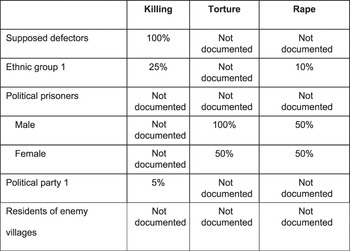
Our approach to targeting is to build explicit lists of those social groups that the armed organization regularly attacks, for each repertoire element. For example, a hypothetical armed organization might engage in killing of three groups (defectors, ethnic group 1, political party 1), torture of another (political prisoners), and rape of two groups (ethnic group 1 and political prisoners).
For each element of the repertoire and targeting, one measure of the frequency is the number of attacks deploying that repertoire element against that target, that is, the count, as when we want to explore whether organization A carried out more kidnappings (counted as events or victims) of some social group than organization B. However, the appropriate measure of frequency is often a rate, which might be the number of events per member of some referent population (incidence), the fraction of the referent population that suffered at least one such event (prevalence), or the number of events or persons of the targeted group per member of the armed organization (rate of perpetration).
An organization’s repertoire, targeting, and frequency can be represented as the two axes of a matrix, with one axis listing forms of violence and the other the social groups targeted. Frequency is indicated in the corresponding cell entry. Figure 1 shows a hypothetical pattern of violence, with the frequency measured as the fraction of the targeted group that ever suffered that form of violence (prevalence).
Pattern of violence in matrix form with prevalence estimate of frequency

How precisely frequency can be measured depends on the quality and granularity of the data. It may be the case that either the count or the denominator is so coarsely measured that only qualitative or ordinal comparisons can be made.
In many contexts, it is also important to consider the technique with which the organization carries out a specific element of the repertoire, that is, the way in which that form of violence is carried out against the targeted population. In the case of lethal violence, are killings carried out with automatic weapons? With machetes? Suicide bombings? So we could add to figure 1 an additional dimension of technique for each element of the repertoire and each social group targeted. In some settings, the technique together with the particular sub-pattern in which it is embedded may serve as the organization’s “signature” Footnote 39 (meaning a blueprint or script for performance). To be sure, a signature can be imitated and is thus imperfect, but its presence may suggest which organization was probably responsible.
Thus an organization’s pattern of violence can be defined as the matrix that summarizes which forms of violence, against which targets, with what count or frequency (clearly specified), and with what technique the organization regularly engages in violence. We note that three of the elements of this definition are lists (not spectra). Table 1 summarizes our definition.
Definition of “pattern of violence”

A. The number of persons tortured at least once/the number of detainees
B. The number of incidents or persons tortured/the number of members of the relevant unit of the armed organization (all members or the members of the responsible unit, depending on the purpose of the analysis)
So far this definition implicitly collapses variation across time and space and across the subunits of the organization. However, that variation may be precisely the object of analysis. So a more precise definition is
the pattern of violence (A, X, T, L) is the matrix summarizing for organization A, subunit X, at time period T, and at location L the forms of violence, and for each combination of form, target and technique, the frequency in which X regularly engages.
Local patterns can be distinct from overarching ones, and particular local patterns may not be observable in national data. Well-founded documentation and analysis of political violence should specify the level(s) of resolution (what values of A, X, T and L) it employs. The correct level of resolution will vary with the research question and the availability of disaggregated data. Sometimes T will be the entire course of the war and L the country itself. At other times, T will refer to a year or perhaps a month—but not much less as the definition refers to “regularly engaged,” which is hard to identify for short periods. L could refer to a municipality or even a village. Getting the concept right is distinct from issues of measurement.
Advantages and Limitations of Our Definition
The discussion above begs several questions. What counts as regularly? As violence? Are all four dimensions of our definition necessary? Are they sufficient? Is the analysis of patterns feasible? We take them in turn.
Just how regularly qualifies as “regularly engaged” depends on the rate of change of the organization’s pattern. Violent acts that occur infrequently—below a threshold that itself depends on the rate of change—do not count as part of the pattern. The notion of pattern connotes stability over the period T.
What counts as violence? In essence, violence is a stream of observable (in principle) acts by members of the organization: member X1 killed civilian C1, member X2 raped civilian C2, and so on. Footnote 40
Each dimension of the definition is necessary. Patterns of violence can be organized around the essential questions: who did what to whom, and (to which we add) how and how often? Footnote 41 The “who” is the organization perpetrating the violence. However, organizations sometimes have ill-defined boundaries. Do members of allied militias count as part of the organization? This is an issue for any approach to documenting violence, not just ours, and the answer depends on the context. The “what” is the repertoire, without which the researcher would be forced to assume that non-lethal violence either does not exist or differs only in irrelevant ways from lethal violence. Without “against whom” (the targeting), the analyst cannot assess the possible purpose of violence by the organization, the extent of violence that is not ordered by commanders, and other characteristics essential for analysis of violence. Without the dimension of frequency, the analyst cannot grapple with the scale of violence exercised by the organization in that form against that group.
And without an analysis of technique (the “how”), she may miss crucial clues to organizational dynamics that are central to the wielding of violence. Techniques are analytically separate from repertoire for several reasons. First, violence does not occur in an organizational vacuum, but requires skills and routines, and is implemented by specific sets of combatants embedded in particular organizational structures. Thus, even when repertoires of two organizations are substantially similar, their techniques may nonetheless differ because their skills and routines differ. Second, documentation of technique can be essential for analyzing causal dynamics, as Conrad and Greene show for the case of terrorist attacks. To capture how terrorist organizations compete with rivals by “outbidding,” analysis must consider tactical “innovation”—including in technique—(and broadening of targeting from government officials to civilians), not just increased number of attacks. Footnote 42 Organizations that engage in frequent rape during war often do so with techniques different from those that occur during peace. Wartime rape is much more often carried out by multiple perpetrators and is significantly more brutal. Footnote 43 Third, in some settings, techniques are an arena rich in imitation and innovation. Footnote 44 Their exclusion would undermine potential insight into organization dynamics. Fourth, the inclusion of technique as a dimension of pattern of violence as a dependent variable enables its documentation even as the scholar is agnostic as to whether it is strategic or expressive (or both).
In addition to being necessary, these dimensions are also sufficient. To be useful (particularly as a dependent variable), the definition of pattern of violence should include only immediate and observable (in principle) characteristics of violent acts. Other factors—whether the violence was ordered or not, its purpose, the structure of the organization, the historical context, the baseline rates of the crime, and so on—are best understood as explanatory or mediating factors, but not part of the pattern itself. Footnote 45
Is the analysis of patterns feasible? For example, are repertoires observable? The feasibility of the analysis of patterns can be challenged on both methodological and conceptual grounds.
A major methodological concern is the availability of data. All too often scholars of violence do not have quality data at the necessary level of resolution to analyze the full pattern, and so have to work at more aggregated levels. Quantitative analysis of even lethal-violence data is likely to be misleading unless sufficient data exists for multiple statistical estimation to be carried out or where a nearly complete list of events/victims exists, as in some special cases such as large massacres in Colombia (discussed later) and the Bosnian Book of the Dead. Footnote 46 It is usually even more challenging for non-lethal violence. Footnote 47 Even where a nearly complete list of events of one form of violence exists, it is extremely rare that analogous lists of other components of the repertoire are similarly well documented.
To address these concerns, we note that it is often the case that the organization’s repertoire, targeting, and technique are more readily measured than frequency. Scholars may therefore be able to engage in qualitative or ordinal comparison of certain subsets of the (coarsely measured) matrix, such as when we have grounds to believe “many” or perhaps N or N percent of political prisoners were raped but do not know their identities. In principle, ordinality in the assessment of frequencies—organization A kills more than organization B (by an explicitly defined measure, to a stated degree of certainty), but rapes less—is enough to be able to compare across organizations, wars, and nations.
In many settings, the best approach is the qualitative comparison of rigorously-defined subsets of the organization’s pattern of violence. Such sub-patterns (for example, a specific combination of repertoire and targeting) may be more observable than the matrix entries for individual repertoire elements and targeted groups. For example, an organization’s deploying of genocidal violence against a particular group may stand out as a specific, ongoing combination of forms of violence (forced displacement, mass killing, perhaps rape and forced pregnancy) against a particular ethnic group. In many settings, sub-patterns are important for distinguishing between armed organizations and identifying changes in patterns over time, as we will show for the case of massacres in Colombia.
The conceptual challenge to feasibility is that it would trigger an infinite regress. The finer the level of granularity, the more patterns will appear. Homicides can be differentiated according to their being performed with machetes, bombs, and guns, and for each of those techniques, with which particular blows or models, and so on.
But the challenge should be turned upside down. Only if she builds on a clear and rigorous concept of pattern can the researcher establish the level of resolution appropriate for the analysis. For example, if the objective is to build a general theory of violence against civilians by non-state armed organizations, the use of a single element of the repertoire as an index of the complete pattern may lead her to ignore potentially large differences across and within organizations. Treating all repertoire elements as following a single logic would be too much lumping. If, on the other hand, the objective is to characterize differences between organizations at the national level in a given conflict, only the most relevant elements of the repertoire and targeting should be considered without taking into account internal differences across regions. Disaggregating to the local level would be too much splitting. Note that the concept of pattern allows the researcher to explicitly evaluate the match between her theoretical purposes and the level of resolution she is adopting, thereby avoiding erroneous, perhaps implicit assumptions.
When is it justifiable to focus on only one repertoire element? Or on a single sub-pattern? The answer depends on both the research question and the context. If the purpose is to develop or assess a theory of political violence in general, the researcher should attempt to document the full patterns of violence by the relevant organizations, noting those repertoire elements, social groups, and techniques that appear to be absent as well as those that are frequent. On the other hand, if he is documenting or testing a theory about a particular repertoire element, e.g., rape, then the scholar would be justified in narrowing his focus to that form of violence. If the focus is on massacres, perhaps the researcher need not include an analysis of forced abortion, for example. However, our approach urges caution, as armed organizations sometimes substitute one form of violence for another, or regularly engage in a form of violence alongside the form on which the researcher is focused. An overly-narrow focus will miss this intertwining of repertoire elements, as we will show. The researcher should not assume that massacres or genocide never involve torture, for example, but should probe data sources for that possibility.
A final note: The analysis need not be organized around the repertoire. The research question may impel a distinct approach, for example, a focus on the target, to answer a question such as which organizations did what against trade unionists.
How Our Approach Advances Scholarly Research
Our definition allows scholars to map patterns of political violence more specifically, to compare patterns of violence more precisely, and thereby to assess their confirmation of theoretical claims more accurately. More pointedly, our approach—by urging documentation of the complete pattern of observed violence—maximizes the analytical leverage with which to evaluate theories of violence. After revisiting the work of Kalyvas and Weinstein, we identify the kinds of precise questions that scholars can better address with our definition of patterns and suggest the type of theoretical issues that it clarifies.
These important works miss some important aspects of violence against civilians, and arrive at some misleading conclusions. For example, Kalyvas’ use of lethal violence as a proxy for all violence obscures differences in repertoires across organizations and over time for which the particular strategic logic he emphasizes cannot account. The recent literature emphasizes that organizational ideology and structure must be included for a complete accounting of variation. Footnote 48 Many forms of non-lethal violence such as sexual attacks may occur for reasons not necessarily related to territorial control. Footnote 49 Indeed, some of these forms of violence may actually undermine and destabilize territorial control, which highlights the complex organizational and motivational structures underlying political violence that are obscured by Kalyvas’ very sparse ontology (organizations are essentially alike in their wielding of violence because all that matters is territorial control). Footnote 50
Similarly, Weinstein’s path-breaking book would have been clearer if he did not include both repertoire and targeting in his notion of “character of violence.” Footnote 51 Second, in documenting more of the pattern as we define it, he would have had to either justify more carefully his essentially binary approach to violence (terror versus restraint) or to develop a more complex dependent variable. In short, he would be forced to consider violence that is “off diagonal” from his theory (combinations of repertoire, targeting, frequency, and technique that do not fall into either restraint or terror). Third, if he had used our concept of identity-based targeting he could have described the patterns in his cases more clearly, comparing repertoires and targeting more carefully, and measuring frequency more consistently. For example, he would have had to discuss the fact that violence on the part of Sendero Luminoso (Peru) and the National Resistance Army (Uganda) were not as similar as his theory predicts. Finally, his definition of “selective” is very broad, ranging from targeting for reasons of victim behavior to doing so to signal costs, thereby introducing into the dependent variable (violence) what should be an explanatory variable. Footnote 52
To illustrate how our proposal facilitates the assessment of theories of political violence, consider the implications for the matrix representation of the two theories. If Kalyvas were correct in treating homicide as a proxy for all violence, then the targeting and frequency for each element of the organization’s repertoire would concur. All columns of the matrix would be identical. And the matrices of all organizations (state and non-state, across all conflicts) would be very similar, given that he argues that they all respond to the same strategic imperatives. In contrast, if Weinstein were correct, the violence matrices for all organizations with initial economic endowments would have entries in all columns, for all social groups, with high frequency. And matrices for those with social endowments would have very few entries in columns (only lethal violence) and rows (only defectors).
We now turn to another contribution of our approach: the kinds of research questions it clarifies. Consider first the pattern of political violence by a single armed organization. Does the organization engage in the same repertoire against all social groups? Whom does it target with each element of the repertoire? Is the technique similar? If not, the approach suggests further analysis of what the difference implies. For example, if the only civilians targeted with rape are those thought to support the rival organization, this pattern of targeting provides some (but not sufficient) evidence that rape may be strategically deployed. Footnote 53 If all civilians killed by the organization belong to the same social group and civilians of other groups are not killed but merely displaced (though equally accessible), the evidence suggests (but does not prove) that the organization controls the exercise of violence by its members.
Typically, models of violence are quite static. But organizations evolve, sometimes dramatically, as do the contexts in which they act and the perceptions and norms that guide their implementation of violence against civilians. Our approach facilitates analysis of the resulting evolution of their patterns of violence. Has violence by the organization escalated/intensified? Our definition prompts a precise re-statement of the question has the list of targeted groups lengthened? Has the repertoire widened? Has the frequency of some repertoire element against some target increased? Has the technique escalated in the sense that—for that element of the repertoire and target—the technique is broader or more violent (e.g., torture now involves a myriad of forms rather than a few)? Has the organization substituted one crime for another (e.g., instead of killing victims, disappear them; instead of raping civilians, sexually enslave them)? Under which conditions does this take place? What facilitates, what constrains such substitution? Mapping such changes precisely facilitates the assessment of how combat dynamics, including changing territorial control and evolving access to resources, shape the evolution of patterns of violence.
By contrasting unit-level patterns with that of the organization as a whole, scholars can deepen understanding of the implications of the non-unitary nature of armed organizations. Is the pattern similar across units of the organization? The definition prompts a response along lines such as the following: while the repertoire was similar, targeting was distinct; while targeting was similar, the repertoire was distinct; or, while targeting and repertoire were similar, the frequency of such violence was very different. The degree of intra-force variation has implications for theory. For example, to what extent do individual field commanders shape unit violence? Footnote 54 Differential unit access to lootable resources? Footnote 55 Distinct unit institutions? Footnote 56
Turning now to comparison across armed organizations, we can ask is the pattern of violence by two organizations identical? Similar? As we have seen, this has been a, if not the, crucial theoretical question for more than a decade. Our approach facilitates a relevant and analytically meaningful approach to this question through the systematic mapping of the four dimensions of patterns of violence. In short, our definition prompts the disaggregation of the question into a set of more precise questions. Are repertoires similar? If not, in what specific ways are they distinct? Is the targeting similar? If not, what social groups are targeted by one organization and not the other? For each repertoire element, is the frequency against a given social group similar? Are techniques for each element and target similar?
In particular, scholars and policy-makers alike often ask is violence by organization X greater than that of Y in the same conflict? This begs similar questions and corresponding analysis. In some settings, the answer will be clear: perhaps the repertoires and targeting are the same but X engages in all elements more frequently. But it is often the case that it is not possible to rank-order the two organizations by their violence. For example, to answer the question might require a determination of which was worse—ten deaths or twenty rapes, or ten instances of torture or ten kidnappings, etc. And it begs these questions: worse from whose perspective? That of the analyst? Victim? Perpetrator?
In its insistence that the pattern of violence be completely mapped, the approach also helps prevent the neglect of certain forms of violence or types of victims. As the researcher constructs the repertoire columns for an armed organization, he is impelled to explore whether rape was part of its pattern, for example. And if it is, the matrix prompts him to ask whether men and boys (and which ones) as well as women and girls were targeted by the organization. More fundamentally, the researcher is forced to grapple with the challenging question of whether the causal mechanism underlying torture is the same one underlying killing or rape. In short, by disaggregating forms of violence and targeting in order to compare—even if very crudely—their frequencies, the researcher avoids making (sometimes unconscious) assumptions that may prove erroneous or at least limiting.
More dynamically, have organizations “learned” from each other over the course of the conflict? Particular sub-patterns of violence (suicide bombing or IEDs, for example) sometimes diffuse across armed actors through imitation or learning or the migration of combatants between organizations. Footnote 57 Such diffusion does not always occur, however. In the case of wartime rape, an asymmetric pattern in which one party but not the other engages in moderate to high levels of rape is quite common in civil wars. Footnote 58 With a clear concept of pattern of violence, we can ask under what conditions do repertoire elements diffuse from organization to organization. Moreover, the definition suggests a particular way to measure diffusion: did a repertoire element such as rape emerge in the pattern of violence of a second organization after being present in that of a first? Did some other specific subset of the matrices of the armed organizations become more similar? The diffusion of repertoire elements and techniques may be more readily observable than targeting or frequency. Footnote 59 Precision about the ways in which violence patterns were or were not becoming more similar will improve analysis of inter-organizational interaction, and thereby address new questions: Did patterns of violence on the part of various actors converge? What are the underlying causal dynamics (identical incentives, imitation, learning, etc.) of convergence? Footnote 60 Of divergence? What constrains convergence? Does ideology play a role?
Relatedly, our approach and discussion suggest that that there are various types of restraint. Overarching restraint (very narrow repertoire and targeting, limited techniques, and also low frequencies) is an interesting and important pattern, but partial restraint (repertoire, targeting, and technique are not so narrow, and frequencies may be higher, than in overarching restraint) may be more frequent. Footnote 61 What accounts for the different forms of partial restraint? What roles do ideology, strategic or material incentives, and structural constraints play?
Thus our approach suggests how scholars might leverage the observed but as yet under-analyzed variation in patterns of political violence across organizations, space, and time. The explicit comparison of matrices may be insightful for comparing patterns across organizations and, for the same organization, across time, space, or units. Footnote 62 In the next section, we demonstrate the potential and challenges of its empirical application.
Comparing Patterns of Violence: Insurgents and Paramilitaries in Colombia
Here we first establish the conclusions that a researcher studying violence in Colombia’s civil war would draw if she focused only on homicides. We then analyze patterns of violence using our approach. The latter yields a much richer understanding of violence—and therefore of the underlying processes—than the former. In particular, focusing only on homicides is misleading, as it misses critical differences across organizations, whether an organization wields forms of violence as complements or substitutes, and the degree of specialization in particular sub-patterns at the unit level. Our unit of analysis is the count of victims at the national level for the FARC and for all paramilitary groups (aggregated) per year (unless otherwise indicated, as for example when discussing a particular unit).
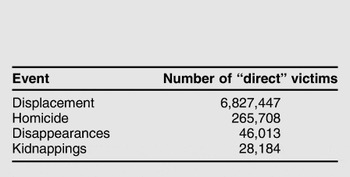
Starting at the latest in the late 1970s (scholars differ), Colombia’s civil war has pitted guerrillas, paramilitary groups, and state forces against each other. The most powerful guerrilla organization is the FARC (Fuerzas Armadas Revolucionarias de Colombia); it began demobilizing in early 2017. Weaker guerrilla organizations like the EPL (Ejército Popular de Liberación) and the ELN (Ejército de Liberación Nacional) have also played an important role; the latter is still active. Paramilitary groups (private counter-insurgent forces that claimed to be fighting the kidnappings and abuses of the guerrillas) emerged between the late 1970s and the early 1980s. They grew very fast, in part because of state support and protection, and by the late 1990s they were approximately as big as the FARC. In 2002, they embarked on negotiations with the government and completed their formal demobilization in 2007. However, up to half of the groups subsequently re-mobilized. Footnote 63 The cost of the war for Colombian civilians has been appalling. More than six million have been displaced, approximately 265,000 killed, and 46,000 disappeared as of June 1, 2016 (refer to table 2).
Number of civilians who suffered direct violence as of June 1, 2016, by crime

Note: This is a conservative measure as it includes only those victims that the Registro Único de Víctimas (RUV, Unique Registry of Victims), the state agency with which victims file claims, considers to be “direct victims.” Including “indirect” victims, the RUV lists 972,298 homicides, 162,631 disappearances, and 31,954 kidnappings. A consolidated roster of victims, the RUV is the main database of civilian victimization during Colombia’s war. It is administered by the Victims’ Unit created in 2011.
Source: RUV webpage (http://rni.unidadvictimas.gov.co/RUV), consulted June 30, 2016. Click on “hechos” and use the cursor tool to disaggregate into direct and indirect victims.
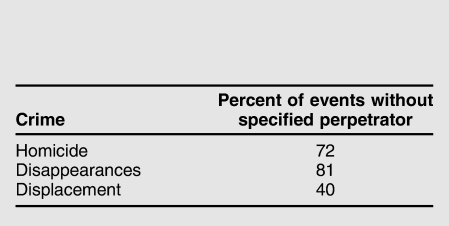
A researcher focusing exclusively on homicides could plausibly conclude—mistakenly, as we will show—that these actors were equally violent. The principal non-state forces of the Colombian war between the late 1980s and the early 2000s—the FARC and the paramilitaries—are not easily distinguished by homicide. Both committed homicide very frequently. The data does not allow us to be more precise, in large part because it is in general quite poor on the identity of the perpetrating group. In table 3, we report missing values (as of 2015) in the perpetrator column for the different crimes as found in the Registro Único de Víctimas (RUV, Unique Registry of Victims, the state agency with which victims file claims). The perpetrator is not reported for more than 70 percent of homicides and for more than 80 percent of disappearances. Furthermore, when the reported perpetrator is an insurgent, he is classified generically as “guerrilla,” which prevents the attribution of the event to a specific organization.
Fraction of victims without a specified perpetrator, by major crime

Source: Gutiérrez-Sanín Reference Gutiérrez-Sanín2015, 36 (note 115).
Despite the poor quality of the data, analysts nearly always argue that the FARC and the paramilitaries both engaged in very high levels of homicide. Footnote 64 Case studies also suggest that both groups could behave very violently, especially when competing for territory. Such competition triggered similar behavior from apparently very different groups. For example, in the region of Urabá, the FARC, the paramilitaries, and the EPL engaged in a violent spiral in the 1990s with each trying to eliminate civilians associated with the other. Footnote 65
Differences in Patterns of Violence
However, this is only part of the story. Other forms of violence clearly differentiate the paramilitary pattern of violence from that of the FARC. To show this, we start with massacres, for which we have comparatively good quantitative data. Massacres are the simultaneous killing of individuals who number or exceed a specified threshold. Footnote 66 We use in this section two thresholds: four or more people killed, as in the Centro Nacional de Memoria Histórica database, Footnote 67 and nine or more, as in an original database of particularly bloody and massive events, which we call “large massacres” (LMs). Footnote 68 In our terminology, a massacre is a sub-pattern, namely, a combination of repertoire (homicide) and frequency (at or over a specific threshold within a narrow time unit). Massacres—especially LMs—very often also involve specific techniques and targets, as we will show.
Massacres were particularly barbarous events that had enormous human, social, and political implications. At least 2,017 massacres were perpetrated in Colombia between 1980 and 2007, more than 72 per year. Footnote 69 Of these, 288 (14.3 percent) were LMs. For the groups that committed them, massacres—including LMs—were specific tactics, quite distinct from individual killings, with specific strategic objectives. For example, paramilitaries used them to terrorize or punish target populations, disband rival constituencies, vacate or compete for territories, and sometimes also to compete for goods and rents. Footnote 70 And their political implications and consequences—in general, and also for the perpetrators—were different from those of individual homicides. Indeed, some leaders of armed groups were quite articulate (in public and private) about both the objectives and the consequences of committing massacres. When the paramilitary figurehead Carlos Castaño publicly declared a massacre offensive against the peace process that was taking place between the FARC and the government in 1998, he argued that it would bring the government and the guerrillas to their knees and would force the country to recognize the paramilitaries as a “third actor.” Footnote 71 In private, during later negotiations for the demobilization of the paramilitaries, he demanded the reduction of massacres and pointed out the huge political costs of massacring vis-à-vis committing individual homicides. Footnote 72 Intermediate officers sometimes made analogous claims in judicial declarations. At least some of them could clearly articulate the strategic importance of massacres for their group, Footnote 73 as well as the political problems they eventually caused.
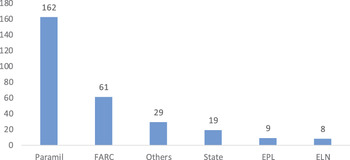
Armed organizations differ sharply in both massacres and LMs. This can be seen best with LMs. Figure 2 shows that by far the leading perpetrators of LMs were the paramilitaries, while the FARC as the second most frequent perpetrator trailed far behind. The paramilitaries committed 2.7 times more LMs than the FARC. The share of other groups is much smaller.
Large massacres by perpetrating organization (1981–2007)
Notes: N = 288.
Accessed August 8, 2016.
If more than one armed organization participated in a massacre, it is attributed to all of them. Note that we analyze massacres through 2007 to preserve comparability with other organizations (the paramilitaries demobilized up to 2007, though some remobilized). The category “Others” includes events without perpetrator data.

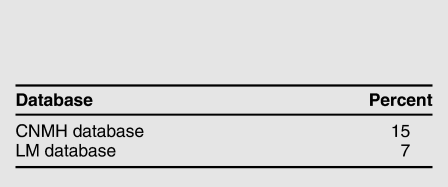
This sharp asymmetry also holds for massacres with four or more victims. We first note that the fraction of both massacres and LMs for which the perpetrator is not reported is relatively low (refer to table 4).
Percent of massacres without a specified perpetrator

Source: CNMH and LM databases.
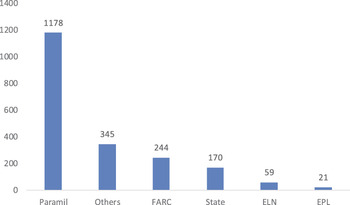
Figure 3 shows how massacres with four or more killings are distributed by perpetrating organization. Of the 2,017 massacres that are reported in the Memoria Histórica database, 1178 (58.4 percent) are attributed to the paramilitaries, 244 (12.1 percent) to the FARC, and 170 (8.4 percent) to diverse state agencies. Footnote 74 Massacres as well as LMs thus strongly differentiate the paramilitaries from the other armed actors.
Massacres by perpetrating organization (1980–2007)
Source: CNMH database.
Notes: N = 2017.
Accessed August 8, 2016.
If more than one armed organization participated in a massacre, it is attributed to all of them. Note that we analyze massacres through 2007 to preserve comparability with other organizations (the paramilitaries demobilized up to 2007, though some remobilized). The category “Others” includes events without perpetrator data.

Several case studies have shown that the paramilitaries targeted massacres more frequently against certain classes, political movements, and regions. Footnote 75 Longitudinal and cross sectional variation of both massacres and LMs was very sharp. Some towns were never affected while others were attacked several times. Some political constituencies were attacked, but others not. Frequently, specific political/electoral constituencies were singled out, a mechanism similar to the targeting of forced displacement in the region of Urabá. Footnote 76 Social, ethnic, and regional characteristics determined who could or could not be massacred. Footnote 77 The paramilitaries often targeted peasants and ethnic minorities with LMs. In contrast, some economic elites, well connected with state officials and with strong incentives to cooperate with the paramilitaries, organized but did not suffer massacres. Footnote 78
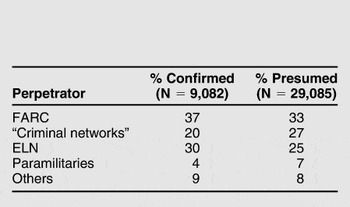
An analogous contrast occurred in the case of kidnappings, only with the ordering of perpetrators reversed. According to the Centro de Memoria Histórica, Footnote 79 the FARC were by far the main kidnapper during the Colombian war, committing more than 30 percent of abductions, followed by common criminals and the ELN. In last place are the paramilitaries, with less than 10 percent (refer to table 5). All of our additional evidence corroborates this basic ordering.
Distribution of confirmed and presumed kidnappings by perpetrating organization

Source: CNMH, 2013, 12.
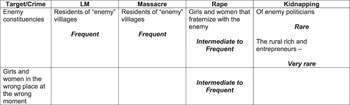
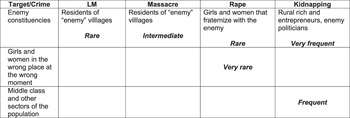
Massacres, LMs, and kidnappings thus differentiate clearly the Colombian non-state armed organizations into three categories. The first are those that engage in very frequent LMs and massacres and infrequent kidnappings (paramilitaries). The second are those who engage in moderately frequent LMs and massacres and very frequent kidnappings (FARC). The third are those that engage rarely in massacres and LMs but in moderate to high rates of kidnapping (other guerrilla organizations). This is in sharp contrast to their apparent similarity when only homicide is considered.
The organizations also differ in other combinations of repertoire and targeting. The paramilitaries and their successor criminal groups are by far the main perpetrators of assassinations of trade unionists in Colombia, for years the country with the most such killings in the world. Footnote 80 The FARC has also killed dozens of social leaders of adversary groups, especially in situations of acute territorial dispute such as in Arauca and Urabá. Footnote 81
There are also distinct sub-patterns of sexual violence. The FARC forces its female combatants to use contraception and if they nonetheless becomes pregnant, to abort. The rare exceptions are for partners of high-level commanders. The data on rape of civilians more generally is poor but there is a twofold recurring pattern across many convenience samples. First, the paramilitary organizations and their successor groups engage in rape, forced prostitution, and sexual slavery significantly more frequently than guerrilla organizations or the state. And second, the paramilitaries, and to a significantly lesser extent members of the FARC, have targeted girls and women associated with the opposing force. In particular, the paramilitaries target female leaders of human rights and women's groups with rape. Thus, even when the frequency of a particular form of violence is not well documented, the concurrence of a wide variety of sources on the relative frequency of these sub-patterns demonstrates further differences in their patterns of violence.
Finally, variation across the repertoires of paramilitary groups demonstrates that the dichotomy of terror versus restraint does not capture the observed patterns of violence. Some paramilitaries such as the Bloque Metro engaged in frequent LMs but little sexual violence, while others such as the Bloque Resistencia Tayrona engaged in high levels of sexual violence and few LMs. Footnote 82
Figures 4 and 5 contrast the violence by the FARC and paramilitary against three groups, where the frequencies shown are ordinal estimates of the prevalence of that repertoire element against that social group.
The pattern of paramilitary violence against some civilian groups (estimate of prevalence)

The pattern of FARC violence against some civilian groups (estimate of prevalence)

Repertoire Elements as Complements or Substitutes
In the Colombian context, armed organizations often engaged in particular repertoire elements simultaneously (complements). For example, during LMs the paramilitaries could rape, burn, and steal. But sometimes they replaced one element with another (substitutes). Substitution processes are theoretically consequential because they frequently reflect the ways in which the group/unit is linked to society Footnote 83 and the international community. Footnote 84
The Autodefensas Campesinas del Magdalena Medio (ACMM), led by Ramón Isaza in the 1990s, offer an outstanding example of substitution. Footnote 85 The ACMM had very stable control of their territory. They had evicted the guerrillas a decade before, and smoothly resolved conflicts with neighboring paramilitary units. However, the ACCM nonetheless engaged in high rates of homicide, frequently targeting several social groups for different reasons, including maintaining the support of its core constituencies and preventing information leaks.
Once they began demobilizing, however, the ACMM started to substitute killings with forced disappearances because frequent killing might jeopardize their relation with state security agencies. Disappearances nonetheless frequently ended in killing the victim, the dismembering of his body, and its disposal in one of the region’s rivers. But if the body did not appear, then the pressure exerted on the regional and local authorities (by public opinion, national agencies, actors of the international community) to curtail its activity could be deflected, as stated by Isaza himself in a judicial hearing:
Judge: Mr. Isaza, when you say that this [disappearing instead of simply killing] made things easier with the state, what was it, say police, public force, judicial processes …
Isaza: Correct, if you threw the body, if you disappeared it, then the search ended, there was no search, there was nothing. Footnote 86
Thus, the pattern of violence changed. A new repertoire element (disappearance) together with a specific technique (dismembering of the body and its disposal at a river) emerged as a fundamental element of the organization’s wielding of violence for territorial control. The organization understood very well the panic that disappearances caused in the population Footnote 87 even as it kept its activity below the radar of the public opinion, international NGOs, and some agencies of the state. Thus, the change occurred as a result of the strategic imperative to avoid destabilizing its regional coalition and alliance with state security agencies.
This was not an isolated case. The neighboring paramilitary units led by alias Botalón that operated in the hinterland of Puerto Boyacá also substituted killing with disappearances for strategic reasons. During the peace negotiations, a colonel who had disliked the paramilitaries had become commander of the Army unit in the region. As a result, the group led by Botalón decided to disappear victims instead of massacring or killing them, and to dismember the bodies of their victims to delay their finding and identification. Footnote 88 Where paramilitary groups had friends and contacts, however, this change of repertoire and technique apparently did not take place.
Substitution also took place on a much larger scale. For example, we saw earlier that the paramilitary leader Carlos Castaño first promoted a massacring offensive in 1998 and later (during the demobilization process) demanded that the paramilitaries curtail massacres in light of its political costs compared to individual homicides. Nor did substitution affect only the paramilitaries. While it was negotiating with the government, the FARC was accused of substituting kidnapping with extortion.
Specialization
We already saw that Colombian armed organizations differ in some major forms of violence. This difference reflects and also deepens a process of specialization in which an organization develops its own violent signature along with the knowledge and coordination devices to implement it. For example, the basic technique to carry out an LM was to isolate the town that was being attacked so that the group could operate freely over defenseless populations during a relatively long time (days or even weeks). This required specific knowledge of the presence of state agencies (or their absence), local infrastructure that would have to be occupied, and abundant contacts with state officials, both military and civilian. Footnote 89 It also implied the capacity to coordinate its various units, which, given the network-like structure of the paramilitaries, should not be taken for granted. This is one of the reasons why paramilitary groups varied sharply in whether they engaged in LMs or “just” massacres (and thus sharply in the technique of massacres). The Bloque Metro, which was relatively small, implemented tens of LMs, while bigger units like the Autodefensas Campesinas del Magdalena Medio or the Bloque Central Bolívar seldom did so. Footnote 90
Implications
Our analysis of patterns of violence in Colombia has several analytical implications. First, the conclusions derived from the observation of patterns diverge sharply from those based only on homicide. Some forms of violence such as massacres, kidnapping, or sexual violence differ sharply across the organizations. Combinations of repertoire elements and targets serve as signatures. Although homicide by paramilitaries in some settings appeared to decrease, it was replaced by forced disappearances. The patterns of violence on the part of different organizations did not converge despite their having analogous strategic incentives, because forms of violence depend on ideology and organizational structure (among other reasons).
Second, the targeting of violence is not well captured by the selective-indiscriminate continuum. One of the main problems of contemporary theories of civil war is that they tend to treat both armed groups and the social fabric over which they operate as homogeneous. Footnote 91 Identifying targets by particular social groups—as in our approach—avoids such homogenizing assumptions. Moreover, our approach ensures that the experience of victims who are marginalized when only lethal violence is considered, such as victims of sexual violence, is acknowledged.
Analogously, variation across the repertoires of paramilitary groups demonstrates that the dichotomy of terror versus restraint does not capture the observed patterns of violence. Some groups kidnapped frequently, while others massacred frequently. Some substituted standard homicide with equally lethal forms of violence. Some raped opportunistically, others attacked women who “fraternized with the enemy.” Furthermore, substitution suggests that at least in some cases, observing only the frequencies of particular repertoire elements could lead to overtly wrong conclusions regarding restraint. Equally importantly, it also shows the need to refine the conceptualization of restraint.
The concept of pattern allows us also to capture key sub-patterns that are context-specific. Analyzing massacres separately from homicide is important if the objective is to capture the mechanisms that govern violence against civilians in the Colombian civil war. Perpetrators were acutely conscious about the strategic specificity of massacres. Indeed, one of the very few points of agreement between academics, victims, and perpetrators is the great centrality that these played in the Colombian war.
Last but not least, the study of patterns highlights the social and political underpinnings of the violence against civilians displayed by different groups. Groups respond to different types of incentives, many of which are processed politically. Differences are partially explained by their political implications, as there are some crimes that the supporting coalition of the group would find hard to accept. The paramilitary constituencies would not condone frequent kidnapping, for example. Substitution, as just seen, can also be a response to political pressures. Patterns of violence reflect the ongoing interaction of politics, ideology, and previous violence by all actors. Footnote 92 The concept of pattern helps bring ideology and politics back into the analysis of organized violence.
Conclusion: Contributions to Scholarship and Implications for Policy
We began by noting the existence of significantly under-theorized and inadequately analyzed variation in patterns of political violence, and that this variation presents an opportunity for the development and assessment of theories of political violence. Our conceptualization of patterns of violence as configurations of repertoires, targeting, frequency, and technique facilitates scholarly analysis of that variation.
What is gained in exchange for the complexity that a multi-dimensional analysis necessarily adds? The mapping of the pattern of violence carried out by an armed organization enables the systematic assessment of novel observable implications of theories of political violence and the mechanisms that govern armed organization behavior. First, systematic comparison depends on comparing suitable—meaning well-defined, relevant, and observable—subsets of patterns of violence. Our definition adds clarity and rigor to comparison. For example, an explicit list of social groups targeted based on their identity offers precision that is lost in the usual distinction between selective and indiscriminate violence. Second, one-dimensional representations of violence—such as the assumption that lethal violence is a proxy for all violence—are likely to violate basic tenets of validity (e.g., by generating a mismatch between the concept and the measure). Resulting inferences are therefore likely to be biased. Third, our approach identifies otherwise overlooked sub-patterns that may effectively distinguish between different actors in a particular conflict, as massacres do in Colombia. Fourth, by emphasizing the full repertoire of violence, we both maximize variation for causal analysis and avoid aggregating forms of violence that are driven by distinct causal mechanisms. Finally, our approach excludes from the definition factors that should be seen as explanatory (e.g., violence as signaling).
Although documenting patterns is costly in terms of the data required, the cost is partly compensated by developing clear guidelines for the documentation and comparison of patterns of violence—including those deployed by different organizations, changes over time (including whether and why an organization substitutes one form of violence for another), and the potentially rich variation across sub-units of the organization. Moreover, our approach to the analysis of patterns enables the identification of new research questions. Do patterns of violence by different organizations converge over the course of the conflict? Does the armed organization engage in different forms of violence as complements or substitutes, and why? What are the causal mechanisms underlying distinct types of restraint?
Problems and challenges remain. We have addressed some of them. For example, we have argued that the concept must include the dimensions we enumerate here, and no more. We end by suggesting that our conceptualization of patterns of violence is very relevant for policy, emphasizing its contributions to policy analysis, to justice, to real-time intervention to protect civilians, and to historical memory.
Systematic documentation of patterns of violence is essential for policy analysis. To return to the example with which we began, analysis of ISIS’s deployment of violence would be sharpened by our approach in several ways. It would emphasize how the particular repertoire varies with the target (the sexual slavery of Yazidi girls and women but the forced marriage of Sunni Muslims). It would help identify “signatures”—characteristic sub-patterns—such as nearly-simultaneous suicide bombing by multiple armed assailants of public sites. It would illuminate innovations in technique, targeting, and repertoire (perhaps reflecting an “outbidding” dynamic in competition with other militant organizations Footnote 93 ). Turning to violence by U.S. forces and its allies, the extent to which coalition attacks kill, wound, and displace civilians—whether intentionally targeted or not—and the consequences of such violence remain the source of significant, ongoing controversy. In short, the “quality” of violence matters. Footnote 94 Our approach facilitates precision in its analysis. Moreover, ongoing, systematic mapping of patterns of violence during peace negotiations would assist analysts in their analysis of the commitment of the parties to the process (for example, to be aware that disappearances were substituting for killings).
More speculatively, our approach to documenting and analyzing patterns of violence may help in the fight against organized crime, terrorism, and other forms of political violence not considered here. For example, a police organization may combine selective and identity-based violence against the same person, as when its initial use of force is to detain someone alleged to have committed a crime (selective on behavior), but its subsequent violence against that person while in detention is extreme because of whom he is (selective on identity).
Documenting patterns of violence matters for justice as well. Under international law, prosecution for war crimes, crimes against humanity, and genocide necessarily draw on the documentation of the pattern of violence by the defendant’s organization. Unless evidence of direct participation or explicit orders is available, prosecution of commanders depends on demonstrating that they were responsible for a particular sub-pattern of violence carried out by members of their organization. For example, to convict a commander for crimes committed by his or her subordinates, it must be shown that the commander (1) knew or had reason to know that subordinates under his or her effective control were committing crimes within the jurisdiction of the International Criminal Court and (2) failed to take necessary measures to prevent those crimes or punish the perpetrators. Footnote 95 A conviction for crimes against humanity requires a finding of a “widespread or systematic attack” against a civilian population. Footnote 96 To count as “genocide,” the alleged act(s) must be against “such person or persons belonged to a particular national, ethnical, racial or religious group,” whom the perpetrator “intended to destroy, in whole or in part, … as such,” and “the conduct took place in the context of a manifest pattern of similar conduct directed against that group or was conduct that could itself effect such destruction.” Footnote 97
Our approach can help on all three fronts. First, in many settings, effective command may be demonstrated by documenting regularities in the pattern of violence wielded, particularly when some elements, targets, or techniques are absent. Second, the documentation of the organization’s overarching pattern would make evident whether the attack of which the alleged criminal act was part was widespread or systematic (usually interpreted as following organizational policy, which implies observable regularities across sub-units). Third, attention to the targets of violence is essential to the determination of whether or not the perpetrators intended to destroy a particular group.
Proving patterns is relevant also in national contexts. In Colombia, for example, under the transitional justice process for demobilized leaders of paramilitary groups, prosecutors seek to demonstrate that they were responsible for a particular “patrón de macrocriminalidad” (pattern of macro-criminality). Relevant evidence may include the identification of the “most characteristic” crimes (illustrated by a qualitative sample), its modus operandi, the purpose of the organization vis à vis the victims, its financial sources, and quantitative documentation of the illegal activities. Footnote 98 Interpretation is controversial, with ongoing contention within judicial circles as superior courts rule on lower court rulings. Footnote 99
The analysis of patterns of violence might also inform policies to intervene to protect civilians during violence, not only afterward. In particular, further analysis of the origins of policies of restraint might lead to fruitful engagement with those leaders who seek to maintain ties with states, donors, or non-governmental organizations, or those who hold (or at least publicly avow) ideologies that should encourage restraint.
Finally, the documentation and analysis of patterns of violence is at the heart of the work of truth commissions, museums that address issues of conflict, and many (if not all) historical memory projects. If commissioners, curators, activists, and scholars seek to document the full pattern of violence, the suffering of social groups whose victimization was not previously acknowledged will be rendered legible, including, for example, victims of sexual violence who, rather than the perpetrator, too often suffer the shame of the crime.
We hope our approach to the mapping, systematic comparison, and analysis of patterns of violence will contribute not only to research but also to policies that mitigate the suffering of its victims, particularly the vulnerable who so often bear the brunt of political violence.