Introduction
The prevalence of vote-buying is one of the most significant weaknesses in the democratic processes of developing countries (Schaffer, Reference Schaffer2007). When individuals exchange their votes in return for cash or minor rewards, the equality of the ballot is undermined, a level and competitive political playing field ceases to exist, and elections are deprived of their policy content (Desposato, Reference Desposato2007; Stokes, Reference Stokes2007a). This practice directly undermines the role of elections as a vehicle for representation and a mechanism of accountability (Stokes, Reference Stokes2007b).
Given the importance of the subject, there has been considerable interest in studying vote-buying and clientelism in general. However, as one author puts it, ‘we actually know very little about how widespread the practice is or the correlates of variation’ (Weitz-Shapiro, Reference Weitz-Shapiro2012: 568). The main culprit is the often hidden and morally indefensible nature of vote-buying that renders reliable data collection difficult in two ways. The social desirability bias associated with measuring vote-buying results in the underreporting of its prevalence, and leads to invalid inferences regarding the types of individuals that are being targeted.Footnote 1 Although there have been advances in the literature in obtaining accurate estimates of the aggregate levels of vote-buying, a reliable diagnosis of the target individuals is yet to be achieved.
In this article we employ an approach that not only enables us to estimate the prevalence of vote-buying while minimizing concerns of social desirability bias, but is also conducive to the analysis of the individual-level determinants of being targeted. Specifically, we combine two methodological innovations in the literature to study the practice of vote-buying in a major developing democracy. While the list experiment technique is useful for addressing the social desirability bias associated with measuring vote-buying, its limitations preclude efficient analysis of multivariate relationships between respondent characteristics and responses (Corstange, Reference Corstange2009; Blair and Imai, Reference Blair and Imai2012). A list experiment, in its original form, relies on difference-in-means tests that are conducive to estimating the aggregate level of the sensitive behavior only, and it does not allow for individual-level analyses (Kuklinski et al., Reference Kuklinski, Cobb and Gilens1997). Researchers can try to conduct pseudo-multivariate analyses by dividing their sample along variables of interest and running difference-in-means tests, or regressions with interaction terms, across the resulting sub-groups (e.g. Holbrook and Krosnick, Reference Holbrook and Krosnick2010; Gonzalez-Ocantos et al., Reference Gonzalez-Ocantos, de Jonge, Meléndez, Osorio and Nickerson2012), but these approaches quickly encounter degrees of freedom constraints, are problematic for continuous variables, and do not use the data efficiently (Corstange, Reference Corstange2009). Thus, they result in hypothesis tests with low statistical power, and the important question of what types of individuals are targeted for vote-buying is left inadequately explored.
We overcome this limitation of list experiments by utilizing a procedure and estimator that allows individual-level multivariate analyses on list experiment data. In particular, we apply a modified version of the list experiment technique and a new estimator (LISTIT), as proposed by Corstange (Reference Corstange2009), to original survey data from the 2011 parliamentary elections in Turkey. The results of our analyses illustrate the value of the approach we employ. When asked directly, only 16% of our sample admitted being targeted for vote-buying. Our experimental evidence, on the other hand, provides an estimate of 35%, more than double of what people report directly. This implies that in the Turkish case approximately one-third of the voting age population was targeted for vote-buying, and almost half of the actual targets were reluctant to reveal this when asked directly. Furthermore, we find that strong partisans of the ruling Justice and Development Party (Adalet ve Kalkınma Partisi (AKP)), less-educated individuals, and urban residents were significantly more likely to have been offered material benefits in exchange for votes.
Our study contributes to the literature in three ways. First, by combining different methodological innovations, we are able to explore a number of hypotheses on what types of individuals are more likely to be targeted for vote-buying that previous researches have not been able to address adequately due to limitations in their approaches. The strength of our evidence, in comparison to existing studies, derives from the use of original data on vote-buying that have been collected in an unobtrusive manner (through a list experiment) and analyzed at the level of individuals (using the LISTIT estimator). We are the first in the literature to present such evidence, and thus are in a position to push the debate on vote-buying forward by providing a reliable diagnosis of the target individuals.Footnote 2
Second, our results lend strong support to theories of vote-buying which predict that parties target their core supporters and socio-economically vulnerable individuals. In the Turkish case vote-buying efforts of the incumbent AKP seem to be focused on individuals who identify themselves very closely with the party, and not on its weak partisans or on individuals who do not identify themselves with any party. Moreover, we find that a particular aspect of socio-economic vulnerability, a low level of education, is correlated with being targeted. Finally, as our study constitutes the first systematic treatment of vote-buying in Turkey, we expand our knowledge on the vote markets, and provide a new insight on the electoral dynamics of an important, large, unconsolidated democracy.
Challenges in diagnosing vote-buying
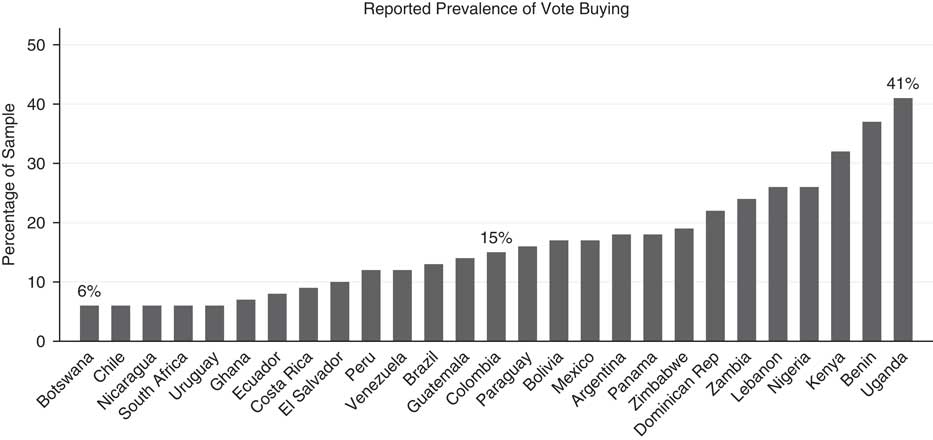
Vote-buying defined as ‘the proffering to voters of cash or (more commonly) minor consumption goods by political parties, in office or in opposition, in exchange for the recipient’s vote’ (Brusco et al., Reference Brusco, Nazareno and Stokes2004: 67) continues to be a widespread phenomenon across the developing world. Figure 1 compiles a number of recent surveys in 27 countries from Latin America, Africa, and the Middle East that asked respondents whether they were offered a material benefit in return for their votes in recent elections. The proportion of individuals responding affirmatively to this question ranges from 6% (Nicaragua, Uruguay, Chile, Botswana, and South Africa) to 41% in Uganda. The median country in this sample is Colombia where 15% of respondents admitted being offered a material benefit in return for their vote.
Reported prevalence of vote-buying efforts across the developing world. Notes: Data for Latin American countries are from Latin American Public Opinion Project (2010). The question is ‘In recent years and thinking about election campaigns, has a candidate or someone from a political party offered you something like a favor, food, or any other benefit or thing in return for your vote?’ and the figures refer to the proportion answered ‘Sometimes’ or ‘Often’. Data for African countries are from Afrobarometer Round 3 (2005–06) and Round 5 (2011–12) surveys. The question is ‘And during the last election in YEAR, how often, if ever, did a candidate or someone from a political party offer you something, like food or a gift or money, in return for your vote?’ and the figures refer to the proportion answered ‘At least once’. The estimate for Lebanon is from Corstange (Reference Corstange2012) and refers to the proportion of respondents admitting that offers of personal services, a job, or something similar have influenced their votes in the 2009 election.
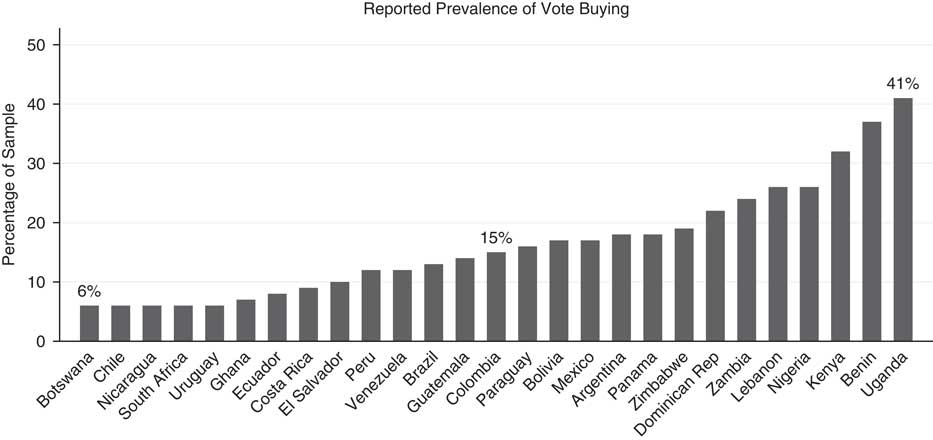
Social scientists frequently rely on self-reported individual opinion and behavior in empirical research, just as the aforementioned figures on the prevalence of vote-buying are based on individuals’ self-reported declarations. When studying stigmatized attitudes or illegal behavior, however, eliciting truthful answers poses a distinct challenge. Survey items that directly ask about sensitive subjects such as racial attitudes, sexual behavior, or vote-buying might lead some individuals to misrepresent themselves, conceal their actions, or simply refuse to respond. Specifically, individuals might choose to show favorable images of themselves to interviewers by giving answers that conform to social norms – a phenomenon known as social desirability bias (Bradburn et al., Reference Bradburn, Sudman, Blair and Stocking1978). Measurement errors that result from social desirability bias and non-response cannot be treated as random, and hence would lead researchers to invalid conclusions (Corstange, Reference Corstange2009; Blair and Imai, Reference Blair and Imai2012). For example, if individuals are disinclined to admit to receiving money or gifts in exchange for votes, then the overall incidence of vote-buying would be underreported. Accordingly, the data in Figure 1 most likely represent a lower bound for the prevalence of vote-buying in the respective countries (Stokes, Reference Stokes2005).
This concern has led scholars to consider asking sensitive questions in an indirect fashion using an unobtrusive measurement technique known as the list experiment (Kuklinski et al., Reference Kuklinski, Cobb and Gilens1997). In a list experiment, the survey sample is randomly split into control and treatment groups. The respondents in the control group receive a list of J non-sensitive yes/no items, and are asked only how many of the items they would respond to in the affirmative. The respondents in the treatment group, meanwhile, receive the same list as the control group plus the sensitive item that the analyst wants to measure, and are asked, similarly, how many of the J+1 items they would respond to in the affirmative. The premise of list experiments is that since respondents have to tell only how many of the items they would respond to in the affirmative, no one can know whether a treatment group respondent’s answer has included the sensitive item. This anonymity, in turn, should encourage a truthful response, and difference-in-means tests can be used to estimate the prevalence of the sensitive behavior/opinion in the sample. In political science, list experiments have been employed to study racial attitudes (Kuklinski et al., Reference Kuklinski, Cobb and Gilens1997), attitudes toward immigrants (Sniderman and Hagendoorn, Reference Sniderman and Hagendoorn2007), self-reported voter turnout (Holbrook and Krosnick, Reference Holbrook and Krosnick2010), and most recently, vote-buying (Corstange, Reference Corstange2012; Gonzalez-Ocantos et al., Reference Gonzalez-Ocantos, de Jonge, Meléndez, Osorio and Nickerson2012).
Despite the usefulness of list experiments in reducing social desirability pressure, an important limitation of the approach in its original design is that it is not conducive to exploring the relationship between respondents’ characteristics and their answers to sensitive items via multivariate analyses (Corstange, Reference Corstange2009; Blair and Imai, Reference Blair and Imai2012). The difference in mean responses between the treatment and control groups are useful only for estimating the proportion of respondents in the sample who answer the sensitive item affirmatively. Strictly speaking, the prevalence of the sensitive behavior/opinion across different sub-groups of the sample can be estimated by repeatedly splitting the sample and running difference-in-means tests between the resulting sub-groups. This approach, however, quickly encounters degrees of freedom constraints and leads to large uncertainty around the point estimates for each sub-group (Corstange, Reference Corstange2009).
This shortcoming of the list experiment method is illustrated by the recent study of Gonzalez-Ocantos et al. (Reference Gonzalez-Ocantos, de Jonge, Meléndez, Osorio and Nickerson2012). In this innovative study, the authors investigate the prevalence of vote-buying in Nicaragua using a list experiment. Startlingly, while only 2% of the registered voters report being offered a gift or service in exchange for votes when asked directly, the list experiment suggests that, in fact, nearly a quarter of respondents were targeted. Beyond this aggregate inference, the authors are also interested in the individual-level characteristics (e.g. partisanship, education, income) that might be associated with being targeted for vote-buying. For this purpose they divide their sample along different variables of interest, and run difference-in-means tests and linear regressions with interaction terms across the resulting sub-groups. At this point the limitation of the list experiment method becomes apparent. Contrary to the entire body of existing literature and conventional wisdom, the analysis suggests that while partisanship and income have no effect on the likelihood of exposure to vote-buying, the more-educated are more likely to be targeted. Surprisingly, while the list experiment estimate of the prevalence of vote-buying among respondents with no formal education is 16%, the same figure for college graduates is 37% – a result difficult to explain.
Looking at the analysis of Gonzalez-Ocantos et al. (Reference Gonzalez-Ocantos, de Jonge, Meléndez, Osorio and Nickerson2012) more closely, the limitation of their approach is that dividing the sample into several sub-groups significantly reduces the number of observations in each sub-group, leading to large standard errors that distort the inferential analysis (Gallego and Wantchekon, Reference Gallego and Wantchekon2012). Therefore, almost all of the sub-group comparisons they investigate result either in a null finding (e.g. partisanship, income) or in a statistically weak result that contradicts conventional wisdom (e.g. education). The low statistical power of this approach severely limits drawing conclusions about the differences in the prevalence of vote-buying across sub-groups of the sample.
This shortcoming of the list experiment method is especially unfortunate for studying vote-buying, because the question of what types of individuals are being targeted is as important as the prevalence of the practice. From a policy perspective, understanding the dynamics of vote-buying is essential if we are going to address the phenomenon to improve the accountability of elections in developing democracies. This, in turn, hinges on specifying the determinants of individual behavior. Theoretical and empirical studies to date point to two principal factors: poverty and partisanship (Stokes, Reference Stokes2007b). In terms of poverty, the conventional wisdom in the literature is that parties should target impoverished, socio-economically vulnerable individuals because they are more receptive to direct, clientelistic exchanges than programmatic policy appeals, and buying their votes is less costly than buying the votes of their wealthier counterparts (Dixit and Londregan, Reference Dixit and Londregan1996; Kitschelt, Reference Kitschelt2000).
In terms of partisanship, there is a lively debate about whether a party should go after its core supporters or after individuals who are indifferent or slightly inclined/opposed to the party, that is, swing voters (Stokes, Reference Stokes2005, Reference Stokes2007b; Cox, Reference Cox2009). The driving ideas behind the ‘core voter’ models are risk aversion (Cox and McCubbins, Reference Cox and McCubbins1986), mobilization (Nichter, Reference Nichter2008), the endogeneity of partisan loyalties to material inducements (Diaz-Cayeros et al., Reference Diaz-Cayeros, Estevez and Magaloni2012), and the rent-seeking behavior of party brokers (Stokes et al., Reference Stokes, Dunning, Nazareno and Brusco2013). A second set of models that are pioneered by Lindbeck and Weibull (Reference Lindbeck and Weibull1987) and Dixit and Londregan (Reference Dixit and Londregan1996), on the other hand, rests on the intuition that transfers to voters who strongly favor or oppose a particular party are unlikely to make a difference, and thus, the best strategy for dispensing material benefits is targeting swing voters. Empirical studies to date paint a mixed picture so that we have results in both directions (Stokes, Reference Stokes2007b; Cox, Reference Cox2009). The difficulties associated with attaining a reliable diagnosis of the target individuals most likely have a role in these mixed results. Accordingly, a procedure that allows individual-level multivariate analysis of list experiment data would greatly facilitate adjudicating between competing hypotheses on who gets targeted for vote-buying.
A modified design of the list experiment
Corstange (Reference Corstange2009) developed a revised procedure and statistical estimator called LISTIT that enables researchers to undertake individual-level multivariate analysis on data generated by a list experiment. In this modified design, respondents in the control group receive the full list of items (i.e. J+1 items that consist of J non-sensitive and one sensitive item), and are asked to evaluate each of the list items individually. There is no change in the procedure for the treatment group. The intuition for this approach is that we can treat the ‘yes’ count of each treatment group respondent as if it were a binomial process with a known average probability for J +1 items but unknown individual item probabilities of responding affirmatively. By asking each of the list items individually to control group respondents, on the other hand, we can estimate the individual probabilities of the J non-sensitive items using a set of covariates. In turn, these estimates are applied to the values of their corresponding covariates among the treatment group respondents. Since we already know the average probability of responding affirmatively to J +1 items for each treatment group respondent, the estimated probabilities of the J non-sensitive items enable us to estimate the probability of responding affirmatively to the sensitive item as well.Footnote 3
This modified design of the list experiment enables us to test hypotheses on the relationship between individual characteristics and the likelihood of being targeted for vote-buying. In line with the existing theoretical and empirical literature, our analysis focuses on indicators of partisanship and socio-economic vulnerability. Specifically, we will test whether there is a difference in the likelihood of being targeted between the partisans of different political parties (and nonpartisans), and whether socio-economically vulnerable individuals are more likely to be targeted. We will employ a number of measures for socio-economic vulnerability (i.e. education, wealth, unemployment) to investigate which aspect(s) of this condition are correlated with vote-buying, if at all.
Accordingly, we conducted this modified design of the list experiment as follows. After splitting the sample randomly into treatment and control groups, respondents in the control group were read the following prompt and the list of options:
‘People decide who to vote for based on a lot of different reasons. Now I will read you some of the reasons people have told us: Please tell me if they influenced your decision to vote for the party that you have voted.
∙ You read newspaper coverage of the campaign regularly
∙ You read the documents of political parties that included campaign promises
∙ Someone offered you or your family personal services, a job, or similar material benefits in exchange of your vote for a party
∙ You and your friends discussed the election campaign and party leaders’.
While respondents in the treatment group were presented with the same list, they were specifically instructed to tell only how many of the items have influenced their decision to vote. The prompt for the treatment group read as follows:
‘People decide who to vote for based on a lot of different reasons. Now I will read you some of the reasons people have told us. Please do not tell me which of the following have influenced your vote decision. Please just tell me how many of the following have influenced your decision to vote for the party that you have voted’.
There are some differences between the wording of our sensitive item (in italics) and the ones used in previous studies on vote-buying that employed a list experiment. In Corstange (Reference Corstange2012), for example, the sensitive item reads as follows: ‘Someone offered you or a relative personal services, a job, or something similar’. In this wording it is not explicit that the offer is made in return for the vote of the respondent. The quid pro quo nature of vote-buying is not signaled clearly, and thus those who give an affirmative answer to this question might actually be reporting an ordinary campaign promise. In our wording the qualification ‘in exchange of your vote for a party’ highlights the quid pro quo nature of the vote-buying transaction (Stokes, Reference Stokes2007b). Thus we explicitly set the context of vote-buying by clearly delineating the transaction in question as an offer of exchange of material benefits for a vote.
Lastly, Blair and Imai (Reference Blair and Imai2012) note that researchers who employ the list experiment technique typically assume that the inclusion of the sensitive item to the list of options has no effect on respondents’ answers to control items. They stress that the validity of a list experiment critically depends on this assumption of no design effect. The presence of a ‘design effect’ would suggest that a respondent’s evaluation of the control items depends on the sensitive item, leading to different propensities to answer control items affirmatively across the control and treatment groups. In turn, they devise a statistical test with the null hypothesis of no design effect. We implement this test, and fail to reject the null hypothesis of no design effect.
Empirical context and analysis
Turkey with a long electoral experience in competitive multi-party elections since 1946 provides a good setting in which to study vote-buying.Footnote 4 There is a voluminous literature on the prevalence and significance of clientelism and patronage in Turkish politics that dates back to the 1970s (Sayarı, Reference Sayarı1977; Heper and Keyman, Reference Heper and Keyman1998; Kemahlıoğlu, Reference Kemahlıoğlu2012). The general disposition of the literature is that with the establishment of a competitive party system in 1946, the historical dependency of the periphery on the center in Turkish politics has resulted in enduring patron–client relationships (Güneş-Ayata, Reference Güneş-Ayata1994). Later, when massive urbanization led to new migrant communities in cities, clientelistic brokerage between political parties and these communities have become the basis of political mobilization. The empirical contribution of this literature, however, has been quite modest, and individual-level systematic evidence for clientelistic linkages is yet not available.
Another attractive feature of the Turkish context is that the factors identified in the literature as the bases of parties’ targeting strategies for clientelism (i.e. partisanship and socio-economic conditions) have become increasingly important in the voting decisions of the electorate during the last decade. A rising influence of party identification is noticeable as a relatively stable period develops in the country with the same party (AKP) winning three consecutive elections (Kalaycıoğlu, Reference Kalaycıoğlu2008; Çarkoğlu, Reference Çarkoğlu2012b). The other element that strongly shapes voting behavior is short-term economic evaluations (Çarkoğlu, Reference Çarkoğlu2012b). The salience of economic conditions, coupled with relatively widespread poverty, suggests that targeting socio-economically vulnerable groups even with minor rewards might result in sizable electoral returns.Footnote 5 These two observations suggest that the factors that shape parties’ clientelistic strategies are very relevant for the Turkish electoral context.
Remaining more than a decade in power as of 2013, the incumbent AKP is well-positioned for implementing clientelistic strategies efficiently given its elaborate organizational network and access to public resources. Stokes (Reference Stokes2005) notes that a tentacle-like, bottom-heavy, and decentralized organizational structure is a great asset for parties that aim to use minor payoffs to sway voters. In the Turkish context, we know that the party with the organizational structure most like that of a political machine is the AKP.Footnote 6 The perception that the prevalence of clientelism and vote-buying distorts Turkish democracy is widespread among the scholars and politicians alike. While Öniş (Reference Öniş2009: 24, footnote 2) considers ‘the distribution of food and coal to actual and potential supporters of the party on a selective basis’ as an important element of AKP’s social policy, the leader of the main opposition party Cumhuriyet Halk Partisi (CHP) openly accused AKP of vote-buying ahead of the 2009 local elections, and appealed to public prosecutors to take action.Footnote 7
Accordingly, our study constitutes the first systematic treatment of the prevalence of vote-buying in Turkey. We embedded our list experiment into a nationally representative face-to-face survey conducted between 21 July and 26 August 2011, two weeks after the parliamentary elections.Footnote 8 The sampling procedure starts with the use of the Turkish Statistical Institute’s (TUIK) NUTS-2 regions. The target sample was distributed according to each region’s share of urban and rural population, in accordance with the Address Based Population Registration System records as of the end of 2010. Next, TUIK’s block data were used with block size set at 400 residents. Probability proportionate to size sampling was used in distributing the blocks to NUTS-2 regions. The individual to be interviewed in each household was selected using a lottery method on the basis of the reported target population of 18 years or older in the household.Footnote 9
We first use the list experiment data to estimate the proportion of individuals targeted for vote-buying. When asked directly, 16.2% of our respondents admitted to being offered a material benefit in exchange for a vote for a party (Table 1, column 1).Footnote 10 In order to compare this figure with what people reported when asked indirectly, we momentarily set aside the control group respondents’ (direct) answers to the sensitive question, and added up their responses to the three non-sensitive items. Then we compared the average of this sum in the control group with the average count in the treatment group on the full list of four items. The mean number of items reported by respondents in the control group with only three options is 1.01, while the mean in the treatment group with four options is 1.36 (Table 1, column 2). Thus, the estimated proportion of individuals targeted for vote-buying according to the list experiment is 35.3%.Footnote 11 When we acknowledge the sensitivity of the question and try to minimize the associated social desirability bias by asking it indirectly, the proportion of individuals who report being targeted for vote-buying is more than double of what people would admit when asked directly. This striking difference highlights the value of the list experiment technique and the extent to which traditional obtrusive measures of vote-buying underreport its prevalence.
Aggregate results on the prevalence of vote-buying in Turkey

Control and treatment values refer to the mean number of items individuals have responded affirmatively to in the list experiment. The number of respondents in each condition is given in brackets. Standard errors in parentheses are adjusted for the survey design.
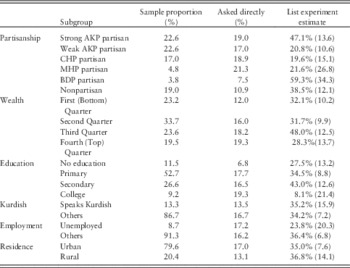
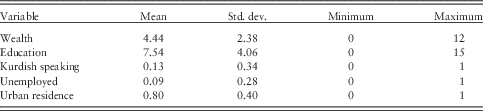
Beyond this aggregate inference on the prevalence of vote-buying, we are also interested in the types of individuals who are being targeted. As a first step, in Table 2 we divide our sample across some key variables related to socio-economic vulnerability and partisanship.Footnote 12 Column 3 of Table 2 presents the proportion of each sub-group in our sample, and Column 4 reports the proportion of individuals within each sub-group that admit to being targeted when asked directly. The corresponding list experiment estimates for each sub-group are given in Column 5. To construct our partisanship variables, we asked our respondents whether they thought of themselves ‘as close to any particular party’. Respondents who answered affirmatively were asked to give the name of the party they felt close to, and were identified as partisans of that party. Nonpartisans are those who did not think of themselves as close to any particular party. In the analysis we include the partisans of the incumbent AKP and of the three major opposition parties (Cumhuriyet Halk Partisi (CHP), Milliyetçi Hareket Partisi (MHP), and Barış ve Demokrasi Partisi (BDP)) that won seats in the parliament.Footnote 13 Additionally, the large number of AKP partisans in the sample allows us to further distinguish between strong and weak partisans of the party – strong AKP partisans are those who felt ‘very close’ to AKP while the remaining AKP partisans are identified as weak partisans. Descriptions of the other variables employed in the analysis and summary statistics are presented in Table 3.
Prevalence of vote-buying across sub-groups of the sample when asked directly vs. list experiment estimates

AKP=Adalet ve Kalkınma Partisi; CHP=Cumhuriyet Halk Partisi; MHP=Milliyetçi Hareket Partisi; BDP=Barış ve Demokrasi Partisi.
Standard errors in parentheses are adjusted for the survey design.
Summary statistics and variable descriptions
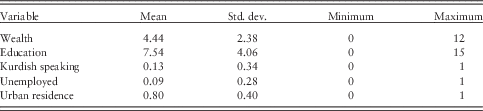
Variable descriptions are as follows. Wealth: sum of the ownership status (1=yes, 0=no) of the following 12 items: landline phone, dishwasher, automatic washing machine, plasma or LCD television, air conditioner in the house, a property that provides rent income, summer house, a private car, mobile phone, credit card, computer, savings account in a bank. Education: number of years of formal education. Kurdish speaking: coded 1 for individuals who can speak Kurdish. Employment: coded 1 for individuals who are currently unemployed but are looking for a job. Urban residence: coded 1 for urban residents.
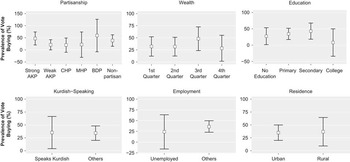
Examining Table 2, two observations stand out. First, across most sub-groups the proportion of individuals that report being targeted for vote-buying increases substantially when asked indirectly instead of directly. Crucially however, the list experiment estimates have large standard errors that render inference on the differences between sub-groups difficult. Figure 2 plots estimates of the prevalence of vote-buying for different sub-groups together with 95% confidence intervals, and we see that across all the variables none of the sub-group estimates are statistically different from each other. For example, while the point estimates for different partisan sub-groups vary considerably (e.g. 47.1% for ‘Strong AKP partisans’ vs. 19.6% for ‘CHP partisans’), the size of the standard errors suggests that there is no statistical difference between them. These results are similar to those reported in Gonzalez-Ocantos et al. (Reference Gonzalez-Ocantos, de Jonge, Meléndez, Osorio and Nickerson2012) in the sense that dividing the sample along variables of interest significantly reduces the number of observations within each sub-group, and leads to large standard errors that limit inference.
Prevalence of vote-buying according to the list experiment across different sub-groups of the sample. Notes: The closed lines represent 95% confidence intervals around the point estimates. The figure is constructed using list experiment estimates for each sub-group as reported in Table 2.

The preceding analysis confirms that the strategy of running difference-in-means tests across different sub-groups of the sample is not a satisfactory approach to address the question of what types of individuals are being targeted for vote-buying.Footnote 14 Accordingly, we need an approach that uses data more efficiently, and for this purpose we utilize the statistical estimator LISTIT developed by Corstange (Reference Corstange2009) to conduct individual-level multivariate analysis of list experiment data.Footnote 15 Again our interest lies in indicators of socio-economic vulnerability and partisanship, and we use the same set of variables used to construct the sub-groups.
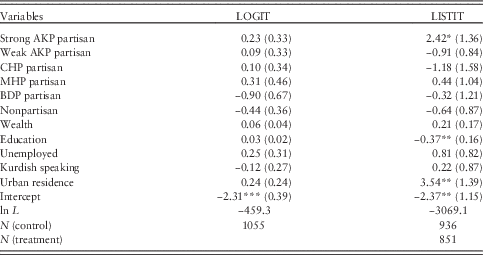
In Table 4 we report our results in two columns: the first column presents estimates from a standard logistic regression with response to the direct question of whether the respondent was targeted for vote-buying as the dependent variable, and the second column reports estimates from the list experiment using the LISTIT estimator. As we can see in the first column, none of the coefficients of the indicators of partisanship and socio-economic vulnerability are statistically significant. Thus, ignoring the consequences of social desirability bias would lead to the conclusion that partisanship and socio-economic vulnerability do not have an effect on the likelihood of being targeted for vote-buying.
Determinants of being targeted for vote-buying when asked directly (LOGIT) vs. list experiment results using LISTIT
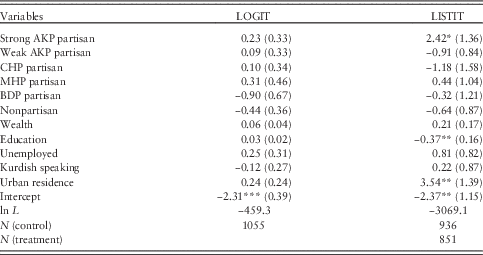
AKP=Adalet ve Kalkınma Partisi; CHP=Cumhuriyet Halk Partisi; MHP=Milliyetçi Hareket Partisi; BDP=Barış ve Demokrasi Partisi.
Standard errors are in parentheses. *p<0.1, **p<0.05, ***p<0.01.
When we account for the sensitivity of the question using the list experiment, however, we obtain some important results as reported in the second column of Table 4. We should note that the estimates presented in the second column are LOGIT coefficients that would be returned if we had asked the sensitive item directly as a yes/no question, and respondents had not misrepresented their answers (Corstange, Reference Corstange2009). First, we see that strong AKP partisanship is a statistically significant predictor of being targeted for vote-buying.Footnote 16 Beyond statistical significance, there is a ten-fold increase in this coefficient when we ask the sensitive question indirectly rather than directly. This result provides support for the ‘core voter’ hypotheses in the literature as the incumbent AKP seems to target individuals who identify themselves very closely with the party, and not its weak partisans or individuals who do not identify themselves with any party.Footnote 17
Second, while none of our indicators of socio-economic vulnerability were statistically significant when asked directly, using the indirect method we see that the level of education is a strong predictor of being targeted for vote-buying. Specifically, less-educated people are more likely to be the targets of such efforts. Voter compliance is critical for vote-buying arrangements (Stokes, Reference Stokes2005), and it might be the case that less-educated people are relatively easier to monitor, or are relatively more afraid by the ‘punishment’ that a political broker can inflict upon in case of non-compliance.Footnote 18 Another potential explanation is that education is a good proxy for socio-economic vulnerability in developing countries. Finally, vote-buying efforts seem to be concentrated in urban areas while no such inference was possible in the direct question model. This result is compatible with the existing literature, hinting that the primary locus of clientelist exchanges in the Turkish context is the newly-urbanized migrant communities in cities (Güneş-Ayata, Reference Güneş-Ayata1994).
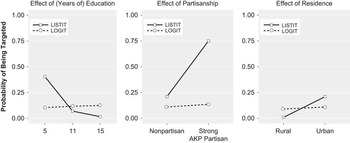
Figure 3 illustrates the value of our approach in a graphical form by comparing the estimated probabilities of being targeted for vote-buying for different values of the key variables across the LOGIT (asking directly) and LISTIT (asking indirectly) estimations. In the left panel we see the impact of education on the likelihood of being targeted for a non-partisan, employed, non-Kurdish speaking urban resident with an average level of wealth. While education has no discernible effect on the likelihood of being targeted when respondents are asked directly, we see a strong negative effect when we account for the sensitivity of the question using the list experiment. The estimated probability of being targeted is around 40% for a primary school graduate (5 years of education), yet it rapidly falls to 7% for a high school graduate (11 years of education), and to just 2% for a college graduate (15 years of education). The very strong effect exerted by AKP partisanship on the likelihood of being targeted is apparent in the center panel: In the LISTIT estimation while the estimated probability for a non-partisan, employed, non-Kurdish speaking urban dweller with an average level of wealth and education (7.5 years) is 21%, it jumps to 75% for a strong AKP partisan with otherwise identical characteristics. Finally, the right panel shows that vote-buying in Turkey occurs in urban settings – another inference that we could not have made if we had asked our respondents directly.
Probability of being targeted for vote-buying when asked directly (LOGIT) vs. list experiment results using LISTIT. Notes: In the left panel the probability of being targeted for vote-buying is calculated for a nonpartisan, employed, non-Kurdish speaking urban dweller with an average level of wealth. In the center panel the reference individual is an employed, non-Kurdish speaking urban dweller with an average level of wealth and education. In the right panel the reference individual is a nonpartisan, employed, non-Kurdish speaking individual with an average level of wealth and education. The figure is constructed using estimates from the logistic and LISTIT regressions as reported in Table 4.

Implications and discussion
Scholarly accounts of vote-buying hint that ‘a blossoming market for votes has emerged as an epiphenomenon of democratization’ (Schaffer, Reference Schaffer2007: 1), yet studying vote markets systematically has been difficult due to the sensitive nature of the topic. We tried to overcome this problem by using an unobtrusive measurement technique, the list experiment, which offers respondents a relatively high degree of anonymity. Our list experiment provides the first systematic evidence of the prevalence of vote-buying efforts in Turkey, a major developing democracy. The openly revealed prevalence of vote-buying in Turkey stands at the median (about 16%) of vote-buying estimates reported in the literature from developing democracies. However, once we neutralize the sensitivity of the subject through the list experiment technique, the prevalence of vote-buying reaches quite significant levels at about 35%. In other words, one in every three voting age citizens in the country appears to be targeted.
This high level of vote-buying activity constitutes important evidence on the pervasiveness of clientelistic electoral linkages in the developing world (Kitschelt, Reference Kitschelt2000), which has ominous theoretical and practical implications for the practice of democracy. From a theoretical perspective, one of the central normative appeals of democracy is that citizens have equal political rights as well as a certain degree of autonomy as voters (Stokes et al., Reference Stokes, Dunning, Nazareno and Brusco2013). Vote-buying, however, precludes certain voters (almost always the socio-economically vulnerable) from revealing their policy preferences in elections (Hasen, Reference Hasen2000). Effectively, ‘a subset of the citizenry is deprived of effective participation in collective decisions to which they will be subject’ (Stokes, Reference Stokes2007a: 90). Thus, the equality of political rights no longer exists in practice, and one of the fundamental tenets of democracy, articulated as the equal consideration principle in elections by Robert Dahl, has been breached. (Dahl, Reference Dahl1987; Stokes, Reference Stokes2007a).
The practical implications of a high level of vote-buying for the quality of democratic processes are equally worrisome. As noted by Schaffer (Reference Schaffer2007), the need to fund vote-buying activities might result in the criminalization of politics. In line with this prediction and the high level of vote-buying activities that we report in Turkey, in a recent graft probe involving several ministers of the AKP government, prosecutors accused suspects of improperly awarding construction permits to certain developers and overlooking violations of construction regulations.Footnote 19 Earlier it was reported that one developer mentioned in the graft probe had donated 40,000 food packages to AKP for distribution.Footnote 20 As the opposition parties do not have access to such resources, the prevalence of vote-buying generates an unfair advantage for the incumbent AKP to sustain its electoral hegemony and establish itself as a dominant party.Footnote 21 The loss of transparency in public spending during the AKP rule is striking as well: The public procurement law has been changed dozens of times, each time exempting more public agencies from the supervision of the Public Procurement Authority, and the ability of the Court of Accounts to audit public spending has been severely restricted.Footnote 22
We also provide strong evidence on the question of what types of individuals are targeted for vote-buying. Our findings represent a unique contribution to the literature as we draw on original, individual-level data that has been collected in an unobtrusive manner in a large, developing democracy. We find that in the Turkish case strong partisans of the ruling AKP, less-educated individuals, and urban residents are significantly more likely to be targeted. In terms of partisanship, our results support the hypothesis that parties target their core supporters rather than swing voters. While Cox and McCubbins (Reference Cox and McCubbins1986) emphasize the role of risk aversion for this strategy, other mechanisms have been offered in the literature as well: Nichter (Reference Nichter2008), for example, argues that targeting core supporters aims at boosting turnout whereas Diaz-Cayeros et al. (Reference Diaz-Cayeros, Estevez and Magaloni2012: 23) emphasize that politicians funnel benefits to their core voters to ‘take care of their own’. More recently, Stokes et al. (Reference Stokes, Dunning, Nazareno and Brusco2013) brought a different perspective to the debate by suggesting that core supporters are targeted not for their votes or turnout but for their involvement in party brokers’ networks. Further research is needed to adjudicate between these mechanisms.
In addition, our results suggest that the education level of an individual is a better predictor of whether she will be targeted for vote-buying than her wealth. Speculatively, a low level of education might put individuals into networks that are easier to monitor by party brokers or they might feel more vulnerable to a potential backlash from a broker in case of non-compliance to the vote-buying arrangement. In the Turkish case, vote-buying activities appear to take place predominantly in the urban communities, which resonates well with the existing literature. In rural communities clientelistic exchanges might have different forms like targeted subsidies, as previously reported (Gürkan and Kasnakoğlu, Reference Gürkan and Kasnakoğlu1991).
Finally, from a research design perspective our study illustrates the value of combining different methodological innovations to answer substantively important questions. A list experiment is a useful tool for ameliorating the measurement error associated with social desirability bias when diagnosing the overall prevalence of a sensitive behavior. However, most often researchers are also interested in the behavior’s individual-level predictors. The list experiment technique in its original form fails to produce satisfactory results to address this question due to data analysis limitations (Corstange, Reference Corstange2009). By combining this technique with a statistical estimator that allows multivariate analysis on list experiment data in an efficient manner, we have been able to estimate the overall prevalence of the sensitive behavior and identify the types of individuals who are more likely to engage in such behavior.
Acknowledgements
The authors would like to thank Nikolay Marinov, Özge Kemahlıoğlu, and participants in the survey research brown bag seminar at Koç University (March 2013) for generous feedback.