Introduction
Host range is a key element of parasites’ ecology and evolution (Appelgren et al., Reference Appelgren, McCoy, Richner and Doligez2016). According to host range, parasites (and other organisms such as herbivores or parasitoids) are usually classified as generalists or specialists (see, for instance, Barrett and Heil, Reference Barrett and Heil2012; McCoy et al., Reference McCoy, Léger and Dietrich2013; Loxdale and Harvey, Reference Loxdale and Harvey2016), even though such categories are vague and are currently under review (Jorge et al., Reference Jorge, Prado, Almeida-Neto and Lewinsohn2014; Loxdale and Harvey, Reference Loxdale and Harvey2016). Parasites success depends on both host profitability (in terms of resource acquisition) and the microenvironment provided by the host, which together define host–parasite compatibility and can differ between hosts (Lemoine et al., Reference Lemoine, Doligez, Passerault and Richner2011). Therefore, the breadth of environments/hosts in which a parasite species can succeed is ultimately determined by the full pattern of its vital rates in each environment/host, including all the life stages (egg, larva, pupa and imago) (Caswell, Reference Caswell1983).
Animals are expected to select resources according to their impact on fitness (Brodeur et al., Reference Brodeur, Geervliet and Vet1998; Krasnov et al., Reference Krasnov, Khokhlova, Burdelova, Mirzoyan and Degen2004). However, an imperfect concordance between host selection and insect fitness has been frequently reported for phytophagous and parasitic insects (Thompson, Reference Thompson1988; Courtney and Kibota, Reference Courtney, Kibota and Bernays1990; Horner and Abrahamson, Reference Horner and Abrahamson1992; Caron et al., Reference Caron, Myers and Gillespie2010). This disagreement can arise from a variety of determinants. For instance, among parasites, host availability plays a key role, which depends on host densities but also on parasites’ ability for finding a host (Kortet et al., Reference Kortet, Härkönen, Hokkanen, Härkönen, Kaitala, Kaunisto, Laaksonen, Kekäläinen and Ylönen2010; McCoy et al., Reference McCoy, Léger and Dietrich2013). Increasing the range of hosts (e.g. by ecological fitting, Agosta et al., Reference Agosta, Janz and Brooks2010; Araujo et al., Reference Araujo, Braga, Brooks, Agosta, Hoberg, von Hartenthal and Boeger2015) could increase the chances of survival, but the new hosts could be suboptimal since the real host range will be determined by the fitness the parasite gets in each of the hosts (Ward et al., Reference Ward, Leather, Pickup and Harrington1998). Another reason for an imperfect concordance between host selection and parasites’ fitness is the inability of the latter to assess host suitability (reviewed by Fox and Lalonde, Reference Fox and Lalonde1993), that can occur, among other reasons, by the fact that different life cycle stages (e.g. larval, puparial or imaginal stages in insects) have different levels of specialization (Loxdale and Harvey, Reference Loxdale and Harvey2016). Our knowledge on the requirements of the non-infective phases of many parasites has increased substantially. Yet, more research is needed since integration of the ecology of all life stages of parasites is necessary for a better understanding of the epidemiology of parasitic diseases (e.g. Pietrock and Marcogliese, Reference Pietrock and Marcogliese2003; O'Connor et al., Reference O'Connor, Walkden-Brown and Kahn2006).
Here, we examine host choice by three allegedly generalist avian, nest-based ectoparasites, the dipteran Carnus hemapterus and two species of louse flies (Family Hippoboscidae), exploiting two avian host species, the European roller Coracias garrulus and the Rock pigeon Columba livia. Carnus hemapterus is a widespread bird parasite in the Holarctic and Nearctic (Grimaldi, Reference Grimaldi1997; Brake, Reference Brake2011). Hippoboscid flies (Hippoboscidae) are worldwide distributed, obligatory parasites attacking a wide variety of bird species (Boyd, Reference Boyd1951; Maa, Reference Maa1969). Whereas the imagoes of both species feed on birds, the non-parasitic stages of their life cycle dwell in birds’ nests. The European roller and the Rock pigeon are secondary hole-nesting birds whose nesting environments are ecologically similar but that, otherwise, differ in several key life-history traits (migration, breeding phenology, clutch size, composition of the nest material), that may impose divergent selective pressures on parasites.
We hypothesize that host selection by the infective phase of the parasites is correlated with the suitability of the host and its environment for the development of the whole life cycle of the parasite. We predict that all stages of the parasites should perform better on the host where imagoes (the choosing stage) reach the higher prevalence and abundance. If so, such estimates of parasitization will be good indicators of host–parasite compatibility and can be used for defining host range. Alternatively, prevalence and abundance of the imago in a given host will not correlate with prevalence and abundance of other stages of the parasite in the same host, so that imago's selection will not be a good indicator of host suitability and parasites’ host range. To test this hypothesis, we evaluated during two years the parasitization of Carnus hemapterus, Pseudolynchia canariensis and Ornithophila metallica on two different avian hosts and estimated puparial abundance in the nests as a surrogate of host–parasite compatibility during the non-infective stage.
Materials and methods
Study species and study area
The study area (around 50 km2) is located in the Desert of Tabernas (Almería, s.e. Spain, 37°05′N, 2°21′W). The landscape mostly consists of open shrubland with olive and almond groves interspersed among numerous dry riverbeds with steep sandstone banks – ramblas. The climate is temperate, semiarid Mediterranean with strong water deficit during the long, hot summer months. The mean annual rainfall is ca. 230 mm, with high inter-annual and intra-annual variability (Lázaro et al., Reference Lázaro, Rodrigo, Gutiérrez, Domingo and Puigdefábregas2001). The average temperature is 18 °C, with mild inter-annual oscillations of 3–4 °C and significant intra-annual fluctuations (Lázaro et al., Reference Lázaro, Rodríguez-Tamayo, Ordiales, Puigdefábregas, Mota, Cabello, Cerrillo and Rodríguez-Tamayo2004).
Carnus hemapterus (hereafter Carnus) is a 2-mm long, nidicolous ectoparasitic fly that colonizes nestling birds of several dozens of species (Grimaldi, Reference Grimaldi1997; Brake, Reference Brake2011). Its life cycle comprises an adult phase, three larval stages and a puparial phase (Guiguen et al., Reference Guiguen, Launay and Beaucournu1983). The puparia are found in the detritus of the nests of the host species. The imagoes (the infective stage) emerge from the puparia after winter diapause and throughout the spring when nestling hosts are available (Valera et al., Reference Valera, Casas-Crivillé and Hoi2003; Calero-Torralbo et al., Reference Calero-Torralbo, Václav and Valera2013). After their emergence, adults are initially winged but lose their wings as soon as they locate a suitable host (Roulin, Reference Roulin1998). Once emerged, adult Carnus cannot survive a long time without feeding and its dispersal period is seemingly short (less than 4 days; Calero-Torralbo, Reference Calero-Torralbo2011; Veiga et al., Reference Veiga, Moreno, Benzal and Valera2018). Mating occurs on the host and eggs are laid in the nest. Larvae are saprophagous and perform two moults (Papp, Reference Papp, Papp and Darvas1998). After the third larval stage, the pupa enters into diapause. In most cases, imagoes emerge the next breeding season. However, prolonged diapause has been recorded for this parasite, so that some pupae remain longer in diapause and adult flies emerge after two or more wintering seasons, therefore enabling Carnus to persist in the nest for several years (Valera et al., Reference Valera, Casas-Crivillé and Calero-Torralbo2006). This haematophagous parasite (Kirkpatrick and Colvin, Reference Kirkpatrick and Colvin1989; Dawson and Bortolotti, Reference Dawson and Bortolotti1997) can have detrimental effects on nestling health (Whitworth, Reference Whitworth1976; Cannings, Reference Cannings1986; Soler et al., Reference Soler, Møller, Soler and Martínez1999, but see Kirkpatrick and Colvin, Reference Kirkpatrick and Colvin1989; Dawson and Bortolotti, Reference Dawson and Bortolotti1997; Liker et al., Reference Liker, Markus, Vozár, Zemankovics and Rózsa2001).
Hippoboscid flies are hematophagous ectoparasites. More than 200 species are recognized, most of them parasitize birds belonging to 18 orders (Maa, Reference Maa1969; Lloyd, Reference Lloyd, Mullen and Durden2002; Lehane, Reference Lehane2005). Imagoes spend most of their time on the body of the bird, where they feed on blood several times a day (Coatney, Reference Coatney1931). Hippoboscids attack more juvenile than adult birds and imagoes die usually within two or three days when removed from the host (Boyd, Reference Boyd1951). Larval development occurs almost entirely within the female. The pupa is formed almost immediately after laying, which occurs in the nest of birds. The insects apparently overwinter as puparia in the hosts’ nests (Boyd, Reference Boyd1951). With the exception of the larval and puparial phase, its dependence on the birds’ nest is lower than in the case of Carnus since adult flies do not lose the wings and are capable of flying between hosts (Harbison et al., Reference Harbison, Jacobsen and Clayton2009; Harbison and Clayton, Reference Harbison and Clayton2011). Hippoboscids cause direct and indirect threats to the health and fitness of their hosts (Waite et al., Reference Waite, Henry and Clayton2012). In our study area, we have identified two species of hippoboscid parasites on birds (Pseudolynchia canariensis and Ornithophila metallica). Pseudolynchia canariensis (hereafter Pseudolynchia) parasitizes mainly pigeons, but it has a wider host range than closely related species and has been described attacking several dozens of bird species (Maa, Reference Maa1966, Reference Maa1969). Adults copulate on the host. Eggs hatch in utero in the female fly, and then three stages of larvae feed from ‘milk’ glands in the female fly (Harwood and James, Reference Harwood and James1979). The larvae pupate and female flies deposit puparia in the substrate in or around pigeon nests (Bishopp, Reference Bishopp1929). Pupal development is sensitive to temperature and can span 36–55 days (Klei and Degiusti, Reference Klei and Degiusti1975; Mandal, Reference Mandal1989). The female produces on average eight pupae during its lifetime, which is on average 24 days under laboratory conditions (range 6–70 days) (Klei and Degiusti, Reference Klei and Degiusti1975). Ornithophila metallica (hereafter Ornithophila) is a poorly known species. It has been described parasitizing a variety of bird species, including several species of the families Columbidae and Coraciidae (Maa, Reference Maa1969).
The European roller (hereafter roller) is a secondary cavity nesting bird. It is a trans-Saharan migrant that arrives into south Spain during April. In our study area, the nest is a slight depression at the sandy bottom of cavities in cliffs or in the nest boxes. They lay a single clutch of two to seven eggs. Nestlings are naked at hatching but, by the age of 13 days, their body is almost completely covered with closed feather sheaths (Cramp, Reference Cramp1998). Juveniles fly from the nest about 20–22 days after hatching (Václav et al., Reference Václav, Calero-Torralbo and Valera2008). Rollers do not expel their faeces from the nest cavity (Sosnowski and Chmielewski, Reference Sosnowski and Chmielewski1996), where detritus can accumulate after several breeding seasons, even though nest sanitation behaviour is common.
Rock pigeons (hereafter pigeons) also use natural cavities and human constructions to breed but not nest boxes. This resident species breeds at any time of the year, but peak times in our study area are spring and summer. The nest is a light platform of straw and sticks, laid under cover. Pigeons lay two eggs and incubation lasts around 18 days (Johnston and Janiga, Reference Johnston and Janiga1995). The newly hatched nestlings have pale yellow down and a flesh-coloured bill. For the first few days, the nestlings are fed exclusively on ‘crop milk’. The fledging period is about 30 days (Johnston and Janiga, Reference Johnston and Janiga1995). Droppings accumulate in the nest cavity that usually is filled becoming unsuitable for breeding after several nesting events.
The distribution of roller and pigeon nests along the study area is patchy and breeding patches can be defined according to distinct geomorphological units (Václav et al., Reference Václav, Valera and Martínez2011): (1) ramblas, with nest boxes for rollers and with natural cavities occupied by rollers, pigeons and other cavity-nesting bird species; (2) individual bridges with numerous, densely spaced cavities (ca. 2–3 m apart), suitable for rollers, pigeons and other bird species and (3) spatial aggregations of suitable nesting places – mostly trees with nest boxes, but also small sandstone banks with natural cavities and isolated country houses with cavities. Rollers, pigeons and other cavity nesting species (mostly Common kestrel Falco tinnunculus, Little owl Athene noctua, Eurasian jackdaw Corvus monedula) co-occur more frequently along ramblas and bridges. Moreover, cavities in sandy cliffs and in bridges or abandoned country houses are frequently used successively (both within the season and among seasons) by these bird species.
Ectoparasite estimation in birds
Fieldwork was carried out in 2016 and 2017. Clean nest boxes provided with unsoiled sand were installed at the beginning of the 2016 and 2017 breeding season for roller reproduction. Cavities in sandy cliffs and in human constructions were examined in search of breeding pigeons. Occupied nest boxes and cavities were monitored along the breeding seasons.
The prevalence and abundance of Carnus imagoes in 251 nestling rollers (32 nests in 2016 and 38 in 2017) and 35 nestling pigeons (9 nests in 2016 and 10 nests in 2017) were determined by examining chicks at the mid-nestling stage (i.e. when they are covered by closed feather sheaths), when the peak of parasite infestation occurs (Václav et al., Reference Václav, Calero-Torralbo and Valera2008). Roller and pigeon broods were carefully taken from the nest and placed in a cotton bag. Subsequently, each nestling was taken and the number of carnid flies on the body surface of each chick was counted twice and then we averaged both counts. This visual census method has been found to be reliable (Roulin, Reference Roulin1998; Václav et al., Reference Václav, Calero-Torralbo and Valera2008).
The prevalence and abundance of hippoboscid flies in 251 nestling rollers (32 nests in 2016 and 38 in 2017) and 42 nestling pigeons (10 nests in 2016 and 13 nests in 2017) were determined in each nest coinciding with the estimation of carnid flies following the same method (i.e. search of flies on body surface and between sheaths). Nonetheless, since the hippoboscid flies are much more mobile than Carnus, quickly leaving the bird when manipulated, underestimation of the actual parasite load is possible. Therefore, we took advantage of successive monitoring of the nests for other purposes and checked the abundance of louse flies on nestlings several times. We used the maximum number of flies observed in each nest for the calculation of prevalence and abundance of these parasites. Imagoes collected from both bird species as well as flies emerging from collected nest detritus (see below) were used for identification purposes.
Sampling nest detritus
During October–November 2016 and July 2017 nest boxes and cavities occupied by the study bird species during the previous breeding seasons were sampled (2016: roller: 32 nest boxes, pigeon: 26 cavities; 2017: roller: 38 nest boxes, pigeon: 10 cavities).
Nest material from rollers’ nests (consisting essentially of sand, excrements and insect remnants) was collected by hand. Pigeons’ nests, which consisted on sticks used to make the nest, and a compact mass of excrements that usually included organic remains like vegetable matter, shells and remains of dead nestlings, were completely removed.
The collected material was stored in plastic bags that were transferred to the Estación Experimental de Zonas Áridas where it was kept in a dark room with open windows to resemble natural conditions (i.e. ambient temperature moderated by partial enclosure and semi-darkness). The samples collected in 2016 were stored for 2–7 months until processing, whereas the ones collected in 2017 were stored for about 2 months.
Nest material treatment
Searching for Carnus hemapterus puparia
A sample of nest material of each roller and pigeon nests was sieved using a column of 4, 1 and 0.5 mm sieves. Material ⩽1 mm was collected and two subsamples of 5 g per nest were selected. During January–March 2017 (for samples from 2016) and July–August 2017 (for samples from 2017) such subsamples were visually examined with a binocular loupe Nikon SMZ645 in search of Carnus puparia, that were identified following Papp (Reference Papp, Papp and Darvas1998) and Valera et al. (Reference Valera, Veiga, Sandoval and Moreno2018). We distinguished between apparently viable puparia (intact, closed puparia) and open puparia. Intact puparia were stored in transparent tubes.
For the calculation of the prevalence and abundance of Carnus puparia in pigeons and rollers nests, only viable puparia were considered. Counts of each subsample of 5 g per nest were averaged.
Searching for Hippoboscidae puparia
A second sample of nest material of each roller (except for 2017, for which only 14 nests were examined) and pigeon nests was sieved using a column of 4 and 1 mm sieves. Material collected in the second sieve was retained. In 2016, 100 g of such material was selected for rollers and pigeons, even though for this second species we could not get such amount in all nests (range 42–100 g). In 2017, the amount of nest material scanned in search of Hippoboscidade pupae ranged 16–42 g for rollers and 42–310 g for pigeons. During March–May 2017 (for samples from 2016) and August 2017 (for samples from 2017), the selected material was extended in a tray and puparia were sought visually. We distinguished between apparently viable puparia (intact, closed puparia) and open puparia. Only intact puparia (that were stored in transparent tubes) were used to calculate prevalence and abundance and values were extrapolated to 5 g in both years.
We found just one type of puparium that was identified as Pseudolynchia canariensis (following Hutson, Reference Hutson1984) after the emergence of the corresponding imagoes from the puparia individually stored in plastic tubes.
In both years, nest detritus from rollers and pigeons not examined in search of pupae was also stored during the autumn–winter and scanned subsequently until next spring in search of emerged flies. In this way, we got some hippoboscid flies from pigeon detritus that were identified.
Statistical analyses
Prevalence (proportion of infected nests among all the nests examined) and mean intensity of imagoes and puparia of each parasite species (mean number of individuals found in the infected nests) and their respective 95% confidence intervals were calculated. Fisher's exact tests and bootstrap 2-sample t-tests were used for comparing prevalences and mean intensities, respectively; 2000 replications were used for estimation of confidence intervals and bootstrap t-tests. Unless otherwise noted, average values and standard errors are given and the tests performed are 2-tailed. Statistical significance was set at P < 0.05.
Statistical tests were done with the program Quantitative Parasitology 3.0 (Reiczigel and Rózsa, Reference Reiczigel and Rózsa2005) and Statistica Academic 13 (Dell Inc., 2016).
Results
Occurrence of infective and non-infective phases of the parasites in two host species
Prevalence of imagoes and puparia of each parasite in each host species did not differ between years for any of the parasite species (Fisher tests, P > 0.20 in all cases), so that data from both years were pooled for each parasite. Similarly, no inter-annual differences in the mean intensity of imagoes and puparia per infected nest were found except for Pseudolynchia puparia in pigeon (see below). Thus, data for both years are shown separately only for this case.
Carnus hemapterus
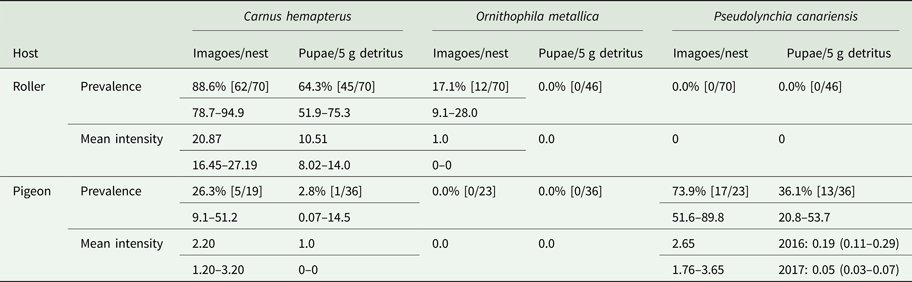
The prevalence and intensity of imagoes of Carnus in rollers’ nests are high. Correspondingly, the prevalence and intensity of puparia are also high (Table 1).
Prevalence and mean intensity (with 95% CIs and number of nests sampled in square brackets) of imagoes and pupae of three ectoparasitic flies, Carnus hemapterus, Ornithophila metallica and Pseudolynchia canariensis, on nests of two bird species, the European roller and the Rock Pigeon (data from 2016 and 2017 pooled except for the intensity of pupae of P. canariensis in pigeon nests)

Pigeons seem to be less attractive than rollers for Carnus, given that both the prevalence and intensity of imagoes per infected nest are significantly lower (prevalence, Fisher test: P < 0.001, intensity: bootstrap 2-sample t-test: t = 6.8, P < 0.001, n = 19, 70). Importantly, the prevalence of carnid puparia in pigeon nests is more than nine times smaller than the prevalence of Carnus imagoes in nestling pigeons and a single puparium was found in samples of 36 nests (Table 1).
Ornithophila metallica
The prevalence of imagoes in rollers is ca. 17% and we found a mean intensity of one fly per infected nest. In contrast, we did not find a single puparium in samples from 46 roller nests (Table 1).
Pigeons were not infected by Ornithophila metallica: neither imagoes nor puparia were found in nestling pigeons and nests (Table 1).
Pseudolynchia canariensis
No imago or puparium were found in nestling rollers or nests (Table 1). In contrast, the prevalence of imagoes on nestling pigeons was high as it was the intensity of imagoes (mean 2.65 flies per nest, range 1–6). We also found that at least 36% of the nests harboured Pseudolynchia puparia. The intensity of puparia in pigeon nests varied significantly between years (bootstrap t-test: t = 2.6, P = 0.04, n = 10, 3) (Table 1).
Discussion
Here, we provide information about the parasitization of three allegedly generalist ectoparasitic flies on two secondary hole-nesting bird species whose nesting environments are ecologically similar. Whereas these parasitic flies are widely distributed we were unable to find detailed information about their parasitic load on our study species or on other bird species (see below). Data on puparia in the nests are even scanter so that comparisons are done only when information was found. Thus, our data contribute to a better knowledge of the epidemiology of these common parasites. Moreover, we compared the parasitization pattern of these ectoparasitic flies considering both the prevalence and abundance of the infective, imaginal stage and the puparial stage on both bird species. In some cases (e.g. for Carnus in rollers, for Pseudolynchia in pigeons and rollers and for Ornithophila in pigeons), the pattern observed for imagoes and puparia was consistent whereas in other cases (e.g. Carnus in pigeons and Ornithophila in rollers) host preferences inferred from imagoes differed from the ones suggested by puparia.
All three parasite species have been frequently quoted as generalist ones. Carnus has been reported parasitizing 64 host species (including the roller and the pigeon) from 24 avian families from raptors to passerines (Grimaldi, Reference Grimaldi1997; Brake, Reference Brake2011 and references therein). Similarly, although Pseudolynchia canariensis shows preference for Columbiformes, it has been described attacking many other bird species, including the genus Coracias (Maa, Reference Maa1966, Reference Maa1969). Klei and Degiusti (Reference Klei and Degiusti1975) and references therein report lack of host specificity in laboratory colonies. Ornithophila metallica was classified by Maa (Reference Maa1969) in the group of louse flies with a very wide host range, citing this parasite species in 134 bird genera, including the genus Coracias and two Columbidae. In our study area, rollers and pigeons commonly breed interspersed, frequently at short distances from each other and even using successively the same cavities. So, detection of each parasite in both bird species would be expected. Yet, our results suggest strong host preferences and rejections. Considering the parasitic stage we found that: (i) Carnus prefers rollers over pigeons. The high prevalence and parasitic load of imagoes in nestling rollers found in this study agree with previous information (Václav et al., Reference Václav, Calero-Torralbo and Valera2008, see also Soltész et al., Reference Soltész, Seres and Kovács-Hostyánszki2018 for other species). We were unable to compare our results on pigeons since, to our knowledge, there is no published information; (ii) adult Pseudolynchia flies were frequently found on nestling pigeons but never on nestling rollers. Pigeons are known to be a preferred host of this louse fly, and the load of adult flies per nest in our study area is within the range reported for the species (Maa, Reference Maa1966; Adang et al., Reference Adang, Oniye, Ezealor, Abdu, Ajanusi and Yoriko2009, but see Amaral et al., Reference Amaral, Bergmann, Silveira, dos Santos and Krüger2013 for a higher load). Concerning rollers, we could find only a record of a Coracias sp. parasitized by P. canariensis (Maa, Reference Maa1966); (iii) adult Ornithophila flies were never recorded in pigeons but they were found parasitizing nestling rollers in ca. 20% of nests. Again, comparisons of our results are limited by the scant data available. These results therefore suggest that the low host specificity reported for these flies cannot be generalized.
In four out of six study cases (three parasites and two hosts) the information provided by the prevalence and abundance of puparia of each parasite in each host nest agrees with the one obtained from imagoes on nestling hosts: (i) parallel to imagoes, Carnus puparia are abundant in rollers nests (see also Valera et al., Reference Valera, Veiga, Sandoval and Moreno2018); (ii) the occurrence of Pseudolynchia puparia in pigeon nests is compatible with the occurrence of imagoes in nestling pigeons; (iii) the absence of Pseudolynchia imagoes on nestling rollers agrees with the nil abundance of puparia in rollers nests; and (iv) similarly, the absence of Ornithophila imagoes on nestling pigeons matches with the absence of puparia in the nests. In these cases, clear and consistent preference/rejection criteria can be deduced.
In contrast, for two other systems, we found that host choice by the imago did not correspond with the occurrence of the puparial, non-parasitic stage in the host’ nest. Carnid flies showed a moderate prevalence in pigeon nests (26%) whereas the occurrence (both prevalence and abundance) of puparia in the nests is very low. Pigeons often nest in cavities previously occupied by other birds, most commonly rollers that usually contain diapausing carnid puparia. Therefore, parasitization of the nestling pigeons by Carnus is very likely the result of the use of cavities infected with diapausing puparia (i.e. involuntary host shifting, see Calero-Torralbo and Valera, Reference Calero-Torralbo and Valera2008). Since the amount of puparia in rollers nests can be very high (e.g. here we found ca. 10 puparia/5 g and more than 0.5 kg of detritus can accumulate in a roller nest during a breeding season) and the mean intensity of adult flies in nestling pigeons is very low, we suspect that freshly emerged flies in pigeon nests migrate in search of other host species and that nestling pigeons are, in fact, rejected by Carnus. Similarly, Ornithophila flies were relatively common in roller nests and the parasitic load found (1 fly/nest) is probably underestimated (Maa, Reference Maa1969 reports that the highest density per infested bird was three flies). However, no puparium was found in any nest during two breeding seasons.
It could be argued that our sampling effort has not been intense enough to detect parasites in some cases. However, we think that our results are reliable because: (i) the number of sampled nests and nestlings of both species is appropriate and the results for both breeding seasons are consistent in nearly all cases; (ii) subsequent monitoring of the nestlings of both species for other purposes did not render different results; and (iii) we did not find Carnus, Ornithophila or Pseudolynchia imagoes emerging from non-monitored, stored detritus of pigeon and roller nests, respectively whereas we did record emergence of Pseudolynchia from stored pigeon nest detritus.
The cases where host suitability deduced from the occurrence of the infective and non-infective phases differs suggest that host compatibility filters occur at the later stage of the parasite. Pigeon nests does not seem a suitable environment for Carnus because, in contrast to rollers nests: (i) organic material (e.g. insect remains) is scarce in the nest so that food for the saprophagous larvae is probably scant, (ii) the nest substratum is probably adverse for Carnus eggs, larvae and puparia. Dung of nestling pigeons acts to cement the nesting material together into a sturdy adobe-like mound that has also been reported to inhibit the development of some ectoparasites (Johnston and Janiga, Reference Johnston and Janiga1995). Thus, the tiny eggs and larvae of Carnus can easily get embedded in the faeces of pigeons. In this case, adult Carnus flies are probably physiologically able to feed on nestling pigeons but parasite fitness is negatively affected given that the nest may jeopardize egg, larval and/or puparia survival. Rejection of pigeon as hosts by adult carnid flies (suggested by the very low load) is consistent with the unsuitability of this species for other life stages of the parasite. The misleading prevalence of adult flies on pigeons should be interpreted as an indirect consequence of other ecological pressures (nesting behaviour of pigeons when nest sites are limiting, Václav et al., Reference Václav, Calero-Torralbo and Valera2008).
Concerning Ornithophila, we ignore the reasons why puparia are absent in roller nests. We do not think that the reasons given for Carnus in pigeon nests also hold for Ornithophila since louse flies lay their pupae in crevices and under layers of nest material (pers. obs. on Pseudolynchia, see also Waite et al., Reference Waite, Henry and Clayton2012). Temperature is known to play an important role in puparial development of Pseudolynchia canariensis (Klei and Degiusti, Reference Klei and Degiusti1975; Mandal, Reference Mandal1989) and it could also be the case for Ornithophila. Since the insulation ability of nest boxes is poor, with oscillations above 30 °C within one day occurring frequently in our study area (Amat-Valero et al., Reference Amat-Valero, Calero-Torralbo, Václav and Valera2014), it could be that artificial breeding places such as nest boxes are unsuitable for development of louse flies. Interestingly, an exhaustive study of dipteran assemblages in nests boxes used by different bird species did not record hippoboscid flies (Soltész et al., Reference Soltész, Seres and Kovács-Hostyánszki2018). Alternatively, predation could account for the absence of puparia in the nests. Kaunisto et al. (Reference Kaunisto, Raunismaa, Kortet and Ylönen2016) found remarkable predation rates of deer ked (Lipoptena cervi) puparia presumably by lizards, spiders, harvestmen (Opiliones) and Formicinae-ants. This could also be the case for Ornithophila puparia since ants are frequently found in roller nests. More research is necessary to highlight the requirements of Ornithophila and the likely filters imposed by its host species and/or their close environment.
The current debate about the terms generalist and specialist warns about several flaws such as the ambiguous definition of the term or the problem raised by the abundance of cryptic species in many taxa (Loxdale and Harvey, Reference Loxdale and Harvey2016). Our study suggests that the adult stages of these allegedly generalist parasites are more specialist than reported. We also suggest that the host range can differ among different phases of a parasite and that the requirements of some stages can be particularly restrictive (see also Dapporto and Dennis, Reference Dapporto and Dennis2013). Thus, it is not only that simple species records are not enough to determine whether a parasite is a true host generalist (McCoy et al., Reference McCoy, Léger and Dietrich2013) but also that different phases of the parasite should be considered to define an organism selective environment.
Acknowledgements
Fran Moyano (Universidad de Almería) supported this research and gave useful comments. José Fulgencio Gálvez helped with the processing of samples. Junta de Andalucía kindly provided permits to sample birds’ nests.
Financial support
F.V. received financial support from the Spanish Ministry of Economy and Competitiveness (grant no. CGL2014-55969-P) and the European Regional Development Fund. J.V. was funded by the Spanish Ministry of Economy, Industry and Competitiveness by means of a predoctoral grant (BES-2015-075951).
Ethical standards
Trapping and handling of birds undertaken in this study was approved by the Dirección General de Gestión del Medio Natural, Consejería de Medio Ambiente, Junta de Andalucía.
Conflicts of interest
None.