Introduction
Osteoporosis is characterized by decreased bone strength, as signified by low bone mineral density (BMD) and vertebral and non-vertebral fragility fractures. A high rate of osteoporosis and osteoporotic fractures in patients suffering from schizophrenia was first reported about 20 years ago (Huston & Bloom, Reference Huston and Bloom1975; Higuchi et al. Reference Higuchi, Komoda, Sugishita, Yamazaki, Miura, Sakagishi and Yamauchi1987; Delva et al. Reference Delva, Crammer, Jarzylo, Lawson, Owen, Sribney, Weir and Yendt1989; Abraham et al. Reference Abraham, Friedman, Verghese and de Leon1995, Reference Abraham, Friedman and Verghese1996; Al-Adwani, Reference Al-Adwani1997). Halbreich et al. (Reference Halbreich, Rojansky, Palter, Hreshchyshyn, Kreeger, Bakhai and Rosan1995) reported decreased BMD in psychiatric patients, primarily in men suffering from schizophrenia, but also in patients with major depression, also primarily in men. Osteoporosis or low bone mass and/or decreased BMD in patients with schizophrenia has been attributed to a variety of factors such as polydipsia and significant hypercalciuria (Baastrup et al. Reference Baastrup, Christiansen and Transbol1980; Delva et al. Reference Delva, Crammer, Jarzylo, Lawson, Owen, Sribney, Weir and Yendt1989), nicotine and alcohol abuse (Lindholm et al. Reference Lindholm, Steiniche, Rasmussen, Thamsborg, Nielsen and Brockstedt-Rasmussen1991; Moniz, Reference Moniz1994; Slemenda, Reference Slemenda1994), lack of physical activity, inadequate diet as well as a lack of ultraviolet exposure and/or vitamin D due to frequent and long-lasting periods of hospitalization. Furthermore, osteopenia and/or osteoporosis have been attributed to antipsychotic drug-induced hyperprolactinaemia and/or secondary hypogonadism, which may contribute to excessive bone loss in psychiatric patients (Meaney & O'Keane, Reference Meaney and O'Keane2003). Finally, other drugs widely used in patients with schizophrenia, such as lithium (Plenge & Rafaelsen, Reference Plenge and Rafaelsen1982; Mak et al. Reference Mak, Shek, Chow, Wing and Lee1998), carbamazepine or valproate (Sheth et al. Reference Sheth, Wesolowski, Jacob, Penney, Hobbs and Bodensteiner1995; Feldkamp et al. Reference Feldkamp, Becker, Witte, Scharff and Scherbaum2000; Farhat et al. Reference Farhat, Yamout, Mikati, Demirjian, Sawaya and El-Hajj Fuleihan2002), may have a negative impact on bone health.
Osteoporosis is described as a disease of impaired homeostatic regulation of the bone. Bone is constantly undergoing change and remodelling processes due to the activity of bone-forming cells, the osteoblasts, and bone-restoring cells, the osteoclasts. Excess bone resorption at the expense of bone formation results in osteopenia and/or osteoporosis. However, osteoclastic activity is directly coupled to osteoblastic activity (‘coupling’); a discontinued coupling mechanism is a condition of osteoporosis.
Bone formation and resorption are under the control of several circulating hormones including sex steroids, oestrogens, androgens, vitamin D and parathyroid hormone (PTH), as well as local factors such as cytokines and growth factors. Some hormones are affected by schizophrenia itself or by specific medication, especially antipsychotics (Halbreich & Palter, Reference Halbreich and Palter1996; Naidoo et al. Reference Naidoo, Goff and Klibanski2003). A major parameter for bone metabolism is PTH, which stimulates bone resorption and inhibits bone formation (Poole & Reeve, Reference Poole and Reeve2005). It is essentially involved in regulating calcium metabolism.
Vitamin D, in particular its metabolite 25-hydroxyvitamin D (25-OH-D), has an important impact on bone resorption. Vitamin D concentrations are not only affected by diet, but also to a significant degree by UV exposure. Low levels of 25-OH-D might cause secondary hyperparathyroidism.
Oestrogen is a well-known and prominent factor in bone metabolism. Hypo-oestrogenism leads to an increased risk for osteoporosis. Oestrogen inhibits osteoclastic activity while increasing gene expression in osteoblasts and increasing the level of type I collagen produced by osteoblast cells. Furthermore, oestrogen affects the synthesis of 25-OH-D and the absorption of calcium in the intestine. By contrast, there are fewer studies of testosterone in the context of bone metabolism. However, due to its effect on osteoblastic activity, low levels of testosterone are correlated with osteopenia and/or osteoporosis. In the same way, dehydroepiandrosterone (DHEA) and its sulfate (DHEAS), important androgen as well as oestrogen precursor, are known to correlate with BMD (Basci et al. Reference Basci, Kosa, Borgulya, Balla, Lazary, Nagy, Horvath, Speer and Lakatos2007).
In the 1980s, the first case reports and case series describing a possible connection between prolactin (PRL)-raising antipsychotic drugs and osteoporotic fractures and/or osteoporosis were published (Rogers & Burke, Reference Rogers and Burke1987; Abraham et al. Reference Abraham, Friedman, Verghese and de Leon1995, Reference Abraham, Friedman and Verghese1996; Meaney & O'Keane, Reference Meaney and O'Keane2003). Several clinical trials have addressed this issue since that time (Keely et al. Reference Keely, Reiss, Drinkwater and Faiman1997; Abraham et al. Reference Abraham, Halbreich, Friedman and Josiassen2002, Reference Abraham, Paing, Kaminski, Joseph, Kohegy and Josiassen2003; Bilici et al. Reference Bilici, Cakirbay, Guler, Tosun, Ulgen and Tan2002; Becker et al. Reference Becker, Liver, Mester, Rapoport, Weizman and Weiss2003; Meaney & O'Keane, Reference Meaney and O'Keane2003, Reference Meaney and O'Keane2007; Meaney et al. Reference Meaney, Smith, Howes, O'Brien, Murray and O'Keane2004; Maric et al. Reference Maric, Popovic, Jasovic-Gasic, Pilipovic and van Os2005; O'Keane & Meaney, Reference O'Keane and Meaney2005). A more recent review of the effects of psychiatric disorders and psychotropic medications on PRL levels and bone metabolism, based on a PubMed search provided by Misra et al. (Reference Misra, Papakostas and Klibanski2004), indicates that BMD tends to be lower and rates of osteoporotic fractures higher in patients taking PRL-raising antipsychotics. However, the results are not consistent and some studies and case reports did not find decreased BMD secondary to hyperprolactinaemia in patients suffering from schizophrenia (Rogers & Burke, Reference Rogers and Burke1987; Abraham et al. Reference Abraham, Paing, Kaminski, Joseph, Kohegy and Josiassen2003; Becker et al. Reference Becker, Liver, Mester, Rapoport, Weizman and Weiss2003; Howes et al. Reference Howes, Wheeler, Meaney, O'Keane, Fogelman, Blake, Murray and Smith2005).
The present study was conducted because only limited empirical evidence is available from larger patient group studies and data are still controversial. The objective was to investigate whether bone turnover and BMD are associated with circulating sex hormone levels in women suffering from schizophrenia.
Method
Subjects
A total of 72 premenopausal women with schizophrenia were included in this study. All patients had been admitted consecutively to the psychiatric unit at the University Hospital of Heidelberg. All participants were Caucasian. The mean age of the sample was 33.8 years [standard deviation (s.d.)=6.5 years, range 20.5–45.3 years]; the mean duration of illness was 8.1 years (s.d.=6.3 years, range 0–21.1 years) and the mean number of hospitalizations was 3.3 (s.d.=4.5, range 1–22). All patients had been diagnosed with schizophrenia according to the criteria of DSM-IV (APA, 1994; chapters 295.0–295.9) and the International Classification of Disease (ICD)-10 (WHO, 1993; chapters F20.0–F20.9). Of the women, 49% were smokers. All but four patients were receiving some kind of antipsychotic medication. Some patients were receiving more than one antipsychotic drug. One patient was receiving lithium and six patients were receiving a non-psychotropic drug for other medical reasons. Most patients were also taking other psychotropic substances such as anticholinergic medication, antidepressants, benzodiazepines, mood stabilizer, or a second antipsychotic drug. Eleven patients were receiving haloperidol, eight levomepromazine, seven clozapine, five flupentixol, and another five benperidol. In less than five patients, olanzapine, risperidone, perphenazine, sulpiride, fluphenazine, promethazine, pipamperone, chlorprothixene, prothipendyle, zotepine, clopenthixole, bromperidole, melperone, pimozide or thioridazine were administered.
Furthermore, a group of age-matched healthy women (n=71) was investigated (mean age 33.7 years, s.d.=6.3 years, range 20.9–45.9 years).
Measurements of BMD were performed in 59 out of 72 women with schizophrenia. Not all participants consented to the procedure. This subgroup did not differ from the entire sample in regard to age (mean 31.1 years, s.d.=6.2 years, range 19.3–45.0 years), duration of illness (mean 7.3 years, s.d.=5.5 years, range 0–20.1 years), number of hospitalizations (mean 3.3, s.d.=3.2, range 1–14) and diagnoses.
Laboratory analyses
To assess bone resorption, urinary excretion of total pyridinoline (PYD) and total deoxypyridinoline (DPD) was measured using high-performance liquid chromatography (Pratt et al. Reference Pratt, Daniloff, Duncan and Robins1992; Seibel et al. Reference Seibel, Baylink, Farley, Epstein, Yamauchi, Eastell, Pols, Raisz and Gundberg1997; Seibel & Woitge, Reference Seibel and Woitge1999; Seibel, Reference Seibel2003). Intra-assay accuracy was between 98% and 103% for PYD and between 96% and 104% for DPD. Inter-assay accuracy ranged between 96% and 103% for PYD, and between 95 and 103% for DPD. Detection limit was 25 nmol/l for PYD and 10 nmol/l for DPD. Serum osteocalcin (OC) was determined as a marker of bone formation by luminescence immunoassay (LIA; Brahms Diagnostica, Berlin, Germany). Serum intact PTH (iPTH) levels were measured using LIA (Chiron Diagnostics, Fernwald, Germany). Serum 25-OH-D levels were measured by radioimmunoassay (INCSTAR Corporation, Stillwater, MN, USA). Serum levels of 17β-oestradiol (E2), PRL, testosterone, follicle-stimulating hormone (FSH), luteinizing hormone (LH) and DHEAS were determined by an automated immunoassay analyser based on electrochemiluminescence detection technology (Roche Elecsys 2010 immunoassay analyser; Erler, Reference Erler1998). For the commercial assay kits, variances and sensitivities were found to be in the range as indicated by the suppliers.
Serum E2 levels, along with all other sex hormones, were only measured during the mid-cycle phase and/or peri-ovulatory phase of the menstrual cycle (cycle days 10–12). Except for testosterone, sex hormones were measured in the patients only. All blood samples were taken in the morning between 08:00 and 09:00 hours.
Assessment of BMD
BMD at the femoral neck and lumbar spine (L1–L4) was measured by dual-energy X-ray absorptiometry (DEXA) with a Lunar-DPXL device (Lunar Corporation, Madison, WI, USA). The DEXA scan is a precise and widely used method of assessing BMD. Results were expressed as both absolute values (g/cm2) and as T-scores. The T-scores compare the patient's results with standardized BMD values for ethnic- and sex-specific groups.
Statistical analyses
In addition to standard descriptive statistics, including Pearson correlations, t tests were applied to test for the differences between the patients with schizophrenia and the controls. Visual inspection of the data distribution did not reveal large deviances from a normal distribution. Since t tests are very robust against small violations of the normality assumption and have greater statistical power than non-parametric tests, we used t tests. All statistical analyses were calculated using Stata statistical software, release 9.1 (Stata Corporation, College Station, TX, USA).
Results
Laboratory parameters
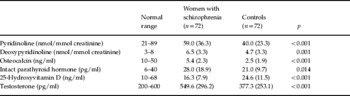
Laboratory parameters of the patient sample and the control group are shown in Table 1. Significantly higher values were seen in women with schizophrenia in both urinary PYD and DPD (p<0.001) and in serum OC (p<0.001). Serum iPTH was within the normal range for both groups, but significantly higher in women with schizophrenia (p=0.022). Serum 25-OH-D was significantly lower in the patient group (p<0.001) but still within the normal range for both groups.
Markers of bone metabolism and testosterone in women with schizophrenia and in age- and sex-matched healthy controls

For the women with schizophrenia and the control subjects, values are given as mean (standard deviation).
A significantly higher testosterone serum level was detected in women with schizophrenia than in the controls (p<0.001), although the mean testosterone level of both groups was within the normal range.
As shown in other samples of premenopausal women with schizophrenia (see Bergemann et al. Reference Bergemann, Mundt, Parzer, Nagl, Eckstein-Mannsperger, Haisch, Salbach, Runnebaum and Resch2005, Reference Bergemann, Parzer, Runnebaum, Resch and Mundt2007), pronounced hypo-oestrogenaemia was observed in the subgroup of 59 patients during the peri-ovulatory phase of the menstrual cycle (days 10–12). The mean E2 level was 40.6 pg/ml (s.d.=27.5 pg/ml) and therefore well below the lower limit of the normal range, which is between 150 and 350 pg/ml. LH was lower in the patient group, which is in line with the results in the aforementioned samples (mean 4.9 mU/ml, s.d.=5.1 mU/ml, normal range 30–80 mU/ml; Bergemann et al. Reference Bergemann, Mundt, Parzer, Nagl, Eckstein-Mannsperger, Haisch, Salbach, Runnebaum and Resch2005, Reference Bergemann, Parzer, Runnebaum, Resch and Mundt2007). FSH (mean 7.0 mU/ml, s.d.=3.8 mU/ml, normal range 2–4 mU/ml) and DHEAS (mean 3596 ng/ml, s.d.=1.792 ng/ml, normal range 350–4300 ng/ml) were both in the normal range. In contrast, PRL was significantly elevated. This could be expected for patients under medication with predominantly conventional antipsychotics (mean 1628 mU/ml, s.d.=1212 mU/ml, normal range 70–410 mU/ml). Misdiagnosis of hyperprolactinaemia due to macroprolactinaemia was prevented by applying polyethylene glycol-precipitation controls. As expected, PYD and DPD correlated highly (r=0.88, p<0.001). Positive significant correlations could also be observed between PYD and OC (r=0.42, p=0.034) and DPD and OC (r=0.35, p=0.038), the latter correlation being somewhat lower. Furthermore, a negative correlation could be shown between iPTH and 25-OH-D (r=−0.33, p=0.012), a result which was expected. No further relevant correlations between the markers of bone metabolism and the hormones in the patient group were detected; however, positive correlations between testosterone and DHEAS (r=0.75, p<0.001) and E2 and LH (r=0.47, p=0.002) were found, whereas no significant correlation was found between E2 and PRL (r=−0.20, p<0.197).
BMD
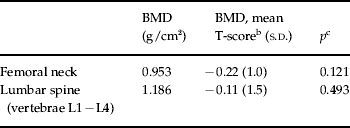
The laboratory parameters reported above indicate high bone turnover. Markers for bone resorption and formation were increased compared with the controls. However, in the subgroup of 59 patients in whom BMD was measured, BMD was within the normal range (Table 2). BMD was calculated as absolute value and mean T-score; the two values correlate at r=0.995.
BMDFootnote a in premenopausal women with schizophrenia (n=59)
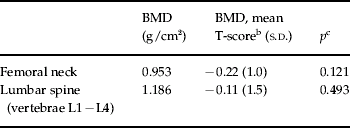
BMD, Bone mineral density; s.d., standard deviation.
a By dual-energy X-ray absorptiometry (Lunar-DPXL; Lunar Corporation, Madison, WI, USA).
b Indicates deviation from the norm.
c Comparison with healthy, ethnic- and age-matched controls.
As expected, a high and significant correlation was detected between femoral neck and lumbar spine BMD (r=0.62, p<0.001). However, no significant correlation was shown between the markers of formation and/or resorption, except a tentative significant correlation between femoral neck BMD and DPD (r=0.36, p=0.056). No significant correlation was found between E2, DHEAS, PRL, LH and FSH levels and BMD measurements. A positive correlation between testosterone and femoral neck BMD of r=0.28 (p=0.080) was observed; however, these expected correlations did not reach statistical significance.
A moderate but remarkable correlation, with significance at the 5% level, was observed in regard to lumbar spine BMD and the duration of illness (r=0.27, p=0.044), i.e. the longer the duration of illness, the higher the lumbar spine BMD. No correlation, however, was seen in regard to the duration of illness and femoral neck BMD (r=0.05, p=0.702). Only a moderate negative correlation was found between age and femoral neck BMD (r=−0.20); this correlation might be plausible, but was not significant (p=0.129). By contrast, there was no correlation between age and lumbar spine BMD (r=0.05, p=0.702).
Discussion
Our study shows that bone turnover is accelerated, in association with normal bone mass, in young menstruating women suffering from schizophrenia. This result is not dependent on the duration of illness. There is even a moderate positive correlation between the duration of illness and lumbar spine BMD, in contrast to what can be expected. While high bone turnover in elderly women usually results in bone loss, this was not observed in the sample presented here. However, the underlying pathological mechanism for our results still must be defined.
Furthermore, we could not find a correlation between age and BMD; however, this result could be explained by the limited age range – all patients included in this study were between 20 and 45 years of age and premenopausal.
Our results are in line with previous findings from Abraham et al. (Reference Abraham, Paing, Kaminski, Joseph, Kohegy and Josiassen2003). They studied a group of 14 women with schizophrenia who were treated with either olanzapine (n=8) or risperidone (n=6). They could not find an association between elevated PRL and bone mineral loss over time but a higher rate of bone turnover in patients with high PRL levels. Our results also correspond to findings from Fujimaki et al. (Reference Fujimaki, Kurabyashi, Ootani, Yamamoto, Yasuda and Tanaka1994), who showed that the degree of coupling of bone formation and resorption increased in a non-psychiatric sample of 21 hyperprolactinaemic women.
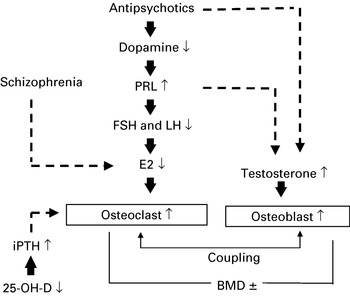
It is well known that some antipsychotic drugs cause hyperprolactinaemia (Green & Brown, Reference Green and Brown1988; Petty, Reference Petty1999; Haddad & Wieck, Reference Haddad and Wieck2004; Hummer & Huber, Reference Hummer and Huber2004), especially the conventional antipsychotics, but also amisulpride and risperidone. PRL secretion is tonically inhibited by dopamine released from the hypothalamus into the tuberoinfundibular system. It acts at the D2 receptors on lactotroph cells of the anterior pituitary. Dopamine is the most relevant hypothalamic inhibitory factor in the regulation of PRL release (Naidoo et al. Reference Naidoo, Goff and Klibanski2003). Dopamine release via hypothalamic–hypophysial mechanisms may cause a decrease in E2, which may result in accelerated osteoclastic activity. However, schizophrenia itself may be associated with and/or cause a decrease in E2 (Bergemann et al. Reference Bergemann, Mundt, Parzer, Nagl, Eckstein-Mannsperger, Haisch, Salbach, Runnebaum and Resch2005). An increase in testosterone, via coupling mechanisms and/or direct effects of antipsychotics or PRL, may promote osteoblastic activation (Kasperk et al. Reference Kasperk, Fitzsimmons, Strong, Mohann, Jennings, Wergedal and Baylink1990). Both mechanisms may help maintain bone mass despite high bone turnover (Fig. 1). Furthermore, secondary hyperparathyroidism due to vitamin D deficiency may lead to osteoclastic activation, and, via the coupling mechanism, to high bone turnover.
Possible mechanisms of maintaining high bone turnover in women suffering from schizophrenia. PRL, Prolactin; FSH, follicle-stimulating hormone; LH, luteinizing hormone; E2, 17β-oestradiol; iPTH, intact parathyroid hormone; 25-OH-D, 25-hydroxyvitamin D; BMD, bone mineral density.

Nicotine has a direct toxic effect on osteoblasts, and patients suffering from schizophrenia have been shown to be heavy smokers (Goff et al. Reference Goff, Henderson and Amico1992). In the present sample, about 53.8% of the patients were smokers.
There are some limitations of the present study that should be discussed. First of all, with the exception of testosterone, sex hormones were only measured in patients but not in the controls. The values for E2, LH, FSH and PRL of the patients were outside the upper or lower limits of the normal range, so that a significant difference from healthy controls can be assumed. Nevertheless, this fact has to be considered when assessing the results.
The fact that sex hormone-binding globulin was not measured is a further limitation. Of the total testosterone, 60–70% is bound to albumin and about 30% to SHGB. Fluctuations of SHGB might have an effect on the free testosterone fraction which normally amounts to approximately 2% of the total testosterone.
Furthermore, some variables were controlled, such as sex, age and duration of disease, but it was not possible to elucidate the prior drug history. In particular, the total amount of antipsychotic medication the patients have received since disease onset might be crucial. Other important factors that were not considered include the history of smoking, the rate of physical activity, and information on diet. Finally, weight was not considered. Weight is a protective factor for osteoporosis. As a large percentage of patients with schizophrenia are overweight (McEvoy et al. Reference McEvoy, Meyer, Goff, Nasrallah, Davis, Sullivan, Meltzer, Hsiao, Stroup and Lieberman2005), this might compensate possible risk factors for osteoporosis in patients with this disease.
There are many factors involved in the pathogenesis of osteoporosis, and no single explanation for changes in BMD can be given. Not only do various factors affect bone metabolism, but a variety of interactions occur between those factors relevant to the pathogenesis of osteoporosis.
Follow-up studies should determine whether high bone turnover is maintained during a longer duration of illness, and further studies should focus on patients with long-lasting schizophrenia and those suffering from amenorrhoea. These studies should also include men. In addition, the data should be confirmed in a larger group of patients with respect to the above-mentioned factors as well as to different medications and subgroups of schizophrenia.
Acknowledgements
This research was supported in part by the ‘Deutsche Forschungsgemeinschaft’ [DFG, ‘Sonderforschungsbereich 258: Indikatoren und Riskomodelle für Entstehung und Verlauf psychischer Störungen’ (Indications and risk models for the development and course of mental disorders)]. We thank Markus J. Seibel, ANZAC Research Institute, Laboratory for Bone Biology, for his assistance in interpreting the results, and Christian Kasperk for performing the BMD measurements at the Internal Medicine Clinic I (Endocrinology and Metabolism), University of Heidelberg. We are also grateful to Jürgen Kopitz who has supported the work with substantial comments. We thank Manoshi Pakrasi for her excellent help in patient recruitment and sample collection, and Sherryl Sundell who assisted with the proofreading of the manuscript.
Declaration of Interest
None.