Madness seized Baku. And madness seized Yerevan. Somebody predicted, … probably, Nostradamus, that … the end of the twentieth century would be horrific. (Voyskunskiy Reference Voyskunski2000, 233)
The city (of Baku) [appeared] as though it were captured by some wild nomads. (Voyskunskiy, Maiden Dreams Reference Voyskunski2000, 215)
“Zadnii gapyny pets” was a well-known Baku joke of the Soviet period.Footnote 1 The phrase consists of words from three different languages: Zadnii means “back” in Russian, gapyny means “door” in Azeri, and pets is “open” in the Karabakh dialect of Armenian. The joke refers to the scene when crowds of people gathered at the bus stations and someone would yell “Zadnii gapyny pets” to a bus driver, requesting that he open the back door in order to let passengers inside the bus. The sentence embodies the multicultural spirit and multilingual vernacular of the city, a diversity that no longer exists.
The article examines a novel by the Baku-born Jewish writer Evgeniy Voyskunskiy. The book, published in 1995, is the very first novel about the tragic consequences of the ethnic conflict for the city (a place where I was also born and grew up). Through the lives of its heroes, Voyskunskiy’s Maiden Dreams reveals how after a series of bloody pogroms, starting in February 1988 in Sumgait and continuing in Baku itself in January 1990, the city of Baku lost its multicultural and cosmopolitan multi-ethnic spirit and turned into a place with no space for “others.”Footnote 2Maiden Dreams is the story of Baku from the beginning of the 20th century to the turbulent period late in the century when it fell into violence and chaos. I will examine the novel from both literary and historical perspectives and compare its narrative with similar books, memoirs, and works of political scientists.
Literature creates vivid images of historical events that can be engraved in the consciousness of individuals for years to come. Non-scholars might still learn a lot from the great novels of Salman Rushdie, Franz Werfel, Orhan Pamuk, Anatoly Kuznetsov, and Akram Aylisli.Footnote 3 Literary works can also serve as media for victims to tell the world about their personal experiences during periods of historical turmoil. It is possible that Voyskunskiy was visiting Baku at that time and wrote his book based on his own experiences and eyewitness accounts, or perhaps the novel resulted from conversations with his friends and family members. But in either case, it is an important supplementary source for contemporary history of ethnic conflicts in the south Caucasus. His Maiden Dreams, as well as Akram Aylisli’s Reference Aylisli2012 novel Das Yuxular (Stone Dreams), are more valuable contributions to the popular understanding of the Karabakh conflict and the shocking events in Baku than are works of many political scientists and scholars. Such novels are important literary reactions to this pivotal juncture that forever changed societal standards of the city and the whole south Caucasus.
The Novel and Its Characters
Born in Baku in 1922, World War II veteran and graduate of the elite school for Soviet writers, the Maxim Gorky Institute of Literature, Voyskunskiy is generally known in the former Soviet Union as a science fiction writer (Figure 1). Maiden Dreams, however, is quite different from Voyskunskiy’s other novels. This book is about actual, true events as they happened in Baku in the late 1980s. The novel was the very first literary reaction to the Karabakh conflict, and was shortly followed by Afanasii Mamedov’s (Milkin) Na Krugi Khazra (In the Circle of Khazr [1998]), then later by Alekper Aliev’s Arutsh ve Zaur (Artush and Zaur [2009]), Aylisli’s Daş Yuxular (Stone Dreams [2012]), Maria Martirosova’s Fotografia na Pamiat (Photography to Remember Me By [2012]), Seymur Baycan’s Gugark (2013), and Eldar Badyrkhanov’s Mesiats Marsa (The Month of March [2013]) and Zhizn’ (Life [2016])
Eugenie Voyskunskiy, earlier known to readers as a science fiction writer and recipient of the Brothers Strugatskii’s International Book Award. The writer is pictured during his interview with Irina Golovanova on the television program Meetings at Peredelkino, April 8, 2016.

As it does in Aylisli’s novel, Voyskunskiy’s narrative shifts back and forth from the early 1900s to the late 1980s, unfolding the story through the lives of several different sometimes even controversial personalities. Their conversations are familiar to anyone who lived through the turbulent days that forever changed the course of their lives and the destiny of Azerbaijan and Armenia. At the center of the narrative is Julia (Iulia) Kalmykova (née Steiner), a woman of mixed German and Russian background. Apart from a short period during World War II and its aftermath, Julia has spent her whole life in Baku. As the daughter of a German man, she has to leave her hometown, fearing police persecution on the eve of the wartime deportation of Soviet Germans. Away, in Leningrad, she constantly pines for her hometown—for its streets, dialects, fruits, beaches, and even its winds. Therefore, after the war ends, Julia returns to Baku with her husband Sergei Bespalov.
Voyskunskiy depicts Bespalov as a controversial and ambiguous character. A hardline communist and propagandist, Bespalov works as a lecturer at the Knowledge (Znanie) society, whose mission is in part popularization of contemporary history and politics, which was generally controlled by the Communist Party. As the son of a priest, Bespalov could not enter the Air Force Academy and fulfill his dream of becoming a pilot. In his effort to prove his loyalty to the Soviet state, Bespalov renounces his own father, who loses his church and dies alone from alcoholism. Bespalov even refuses to attend his father’s funeral and writes articles praising the government’s decision to turn his father’s church into a storage space (Voyskunskiy Reference Voyskunski2000, 16). Bespalov even denounces his best friend’s father to the NKVD. In another scene, he confiscates a baptismal cross from a young sailor, nearly driving him to suicide (Voyskunskiy Reference Voyskunski2000, 167–173).Footnote 4 As a devoted dogmatist, by the end of the 1980s, Bespalov unquestionably accepts the official Azerbaijani version of history: that Karabakh is a “historical and indissoluble” part of Azeri territory. This causes heated debates with his Armenian friend Konstantin Avakov (Voyskunskiy 2000, 29, 63).Footnote 5
Like most Armenian residents of Baku, Konstantin Avakov tends to blame the conflict on both sides: on Azeris, for their decades of suppressing Armenian culture in Karabakh, and on Armenians in Armenia for making radical demands and irritating people in Azerbaijan, which thereby puts Armenians in Baku at risk. At this point, Voyskunskiy is reproducing what most Armenians and some others in Baku believed at that time.
Pavlik (Pavel) Goldberg, the husband of Julia’s daughter Nina, is a young, talented Jewish architect and also a Baku native. Unhappy in the USSR because of so-called “positive discrimination,” according to which authorities distribute the most lucrative positions and projects to ethnic Azeris outright rather than based on merit, Goldberg never considers leaving his hometown until the outbreak of anti-Armenian pogroms (Voyskunskiy Reference Voyskunski2000, 27).Footnote 6
Vladimir Avakov is the son of Konstantin and of Julia’s best friend, Elmira an Azerbaijani. He is an educated and talented young physician, and, as a man of mixed heritage, he finds himself unable to take sides in the conflict. Shortly before his tragic death, he meets and falls in love with a former classmate, Natasha, a half-Azeri and half-Jewish woman (Voysunskiy Reference Voyskunski2000, 220). People like Vladimir were especially vulnerable during these ethnic conflicts, being alienated by both sides; and he would have also felt very uncomfortable in central Russia in the wake of growing xenophobia after the disintegration of the USSR.
Naturally, there are also other characters in the novel, but Voyskunskiy in general focuses on these main personages, typical for that time and place, and leads his readers through their lives and through the bloody last days of the city that once was open and hospitable to all ethnic groups.
Baku Armenians and Bakuvians: Myth or Reality?
When the Karabakh conflict erupted and Armenians in Armenia began the miatsum (the struggle for unification of Karabakh with the Armenian SSR), this turned into a nightmare for those who lived in Baku.Footnote 7 The reaction in Azerbaijan was predictable: outrage. Sadly enough, the rage of the mobs was aimed at neighbors next door. But those who started this movement did not think about their compatriots in Baku. Former Baku resident Anna Astvatsaturian-Turcotte recalled in her memoirs that at the end of the 1980s, neither the people in Armenia nor the Armenian (then Soviet) government cared about the Baku Armenians (2012, 147). She also recalled that her mother was frightened upon hearing the news about the secession movement in Karabakh: “Why they don’t think about us?” she asked (Astvatsaturian-Turcotte Reference Astvatsaturian-Turcotte2012, 6). Yet, monoethnic societies remain oblivious to the problems of multiethnic ones.
The gap between the two Armenian communities is reflected in the novel through a conversation between two Armenian brothers, one who lives in Yerevan and “an honorable oil worker,” Samvel Galustian, who lives in Baku. The brother in Yerevan argues that Karabakh is crucial for Armenia’s future and national identity, while Samvel asks if their fellow citizens from Yerevan are ready to sacrifice their Baku compatriots for this goal (Voyskunskiy Reference Voyskunski2000, 220). In Afanasii Mamedov’s Na Krugi Khazra, Maya, a young Armenian woman, says to Afik Agamaliev (the main character and narrator) of her relatives in Yerevan: “They are as [much] mine as yours! We are nobody [for them]. We are Turkified.” (A. Mamedov Reference Baycan1998, 29). Most Armenians in Baku did not share the nationalist aspirations of their ethnic brothers in Armenia. Those who lived in Baku were more cosmopolitan, Russified, and about 40 percent of them considered Russian to be their primary language (Goskomstat SSSR 1989, 39).Footnote 8 Later (Voyskunskiy Reference Voyskunski2000, 251, 253), Samvel Galustian refuses to go to Armenia to his brother because the latter told Samvel that he does not speak proper Armenian. Some Armenians in Baku had Russian, Jewish, and even Azeri relatives and family members. As Thomas De Waal notes about old Baku and its community before the outbreak of pogroms and waves of violence, Baku had its own distinctive “national identity.” He notes that, for example, “Garry Kasparov, the former world chess champion born here of a Jewish father and an Armenian mother, when asked his nationality, used the Russian word Bakinets [Bakuvian]” (de Waal 2013, 99). Some Bakuvians were proud of their multiethnic origin and emphasized it frequently. Thus, former Baku resident Roald Reshetnikov, author of the U.S.-published memoir about the massacre in Baku (Reshetnikov Reference Reshetnikov2011), wrote that his father was half-Russian and half-Latvian and his mother was Jewish, while his wife is Armenian. Most of the Baku residents were very suspicious of more ethnically homogenous societies and did not want to leave their homeland. Another Baku native, Eldar Badyrkhanov, also a writer of mixed Lezgin, Armenian, and Russian origin, wrote in his 2013 novel about these tragic events. The narrator’s Grandmother Emilia says: “This is my city! How can I leave my hometown? … I don’t want to go to Armenia. There is only one nation there—the Armenians…. I like it when many different nationalities [live together], and I don’t like nationalists” (Badyrkhanov Reference Badyrkhanov2013, 7). A person of multiethnic background faces troubles in any homogeneous society, especially during turbulent times of history; perhaps literature can help us to understand this situation better than anything else. Later, in Armenia, the mother of the main charachter and a narrator in Mesiats Marsa encounters a flamboyant Armenian nationalist who boasts of his brutality against Azerbaijanis during the Karabakh war. When she asks him how people of mixed origin are supposed to act, he responds that they “should simply hang themselves” (Badyrkhanov Reference Badyrkhanov2013, 26).
De Waal noted that after the massacre in Sumgait, a group of Armenian survivors who gathered in the local Palace of Culture requested to be evacuated not to Armenia but to Russia. A Soviet military officer reported that, “No one that we spoke to at the time expressed a desire to fly to Armenia. They all asked for the Krasnodar, Stavropol, and Rostov regions.” When asked, “Why? They said, ‘No one in Armenia needs us. They don’t think of us as real Armenians; we are not real Armenians [to them]’” (de Waal 2013, 40). Some Bakuvians claimed that in Armenia they faced distrust, suspicion, and misunderstanding from the locals. Astvatsaturian-Turcotte recalled that after her family escaped to Armenia, she was pejoratively referred to by her secondary school classmates there as a bakvetsi (person from Baku) (Reference Astvatsaturian-Turcotte2012, 152). Her classmates used this derogatory term on many occasions. Neither they nor her teacher were willing to help or communicate with her because she was from Baku (Astvatsaturian-Turcotte Reference Astvatsaturian-Turcotte2012, 128, 152). Later, she adds about her stay in Armenia, “Now who do I belong to …where do I belong now? Nowhere” (Astvatsaturian-Turcotte Reference Astvatsaturian-Turcotte2012, 155).
The city of Baku itself is a character in Voyskunskiy’s novel. He leads us through the world where he was born and raised, filling the book with street names and facts about the city’s history. The novel thus gives its readers an opportunity to experience an atmosphere that has now forever disappeared. For example, while walking home, Julia reflects:
I think we are Bakuvians. In essence, we are special people. Very diverse in composition, which unites [us]…. And Sergei is right, we’re also united by a special spirit…. In Baku people speak in … a mixture of Russian and Azeri … and these old Baku yards full of the smell of cooking, of the hubbub of children, the screams of infants, sounds of grindstones, full of the smell of greenery and matsoni [local yogurt] … and this wolf-like howling of the nord [northern wind] and the wet breathing of the southern wind of moriana [wind off the sea]. (Voyskunskiy Reference Voyskunski2000, 147)
This sense of nostalgia for Baku, before pogroms, appears in many literary works. For example, Zulia (Zulfia), an Azeri character in Na Krugi Khazra, is resonant of Voyskunskiy’s Julia. In the 1980s she tells the main character and the narrator Agamaliev how much she misses her hometown during her studies in Leningrad. Like Julia, Zulia missed Baku, including the minarets of the Teze Pir [a mosque] and the island of Nargin, “which looks like huge fish protecting the entrance into Baku’s bay.” She remembers cracked pomegranates “bleeding blood” (A. Mamedov Reference Baycan1998, 9–10) (Figure 2). At the very beginning of the conflict, most of the Armenian residents of the city did not want to leave, and literature shows this through various characters. In Eldar Badirkhanov’s Mesiats Marsa, the narrator’s Armenian grandfather Grigori, a World War II disabled veteran, is being expelled from Baku and cannot understand what is going on in his hometown where he grew up, worked, and built his own house from the ground up:
[But] it was no longer his Baku anymore. Baku could not be so vicious, such a predatory city. Baku was [now] a different place. Baku used to be an absolutely different city. The last couple of years it was shaken down, through the walls of the building like monstrous cockroaches run cracks and this morning the house together with the city felt under the ground. (Badyrkhanov Reference Badyrkhanov2013, 9)
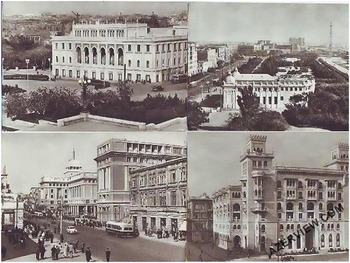
Old Baku.

After the outbreak of the conflict and the exodus of most of the members of the non-titular nationality, the city became a different world. In another novel by Afanasii Mamedov (Frau Shram [2002]), a young Azeri woman asks a main Jewish character, Ilya Novogrudtskii, why he is not returning to the city where he was born. In response, Novogrudtskii recollects that, unlike the present, the former Baku was friendly and cosmopolitan, “when Jews did not think about giving up [their flats] on Torgovaia [Street] and Lieutenant Schmidt [Street]Footnote 9 for the Promised Land and Armenians did not even think about pogroms” (A. Mamedov Reference Mamedov2002, 277).
Those who came to Baku at the beginning of the 21st century could not fail to see these changes. Vitaly Vulf, the famous Russian Jewish cinema, art, and theater critic, noted that when he visited the city in 2006, he noticed many positive changes: new buildings, clean streets, and the shining windows of the offices of leading international companies. Yet the city was also very different, with fewer non-Azeris and fewer faces of the intelligentsia on the streets (Vulf Reference Vulf2011; see also A. Mamedov Reference Mamedov2013).
Remarkably, the idea of Baku as having been a multi-ethnic and international city with its own identity has been challenged by some Western scholars. Thus, Bruce Grant claims that he heard this idea mostly in Russian, and from people who were in their fifties—from those who were born prior to the collapse of the Soviet Union. Grant also asserts that the idea of a “Baku community” comes from those who, allegedly, belonged to the post-Soviet intelligentsia—people who failed to adapt themselves to the economic realities of the end of the 20th and beginning of the 21st century. He writes, “Most Azeris never forgot what linguistic and social Russification meant for their republic, nor did they forget who had access to goods and services more than others” (Grant Reference Grant2010, 130). Grant Reference Grant2010 argues that under the USSR, Russians and Armenians controlled all key positions in the city and were in higher social positions relative to the native population of the republic. One of those whom he interviewed even told him that Russians were at the top, Armenians came next because they held most key government jobs, and Jews were among them too, while Azeris were on the bottom, ranking [even] behind the Lezgins (Grant Reference Grant2010, 131). Grant concludes that “internationalism” never came entirely by choice, and was enjoyed more by some than by others (2010, 131).
Meanwhile, Voyskunskiy tells us about Pavlik, who has never been commissioned for any important projects, such as the design of new hotels or malls, which the city’s planning bureau traditionally has assigned to ethnic Azeris. Pavlik designs only occasionally and only second-rank projects such as small pavilions or bookstores (Voyskunskiy Reference Voyskunski2000, 27). Though a fictional character, Pavlik does not think that he enjoys a better position than ethnic Azeris. Finding the “right position” for a person of “right ethnic origin” in multiethnic society and “choosing” between ethnicity and merit is a very ambiguous task. Voyskunskiy gives us another example. In the novel, Samvel Galustian’s immediate supervisor, from the Azeri Oil Exploration Bureau, nominates him for the highest Soviet medal: Hero of Socialist Labor. But officials from the Republican Ministry of Industry suspend the decision, and Galustian receives only the Medal of Lenin [a decoration of lower value] (Voyskunskiy Reference Voyskunski2000, 252). The “affirmative action empire” turned out to be very incompetent. Meanwhile, Grant’s claims that Azeris were discriminated against in favor of minorities within their own republic is also contradicted by the findings of other scholars who have worked on Soviet nationalities policies and Soviet support for ethnic bureaucracies in the national republics (see Suny Reference Suny1993; Martin Reference Martin2001; Hirsch Reference Hirsch2005). As Viktor Shnirelman noted, “According to Soviet ideological dogma, these privileges could be only granted to the authentic indigenous groups. Therefore, the concept of authenticity was of crucial political importance” (Reference Shnirelman2001, 4).Footnote 10
Crisis, Violence, and the End of Old Baku
At the end of the 1980s, Soviet nationality policy and the Soviet ideological dogma of “friendship of peoples” became hotly debated topics in Baku. This is also reflected in Voyskunskiy’s novel, when guests discuss these crucial issues during Elmira’s birthday party. When the conversation turns to the topic of a “peaceful life” in Baku under the USSR, Vladimir claims that despite periodic tensions and spontaneous conflicts between people of various ethnic groups, especially Azeris and Armenians, people still live in peace. His father, Konstantin, calls these “child’s illusions” and recalls violent clashes at the stadium during the football (soccer) games between fans of FC Ararat (Yerevan-Armenia) and FC Netftchi [Oilman] (Baku-Azerbaijan) (Voyskunskiy Reference Voyskunski2000, 148). Vladimir disagrees with his father, pointing out that the main source of these problems is the growing nationalism in both ex-Soviet republics. Vladimir calls nationalism a disease (Voyskunskiy Reference Voyskunski2000, 147–148).
This perception of nationalism as a disease appeared frequently in multiethnic societies, especially since nationalism evolved as an ethnic form in almost all the former Soviet republics. Members of the Baku intelligentsia generally shared this view as well, since in a society characterized by interethnic marriage, people of mixed ethnic backgrounds did not fit into any specific group and were usually not accepted as “their own” in any “specific place.” Some Western scholars praised nationalist movement in the former USSR for its decisive role in the breakup of communism. Thus, Diuk and Karatnysky claimed that “Nationalism—not in its xenophobic form, but in its patriotic and democratic aspects—was the force that in large measures helped to defeat the August 1991 coup. In Russia, as in Ukraine, in Armenia, and the Baltic States, it was nationalism that led the opposition to the illegal actions of the coup plotters” (Diuk and Karatnysky Reference Diuk and Karatnycky1993, 1). And yet Voyskunskiy, as well as other writers and scholars, reveal quite a different perspective. As Valery Tishkov noted, for example, “Ethnonationalism has made the post-Soviet space an arena of destruction, ethnic cleansing, and uncontrolled violence. Thousands of people have been killed and millions more displaced, in addition to enormous material loss” (Tishkov Reference Tishkov1997, 228).
Nationalism originated from the time of the Enlightenment and the French Revolution, presenting the people as the main and only legitimate source of power (Anderson Reference Anderson2000, 7).Footnote 11 While often a powerful unifying force, it has also proven to be a source of profound division. Benedict Anderson notes that “the nation is imagined as limited because even the largest of them, encompassing perhaps billions of living human beings, has finite even if elastic boundaries beyond which lie other nations” (Reference Anderson2000, 7). Ethnic nationalism segregates peoples, making it difficult if not impossible for ethnic minorities or those with mixed backgrounds to be included in the nations of the titular groups.
In Voyskunskiy’s novel, the effects of growing nationalism appear disastrous for Baku. The author candidly follows what is going on in the streets, showing his readers everything, often in bloody detail, from the end of the 1980s up to January 19, 1990 (the day Soviet troops entered the city). Rallies and demonstrations occurred on both sides. Svante Cornell wrote, “Nothing did more to mobilize Azerbaijan’s population and spur the Azerbaijani national movement than the issue of Mountainous Karabakh” (Reference Cornell2011, 47). Like Cornell, Audrey Altstadt reemphasized that, “For Azerbaijan in the late Soviet period, Armenia’s challenge to Azerbaijan’s possession of this region [Karabakh] was the most powerful engine of political change. It drove thousands of ordinary Azerbaijani citizens into public squares, time after time, to demand that local communist party leaders defend their land and their national honor” (Reference Altstadt2017, 31). Both authors, however, totally ignore the anti-Armenian violence that accompanied this “awakening.” As I noted earlier, the Karabakh conflict escalated into one of the most horrific in the former USSR and later into a full-scale war between the two former Soviet republics.
At the beginning of the conflict, Julia asks herself how such violence could be possible in the USSR, a country that had supposedly resolved the nationality question and replaced it with interethnic brotherhood (Voyskunskiy Reference Voyskunski2000, 29). First, on February 22, 1988, the eve of the Sumgait pogroms, clashes in the city of Askeran [in Nagorno Karabakh] cost the lives of two Azeri men. This was quickly followed by the sudden outbreak of dreadful anti-Armenian pogroms in the city of Sumgait, on February 27–29, 1988. Julia thinks:
Oh. Sometimes in our childhood we heard from adults about the “Tatar–Armenian massacre”Footnote 12 under the tsar, in 1905, which happened again in 1918, but later under the Soviet power, this hostility faded and turned, as we say, into the unbreakable friendship of peoples. We could never imagine that the old hatred would flame again…. Oh Lord! How it could be happening in such a country [as ours]? Not in Ethiopia, not in Cambodia, but in ours [Sumgait] that people were killed and raped in broad daylight under victorious Socialism…. (Voyskunskiy Reference Voyskunski2000, 10)
Indeed, in the early 20th century, the Russian Empire saw rising revolutionary movements countrywide, and particularly in the south Caucasus. Baku was an important industrial center, and the Russian imperial government tried to combat revolutionary movements there by provoking inter-ethnic strife between Armenians and Azeris. Luigi Villari, an Italian historian and diplomat who visited Baku during the time of the so-called “Armenian–Tatar Wars,” wrote that the Russian government encouraged the Tatars (Azeris) to attack Armenians and did not mind when the Armenians attacked the Tatars, either” (Reference Villari1906, 275).Footnote 13 Yet, by the end of the 20th century ethnic hostilities had resumed.
The pogroms in Sumgait shocked the inhabitants of Baku as well as people across the former USSR and around the world. The massacre demonstrated the total inability and weakness of the Soviet security system, since the center was unable to react to such a crisis on the borders of the country. Mamedov describes the same events in Na Krugi Khazra. When the bus to Sumgait carrying Afik Agamaliev suddenly encounters a body of a murdered Armenian, a furious mob tries to break into the bus in search of Armenian passengers, but the bus driver refuses to let them in and drives back to Baku (A. Mamedov Reference Baycan1998, 16). De Waal wrote about the pogroms in Sumgait: “The peacetime Soviet Union had never before experienced what happened next. Gangs, ranging in size from about a dozen to more than fifty, roamed around, smashing windows, burning cars, but above all looking for Armenians to attack. Several blocks of Sumgait turned into a war zone.” He continues: “The roving gangs committed acts of horrific savagery. Several victims were so badly mutilated by axes that their bodies could not be identified. Women were stripped naked and set on fire. Several were raped repeatedly” (de Waal 2013, 35). The Soviet authorities turned out to be totally incapable or even unwilling to halt the violence. De Waal notes that during the Armenian pogroms “in Sumgait, young soldiers were instructed from Moscow to fire blanks rather than live rounds” (de Waal 2013, 38).Footnote 14 Reshetnikov recalled that during the pogroms the police (militsiia) either did not react to phone calls for help, or responded that they were coming but never arrived, and in some cases even instigated the criminals (Reference Reshetnikov2011, 111). The troops that arrived stood still and responded to requests for help that they were ordered not to open fire under any circumstances (Reshetnikov Reference Reshetnikov2011, 111; see also Mosesova Reference Mosesova1998). Astvatsaturian-Turcotte remembered her uncle saying about massacre in Sumgait: “The worst thing about this was that the Soviet Army [that] was supposed to protect Armenian families in the city from these rioting mobs, stood and watched people being humiliated, thrown out of their houses, beaten, raped, burned and killed” (Reference Astvatsaturian-Turcotte2012, 43).
Based on the Politburo’s records, de Waal tells us that during an extraordinary meeting on February 29, 1988, Mikhail Gorbachev firmly opposed deploying the army against mobs in Sumgait, arguing that “soldiers provoke hostility” (2013, 39). Perhaps, having succeeded conservative party bosses such as Leonid Brezhnev and Yuri Andropov, Gorbachev was preoccupied with his reputation as a “dove” and reluctant to use force in any situation.Footnote 15 However, after Sumgait, the situation in Baku became more and more tense, and criminal gangs attacked Armenians on the streets and in their homes. In Maiden Dreams, Vladimir Avakov brings horrifying news to the same birthday party that his hospital received four severely beaten Armenians. Stone Dreams similarly begins with a hospital arrival: a famous Azeri actor, Sadai Sadyghly, who had stepped forward to protect an Armenian passerby from a group of yerazy [a pejorative term indicating Yerevan Azeris, i.e., Azeri refuges from Armenia] and was severely beaten (Aylisli Reference Aylisli2012, 14–16). As he operates on Sadyghly, the surgeon, Dr. Farid Farzani, recalls: “Just ten or fifteen days ago, he, in this exact same surgery room, was doing a complicated surgery on a fourteen-to fifteen-year-old Armenian girl…. She was assaulted by several Azeri women who lynched her at the metro station, in front of the eyes of numerous people at a station that was generally always crowded with people …” (Aylisli Reference Aylisli2012, 14–16).
Meanwhile, Voyskunskiy leads us through those dark days and presents us with typical conversations in apartments of Baku of that time. One remarkable dialogue occurs between Vladimir Avakov and Vagif Gardjiev (Hadjiev), a member of the newly organized Azeri Peoples’ Front (Azerbaijan Halg Jefesi [AHJ]), at the same birthday party at the house of Vladimir’s parents:
“So, explain to me please, Vagif,” says Volodya, putting his fork down. “And what do you advise me to do? My Armenian part screams from pain when it is being slaughtered in Sumgait by my Azeri part…. My Azeri part screams of grievance when it is expelled from its house by my Armenian part. How I am supposed to live, my dear member of the Peoples’ Front?”
“What can I say?” Vagif raised his eyebrows and spread his arms in a helpless manner. “Let your Armenian part give up its claims for Karabakh. Then your Azeri part will come back to its house and won’t demand the expelling of Armenians.” (Voyskunskiy Reference Voyskunski2000, 150)
Vagif gives a brilliant answer quite typical for the members of the AHJ. It is needless to say that a single Armenian living in Baku could not force the Armenians in Karabakh or those in the Armenian SSR to give up their claims in exchange for Vladimir’s personal security or the security of other Baku inhabitants. But replying to the questions about the Sumgait pogroms, Vagif maintains that this massacre was justified as a response to the murder of two Azeri men in the town of Askeran. It is difficult to substantiate claims that the leaders of the Azeri Peoples’ Front had an unquestionable agreement “respecting the rights of every citizen, including ethnic and religious minorities” (Cornell Reference Cornell2011, 51–52). Reshetnikov wrote that “Lists of Armenians with their addresses were on display at the display at the headquarter of the Azeri People’s Front building on Rashid Beibutov street [in Baku]” (Reference Reshetnikov2011, 119).
Meanwhile besides being assaulted on the streets, some Armenians were also discriminated against by their superiors at their workplaces. As pointed out above, Vladimir loses his job because of his father’s last name and natsional’nost’ (nationality—ethnic background indicated in his passport) (Voyskunskiy Reference Voyskunski2000, 190). The head of the clinic where Vladimir works fires him but tells him that if he had used his mother’s (Azeri) last name, things might have been different. Vladimir refuses to change his surname, seeing this action as a sign of weakness and a betrayal of his father (M. Mamedov Reference Mamedov2014, 49).Footnote 16 In the end, Vladimir—whose only “guilt” is his ethnic origin—is killed by a mob. Relatives find his body, covered in blood and hundreds of knife wounds. He is murdered in his own apartment, like many of his compatriots (Voyskunskiy Reference Voyskunski2000, 246).
It is important to note that some critics accused Akram Aylisli of being one-sided and ignoring Armenian misdeeds against Azeris. In contrast, Voyskunskiy refers to Armenian atrocities against Azeris in Armenia at several points (Voyskunskiy Reference Voyskunski2000, 233, 244). When a gang of yerazys comes to expel an Armenian family from the house where Nina lives, Pavlik overhears a conversation between the refugees and their Azeri neighbor Hamid:
Pavlik said: … “Their chief was telling Hamid that when they were expelled from Armenia … From Zangezur … [a region in Armenia bordering Iran] their house was burned down.… They were going through the mountains during the winter and his grandfather froze to death on the mountain pass …” (Voyskunskiy Reference Voyskunski2000, 233)
The situation is tragic and paradoxical at the same time. Pavlik and his entire family are deeply frightened because they are hiding their Armenian neighbors and could be killed at any moment. Yet, at the same time, Pavlik feels deep sorrow for the poor old Azeri man who froze to death far away in the south Caucasus Mountains. He simply cannot ignore the words that he has just heard. Voyskunskiy speaks about atrocities committed by Armenians, but without going into much detail; when he describes the anti-Armenian pogroms in Baku, his language is as vivid as Aylisli’s, and the content of the book is as terrifying.
The AHJ used various means to incite hatred toward their Armenian neighbors, often seeking historical “endorsements” from great literary sources. Supporters of the Peoples’ Front carried posters through the streets of Baku featuring selected “anti-Armenian” quotations from Great Russian writers, generally taken out of context and often distorted. In Maiden Dreams, a friend calls Elmira’s sister, the philologist Farida, to inquire about the veracity of a Pushkin quote: “You are coward, you are slave, and you are Armenian” (Voyskunskiy Reference Voyskunski2000, 240). Soviet General Lebed also recalled that during that time he saw a young man holding a sign with the words “You are slave, you are thief, you are Armenian” (Reshetnikov Reference Reshetnikov2011, 127). The quote indeed comes from Pushkin’s unfinished poem Tazit (1829), but come from the mouth of a Chechen character who is accusing his son of cowardice. They were not, then, Pushkin’s own thoughts about Armenians.
Like Voyskunskiy and Aylisli, Maria Martirosova shows the peoples’ tragedy of witnessing chaos, violence, and disorder on the city’s streets in her novel Fotografia na Pamiat (2012, 33). The writer draws parallels between the tragedy in Baku and the massacre of the Huguenots on the Night of St. Bartholomew in France, August 23–24, 1572 (see also M. Mamedov Reference Mamedov2014, 52). Writers of different nationalities give different pictures of the atmosphere at that time. Demonstrations begin on the streets of Baku, with crowds carrying signs with anti-Armenian slogans. Azeri author Seymur Baycan depicts it as a period of great hopes and expectations. He writes that “all heads were hazy.… People lost their sense of reality” (Baycan Reference Baycan2013, 70–71). At least some Azeris believed that a beautiful future was ahead of them; yet in reality, Azerbaijan was gradually slipping into turmoil and bloodshed. Baycan is very critical about what he saw on the streets (M. Mamedov Reference Mamedov2014, 53). His total disillusionment with the Soviet past, however, does not prevent him from being critical of the new and growing nationalist ideology, and he scorns those who publish “cheap patriotic books,” searching for invented national glory in ancient or forgotten Azerbaijani history (Baycan Reference Baycan2013, 75; M. Mamedov Reference Mamedov2014, 50).
Newly emerged patriots, nationalists, and extremists, on both sides, produced and reproduced various pamphlets spreading hatred and presenting distorted histories of one another. Vasyli Velichko, a long-forgotten Russian chauvinist and racist, became popular in Azerbaijan at that time due to the efforts of Zia Buniatov, an Azeri historian and member of the Azeri Academy of Science. Buniatov published 30,000 copies of Velichko’s The Caucasus: Russian Concerns and Inter-Tribal Affairs (1904), in which Velichko claimed that Armenians had small brains, compared them unfavorably to Jews, and alleged that they were politically unreliable even as he simultaneously praised the loyalty of hard-working Azeris (de Waal 2013, 156).Footnote 17 The AHJ also spread various rumors in the city. Voyskunskiy shows that some Azeris started to believe these clichés and myths, preparing the ground for future violence. Rumors held that Stepan Shaumian, de facto founder of the first Communist Government in Baku in 1918, was still alive; that Dashnaks had organized the first Soviet government in Soviet Armenia; that Armenians were cutting down a forest in Topkhane for factory construction; and that Russian soldiers in Karabakh were touching Azeri girls (Voyskunskiy Reference Voyskunski2000, 224; de Waal 2013, 91).Footnote 18
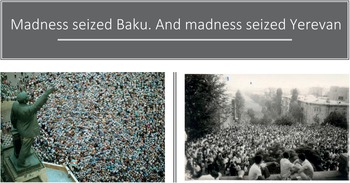
Ethno-nationalists invented stories and myths to instigate violence and justify hatred of their neighbors. Extremists gave hate-filled speeches in the squares of both capitals before crowds of thousands who enthusiastically cheered them (Figure 3). In Maiden Dreams, while walking through the center of the city, Farida sees large crowds of agitated people listening to an orator. She thinks, “Writers, TV journalists, intelligentsia! What are you doing? [She wanted] to yell to them, to those who were screaming at the meetings in Baku and Yerevan, tell them to stop! Stop inciting hatred!” (Voyskunskiy Reference Voyskunski2000, 242). So-called intellectuals encouraged hatred of their neighbors on both sides. Farida passes by a building where members of the intelligentsia live and notices a gray-haired poet who speaks in front of a cheery crowd about “our ancestors, their graves and the next generations who would not forgive the mistakes of the present time.” During the Soviet period, state ideology always emphasized that Soviet culture was “national in form but socialist in essence.” But as Yuri Slezkine has pointed out, “‘National form’ was acceptable because there was no such thing as national content” (Reference Slezkine1994, 418). During such crises, “the form” fused with “content.” Each of the former Soviet republics, with the surprising exception of the Russian Federation, had their own Academies of Science, National Institutes of History, historical museums, flags, hymns, national Communist Party branches, Supreme Soviets, and Councils of Ministers. In this way, nationalism was continuously cultivated in all former Soviet republics, and toward the end of 1980s, its seeds fell on fertile ground (Suny Reference Suny1993; Slezkine Reference Slezkine1994). As the Union disintegrated, the nationalist intelligentsia stepped to the forefront of the extremist movements.
Extremists offered hate-filled speeches in the squares of both capitals before crowds of hundreds of thousands who enthusiastically cheered them. On the right: A demonstration at the then Lenin Square [today called Azadlyg ( Freedom) Square] in front of the Lenin statue at the center of Baku, November 17, 1988. For some Azeris, these were glorious days; for many other locals, especially for ethnic Armenians, they were a nightmare. On the left, Armenian demonstration at the Theater Opera Square in Yerevan (today, ironically Freedom Square too). The issue of Karabakh was existential for both former Soviet nations. Having achieved independence, both new states purged their territories from now “undesirable” ethnic minorities.

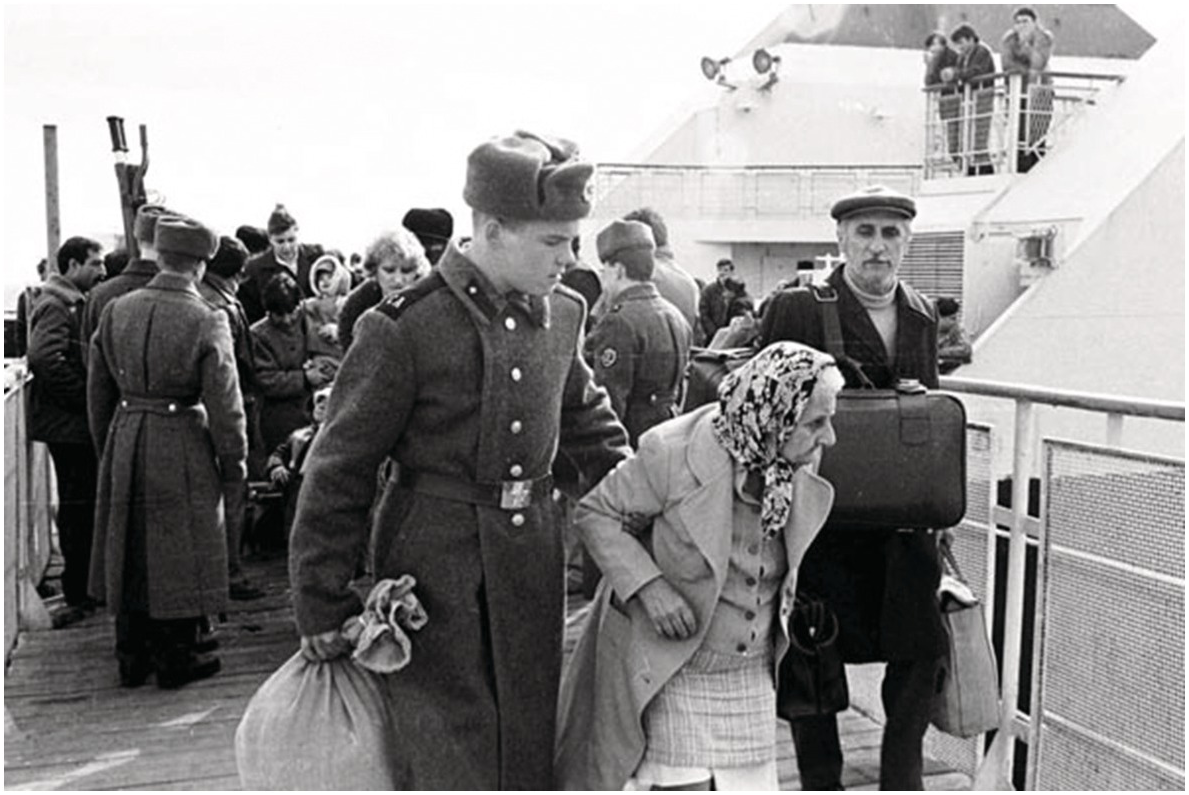
On the eve of the pogroms, as they make their way home, Julia and Sergei see large crowds of people listening to hate-filled speeches by Neimat Panakhov, who demands the expulsion of the Armenian population from Baku (Voyskunskiy Reference Voyskunski2000, 224–225). De Waal pointed out the sinister role that Neimat Panakhov and Rahim Gaziev, another leader of the Front, played in Baku pogroms. On the eve of the most horrific days, they appeared on the republican TV channel and said Baku was full of homeless refugees, while thousands of Armenians were still living in their apartments in comfort. This signaled the beginning of the mass pogroms (de Waal 2013, 91).Footnote 19 The mass pogroms that occurred in Baku on January 13–19, 1990, completely destroyed the population of a quarter million Armenians in the city (Figure 4). The calamity did not spare 200,000 Azeri people living in Armenia, who were similarly forced out of their homes as a result of the violence and the growing animosity between Armenia and Azerbaijan. As military operations expanded during 1991–1993, more Armenians were expelled from areas north of Karabakh, followed by expulsions of hundreds of thousands of Azerbaijanis from within and around Nagorno Karabakh.Footnote 20
In the wake of the Baku pogroms, a Soviet soldier escorts an elderly Armenian woman to a ferry in Baku port to go a port in Turkmenia on the opposite side of the Caspian Sea (January 1990).

Writing about the multiethnic society in Baku, Voyskusnkiy never tries to idealize the whole Soviet past. During early 1950, the Soviet Union saw waves of anti-Semitic campaigns in the country. And when Julia comes back to Baku, her family friend uncle Alekper tells her that Baku has its own anti-Semitism, which is directed against Armenians (Voyskunskiy Reference Voyskunski2000, 194). When Sergei Bespalov tells Samvel Galustian that he was expelled from Baku not by the Soviet authority but by AHJ, the latter reminds Sergei about Soviet-era deportations of Kalmyks, Chechens, and Crimean Tatars. The People’s Front, Galustian claims, had good teachers (Voyskunskiy Reference Voyskunski2000, 253). Tensions and discrimination among various ethnic groups no doubt existed, but only at the end of the USSR in 1991 did they escalate into massacres, ethnic cleansing, and later to the full-scale war of 1991–1994.
Like Stone Dreams, Maiden Dreams has its shortcomings. For example, Voyskunskiy could have included some passages addressing the AHJ leaders’ thoughts on how they sinisterly rationalized ethnic cleansing. Since the author takes readers through the whole 20th century, he might have written something on the Armenian-Azeri conflict at the beginning of that century.
Voyskunskiy’s book ends with the entry of Soviet troops into Baku on January 19, 1990. At that moment, Sergei Bespalov is killed by a sniper’s bullet. Nina, Pavlik, and their son leave for Israel, but Julia stays in Baku to be near Sergei’s grave. She later receives a letter from her daughter pleading her to join the rest of the family in Nazareth, Israel, a town indissolubly linked with the name of Jesus.
Conclusion
Literary texts like Maiden Dreams are valuable because they efficiently preserve, disseminate, and even popularize historical evidence of violence, ethnic cleansing, and genocide in public memory. Fiction can also enjoy a wider audience than traditional historical scholarship or works by political scientists. Martina Korf notes that novelists working on such painful topics often write their works from a distance, about events they themselves never experienced, which allows them better to understand and mediate public memory (Korf Reference Korf2012). Their fictional works are inspired by the intention of bearing witness, and to create and transmit knowledge about genocide. Such writers, like Voysunskiy, are concerned with offering testimony rather than with creating representations of trauma (Korf Reference Korf2012). Korf’s methodology is based on Chinua Achebe’s (Reference Achebe1988 [1978]) notion of the uses of imagination in the quest for historical truth and Geoffrey Hartman’s (Reference Hartman1998) concept of the intellectual witness.
More importantly, the year 2016 marked the 25th anniversary of the disintegration of the Soviet Union and the emergence of the New Independent States, including two independent republics of the south Caucasus—Armenia and Azerbaijan. While many scholars have praised the independence acquired by the former Soviet republics in 1991, some have totally ignored the ethnic cleansing, violence, and xenophobia in the post-Soviet space. Anatoly Khazanov, for example, argues that “The ultimate goal [of the Soviet nationality policy] was the complete Russification of non-Russian nationalities under the slogan ‘Merging of the nations’” (Khazanov Reference Khazanov1995, 12). Khazanov claims that the Soviet troops invaded Baku in 1990 only in order to crush the independence movement. Without any references to anti-Armenian violence, the author, referring to the words of one person he interviewed, suggests that the number of Azeri victims could have been around 400 (Khazanov Reference Khazanov1995, 34). Some other Western authors expressed similar views (Cornell 2015; Altstadt Reference Altstadt2017).
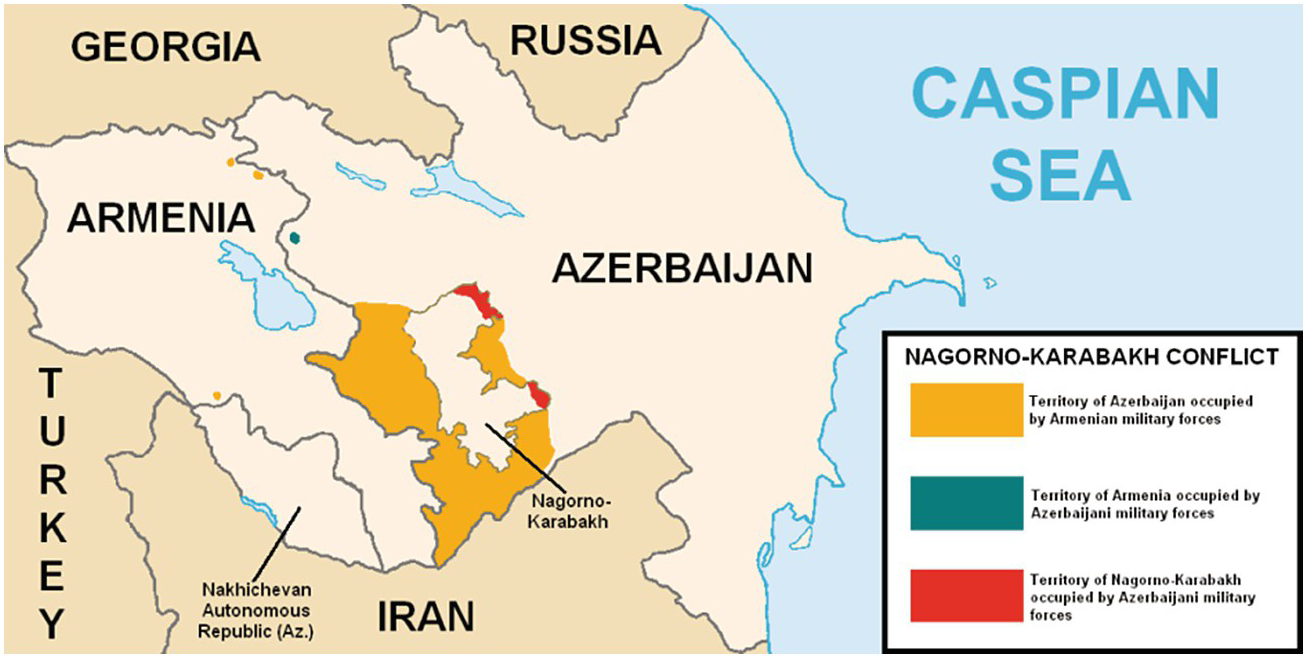
Meanwhile, the countries of the southern Caucasus achieved their independence in 1991, at the price of thousands of human lives. For some Baku Armenians, 2018 marked the 30th anniversary of the genocide of the Armenian population in modern Azerbaijan that started with pogroms in Sumgait in February 1988.Footnote 21 Later, after mutual ethnic cleansing, expelling of the Azeri population from Armenia and the Baku pogroms of January 1990 led to a full-scale war between the two former Soviet republics, which lasted until Russia meditated a ceasefire in 1994. As Viktor Shnirelman observed, “For decades, Western sociologists developed their concept that emphasized confrontation between Russian and non-Russian people as the core collision in the Soviet political model” (2001, 3). In reality, the situation was far more complex. Praising nationalists as “true fighters” for the independence of their nations, these scholars have totally ignored historical, social, and political contradictions between various ethnic groups within the Soviet Union and, as a result, have failed to understand the full price of independence and the bloody events that accompanied the end of the Union as a multicultural entity. Tom Nairin once referred to nationalism as a pathology in the development of modern history that is as unescapable as neurosis is in an individual (Reference Nairin1977, 359). In his novel, Voyskunskiy explores the dramatic events that affected the lives of a whole generation of people who were born and raised in the previously multiethnic city of Baku and who were forced to escape from rising nationalism within a new country that was not only acquiring its independence but also ridding itself of “undesirable” internal elements (Figure 5).
The Karabakh conflict today; a map of Azerbaijan and Armenia.

Acknowledgments.
Earlier versions of this paper were presented at the United States Holocaust Museum on March 29, 2019, as an individual paper, and at two conferences—the Southern Conference on Slavic Studies, George Mason University, Fairfax, Virginia, April 6–8, 2017, and the Association of Slavic Eastern European and Eurasian Studies (ASEEES) conference, Washington, DC, November 17–20, 2016. I am very grateful to the participants of these conferences for their insightful comments. Also, my special thanks to Emil Sanamyan (University of Southern California), Ulvii Ismail, Internews, Washington, DC, and Michael Gelb (United States Holocaust Museum).
Disclosure.
Author has nothing to disclose.