INTRODUCTION
The wide-eyed flounder Bothus podas podas (Delaroche, Reference Delaroche1809) is a small fish belonging to the Bothidae family. It is characterized by a flat body with variable coloration, pigmented in mosaic.
Bothus podas podas has a large geographical distribution in the world. Indeed, this species is present in the Atlantic: on the west African coasts (Nielson, Reference Nielson, Whitehead, Bauchot, Hureau, Nielsen and Tortonese1986) as well as on the South American coasts (Stauch, Reference Stauch1966). It is also found in the oriental and western basins of the Mediterranean Sea, and in the Adriatic (Nielsen, 1986b; Fisher et al., Reference Fisher, Schneider and Bauchot1987; Fredj & Maurin, Reference Fredj and Maurin1987).
Moreover, it is very frequent on the Azure coasts (Quignard et al., Reference Quignard, Trabelsi, Tomasini, Boussaid, Focant and Maamouri2000), on the Italian coasts (Tortonese, Reference Tortonese1975) and in Spain and Turkey (Akyol, Reference Akyol2003). This species is present in most of the Maghreb countries: in Mauritania (Maigret & Ly, Reference Maigret and Ly1986; Diop et al., Reference Diop, Ly and Girardin1996; Sidi & Guénette, Reference Sidi and Guenette1998); in Morocco, on the coasts of Alhoceima (Molinari et al., Reference Molinari, Salvati and Tunesi2004) and on the ‘Mar Chica’ in Mellila (Aloncle, Reference Aloncle1961). It is also mentioned on the Algerian coasts (Dieuzeide et al., Reference Dieuzeide, Novella and Roland1955). In Tunisia the species has been found in the south by Pietschman (Reference Pietschman1906) and in the north by Azouz (Reference Azouz1971, Reference Azouz1974), and by Bradai (Reference Bradai2000).
Bothus podas podas is a fish with very interesting biological and behavioural characteristics. It has attracted the attention of researchers across the world and has been the object of several studies (Bell et al., Reference Bell and Harmelin-Vivien1983; Nielsen, 1986; Nash et al., Reference Nash, Geffen and Santos1991).
Biometrics data for this species have been collected from many different areas. We could mention the studies by Dieuzeide et al. (Reference Dieuzeide, Novella and Roland1955), Tortonese (Reference Tortonese1975), of Nielsen (1986), Fisher et al. (Reference Fisher, Schneider and Bauchot1987) and of Quignard et al. (Reference Quignard, Trabelsi, Tomasini, Boussaid, Focant and Maamouri2000).
The data concerning the survey of the growth of Bothus podas podas in the Mediterranean Sea are numerous. Notable examples are those of Stergiou & Moutopouloses (Reference Stergiou and Mouropoulos2001), of Morato et al. (Reference Morato, Afonso, Lourinho, Barreiros, Santos and Nash2001), Abdallah (Reference Abdallah2002) and of Morato et al. (Reference Morato, Afonso, Carvalho, Lourinho, Santos, Krug and Nash2007).
Schintu et al. (Reference Schintu, Passariello, Belluscio and Ardizzone1994) studied the growth and feeding habits in the central Mediterranean Sea. Concerning the reproduction, the works of Dieuzeide et al. (Reference Dieuzeide, Novella and Roland1955), Tortonese (Reference Tortonese1975), Nielsen (1986), Fisher et al. (Reference Fisher, Schneider and Bauchot1987) and Morato et al. (Reference Morato, Afonso, Carvalho, Lourinho, Santos, Krug and Nash2007) are mentioned.
Nash et al. (Reference Nash, Geffen and Santos1991) was interested in the survey of the spawning period of B. podas podas on the coasts of the Azores. The study conducted by Carvalho et al. (Reference Carvalho, Afonso and Serräo Santos2003) concerned the sexual behaviour of the wide-eyed flounder in the coastal waters around the Azorean Islands.
The present study provides more information on the reproduction of B. podas podas.
MATERIALS AND METHODS
Study area
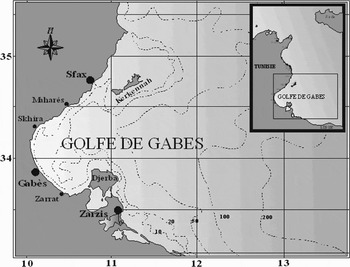
The Gulf of Gabès, also known as Petit Syrte, is a large neckline situated on the south coastline of Tunisia (Azouz, Reference Azouz1971; Burrolet et al., Reference Burrolet, Clairefond and Winnok1979), spreading for about 750 km (58% of the country's coastline), from Cape Kapoudia (35th parallel) to the Tunisian–Libyan borders (33°10′N) (Figure 1) (Bradai et al., Reference Bradai, Ghorbel, Bouain, Jarboui, Wannes-Ghorbel and Mnif1995).
Map showing the geographical position of the Gulf of Gabès.

It represents the most important maritime zone of the country. Thanks to its favourable topographic, oceanographic and geomorphologic particularities, and in addition to the presence of vast fields of phanerogames herbaria, the Gulf of Gabès is an exceptional nursery encouraging the reproduction and the development of the larvae of numerous marine species (Bradai, Reference Bradai2000; Ben Salem et al., Reference Ben Salem, Franquesa and El Abed2002).
In the Gulf of Gabès, the trawl nets normally used for the fishing of shrimp, are now used for the fishing of the wide-eyed flounder at a depth of 20 m during the shrimp fishery seasons. This fish can rarely be taken by trawl nets deeper than 50 m.
Sampling
To gather information on the biology of the wide-eyed flounder, 749 individuals of Bothus podas podas having total lengths between 13 and 24.4 cm were examined. Samples were bought twice a week from the fishmarket of Sfax during the period of May 2004 to September 2005. Most of samples were the products of trawl fishing landed at the ports of Sfax and Zarzis (Figure 1).
Sex-ratio
Bothus podas podas is among the species which allow for an external distinction of the sex due to their magnificent display of sexual dimorphism.
For this study, we have determined the sex of each specimen. The total length (TL) and standard length (SL) were measured in mm. The total weight (TW) and eviscerated fish weight (EW) were also measured in grams. The dissection allows the confirmation of sex and the determination of the sexual maturity.
The sex proportions were determined using the following formula: proportion of males: (%M) = (M/M+F) × 100 where M = males number; F = females number and M+F = total staff. Our results were tested using the χ2-test: χ2 = Σ(N0–Nt)2/Nt where N0 = observed number and Nt = theoretical number.
Sexual cycle
To monitor the variation and the evolution of the gonads and the liver conditions, we calculated the following: the gonad somatic index (GSI) translating the mass evolution of the gonads during the studied period: GSI = (GW/EW) × 100 where GW = gonads weight (g) and EW = eviscerated fish weight (g). This index gives a general and quantitative idea about the reproductive states, and therefore constitutes an interesting approach in the survey of reproduction.
The liver somatic index (LSI) translating the mass evolution of the liver during the studied period: LSI = (LW/EW) × 100 where LW = livers weight (g) and EW = eviscerated fish weight (g). This ratio reflects the physiology of fish, because the liver is the energy store necessary for the maturation of the gametes.
Some fish stock their reserves in the muscle. So we define the condition factor (K): K = (EW/TL 3) × 100 where EW = eviscerated fish weight (g) and TL = total length (mm). The analysis of the monthly evolution of these two ratios gives us the plumpness of fish as well as the organ accumulation of lipid reserves before and during the maturation period.
The confidence interval (Ci) for each monthly middle value of these indices has then been calculated:  where N = individual number and σ = ecart type.
First sexual maturity
The determination of this parameter is essential to assure a good rational management of fish stocks. It allows us to choose and fix fishing instruments with appropriate stitches; so that each individual of the population will be able to reproduce at least once in its lifetime.
To estimate the size at the first sexual maturity L50, we calculated the proportion of mature individuals (Pi) sorted by sex and by size-class: Pi = (Mi/Iei) × 100 where Mi = number of mature individuals in the size I and Iei = number of examined individuals in the same size-class.
The obtained data were fitted to a logistical function using the software ‘FSAS’ (Sauls et al., Reference Saul, Conrad and Michael1988). This function has the advantage of estimating with precision the lengths L25, L50 and L75 that are often required by most software to analyse the stocks of fish (Ghorbel et al., Reference Ghorbel1996). The equation used was: P = 1/(1+e−(b+aLT)) where P = proportion of mature individuals, LT = total length of fish and a, b = two constants.
The results were tested using χ2-test (Lamotte, Reference Lamotte1967): χ2 = Σ(Mi–nPi)2/nPi where Mi = number of mature individuals in the size I and nPi = calculated number of mature individuals.
RESULTS
Sexual dimorphism
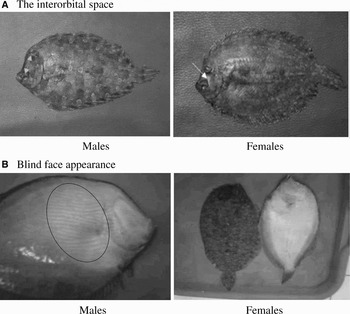
The sexual dimorphism is an interesting property that characterizes the studied species. This characteristic is translated by the interorbital space and the blind face appearance. Indeed, the spacing between the eye balls is more pronounced among the males than the females (Figure 2).
Sexual dimorphism of Bothus podas podas in the Gulf of Gabès.

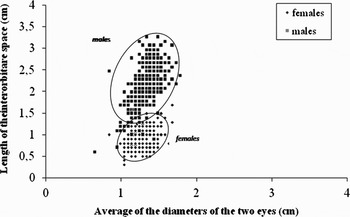
Conversely, it was noted that the blind face is streaked among the males (especially on the individual's superior half). The female's face has a clear colour without particular marks (Figure 2). The biometric study allowed us to confirm the observed sexual dimorphism in this species. The following diagram shows that the females always have a short interorbital distance in contrast to the males which present large interorbital distances (Figure 3).
Variation in length of the interorbital space according to the diameter of the eyes in both sexes of Bothus podas podas in the Gulf of Gabès.

Sex-ratio
Among the 749 individuals examined, we counted 328 males and 421 females; which gives a rate of masculinity of 43.79%.
This rate of masculinity shows a clear dominance in favour of females. This result is confirmed by the χ2-test (χ2 = 11.55). This value indicates a meaningful difference between sex proportions.
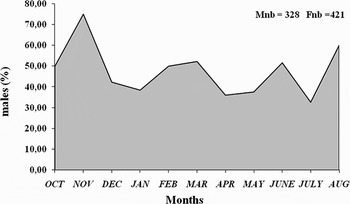
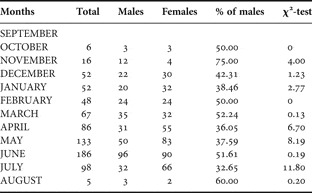
The monthly follow-up of the sex-ratio is presented in Figure 4 and Table 1. It was noted that the sex-ratio is balanced (equal to 50%) in December, January, February, March, June, August and October. It is in favour of the males in November, and distinctly in favour of the females in April, May and July. The value of the χ2-test indicates meaningful differences during these months where one of the two sexes dominates distinctly.
Monthly change in the sex-ratio of Bothus podas podas in the Gulf of Gabès. Mnb, number of males; Fnb, number of females.

Monthly variation of the sex proportions (%) of Bothus podas podas in the Gulf of Gabès.

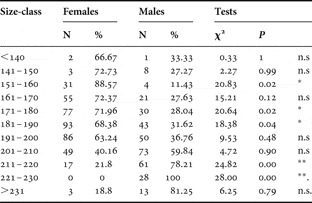
Considering the variations of sex proportions according to sizes, we noticed that the sex-ratio is in favour of females for the smaller individuals. The rate then begins to change to the favour of the males from the size of 20.1 cm (Table 2). This shows that the male growth rate is greater than that of the females. Another hypothesis to explain this result is that the males live longer than the females.
Variation of the sex proportions (%) according to the size of Bothus podas podas in the Gulf of Gabès.

N, number of individuals in the size-class; %, percentage of females or males in the size-class; χ2, χ2-test. (test P = significance test): n.s., not significant; *, significant for P < 0.05; **, highly significant for P < 0.01; ***, very highly significant for P < 0.001.
Sexual cycle and spawning period
For the wide-eyed flounder Bothus podas podas, the macroscopic observation permits us to discern males from females and shows that the two gonads are as well functional among the males than the females. No case of hermaphroditism was observed.
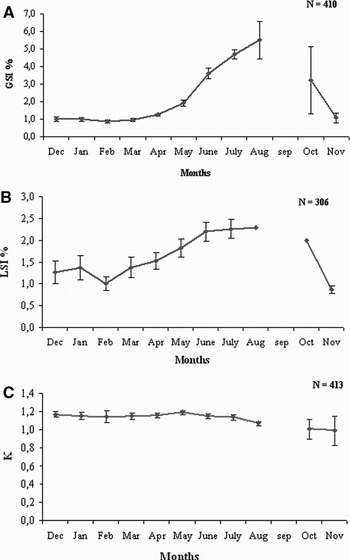
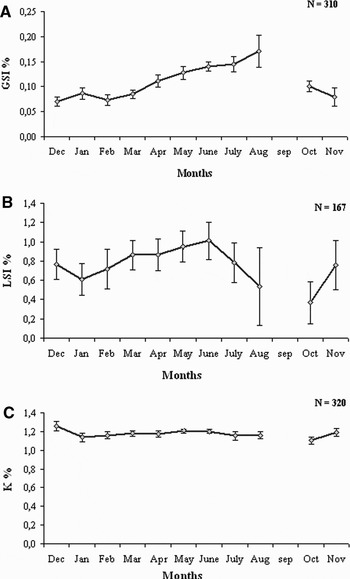
The monthly samples used to determine the maturation and spawning periods of B. podas podas from the Gulf of Gabès are represented in Table 1. The yearly sexual cycle is marked by monthly variations of the activity of the genital glands, the liver and muscles. These variations concern respectively the indices: GSI, LSI, and K. Results are illustrated graphically in Figures 5 & 6.
Monthly variation of (A) the gonad somatic index (GSI); (B) the liver somatic index (LSI); (C) the condition factor K for females of Bothus podas podas in the Gulf of Gabès (means±interval of confidence, Ic).
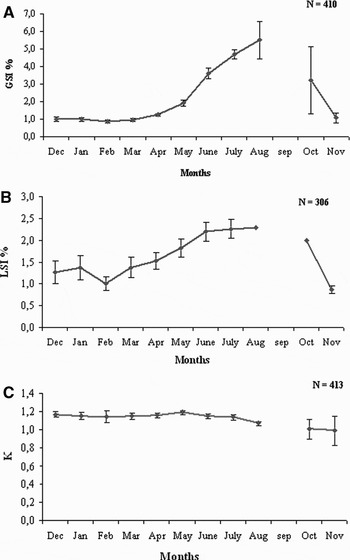
Monthly variation of (A) the gonad somatic index (GSI); (B) the liver somatic index (LSI); (C) the condition factor K for males of Bothus podas podas in the Gulf of Gabès (means±interval of confidence, Ic).

For females, the monthly variations of the GSI show four phases (Figure 5A): (1) a phase of prematuration; (2) a relatively slow maturation phase; (3) a spawning phase marked by a fast fall of GSI to the value of 1.06 (in November). According to these results, we can say that the spawning period probably began in August and extended until November; and (4) a phase of sexual rest: this extends from December to February, and is marked by values of relatively constant GSI oscillating around 0.95.
The evolution of the LSI follows the one of the GSI. However, the GSI reaches its minimum (GSI = 0.88) in February which corresponds with the beginning of the maturation of the gonads. During the full maturation stage (June, July and August) the values of this index remain constant (LSI = 2.28 on average). So to nurture its gametes, the females would store B. podas podas lipid reserves in the liver (Figure 5B). This species would seem to belong to the Gadus type described by Bougis (Reference Bougis1952).
The same observations are noticed in males: the phase of gamete maturation is located between February and August. The spawning period among the males seems to run from August to the end of October or November. The phase of sexual rest is similar to that of the females, from December to February (Figure 6A).
The LSI ratio among the males begins to grow from October until June when it reaches its maximum (1.02). So it also appears that the same process occurs among the males whereby the liver accumulates the lipid reserves and passes them on to the gonads (Figure 6B).
Figures 5C & 6C show that the monthly values of the condition factor K do not present considerable variations. This fish would be of Gadus type (Bougis, Reference Bougis1952).
First sexual maturity
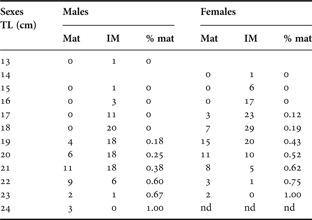
The first sexual maturity among the males and the females of Bothus podas podas was determined from 132 individuals. The withdrawals have been done during the period of reproduction of the studied species. The proportions of the mature individuals calculated from these data are grouped in Table 3.
Variation of the mature proportions (%) according to the size of Bothus podas podas in the Gulf of Gabès.
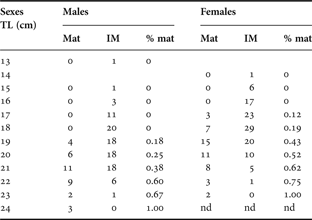
TL, total length; Mat, mature individuals; IM, immature individuals; % mat, proportion of matures; nd, not determined.
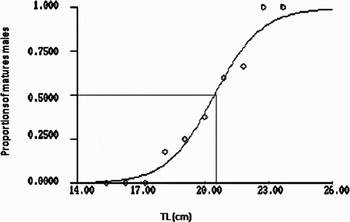
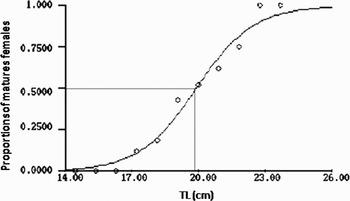
The results show that females reach maturity at a lower size than males. Indeed, females' size at first sexual maturity is 20.40 cm; whereas the males' size at first sexual maturity is 21.01 cm (Figures 7 & 8).
First sexual maturity for males of Bothus podas podas in the Gulf of Gabès.

First sexual maturity for females of Bothus podas podas in the Gulf of Gabès.

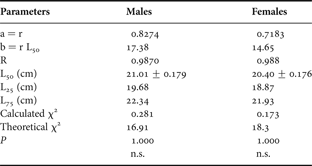
The χ2-test shows that for both sexes, χ2 remained much higher than the calculated values (calculated χ2 < theoretical χ2). It can be deduced that the logistic function is well adjusted to the observed data. In this table, we also present the different values of the logistical function adjusted to the relative data to the first sexual maturity of the males and the females of B. podas podas (Table 4).
Parameters of the sexual maturity of Bothus podas podas in the Gulf of Gabès.
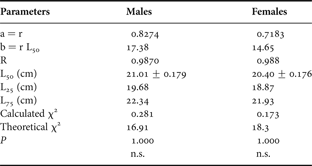
R, coefficient of interrelationship; a & b are two constants; L50, standard length at first sexual maturity; L25, standard length at 25% sexual maturity; L75, standard length at 75% sexual maturity; χ2, χ2-tests; and the P test of significance: n.s., not significant; *, significant for P < 0.05; **, highly significant for P < 0.01; ***, very highly significant for P < 0.001.
DISCUSSION
The wide-eyed flounder Bothus podas podas is a rare species presenting a sexual dimorphism that appears by the interorbital space and the blind face appearance.
The analysis of the sex-ratio showed meaningful differences between the proportions of the males and those of the females of the entire sample, according to the months and according to the size.
In this study, a female-biased sex-ratio was noted. Contradictory results have been found in the survey made by Morato et al. (Reference Morato, Afonso, Carvalho, Lourinho, Santos, Krug and Nash2007) from the Azores, while the studied population has a sex-ratio biased to males.
It is also notable that the males grow larger than the females. Indeed, the sex-ratio is in favour of the males for their size. This result can be explained by the difference in the longevity between the two sexes.
The monthly following of the GSI shows that the sexual cycle of the males and the females are synchronized. In fact, the active period extends from February to November: the period of maturation occurs between May and August, while the spawning period takes place from September to October, perhaps continuing into November. The phase of sexual rest extends from December to February.
The progression of the LSI value indicates that to develop its gametes, B. podas podas uses the lipid reserves stored in the liver.
The absence or the lack of sampling during the period of August, September and October is explained by the biologic rest imposed by the fishing regulation (1 August to 15 September), when the trawling is stopped in the Gulf of Gabès.
Our results are compared with data given by some authors in different localities of the Mediterranean Sea in Table 5.
Reproductive period of Bothus podas podas given by some authors.

The monthly progression of the LSI presents significant variations; it can thus be explained that the liver is an important organ for storage and mobilization of reserves for this species. It is also noted that the condition factor K evolution shows no significant variations through the studied period.
These observations lead us to conclude that B. podas podas accumulates hepatic lipid reserves to assure maturation of the gonads. Consequently, we can consider that this fish belongs to the Gadus type (Bougis, Reference Bougis1952).
Concerning the size of the fish at the first sexual maturity, it was noticed that for both sexes, this fish arrives at sexual maturity at a young age. It is also clear that females reach maturity at a smaller size than males: this size is 20.4 cm amongst the females in comparison to 21 cm amongst the males (Abid, Reference Abid2005).
CONCLUSION
The reproduction survey of the wide-eyed flounder Bothus podas podas has been based on the macroscopic observation of the gonadal appearance in addition to its sexual dimorphism.
The analysis of sex proportions showed that, of the whole sample, the sex-ratio is in favour of females (57.29% against 43.71% for the males). From this analysis it can be supposed that males grow relatively faster than females. Indeed, the sex-ratio is in favour of the males in the classes of the larger individuals (for specimens of TL > 20.1).
The analysis of the monthly variations of the GSI showed that the period of maturation of B. podas podas spans from May to August in both sexes. The spawning period occurs from August to October and perhaps November.
The monthly variations of the LSI and of the coefficient of condition K indicate that this species belongs to the Gadus type as it stocks hepatic lipid reserves.
The size of first sexual maturity L50 is determined at 20.4 cm for females. They reach sexual maturity before males whose size of first sexual maturity has been fixed at 21 cm.