Introduction
Personal names are an important part of people's social identity, and they function socially as labels that both identify and distinguish an individual from others (Watzlawik et al., Reference Watzlawik, Noemi Pizarroso, Doria, Han, Ma and Jung2012). Cheang (Reference Cheang2008) suggests that personal names can be a vehicle of self-presentation/self-promotion (cf. Goffman, Reference Goffman1980), not just a passive label, if the names are selected by the name bearers themselves. Although self-naming is also observed with a small minority of people who have changed their names given by their parents or close relations, the most common cases of self-presentation/self-promotion seem to be entertainers’ adopted stage names.
Unlike in Inner Circle countries, in nations of Outer and Expanding Circles (Kachru, Reference Kachru and Kachru1992), entertainers’ stage names can be selected from two source languages – the local language(s) or English – and the latter is usually associated with more positive images and can be a vehicle for presenting a radically different social identity. English stage names are particularly common among popular music artists around the world (cf. Omoniyi, Reference Omoniyi2006; Lee, Reference Lee2007; Jin & Ryoo, Reference Jin and Ryoo2012; Snodin, Reference Snodin2014; Yang, Reference Yang2015). South Korea (hereafter Korea) is no exception, and Korean music artists’ use of English names is quite common and has a rather long history.
As seen in the examples of BTS, PSY, and BLACKPINK, who are well known around the world, a high percentage of Korean music artists currently adopt and use English stage names. Some of the artists use English names only for their international activities and promotions, while most others use such names for their domestic activities and for their Korean fanbases, who are, in most cases, the artists’ main target audiences. Although Jin & Ryoo (Reference Jin and Ryoo2012: 122–123) and Lee (Reference Lee2005: 72) report the percentages of English-named Korean popular musicians on the basis of the names on popular music charts, comprehensive research has not been conducted on Korean musical artists’ names, except that by Yang (Reference Yang2015), who examined the names of Korean singers and singing groups active in the 1990s and 2000s.
Unlike Yang (Reference Yang2015), an overall analysis and discussion of Korean musical artists’ names, the present article focuses on examining Korean music entertainers’ practice of English naming based on more recent and varied data. The primary aims of this article are threefold. First, it will investigate how widely English names are used by Korean musical artists and what factors affect their adoption and use of English names. Second, it will examine what types of English names and word/name formation processes are used by Korean music artists in their naming. Finally, it will attempt to analyze the motives behind the common practice of choosing English names by Korean music artists, and discuss the practice in connection to the social meaning of the English language in Korean society as well as from the perspective of the Englishization of a local language (Kachru, Reference Kachru1994).
Background
Previous research reports that English naming is used for various purposes in non-English-speaking countries. English is used for the names of television and radio programs (Snodin, Reference Snodin2014; Ahn & Lee, Reference Ahn, Lee, Gargesh, Sharma, Giri and D'Angelo2020), titles of popular songs (Lee, Reference Lee2007) and movies (Snodin, Reference Snodin2014), and names of businesses and commercial product brands (Friedrich, Reference Friedrich2002; Bhatia, Reference Bhatia, Lee and Moody2012). English naming is not confined to these titles and brand names, however, as it is also adopted in naming people. Fischer (Reference Fischer2015) suggests that English names are used not only in countries of Inner and Outer Circles but also in Expanding Circle nations such as Brazil, China, and Korea. People in many non-English-speaking countries use English names for various purposes – for ease of international communication with foreigners, for their English conversation classes, or to identify themselves via user/profile names on social network services, email addresses and instant messengers.
The English naming practice for ordinary Korean people is a relatively new trend in Korea. Chae (Reference Chae2004) reported that approximately 60% of the students at a college in Seoul and the young employees of a top business company had English names. However, at present, generally only younger Koreans have English names. They are mostly adopted for English conversation classes at colleges or high schools and are almost exclusively used in interactions with foreigners or engagement in SNS or online activities; they are not commonly used for other purposes.
The English names of Korean solo singers (hereafter singers) and singing groups (hereafter groups) are, in contrast, different and exceptional in this respect. As mentioned earlier, their use of English stage names has a rather long history. Shin Kanaria (<–Canary) and Lee Aerisu (<–Alice), both of whom began their career during the Japanese colonial period (1910–1945), were the first solo singers who had English names; some of those singers and groups, who sang in the 1950s and 1960s for the American soldiers of the 8th Army stationed in Korea after the Korean War, also had English names (e.g., Patti Kim, Wicky Lee, The Kim Sisters, The Four Clovers).Footnote 1 The English names of Korean musical entertainers are also different from those of ordinary Koreans in terms of their purpose: Musical artists adopt and use English stage names primarily to convey certain images that they want to project toward their potential audiences or fans, and their names function as a means of self-presentation or self-promotion. There are certainly cases when entertainers’ stage names are proposed by people around them and then accepted by the entertainers. Nevertheless, it is the entertainer him or herself who decides whether to adopt the name and continue to use it.
Although there are two studies, Lee (Reference Lee2009) and Neethling (Reference Neethling2018), that examined the names of American rock and roll groups of the 1950s and 1960s and the name changes of celebrities (which include singers), respectively, few studies have investigated the naming of singers and singing groups in general, leaving a clear research gap in this area. The same holds true of the naming of Korean popular music artists, as little research has been undertaken on this topic except Yang (Reference Yang2015), especially on their English names. The present article reports the results of a comprehensive study of Korean singers’ and groups’ current and recent English names and the motives for and the social meaning of their use.
Data sources
The data for the present study comes from Korean music artists’ names listed on the Bugs hit singles charts. Bugs (https://music.bugs.co.kr) is one of the major popular music sites in Korea, where people can listen to or download music for the cost of a membership fee. The site offers at-the-moment, daily, weekly, year-end, and decade-end singles charts, together with daily and weekly album charts and daily and weekly genre-by-genre singles charts (as of June 30, 2022). This study analyzes three sources:
(1) Artist names on the year-end charts from 1991 through 2020
(2) Artist names on the daily genre charts of February 27, 2021
(3) English names of the Korean music artists on the year-end charts from 2001 through 2020
Some Korean-named solo singers and groups have an additional English name and use it mostly for their international activities. The names analyzed in this study do not include such names, and only the artists’ ‘primary’ names listed on Bugs’ charts are investigated. When more than one song of the same singer/group was listed on the year-end/genre chart, the artist's name was analyzed only once for that year or genre.
Prevalence of English naming among Korean music artists
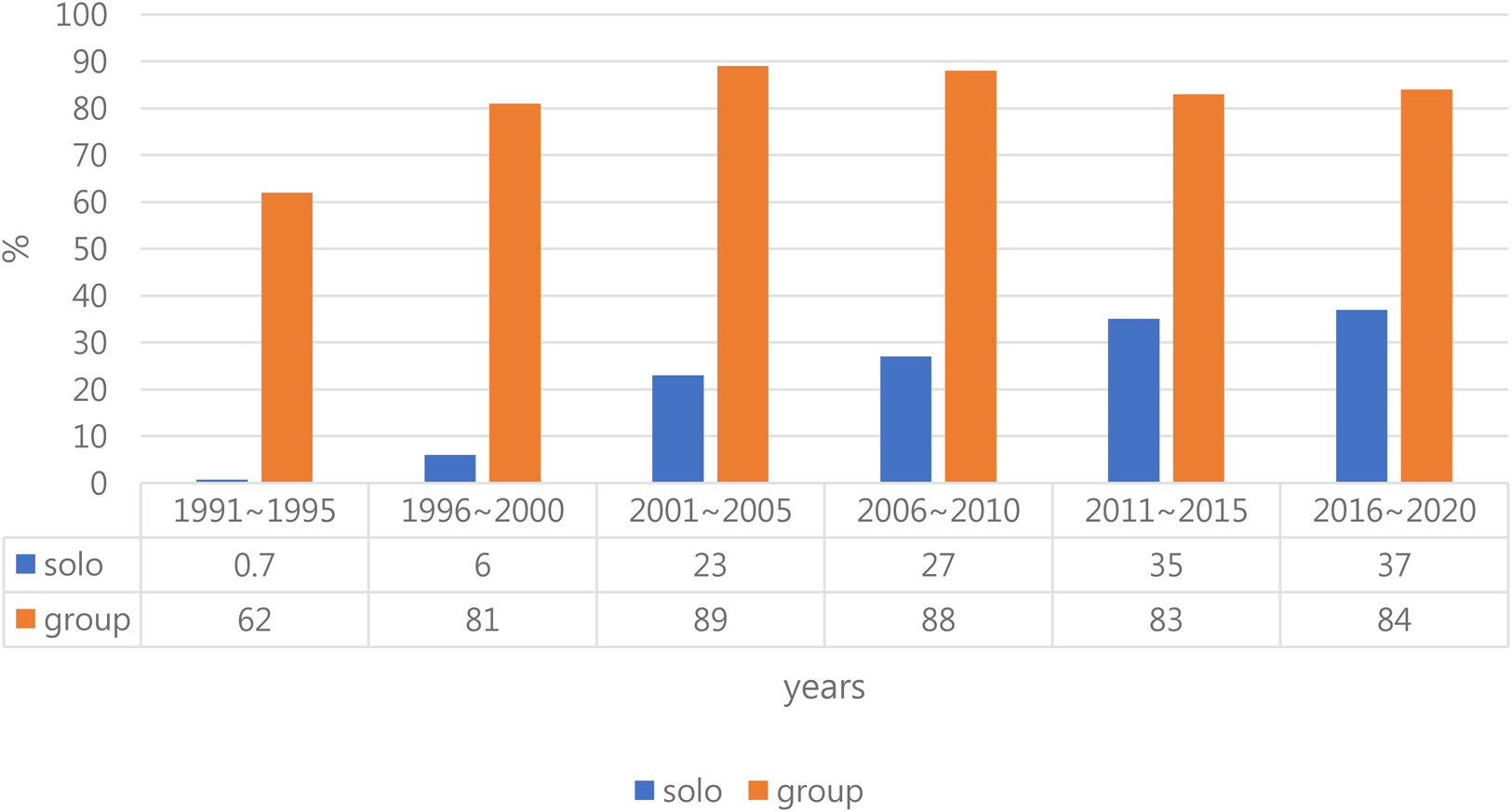
Korean singers and groups, as suggested by Yang (Reference Yang2015), show clear differences in their English naming practices, with the latter having a much higher proportion of English names. Thus, the analytical results of naming trends are given separately for singers and groups, as shown in Figure 1. We find that during the period from 1991 to 1995, Korean solo singers hardly used English stage names but that groups already adopted English names at a quite high rate of 62% (a similar situation is conjectured to have existed before this period as well). The reason that Korean groups began to take English names earlier than singers is quite likely related to the fact that the former had to create a new name to represent the group and could choose names, including English ones, that seemed attractive and well suited to them. Solo singers, on the other hand, did not have to adopt a new/stage name, which might cause a change in their self-identity. It appears that solo singers at that time were more cautious in changing their real names – usually given by their parents – to stage names and, furthermore, were far more reluctant to take on a foreign identity with the adoption of an English name. It is noteworthy that only 19% (13/67) of the solo artists on Bugs’ 1991 top 100 singles chart had stage names, showing a sharp contrast with the 2020 top 100 list, where 65% (26/40) of the solo singers used stage names (the Korean Wikipedia page of each artist was referred to for his or her legal name). This difference suggests that in the earlier periods of Korean popular music, having any stage name, let alone an English one, was not very common.
Percentages of English-named Korean solo singers and singing groups across different periods (based on Bugs’ year-end singles charts of 1991˜2020)

Korean singers’ and groups’ use of English names, however, increased sharply in the periods of 1996~2000 and 2001~2005. The ratio of English names in these two periods increased from 0.7% of the previous period to 6% and then 23% among singers, and the percentage of English names among groups surged from 62% to 81% and then to 89%. This rather sharp increase in English names among Korean singers and groups is deemed attributable to the following two sociocultural factors.
The first is related to the globalization (segyehwa) campaign launched in 1994 by former President Kim Young–Sam and strongly driven by his administration from 1995 on (Kim, Reference Kim2007). The drive was intended not only to boost the economy but also to alter the political, social, and cultural domains. Even some government ministries were restructured to further the implementation of globalization policies, and the so-called Globalization Drive Commission (segyehwa chujinwiwonhoe) was created to promote internationalization and globalization. This somewhat politically motivated campaign spread a globalization fever across the country (Kim, Reference Kim and Kim2000). This fever also led to another social phenomenon called English fever (J.–K. Park, Reference Park2009; J. S.–Y. Park, Reference Park2009) – a craze for English, a global language deemed a necessary linguistic tool for globalization. Social phenomena in Korea related to English fever included a rapid rise in the number of English ‘cramming’ institutes and English study-abroad programs, the construction of ‘English villages’ around the nation, and the so-called ‘wild-goose fathers’ – fathers who are left alone working in Korea while their children study in English-speaking countries accompanied by their mothers (Chung, Reference Chung2008). One of the main causes of English fever, maybe the most important, was the government's introduction of mandatory English education in primary school, which was gradually implemented from 1997 to 2000. The IMF/financial crisis, which occurred in 1997 and made Koreans intensely aware of the importance of English in economic/financial globalization and the overcoming of the crisis, also contributed to the strengthening of English fever (J.–K. Park, Reference Park2009; Jin & Ryoo, Reference Jin and Ryoo2012;). Influenced by this ‘global’ mood of society, more popular music singers and groups began to take English names and attempted to take on an international identity.
The second factor is the beginning of the so-called Hallyu (the Korean Wave) of Korean popular music, television drama, and film, which started in the latter part of the 1990s in Asian countries (Lee, Reference Lee2016). With the concerts, television appearances, and records of H.O.T., CLON, etc., the popularity of so-called K-pop expanded from China and Taiwan to other Asian countries, such as Japan, Nepal, Vietnam, Thailand, Indonesia, and Mongolia. The most internationally successful artists at that time were mostly boy groups, especially H.O.T., TVXQ, and Super Junior. Somewhat like the globalization campaign, Hallyu was also in part driven by the government's policy of promoting Korea's cultural industry by financially and legally supporting it with subsidies and relevant legislation and of expanding the country's exports not only in traditional industrial and consumer goods but also in the cultural sector. With the popularity of Hallyu and with new music markets open, a larger number of Korean music entertainers adopted and used English names than in the previous periods.
Figure 1 shows that the use of English stage names is indeed prevalent and a widely observed social phenomenon among Korean music entertainers; in the most recent period of 2016~2020, according to Bugs’ data, more than one-third (37%) of singers and more than four-fifths (84%) of groups had English names. The figure, however, also shows a clear disparity between singers and groups in their naming trends. The ratio of English-named solo singers still seems to be increasing due to the attractive/favorable image and prestige of English and to the effects of the still-strengthening Hallyu of K-pop, especially with the advent of entertainers such as BTS and BLACKPINK. The English naming of music groups, however, shows a somewhat different pattern. It reached its peak of 89% in the period 2001~2005 but stagnated after that, although the percentage of English-named groups continued to surpass 80 in the subsequent periods. Considering that more than 80% of groups having an English name is a very high percentage, I cautiously interpret this phenomenon as resulting from a saturation effect, meaning that there is little room for an increase in English naming for vocal groups. The reason for this interpretation is that there are, although a minority, always some music groups who wish to maintain their Korean identity due to their personal beliefs or to meet the potential demands and preferences of their target audiences. The latter is also crucially linked to the groups’ genre(s) of music, as shown below.
Variation in English naming across music genres
Popular music, as is well known, can be divided into various music genres, be those broad or narrow categories. Bugs divides Korean popular music into 11 genres: (sentimental) ballad, dance-pop, folk/acoustic, idol, rap/hip-hop, R&B/soul, electronic, rock/metal, jazz, indie, and trot. Some of these music genres clearly have different target age groups. Trot is considered music for older adults (Chang, Reference Chang, Shin and Lee2017); rap/hip-hop, dance-pop, and rock/metal are generally targeted toward younger people; and ballad and folk/acoustic music seem to be aimed at a broader range of ages but the main target may be middle-aged individuals. Lee (Reference Lee2014) observes that there are cross-generational differences in English proficiency in Korea, and so age is an important factor in people's understanding of the English used by Korean mass media. Lee (Reference Lee2004, Reference Lee2007) further shows that English mixing in Korean song lyrics is mostly observed in popular music genres whose target listeners are younger people.
These observations and suggestions by Lee imply that the same phenomenon may also be observed in the names of music artists. This study accordingly analyzed currently active artists’ names listed on Bugs’ daily top 100 charts for six genres (trot, folk/acoustic, ballad, rap/hip-hop, dance-pop, and rock/metal) on February 27, 2021, and examined whether there were any differences in the percentages of English names among these genres.
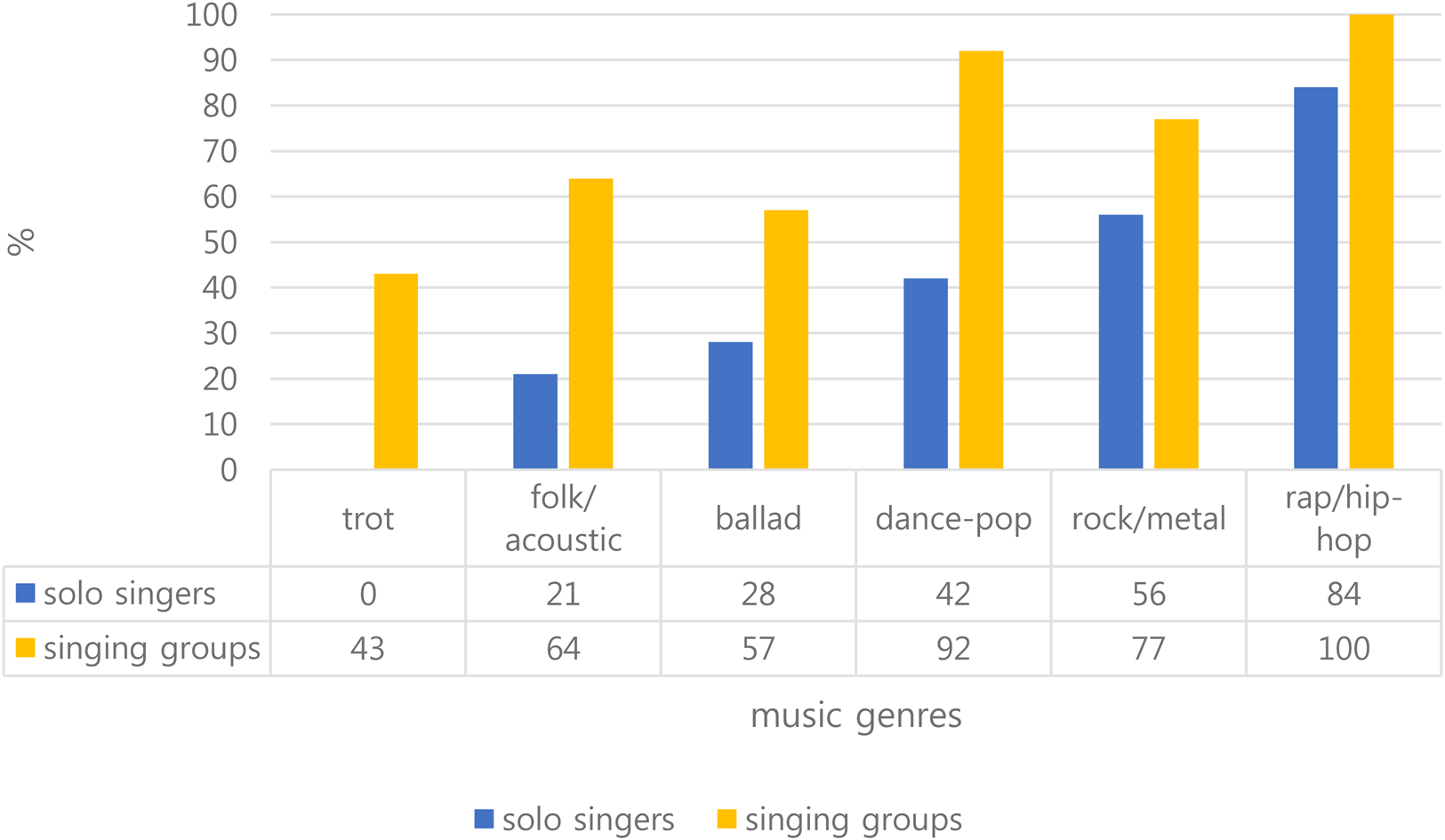
The results of the analyses indeed exhibited quite clear differences in English naming practices across Korean music artists working in different popular music genres (see Figure 2). As expected, the six music genres could be divided into three patterns of English name usage. None of the 70 trot singers had an English name, and only three trot groups out of seven (43% (3/7)) had English names. Rap/hip-hop singers and groups showed the highest proportions of English names with 84% (72/85) and 100% (7/7), respectively. Dance-pop and rock/metal had the next highest percentages. Those with English names among the singers and groups totaled 42% (23/55 singers) and 92% (33/36 groups) for dance-pop and 56% (24/43 singers) and 77% (40/52 groups) for rock/metal. Rap/hip-hop and dance-pop, two newer genres imported from the West/United States, and rock/metal, another generally fast-tempo genre, all target young audiences with higher educational backgrounds, better English proficiency, and more international minds and cultural orientations than older audiences. Ballad and folk/acoustic, whose fan bases are wider in terms of age, constitute the middle group between trot and the three youth-targeting music genres. The percentages of singers and groups with English names were 28% (24/85 singers) and 57% (8/14 groups) for ballad and 21% (6/28 singers) and 64% (9/14 groups) for folk/acoustic.Footnote 2 These results clearly indicate that in addition to the solo/group factor, music genre is another important constraint affecting the adoption and use of English names among Korean music entertainers.
Percentages of Korean solo singers and singing groups in various genres who had English names (based on Bugs’ genre charts of Feb 27, 2021)

Types and formation processes of English names
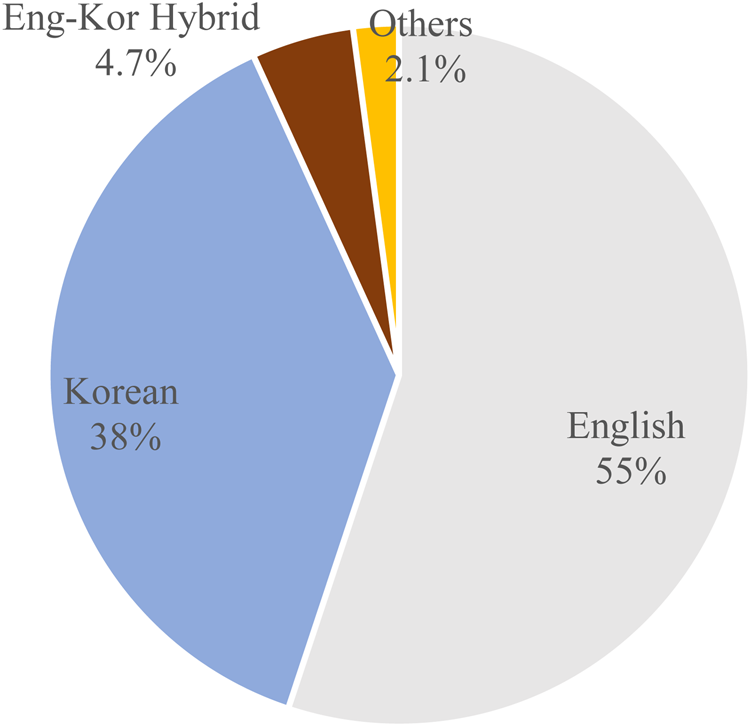
Six hundred and fifty-seven names of Korean music artists were obtained from Bugs’ year-end top 100 charts of the two most recent decades (2001~2020) and analyzed. The two main source languages of the music artists’ names were English (55% [361/657]) and Korean (38% [251/657]), together accounting for 93% of the names (see Figure 3). The next source was a hybrid of English and Korean (4.7% [31/657]). The remaining 14 names (2.1%) consisted of four other types of hybrids (i.e., combinations other than English–Korean)Footnote 3, two Japanese names, two Hebrew names, and one name each of Spanish, Greek, Chinese, French, Malay, and Arabic origin. Altogether, 394 names (60% [394/657]) had an English element.
Source languages of Korean music entertainers’ names (based on Bugs’ year-end singles charts of 2001˜2020)

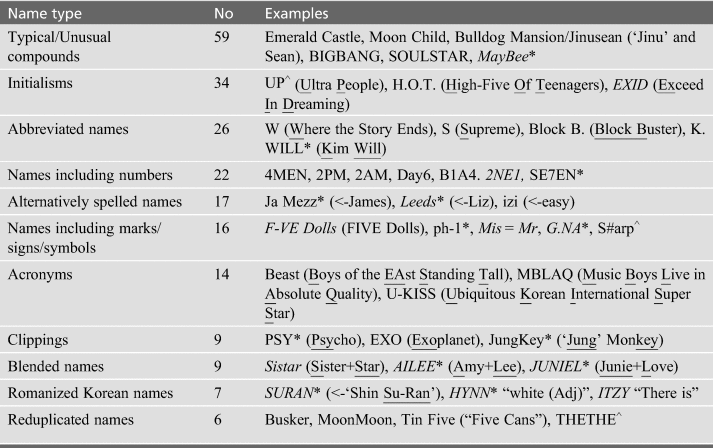
The 361 English-named Korean music entertainers consisted of 120 singers and 241 groups, revealing singing groups’ more common practice of English naming. Their English names can be broadly divided into two main groups: 1) those that came from existing English names or words/expressions without being involved in word formation process(es) (e.g., Tim, Bank, Big Mama) and 2) those names that were created through word formation process(es) such as compounding, abbreviation, blending, reduplication/repetition and clipping (see examples in Table 1).
Types of English names made through word formation processes

Names drawn from existing English names/words/expressions
Approximately 41% of the English names (148/361) came from existing English names or words/expressions. Nominals were naturally a majority, accounting for 89% (132/148) of this subclass of names. Some examples of nominal names are given in (1) for illustration. For readers’ convenience, hereafter, solo singers’ names are asterisked, female singers and groups are italicized, mixed-gender groups are marked with a caret (^) symbol, and Korean names are written in single quotations (for this reason, meanings/glosses of words or expressions are noted inside double quotations). As seen in the examples given in (1), most of the common nouns and noun phrases were singing groups’ names, while most solo singers’ names were proper nouns.
(1) Common nouns (48): Idol, Bank, Cult, Panic, Noise, Position, Flower, Page, Wax*, etc. Proper nouns (46): APRIL, Tim*, DEAN*, Eddy Kim*, Simon Dominic*, Ali*, Maya*, etc.
Noun phrases (38): The Classic, The Day, Big Mama, Brand New Day, Mad Clown*, etc.
Seven adjectives (Goofy, Yellow, Natural, Wanted, Untouchable, COOL^, Primary*), four verbs (Can, TAKE, Untitle, Howl*), two prepositional phrases (After School, As One), one ‘interjection + noun’ (Viva Soul), one ‘interjection + noun phrase’ (Oh My Girl), and one adverb (Twice) were also observed as grammatical categories of English names. Even though nominals were the absolute majority in terms of grammatical categories, the use of a wide variety of other categories, which also extends the range of possible meanings, is intriguing and merits attention.
Regarding the meaning of vocal groups’ names, gender was found to play an important role. One often observed semantic feature of male groups’ names was an allusion to superiority, power, and value. Examples of this type of name include Idol, The Classic, Super Junior, Noblesse, Dynamic Duo, Supreme Team, Teen Top, and WINNER, while Jewelry and Diva were the only female groups’ names in this category. In contrast, color terms – usually associated with women (Lakoff, Reference Lakoff and Bucholtz2004) – and gendered/gender-marked expressions were often found in female groups’ names. Examples of the former were Orange Caramel, Red Velvet, BLACKPINK, Black Pearl, and Rainbow, and those of the latter included Big Mama, Bubble Sisters, Girl Friends, Ladies’ Code, Oh My Girl, and Diva. The meanings of solo singers’ names were so varied that they were not easily semantically generalizable.
Names created through word formation processes
The remaining 59% (213/361) of the English names were formed through various word formation processes and thus constitute diverse, morphologically distinct name types. Table 1 shows these name types, the number of names of each type, and examples. Some names were formed through more than one formation process and there were some names that could not be easily classified into one of the types in Table 1; thus, the sum of the numbers does not exactly add up to 213. It should be noted that non-entertainers’ regular/legal names usually do not involve word formation processes.
Compounds, initialisms, and abbreviationsFootnote 4 were the most common and productive types of name formation. Notably, among compounds, a rather unusual type of solid compound was found to be used among Korean music artists. They look quite different from ordinary ones and are not generally used in other (socio)linguistic contexts with the exceptions of corporate or product brand names (e.g., Citigroup, UnitedHealth, ServiceNow; ThinkPad, Anycall, Joinus). Examples are Jinusean (a duo whose members are ‘Jinu’ and Sean), BIGBANG, SOULSTAR, and MayBee*. Names including numbers or marks/signs/symbols also look quite idiosyncratic and creative, and their use as personal names seems to be observed exclusively in entertainers’ names, especially those of popular music artists. Some number-including names involved additional change(s) inside, e.g., SE7EN* (where the letter ‘V’ is replaced by number 7) and 2NE1 (which means ‘New Evolution in the 21st Century’ and involves the separation of the number 21 and the combination of the initials of the first two words). The marks/signs/symbols found in the names include a hyphen (e.g., F-VE Dolls (FIVE Dolls)), a mathematical sign (Mis = Mr), a musical symbol (S#arp^ [Sharp]), a period (G.NA* [Gina]), and a comma (Car, the garden*).
Although compounds, initialisms, and abbreviations are the most common types of name formation, there are various formation processes involved in the creation/formation of Korean music artists’ English names as seen in Table 1 (see also Fuhr [Reference Fuhr2016: 62] for a related discussion). Some processes are identical to those of common word formation (Plag, Reference Plag2003) and also observed in other types of proper nouns (e.g., NATO, USA, Eiffel Tower, Beth). However, other processes, especially the use of Arabic numbers or marks/signs/symbols and the use of unusual solid compoundsFootnote 5, are rarely found in personal names in non-entertainment domains. The fact that these processes are also used for the naming of corporate and product brands (e.g., PayPal, 3M, Yum! Brands, Coca-Cola, V8) seems to suggest that music entertainers’ names are becoming somewhat like commercial brand names (cf. Bunde, Reference Bunde2019). However, these processes, which help musicians build their individuality and identity, are not uniquely found in the Korean music scene. They are also observed in Anglo-American and other foreign musicians’ names, as exemplified by the following stage names: Alexisonfire (unusual compounding <– Alexis on fire [Canada]), AlunaGeorge^ (unusual compounding <–Aluna Francis & George Reid [UK]), U2 (number use [Ireland]), Maroon 5 (number use [US]), U$O* (sign use [Denmark]), A*M*E* (symbol use [UK]).
Discussion: Motives/reasons behind Korean music entertainers’ use of English names
Unlike in Inner Circle countries, where almost all entertainers naturally have English names, in Outer and Expanding Circle nations, entertainers are named either in a local language or English – with rare exceptions. English stage names, especially in Expanding Circle countries, can be said to be a more peculiar or special type of stage name. They often exude images of modernity, refinement, freedom, youth, internationality, etc., which are typically associated with the English language in many nations around the world (cf. Lee, Reference Lee2006; Snodin, Reference Snodin2014; Fischer, Reference Fischer2015), and entertainers attempt to present such an image to the public by choosing English names. Notably, in many non-English-speaking countries, singers seem to use English names at a higher rate than other entertainers, such as actors or comedians.
This tendency is especially clearly observed in Korea. According to Bugs’ year-end top 100 song charts from the most recent decade (2011~2020), the percentage of solo singers possessing an English name was 36% (89/247) (cf. Figure 1). This clearly contrasts with entertainers in other entertainment fields, where very few English names are found. The websites of the Korean associations of film actors, television actors, theater actors, and television comedians offer lists of the member names of each organization.Footnote 6 Only ten of 684 movie actors and three of 941 television actors had an English name. Theater actors and television comedians showed no differences: Only five of 295 stage actors and one of 538 television comedians were English-named. In contrast, at present, more than 30% of Korean solo singers and more than 80% of the nation's singing groups have English names, and these figures are far higher than those for actors or comedians. Thus, the question arises as to why Korean popular music artists so commonly adopt English stage names.
It is true that both popular music and movies in Korea have been significantly influenced by Anglo-American music and films. In particular, popular music and movies from the U.S. have had global influence because of the politico-economic and cultural power of the U.S. as the world's leading nation. Korea is no exception in this respect. It seems, however, that Anglo-American popular music had an earlier and stronger influence in spreading the English language than Anglo-American films did, as Crystal (Reference Crystal2003: 102) suggested that “no other single source [other than Anglo-American popular music] has spread the English language around the youth of the world so rapidly and so pervasively”. As Cho (Reference Cho2019) and Chang (Reference Chang2016) showed, the influence of Anglo-American popular music on the development of Korean popular music started early and its linguistic effect was strong. Some pieces of popular U.S. music, mostly jazz and swing, were introduced to Korea as early as the 1920s and 1930s through records, radio stations, concerts (of domestic musicians), and music cafes, sometimes not far behind their releases in the U.S. This was possible because popular music easily entered the daily lives of people – even those across the globe – through radios and records, two important media in the development of modern popular music. Chang & Seo (Reference Chang and Seo2015: 118) observe that Korean jazz songs released at this time often contained English words in their titles or lyrics. The first Western music band, who made their debut in 1926 and gained massive popularity in the latter period of the 1920s, was also named in English, i.e., Koria Jaejeu Baendeu (Korea Jazz Band). Thus, first, this long history of linguistic influence from Anglo-American popular music is conjectured to have contributed to earlier adoption of English stage names among Korean music artists.
Second, the common adoption of English stage names by Korean music artists also seems to be related to the character of singers as entertainers, which is somewhat different from those of actors and television comedians. As typical performing artists, singers engage in many more live performances than film and television actors, whose acting is usually video-recorded for later screenings with movie goers and television viewers (and who are, accordingly, not always classified as performers [Barry, Reference Barry2017]). Additionally, most singers’ performances usually include not only singing but also gestures and dance – mostly in front of live audiences. This more ‘performative’ character of singers is presumed to affect their identity as entertainers, leading them to assume and present a more performative name. This is closely related to the fact that among sports stars, those who use pseudonyms most commonly are professional wrestlers (e.g., Hulk Hogan, Andre the Giant, The Undertaker, Doudrop), who continue to perform athletic shows and display showmanship for audiences during their matches and who can be considered the most performative sportspeople. This rather different and distinctive character of singers seems to be reflected in their more frequent adoption of a stage name than other groups of entertainers and in the higher percentage of English names among Korean music artists.
Third, a sharp increase in Korean singers and groups who want to market their music overseas after the beginning of Hallyu/the Korean Wave is deemed another reason for the rise of English names among Korean music artists. As noted earlier, a sizable expansion of the Korean popular music market to foreign countries occurred alongside the rising popularity of Korea's music around various Asian countries, which began in the latter part of the 1990s. Naturally, artists who seek a wider audience and a larger music market in foreign countries are likely to exert effort to make potential fans feel closer to them by adopting a more fan-friendly, internationally understood English name. Further, music entertainers may be more strongly motivated to adopt English stage names than actors or comedians because English often functions as the lingua franca in popular music with its wide use in song lyrics and titles (Burton, Reference Burton2015; Moss, Reference Moss2016).
Further discussion and conclusion
The three motives/reasons suggested above are conjectured to have combined with the prestige of English in making the English naming practice among Korean music artists so common and prevalent. That is, the fundamental motive for their pervasive use of English names is deemed the indexical social meaning of English – a marker of prestige, refinedness, youth, and internationality within Korea (Lee, Reference Lee2006, Reference Lee, Bolton, Botha and Kirkpatrick2020; Ahn & Lee, Reference Ahn, Lee, Gargesh, Sharma, Giri and D'Angelo2020) and across many other nations (Snodin, Reference Snodin2014; Fischer, Reference Fischer2015; Moody, Reference Moody, Bolton, Botha and Kirkpatrick2020).
In the case of Korea, in particular, so-called ‘English fever’ (J.–K. Park, Reference Park2009; J. S.–Y. Park, Reference Park2009) has long been observed, especially since the latter part of the 1990s. Although there is a report (Kang, Reference Kang2017) that the fever in the nation has now slightly cooled with the rise of China (and its language, Mandarin) in the global community as a member of G2, the statistical results of this study imply that English still holds a special position and status in Korean society. This superior stature of English is demonstrated by the ongoing formation of Jeju English Education City in Jeju Island, the implementation of official English policy by leading colleges such as POSTEC and UNIST, and Incheon Metropolis's efforts to make English an official language in its Songdo International City.
The prestige and glamor that English currently enjoys in Korean society are also verified by the common use of English or English-mixed names in other domains; 63% of women's cosmetic brands are English-named (Park, Reference Park2013), and 52% of the corporations registered in the Korea Composite Stock Price Index and nearly 60% of Korean television programs have English or English-mixed names (Moon, Reference Moon2017; Lim, Reference Lim2004). Unlike in artist names or song titles, English may be used for some other functions in song lyrics, e.g., as a vehicle to express self-assertion or resistance to a conservative Korean society (Lee, Reference Lee2006) or as a means of delivering the main political/social messages of the songs (Ahn, Reference Ahn, Low and Pakir2021); however, the primary motive underlying the use of English names by Korean music entertainers and business corporations seems to be the conveyance of an image of refinement, modernity, globality, etc. (Fuhr, Reference Fuhr2016: 72). With this social image and social meaning of the English language, English names clearly function for Korean music entertainers as an important means of presenting a different self and performing a new and more attractive identity.
Korean musical artists’ adoption of English names can be considered one facet of the Englishization of local languages (Kachru, Reference Kachru1994). In the 1950s and earlier, all but a few popular Korean musicians had Korean names, but at present, more than one-third of solo singers and more than four-fifths of groups use English names for domestic audiences. Approximately one quarter of these singers and groups even use the Roman script in the official writing of their names. Englishization is also observed in English-Korean hybrid names (e.g., MC ‘Mong’ “MC dream” or H-‘Yujin’ “H-yujin”), which accounts for approximately five per cent of Korean music entertainers’ names (cf. Figure 3).
The practice of English naming as observed among Korean music artists is expected to continue for the foreseeable future because English continues to connote status, refinement, and internationality in Korean society, and because the ongoing success of K-pop singers and groups abroad will continue to prompt them to seek wider overseas markets. Unlike the English names of Thai movies, magazines, television programs, vocal bands, etc., which Snodin (Reference Snodin2014) suggested were used for intranational communication, the English names of Korean music artists are currently created and used not only for intranational purposes but also for international communication, although the former undoubtedly remains the primary motivation for most musicians.
Acknowledgments
The present research was supported by a 2020 research fund grant from Dankook University, South Korea.
 HYEON–SEOK KANG is a professor in the English department at Dankook University in South Korea. He received a Ph.D. in linguistics from the Ohio State University. His research interests include sociolinguistic variations in Korean English and Korean dialects, genderlects, onomastics, and language policies on the Korean Peninsula. Email: hskang1@dankook.ac.kr