Introduction
Background
Agencies that provide care to patients in their homes serve a population that has particular vulnerabilities due to chronic conditions and limitations in physical and psychological functioning. 1 Home-bound patients tend to be an older population dealing with the normal, additional changes that accompany old age. 2 For these reasons, these patients may be at increased risk during disasters and may not adequately be prepared. 1 , 3 , Reference Fernandez, Byard, Lin, Benson and Barbera 4 Home health programs are in an advantageous position to address patient preparedness as they may be one of the few outside resources that maintains regular contact with these community-dwelling adults.Reference Mailey 5
In addition to efforts to assess and prepare the patient population, health care agencies must also be prepared to handle disasters.Reference Hunter Revell and McCurry 6 While an all-hazards approach for home health agencies should be considered (ie, regardless of the emergency or disaster, there are factors for which all home health programs must be prepared, such as electricity outages, preparation for evacuation, and understanding how to shelter-in-place), it is also important to consider that each community has additional needs that are unique to the characteristics of that geographic area, such as extreme heat, flooding, and tornadoes.
The Veterans Health Administration (VHA; Washington, DC USA) is the United States’ largest integrated health care system, serving 8.76 million veterans each year. 7 The agency provides public-sector care for honorably discharged veterans of the US armed forces. The VHA is financed mostly from general taxation, offers a broad range of health care services to meet veterans’ needs, and can be characterized loosely as a veteran-specific national health service.Reference Oliver 8
The VHA home-based primary care (HBPC) program was created by the VHA with the express focus of delivering comprehensive primary care in the home, where HBPC becomes the primary care provider for its veteran constituents. It utilizes a highly interdisciplinary approach, and the core team generally is composed of a Physician, Nurses, a Social Worker, a Rehabilitation Therapist, a Pharmacist, a Dietitian, and Psychologists. Currently, there are 157 HBPC programs distributed across the country, all within the VHA. Each is connected with a US Department of Veterans Affairs Medical Center (VAMC). The HBPC population has a mean age of 76.5 years, its patient population has, on average, eight or more chronic conditions, and 47% are dependent in two or more activities of daily living.Reference Beales and Edes 9
Wyte-Lake, Claver, Griffin, and DobalianReference Wyte-Lake, Claver, Griffin and Dobalian 10 examined a single VHA HBPC program to gather background information about VHA policy and procedures regarding the role of HBPC providers in assessing disaster preparedness among their patient population. They learned that although there are general guidelines established by The Joint Commission (TJC; Oakbrook Terrace, Illinois USA), according to the Program Director respondent, each VHA HBPC program develops its own policy regarding the extent to which disaster preparedness is included in the assessment and training of staff, and there is some variability in how the practice guidelines are implemented by providers. This finding indicated a need for further exploration of the similarities and differences among VHA HBPC programs. Therefore, this in-depth study of five sites aimed to further analyze how VHA HBPC programs are structured to support the disaster preparedness of community-dwelling veterans.
Statement of Problem
This study aimed to: (1) describe the range of local VHA policies regarding the role of HBPC programs in disaster preparedness; and (2) identify disaster preparedness training opportunities for HBPC programs.
Methods
This exploratory study used qualitative interview methods to examine local VHA HBPC program policies about disaster preparedness and to identify disaster preparedness training opportunities for HBPC programs.
Sample
Leadership and practitioners (eg, Nurse Practitioners, Registered Nurses, Social Workers, Occupational Therapists, Physical Therapists, and Psychologists) from five VHA HBPC programs across the country were invited to participate in this exploratory study, for a total of 48 invited participants. The selected sites were chosen through purposive sampling to include both rural and urban sites as well as sites that recently had experienced a Presidentially-declared disaster from April 1, 2013 through June 30, 2013. 11 Two sites that were selected initially as part of this purposive sampling declined to participate; therefore, two additional sites were selected, using the same criteria as indicated above.
Additional Data Sources
When asked, some leadership identified TJC requirements for disaster preparedness protocols, but did not identify any other national protocols, policies, or procedures. Additional national and local protocols, procedures, assessment tools, and educational resources related to assessing disaster preparedness that were used by the HBPC providers of these five HBPC programs were included.
Data Collection Methods
Data were collected through telephone interviews with practitioners at each of the five HPBC sites. The second author (TW-L) conducted all of the interviews and the first author (MC) took handwritten notes during the interview and asked clarifying questions, when appropriate. The interviews were semi-structured, meaning that an interview guide was used to organize the interview (Appendix A; available online only), while allowing it to cover topics raised by the respondent that may not have been specific items on the interview guide. Leadership personnel (ie, the Program Manager) were the first point of contact at each site. These respondents then identified additional practitioners that were invited to participate, with a goal of including eight individuals per site. Interviews, about 30 minutes in duration, were guided by an interview protocol and addressed agency preparedness policies and procedures. The guide included questions concerning the disaster preparedness training of HBPC staff and patient education and training provided by HBPC staff.
Analysis Plan
Interviews were audio recorded with the permission of the respondent, and the interviews were transcribed. Transcripts were analyzed using qualitative content analysis based on a start list of codes derived from the interview guide, as well as through the inductive development of codes based on the content of completed interviews. Over the course of the interviews at different sites and with respondents with different backgrounds, saturation actually was achieved well before the interviews were completed based on the experience of the authors as qualitative researchers, the theoretical bases (aims) of the interviews, and the ongoing process of thematic analysis. Additional interviews were conducted with a number of respondents within each of the programs, even after achieving saturation, in order to verify that theme saturation indeed was achieved. The first two authors independently coded the data, discussed discrepancies, and resolved those by consensus. The VA Greater Los Angeles Healthcare System Institutional Review Board (Los Angeles, California USA) approved this study.
Results
Site Characteristics
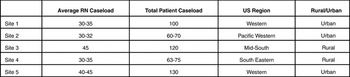
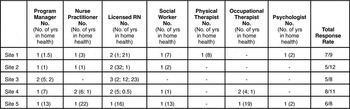
Thirty-one team members, including providers and practitioners, from five HBPC programs across the country participated in this research study. Two of the sites were rural (both had to deal with inclement weather on a semi-regular basis) and three were urban (two sites that recently were affected by disaster and one that was not; Table 1). The list of potential respondents included: Nurse Practitioners, Registered Nurses, Social Workers, Psychologists, Occupational Therapists, Physical Therapists, as well as the Program Manager at each site. A total of 31 respondents (Table 2) provided information about policy/procedures and training about disaster preparedness specific to the patients served in the HBPC program. Four themes emerged from the analysis of the resulting data: (1) the development of HBPC disaster preparedness policy; (2) training on preparing the HBPC program for disaster; (3) training on preparing patients for disaster; and (4) the role of HBPC programs in disaster preparedness.
Site Demographics

Abbreviation: RN, Registered Nurse.
Number of Respondents, by PositionFootnote a

Abbreviation: RN, Registered Nurse.
a Note that not all sites had individuals in all positions.
Development of HBPC Disaster Preparedness Policy
National Policy
Four of the five sites were not aware of any national HBPC policy. Three mentioned the role of TJC, especially after Hurricane Katrina (2005), in driving efforts to revise or more fully develop HBPC program protocols and policies. All of the sites indicated that the overarching VAMC emergency disaster plan influenced the development and/or revision of the HBPC emergency protocol. An Occupational Therapist noted a lack of nationwide consistency in the HPBC programs, saying: “I know just in a little bit of research that one of our other therapists has done, there’s not really that much consistency across the board nationally in home-based primary care program” (Site 4, Occupational Therapist 2). A Program Manager characterized the role of the national HBPC office as informal regarding policy: “…at the national office, they do not send out a ‘here is a policy; you must write it to fit yours.’ It’s more casual than that” (Site 4, Program Manager).
Learning from Other HBPC Programs
In the absence of a national policy for HBPC programs regarding disaster preparedness policy and procedures, respondents from three sites mentioned learning from one another by communicating with directors from other HBPC programs and sharing information and protocols. One Program Director mentioned that their program’s disaster preparedness protocol was heavily influenced by the protocol from another program: “I mean, in the earlier versions of our [Standard Operating Procedure], I know that I plagiarized other people, other people plagiarized me, or maybe ‘shared’ is a better term” (Site 4, Program Manager). The resources for communicating with other HBPC programs, as described by leadership at various sites, included an HBPC SharePoint, an HBPC Directors’ Listserv, and an upcoming national conference for HBPC directors (that had been put on hold the past few years due to budgetary issues). The SharePoint site was described as having: “quite a few internal documents loaded. There are the VHA-directive level documents and then local documents, so there’s just hundreds of stuff. And we use that as our go-to place as a resource” (Site 2, HBPC Coordinator). Although sharing does continue to take place between HBPC programs regarding disaster preparedness policy, one long-time Program Director mentioned that HBPC program culture has strayed a bit from the collaboration that used to exist. She said:
It could be that in the early years, HBPC was such a stepchild and so small and so weird. Nobody really understood what we did, so I think we buddied up. Today, it’s different. It’s so much bigger. It’s so much more institutionalized that I think some of that camaraderie is lacking and we haven’t had a national conference in several years because of the whole budget thing…so, I do know that some of that is changing
(Site 4, Program Manager).
Another respondent from that site emphasized the potential usefulness of learning even more about what other programs have done, stating: “…of course, different terrains and different areas may warrant different emergency plans, but it would just be interesting to see what other programs are doing also” (Site 4, Occupational Therapist 2).
Training and Drills: Agency Preparedness
None of the respondents mentioned having HBPC-specific disaster preparedness training, although one respondent mentioned reading the HPBC Standard Operating Procedures during orientation. Eight respondents reported participating in hospital-wide or city-wide drills, and 13 respondents mentioned participating in HBPC program drills at least once. Three sites had a team member that participated on the hospital emergency management committee and was thus charged with bringing information back to the HBPC team.
Most of the respondents who described participating in HBPC program drills described a process that involved management contacting staff (usually by pager), and staff reporting their availability back to the manager. Some of the respondents were involved in drills that entailed making phone calls to patients. As noted by one respondent, this was seen as not only helpful to the program staff, but also appreciated by the patients:
We could identify how well it works because we could identify everybody. [Local government officials identified] where the flood was. We found all our patients in that flood zone and we contacted each and every one of them. And we had a script of questions that we asked everybody…and the patients really appreciated that. They were kind of surprised. It worked very well
(Site 1, Nurse Practitioner).
Drills generally were seen to be useful in identifying challenges to the preparedness protocols. As one respondent described:
The committee [to review the program’s disaster plan and risk categorization] was formed, I’m assuming, because we had… two emergency preparedness drills in a span of about three months. And there was some confusion with regard to how this is supposed to be carried out because our supervisor made it a situation where… she removed herself, and in the midst of that situation there were also team members that weren’t able to be present because they couldn’t make it in because of the snow and that really helped us see that there were a lot of people running around wanting to do things and [who] have good intentions. We were all working towards the same end goal, but were going about it a different way
(Site 4, Occupational Therapist 2).
Issues that arose out of the drills included non-working or unanswered pagers, confusion about the plan, problems getting reliable information about the disaster, and which patients might be impacted. One respondent noted: “I know whenever we have a drill, we’ll find little things like someone who doesn’t carry their pagers so you can’t get a hold of them” (Site 5, Nurse Practitioner).
While some of the respondents expressed confidence with knowing their role during a disaster if they were at the office site, a few were unsure about what to do if a disaster should occur while he or she was in the field or in a patient’s home. A nurse that has worked in HBPC for three years stated:
I myself am unsure what to do say I was out at a patient’s home and there was an earthquake, you know? I’m not exactly sure what my role would be and, you know, what I would do in that situation or if I were at work. I understand that if we have a disaster, I’m supposed to go help a certain unit, but really that’s just about all that I understand about disaster preparedness…and I also feel inadequately informed about if we were to have some type of terrorist attack or a gunman on the campus. I’m not sure what my role would be and what I should do in that situation either
(Site 5, Registered Nurse).
Training and Drills: Preparing Patients for Disaster
Three of the sites (Sites 1, 4, and 5) have scheduled drills every six months. Two of those sites (Sites 1 and 5) had a disaster event in the recent past (ie, flood and windstorm), and the other (Site 4) is a rural program that frequently experiences inclement weather events. Site 4 mentioned that although they technically do not complete drills, they frequently do make patient phone calls to prepare patients for inclement weather. Site 2 has done drills, but respondents indicated that they did not do so regularly. During drills or inclement weather warnings, sites call patients using the acuity/risk categorization sheets, although this process looks a little different from site to site. At two of the sites (one urban and one rural), one team member is responsible for alerting all of the program practitioners, and each practitioner is responsible for calling his or her own patients. The Psychologist at one of those sites shared:
We have to contact our patients. So yes, the whole home-based primary care program participated in that. We had maps of where the flooding had occurred, what patients were going to be affected depending on what zip code they lived in. We did actually call patients
(Site 1, Psychologist).
At another site, the Program Director or Nurse Practitioner makes the calls to patients, while at another site, the Social Worker makes the calls. It is unclear who makes calls at the last site. An additional aspect about making patient calls, whether during a drill or an actual event, was shared by a Nurse Practitioner:
So in an event that even if we can’t make it in, I have those lists in three areas of the hospital, so if we can’t make it in, like our admitting staff or somebody else in another area can get those lists and they know who to call and it gives information like where they live, what their phone number is, emergency contact…So somebody else looking in from the outside will know based on how we have our sheet set up, how to call the veteran
(Site 3, Nurse Practitioner).
Respondents mentioned wanting more training about how to motivate a veteran population to engage in disaster preparedness activities. For example, one area of patient engagement involved conducting home evacuation drills with patients, especially for those at highest risk (eg, patients needing assistance with mobility or dependent on medical equipment such as oxygen). Related to this issue was a desire for more training about how to individualize and tailor the patient education to veterans that have cognitive or other impairments. A Registered Nurse case manager shared:
If someone was assigned to oversee [how to work with veterans] and make sure that the training was provided and that it is followed up and make sure that the vet, because each veteran situation is different. You could, some of them have a hard time having food and water and medication for the immediate time, let alone trying to plan ahead. They don’t look that far. They just deal with one day at a time. And we would need formal training to try to get them to even think that far in advance
(Site 1, Registered Nurse).
Respondents also mentioned that perhaps aiming to provide too much information to the patient during the initial visit is not effective, especially for veterans with cognitive impairment or other frailties.
Many of the respondents not officially responsible for reviewing information in the HBPC patient resource binder with the patient admitted to not knowing what disaster preparedness information was in the binder. Finally, practitioner time with the patient was noted to be an issue since there is so much to cover in each visit that reviewing the actual materials becomes too burdensome. As one Nurse Practitioner noted: “They say it’s [the disaster plan] in the computer, read it. But to be honest with you, I don’t have time to read. I don’t even have time to read the patient’s booklet” (Site 2, Nurse Practitioner).
Role of HBPC Programs in Disaster Preparedness
Respondents at three of the five sites mentioned the role of HBPC as primary care, which limits the amount of disaster response and preparedness activities they should be doing with patients. One respondent mentioned that HBPC is not the American Red Cross (Washington, DC USA) and that the emphasis should be on promoting individual responsibility and self-sufficiency during a disaster:
I think that it behooves us to understand that the VA only has so much control over these veterans. And they have personal rights and they don’t have to do anything we tell them to do. We tell them a lot. The nurse tells them a lot. I tell them a lot, and no matter how jokingly I might put something, they either – they could get offended by that if they chose to
(Site 1, Social Worker).
A Program Director at another site stated: “What I don’t want us to be is the Red Cross” (Site 4). The supportive role of HBPC is educating the patient and assisting with the identification of caregivers and other resources that could be called upon by the patient and his/her caregiver in the event of a disaster.
It is noteworthy that at the three sites that discussed the role of HBPC as strengthening patient self-sufficiency and the availability of support networks in case of a disaster situation, the social worker was either the lead in disaster assessment and education, or contributed to disaster assessment and education in a major way. At the two sites that did not compare the roles of HBPC to the American Red Cross, the Social Worker was either not aware of disaster assessment by the team or did not play a major role in identifying support for the patient during a disaster.
Discussion
In this study, the authors aimed to describe the range of local VHA policies around disaster preparedness. Among the most notable findings is that in the absence of strong national guidelines for these programs, there exists a clear desire for a stronger network through which HBPC Program Directors can share best practices. Due to the scarcity of national guidelines for HBPC, there is clearly a wide spectrum of policies developed by local HBPC programs to support their role in the emergency preparedness of their patients. This finding is similar to what is found in the private sector with home health agencies.Reference Wyte-Lake, Claver, Griffin and Dobalian 10 , Reference Kirkpatrick and Bryan 12 - Reference Wyte-Lake, Claver, Dalton and Dobalian 14 With the Centers for Medicare and Medicaid Services (Baltimore, Maryland USA) proposed increased role of home health agencies in preparing their patients for emergencies, 15 local agencies will be required to clarify their policies and procedures.
As a national health care system, the VHA can take advantage of certain communication strategies that are unavailable to other home health organizations. One example is a nationwide SharePoint site, which allows for inter-site communication. The HBPC SharePoint site emerged as a useful resource for Program Managers to identify tools and protocols from other programs. Additionally, there was hope that a conference for HBPC directors would be reinstated. Activities such as these, which connect programs both virtually and in person, could be used by other, non-VHA providers through avenues such as Listservs and national conferences. Sharing information through these mechanisms would limit the need for each program to start from the beginning.
Home-based primary care programs generally operate in a team-based approach, and this study’s findings show that it is not always the Program Manager who primarily is responsible for disaster preparedness policy revisions and training. There is considerable variation as to which team member or members at a particular site take the lead regarding disaster preparedness activities. For example, at one site, the Social Worker took the lead role in the agency’s preparedness activities, while at another site, the provision of training to staff was the responsibility of the Occupational Therapist. The assignment of different service groups to the task of leading preparedness activities resulted in differing perspectives on how the preparedness activities were actualized. For example, the site where the Social Worker was the lead focused the majority of its assessment on the patient’s support structures, something not seen in other sites, but in line with the Social Work expertise and domain. 16 Such variations could lead to inadequate attention being given to certain patient needs if other types of health care providers do not provide adequate input into preparedness policies and training.
As has been noted in the literature, staff understanding of their role in an emergency is indispensable to the success of any preparedness plan.Reference Wyte-Lake, Claver, Dalton and Dobalian 14 , Reference Ruder 17 , Reference Doherty 18 There was variability in how much HBPC-specific training happened and some discrepancy between reports from leadership and other staff that participated in this study. At one site, the Program Manager described staff training as occurring at each interdisciplinary (all-staff) team meeting, while practitioners at that site did not report that such training occurred when asked. While many discussed attendance at trainings regarding disaster preparedness at their affiliated VAMC, this training was not specific to the particular role of the HBPC in a hospital-wide response or how to prepare the program for a disaster. Home-based primary care providers generally believed that there was a need for such HBPC-specific training. Drills were discussed more often, in which practitioners were paged or called to determine availability and ability to call back to the program office. There was some confusion and uncertainty as to the role of particular HBPC practitioners in a greater medical center-based response. The sites that more regularly experience disasters, such as extreme weather or floods, reported that the patient calls they made in those events served as drills. Consistent with the literature, sites that run through their protocols more frequently generally seem more comfortable with their disaster preparedness protocols.Reference Kirkpatrick and Bryan 12 , Reference Doherty 18 - Reference Quarantelli 20
With the exception of sites that regularly implemented their disaster preparedness protocols due to frequent periods of inclement weather, there was a definite call by practitioners for further training regarding how to assess patient disaster preparedness and patient willingness to prepare properly. Many of the patients seen by the HBPC program could be categorized as frail elderly, and thus, economic constraints or social isolation contribute to their vulnerability as well as provide challenges to undertaking preparedness activities.Reference Fernandez, Byard, Lin, Benson and Barbera 4 As defined by Balducci,Reference Balducci 21 the frail elderly person utilizes his or her whole functional reserve for basic survival, and therefore, has negligible tolerance for even minimal stress. One way to address this issue is to increase the focus on patient resilience in these programs. As can be seen in the results, sites where program goals for disaster preparedness included strengthening patient resilience had the Social Worker as a lead in the disaster assessment and education activities for the patient. This is a resourceful way to leverage the skills of the practitioners on the HBPC team, or to use each services skill set to their utmost level in order to optimize the care for the patient.
The unique challenges of this population result in practitioners requiring creative tools and methods to improve success of preparedness efforts. An interesting suggestion that arose out of one interview was that it would be helpful to receive training about how to improve patient compliance with suggestions for preparing for a disaster. A Clinical Psychologist suggested:
I think maybe doing a brief formal assessment [about the veterans’ willingness to engage in disaster preparedness] with the patients might be a good idea…I certainly think that it might be a worthwhile endeavor, especially when you’re working with an at-risk population like we do (Site 1).
As found in the prior pilot study, there was also some question about how best and when to present educational information to patients.Reference Wyte-Lake, Claver, Griffin and Dobalian 10 Further training about these aspects of providing patient care was desired by the respondents in this study as well.
Although not often discussed in the literature, the idea that HBPC programs are not themselves necessarily considered to be community first responders emerged in three of the five sites. As Hunter Revell and McCurryReference Hunter Revell and McCurry 6 point out, home health care is often coordinated with other agencies such as the local Department of Public Health (Washington, DC USA) and the American Red Cross. Thus, one of the main roles of the HBPC program is to focus on assessing and preparing patients for disasters in order to increase their resiliency in the case of a disaster or emergency. As one respondent noted, the HBPC programs can provide copious amounts of information, but in the end, it is the patient’s responsibility to act on it. This, of course, can become a conundrum as issues around the patients being defined as a part of the frail elderly who have limited resources can be at odds with the idea of increasing the responsibility on the part of the patient. In this light, it becomes even more essential for the program to identify caregiver support, particularly for those patients who may be living alone, that can be available to assist the patient during a disaster.
Despite the diversity and uniqueness of HBPC programs and the communities they serve, there are basic aspects of preparedness that should be addressed by these programs. The National Association for Home Care and Hospice (Washington, DC USA) has published a comprehensive guide regarding disaster preparedness for home health agencies, 22 which covers detailed protocol for preparing the agency, as well as the patients the agency serves, for disasters, although awareness of its existence was very limited in this study. The incorporation of national standards and best practices into assessment and preparedness activities, accompanied by increased communication among directors of HBPC programs across the country, may improve HBPC programs’ abilities to assist their patients and their caregivers in preparing for a disaster.
Limitations
The results of this study were based on interviews with leadership and practitioners from five HBPC programs across the country. Although efforts were made to include sites based on rural/urban location and experience with a recent disaster, the results were not representative of all VHA HBPC programs in the United States. These study results demonstrated that there was great variation among programs, and it is expected that future studies in this area will reveal even more diversity in the ways in which HBPC programs incorporate disaster preparedness into their work. Some diversity is to be expected and may even be beneficial, since HBPC program and the communities they serve have unique characteristics. Future research should further explore this diversity as well as similarities that might be beneficial to share among HBPC programs.
Additionally, the request for leadership to identify study participants from amongst their team may result in selection bias among the sample and may be considered a limitation of this study. However, the key stakeholder positions identified by the project team consistently were included in the practitioner lists at each site. Moreover, respondents often mentioned other practitioners who would be appropriate for inclusion in this study, which did not include any individuals not previously identified by the initial recruitment methods.
Conclusion
In the absence of a national HBPC policy to guide agency and patient preparedness for disaster, the HBPC programs in this study described a limited amount of sharing ideas with other HBPC programs. Policy formation is guided by each HBPC program’s understanding of its role in disasters, which limits the response and preparedness in which it engages. There is a great opportunity for HBPC-specific disaster preparedness training, because according to the respondents, it is not currently being offered. Specific topics for further training include the role of the practitioner who is out in the field during a disaster, how to motivate a veteran to participate in his/her own preparedness, and how best to educate the HBPC patient about disaster preparedness.
Supplementary Material
To view supplementary material for this article, please visit http://dx.doi.org/10.1017/S1049023X15004847