Following the 1990 National Conference, in February 1993, a Vodun Art and Culture Festival was organized under the aegis of Nicéphore Soglo, the first elected president of the Benin republic after the reinstatement of democracy. Labelled Ouidah 92, this festival was initially to be held in 1992 in the former slave trade post, but had to be postponed until February 1993 because of delays in the preparatory work. The main aim of this festival was to replace the painful memory of the slave trade for the descendants of slaves in the New World through a transnational dialogue revolving around a shared vodun culture.
Along the beach at Ouidah, temporary tiers of seats had been installed with their backs to the sea, for the numerous representatives of the African diaspora who had come from the four corners of the world to take part in the parade of vodun deities. Once on the spot, and before the beginning of the festival, I was taken aback to see that leading the very first groups of the parade was the head of a Tron Footnote 1 cult whom I had met many a time in the 1980s. He lived in one of the slums of Cotonou, in the Houeyiho district, and his followers belonged to the most destitute group of men and women who had moved to the economic capital of the country, fleeing poverty and/or family conflicts. His Tron was very fierce in nature and his followers would be caught up in very aggressive trances reminiscent of the social violence with which they had been confronted when arriving in the capital city, with no family nor any other form of support to help them in the urban jungle. AdumadjaFootnote 2 had been invited by the new chairman of the National Community of Vodun Cults in Benin (CNCVB), Sossa Guedehoungue, who had been involved in a ruthless battle with Daagbo Hunon Xuna, the person in charge of local cults at Ouidah, and had been awarded the running and religious management of the festival.Footnote 3 His reputation stemmed from a personal vodun cult that he had put at the disposal of many politicians and businessmen in Central Africa and it is thanks to his personal wealth, prodigality and international networks in Africa that he managed to oust his competitor, who represented at the time a form of tradition and the legacy of the former authoritarian regime.
Guedehoungue's chairmanship marked the advent of deities hitherto scorned by the proponents of more ancient cults in the vast vodun pantheon. When I first started my investigation in Benin, I noticed how very dynamic these cults and their leaders were, responding much more quickly to the problems of their countrymen. Perfectly attuned to their time, these religious leaders interacted with the diaspora insofar as their own cults had appeared on the former Slave Coast following the radical transformations of societies confronted first with the Atlantic slave trade and then with European colonization. Indeed, the encounter of these cults with world religions (Islam and Christianity) is part and parcel of their history.
Twenty years have gone by since the 92 Ouidah festival, during the course of which vodun harking back to precolonial times have been gradually overtaken by dynamic anti-witchcraft leaders whose networks extend way beyond the strictly religious framework.
In this paper, I shall consider the way in which some religious leaders emerged as mediators between the state, civil society and the transatlantic African diaspora at the beginning of the 1990s. After a brief historical and socio-political overview of the relationship between the state and vodun cults in precolonial times, I shall suggest a portrait of a Tron leader who, in the wake of the 92 Ouidah festival, managed to extend his power gradually, through increased responsibilities given to him under successive governments. Today, this Tron leader is both a traditional practitioner rooted in a national and international environment and a sustainable development activist who promotes equally forcefully the heritage value of ancestral knowledge and the acquisition of modern technical knowhow. He is also a provider of cultural goods, magic and religious services, and finally he acted as a representative of civil society in the last two rounds of presidential elections (2007 and 2011).
To portray this Tron leader who is both unique and yet at the same time representative of the theological and political dimension of religious power in present-day Benin, I will make use of Louis Marin's work. On the basis of an analysis of semiotic systems in various contexts (painting, philosophy, literature, anthropology) and a blending of pragmatic linguistics with Pascal's theory of signs, Marin demonstrates that an interpretation of these systems in theological and political terms makes it possible to account for the chiasmus (reversal) between any form of power and its representations. Considering that power can only exist in its representation, Marin takes as an example Louis XIV's portrait painted by Hyacinthe Rigaud to illustrate his hypothesis. To define the historical context of his analysis of absolute power, Marin borrows the grid for reading signs from the Port-Royal's logicians; for them, royal power and divine power operate by way of transubstantiation on the model of ‘this is my body’ through the presentation of the host during the Catholic ritual. The dogma of the Eucharist, through which the Port-Royal logicians developed their sign theory, allows Marin to demonstrate in a very convincing fashion that might and power are inherent both in their enunciation and in their representation as a sign. From this relationship between power and representation, Marin then concludes that power only materializes in its representation, or, put differently, where there is no sign, nor material underpinning, there is no power.
In Benin, to approach the sign and the processes of transubstantiation at work, I propose to study them in the context of the South Atlantic. The South Atlantic, which is marked by the slave trade, establishes one sort of power/representation nexus where bodies are central. There, the sign shows its power of incarnation of the deities in the public performances of religious leaders and in the experiences of their followers. The processes of transubstantiation work in the South Atlantic where the sign is the visible passion. All power and its representation literally physically take hold of the whole body of social actors as in a pantomime where the power/representation exposes itself and explodes in a thousand reflections. The metaphor of the baroque mirror becomes relevant to delineate, in these corporeal exchanges, the power through which is produced not only the body of a leader but also a social body, a community of political subjects and/or followers.
To conclude, I shall endeavour to explain the processes whereby local practices and those coming from entirely different universes coexist, through the concept of the ‘baroque mirror’ which I developed and tested in my analysis of the candomblé in Bahia,Footnote 4 a Brazilian possession cult usually considered as syncretic. The baroque mirror is to be viewed as a device exhibiting and intensifying the links between objects that at first glance seem totally unrelated, while remaining hidden. In this fashion, everything can be seen, nothing is hidden, but what enables us to see and to believe does not belong to the realm of the visible. In deepening my exploration of power and beliefs in Benin, in the light of the brilliant analysis by Louis Marin (Reference Marin and Marin1986) of Louis XIV's portrait as painted by Rigaud, I analyse the vodun representations, not as masks that would conceal the secret of some deities, but as portraits that would actually materialize their presence. The metaphor of the baroque mirror thus enables me to avoid interpreting the occult as a kind of new theodicy, which would explain the expansion of the market economy, all too often deemed responsible for the increase in witchcraft in postcolonial Africa.
Here, the mirror is a tool for assertion, which reinforces the theological and political fiction of the power-portrait. For Marin, the mirror is a device of presentation, to make or render something present, such as in the picture whose opacity he is deciphering. I draw some sort of analogy between Marin's ‘opacity of the painting’ and the concept of the baroque mirror that I constructed in my analysis of practices and body experiences in the candomblé. Both are devices whose work is made visible in portraits. In Benin, the portrait's logic enables me to make visible the context of the South Atlantic where the body is always called upon. They are performances, incarnations, experiences and trances that the mirror's device reveals or allows us to see, or makes visible.
VODUN COSMOLOGY IN THE LONG DURATION OF HISTORY
In their work on the kingdom of Danxome and the Atlantic slave trade, historians Robin Law (Reference Law2004) and Edna Bay (Reference Bay1998; Reference Bay2008) explored the relationship between state power and religious organization. Law highlighted the way in which the kingdom had gradually been structured by military, administrative and religious supervision to gain the upper hand in the slave trade. Bay, for her part, demonstrated how the kingdom, weakened by the ban on the slave trade in the middle of the nineteenth century, found a way of consolidating its declining power through new religious figuresFootnote 5 created ex-post to celebrate the advent of different Abomean dynasties and new altarsFootnote 6 for the elders to commemorate ancient kings. In looking at the emergence of these new figures and objects against the logic of the portrait, as suggested by Marin, one can then consider the portraits of deceased kings and their ancestors as so many mirrors directed by a decaying kingdom towards itself in order to materialize the presence, through the gaze, of its own strength, its own power. With the official end of the Atlantic slave trade, the production of new figures enabled Danxome to maintain its power.
The political model of Danxome was influenced by the matrilineal organization of the Akan kingdom, located to the west of its territory, and the patrilineal regime of the kingdom of Ọyọ to the east. For the monarchy, the religious life of the kingdom was, strangely, an opportunity for the state to centralize its power while sometimes appearing as a threat insofar as the might of certain vodun could very well kill the leader or his warriors, for instance by triggering epidemics. Such was the case of the vodun Sakpata, deity of the hot earth manifesting itself through smallpox, which was banned from the kingdom when several kings were wiped out by outbreaks of smallpox. Conversely, vodun perceived as allies were adored and spoiled to ensure that their powers would develop and sustain the kingdom. Worshipping this or that vodun and disregarding another was a deliberate act aimed at modifying the power of vodun in favour of the monarchy and the state. The majority of the religious leaders of the main vodun temples in the kingdom were under the authority of a minister who was responsible for religious affairs (ajaxo) and saw to it that no rebellion was harboured in these vodun temples. For instance, at Ouidah, Dan, deity of the earth protecting the defeated kingdom of Savi and represented by a snake, was demoted in favour of Adantoxu, god of the sea, thereby meaning that the prosperity of the kingdom came from the sea trade. However, by reversing the order between the two local gods, the kingdom was guaranteeing its power – and doubly so – by stressing the role of the sea, the source of new riches with the slave trade, while consolidating its command through the downgrading of the vodun protecting the vanquished kingdom.
Thousands of spiritual beings were recognized during the precolonial period. A distinction was made between vodunFootnote 7 linked to royalty and those who were not. Commoners also worshipped their ancestors, but the subjects of the kingdom could be part of larger extra-family communities worshipping deities related to the elements. Such vodun linked to the four elements could be worshipped throughout very large territories, beyond the political borders of the kingdom, and their followers could very well include people of different nations and ethnic groups. In Danxome, many vodun came from Yoruba-speaking territories to the east: Gu, the iron god, Legba, the trickster messenger, and Sakpata, the divinity of the hot earth, for instance.
Religious practice in Danxome was pragmatic, eclectic and cumulative. Thus, a vodun with a certain reputation in another community was most welcome in the kingdom. Immigrants, including war prisoners, would very often bring their deities with them and install them in their new home. The Abomean people were sometimes sent to neighbouring regions to be trained as priests for these new gods, especially when the latter had been acquired as war bounty.
To sum up, it could be said that the kingdom of Danxome used to its advantage ancestral cults, be they local or foreign, and invented a number of figures to expand and consolidate its power over a territory made up of countless small kingdoms and chefferies (chieftaincies). The Atlantic slave trade and the territorial, social and political rearrangements that ensued on the African continent reshaped the religious universe around the worship of royal, clan and lineage ancestors and nature deities, making up vodun cosmology, as described by J. M. Herskovits (Reference Herskovits1938) and Pierre Verger (Reference Verger1957).
During French colonial rule, diaspora-related cults took root on the territory of the former Slave Coast. Originating from northern Ghana, these cults had been travelling across different territories since the seventeenth century.Footnote 8 Vodun travel a lot and new figures emerge when needed, as accumulation and plasticity/flexibility are part of vodun characteristics,Footnote 9 but the acknowledgment of their power always needs to go through a process of transubstantiation. That is why a common saying maintains that vodun are like human beings, who need to eat to live. Offerings and sacrifices give them power and might by way of transubstantiation.
ANTI-WITCHCRAFT CULTS: A BRIEF HISTORICAL REMINDER
In Benin, Tron is a generic term for anti-witchcraft cults that emerged at the end of the nineteenth and the beginning of the twentieth centuries on the former Slave Coast. But they were also found at the same time in Upper Volta (present-day Burkina Faso), according to a report on fetish activities drawn up by a colonial officialFootnote 10 in the 1930s. An analysis and a synthesis of this report and other ethnographic materialFootnote 11 make it possible to identify three main social and historical factors that fostered the emergence of these cults in the area:
-
(1) the breakdown of earlier social and political structures (wars between neighbouring kingdoms that paved the way for the first settlers);
-
(2) the activity of missionaries of the Christian Missionary SocietyFootnote 12 with seasonal labourers travelling down the coast from Ghana to Nigeria in cocoa plantations; and
-
(3) the dissemination of writing that profoundly transformed thought processes (Goody Reference Goody1979).
During the precolonial period and Danxome's rule, the Aja-Fon territory was governed by social political structures delineated by vodun. The breakdown of the Danxome kingdom, the introduction of the Christian faith and of a European currency in trade relations, and the advent of wage earners and urbanization all contributed to the strengthening of these new gods. Like the religions of the New World, the new gods found in heterogeneous religious universes (Islam, Christianity, Paganism) elements consonant with one another and possible solutions to confront illness and misfortune. Thus, initially, they might have seemed like a Christian reform movement,Footnote 13 spurred by Christian ScienceFootnote 14 at the end of the nineteenth century in Togo (see Merlo Reference Merlo1950) or as a form of Islamic neo-traditionalism in Upper Volta, whereas today, in both Benin and Togo, they are considered by most people as anti-witchcraft cults, having merged into the vast vodun world, even though Tron leaders claim to be ecumenical during traditional celebration feasts, such as Christmas and Tabaski.Footnote 15 From the onset, I first viewed them as cults of prosperity breaking away from older cults on account of their individual and mercantile features. Merlo, head of the colonial civil service in Lomé, speaks in deprecating terms of ‘fund extortions’ while noting that these ‘fetishists’ belong to the class of trade employees and civil and military officials. He warned that ‘fetishism in its international guise’ was politically dangerous, since in those days it was mainly migrant seasonal labourers who disseminated these ‘fetishes’.
Nonetheless, in contrast to the witchcraft–modernity paradigm, in my consideration of witchcraft as a power to be represented in order to be effective, its singularity and individuality are then nothing new. Indeed, witchcraft has to be named and represented to become powerful, and, as in the logic of portraiture, its image is always unique, to be seen in a special context. For instance, in urban areas, even when some Benin witch-hunters prefer to keep the names of witches and sorcerers concealed from their victims, the present-day uniformity of social explanations that I noted for illness or misfortune does accord paradoxically with the fact that every case is special and treated as such by all soothsayers and healers.
Throughout Aja-Fon and Yoruba lands, witchcraft is perceived in two ways. The first relates to an innate force or one stemming from maternal lineage, as conveyed in the evocative expression ‘Our mothers, the witches’ (Minona). The second assumes a force acquired with the assistance of an expert possessing specific technical knowhow. Both forms of witchcraft commonly share the notion of a debt vis-à-vis a parallel world, where sorcerers feast at cannibal banquets. All vodun offer protection against witchcraft assault but, until recently, anti-witchcraft cults were viewed differently from other vodun since they emerged during the slave trade and colonial rule.
Thus, Tron vodun are different from previous vodun in the history of the area, not so much by virtue of their intrinsic qualities as because of the context of their rise. Whereas the itinerary of most of these religious leaders follows the usual path of conversion (disease – revelation – initiation), the misfortunes of the past tend to be overtaken by a discourse that testifies to the building of an enterprising self. Let us not forget that the background against which all these cults developed in the southern parts of the West African coast was that of a plantation economy that replaced the Atlantic slave trade. The emergence of wage earners modified social relations between elders and juniors, between men and women, and in a certain way, the kola nut, the main offering in these cults, highlights this new economic order and its entrepreneurial spirit.
In the Muslim societies of West Africa, the kola nut, a rather rare fruit in the Sahel region, is to this day considered a sacred gift to be offered to a marabout in exchange for his blessing or Baraka. The kola nut could be considered a symbol of prosperity and of the market economy. Money and wage-earning work throughout colonial rule were the new signs of power, and this is why in order to ward off the jealousy or wrath of the elders, as in witchcraft attacks, every individual has to find new forms of protection, more powerful than those of their envious elders. Furthermore, according to Marin's analysis of power and representation, the kola nut can be construed not as a symbol but as a device that brings to the fore the fact that it produces a community through transubstantiation. Indeed, the kola nut is always shared and chewed jointly by the donor and his marabout or Tron priest.
Cults whose leaders would organize public witch-hunts until recently have become more sophisticated, especially in urban areas, and the identification of sorcerers occurs discreetly behind closed doors. Nowadays, it is the pastors of Evangelical churches who organize proselytizing campaigns by denouncing devils everywhere. However, because of their reputation for violence and undermining the establishment, Tron leaders were often accused of quackery and corruption before they came out in public and were recognized as part of vodun's cosmology at the Ouidah 92 festival.
In order to address the dynamics and representations of these cults, formerly ostracized, I shall resort to the logic of the portrait of Gbediga,Footnote 16 a religious leader whose career has been exemplary: its multiple facets, reconciling his therapeutic and sacred gifts with his political role in present-day Benin, must be viewed as a composite image, a representation that enables one to see, and in whose reflection one can be seen, while giving rise to a community of believers.
Projecting one's gaze onto objects and people, in the logic of the portrait as developed by Louis Marin, enables one to have a better grasp of what brings individuals together around certain figures and representations.
GBEDIGA: TRADITIONAL PRACTITIONER AND RELIGIOUS LEADER
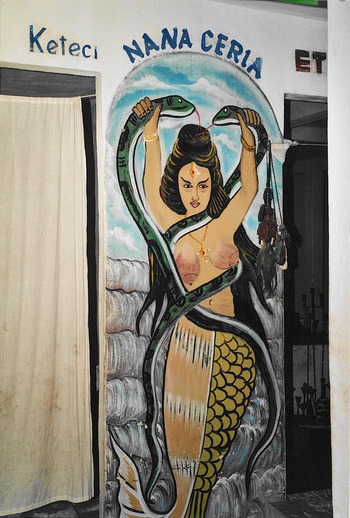
When I met Gbediga for the first time, in March 2002, he was already famous with social science PhD students because of his open-mindedness and his freedom of speech regarding his religious responsibilities. He was also seeking international recognition to assist him in the pursuit of very ambitious personal projects. He had already been to Brazil with a delegation of vodun leaders, at the invitation of the Brazilian government. His visit to Brazil appeared prominently on one of the walls of his vodun temple: an image of the mermaid Yemanja had been painted on the wall and its name in Portuguese was misspelled (Ceria instead of Sereia).Footnote 17 During his trip, he had met an Umbanda Footnote 18 priestess in Rio de Janeiro, and together they had planned her visit to Benin. I had the opportunity to meet this priestess in Brazil the following year, but, for family reasons, she never managed to go to Benin.
When we first met, Gbediga was already a mature man but in excellent physical condition, always ready to exhibit his ‘six-pack’ even when he wasn't making offerings to his deities. Born in the Zou province, he was also the heir to vodun Sakpata and bore the title of Asogba like all the older sons of a woman follower of this god. A year after the death of his father in 2007, he became chief of his lineage and he brought Yaa, his father's vodun, back to Cotonou.
Because of an ailment caused by sorcerers – brothers on his father's side – when he was still at school, he became involved with Tron. He bought it some thirty years ago from a famous worshipper of this vodun in the Bé district of Lomé. With a master's degree in economics, he started by teaching for several years in various secondary schools in Cotonou and Porto Novo before being hired as a manager by a car dealership. Six years later, he resigned to devote himself entirely to his therapeutic and religious activities. At the beginning of the 1980s, he founded an NGO, registered since 2003 with the ‘poverty eradication’ commission at UNESCO. With this NGO, he wishes to develop an inter-African research project on what he has labelled ‘the Totem Geography of Africa’ by involving European researchers, African traditional practitioners and international development agents. He is also a member of other associations such as the Traditional Medicine Practitioners’ Association in Benin – he is one of its officers – and of the CNCVB, where he was secretary general until its demise. Regarding the dispute between Daagbo Hunon Xuna and Sossa Guedehoungue, during the 92 Ouidah festival, Gbediga acted as a conciliator between the two men, but he was nonetheless much closer to Daagbo Hunon right up to his death.Footnote 19 This closeness with a traditionalist leader should be viewed as a strategy for reconciling ancient and more recent cults, a strategy that proved successful, since, following Ouidah 92, both sides started participating together in the vodun festivalFootnote 20 from 1996 onwards. In 1995, the Council of the Kings of Benin appointed him Minister of Afro-American Cults, following his attendance at a congress in Brazil the year before.
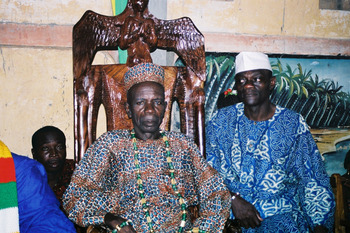
Gbediga is present at all the official gatherings of vodun non and this is how he found himself in the delegation that met with the Pope in January 1993, a few days before the celebration of Ouidah 92. He also met several times the different successive heads of government at the helm of the state since 1991, and he is also very close to a number of senior civil servants of the Ministry for Foreign Affairs, the Ministry of the Interior (Home Office) and the Ministry for Relations with Institutions, which is the successor of the former. Gbediga is a regular host, in his home, to a few American researchers who visit him in order to be initiated into the mysteries of Fa geomancy. One of his sons has been acting as an interpreter and master of Fa for his Western guests since the age of fifteen. Apart from his intercontinental trips within the framework of agreements between the Benin state and international organizations, Gbediga devotes a great deal of attention to his family and professional networks. He always attends the Tron annual festive commemoration held in the compound of his Togolese mentor in Lomé (see Figure 1). He also visits his friends’ temples, in particular at Ouidah and in his native town, Cove. Like most religious leaders, he has several wives and each of them has enabled him to extend his network. His first wife is a first cousin on his father's side whereas the second one is related on her mother's side to Daagbo Hunon Xuna from Ouidah. His third wife comes from Bohicon, a town at a crossroads between the north and the south of the country and located in neutral territory, but close to Abomey, the capital of the former kingdoms of Danxome and Allada, the cradle of the Aja ‘ethnic group’ in the region.
Gbediga looking at his mentor in Lomé, February 2003

Allada was the first stop in the migration process of the Aja princes from Tado in the fifteenth century and also the birthplace of Toussaint Louverture. With the erection of the memorial monument to the hero of the first black republic, financed by France, the kingdom of Allada was revived and, in the wake of this generous gift, undertook to rehabilitate the former royal palace and promote cooperation with local and foreign entrepreneurs in order to reap the benefits of agricultural development and the passion for Allada's glorious past. The present king, who holds a master's degree, is related to Gbediga, who readily admits that his attributes as a vodun priest have made it easier for him to access precolonial authorities since he also serves as secretary to the Council of Kings. His matrimonial links are in large part connected to his personal choices and ambitions. He even tried to marry an American or European woman in traditional fashion to strengthen his networks outside Africa. He has not yet managed to do so, probably because he does not seem rooted enough in African tradition in the eyes of a Western woman looking for African-ness and exoticism to flaunt in the diaspora.Footnote 21
Thanks to the variety of his networks, Gbediga is totally part and parcel of a religious heritage dynamic, spearheaded by his Totem Geography. But he is also present inside the country in regional and inter-regional networks where his main activity is to offer magic/therapeutic and religious services. To this end, he travels regularly to Togo and Nigeria and once or twice a year to France, at the invitation of his clients.
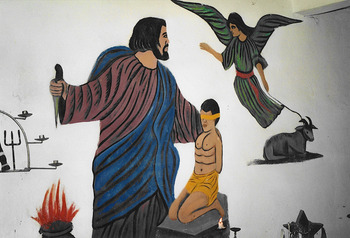
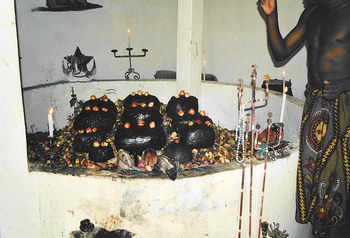
Like many vodun leaders living in Cotonou, Gbediga's temple and home are located within the same compound. When you enter, at street level, a large dark and sandy courtyard offers rows of benches, like in a classroom, where patients and clients are greeted. To the left of the threshold is the Legba messenger, and, on the right-hand wall, a blackboard is affixed where one finds the announcements of the day, the Fa sign and recommendations about the offerings to be made for the ritual ceremonies usually taking place at the end of the week. To the right of the threshold, one also finds the Ogun and Sakpata altars. Facing the main entrance, at the back of the courtyard, there are several altars hosting the main deities of the master of the house. The main altar, Tron Kpeto Deka,Footnote 22 looks like a genuine Brazilian shrine. Yemanja's effigy decorates the outside wall (see Figure 2) and the semi-circular inside wall is entirely painted in white and decorated with a mural representing an angel holding a ram and appealing to Abraham, who holds his son blindfolded, ready to kill him (see Figure 3). The altar is surrounded by a low wall with two openings – one for the priest, the other for the supplicant – and is filled with several piles of ‘stones’ wrapped up and covered with kola nuts and red palm oil in front of the trident (see Figure 4). To its left, another room is dedicated to Bawungle Keteci, another Tron, and behind the two altars one finds the Osanyi bush, a forest and medicinal plant divinity where clients and followers can take their medicinal baths and where Gbediga prepares his medicine. On the right-hand side of the entrance to the compound, an antechamber leads to the apartment of the first wife, who sells various small items, particularly everything that is necessary for the rites (candles, perfumes, kaolin, kola nuts, etc.).
Yemanja, the Afro-Brazilian mermaid

Abraham's sacrifice

Tron shrine

Gbediga's entire family is involved in the activities of the cult. His wives act as Tayino,Footnote 23 his sons take part in the bloodletting sacrifices, vodun consultations and Fa geomancy, whereas his daughters handle the shops (an internet café and a shop selling woven items) located on the street, as an extension of the compound. Above the courtyard and the altars hosting the various vodun, Gbediga has had four storeys built to house, in the top two floors, his foreign guests for sessions that he organizes every year during the vodun festive period (10 January). The second floor houses his apartments and a reception hall where he welcomes his distinguished guests. A long narrow space, this reception hall has walls decorated with countless photographs of Gbediga, pictures that show him in the company of a president of Benin, as a member of a delegation attending a conference in the US, dressed like a Mande hunter standing in the middle of a French public park, not to mention the different diplomas, in their richly decorated frames, illustrating the degrees bestowed upon him as a traditional practitioner or religious leader. Also hanging on the wall is an enlarged photocopy of the first cheque for 100 million CFA that he received in 2009 from the Yayi Boni government in his capacity as President of the Endogenous Religions.Footnote 24
Every weekend, from Friday night to Sunday afternoon, followers and clients go to Gbediga's home to take part in ritual activities. Everyone comes with the offering prescribed by the religious leader. Thus, for a ceremony that was to be held during Christmas week in December 2012, the blackboard instructed devotees to come with the following offerings: ‘82 kola nuts + 2 packs of candles + 2 bottles of perfume + 2 boxes of matches + 2010 CFA for the women and 5010 CFA + 1 bottle of liqueur for the men’.
During the week, clients and followers come in large numbers to Gbediga's place to solve various health problems or other types of misfortune; his wives and children handle the rites to identify the causes and also perform the propitiatory rites that will soothe the client/patient. Gbediga deals only with recent clients and followers. For the rest, he delegates, but only to members of his family. Still, every weekend, when he is not travelling, he is there to preside over the rituals, which at one and the same time afford relief and solace while strengthening his community of followers. Initiates and novices are there in large numbers to guarantee the spectacle.
Successive trances, more or less violent, occur during Friday and Saturday night while clients and spectators from the neighbourhood come in to present their compliments to the chief during the day. One never knows whether, during the night, witchcraft accusations might be levelled at some uninformed, naïve spectator. As a rule, followers arrive separately at nightfall; everyone rushes in to go and hail the local deities, while bowing low to the ground before saluting the master of ceremonies and then the different members of the cult, abiding by a strict hierarchical order. As musicians play the drums, Gbediga's spouses and children move from one altar to the next to feed the deities with kola nuts, red palm oil, sodabi,Footnote 25 and poultry brought by followers with special requests. Offerings to the deities are always accompanied by the officiant chewing kola nuts and drinking a glass of sodabi. Any ritual act is a performance in the course of which transubstantiation is crucial. One could say, following Louis Marin's analysis of power and its representation, that all sacrificial rituals can be construed on the basis of a Eucharistic model, or else along the lines of Bazin's (Reference Bazin and Bazin2008) and Augé's (Reference Augé1988) analysis that any ‘God-thing’ or ‘Object-God’ only exists as strength, power and might in their physical form. Indeed, with Gbediga (but this also holds true for all the other vodun cults) the consultation of a god and his real materialization always go hand in hand with offerings and libations shared by the deities, the officiating persons and the supplicants.
Over and above the three annual feasts that take place regularly at Christmas, during the Tabaski, and after the commemoration of 10 January for the revival of the principal vodun of the house, when sheep and sometimes oxen are offered, animal sacrifices are limited to poultry, plus cats and dogsFootnote 26 for special requests.
I often witnessed very short rituals, speedily performed, usually to protect clients and followers from spells. For instance, on a Saturday afternoon, I arrived in the middle of an exorcist session for a mother with her three children. The drums beating at a frenzied pace were being played by young boys and girls between six and ten years of age, while the protagonists in the ritual were seated on a mat in front of the shrine where Gbediga was officiating. One after the other, he removed from the inside a puppy, then a kitten, and finally three young chickens, which were sacrificed in sequence; the blood of the animals was poured into a dish that would be used to feed his Tron. He then smeared with blood the wrists, ankles, temples and sternum of the supplicants. One of his sons retrieved the dead bodies of the animals. Upon completion of the sacrifices, the supplicants entered the shrine to pray, except for one of the young girls who had her period. The whole ritual did not last more than ten minutes. Now Gbediga moved towards his audience, almost exclusively made up of women, with whom he discussed in small groups. He told me that most of them were spellbound. Many of them would spend the weekend in the courtyard of the compound, and the night in the antechambers of Gbediga's wives. And on Sunday, in the middle of the day, a shared meal would mark the end of the weekend rituals. Sharing a meal consisting of sacrificed poultry during those two days is a source of regeneration and protection for the followers.
In February 2003, I met with Gbediga in Lomé for the annual festival at his mentor's compound. Several hundred initiates had come, from Abidjan to the borders of Nigeria, each and every one of them carrying Tron Kpeto Deka ‘God-Thing’, in order to have their powers regenerated by the numerous sacrifices of oxen and other animals. There were more than 400 ‘Object-Gods’ stacked up in the courtyard of the founder and every religious leader in attendance had come with his delegation of devotees to take part in the dancing and singing that would last till dawn, and would start all over again at 10 o'clock in the morning. The festivities would last three full days. And it was in the dark of the night that mediums would be caught up in the most violent trances, grabbing from the hands of the sacrificer the ram that had just been offered, holding it by the neck in their mouths, tottering along the street, which had been closed off to traffic for the occasion, and coming back to the courtyard where they would spit out the offerings in front of the altar before collapsing in a frenzy of tremors. After those three days of profound excitement of the senses, everyone would go back home, clinging to his ‘Object-God’, which would be returned to its shrine and fed once again with the blood of a ram, to guarantee peace and prosperity for the community throughout the year.
The following Monday morning, on the way back to Cotonou with Gbediga, I noticed that he was unusually nervous, in contrast to his normally calm and restrained nature. We were driving through the suburbs of Cotonou in a collective cab and he was upset that the traffic congestion and the heat might dilute the regenerated fluids of his portable vodun. That was why he stopped in Godomey and hopped into an individual cab that would drive him home directly. This annual revival ceremony was of a grandiose and baroque nature that I frequently found in other Tron festivals.
GBEDIGA: A MEDIATOR FOR CIVIL SOCIETY
Since 2009, President Yayi Boni's government has been allocating an annual budget of 100 million CFA to the four main religions of the country.Footnote 27 Gbediga has been responsible since then for distributing the amount earmarked for endogenous religions to the vodun representatives of the twelve administrative districts of the country. A little under a quarter of the budget goes to the functioning of the endogenous religious administration, headquartered near St John's church in Cotonou. The executive board is fairly well balanced to the extent that every vodun class and department is represented. Oro, Egungun,Footnote 28 and anti-witchcraft vodun, however, tend to prevail over natural deities. One is duty bound to note that anti-witchcraft cults and male societies dominate the vodun landscape in present-day Benin society. These cults are acquired through personal choice and enable the followers to be released from some lineage obligations, while not representing as drastic a breakaway as converting to the Evangelical faith.
Since the mid-1980s, Gbediga has taken part in public and political events staging vodun culture. His role as a peacemaker in disputes among vodun leaders and, more importantly, his way of standing in the background establish him as the painter of a picture who brings to centre stage the protagonists of the painting. The latter, depending on the context, extol ancient vodun culture or the African heritage of the African American diaspora, or yet again the role of precolonial kingdoms in the making of the artisan traditions of their heritage. The different theatres where Gbediga appears have turned him into a versatile hero,Footnote 29 to quote a famous Brazilian novel, capable of evolving in multiple universes and emerging as the man who can cope in any situation.
Today, Gbediga holds several positions, President of Endogenous Religions, Secretary to the Council of Kings in Benin, and founder of the NGO Totem Geography of Africa, which explains why he is invited to countless congresses and debates on sustainable development, peace and civil society. In February 2010, he was invited by the United Nations Development Programme (UNDP) to take part in a workshop in New York; he also served on the Autonomous National Electoral Commission (CENA), and, during the disorders that followed the first round of presidential elections on March 2011, he seemed very well informed on what was going to happen next. And thus, despite a call to protest on the part of Houngbedji,Footnote 30 the opposition candidate, which caused some turmoil among the members of his coalition, Gbediga predicted that the runner-up would withdraw peacefully. Although fully aware of party disputes, Gbediga, like most other vodun leaders, is always to be found, in his action, on the side of the winning coalition.Footnote 31
Why is it then that Gbediga is viewed as a providential man, moving effortlessly from a domestic ritual to a vodun festival, from an administrative meeting to a UNDP conference?
He has an uncanny ability to move from one world to another. Many clients of his Tron belong to the established institutions (the police and the army) that maintain the monopoly of state violence. Many of his friends within government circles are attached to the magic religious services that he provides. The witchcraft model is extremely prevalent among civil servants who compete fiercely with one another and whose social promotion does not always hinge on professional skills.
THE EUCHARISTIC MATRIX OF VODUN CULTS
When one observes a vodun ritual, one is first and foremost engulfed in the experience, in that the performance of the actors also includes the observer, who simply by being there validates the event: the rhythm of the drums, the chants of the initiated women, the sacrificial rites unleashing the trances of the mediums – everything contributes to turning the rite into a genuine experience shared by all the attendants. It has already been stressed how violent the trances of the Tron devotees can be, when during the offering of the ram, the mediums grab it and bite into it in a total fusion between the individual possessed, the animal sacrificed and the god that is revered, each being a mere mirror reflection of the other, including the image of the spectators.
In all the offerings and sacrificial rituals, what happens is a transformation of the substance of animate or inanimate objects into divine bodies, which produces the mystical body of believers. Such acts have to be construed as a way of depicting the invisible as such, as a way of rendering present deities that manifest themselves. Analysing the phenomenon of transubstantiation not as a dogma but as a practice, in the wake of Ludwig Wittgenstein (Reference Wittgenstein1977), for whom the essence of religion resides not so much in beliefs as in sensations and practices, sheds new light on the whole question of fetishism. Wittgenstein, who was wary of metaphysics and symbolic interpretations, suggested that we stick to the description of facts and present them synoptically, as the way in which we see things and then draw formal correlations on the basis of intermediary terms.
Establishing a formal correlation between practices belonging to vastly different views on the world actually reinforces the idea that what matters in religion is not so much beliefs as emotions and practices, in other words, ultimately, experience.
With Gbediga, such an experience is renewed daily in the therapeutic rites that he performs for his patients and clients. Chewing of the kola nuts that are then shared during these private rites is part and parcel of the real presence of invoked deities, and transubstantiation is accomplished and repeats itself for each and every patient or follower. It reaches its paroxysm during the annual festival commemorating the birth of Christ or Abraham's sacrifice. However, whereas during the private rites performed within his home Gbediga is the main operator at the centre of the picture, as soon as he takes part in public rites, his position changes and he moves sideways towards the frame of the picture. Thus, most of the time, he is present as the frame defining the picture, directing the gaze, reflecting the outside and inside of the picture, what Louis Marin conveys in terms of opacity of the painting.
GBEDIGA IN THE LOGIC OF THE PORTRAIT
Drawing upon the logic of the portrait as developed by Marin enables me to discuss the multiple facets of Gbediga as a whole, making up a painting where the components appear and disappear, depending on the way one looks at them.
In the picture that Gbediga has projected in recent years, I have perceived four essential elements: 1) his physical appearance; 2) his therapeutic and ritual activities; 3) his marriage links; and finally 4) his institutional responsibilities. All of these components, far from being unconnected, complement each other to form the invisible device of the baroque mirror.
Gbediga's very fit body recalls the noble demeanour of Louis XIV in Rigaud's famous painting. Just as royal attributes do not necessarily entail the mastery of dancing, similarly those of a religious leader do not lead to sporting competition. And yet, in both cases, the presentation of a young and energetic body underscores the presence of power. Indeed, it is unusual to meet in Benin, especially in urban areas, a man in his prime in such good physical condition. As a rule, power and might conjure up overweight bodies, for obesity is a sign of prosperity. However, let us point out that in some cults followers have to be in good physical shape to perform the acrobatic dances honouring their gods.Footnote 32 And yet dances where religious leaders are possessed are very rare since the mediums are relegated to the role of instruments of the gods. Thus, Gbediga's lean and sinewy body should not be construed as a nod to a Westernized diaspora alive to the danger of obesity, but rather as a sign of greater power than that exhibited by the overweight political and economic elites. In most West African societies, and this precedes the AIDS epidemic, the symptoms of being bewitched were to be found in skinny bodies under cannibalistic attack. One can therefore appreciate Gbediga's assertively lean body as a sign of great strength where the image of his leanness may be interpreted through the metaphor of the baroque mirror, as a reverse reflection of his power. This visible sign conceals another, and the thinness due to witchcraft then makes it possible to switch from the position of a victim to that of a healer, through the control of the always invisible power of witchcraft.
Gbediga did not choose to devote his life to religious affairs to escape destitution. Like most religious leaders who acquire their vodun through a monetary transaction, illnessFootnote 33 was the starting point of his calling. And yet with a master's degree in economics, he could have carried on with a teaching career or in the private sector. His choice, at first glance seemingly a return to a traditional way of life, should rather be viewed as a rational choice spurred by a fine knowledge of the rules of the International Monetary Fund on good governance and sustainable development imposed on many African countries in the mid-1980s. Realizing that working for the state or a private company would never enable him to become his own master, Gbediga chose to develop his religious gifts consistent with a good knowledge of the market economy and its values. His NGO the Totem Geography of Africa has been extended to other countries, thanks to the workshops organized every year for the commemoration of 10 January, and has turned him into a global leader. His portraits and the framed degrees decorating his reception room are an abundant testimony to this.
I have already shown how his matrimonial alliances and networks in regions considered the cradle of vodun culture have guaranteed his legitimacy. His closeness with an extremely traditionalist chief in Ouidah and his friendship with the new generation of educated representatives cancel out earlier conflicts between ancient and new vodun cults, and between royal dynasties and vodun. As regards both religion and the representation of precolonial authorities, Gbediga appears far more as a conciliator than as a charismatic leader. His presence in the frame and not in the centre of the picture goes a long way to explain his social advancement, visible in the countless responsibilities bestowed upon him by various governments.
Let us recall that, in the public domain, his many connections with institutions representing the precolonial world have served to bolster his role as a mediator between civil society and government institutions. Never the charismatic leader, he is nonetheless always there, a witness to all the major theological and political events that bring together politicians and representatives of tradition, at election time and in international meetings, whether the theme be sustainable development, peace within civil society, or the heritage and memory of the slave trade.
CONCLUSION
In referring to the logic of the portrait by Louis Marin, I wished to demonstrate first that the central role of transubstantiation was not peculiar to the Christian religion or to the figure of the despot as embodied by Louis XIV.
In Gbediga's portrait, the images, though composite, can also be analysed against a Eucharistic matrix: the bodies of Gbediga and the mediums, of the sacrificed animals, the material nature of the offerings and of the gods are all rendered present through transubstantiation either in public or private rites. All these images of bodies incarnate are also underpinned by a narrative (a legend or myth revolving around a deity and/or the encounter between men and deities), an assertive discourse (the truth of the soothsayer and of body language when gods descend to inhabit the initiates) and a prescriptive one (taboos and obligations) that produce the community of believers, and this is reinforced by a shared meal.
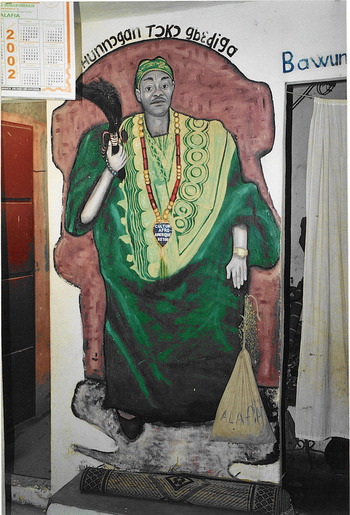
Gbediga's portrait has also enabled me to illustrate the way in which the presentation of his bodies, or the variety of his activities, turned him into a powerful and incarnate body in present-day Benin. When at home resolving the problems of his clients and followers, Gbediga's image incarnates the full power of a religious leader and healer (see Figure 5). When in a public space, his figure is more ambiguous, since what is at stake is state power. Like the painter analysed by Marin, Gbediga is the frame within which what is staged is the sacred part of state power. As in a mirror, Gbediga's image is always the reflection of what is at stake. During a public festival such as the celebration of the vodun's day, members of the government are officially present and Gbediga's image highlights the power of the state by giving it a mystical dimension. Vodun's day reveals another dimension that is also present in Gbediga's home, that of the South Atlantic world through the images of Yemanja or Mami Wata. Most of the anti-witchcraft leaders associate Tron figures with Atlantic deities and look for a diaspora clientele.
A portrait of Gbediga

Other figures, however, other bodies, also exhibit their power, more often than not in an obese body or by defending stubbornly a form of traditional purism, or the opposite, mindless post-modernism, blending Eastern and African philosophical traditions to break away from the region's historical religions.
The concept of the baroque mirror, a genuine epistemological challenge developed on the basis of religious productions in Brazil, was also a way for me to delve into the issue of the reflection projected by incongruous images. By isolating and reconfiguring features, a portrait makes it possible to chart a sort of exploration within the space, rendering him visible from within and without. A portrait implies a relationship between an image and a body that is thus materialized, and there is always a tale to make the whole illustration come alive. Whether a myth or history, the tale/portrait of Gbediga ushers in the historical long duration dimension through which are discussed and recast the religious issues of the slave trade, the colonial rule period and the postcolonial era in heritage social practices.
Thus, the approach to Gbediga's persona in its multiple facets exposes, as in a mirror, intertwined figures, which far from being superimposed in the cumulative manner often ascribed to polytheistic cultsFootnote 34 echo one another and are interconnected through transubstantiation. The baroque nature of the mirror is due to the fact that the distorted images belong to distinct worlds where fiction rendered present in the rituals leads to a juxtaposition of images belonging to worlds considered separate. Just like Macunaíma, the hero without any character, Gbediga moves about in the device of the baroque mirror as naturally as a fish in a pond.
ACKNOWLEDGEMENTS
Many thanks to Christine Marteau for her great help and patience in turning my broken English into readable academic prose.
SUPPLEMENTARY MATERIALS
A French version of this paper is available with the online version of the article at http://dx.doi.org/10.1017/S0001972013000764.