Introduction
Reconciliation of work and family life has been a salient EU policy discourse since the beginning of the 1990s (Hantrais, Reference Hantrais and Hantrais2000; Threfall, Reference Threfall and Hantrais2000). Compared with the previously dominant ‘equal opportunities at work’ approach, the reconciliation of work and family life debate recognised for the first time that access to employment for women was not central to gender equality and that employment was just one outcome of a more complex problem of gender inequality (Duncan, Reference Duncan2002).
This article examines the principle of gender equality within the context of policies for the reconciliation of work and family life as formulated in the European Employment Strategy (EES). The paper compares two main policy instruments for reconciling work and family life: childcare provision and parental leave. While the former falls within the domain of welfare provision, the latter is among mechanisms designed to enhance flexible work arrangements. Both instruments aim to support working parents. The Parental Leave Directive, put forward in 1996 by the European Social Partners as a negotiated framework agreement,Footnote 1 aims to improve work/family balance. The European Commission promotes childcare provision as a key benchmark in the EES. Yet, the childcare strategy follows a ‘soft law’ approach through the Open Method of Coordination, whereas the Parental Leave Directive belongs to the more traditional ‘hard law’ system albeit with a minimum number of binding provisions. This article assesses the potential of these two instruments in promoting a work/family balance approach to gender equality.
The research entailed an exhaustive documentary analysis covering the period 1997–2005, from the first to the last version of the EES. Relevant documents relating to EU employment and social policy, gender equality and work/family balance were analysed.Footnote 2 In-depth interviews with purposively selected key informants from the European Commission and independent experts in the EESFootnote 3 complement the documentary analysis.
The European Social Model and gender equality: legitimising the ‘adult worker model’
As agreed at the Lisbon Council in March 2000, the European Social Model (ESM) attempts to match employment growth with greater social cohesion. Although the term is a, ‘loosely defined normative concept’ (Jepsen and Serrano, Reference Jepsen and Serrano2005: 232), it certainly frames the values of social citizenship embedded in European welfare states. Crucially, the ESM embraces a definition of social citizenship where engagement in paid work is seen as the key to social integration (Levitas Reference Levitas1998).
Gender equality is integrated in this formulation of social citizenship in two important ways. The formulation firstly acknowledges the right of women to enter paid work. It also concedes that the traditional relationship between paid work and welfare benefits had been mediated by the far more ‘subterranean’ relationship, linking men's waged labour to women's unpaid domestic work. Traditionally, the organisation of these social arrangements around the ‘male breadwinner’ model resulted in a strong gender divide in terms of the capacity of men and women to claim benefits. Women outside the labour market were excluded from insurance-based social protection and social rights on an independent basis, instead needing to claim as dependants. Scholars have pointed out, however, different welfare traditions put different adaptations of the ‘male breadwinner model’ into practice (Lewis Reference Lewis1992; Orloff Reference Orloff1993; Ostner Reference Ostner1997; Sainsbury Reference Sainsbury1999). Today, however, the context of the ESM radically differs from the model outlined above precisely because the ‘male breadwinner model’ has been substantially eroded on many fronts (Lewis, Reference Lewis, Knijn and Komter2004). Simultaneous factors have worked towards the consolidation of a different settlement with important gender implications. The emerging ‘Adult Worker Model’, which Lewis contrasts with the traditional ‘male breadwinner model’, presupposes the participation of all adults, men and women, in the labour market. This transition from the traditional system demands a totally different approach to social policy, one that would ‘defamilialise’ welfare provision so women gain financial autonomy from male partners through engagement in paid work. The renovated ESM, in theory, brings greater awareness of the relationship between paid and unpaid work and the impact that unpaid care work has on women's capacity to be in paid employment. In practice, it is dominated by a ‘work first’ strategy for women with less attention paid to the unequal gendered division of household labour (Lewis and Giullari, Reference Lewis and Giullari2005: 82).
Embracing the ‘Adult Worker Model’ hinges on a renovated discourse of gender equality, notably visible since the beginnings of the 1990s. The discourse aims to step forward from the previously dominant Equal Opportunities discourse, to address issues of work/family conflict (Beveridge et al., Reference Beveridge, Nott and Stephen2000). Work/family balance policies also address the flexibility needs of European labour markets in a context of growing dependency ratios (Duncan, Reference Duncan2002: 311).
In parallel to this development, ‘gender mainstreaming’ progressively imposes itself as the new tool to implement gender equality objectives (Rees, Reference Rees1998; Mazey, Reference Mazey2000; Leibert, Reference Leibert, Beveridge and Shaw2002). Mainstreaming goes a step beyond previous equality mechanisms by attempting to integrate a gender perspective into the process of formulating and implementing policies. However, as Squires (Reference Squires2007: 40) has pointed out, while gender equality is the key aim of mainstreaming, ‘variations emerge in relation to what a gender-equality perspective entails and so what it is precisely that is being mainstreamed’. This ambiguity that seems inherent in the gender mainstreaming approach also appears in the European Commission's efforts to tackle gender equality.
The European Commission has tactically implemented gender mainstreaming through the ‘soft law’ approach of the Open Method of Coordination (OMC). In the realm of social and employment policies, the OMC implies that labour regulation and social rights should be discussed and implemented through social dialogue and agreements. Principles and targets continue to be established at the EU level, but OMC assumes member states will find a way to meet these targets through a process of mutual policy learning and advice. There has been, and still is, a vivid debate in the academic literature regarding the potential for greater success using soft law (via the OMC) as opposed to hard law (Directives). From a gender point of view, the OMC can promote positive behaviour patterns, being used as a code of good practice and allowing for a wide range of representation among social actors. On the negative side, however, the success of gender mainstreaming depends to a very large extent on political commitment to the principle (Rubery, Reference Rubery2002: 503). Its capacity for success is also hindered by the very institutional logics and social and political orders of member states (Pollack and Hafner-Burton, Reference Pollack and Hafner-Burton2000; Beveridge and Nott, Reference Beveridge and Nott2002). Finally, given the key role political and social actors play in the application of the gender equality principle through ‘soft law’, issues of a balanced gender representation need to be addressed (Gardiner, Reference Gardiner1997). At a more general level, many scholars remain sceptical as to the capacity of this ‘soft approach’ to bring about profound changes in the absence of binding obligations (De la Porte and Pochet, Reference De La Porte and Pochet2004; Jacobsson, Reference Jacobsson2004; Sabel and Zeitln, Reference Sabel and Zeitlin2007). As argued in this paper, however, despite the difficulties that the OMC might encounter, in the field of reconciling work and family life, directives have a limited capacity to impact on national legislation.
Work/family balance and the European Employment Strategies: childcare provision versus parental leave
Equal opportunities policy has always been a salient component in the employment strategies of the European Commission. The last of the four pillars of the 1997 European Employment Strategy was on gender equality.Footnote 4 Moreover, three key objectives of the four pillars were activation, lifelong learning, and reconciling work and family life. Two years after the publication of the EES in 1997, the Commission introduced a new Guideline requiring member states to adopt a gender mainstreaming approach in implementing the guidelines across all four pillars. According to the ‘Impact Evaluation Report of the EES’ for the period 1998–2001, there has been increased visibility of equal opportunities for women and men as a European-wide objective as a consequence of the European Employment Strategy (EC, 2002a: 4). Nevertheless, the report also recognises that member states could be clustered according to the degree of inclusion of gender equality in their employment policies.
The Commission, following a report from the Gender and Employment Group of experts, underlined that the main policy initiatives to be taken in the field of reconciling work and family life by member states address the quantity and quality of childcare provision (EC, 2002a: 12).
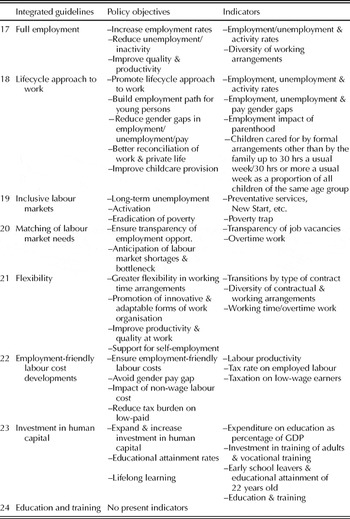
The new EES, relaunched in 2005, reduced the number of guidelines in an attempt to synthesise the objectives and benchmarking of the European Commission with regard to employment and economic growth (EC, 2002b; EC, 2003a). The new EES had eight out of 24 integrated guidelines. Within this simplification, the pillar of equal opportunities between men and women disappeared. Instead, it introduced more peripheral employment guidelines on gender equality (see Table 2). Hence, although none of the integrated guidelines is devoted to equal opportunities, the issue is included in other guidelines, most prominently Guideline 18 on a ‘lifecycle approach to work’. Equal opportunities between women and men, and indeed general issues of social cohesion and equality, are not as centrally positioned in the revised EES. As Mósesdóttir (Reference Mósesdóttir, Pascual and Jepsen2006) has pointed out, the change is likely to be interpreted by the member states as a downgrading of the gender agenda in the new EES. Other scholars see the new EES as subordinating social goals to economic ones (Scharpf, Reference Scharpf2002; Zeitlin and Pochet, Reference Zeitlin and Pochet2005; Sabel and Zeitlin, Reference Sabel and Zeitlin2007). As noted by one of the interviewees from the European Trade Union Institute for Research (ETUI):
They (the current European Commission) boiled down a very open and wide-ranging employment strategy into very few guidelines centred on three broad things and they have left out the whole of the gender equality idea. Before we discussed the EES, now we don't discuss anything, we have stopped discussing the employment guidelines, I don't hear anybody talking about this anymore, it has disappeared from the surface of the earth. Before the EES was an instrument to discuss how to reach employment growth with quality and other social concerns, now, we only have growth.
One of the European Commission's senior officials, however, contested this view. As the quote below shows, the EES had to find a trade-off between political declaration and effective implementation:
the EES to some extent intends to be at the centre of EU policy, and until 2004 the EES was hardly central to the European Commission, the EES has not been seen as a major European initiative . . . but the relaunch of Lisbon gave the EES the possibility of being at the heart of European policy. In order to fit into this the EES to some extent had to pay the price of simplification. EES as in 2005 had 8 among 24 integrated guidelines and it is a more narrowly focus more simplified strategy to fit into the broader strategy, so if you like the strategy paid certain price in terms of perhaps being slightly less ambitious; being less far reaching but in exchange it got prominence. The alternative would be for the strategy to continue as it was, to develop a better set of guidelines, better detailed. So more clarity but less influence, there is a choice.
One straightforward consequence of this new, more narrowly focussed EES has been the priority given to quantifiable objectives. As Table 1 shows, the Integrated Guideline 18 on a ‘Lifecycle approach to work’, translates the policy objective of a better reconciliation of work and private life into a specific benchmark. The goal for member states is to provide childcare to at least 33 per cent of children under the age of three, and to 90 per cent of children between three years and mandatory school age (Council of the European Union, 2005: 27).
Employment guidelines (2005 to 2008)

Source: Elaborated from Council of the European Union, 2005a.
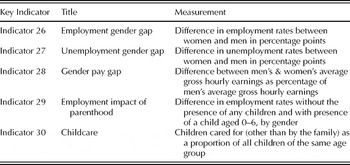
Thus, while the Guidelines for the Employment Policies of the Member States approved in July 2005 make no direct reference to parental or other forms of leave, they do explicitly address the need to improve public childcare provision in all member states as a prerequisite to increasing female employment rates. As Rubery (Reference Rubery2002: 503) points out, issues where the EES has defined quantifiable targets are likely to be taken more seriously by member states. Similarly, all the key indicators created to monitor the implementation of the Employment Guidelines on Gender Equality (see Table 2) relate to the performance of women in the labour market. Indicators will scrutinise the evolution of the employment and unemployment gender gap, the gender pay gap, the employment impact of parenthood and developments in childcare provision.
Key indicators for employment guideline on gender equality

Source: elaborated from European Commission, 2005a: 7–8.
The guideline of promoting flexibility and security in employment presumably includes parental leave packages. Part-time employment is explicitly promoted as a main route to flexibility, but parental leave does not receive such recognition. Overall, the narrowing of work/family policies to focus on childcare targets signals a strong preference for the promotion of an adult worker model (Lewis, Reference Lewis2006; Annesley, Reference Annesley2007).
Outside the scope of the EES, the recent Green Paper, Confronting demographic changes: a new solidarity between generations (EC, 2005b) explicitly recognised two policy issues needing serious attention: better reconciliation of work and family life and the provision of accessible and affordable childcare facilities and care for dependants. In a similar vein, the European Commission's Roadmap for Equality between Women and Men 2006–2010 (2006a), which then led to the European Pact for Gender Equality (2006b), underlines the importance of addressing the work/family conflict in a variety of ways. These include increasing and improving care provision for the elderly and children, and articulating flexible working arrangements for both male and female workers.
Therefore, evidence so far suggests that whether out of economic interests, demographic threats or concerns for gender equality, the European Commission has made remarkable steps towards legitimating the ‘adult worker model’ by recognising that work/family conflict is at the heart of women's relationship with paid employment. The direction taken to tackle this issue takes the route of the commodification of care, childcare in particular, whereas the share of caring responsibilities between men and women and the issue of ‘time for care’ for all workers attract less attention. Also, there does not seem to be much specification of what is meant by ‘high quality’ childcare provision and the form that this provision should adopt. This would require the use of more qualitative indicators to complement the quantitative targets. In fact, the latest Report on Equality between Women and Men (EC, 2008) stressed that while much attention had already been given to improving the availability and accessibility of services, the quality aspects now needed consideration.Footnote 5 In any case, a relevant question becomes why EU discourse of work/family balance gives clear preference to childcare provision. Why are leave packages so often absent from the work/family balance debate, despite the existence of a directive on the matter?
Perhaps the most straightforward answer to the question is that the relationship between childcare provision and female employment appears to be pretty unequivocal. No matter how the causal relationship between female employment and childcare provision is established, the vast majority of comparative research subscribes to the thesis that the impact of childbirth on female labour supply is less negative in countries with more generous provision of public childcare (Gornick et al., Reference Gornick, Meyers and Ross1998; Uunk et al., Reference Uunk, Kalmijn and Muffels2005; Vlasblom and Schippers, Reference Vlasblom and Schippers2006). In other words, publicly supported arrangements for childcare are an effective remedy for the problem of low female participation in the labour market. As one senior official from the European Commission has put it:
those Member States who appear to have low female employment rates . . . are those which appear to have very low provision of childcare but not necessarily low parental leave.
Furthermore, as another senior official from the Commission explained, high-quality child care not only facilitates women's employment, it also facilitates social inclusion, especially for children living in poor families. This point has been clearly expressed by Esping-Andersen et al. (Reference Esping-Andersen, Gallie, Hemerijk and Myers2002: 48) when he states that, cognitive stimulation of children in families with limited resources should be provided by the welfare state through high-quality day care.
The long-term effects of parental leave schemes on female employment, however, are less clear and far more contradictory. These issues partly explain why parental leave is not mentioned as often as childcare. In fact, parental leave can be interpreted in conflicting ways, depending on the conditions attached to it. On the one hand, leave arrangements with good wage replacements can allow women to remain in the labour market without interruption if there are good wage replacements and social rights are well protected. On the other hand, leave arrangements can cause female workers to miss work experience and career-enhancing opportunities (Uunk et al., Reference Uunk, Kalmijn and Muffels2005: 44). Which career effect dominates depends on the duration of the leave and whether it is paid or unpaid. As Hardy and Adnett (Reference Hardy and Adnett2002: 169) point out, when parental leave is unpaid, the measure encourages more than it eradicates the ‘male breadwinner model’. Within a household, the male partner usually has the higher income, so mothers are more likely to take the leave. A statutory entitlement to parental leave that does not clearly differentiate between maternity and paternity entitlements and that does not provide leave which is proportionate to the salary will very likely encourage mothers to look after their children and stay out of the labour market. This reflects traditional family policy where gender roles are clearly differentiated between care and paid employment. This used to be the case with parental leave in West Germany. Before the 2006 reform was introduced, the lengthy, low-paid parental leave was identified as a policy approach with a potentially negative impact on the employment of young mothers (Rubery et al., Reference Rubery, Smith, Figueiredo, Fagan and Grimshaw2004: 26). By replacing the existing means-tested parental leave benefit by a one-year wage-dependent benefit, the new German parental leave provision discourages young mothers from staying out of the labour market for too long. Since implementation of the new measure, the working hours and labour market participation of women in the second year after birth have increased significantly, which Spiess and Wrohlich (Reference Spiess and Wrohlich2006) argue reflects Germany's move towards the Scandinavian model.
An expert on the Swedish case indicated that any real approach to work/family balance has to combine good childcare provision and parental leave packages that clearly differentiate between mothers and fathers.
childcare is a broader measure, you use childcare for many years, even in pre-school you need childcare for after school hours so it is very long-term whereas parental leave schemes are appropriate for the first one or two years.
As a matter of fact, within Europe, countries with generous parental leave schemes tend to also have high availability of childcare provision and high female employment rates. These work/family balance instruments are not necessarily opponents but, on the contrary, often allies. However, even the ‘best examples’, such as Sweden, are viewed with scepticism by some experts. As a trade union expert pointed out:
Parental leave in the way it's been done in a lot of countries including the Nordic countries, where they have expanded it to make it more attractive, is withdrawing women from the labour market rather than putting them into the labour market . . . Sweden is often put as an example but Sweden has one of the most highly gender segregated labour markets.
In sum, while there appears to be little disagreement about the effects of increasing levels of childcare on female employment, the debate on parental leave is riddled with dilemmas. Firstly, there is the question of whether welfare states should encourage the role of informal care within the family. Secondly, there is the issue of whether that role is gendered. A similar controversy is also present in academic interpretations of parental leave as a work/family balance instrument. Leitner (Reference Leitner2003) for instance, uses parental leave as an indicator of ‘familialism’ since this is a policy which supports the caring function of the family. At the other end, the author considers the percentage of children under three years of age who are in formal child care as a dimension of ‘strong’ and ‘weak’ de-familialisation.Footnote 6 Other authors, however, would claim that some ‘familialistic’ instruments, such as some formulations of parental leave, might promote gender equality. As Pfau-Effinger (Reference Pfau-Effinger2005) argues, the degree of formalisation of informal care is determined by the degree to which welfare states support gender equality. The labour market integration of women does not take into account that informal care has itself been modernised and that the promotion of informal family care as through parental leave would not necessarily contradict ideas about gender equality (Pfau-Effinger, Reference Pfau-Effinger2005).
The convergence of EU countries towards greater universal provision of pre-school care and education has been possible partly through low politicisation, an alleged advantage of the OMC, whereby policy makers agree upon the causal mechanisms at work in specific policy areas, and definitions of desirable and unacceptable policies (Radaelli, Reference Radaelli2003: 9). In fact, the hardship of an agreement over a parental leave directive has been the diversity of opinions and ideological standpoints over matters of work/family conflicts – and the role of the state in solving them, an obstacle that the OMC has succeeded in overcoming. Some countries were very reluctant to have any binding provision around this issue because they saw it as interfering with principles and practises of their welfare states. In 1993, Germany, for instance, did not accept the principle of non-transferability which aimed at giving fathers stronger incentives to go on leave (Falkner et al., Reference Falkner, Treib, Hartlapp and Leiber2005). Other countries, Britain in particular, considered these leave provisions as falling within the domain of labour relations where state's intervention is often felt to be problematic. Parental leave, and indeed any working time flexibility measure is market-oriented. Even with the right incentives, employers would be concerned with the repercussion of leave packages on employees' productivity levels.
After years of unsuccessful propositions, stemming from these conflicting interests, the Parental Leave Directive (PLD) was finally adopted as part of the Euro-collective agreements between social partners. The directive was agreed with a high number of recommendations and very few compulsory minimum standards. The most important of which is probably the non-discrimination principle, that workers may not be dismissed for exercising their right to parental leave. The weakest parts, the non-binding recommendations, include remuneration (the Directive does not specify whether leaves have to be paid or unpaid), and the balance of responsibilities between men and women was not addressed. In other words, fathers are not necessarily included in the package. Compared with the Pregnant Workers Directive approved in 1992, the PLD has a much weaker legal base (Leon and Millns, Reference León and Millns2007),Footnote 7 precisely because the PLD is viewed as providing for the right to time for care. This is quite different terrain from the more traditional battleground of gender equality where the EU has a stronger mandate. Sex discrimination in the workplace, along with health and safety issues, is what the Pregnant Workers Directive addresses.
Therefore, albeit ‘hard law’ in principle, the Parental Leave Directive works in practice as a ‘soft-hard law’ mechanism. Member states are persuaded but not obliged to take action in this terrain. In this way the parental leave puts into action one of the defining features of the ESM: that labour regulation should be discussed and implemented through social dialogue and agreements. To reinforce the role of social partners through collective labour rights can have the advantage of promoting positive behaviour patterns and used as a code of good practice. These processes of negotiation of ‘soft law’ measures, however, are highly vulnerable to the balance in representation of men and women in the decision-taking bodies amongst the negotiating parties. If social pacts are to play a much greater role in policy-making, then issues of democratic deficit (in terms of representation of men and women in the decision-taking bodies) gain some relevance to guarantee fair play in the discussion of collective agreements and social pacts. In this aspect, cross-national variation within the EU is of key relevance. As O'Connor (Reference O'Connor2005) has pointed out referring to the Open Method of Coordination more generally, fulfilling the potential of the OMC is dependent on national policy legacies and political contexts. A possible institutional deadlock, lack of clear political project from the part of the EU, and the enlarged EU are all aspects seen by some of the interviewees as imposing obstacles for the real capacity of the EU to innovate and lead in social policy developments.
Concluding remarks
Research has shown that the European policy context now firmly supports the introduction of work/family balance mechanisms as a key issue within social and employment policies. For a long time gender equality strategies have mainly concentrated on women's relationship with the labour market, articulating mechanisms to address discrimination issues, equal pay being the most prominent claim. Since the 1990s, there has been a general awareness that a prerequisite to dealing with women's integration into the labour market is the reconsideration of how men and women with family responsibilities should organise their time around paid and unpaid work. Furthermore, in the context of ageing populations in Europe, the ability of women to reconcile their working and family life has clear repercussions for demographics. In Europe, fertility is lowest in those countries where the work/family equilibrium, especially of women, is not taken seriously. There is then a strong political urge to articulate and implement policies addressing these issues.
The PLD, and more generally parental leave as a policy instrument, has been received with enthusiasm by those gender scholars that, embracing an ‘ethic of care’ perspective, have been claiming that social citizenship is not properly dealt with if men's absence from unpaid domestic care work is not properly acknowledged by policy practice (Lewis, Reference Lewis2002; Lister, Reference Lister2002; Leitner, Reference Leitner2003; Pfau-Effinger, Reference Pfau-Effinger2005; Caracciolo di Torella, Reference Caracciolo di Torella2005). From a merely symbolic point of view, the PLD plays a relevant part in the European Commission's interest to devise a new social policy agenda, although, in this context, the contrast between theory and practice is remarkable. The European Commission seems to more readily encourage welfare states to adopt woman-friendly measures basically to enable the employability of mothers with small children. But the more complex understanding of gender equality, one that also looks at the (un)equal distribution of unpaid care work between men and women, is not enforced by policy practice, although present in political rhetoric.
This article has shown that in the context of European social and employment policy, childcare provision is being framed as the essential − and in some member states missing − link between female paid employment and unpaid care work. More and better quality care provision for children has also been put forward as an effective measure for the prevention of child poverty. In this respect, policy learning is working well, as most countries are getting closer or have reached the established benchmark on levels of childcare provision. In contrast, parental leave schemes are more ‘ambiguous’. They can either facilitate or discourage permanence in the labour market. It is also a highly contentious political issue partly because regulating working time flexibility to favour employees' needs and choices can be seen as conflicting with business interests. Finally, the implementation of parental leave schemes for both men and women requires a favourable environment in terms of social values and cultural norms that understand demands for a more equal balance of time spent in paid and unpaid work between men and women as legitimate. As a result, the presence of parental leave mechanisms in work/family balance debates is less secured.
Acknowledgments
I am very grateful to Peter Taylor-Gooby for his useful advice on an earlier version of this article. Help from my colleagues Lynn Prince Cooke and Rebecca Taylor is gratefully acknowledged. Very useful comments were also provided by the two anonymous referees.