Due to aging of the population, the number of people with cognitive, vision, and/or hearing impairment is set to increase (Oxford Brookes University, 2016). Cognitive, vision, and hearing impairments are listed among the European Union's (EU) ten highest disease burdens in terms of increased healthcare usage and reduction in quality of life (Mathers and Loncar, Reference Mathers and Loncar2006). Hearing and vision impairments are particularly common in older adults with dementia, with prevalence estimates significantly higher than in the general population. In one study sample from memory clinic, up to 94% of attendees with cognitive impairment had clinically significant hearing impairment (Gold et al., Reference Gold, Lightfoot and Hnath-Chisolm1996). In a national survey in the UK (Bowen et al., Reference Bowen2016), significant visual impairment (visual acuity (VA) worse than 5/12) was detected in 32.5% of a sample of people with dementia. Both hearing and vision impairments are under-diagnosed and under-treated (e.g. Evans and Rowlands, Reference Evans and Rowlands2004), especially among people with cognitive impairment (Allen et al., Reference Allen2003; Bowen et al., Reference Bowen2016).
Despite the high prevalence of concurrent sensory and cognitive impairment among older adults, commonly used tests of cognition consist mainly of test items presented through the visual or auditory modality. Accurate assessment of cognitive function is important for identification and diagnosis of dementia, differential diagnosis of cognitive versus sensory problems, facilitation of early intervention, and monitoring change in cognition over time (Callahan et al., Reference Callahan, Hendrie and Tierney1995; Chang and Silverman, Reference Chang and Silverman2004; Silverberg et al., Reference Silverberg2011). Administration time, easy availability, low cost, tolerability for the patient, and ease of scoring are all considerations for use of any cognitive test in primary or secondary care settings (Shulman, Reference Shulman2000). A cognitive test must have high sensitivity and specificity for identification of cognitive impairment and should measure multiple domains of cognition so as to be sensitive to different patterns of impairment associated with different subtypes of dementia (Cullen et al., Reference Cullen, O'Neill, Evans, Coen and Lawlor2007).
One of the most widely used screening measures of cognitive function is the Mini-Mental State Examination (MMSE; Folstein et al., Reference Folstein, Folstein and McHugh1975). However, recent enforcement of the copyright by the license holders Psychological Assessment Resources has meant that costs are incurred for every test administration resulting in a decrease in the test's popularity (Martin and O'Neill, Reference Martin and O'Neill2009). The freely available Montreal Cognitive Assessment (MoCA; Nasreddine et al., Reference Nasreddine2005) offers an alternative to the MMSE. The MoCA is similar in length, but has greater sensitivity in the detection of mild cognitive impairment (MCI) than the MMSE (Tsoi et al., Reference Tsoi, Chan, Hirai, Wong and Kwok2015). The Addenbrooke's Cognitive Examination (ACE-III; Hsieh et al., Reference Hsieh, Schubert, Hoon, Mioshi and Hodges2013) has also demonstrated superior psychometric properties to the MMSE and is frequently employed as an alternative assessment tool (Velayudhan et al., Reference Velayudhan2014). These tests are all relatively short (usually <20 min administration time), available in multiple languages, measure several different components of cognition and are psychometrically robust. However, the MMSE, MoCA, and ACE-III all include multiple items that rely on the auditory and visual perceptual abilities of the test taker (Uhlmann et al., Reference Uhlmann, Teri, Rees, Mozlowski and Larson1989; Reischies and Geiselmann, Reference Reischies and Geiselmann1997; Wittich et al., Reference Wittich, Phillips, Nasreddine and Chertkow2010; Dupuis et al., Reference Dupuis, Pichora-Fuller, Chasteen, Marchuk, Singh and Smith2015). Participants with sensory impairment and participants performing cognitive tests under the simulated effects of sensory impairment consistently performed more poorly than comparison groups without sensory impairment/simulated sensory impairment (e.g. Cronin-Golomb et al., Reference Cronin-Golomb, Gilmore, Neargarder, Morrison and Laudate2007; Toner et al., Reference Toner, Reese, Neargarder, Riedel, Gilmore and Cronin-Golomb2012). Confounding of cognitive tests with sensory impairment results in false positive identification of cognitive impairment, over-estimation of the severity of cognitive impairment, and reduced test specificity (e.g. Jagger et al., Reference Jagger, Clarke, Anderson and Battock1992; Kempen et al., Reference Kempen, Krichevsky and Feldman1994). Enlarging visually presented items in cognitive assessment tools facilitated better performance for visually-impaired individuals (Kehrberg et al., Reference Kehrberg, Kuskowski, Mortimer and Shoberg1993; Bertone et al., Reference Bertone, Wittich, Watanabe, Overbury and Faubert2005). Amplification of test instruction sound level resulted in better performance on a cognitive screening test by individuals with dementia and hearing impairment (Weinstein, Reference Weinstein1986). Although adaptations like these are simple to implement, it is not always clear how such alterations affect test validity.
Given the rising numbers of people with both sensory and cognitive impairment, there is a need to identify appropriate methods to assess cognition in individuals with hearing and vision problems. Previous reviews have discussed neuropsychological assessment in individuals with congenital or life-long hearing and/or visual impairment, including Deaf users of sign language and blind people (Bylsma and Doninger, Reference Bylsma and Doninger2004; Hill-Briggs et al., Reference Hill-Briggs, Dial, Morere and Joyce2007). However, we are not aware of any systematic review of cognitive screening tests for dementia that aim to overcome the confounds of sensory dysfunction due to age-related acquired sensory impairments. The goal of the current paper was to provide an overview of brief cognitive screening tests that have been developed or adapted for adults with acquired hearing and/or vision impairment for use in the clinical evaluation of MCI or dementia. Papers were reviewed in relation to the attempts made to validate these tests and their availability. The discussion of the papers selected in this review covers current strengths and areas of future research need.
Method
Design
Due to the paucity of information in this area, a scoping study was deemed the most appropriate method for gathering data. Scoping studies cover broader subject matters than systematic reviews and encompass several different study designs (Arksey and O'Malley, Reference Arksey and O'Malley2005). Scoping reviews are not used to assess the quality of research in a given field, but to explore the depth and breadth of existing studies (Levac et al., Reference Levac, Colquhoun and O'Brien2010). They are utilized when an area has not previously been systematically reviewed and can be conducted as a standalone project (Mays et al., Reference Mays, Roberts, Popay, Fulop, Allen, Clarke and Black2001). Scoping reviews provide a useful means of identifying gaps in the literature as well as areas requiring further research development. Scoping reviews differ from systematic reviews in that they provide a “first step” in the decision process as to whether or not a full systematic review is warranted. Where systematic reviews are often focused upon a highly specific research question, often including clearly defined design requirements, scoping studies include all research on a given topic irrespective of study design. Another key difference between a scoping study and a systematic review is that a scoping study does not attempt to synthesize evidence in terms of consistency of findings and strengths of the research; rather it provides a descriptive narrative of existing research in a given field (Arksey and O'Malley, Reference Arksey and O'Malley2005).
The primary aim of the present study was to identify and summarize all the cognitive tests adapted for individuals with age-related acquired hearing and/or vision impairment and to inform readers about the increasing need to develop appropriate cognitive screening tools for this population. The framework used to conduct this review was the five-stage process described by Arksey and O'Malley (Reference Arksey and O'Malley2005), and further refined using the recommendations from Levac, Colquhooun and O'Brien (Reference Levac, Colquhoun and O'Brien2010).
Identification of the research question
The research question was defined as “What brief cognitive screening tests exist that are developed or adapted for adults with age-related acquired hearing and/or vision impairment?” The definition of “cognitive screening tests” was further clarified to include only cognitive tests employed in the detection and assessment of (all cause) dementia and MCI. It was decided that for the purposes of this review, tests designed to measure cognition in terms of vocation, education, or intelligence quotient would be excluded. To restrict the focus to acquired sensory impairment, tests that relied on the use of sign language or braille were also excluded. These decisions were discussed with the multi-disciplinary scoping team via teleconference prior to undertaking any reviewing activity.
Identification of relevant studies
The keyword subject search terms used were (Hearing Disorders AND Cognitive Assessment) OR (Vision Disorders AND Cognitive Assessment). For practical reasons, a publication was only included if written in one of the six most widely spoken languages within the EU (German, Italian, English, French, Spanish, or Polish). To maximize the identification of the relevant literature, a number of different sources were used during the review process. Electronic database searches were conducted in Pubmed, PsycINFO, CINAHL, ConDisDome, and Web of Science. The search was augmented by web-based gray literature searches, for published and unpublished data in books or journals, including conference proceedings and abstracts, dissertations or theses, project reports and government documents in OpenGrey and Greynet. In addition to the electronic searches, a network of 53 clinical and/or academic experts in the fields of psychiatry, psychology, audiology/otolaryngology and optometry/ophthalmology in the US, the UK, France, Greece, Cyprus, Germany, Norway, the Netherlands, and Demark were approached via personal email and asked to identify any additional literature that may have been missed. The reference sections and bibliographies of all included studies were then screened for further relevant papers.
Study selection
Following initial discussions regarding inclusion and exclusion parameters, each member of the team was given time to raise questions or concerns in relation to the search procedure. After the initial search, the reviewers trialed the coding procedure and exclusion criteria on the first 50 results. The review team then met to achieve consensus on coding guidelines and criteria for inclusion. Upon completion of the search, titles were screened independently by two reviewers for potential inclusion. The second stage of the review process involved screening of abstracts for inclusion for all the titles identified in the initial screening. The final stage involved screening full papers that had passed the previous two stages. If there was a disagreement at any point in the process regarding inclusion of a paper, a third reviewer provided a decision. Following completion of the review procedure, the review team held a final consultation to discuss the process and finalize papers for inclusion.
Charting the data for included studies
The papers that were approved by the review team for inclusion were charted on the following parameters:
-
1. Authors and date of publication.
-
2. Details of how the test was constructed or adapted for use for people with sensory impairment.
-
3. Methods used in the validation of the test.
-
4. Results of the test validation.
-
5. Language availability.
-
6. General availability.
The data charting parameters were established collectively by the team of reviewers based on information required to answer the research question.
Results
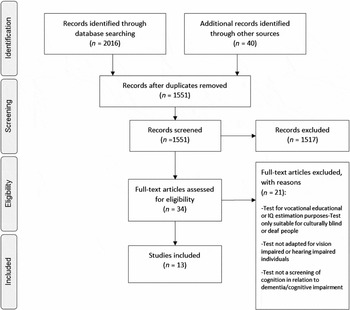
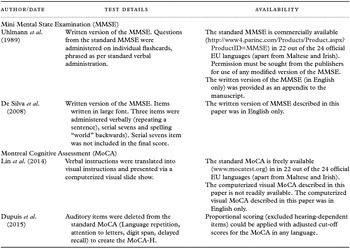
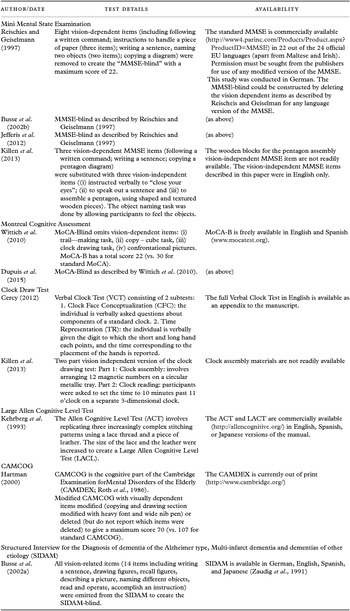
Of the 1,551 papers identified, 13 papers fit the criteria for inclusion (Figure 1). Out of those 13 papers, 4 studies related to cognitive tests adapted for hearing impairment (Table 1), and 11 studies related to cognitive tests adapted for vision impairment (Table 2).
Flow diagram to illustrate the paper selection process.

Cognitive tests adapted for hearing impairment

Cognitive tests adapted for vision impairment

Adaptations for hearing impairment
Mini-mental state examination (MMSE)
Uhlmann et al. (Reference Uhlmann, Teri, Rees, Mozlowski and Larson1989) described a written version of the MMSE. Questions from the standard MMSE were administered on individual flashcards, phrased as per standard verbal administration. This study reported on 71 adults with dementia due to Alzheimer disease (including adults with hearing impairment (average pure tone audiometric threshold > 25 dB HL in the better ear; n = 38), and normal hearing adults (n = 33). Participants completed the standard MMSE and were then randomized to re-administration of standard MMSE or written MMSE. The authors described a statistically non-significant trend for poorer written MMSE scores than the standard MMSE by the hearing-impaired group, with a statistically non-significant trend for better written MMSE scores than the standard MMSE by those who had normal hearing. They concluded that the written MMSE may be equivalent to the standard MMSE and may therefore be suitable for people with hearing impairment.
De Silva et al. (Reference De Silva2008) developed another written version of the MMSE with items written in large font. Their written MMSE differed from Uhlmann et al.’s in that three items were still administered verbally (repeating a sentence, serial sevens, and spelling “world” backwards). The serial sevens item was not included in the final score. De Silva et al. compared standard and written MMSE scores in individuals with a range of dementia stages with either hearing impairment (based on failing a whispered voice hearing screening test; n = 27) or without hearing impairment (n = 55). The written MMSE was administered three days apart from the standard version, with the order of presentation counter-balanced across participants. There was no difference between written and standard MMSE scores in hearing-impaired individuals; 75% of those with hearing impairment and 58% of those with normal hearing preferred the written to the standard version. De Silva et al. concluded that the written MMSE may be a more acceptable and appropriate form of the test for people with hearing impairment.
Montreal cognitive assessment (MoCA)
Lin et al. (Reference Lin, Chung, Shipp and Masellts2014) developed a computerized visual version of the MoCA, with verbal instructions translated into visual instructions. Adults who passed a cognitive screening battery with normal hearing (n = 55) or severe-to-profound hearing loss (n = 50) completed the visual computerized visual version of the MoCA. The standard MoCA was completed by a subset of normal hearing participants six months after completing the computerized MoCA. This study found no difference in computerized visual MoCA scores between participants with normal hearing and participants with hearing loss. The authors also reported “similar scores” for computerized visual MoCA versus MoCA for the subgroup of normal hearing participants retested at six months. No details of the statistical analyses nor the specific hearing or cognitive assessments administered were reported.
Dupuis et al. (Reference Dupuis, Pichora-Fuller, Chasteen, Marchuk, Singh and Smith2015) developed the MoCA-H for people with hearing impairment by deleting auditory items from the standard MoCA (language repetition, attention to letters, digit span, and delayed recall). Adults with hearing loss (PTA > 25 dB HL; n = 43), normal hearing (n = 79), and normal near and far VA completed the standard MOCA. The authors reported that the MoCA-H yielded a higher pass rate than the standard MoCA among adults with hearing loss (71% vs. 53%). However, significantly fewer hearing-impaired participants achieved passing scores with proportionally adjusted cut-off scores versus normal hearing group (53% vs. 85%) on the MoCA-H. This study found that the MoCA-H reduced but did not eliminate poorer performance of hearing-impaired versus non-impaired participants, and that the poorer MoCA performance of hearing-impaired participants may not have been entirely attributable to confounding with hearing impairment. Dupuis et al. did not carry out any independent assessment of the cognitive level of participants.
None of the papers described above examined the sensitivity and specificity of the adapted versions of the MMSE or the MoCA for identification of cognitive impairment.
Adaptations for vision impairment
Mini-mental state examination (MMSE)
Reischies and Geiselmann (Reference Reischies and Geiselmann1997) created the Mini-Mental State Examination-Blind (MMSE-B) by deleting eight vision-dependent items (including following a written command, instructions to handle a piece of paper (three items), writing a sentence, naming two objects (two items), copying a diagram). A similar sensitivity and specificity of the MMSE-B compared to the standard MMSE for dementia (with diagnosis by a psychiatrist of dementia based on DSM-III-R criteria and the Geriatric Mental State interview) for participants (n = 516) in two age groups (70–84 and >85 years) was reported. There was no evaluation of vision status in this study, and the authors reported that the sample was too small to permit examination of the impact of educational level on MMSE-B performance within the two age groups.
Busse et al. (Reference Busse, Sonntag, Bischkopf, Matschinger and Angermeyer2002b) tested the validity of linear transformation (multiplication of MMSE-B scores by 33/22) as a method to estimate full-scale MMSE scores. They analyzed data from participants aged >75 years with visual impairment (n = 88) or normal vision (n =1,048) from the Leipzig Longitudinal Study of the Aged. The visual impairment and normal vision groups included participants with dementia (n = 27; n = 160, respectively). Identification of visual impairment was based on self-report. Identification of dementia was based on the Structured Interview for the Diagnosis of dementia of the Alzheimer type, multi-infarct dementia, and dementias of other etiology (SIDAM) diagnostic algorithm (Zaudig et al., Reference Zaudig1991). There was no difference between vision-impaired or normal-vision groups on MMSE-B score or on individual MMSE-B items (controlling for dementia, age, and educational level), leading the authors to conclude that vision impairment does not impact performance on the MMSE-B. However, they noted that that the eight vision-dependent items removed from the MMSE to form the MMSE-B were all items with low difficulty (items with a proportion correct across participants between 70% and 100%), and that the MMSE-B is therefore “more difficult” than the standard MMSE. Except for very poor (<3) and very good (>28) MMSE scores, linear transformation of MMSE-B scores resulted in an underestimate of the full MMSE scores among the normal vision group, which was consistent with the differential difficulty of the items deleted. The authors then provided age- and education level-specific norms and optimal cut-off scores for the MMSE-B. Sensitivity and specificity for detection of dementia by the MMSE-B using the suggested cut points was high (>90%).
Jefferis et al. (Reference Jefferis2012) compared the performance of 85-year-old adults with vision impairment (based on general medical practice records as being blind/partially sighted; n = 44) to the performance of older adults without recorded vision impairment (n = 795) on MMSE items requiring vision and the MMSE-B. No vision testing was carried out to verify vision status. Participants with visual impairment scored significantly lower on MMSE vision-dependent items (naming objects, writing a sentence, copying a diagram, and following an instruction). They also had significantly lower scores on two non-vision dependent MMSE items (orientation in time and place; repetition of a phrase). There was no difference between groups in the median score for the MMSE-B, suggesting that the MMSE-B may be a fairer cognitive assessment for people with vision impairment than the standard MMSE.
Killen et al. (Reference Killen2013) adapted the MMSE by substituting three vision-dependent MMSE items (following a written command, writing a sentence, copying a pentagon diagram) with three vision-independent items (instructed verbally to “close your eyes,” to speak out a sentence and to assemble a pentagon using shaped and textured wooden pieces). The object naming task was undertaken by allowing participants to feel the objects. The authors compared performance of participants with visual impairment (binocular best near VA < log MAR 0.5; n = 74) to performance of those without visual impairment (n = 76) on: vision-independent tests (verbal fluency, category fluency test, and the Rey auditory verbal learning test (RAVLT)), MMSE vision-dependent items, MMSE vision-independent items (i.e. the three substitute vison-independent MMSE items). Participants with vision impairment had significantly poorer performance on the vision-dependent MMSE items but there was no difference between the groups on vision-independent tests (verbal fluency, category fluency, RAVLT), vision-independent MMSE items or the three substitute vision-independent MMSE items. The authors concluded that fair assessment of cognition in people with visual impairment should be based on cognitive tests that do not rely on vision.
Montreal cognitive assessment (MoCA)
Wittich et al. (Reference Wittich, Phillips, Nasreddine and Chertkow2010) re-analyzed the original MoCA normative data with respect to the MoCA-Blind, a version of the MoCA that omits vision-dependent items (trail-making task, copy-cube task, clock drawing, and picture naming). They tested the sensitivity and specificity of MoCA-B scores with two cut-off points: (i) cut-off at 17 (an absolute shift subtraction of 8 points to account for the reduction in overall score), and (ii) cut-off at 18 (83% proportionally adjusted cut-off comparable to standard MOCA) with respect to cognitively normal (n = 90), MCI (n = 94), and dementia due to Alzheimer disease (n = 93) groups determined by neuropsychological examinations. The proportionally adjusted cut-off yielded better sensitivity and specificity than absolute scoring. Specificity for dementia identification increased from 87% to 98%, compared to the standard MoCA. However, the MoCA-B had poorer sensitivity than the standard MoCA for identification of MCI (63% for the MoCA-B vs. 90% for standard MoCA), and for identification of dementia due to Alzheimer disease (94% for the MoCA-B vs. 100% for standard MoCA). These authors did not report on the vision status of the participants in the original MoCA normative sample.
Dupuis et al. (Reference Dupuis, Pichora-Fuller, Chasteen, Marchuk, Singh and Smith2015) examined the effect of proportional scoring (i.e. the 83% correct cut-off recommended by Wittich et al.) with the MoCA-B on the performance of participants with normal vision (n = 259) versus those with vision impairment (n = 38; based on far acuity poorer than <log MAR 0.3). Participants with normal vision had higher mean standard MoCA scores than participants with vision impairment. There was no difference in MoCA-B scores. A slightly higher proportion of participants in both groups scored within the normal range on the MoCA-B compared to the standard MoCA.
Clock draw test
Cercy (Reference Cercy2012) described a spoken version of the Clock Draw Test (CDT), the Verbal Clock Test (VCT), consisting of two subtests: (i) Clock Face Conceptualization (CFC): the individual is verbally asked questions about components of a standard clock, including the shape of the clock face, number and placement of digits, number and size of hands and placement of hands according to time; and (ii) Time Representation (TR): the individual is verbally given the digits to which the short and long hand point, to respond with the corresponding time. The individual's verbal response to each question is scored for accuracy. A clinical sample of adult patients (normal cognition n = 14, MCI n = 152, dementia n = 126) completed a test battery that included the MMSE, Wechsler Adult Intelligence Scales-3, digit span, Trial Making Test, Symbol Digit Modalities Test, Modified Wisconsin Card Sorting Test, Controlled Oral Word Association Test, Animal Fluency Test, Boston Naming Test, Rey-Osterrieth Complex Figure Test, Hopkins Verbal Learning Test-revised, Geriatric Depression Scale-15, standard clock drawing test, and VCT. The diagnosis of MCI or dementia was based on neuropsychological assessment. The study revealed that age and education were modestly correlated with both VCT subtests; there was no difference between genders, but there were small significant differences between Caucasian and Hispanic and African-American ethnic groups in VCT performance. Factor analysis suggested that the two VCT subtests loaded primarily onto the same factor as other putative tests of executive function. The VCT successfully differentiated participants with normal cognition from those with cognitive impairment (either MCI or dementia) with an 84.1% sensitivity and an 83.3% specificity. However, these data were presented as preliminary findings due to the small number of participants with normal cognition (n = 14), and the predominantly male sample (92% were male). There was no assessment of visual function.
Killen et al. (Reference Killen2013) described a two part vision-independent version of the clock drawing test: Part 1: Clock assembly: involving arrangement of 12 magnetic numbers on a circular metallic tray with the verbal instruction “Please arrange these numbers as they would appear on a clock face.” Part 2: Clock reading: participants were asked to set the time to 10 min past 11 o'clock on a separate 3-dimensional clock. The performance on vision-independent tests (verbal fluency, category fluency test and the RAVLT) were then compared with the standard written clock drawing test and vision independent clock drawing test for participants with visual impairment (binocular best near VA < logMAR 0.5; n = 74) versus participants with normal vision (n = 76). Findings revealed a significantly poorer performance on the standard clock drawing test by the vision-impaired group compared to the group with normal vision. There was no difference between groups on the vision-independent tests or the vision-independent clock drawing test. The authors concluded that patients with vision impairment benefit from cognitive tests that are vision independent.
Allen cognitive level test
The Allen Cognitive Level Test (ACT) involves replicating three increasingly complex stitching patterns using a lace thread and a piece of leather. In Kehrberg et al.’s (Reference Kehrberg, Kuskowski, Mortimer and Shoberg1993) study, the size of the lace and the leather were increased to create a Large Allen Cognitive Level Test (LACT). The authors compared performance on the ACT versus LACT for participants with normal cognition (n = 34) and participants with dementia due to Alzheimer disease (n = 49). The average VA (based on near acuity measured with pocket screener charts) for all participants was logMAR 0.18 (Snellen 20/30; moderate low vision). There was no significant difference between ACT and LACT scores for either participants with normal cognition or participants with dementia. There was a high correlation between ACT and LACT scores within groups (normal cognition; r = 0.6; dementia r = 0.95) and a high correlation between both ACT and LACT and MMSE scores (~r = 0.8).
Camcog
CAMCOG is the cognitive part of the Cambridge Examination for Mental Disorders of the Elderly (CAMDEX (Roth et al., Reference Roth, Tym and Mountjoy1986)). CAMCOG assesses orientation, language, memory, praxis, attention, abstract thinking, perception, and calculation. Hartman (Reference Hartman2000) constructed a modified CAMCOG with visually-dependent items adapted (copying and drawing section modified with heavy font and wide nib pen) or deleted (but did not report which items were deleted) to give a maximum score of 70 (vs. 107 for standard CAMCOG). Non-cognitively-impaired adult participants (n = 42; based on case history and normal range MMSE score) with a range of VA levels completed the modified CAMCOG and standard CAMCOG. There was a significant negative correlation between CAMCOG score and VA; there was no correlation between modified CAMCOG score and VA.
Structured Interview for the Diagnosis of dementia of the Alzheimer type, Multi-infarct dementia and dementias of other etiology (SIDAM).
The SIDAM is a test battery for diagnosis and measurement of dementia, which involves a structured clinical interview, cognitive tests (including the MMSE), clinical judgment and information from third parties (Zaudig et al., Reference Zaudig1991). The SIDAM version for the blind was developed by deleting 14 vision-dependent items (including writing a sentence, four items involving drawing figures and recalling them, picture description, three items involving naming objects, two items involving reading and obeying a sentence, and three items involving performance of a three-stage command, resulting in a total score of 41 for the SIDAM-blind versus 55 for the standard SIDAM) (Busse et al., Reference Busse, Aurich, Riedel-Heller, Matschinger and Angermeyer2002a). Participants from the Leipzig Longitudinal Study of the Aged with normal vision (n = 1,001; including 143 with dementia) completed the standard SIDAM while participants with visual impairment (n = 106; including 31 with dementia) completed the SIDAM-blind. Dementia was diagnosed according to DSM-IV criteria, but no details were provided about how those criteria were operationalized. The identification of visual impairment was based on self-report.
No significant difference in total SIDAM-blind score between the vision-impaired and the normal-vision groups was observed. Examination of the distribution of items according to item difficulty (proportion correct across participants) suggested that item deletion had resulted in the SIDAM-blind containing relatively fewer “easy” items (items with >70% correct). Examining the scores of participants with normal vision who had completed the standard version of the test, it was concluded that extrapolating SIDAM-blind scores over-estimated full SIDAM scores. Extrapolation of SIDAM-blind scores resulted in under-estimation of the proportion of participants scoring within the clinical range (scores < 30). It was therefore concluded that SIDAM-blind scores could not simply be extrapolated for use with SIDAM norms. The authors reported age-standardized cut-off scores (with sensitivity and specificity >91%) for the SIDAM-blind for identification of dementia.
Discussion
The studies identified in this scoping review date back to the late 1980s. Thus, there has been a long-recognized clinical need for tests to reliably identify cognitive impairment in adults with sensory impairment. Given the lack of biomarkers for the detection of cognitive impairment (Wood and Wood, Reference Wood and Wood2014), cognitive testing plays a vital role in establishing the diagnosis of an individual. Unfortunately, no study in the present review reported the sensitivity or specificity of adapted tests in detecting MCI and dementia among those with sensory impairment. The present review identified several common limitations with previous attempts to adapt cognitive tests for sensory-impaired populations.
Most notably, several adaptations relied on item deletion (Reischies and Geiselmann, Reference Reischies and Geiselmann1997; Hartman, Reference Hartman2000; Busse et al., Reference Busse, Aurich, Riedel-Heller, Matschinger and Angermeyer2002a; Reference Busse, Sonntag, Bischkopf, Matschinger and Angermeyer2002b; Wittich et al., Reference Wittich, Phillips, Nasreddine and Chertkow2010; Jefferis et al., Reference Jefferis2012; Dupuis et al., Reference Dupuis, Pichora-Fuller, Chasteen, Marchuk, Singh and Smith2015) which poses numerous potential confounds. First, deleting items obviously dependent on visual/auditory function (such as naming pictures, in the case of vision) may not eliminate bias, because there may be other items that are indirectly impacted by sensory impairment. For example, people with vision impairment may be less likely to read newspapers or calendars, and so may be disadvantaged on items related to orientation in time. Second, item deletion may result in under- or over-estimation of cognitive performance (Busse et al., Reference Busse, Sonntag, Bischkopf, Matschinger and Angermeyer2002b; Wittich et al., Reference Wittich, Phillips, Nasreddine and Chertkow2010; Dupuis et al., Reference Dupuis, Pichora-Fuller, Chasteen, Marchuk, Singh and Smith2015) if the deleted items happen to be harder or easier than other items in the test. Third, item deletion is likely to mean that the test under-represents certain cognitive domains, compromising the factorial structure of the screening tool and reducing sensitivity to dimensions of cognition characteristically impaired in certain types of dementia. Last, there is potential for item deletions to negatively impact re-test reliability (Symonds, Reference Symonds1928).
Substitution of items in a different modality may be an alternative approach to item deletion. Item substitution could avoid the disadvantages of item deletion if substitute items are of comparable difficulty and assess the same cognitive domains as the original items. Unfortunately, substitute item difficulty level and validity have typically not been assessed and there is a need for future research to address this. Item response theory could provide a means of examining the psychometric properties of adapted tests including the appropriateness of items for deletion and substitution. The collection of appropriate normative data for modified tests would also be advantageous. While Busse et al. (Reference Busse, Sonntag, Bischkopf, Matschinger and Angermeyer2002b) collected age- and education-related normative data for the MMSE-B, the norms generated by the study may be appropriate only for populations similar to the study's urban German population.
Establishing the equivalency of the adapted version of a cognitive test and testing for bias against people with sensory impairment was problematic in all of the studies in the present review. Most studies compared the cognitive performance of people with hearing or vision impairment to age-matched groups of participants with normal hearing or vision. Finding no difference in the performance of a standard or adapted cognitive test between groups of people with hearing/vision impairment and normal hearing would be reassuring as it would support that the test is free of bias to hearing/vision impairment. However, findings of poorer performance among the hearing/vision group (Jefferis et al., Reference Jefferis2012; Dupuis et al., Reference Dupuis, Pichora-Fuller, Chasteen, Marchuk, Singh and Smith2015) would not necessarily indicate bias against people with sensory impairment. One explanation for poorer performance among people with sensory impairment on adapted tests may be that remaining items less obviously impacted by sensory impairment create bias. But, alternatively, it is possible that people with sensory impairment do have poorer cognitive performance than those without sensory impairment. Poorer cognition among those with sensory impairment is consistent with the notion that sensory impairments are markers of cognitive ill-health (e.g. Baltes and Lindenberger, Reference Baltes and Lindenberger1997). It is therefore problematic to compare the performance of people with sensory impairments to those without sensory impairments to determine the sensory bias of a test. The alternative is to compare the performance of adapted versus standard versions of a test in people with normal sensory function (e.g. Reischies and Geiselmann, Reference Reischies and Geiselmann1997; Lin et al., Reference Lin, Chung, Shipp and Masellts2014). This comparison provides information on test equivalency (at least for people without sensory impairment). An obvious limitation of this approach is that there may be biases in the adapted version of the test that result in poorer performance by people with sensory impairment, which would not be apparent based on examining test equivalency in groups of people with normal sensory function. No study in this review attempted to evaluate the equivalency of adapted versions of a test under conditions of simulated sensory impairment (e.g. Wood et al., Reference Wood2010; Jorgensen et al., Reference Jorgensen, Palmer, Pratt, Erickson and Moncrieff2016), which would be an ideal way of testing whether an adapted test is resilient to bias.
Additional limitations of the tests identified in the present review include sensory function either not being assessed (e.g. Wittich et al., Reference Wittich, Phillips, Nasreddine and Chertkow2010; Cercy, Reference Cercy2012) or based on self-reported sensory function (e.g. Busse et al., Reference Busse, Aurich, Riedel-Heller, Matschinger and Angermeyer2002a; Reference Busse, Sonntag, Bischkopf, Matschinger and Angermeyer2002b), which may underestimate cases of sensory impairment.
A general consideration omitted from all of the studies in this review is the level of sensory impairment that is significant for cognitive evaluation. The studies in this review identified sensory impairment based on self-report, sensory screening test or standard clinical criteria. However, it is unknown whether such standard criteria for sensory impairment are too lenient (i.e. that sensory impairment affects performance on cognitive tests at more severe levels of impairment) or too stringent (i.e. that milder levels of sensory impairment may have an important impact) with respect to cognitive evaluation. Milder levels of impairment may have negligible impact on test performance, given optimal test conditions (i.e. a well-lit quiet room). On the other hand, milder levels of impairment than those typically used for clinical identification of sensory impairment may have a significant impact on cognitive tests (e.g. Rabbitt, Reference Rabbitt1991). The impact of sensory impairment severity could be estimated by correlating performance of sensory-dependent versus sensory-independent items to the severity of sensory impairment. Alternatively, severity levels of sensory impairment could be systematically simulated to test the impact on test performance (e.g. Wood et al., Reference Wood2010; Jorgensen et al., Reference Jorgensen, Palmer, Pratt, Erickson and Moncrieff2016). It would be clinically important to know what level of sensory impairment renders standard measures of cognitive performance invalid, necessitating the use of alternative assessments.
The most commonly examined tests in relation to detection of cognitive impairment in adults with age-related acquired hearing and/or vision impairments were the MMSE and the MoCA. The focus on the MMSE and the MoCA is unsurprising given the popularity and ready availability of these two tests. Eleven studies reported on cognitive tests in relation to vision impairment, while four were concerned with hearing impairment. The relative scarcity of studies concerning cognitive assessment in people with hearing impairment is surprising considering the very high prevalence of hearing impairment in older people, particularly among those with dementia (Gold et al., Reference Gold, Lightfoot and Hnath-Chisolm1996). The lack of attention to hearing impairment in cognitive assessment may reflect a lack of recognition of the impact of hearing impairment on cognitive assessment. There is a particular need for attention to development of reliable cognitive assessments for individuals with hearing impairment.
Only two tests relied on manipulation of objects by touch and may thus be suitable for adults with both hearing and vision impairment (Clock Assembly Task (Killen et al., Reference Killen2013) and the Large Allen Cognitive test (Kehrberg et al., Reference Kehrberg, Kuskowski, Mortimer and Shoberg1993)). Dual sensory impairment is increasingly prevalent in older people (Dawes et al., Reference Dawes2014), rendering the lack of assessments suitable for detection of cognitive impairment in people with dual sensory impairment particularly problematic. The sensitivity and specificity for the detection of dementia in sensory-impaired individuals has yet to be ascertained for the two tactile tests reported in this review (Kehrberg et al., Reference Kehrberg, Kuskowski, Mortimer and Shoberg1993; Killen et al., Reference Killen2013), constituting another important area for future work.
Finally, several brief screening tests are free of vision-dependent items, for example telephone administered cognitive screening tests (for a review see Castanho et al., Reference Castanho, Amorim, Zihl, Palha, Sousa and Santos2014) and the Six-item Cognitive Impairment Test (6CIT; (Larner, Reference Larner2015)). These tests were not specifically developed or validated for people with vision impairment, but it is likely that they would be well tolerated.
Conclusions
In the absence of a valid and reliable test, there are several strategies that can be employed in order to minimize the sensory bias of cognitive tests. In instances where clinicians are aware of diagnosed sensory impairment, it is important to consider the environment in which the test is being taken: ensuring good light levels, low background noise, and use of sensory corrective devices would reduce the confounding effects of vision and hearing loss. However, because hearing and vision impairments are under-diagnosed and frequently unrecognized, the use of brief vision and hearing screening tests in conjunction with cognitive tests would allow for an understanding of how sensory impairment might impact cognitive evaluation and contribute to the clinical presentation of the individual. Additionally, greater emphasis could be given to other methods of assessment in individuals with sensory impairment such as informant-reported functional and cognitive changes and patient history.
Future cognitive test adaptations for adults with age-related acquired hearing or vision impairment should use item substitution rather than deletion, should collect appropriate normative data and establish test equivalence by testing the impact of simulated sensory impairment on test performance. Furthermore, psychometric properties of the adapted tests should be explored more extensively, including the use of item response theory to identify the appropriate items for adapted versions of tests. Future research should attempt to establish sensitivity and specificity of adapted tests (e.g. MoCA and MMSE) and other potentially relevant tests (e.g. telephone administered cognitive tests for people with vision impairment) for detection of MCI and dementia among people with sensory impairment.
Conflict of interest declaration
None.
Descriptions of authors’ roles
I. Leroi and P. Dawes are principal investigators for the project. C. Thodi and P. Dawes are work package leads for this branch of the project. Authors A. Charalambous, P. Dawes, and A. Pye contributed to screening and selection of included papers. All authors contributed to the writing of the paper and have approved the final version.
Acknowledgments
This review is part of the Work Package 2 of the SENSE-Cog project, which has received funding from the European Union's Horizon 2020 research and innovation programme under Grant agreement no. 668648.