Introduction
Around 1720, the committee that oversaw the water supply for the city of Piacenza, Italy, received a long letter.Footnote 1 It was a report about a dispute between two ecclesiastical institutions over a wall, a road and a canal. The canal, called San Savino, was one of the oldest in the city. The institutions, a convent and a monastery, were located near the entrance of the canal through the city walls. The convent, the older institution established in 1096, was unhappy with actions taken by the brothers of the newer monastery, built after 1569. The monks had walled off access to the canal where it ran between the two properties. The nuns foresaw significant problems with the new arrangement. It would affect their ability to water their large garden and to fulfil the canal maintenance required of them. They feared winter floods and ice build-up. The report cited earlier agreements that contradicted the actions of the Capuchins, but the brothers wanted increased access to the water in order to wash large amounts of wool. Despite the fact that the convent was the older institution, with long-standing water rights, the water utility in charge eventually approved the wall possibly due to differences in political influence. The nuns received approval for a new ornate gate, perhaps as compensation.Footnote 2
For early modern Italian cities, any deficiency of water resources was a problem that could potentially halt economic development. Cities needed not only potable water, good enough to drink and prevent illness, but also running water to carry away sewage and pollution. They also needed sufficient quantities to cover the needs of water-dependent industries such as textile production and paper-making. Dependent upon their geographic location, position within the watershed and geomorphologic characteristics, each city had to find water and get it inside the city walls for use by residents and industries. Once there, decisions had to be made about the distribution of the precious resource. Water supply was critical for urban growth in terms of domestic use, industrial development and sanitation of households, city streets and industrial sites. Without electric pumps, all were vulnerable to the dynamics of weather, climate and their particular ecosystem.
Several northern Italian cities had highly developed water systems from the late Middle Ages, along with the social and political methods to manage them. This meant legislation and the means of enforcement had to be developed. One of the most important tools of management was for authorities to grant rights for various uses of water. Such rights could include navigation, management of piers and bridges, fishing, ferries, mill wheels, artisanal processes, agricultural irrigation, domestic uses and sanitation.Footnote 3 Along with the rights came responsibilities, as often those granted the rights had to construct and maintain the infrastructure. An examination of issues connected specifically with water in the city can give insight into the decisions and negotiations that make up the human relations within an urban ecosystem.
Today, as a combination of vulnerable water resources and populations raises questions about how cities supply their needs, it may be time to re-examine past solutions to these problems. This article will explore the day-to-day urban supervision of the water utility of Piacenza, Italy, from 1545 to 1736. Of primary interest will be the urban committee that oversaw management of the infrastructure, its organization and sustainability. This committee, the Congregazione sopra l'ornato (CSO), and its activities are recorded in an archival collection found at the Archivio di Stato di Piacenza. Over 3,000 of the archived documents illuminate the day-to-day management of the water utility and the relationship between administrators and urban residents. With the information within the archive, it is possible to ask how people within a city organized themselves to manage water, waste and sewage.
Research on northern Italian water systems
There has been a surge of research on the canal systems of north and central Italy in the past two decades.Footnote 4 Several systems may have been involved in any given city's solutions to the problems of water provision and sanitation. A variety of infrastructure may also have been required depending upon the location and nearby resources. Piacenza was not alone in canal construction and use amongst cities in northern Italy at that time. Many systems had their post-Roman origins in the late medieval period as populations in Europe rose. Increased urban density and the desire for economic development encouraged a more public approach to the problem of supplying water and sanitation to urban residents. For Piacenza, this meant that canals built by ecclesiastical institutions were transferred to municipal authority and the city took over infrastructure management and construction.
Fantoni's research on Milan covers a system with similarities to that of Piacenza, canals were dug to facilitate sanitation and waste removal, wells were used for potable water and private sanitation cisterns were required by residents to ease demand on the municipal system. However, Fantoni focuses on the years 1385–1535 and on legislation and the municipal officials connected to the administration. Work done in Bologna by M. Poli pulls together information on that canal system and the distribution of water that deals with mills and neighbourhood services. While Kucher's work on Siena covers the system comprehensively in terms of structure, the focus there is also on medieval legislation.
Piacenza's canal system has been studied by a number of other historians, such as Valeria Poli, who examined the system of canals, especially those outside of the city walls, and traced the political alliances and conflicts that affected their management as well as the architects and engineers who worked on the infrastructure. Poli's work spans the history of the system and focuses on management and the administrators.Footnote 5 Others, such as Maria Cristina Cademartiri and Anna Zaninoni, have researched a single ecclesiastical institution and their water rights.Footnote 6 The canal system has also been discussed by historians interested in the architecture and built form of Piacenza.Footnote 7 This new research adds information on the final downstream users of the canal water, the urban residents. It focuses on the dynamic relationship between the urban users and the administrative body that oversaw the urban water utility and sketches the shifts and changes during the Farnese period.
While Piacenza has been richly explored by Italian historians it has been often overlooked by those from outside Italy. Racine, a French scholar, did a comprehensive examination of the city with an emphasis on the medieval period.Footnote 8 But English scholars have tended to pass by Piacenza, perhaps in search of better-known urban areas. One exception is Daniel Curtis and Michele Campopiano, who wrote a comparison on medieval land reclamation in Holland and the Po Valley. They looked at the social process of land reclamation and concluded that the Po Valley demonstrated a more authoritarian, more coercive society, marked by polarization and repression, thus making these less resilient polities.Footnote 9 This article will argue in favour of a more nuanced view based on the archival evidence from the CSO.
Much of the research on Italian cities has concentrated on the administration of water systems from the fourteenth to sixteenth centuries. Gonizzi's study of Parma (about 60 kilometres south-east of Piacenza) does cover the early modern period with his investigation of the Farnese-led improvements to that system. But he does not explain the administration of the infrastructure.Footnote 10 Poli does deal with the early modern period but mainly makes use of other archival collections. The collection Congregazione sopra l'ornato offers a new understanding of how urban managers organized and oversaw the water utility in the city of Piacenza. It contains the communications between the committee and the urban residents including complaints by residents, committee orders and decrees as well as bills from workmen, tax lists and engineering reports. It provides a comprehensive overview of how the city organized and managed its water utility during the Farnese period from 1545 to 1736.Footnote 11
It is a more detailed examination of the urban water system than has been seen before, and specifically brings in the viewpoint of those who made use of the system on a daily basis. With the CSO archive, another voice is added to our understanding of early modern urban water management, that of the urban resident. Analysis of the material in the CSO will reveal a finely tuned social system overseen by nobility, reliant on engineering expertise, managed through private/public partnerships of millers and associations with an attempt to control cheating through the use of fines.
Piacenza
The city of Piacenza is located 65 kilometres south-east of Milan in the Po River valley. It was established by the Romans as a colony in 218 BCE with 2,000 families and a garrison.Footnote 12 Sited on the south side of the Po River, it was developed then with a navigable canal called the Fossa Augusta, along with sewers and fountains.Footnote 13 The Fossa Augusta, later called the Fodesta, ran from where the Trebbia River, just to the west of the city, entered the Po River. The Trebbia begins up in the Ligurian Apennines south of the city, flows through the important monastery town of Bobbio, then irrigates the flatlands and finally empties into the larger Po River. The city sits on a small rise of ground created in a delta of rivers and torrents as they entered the Po River. The immediate area around the city is flat and was often marshy. The Romans were quick to take advantage of the fertile soil deposits. They drained wetlands and established an extensive system of agricultural irrigation canals from the Trebbia River.Footnote 14 This infrastructure fell apart after the fall of the empire with the invasions and wars over several centuries. Finally, in the early tenth century the church emerged as the dominant local power and revived and expanded the canal system that would serve the city. At that time, the city centre held about 9,000 inhabitants with walls that enclosed around 45 hectares.Footnote 15
Despite its location along the Po River, the city never really used the Po for a water supply other than for transportation between other cities and floating mills. The Po is prone to floods, and cities near its banks often built levees to protect themselves. It has also shifted course over the centuries which makes infrastructure investments a risk. Industry developed, especially the production of textiles and paper along with other artisanal activities that required water to drive mill wheels and chemical processes. The expanding medieval population, augmented by the visits of religious pilgrims, needed sufficient water to drink, to cook with and for sanitation.Footnote 16 With fish and meat markets in town and the associated butchering activities, there was a need to cope with pollution and waste.Footnote 17 For home and industrial use, as well as to manage pollution and sanitation, water was needed for the economic growth of the city.
In the Middle Ages, several convents and monasteries were given permission by the authority of the Holy Roman Emperor to dig canals that ran from the Trebbia River to the city. The first concession was granted in 879 to the monastery of San Sisto.Footnote 18 These gravity-fed canals came to be the primary water utility for the city. The early channels were owned and managed by large ecclesiastical institutions such as San Sisto and San Savino.Footnote 19 These institutions had the wealth to invest in the waterways and they had agricultural lands that required irrigation. Many of the first canals would have run outside of the medieval city walls to provision the agriculture close by. These canals came inside the city when the walls were extended.Footnote 20
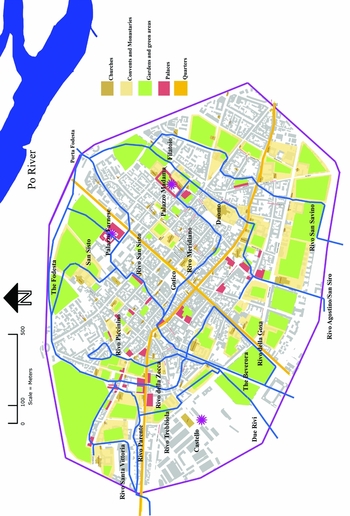
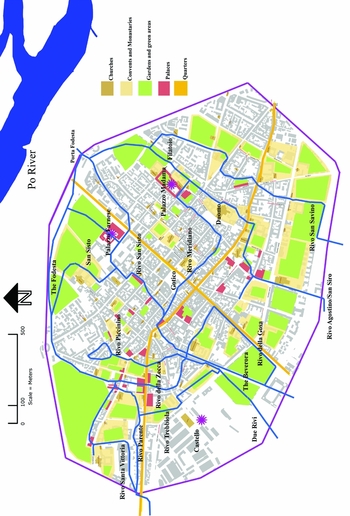
Municipal government was established in the city in the early twelfth century. The urban administration, which had control of the nearby countryside, sold concessions to small groups of rural landowners to construct and manage canals for irrigation of agricultural lands and to power rural mills.Footnote 21 Eventually, each canal in the agricultural production area had its own collective or consorto, a local association, responsible for its management. This patchwork of private enterprise under city management was transferred to the urban area itself with many consorti created to construct and maintain the water system. The city acted quickly to build new canals and to take control of the existing church-owned waterways (see Figure 1). It wanted a guaranteed water supply for industry. By 1300, Piacenza was the second largest city in the Emilia region, behind Bologna. It was densely populated with 23,000 urban residents and more in the countryside. It had an advantageous location and a strong artisanal population especially skilled in textile production.Footnote 22
Urban canals on contemporary Piacenza city map with quarters, major landmarks, palaces, convents, churches and urban gardens. The historical canals are no longer visible in the city. Map by author.
While the Trebbia River does not go completely dry in the summer, the flow is reduced. The city chose to privilege its urban industries even if agriculture and the rural-based feudal lords suffered.Footnote 23 Despite urban needs, the city had to remain attuned to the rural area as the water not only came from outside of the city but had to travel some distance in channels through the countryside to arrive there.Footnote 24 The urban water supply ran from the Trebbia River through a site called Colonna, the start of the two main urban channels. Colonna was located near Gossolengo about nine or ten kilometres south-west from the centre of Piacenza. In 1420, while under the governance of the Visconti dukes of Milan, the city handed control of the water utility, and especially the site of Colonna, to Count Landi, a Visconti supporter. This led to 50 years of conflicts and complaints due to inadequate water supply for the city. In 1470, the city initiated reform and published an act to regulate the water from Colonna that dealt with the conflicts between agricultural use, the powerful feudal lords and urban industry.Footnote 25
Colonna was an important site for the city. It ultimately became the point of division in terms of water jurisdiction during the later Farnese period. Various administrative models were attempted, but by the early modern era, one commissioner oversaw the agricultural waterways upstream of Colonna while another oversaw all the city water that flowed in the two main channels downstream from Colonna. The city administration continued to combat feudal influence and power over its water supply. The Landi were one of the four main feudal families in the city. It was their administration of the water that caused many disputes. The Landi family was powerful enough that they could flout the desires of the city until the situation was resolved in the Farnese period. The Farnese pope, Pope Paul III, gave the duchy of Parma and Piacenza to his son, Pier Luigi, in 1545. Pier Luigi was assassinated by local nobles in 1547 in Piacenza and was succeeded by his son Ottavio in a disputed succession resolved in 1556. Pier Luigi set up the CSO that oversaw the urban space throughout the Farnese dynasty and beyond. After 1736, there was a change in management as the Austrians took over the administration of the duchy.
The CSO was charged with the maintenance of urban space. Its members had oversight of the urban fabric, particularly the infrastructure that included roads, canals, underground conduits, cisterns, public wells, walkways and bridges. They also issued building and business licences and resolved conflicts over building plans. A detailed study of buste 1–19, out of the total of 25, shows the bulk of the committee's work was taken up with the management of the water supply and street sanitation. It is these documents that have formed the foundation of this research.Footnote 26
By 1500, the city of Piacenza had a population of around 25,000.Footnote 27 Residents were served by two main canals called the Rivo del Comune and the Piccinino. Each subdivided before and after they entered the city for a total of 11 main canals in the city.Footnote 28 Within the city, the 11 canals joined together again to exit into the Po River. The water came from south-west of the city and exited at the north-east end near the gate, Porta Fodesta. Most of the canals serviced urban mills, and there was enough power even at the north-east edge of the city for mills to function. However, since the water arrived from the south and west, the western edge of the city was the predominant area for mills and water-dependent industries.
The CSO was also concerned with the management of rain water. The city streets were constructed with storm water conduits and often paved. Home owners requested licences to construct small pipelines to drain their courtyards into the street conduits that then flowed into the canals.Footnote 29 The city charged for licences, and if needed, issued work orders for the infrastructure that was to be constructed. These work orders were very specific and designated the materials and dimensions of the work to be undertaken and often who was ultimately responsible to maintain it.Footnote 30 Plainly, while the city preferred not to finance the infrastructure, it needed control over the final design in order to assure that the system, a patchwork of privately built pipes and conduits, would fit together and work as a whole.
Equally important was the provision for household sanitation. The archives show that the CSO was aware of and concerned with the management of sanitation in the city. In addition to the canals, the CSO oversaw household waste cisterns. There were regulations for the management of the sewage cisterns particularly for cleaning them and the disposal of waste. How extensively were the canals used for sewage? The records indicate that while water was frequently piped into a house from one of the waterways, the sewage was often managed with a cistern in the basement or courtyard in a pozzo di immonditie, pozzo nero or pozzo necessario. Sometimes, a similar facility was shared by a number of households and located beneath the street. There were complaints about odours from cisterns that had overflowed and sent sewage into the streets. An overflow that involved pollution and sewage was seen as a serious matter and a health hazard. The cisterns were frequently cleaned out at night so that the mess could be immediately removed from the streets before everyone was up and about their business. Complaints came about sewage left on the streets or in one case, from sewage that was deposited illegally around town.Footnote 31
It is difficult, however, to be sure how many of these pozzi were actually for human sanitation and how many served as drains for street water or for other pollution. The word immonditie is used to describe many situations in complaints and requests for building licences. At times, the infrastructure is described as being located in a household or convent cellar, but at other times, the request to the committee was to deal with a pozzo immonditie in the street in order to facilitate street drainage. It is obvious that the waterways were polluted upon entrance to the city. With industry and artisanal activities clustered along the west side of the city, pollution entered the municipal water stream at the beginning of its journey through the urban space. For example, the records show use of the water from the channels to wash textiles. The dyers and those who processed skins for leather also used the water of the canals for their trades. As the water moved through the city, especially past the meat market, its cleanliness became an ongoing problem.Footnote 32
There is evidence of potable water wells in courtyards and gardens, though these are rarely mentioned in the committee's documents. A few documents mention white (pozzo bianco) water wells.Footnote 33 Some archival documents show that home owners used their water for everything from washing dishes to washing clothes or producing aqua vita and complained when the flow was inadequate.Footnote 34 Did they drink the canal water? If so, then summertime would have created difficulties as the flow of the Trebbia slowed down and diminished and so too did the channels. It is during the summer months that complaints arose about turbid and fetid water in the waterways along with urgent requests for purges and canal cleaning. There is, however, no evidence of a guild that drew water from the Po and sold it to the residents.Footnote 35 The canals and wells appear to have provided the water needs of the city. The waterways not only provided water for urban agriculture and the energy for mills but also acted to take away pollution from industry and human waste, and drained rain water from the streets.
The Congregazione sopra l'ornato: types of records
The CSO consists of a number of types of documents that demonstrate the work of the committee over the 250 years of the complete archive. One of the problems with this kind of research is the question of document classification and how to understand the quantity of the committee's work. An index was constructed based on committee actions. The information in the archival collection is complex, to understand it is to unravel a network of relationships over time. The infrastructure can be quite straightforward, it is either one of collection and storage or of redirection and distribution of water. It is the human relationships that create the complexity in system management. On an individual level, some problems took time to resolve and are described in multiple documents. Inside the various documents are numerous clues about individual social and economic situations. To tease out information in the index, all documents were placed within a typological category and examined for actions taken by a resident or the committee or others. To work out the chronology of events, the records were put into tables organized by decades. This raised an immediate problem with letters from the residents as they were rarely dated. Their position within the buste and folders, which often indicated the decades covered, was what determined their position in the index unless the contents indicated otherwise. Committee-issued documents were often dated and could be placed in the index with precision. All documents were then numbered. The number indicates first their busta number within the collection, then the folder within the busta, and finally their location within the folder. Only documents that dealt with water or the infrastructure to manage it, in almost any way, were counted. The index is now available at the Archivio di Stato di Piacenza.
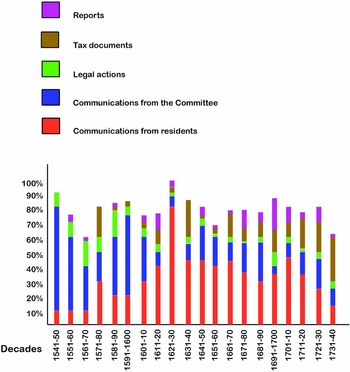
While the types of documents found in the archives are fairly consistent through the study period, the proportions changed (see Figure 2). In the early years, the committee issued many orders, frequently to the whole city. But those decades appear to have few of the letters from inhabitants that come to dominate the collection in later years. In the early decades of the seventeenth century, during times of famine, plague and war, the letters from residents increased dramatically in number, while committee-issued orders dropped significantly.Footnote 36 In these years, there were also more letters in which the residents begged for financial relief from taxes and penalties that supported the system.Footnote 37 The number of engineering reports rose near the end of the research period and indicates increased reliance on professional experts to help manage the infrastructure. Most of the documents in the collection were hand-written, but over time, printed orders appeared. The committee also used pre-printed forms that could be filled out as receipts or as advisories of expected street work.Footnote 38
Chart showing the proportions of the various document types found in the committee archives for the study period of 1541–1740. Chart by author.

From the residents came petitions, pleas, reports and grievances. Frequently, residents informed the committee of a problem in water supply due to infrastructure breakdown. A lack of service could be caused by damage triggered by flooding or because of rubbish and silt that blocked the water flow. It was considered a serious offence to block a canal and immediate orders were given to remedy the situation. These types of letters were used to ask for licences to construct pipelines from canals into homes for private water service or to construct the conduit and drainage network required to channel rain water off of the street and into a canal.
At times, a letter was used to inform on another person who had caused a problem within the system or failed to fix it as required. Quite frequently, millers were cited as the ones who failed to close off a part of the canal when needed and thereby caused a flooded basement. Because the system was gravity-fed and highly responsive to the conditions of the Trebbia, it required constant manual management along the channels.
These normally short letters appear to have been the primary means by which residents communicated with committee members. Through these notes, the CSO was made aware of difficulties with the infrastructure and problems between the different people who built, repaired and used it on a daily basis. These letters show that residents had significant knowledge of the system. They were frequently able to trace and accurately describe the problem that was the source of the complaint and name the different pieces of equipment involved. It is a level of knowledge unknown to the majority of contemporary urban residents today. But the dynamics of the system meant it required ongoing human interaction and informed users.
Some letters came from groups and coalitions that could include millers, ecclesiastical institutions, churches, associations and others connected to the particular infrastructure. Frequently, the writers named their profession, especially if they were a miller or a gardener. Perhaps more importantly, they always named their parish neighbourhood and sometimes added other details to precisely locate the problem. Once a letter arrived, the committee had to respond. Frequently, the first response of the committee was to send out a member or an engineer to inspect the site and report back on the problem. After the site visit, the engineer wrote a report that detailed the location of the problem, the cause and the construction or repair needed to fix it. He would normally include an estimate of the costs involved.Footnote 39
Once the CSO had the information it needed, orders were issued that escalated in urgency as long as the problem required resolution. Orders could be specific to a single person who was obligated to clean a part of a channel or fix a smaller pipeline. Or the order could instruct an association of millers to do an annual or regular purge to clean and excavate a major waterway. Sometimes a decree was issued for the whole city.Footnote 40 If repairs were essential, a deputy was authorized to collect the monies needed from the people who lived near the site. It was a user-pay system that taxed those most directly affected by a particular canal or part of the water system.
Orders always listed a penalty for non-compliance, normally a fine. The amounts of the fines varied from minimal to those that appear significant. There is little material in this particular archival collection to make clear how many fines were collected for a total amount per year. The archive does contain requests for reimbursement of fines or pledges already paid because the required work was done. These appeals often contain comments at the bottom that indicate the funds were returned as requested.
Like any corporation, the city was concerned with the economics of its infrastructure. When a concession was granted, it stated what parties and infrastructure were linked through responsibilities and the frequency of required maintenance.Footnote 41 When work was needed on a channel, the deputy would make a list of the names of all those considered responsible for the site.Footnote 42 The deputy then calculated who owed payments for the work on the waterway. The payment depended upon the type of service. Gardens were paid for according to the amount of land involved, while mills would pay based on the number of mill wheels. Home owners paid either by type of service, that is, according to whether they had control of a small lock or an opening in the canal, or by the length of the pipe that ran from the channel to their home. Later tax lists included the number of water closets in a residence or ecclesiastical institution.Footnote 43 Over time, the system of fee solicitation and the expectation that individuals would arrange for the work to be done shifted slightly. The city became willing to finance the work with collection of taxes afterwards to pay for it. Occasionally, in these later tax documents, the work cited for the purposes of taxation occurred one or two years before the actual collection of funds.
In the archive are bills from the contractors who did the work of repair and maintenance of the canals. These bills were quite specific about the work done, the length of time it took, the number of workers involved, the materials used and the amount of wine purchased for the workmen.Footnote 44 It is unclear how the CSO determined who would do the necessary work on the infrastructure. Some orders called for ordinary people to do the work because they were home or business owners that bordered on the waterway. Yet the bills make obvious that at other times a professional contractor was brought in with a crew to do what was needed on a channel.
Beyond the main types of documents are a number of other records in much lesser numbers. These include capitoli, licenze and convocati. Capitoli were issued when new major infrastructure was to be constructed. The capitoli outlined the responsibilities of the owners when concessions were sold.Footnote 45 Licences were shorter documents for concessions such as construction of a drain pipe from a courtyard to connect into the street drainage system. The final category is the convocati, the minutes of the CSO committee meetings. While brief and often without much explanation, these do show that the CSO made use of engineering reports and even oral testimony before rendering decisions. The CSO met under the authority of the Farnese-appointed governor along with the water commissioner for the system. The major names of the noble families in Piacenza, such as Scotti and Landi, were in attendance at the meetings. They appear to have met irregularly rather than on a weekly or monthly basis.Footnote 46
Taken together, these various types of documents give an insight into the dynamic relationship between the administration and the users of the water utility. The archives detail the explicit and implicit understandings in a relationship that continued beyond the Farnese period.
Roles in the system
The members of the CSO were primarily a small number of nobles who sat on the larger city council augmented by the appointed water commissioners. The members were elected to the council under the rubric of the four main noble families in the city and then onto the CSO. However, these noble families were also often the same people who had an interest in the agricultural canals out in the countryside. In times of low water, plainly there could be a conflict of interest between the countryside and provision to the thirsty city. It is not clear in the minutes of the CSO meetings how such conflicts were handled. Usually, only the final resolution is recorded without any of the discussion.
The position of water commissioner was a contentious one between the second Farnese Duke Ottavio and the city. He regained control of the city from Spain, who had seized Piacenza following the assassination of his father, in 1556 through the Treaty of Ghent, and appointed as commissioner Francesco Paciotto from Urbino. However, the city complained about Paciotto's management, absenteeism and the fact that he was foreign rather than local. The use of non-local commissioners continued into the rule of Ottavio's son, Duke Alessandro. In response to complaints by city administrators, he appointed a new commissioner from an aristocratic family named Arcelli in 1591. Not unusually for the time, the position was then passed down in the family for several generations.
With the takeover of the city by the Farnese family in 1545, there was the added role of the now local duke. Pier Luigi, the first duke, had intended to make Piacenza his centre, but after his assassination, Ottavio chose Parma as the court city. Accordingly, Piacenza was governed on a day-to-day basis by the duke's governor and representative. The territorial leadership of the Farnese dukes had to support a delicate balance between varied needs and users. In this way, the duke became an important figure for the resolution of the ongoing conflict between the city and the feudal families, particularly the Landi. In 1585, after years of complaints about lack of water by the city officials, Duke Ottavio acted against the Landi family to ensure that the city had sufficient water supply. It was the final wresting away of Landi control over Colonna that had been granted in 1420. At that time, the duke published the Ordini sul reggimento delle acque di Trebbia, to push against feudal powers and enhance the municipal ownership and management of the water supply.Footnote 47 This suited the overall Farnese aim to reduce the power of the feudal nobility within their administration.
Once the 1585 reform was in place, ducal involvement was limited. Over the 200-year research period, there are a total of only seven letters from a duke to the CSO that deal with water service in the city.Footnote 48 Dukes occasionally intervened in specific matters, especially if someone had written to them directly. However, the ducal family also encountered the water system like other users in the city, as recipients of service that varied in quality. The ducal family had two palaces in Piacenza. Palazzo Farnese was an expansion of an earlier Visconti cittadella. It is located at the extreme end of the San Sisto canal and just above the final leg of the old Fodesta. This end of the San Sisto canal watered the extensive gardens behind the palazzo. While the Farnese palazzo remains, the other ducal residence does not – this was Palazzo Madama.Footnote 49 It was located in the north-east part of the city near the monastery of San Lorenzo. Records indicate that this property was used early in the Farnese period, possibly as residences for members of the ducal camera.Footnote 50 In the mid-seventeenth century, it was given over to the dowager duchess, Margherita, for private use as a residence. Nearby, also on the site, was the ducal silk spinning factory established in 1678 east of Palazzo Madama.Footnote 51 The gardens and factory site needed to be well supplied with water yet they were located at the end of the canal system in the city not far from the exit through the city walls. The Palazzo Madama garden was serviced by Rivo Meridiano, the same canal that dealt with the upstream meat market. It was constructed when the meat market was relocated to the city centre to enable oversight against fraud. Water flow in the Meridiano appears to have been irregular, contributing to the smell of rotting organic waste when flow was insufficient.Footnote 52 While the ducal family had power over the functioning of the water system, as users located at the extreme downstream position in the city, they also dealt with the day-to-day difficulties that could arise in the system.
The CSO depended upon the millers as a group for the daily management and maintenance of the infrastructure. The extra rights of the millers meant that they also incurred extra costs and responsibilities. They managed the locks to control the flow to their mills which were often fed by a channel off of a main canal. They also had control over larger locks in the main waterways. This group was charged with the regular maintenance of their particular canal and would make application to do so to the CSO. However, if they failed to keep up the channel or part of it, then the residents complained to the CSO. The millers had responsibility for the annual purging of the canals. They had to keep the system running, especially so that silted up canals did not damage the mill wheels or simply keep them idle. The millers operated as independent contractors accountable to the CSO. As such, they were present in every aspect of CSO business from tax documents to legal actions. The high involvement of the millers as a group could lead to difficulties and the archives include several lawsuits involving the millers responsible for canal maintenance who failed to perform their duties satisfactorily.
The other profession that figures prominently in the archive is that of the gardeners. These men managed the many orchards and food gardens in the city, often as employees or tenants. They were cited as a cause of floods due to poorly regulated locks in the gardens. The gardeners as a group did not have the power of the millers when it came to the canal management but were important in their actions.
Conclusion
The CSO archival collection provides fresh information on the management of water in early modern Piacenza. This research adds to our understanding of the political ecology of an early modern city. The archives reveal that the city directed its water supply through a sophisticated and complex assortment of social procedures designed to promote co-operation and constrain cheating. The solutions for any problem had to involve social as well as technological responses. The complaints show that clean streets and waterways were important to the urban residents. The utility, run through private/public partnerships, gave many in the city an expertise in the management of their own urban space.
There are lessons to be learnt from Piacenza that can be applied to present-day stresses on urban regions especially with the acceleration of climate change. Cities today face a variety of climate change induced problems. While technology has a strong role in increasing urban resilience, the story of pre-industrial water utilities demonstrates that the answers for many problems require political and social solutions to support any technological approaches.
The social organization of associations that oversaw the infrastructure in Piacenza was a model of decentralized resource management. These private/public partnerships were common in the early modern period and demonstrate the advantages and disadvantages of such management systems. The arrangement in Piacenza worked best when the associations were local and in no way threatened the oversight of the CSO. This kind of management structure often encounters problems when the private corporation is of a scale where there is little requirement to heed the needs and desires of the public administration. It is a matter of scale in terms of whether a centralized or decentralized authority is required. Gerrard comments on the system in Spain that the regular user was required to keep the system going at the small scale. But community-wide management or infrastructure investment often required involvement of higher levels of authority.Footnote 53 This type of social expertise, at appropriate scales, could be reclaimed as a form of sustainability in the management of resources. We can learn from cities like Piacenza and their historical social organization as they grappled with human nature, varied levels of resource availability and the task of providing for a city.