While many L2 acquisition models acknowledge the importance of input (e.g., Bybee, Reference Bybee, Robinson and Ellis2008; Rankin & Unsworth, Reference Rankin and Unsworth2016), precisely how learners extract form and meaning from L2 input in ways that promote learning remains under debate. According to some accounts, repeated exposure to particular structures is necessary for the development of abstract L2 grammatical representations and the efficient retrieval of these forms during language production (e.g., Dell & Chang, Reference Dell and Chang2014; Hartsuiker & Bernolet, Reference Hartsuiker and Bernolet2017). Such claims are supported by evidence of structural priming—the tendency to repeat structures one has recently heard or produced—among L2 speakers (see Gries & Kootstra, Reference Gries and Kootstra2017; Hartsuiker & Pickering, Reference Hartsuiker and Pickering2008; Trofimovich & McDonough, Reference Trofimovich and McDonough2011, for reviews). The magnitude of such effects can increase over time, with cumulative exposure to the target structure (e.g., Bernolet, Hartsuiker, & Pickering, Reference Bernolet, Hartsuiker and Pickering2013; Kaan & Chun, Reference Kaan and Chun2017). Priming can also extend a week or more postexposure, leading researchers to propose that long-term priming constitutes a form of implicit learning (e.g., Chang, Dell, & Bock, Reference Chang, Dell and Bock2006; Dell & Chang, Reference Dell and Chang2014; see also Branigan & Messenger, Reference Branigan and Messenger2016; Shin & Christianson, Reference Shin and Christianson2012). However, some studies find only minimal priming for certain structures among less-proficient L2 learners (e.g., McDonough, Reference McDonough2006), or significant short-term priming that is not sustained (e.g., Jackson & Ruf, Reference Jackson and Ruf2017; Ruf, Reference Ruf2011). To provide insight into connections between short-term priming and longer-term L2 learning, researchers must expand the scope of inquiry to include a wider constellation of task-based factors that may increase short-term priming, and investigate how such factors interact with individual participants’ priming profiles to influence longer-term changes in L2 production. Such research is particularly important among less-proficient L2 learners, whose abstract L2 syntactic representations are still developing. The present study addresses this call by investigating (a) whether the task-based factor of prime repetition modulates the magnitude of short-term and longer-term priming of word order variation (adverb-verb-subject vs. subject-verb-adverb order) among intermediate English-German L2 learners, and (b) whether individual differences in short-term priming predict the presence of longer-term priming.
ACCOUNTS OF L1 AND L2 STRUCTURAL PRIMING
Several theories exist to account for structural priming in L1 production. Lexicalist accounts posit that priming stems from residual activation of abstract syntactic representations (Pickering & Branigan, Reference Pickering and Branigan1998). Nodes representing lexical items are linked to combinatorial nodes representing how these items can be combined in a sentence. During production, these nodes remain active for several seconds, which can lead a speaker to repeatedly use the same construction. This account can successfully explain the lexical boost effect, whereby short-term priming is increased in the presence of lexical overlap between prime and target sentences (see Pickering & Ferreira, Reference Pickering and Ferreira2008, for review).
However, lexicalist accounts have greater difficulty explaining long-term priming (but see Malhotra, Pickering, Branigan, & Bednar, Reference Malhotra, Pickering, Branigan, Bednar, Love, McRae and Sloutsky2008), leading other researchers to propose that structural priming is a form of error-based implicit learning (e.g., Branigan & Messenger, Reference Branigan and Messenger2016; Chang et al., Reference Chang, Dell and Bock2006; Dell & Chang, Reference Dell and Chang2014). For example, if one expects to hear an active sentence but then hears a passive sentence, the expectation of hearing a passive in subsequent utterances increases. Such changes in expectations increase the likelihood of producing a passive construction in subsequent production. Over time, these adjustments can lead to cumulative changes in the language system, which constitutes learning. Recently, Bernolet, Collina, and Hartsuiker (Reference Bernolet, Collina and Hartsuiker2016) proposed a multifactorial account of structural priming. Under this account, long-term priming results from implicit learning. Short-term priming, especially in the presence of lexical overlap, stems from explicit memory of the prime sentence. Such explicit memory processes facilitate the retrieval of the prime sentence’s structure in subsequent utterances (see also Branigan & McLean, 2016).
Turning to L2 production, Hartsuiker and Bernolet (Reference Hartsuiker and Bernolet2017) proposed a developmental model of shared syntax between an L2 speaker’s languages to account for research showing that priming occurs within and across languages, and that the strength of such effects varies with L2 proficiency. At initial stages of L2 proficiency, L2 speakers’ representations are lexically based, with only weak links between lexical items and abstract L2 syntactic information (or combinatorial nodes) that constrain how such lexical items combine to form an utterance. In a subsequent stage, syntactic representations are linked to specific L2 lexical items, with the development of such links occurring earlier for more frequent L2 structures. In earlier stages, Hartsuiker and Bernolet posit that priming both with and without lexical overlap results from explicit memory of a previously encountered sentence, rather than the activation of abstract syntactic representations. Lexical overlap reinforces such explicit memory processes, leading to greater priming with lexical overlap (e.g., Bernolet et al., Reference Bernolet, Hartsuiker and Pickering2013; Kim & McDonough, Reference Kim and McDonough2008). Only at advanced L2 proficiency are combinatorial nodes shared across L2 lexical items and, eventually, between a speaker’s two languages. This leads to significant within- and across-language priming resulting from residual activation of abstract combinatorial nodes, rather than explicit memory of recent sentences.
PRIMING AMONG L2 LEARNERS
Hartsuiker and Bernolet’s (2017) model accounts for the development of abstract syntactic representations as L2 learning progresses, and how different types of structural priming may reflect these developmental stages. However, in its current form, their model does not address how L2 learners advance from one developmental stage to the next. Of relevance are studies showing that long-term priming, as measured by posttests completed immediately or up to six weeks after the priming task, is influenced by the magnitude of learners’ short-term priming during the priming task (McDonough & Chaikitmongkol, Reference McDonough and Chaikitmongkol2010; McDonough & Mackey, Reference McDonough and Mackey2008), and especially the magnitude of short-term priming without lexical overlap (McDonough, Reference McDonough, Trofimovich and McDonough2011; see also McDonough & Mackey, Reference McDonough and Mackey2006). Further, L2 priming studies have reported no significant priming when L2 learners do not demonstrate sufficient prior knowledge of the target structure (McDonough, Reference McDonough2006; McDonough & Fulga, Reference McDonough and Fulga2015). Such findings highlight that precisely how L2 learners interact with L2 structures during priming is crucial for whether short-term priming leads to long-term priming in ways that promote L2 learning.
Additionally, whether speakers repeat prime sentences aloud can impact the magnitude of short-term and long-term priming among less-proficient L2 speakers. Prime repetition has no significant impact on the magnitude of priming among adult L1 speakers (Bock, Dell, Chang, & Onishi, Reference Bock, Dell, Chang and Onishi2007) or more-proficient L2 speakers (Chen, Jia, Wang, Dunlap, & Shin, Reference Chen, Jia, Wang, Dunlap and Shin2013; McDonough, Reference McDonough2006). However, Shimpi, Gámez, Huttenlocher, and Vasilyeva (Reference Shimpi, Gámez, Huttenlocher and Vasilyeva2007) found that three-year-old children exhibited significant priming only when they repeated prime sentences aloud (see also Gámez & Shimpi, Reference Gámez and Shimpi2015). Kim and McDonough (Reference Kim and McDonough2016) similarly reported that less-proficient adult L2 speakers who repeated prime sentences produced more passive sentences on immediate and two-week delayed posttests than participants who heard the prime sentence but did not repeat it aloud (see Gámez & Vasilyeva, Reference Gámez and Vasilyeva2015, for similar findings with child L2 English speakers). Kim and McDonough concluded that for less-proficient L2 learners, whose abstract syntactic representations are less complete, prime repetition can increase activation of target syntactic representations through additional exposure to and increased short-term memory of the target structure, leading to more robust abstract representations over time. It remains an open question whether prime repetition creates a learning context that fosters increased production of targeted structures across all learners, or whether even with prime repetition, less-proficient L2 learners remain differentially susceptible to short-term priming and its potential for longer-term learning.
Relevant for the present study, Jackson and Ruf (Reference Jackson and Ruf2017) reported significant short-term priming for adverb-first word order in L2 German with fronted temporal (TP) and locative phrases (LP) among intermediate English-German L2 learners, but differences in longer-term priming across construction type. Placing an adverbial phrase in sentence-initial position for emphasis is more common in German than English, and producing adverb-first word order (XVS) rather than relying solely on subject-first word order (SVX) is particularly difficult for L2 German learners (Bohnacker & Rosen, 2008; Jackson, Reference Jackson2012). Nevertheless, producing XVS utterances is critical for the perceived nativelikeness of L2 German discourse (Bohnacker & Rosen, 2008). During the priming phase, which measured the magnitude of short-term priming, participants produced 25% more fronted-TP sentences and 26% more fronted-LP sentences immediately following a fronted-TP or LP prime sentence than a nonfronted-TP or LP prime, when the prime and target sentences contained the same adverbial phrase. Participants produced 8% more fronted-TP sentences and 7% more fronted-LP sentences immediately following a fronted-TP or LP prime than a nonfronted-TP or LP prime when the prime and target sentences contained different adverbial phrases (see examples 1a–1b).
(1a) Im Winter/Am Morgen trinkt der Opa heiße Schokolade. (fronted-TP prime; with/without lexical overlap)
In winter/In the morning drinks the grandpa hot chocolate
(1b) Auf dem Berg/In der Küche trinkt der Opa heiße Schokolade. (fronted-LP prime; with/without lexical overlap)
On the mountain/In the kitchen drinks the grandpa hot chocolate
“In winter/In the morning/On the mountain/In the kitchen the grandpa drinks hot chocolate.”
(2a) Der Opa trinkt im Winter/am Morgen heiße Schokolade. (nonfronted-TP prime; with/without lexical overlap)
The grandpa drinks in winter/in the morning hot chocolate
(2b) Der Opa trinkt heiße Schokolade auf dem Berg/in der Küche. (nonfronted-LP prime; with/without lexical overlap)
The grandpa drinks hot chocolate on the mountain/in the kitchen.
“The grandpa drinks hot chocolate in winter/in the morning/on the mountain/in the kitchen.”
(3) Im Winter/Auf dem Berg trägt der Schüler eine Jacke. (Target-TP/LP sentence)
In winter/On the mountain wears the pupil a jacket
“In winter/On the mountain the pupil wears a jacket.”
However, only fronted TPs exhibited significant longer-term priming, as measured by the continued production of adverb-first word order during a posttest phase that immediately followed the priming phase. Participants exhibited increased production of fronted-TP sentences in the posttest phase (48%), compared to an initial baseline phase that preceded the priming phase (27%). In contrast, participants produced no fronted-LP sentences in the baseline phase and few fronted-LP sentences (6%) in the posttest phase, with only 4 of 19 participants producing at least one fronted-LP sentence on the posttest.
To explain the difference in longer-term priming between fronted-TP and fronted-LP sentences, Jackson and Ruf (Reference Jackson and Ruf2017) appealed to Hartsuiker and Bernolet’s (2017) developmental model, arguing that these intermediate L2 learners possessed abstract syntactic representations for fronted-TP sentences, resulting in significant longer-term priming. However, their representations for fronted-LP sentences were still lexically based, resulting in significant short-term, but no longer-term priming. As the target structure (i.e., XVS word order) is identical for fronted-TP and fronted-LP constructions, Jackson and Ruf concluded that at lower proficiency, the presence of significant longer-term priming may depend on the lexical-semantic content of a construction, and the strength of such semantically constrained constructions in memory. Further, the strength of such representations likely depends on L1 frequency of the target construction (fronted-TPs are more frequent in English than fronted-LPs; Jackson, Reference Jackson2012) and the L2 input to which classroom learners are exposed (most beginning German textbooks include fronted-TP sentences but fronted-LP sentences are less common; e.g., Lovik, Guy, & Chavez, Reference Lovik, Guy and Chavez2013).
PRESENT STUDY
The present study builds on the results with fronted-LP sentences in Jackson and Ruf (Reference Jackson and Ruf2017), to investigate whether intermediate English-German L2 learners exhibit more robust short-term and longer-term priming with fronted-LP constructions in German when they repeat the prime sentence. This study conceptually replicates research showing a benefit for prime repetition among less-proficient L2 learners (Gámez & Vasilyeva, Reference Gámez and Vasilyeva2015; Kim & McDonough, Reference Kim and McDonough2016) by expanding such research to investigate a different target language (i.e., L2 German) and a new target structure (i.e., XVS word order). Critically, by including analyses that investigate whether individual participants’ short-term priming profiles during the priming phase predict the presence of longer-term priming, as measured by participants’ production of fronted-LP constructions in the posttest phase, the present study investigates whether prime repetition leads to sustained changes in L2 production across all learners or whether, even in the presence of prime repetition, individual differences remain. The present study poses the following research questions:
1. Does prime repetition impact the immediate production of fronted-LP sentences during a priming task? Is the impact of prime repetition similar for sentences with and without lexical overlap between the prime-target sentence pair?
2. Does prime repetition impact the subsequent production of fronted-LP sentences in a posttest phase?
3. Does the magnitude of short-term priming—either with or without lexical overlap—during a priming task predict the likelihood that L2 learners subsequently produce fronted-LP sentences in a posttest phase?
METHOD
PARTICIPANTS
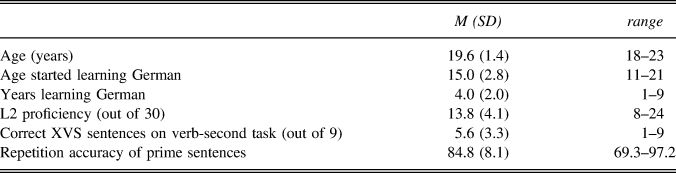
Thirty-three college-aged English-German L2 learners from third and fourth semester German classes at an American university participated for payment. These participants were recruited from a participant pool similar to the participants in Jackson and Ruf (Reference Jackson and Ruf2017). Two participants were excluded because they did not complete the German placement task, and one was excluded because of a technical error, resulting in 30 participants (13 female, 17 male) for the final analyses.Footnote 1 See Table 1 for biographical information.
Biographical information

MATERIALS
Priming Task
The task used the same items as Experiment 2 from Jackson and Ruf (Reference Jackson and Ruf2017), with 40 critical prime-target sentence pairs for the priming phase, five prime-target pairs for the baseline phase, five prime-target pairs for the posttest phase, and 100 filler prime-target pairs, which were spread across all three task phases (see IRIS for all study materials, www.iris-database.com). As in examples (1) through (3), prime sentences for experimental items in the priming phase varied according to fronting (fronted vs. nonfronted LP) and lexical overlap of the LP between the prime and target sentence (lexical overlap vs. no lexical overlap). In the baseline and posttest phases, target sentences were similar to sentence (3) but prime sentences contained a subject and intransitive verb. Prime and target sentences in the filler items varied in structure, but none contained an LP.
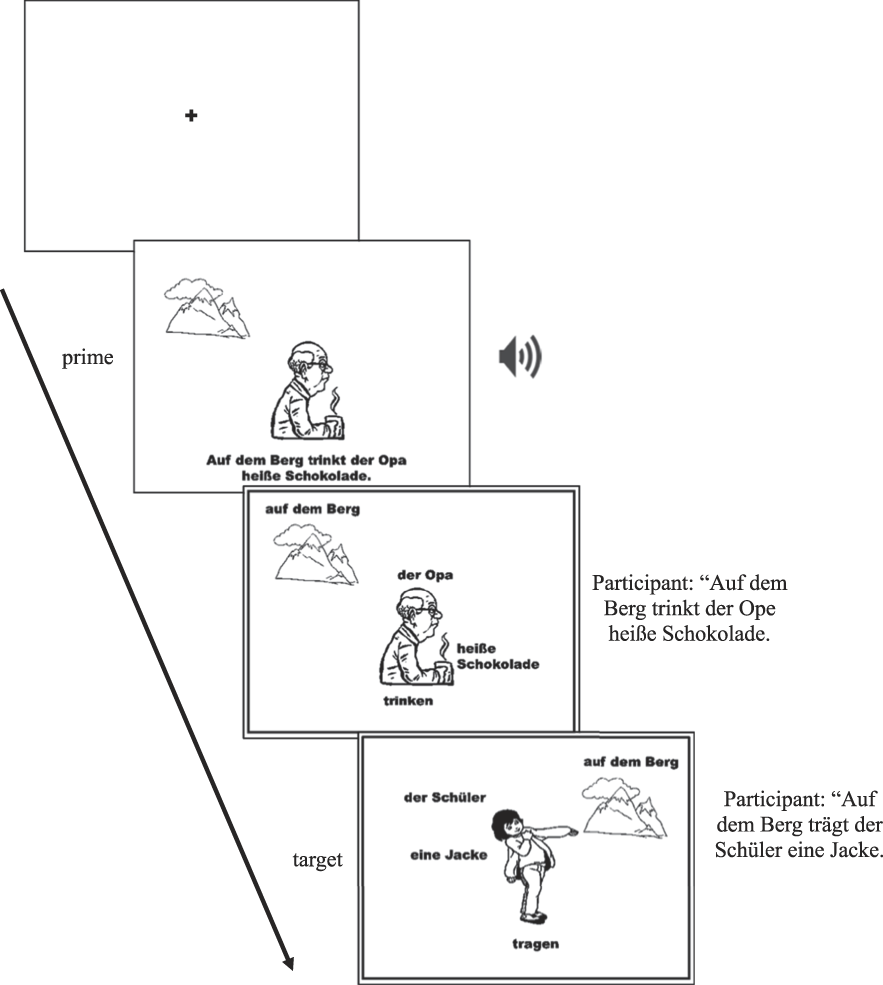
All prime and target sentences were accompanied by black-and-white drawings representing the meaning of the sentence, with all critical components labeled with the appropriate vocabulary (see Figure 1). The LP-image location was counterbalanced across experimental items during the priming phase and always placed in the upper right-hand corner during the baseline and posttest.
Sample target picture for the priming task.

For the priming phase, four experimental lists were created containing ten prime-target sentence pairs for each condition, but only one version of any given item, such that fronting and lexical overlap were within-participant variables. Within each condition, five items contained the LP image in the upper left-hand corner and five items contained this image in the upper right-hand corner, with LP image placement for each item counterbalanced across participants. All participants saw the same five experimental prime-target sentence pairs in the baseline and five different experimental prime-target sentence pairs in the posttest. In all task phases, experimental items were separated by two filler items. Items were pseudorandomized, with two different randomizations for each experimental list, so that no consecutive experimental items were from identical prime conditions.
Verb-Second Task
Participants described pictures and were instructed to begin their sentence with the phrase presented. In nine sentences this phrase was an adverbial phrase, with three sentences each that began with a TP (e.g., Jeden Tag “every day”), a LP (e.g., Auf dem Tisch “on the table”), or a manner phrase (e.g., Mit dem Löffel “with the spoon”). This task measured whether participants placed the verb immediately after the adverbial phrase, producing a grammatically correct XVS sentence. There were 11 filler items, in which the subject (eight items) or the direct object of the target picture (three items) was the provided phrase.
PROCEDURE
Participants completed the experiment in a quiet room on a computer using E-Prime 2.0 (Psychology Software Tools, 2012). Participants first completed the verb-second task. In this task the experimenter told participants to describe the picture on the screen, starting their sentence with the phrase provided. Participants were encouraged to produce a complete sentence. After participants finished their sentence, the experimenter clicked the mouse to begin the next trial. Afterward, participants filled out a language background questionnaire.Footnote 2
Participants then completed the priming task, which consisted of the baseline phase, followed immediately by the priming phase, and then the posttest phase. Even though the task contained three distinct phases, participants completed the three phases as a single continuous task (see Hartsuiker & Westenberg, Reference Hartsuiker and Westenberg2000; Jackson & Ruf, Reference Jackson and Ruf2017; Nitschke, Kidd, & Serratrice, Reference Nitschke, Kidd and Serratrice2010, for similar procedures). Each trial for all three phases in the priming task began with a fixation point for 500ms (see Figure 2). When the fixation point disappeared, participants saw a picture with a complete sentence below it and heard a recording of the sentence by a female German native speaker. Next, the prime picture was replaced with the same picture along with the individual words from the sentence, and participants repeated the sentence they had just heard. After participants repeated the prime sentence, the experimenter clicked the mouse and the target picture appeared and remained on the screen until participants produced their sentence. The experimenter then clicked the mouse to begin the next trial. Participants completed four practice trials. All responses were recorded with a digital recorder.
Sample trial for the priming task.

Afterward, participants completed a German placement test that contained 30 multiple choice items targeting German grammar designed to assess L2 proficiency at low and intermediate levels (University of Wisconsin Testing and Evaluation, 2006). Finally, participants completed a debriefing survey that probed whether they noticed the target LP structures, if they developed strategies for producing the target sentences during the task, and how natural German fronted- and nonfronted-LP sentences sounded to them.
SCORING AND DATA ANALYSIS
Priming task responses were transcribed and scored as (a) LP-V-S-O (LP-verb-subject-other), (b) LP-S-V-O (LP-subject-verb-other), (c) S-V-LP-O (subject-verb-LP-other), (d) S-V-O-LP (subject-verb-other-LP), (e) miscellaneous responses, and (f) technical errors (e.g., when the sentence was accidentally not recorded or the target picture disappeared before the participant responded). Miscellaneous responses included sentences missing one or more target words or sentences with a word order other than those listed in the preceding text. A second coder scored the data, with an interrater reliability of 98.8%. Verb-second task responses were transcribed and scored as correct if participants produced the correct word order (SVX or XVS) and incorrect if they produced the incorrect word order. Cronbach’s alphas for the verb-second task and the posttest phase of the priming task were .915 and .845.Footnote 3
To address research question 1 we conducted a mixed-effect logistic regression analysis using the lme4 package in R version 3.2.5 (R Development Core Team, 2016), using the same procedures as Jackson and Ruf (Reference Jackson and Ruf2017). Placement of the LP in the target sentence (fronted vs. nonfronted) was the dependent variable. Fronting in the prime sentence (nonfronted vs. fronted LP) and lexical overlap between the prime and target sentence (no lexical overlap vs. lexical overlap) were entered as fixed effects, contrast coded as -.5 and .5. To account for cumulative changes in LP placement during the priming phase, trial number was included as a fixed effect, centered at the sample mean. The random effect structure included random intercepts for items and participants, uncorrelated by-item random slopes for repetition and uncorrelated by-participant random slopes for fronting. Models containing additional complex random effects did not converge. We then compared the results from the priming phase of the present study with the results from the priming phase of Experiment 2 from Jackson and Ruf using between-group effect sizes (Cohen’s d) and their bootstrapped 95% confidence intervals using the BootES package in R (Kirby & Gerlanc, Reference Kirby and Gerlanc2013; see McManus & Marsden, Reference McManus and Marsden2017, for similar procedures).
To address research question 2 we compared the results from the baseline and posttest phases of the present study. A weighted empirical logit model of the proportion of fronted sentences was calculated (Barr, Reference Barr2008), as no fronted sentences were produced in the baseline phase and standard mixed-effect logistic regression models are not appropriate when proportions approach 0 (Jaeger, Reference Jaeger2008). Placement of the LP in the target sentence (fronted vs. nonfronted) was the dependent variable, with random intercepts for participants. Task phase (baseline vs. posttest) was entered as a fixed effect, contrast coded as -.5 and .5. We then compared the results from the posttest of the present study with the results from the posttest of Experiment 2 from Jackson and Ruf (Reference Jackson and Ruf2017) using between-group effect sizes and their bootstrapped 95% confidence intervals.
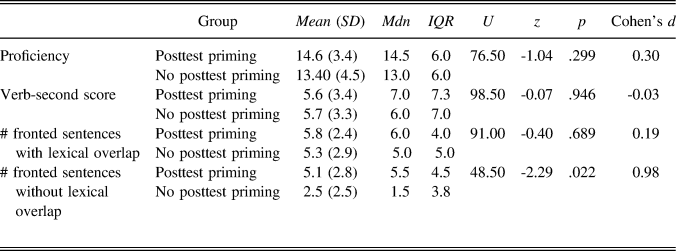
To address research question 3 we compared those participants from the present study who produced fronted-LP sentences on the posttest (n = 10) to those who did not (n = 20) on (a) L2 German proficiency, as measured by the German placement task, (b) XVS accuracy on the verb-second task, (c) the number of fronted-LP sentences produced during the priming phase with lexical overlap, and (d) the number of fronted sentences produced during the priming phase without lexical overlap (see Kidd, Reference Kidd2012; Serratrice, Hesketh, & Ashworth, Reference Serratrice, Hesketh and Ashworth2015 for similar procedures). As the verb-second task results were not normally distributed (according to Shapiro-Wilks tests, ps < .05), we used nonparametric Mann-Whitney tests. For these comparisons, and those comparing results from the present study to Jackson and Ruf (Reference Jackson and Ruf2017), we relied on L2-specific benchmarks to interpret between-participant effect sizes (small: 0.40 ≤ d ≤ 0.70; medium: 0.70 ≤ d ≤ 1.00; large: d ≥ 1.00; Plonsky & Oswald, Reference Plonsky and Oswald2014).
RESULTS
From 1,500 possible responses (150 in the baseline phase; 1,200 in the priming phase; 150 in the posttest phase), participants produced 332 (22.1%) LP-V-S-O sentences, 35 (2.3%) LP-S-V-O sentences, 24 (1.6%) S-V-LP-O sentences, 1,090 (72.7%) S-V-O-LP sentences, 15 (1.0%) miscellaneous responses, and 4 (0.3%) technical errors. For all analyses, S-V-LP-O and S-V-O-LP sentences were coded as nonfronted sentences. As German sentences with a fronted adverbial phrase followed by the subject are ungrammatical, the LP-S-V-O sentences, along with miscellaneous responses and technical errors, were excluded from all analyses. See Figures 3 and 4 for descriptive results.
Proportion of fronted-LP sentences in the priming phase. Error bars represent the by-participant bootstrapped 95% confidence intervals.

Proportion of fronted-LP sentences in the baseline and posttest phases. Error bars represent the by-participant bootstrapped 95% confidence intervals.

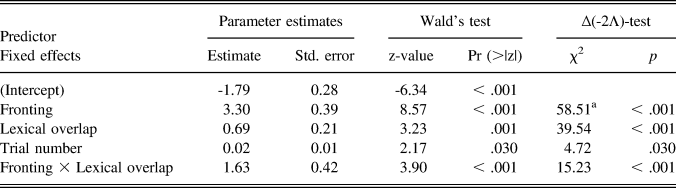
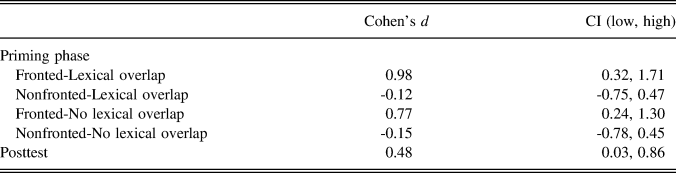
Addressing research question 1, as seen in Table 2, in the priming phase there was a significant effect of trial number because the proportion of fronted-LP sentences increased as the task progressed. There was a significant effect of fronting because the proportion of fronted-LP sentences was greater when the prime sentence contained a fronted LP. There was a significant effect of lexical overlap because the proportion of fronted-LP sentences was greater with lexical overlap. There was a significant fronting × overlap interaction because priming with fronted-LP primes was greater with lexical overlap (54%) than without lexical overlap (28%). As seen in Table 3, there was a reliable difference across studies—as indicated by confidence intervals (CIs) that do not span zero—in the proportion of fronted-LP sentences following fronted-LP primes in both lexical overlap and no lexical overlap conditions, with medium effect sizes. The positive value for Cohen’s d indicates that the proportion of fronted-LP sentences in the present study was greater than in Jackson and Ruf (Reference Jackson and Ruf2017).
Summary of the mixed logit model for the priming phase

a Likelihood ratio tests for main effects are based on omitting the main effect and any two-way interaction terms involving that main effect.
Comparison of bootstrapped confidence intervals between the present study and Jackson and Ruf (2017)

Addressing research question 2, the empirical logit model revealed a significant effect of task phase (β = 1.19, SE = 0.33, t = 3.62; χ2 = 10.57, p = .001) because the proportion of fronted-LP sentences was greater in the posttest than the baseline phase. As seen in Table 3, there was also a reliable difference across studies in the proportion of fronted-LP sentences produced on the posttest, with a small effect size, because the proportion of fronted-LP sentences on the posttest was greater in the present study than in Jackson and Ruf (Reference Jackson and Ruf2017). However, only ten participants produced at least one fronted-LP sentence on the posttest in the present study, meaning that this effect reflects the actual productions of only 33.3% of the participants.
Addressing research question 3, as seen in Table 4, the participants who produced fronted-LP sentences on the posttest and those who did not differed only in the number of fronted sentences produced during the priming phase without lexical overlap, with an effect size that approaches a large effect.
Comparison of participants on the posttest

GENERAL DISCUSSION
The present study investigated whether repeating prime sentences would increase the magnitude of short-term and longer-term priming of fronted-LP sentences among intermediate English-German L2 learners. As in Jackson and Ruf (Reference Jackson and Ruf2017), participants exhibited significant short-term priming, as they were more likely to produce a fronted-LP sentence after hearing a fronted-LP prime during the priming phase, especially in the presence of lexical overlap. Effect-size comparisons revealed that these effects were larger in the present study than Jackson and Ruf. In contrast to Jackson and Ruf, there was also significant cumulative priming because the proportion of fronted-LP sentences produced increased as the priming phase progressed (indicated by the significant effect of trial in the priming phase). Also contrasting with Jackson and Ruf, there was significant longer-term priming, as measured by the increased proportion of fronted-LP sentences produced on the posttest compared to the baseline. However, this significant longer-term priming was driven by ten participants. Analyses revealed that these ten participants were more likely to produce fronted-LP sentences in the absence of lexical overlap during the priming phase than the other participants.
These findings parallel results from Kim and McDonough (Reference Kim and McDonough2016), who also found a benefit for prime repetition among less-proficient L2 speakers. One might posit that this benefit stems from the fact that by repeating each prime sentence aloud, participants were exposed to twice as many fronted-LP sentences in the present study as the participants in Jackson and Ruf (Reference Jackson and Ruf2017).Footnote 4 However, the magnitude of short-term priming was already noticeably larger by halfway through the present study (with lexical overlap: 50%; without lexical overlap: 26%), at the point participants had heard an equivalent number of fronted-LP sentences as the participants during the entire priming task in Jackson and Ruf. This suggests that prime repetition—rather than just increased exposure—is critical to support short-term and longer-term priming among intermediate L2 learners. This may be particularly important when priming tasks encourage increased production of a structure, like fronted-LP sentences, that L2 learners are less likely to encounter in their L2 input or that they may be disinclined to use based on contrasting L1 structural preferences (Jackson, Reference Jackson2012; Jackson & Ruf, Reference Jackson and Ruf2017).
Under the assumption that prime repetition may increase short-term memory for a particular structure (Kim & McDonough, Reference Kim and McDonough2016) and learners’ ability to attend to grammatical patterns in the input (Gámez & Vasilyeva, Reference Gámez and Vasilyeva2015), the present findings underscore the importance of explicit memory as a driving force in short-term priming (Hartsuiker & Bernolet, Reference Hartsuiker and Bernolet2017). In light of greater longer-term priming of fronted-LP sentences in the present study, compared to no significant longer-term priming with fronted-LP sentences in Jackson and Ruf (Reference Jackson and Ruf2017), the present study also suggests that such explicit memory processes may play a key role in how short-term priming facilitates longer-term priming and the development of more abstract L2 syntactic representations. On the debriefing questionnaire, all participants reported that they noticed some of the sentences they heard began with an LP (i.e., the prime sentences). However, only 15 participants reported that they relied on word order in the prime sentence when they produced their own sentences. Even among the ten participants who produced fronted-LP sentences on the posttest, four responded that the prime sentence had no impact on their subsequent production. The absence of a conscious strategy among half of the learners does not automatically implicate implicit over explicit learning processes, especially because these data come from a nonconcurrent questionnaire after the task (see Leow, Reference Leow and Rebuschat2015, for discussion). However, this does suggest that the importance of explicit memory in short-term and longer-term priming should not be equated with learners necessarily adopting a conscious strategy of repeating structures they have recently heard when creating their own target output (see also Bernolet et al., Reference Bernolet, Collina and Hartsuiker2016, Branigan & MacLean, Reference Branigan and MacLean2016, for evidence that explicit memory of primed structures decays rapidly).
However, prime repetition does not guarantee that short-term priming will extend beyond the immediate priming task, as only 10 of the 30 participants continued to produce fronted-LP sentences on the posttest. Given that no participants produced a fronted-LP sentence in the baseline phase, this indicates that longer-term priming may be more limited when learners do not possess adequate productive knowledge of the target structure (McDonough, Reference McDonough2006; McDonough & Fulga, Reference McDonough and Fulga2015). Similar to McDonough (Reference McDonough, Trofimovich and McDonough2011), those participants who produced fronted-LP sentences on the posttest were more likely to produce fronted-LP sentences without lexical overlap between prime and target sentences during the priming phase. This supports claims that a critical factor linking short-term priming to longer-term learning is a learner’s ability to create targetlike utterances with new lexical items rather than simply repeat previous utterances verbatim (McDonough & Mackey, Reference McDonough and Mackey2006). At the same time, in drawing this comparison, we do not equate the presence of longer-term priming with long-term learning per se, as the longer-term priming in the present study was measured using a posttest immediately following the priming phase, rather than using tasks that occurred one or more days later.
Critically, neither overall L2 proficiency nor accuracy in producing XVS word order in adverb-first sentences, as measured by the separate verb-second task, differed between those participants who produced fronted-LP sentences on the posttest and those who did not, suggesting that (in)complete knowledge of XVS word order was not a deciding factor in the longevity of priming. More striking are results from the debriefing questionnaire, in which seven of the ten participants who continued to produce fronted-LP sentences on the posttest—in contrast to only 6 of the 20 participants who did not produce any fronted-LP sentences on the posttest—reported that fronted-LP sentences sounded more or equally natural to nonfronted-LP sentences in German. This raises the possibility that the L2 learners who perceived multiple L2 structural alternatives as natural were more likely to overcome a strong tendency to produce only canonical SXV sentences (i.e., nonfronted-LP sentences) when they were exposed to—and required to repeat—sentences with the less-frequent XVS alternative (i.e., fronted-LP sentences) during the priming task. This openness to different L2 structural alternatives may support increased short-term priming, especially in the absence of lexical overlap, and the probability that such short-term priming leads to longer-term priming. As these data come from the debriefing questionnaire and are necessarily descriptive in nature, this hypothesis must remain speculative. Further, it is impossible to discern whether these participants already considered both word order alternatives as natural prior to the priming task or whether the perceived naturalness of both alternatives developed as they interacted with the flood of fronted-LP sentences during the task. However, this warrants future research.
CONCLUSION
The present study adds to research demonstrating that prime repetition can have a positive impact on short-term and longer-term priming among less-proficient L2 learners (Gámez & Vasilyeva, Reference Gámez and Vasilyeva2015; Kim & McDonough, Reference Kim and McDonough2016), while showing that even the addition of prime repetition may not lead to significant longer-term priming for many learners. Additional analyses revealing a link between short-term priming without lexical overlap during the priming phase and the probability of significant longer-term priming on the posttest is in line with other research underscoring how individual learner factors can modulate the longer-term impact of structural priming on L2 production (e.g., McDonough & de Vleeschauwer, Reference McDonough and de Vleeschauwer2012). The present study highlights how researchers must adopt a multifaceted approach to the investigation of L2 structural priming, to fully understand the underlying cognitive processes that support L2 priming and how to implement priming activities in ways that promote L2 grammatical learning.