Introduction
The genus Lasioloma was established by Santesson (Reference Santesson1952), based mainly on its woolly prothallus, pilose apothecial margin and muriform ascospores. Santesson recognized three species of the genus from Asia, but at the time did not capture the nature of the campylidioid anamorphs in this genus and considered them to represent a lichenicolous fungus, which he named Pyrenotrichum staurosporum comb. ined., based on Chlorocyphella aeruginascens var. staurospora Keissl.
Vězda (Reference Vězda1986) recognized the true nature of these structures for the first time and described in detail the conidial morphology of the type species of the genus, L. arachnoideum (Kremp.) R. Sant., as another important feature to delimit the genus Lasioloma.
Species of Lasioloma are known from foliicolous and corticolous substrata, mainly distributed in tropical rainforests. Foliicolous species are characterized by a woolly prothallus, a dispersed to continuous thallus, and a pilose apothecial margin; corticolous species usually lack a woolly prothallus and their thalli are usually continuous. All known species produce campylidia and branched conidia (Santesson & Lücking Reference Santesson and Lücking1999; Lücking & Sérusiaux Reference Lücking and Sérusiaux2001; Breuss Reference Breuss2002; Lücking Reference Lücking2008; van den Boom et al. Reference van den Boom, Sipman, Divakar and Ertz2018; McCarthy Reference McCarthy2020; Lücking et al. Reference Lücking, Högnabba and Sipman2021).
A total of eleven species of Lasioloma have been reported and a key has also been produced for these species, except L. corticola (McCarthy Reference McCarthy2020; Lücking et al. Reference Lücking, Högnabba and Sipman2021), but there has been little recent progress in research on this genus in Asia and so the present study aims to reduce this knowledge gap.
Materials and Methods
The material collected from Malaysia is deposited in the Minnan Normal University (MNNU), and that collected from China (Guangxi Province) is deposited in the Institute of Microbiology of the Chinese Academy of Sciences (HMAS-L).
Micrographs of morphological and anatomical features of specimens studied were taken with a Motic SMZ171 dissecting microscope and a Leica TM500 compound microscope, respectively. Secondary chemistry was assessed following Orange et al. (Reference Orange, James and White2010).
DNA extraction, PCR amplification and sequencing
PCR amplification of mtSSU rDNA was performed with the primers mrSSU1 and mrSSU3R (Zoller et al. Reference Zoller, Scheidegger and Sperisen1999), of ITS with the primers ITS1F and ITS4 (White et al. Reference White, Bruns, Lee, Taylor, Innis, Gelfand, Sninsky and White1990), and of mtLSU rDNA with the primers ML3A and ML4 (Printzen Reference Printzen2002). Total DNA extraction, PCR cycling parameters, PCR product purification and sequencing were performed as described in Wang et al. (Reference Wang, Sangvichien, Wei and Wei2020).
Sequence alignment and phylogenetic analysis
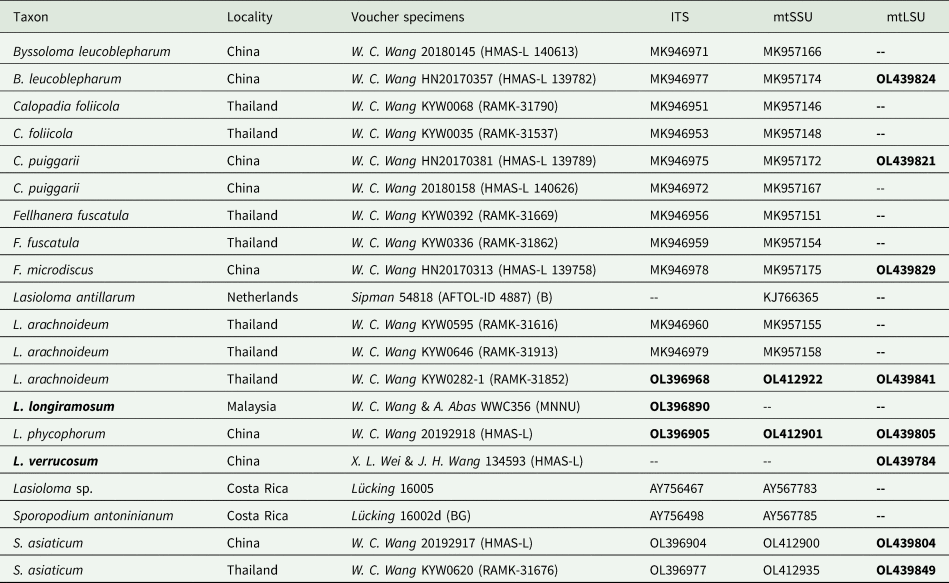
Geneious v. 6.1.2 (Biomatters Ltd, Auckland, New Zealand) was used to assemble and edit the original sequence reads. A total of 13 newly generated sequences were aligned together with 31 sequences retrieved from GenBank (Table 1). Byssoloma leucoblepharum (Nyl.) Vain. was chosen as outgroup based on previous phylogenetic analyses (Wang et al. Reference Wang, Sangvichien, Wei and Wei2020). The assembled sequences were aligned using the online version of MAFFT v. 7 (Katoh et al. Reference Katoh, Asimenos and Toh2009). Gblocks v. 0.91b (Castresana Reference Castresana2000) was used to delimit ambiguous regions, implementing all the options for a less stringent selection which yielded final alignments of 618 bp (ITS), 837 bp (mtSSU) and 809 bp (mtLSU). Alignments were concatenated in Geneious v. 6.1.2 for multilocus phylogenetic analysis. The final alignment consisted of three ITS, two mtSSU and eight mtLSU sequences newly generated from nine specimens, and 15 ITS and 16 mtSSU sequences downloaded from NCBI (Table 1).
Specimens of Lasioloma and outgroup species used in the phylogenetic analyses (Fig. 1) with voucher information and GenBank Accession numbers. New sequences and new species are in bold.

A maximum likelihood (ML) analysis was used to infer phylogenetic trees based on the combined ITS, mtSSU and mtLSU data set, using RaxML-HPC v. 8.2.6 (Stamatakis Reference Stamatakis2014) on the Cipres Science Gateway (http://www.phylo.org). Bootstrap support values (BS) were based on 1000 non-parametric pseudoreplicates. The phylogenetic tree was visualized with the program FigTree v. 1.4.3. and edited in Adobe Illustrator CC 2019.
Results and Discussion
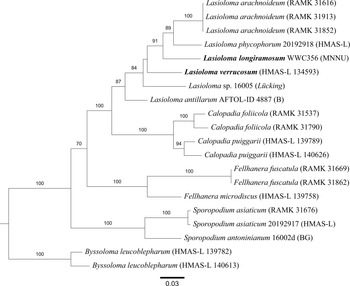
Based on a priori taxonomic assessment, five species of Lasioloma were included in our phylogenetic tree (Fig. 1) and they form a well-supported (BS = 87) clade. Most species were represented by singletons, whereas L. arachnoideum included two terminals. The Thai sequences identified as L. arachnoideum (31616, 31852, 31913; Fig. 2) did not form a clade with a Costa Rican sequence (Lücking 16005), which was named as L. arachnoideum in GenBank, suggesting two separate species.
Phylogram of Lasioloma species using maximum likelihood (ML) inferred from a concatenated data set of ITS + mtSSU + mtLSU. Bootstrap values ≥ 75 are indicated at the branches. The tree was rooted using Byssoloma leucoblepharum. Scale = 0.03 substitutions per site.

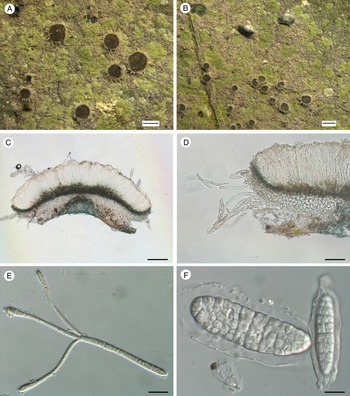
Lasioloma arachnoideum (W. C. Wang 31636, RAMK). A, dispersed thallus with apothecia. B, dispersed thallus with apothecia and campylidia. C & D, section of apothecium showing pigmentation. E, filiform conidium with three long branches and a shorter main branch. F, muriform ascospores. Scales: A & B = 500 μm; C = 100 μm; D = 50 μm; E & F = 10 μm. In colour online.

The conidia of the Thai samples have four branches (main branch of c. 48–49 μm in length, other three branches 40–42 μm), and are similar to the conidial description of the type species (four branches, main branch 38–56 μm, other three branches c. 36 μm) by Vězda (Reference Vězda1986), whereas those of neotropical samples have much shorter branches (each branch only 20–30 μm in length) (Lücking Reference Lücking2008). The holotype of L. arachnoideum originates from South-East Asia (Santesson Reference Santesson1952) so the Thai specimens should represent that taxon in its strict sense. There is currently no alternative name available for neotropical material thus far identified as L. arachnoideum.
The target samples, WWC356 and 134593, were each resolved on a separate singleton branch; they were also revealed as morphologically different from all known species of the genus (see notes below) and therefore we describe these two species here as new.
While Lasioloma can be easily recognized at genus level due to its pilose apothecial margin, woolly prothallus and filiform conidia with 3–5 branches originating from a single point, the study of the Asian specimens revealed that there are diagnostic differences in conidial morphology and dimensions between species of this genus, especially the length of the conidial branches, a feature that has not been explored in previous studies but should be regarded as an important additional line of evidence for species delimitation in Lasioloma.
Taxonomic Treatment
Lasioloma longiramosum W. C. Wang & A. Abas sp. nov.
Fungal Names No.: FN 571259
Differs from other foliicolous Lasioloma species based on its single, small ascospores (53–61 × 19–25 μm, 2.5–2.8 times as long as wide) and long filiform conidia (three long branches 65–80 μm and one shorter main branch of 22–28 μm).
Type: Malaysia, Pahang, Raub, Fraser Hill Forest Park, Jeriau Waterfall Trail, 3°42ʹ50.4ʺN, 101°44ʹ6ʺE, 700 m alt., on leaves, 7 September 2019, W. C. Wang & A. Abas WWC356 (MNNU—holotype!).
(Fig. 3)
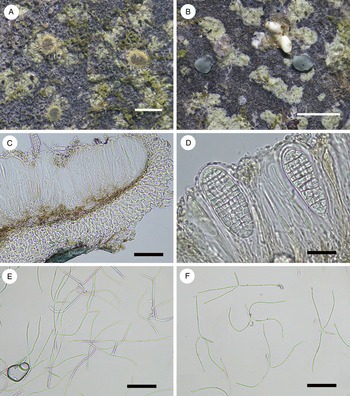
Lasioloma longiramosum (holotype, W. C. Wang & A. Abas WWC356 MNNU). A, dispersed thallus with apothecia. B, dispersed thallus with grey campylidia. C, section of apothecium showing pigmentation. D, muriform ascospores (one ascospore per ascus). E & F, filiform conidia with three long branches and a shorter main branch. Scales: A = 500 μm; B = 1 mm; C, E & F = 50 μm; D = 20 μm. In colour online.

Thallus epiphyllous, crustose, dispersed into irregular patches, 8–10 mm across, ecorticate, uneven, pale green, every patch 0.5–0.7 mm wide, composed of colourless and branched hyphae, 2.5–5 μm wide; prothallus well developed, between algiferous thallus patches, formed by loosely interwoven hyphae, white to pale grey. Phycobiont a species of Chlorococcaceae, cells round, green, 5–12.5 μm diam.
Apothecia rounded, 0.25–0.4 mm diam. and 200–240 μm high; disc plane, yellowish brown; margin thick, khaki, laterally densely pilose. Excipulum paraplectenchymatous, colourless, 16–22 μm wide, laterally with short hairs formed by individual, septate hyphae, up to 110 μm long; hypothecium 25–30 μm high, dark brown; apothecial base aeruginous; epithecium thin, 5–10 μm high, pale brown; hymenium 80–85 μm high, colourless. Asci 60–72 × 22–27 μm. Ascospores single, oblong, muriform, 53–61 × 19–25 μm, 2.5–2.8 times as long as wide, colourless, halonate.
Campylidia sessile, 0.4–0.5 mm wide; lobe well developed, hood-shaped, dark grey, non-pruinose; socle not apparent. Conidia filiform, colourless, with four branches originating from a single point, main branch distinctly shorter than the others, 2–3-septate, 22–28 × 2–2.5 μm; other three branches 5–8-septate, 65–80 × 1.5–2 μm.
Secondary chemistry
No substances detected by TLC.
Etymology
The epithet longiramosum refers to the filiform conidia with three long branches.
Habitat and distribution
This species grows on leaf surfaces and was found in the lower stratum of a damp understorey rainforest near a river in a valley in Malaysia.
Notes
So far, four foliicolous species of Lasioloma with a single ascospore have been described worldwide: L. arachnoideum, L. phycophilum (Vain.) R. Sant., L. phycophorum (Vain.) R. Sant. and L. trichophorum (Vain.) R. Sant. (Lücking et al. Reference Lücking, Högnabba and Sipman2021). All are mainly distributed in South-East Asia.
The new species, Lasioloma longiramosum, also has one ascospore per ascus but its small ascospores and long conidia readily distinguish it from the four other known foliicolous species; it is also distinguished phylogenetically from two of the species that have been sequenced (Fig. 1).
In its gross morphology, the new species resembles L. arachnoideum, since both have a dispersed thallus and a distinct woolly prothallus. However, L. arachnoideum is distinguished by having shorter conidia (main branch 38–56 μm, the other three branches c. 36 μm), shorter ascospores, and dark (greyish) brown apothecia (Lücking Reference Lücking2008).
Although conidia of the three other foliicolous species (L. phycophilum, L. phycophorum and L. trichophorum) have not been described in the literature, the species usually have vermicular cephalodia, a continuous to marginally dispersed thallus, an indistinct prothallus and longer ascospores (Santesson Reference Santesson1952; Lücking & Sérusiaux Reference Lücking and Sérusiaux2001; Lücking et al. Reference Lücking, Högnabba and Sipman2021).
Lasioloma verrucosum W. C Wang & X. L. Wei sp. nov .
Fungal Names No.: FN 571260
Differs from other corticolous Lasioloma species based on its warted thallus of verrucae 0.1–0.15 mm diam., and filiform conidia with three long branches of 56–65 μm and one shorter main branch of 22–32 μm.
Type: China, Guangxi Province, Nanning City, Daming Mountain National Natural Reserve, 23°30ʹN, 108°26ʹE, 1231 m alt., on bark of Betula sp., 22 May 2015, X. L. Wei & J. H. Wang GX2015083 (134593 HMAS-L—holotype!).
(Fig. 4)
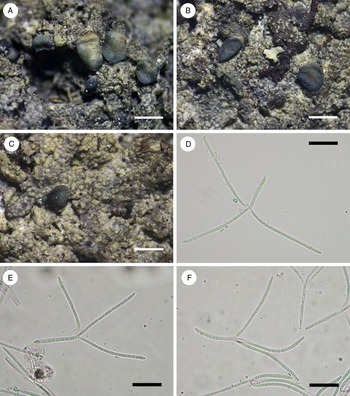
Lasioloma verrucosum (holotype, X. L. Wei & J. H. Wang 134593 HMAS-L). A–C, warted thallus with campylidia. D–F, filiform conidia with three long branches and a shorter main branch. Scales: A–C = 1 mm; D–F = 20 μm. In colour online.

Thallus corticolous, crustose, continuous, 4–6 cm diam., greyish white (the green likely to fade), irregularly extended, warted, entirely made of densely arranged, compact verrucae; verrucae 0.1–0.15 mm diam., medulla white, K−. Prothallus not observed. Photobiont chlorococcoid, algal cell globose, green, 7.5–12.5 μm diam.
Apothecia not observed.
Campylidia sessile, 0.5–1 mm wide; lobe well developed, large, hood-shaped, inside dark greyish green, outside pale grey to grey, non-pruinose; socle not apparent. Wall paraplectenchymatous, 50–58 μm thick, laterally with thin layer of densely interwoven hyphae, pale aeruginous, and peripherally with free hyphae composed of thick-walled cells, colourless; conidiogenous cells lining inner wall surface, oblong-papilliform, unbranched.
Conidia filiform, colourless, with four branches originating from a single point, the main branch shorter than the others, 4–8-septate, 22–32 × 2.5 μm, the other three branches 8–13-septate, 50–65 × 2.5 μm, all conidial branches without short terminal appendages.
Secondary chemistry
No substances detected by TLC.
Etymology
The epithet verrucosum refers to the warted thallus composed of densely compact verrucae.
Habitat and distribution
Lasioloma verrucosum is known only from the bark of Betula sp. in montane rainforest in subtropical areas of China.
Notes
Among the 11 species of Lasioloma currently known, there are five corticolous species: L. antillarum Lücking et al., L. appendiculatum Breuss, L. corticola P. M. McCarthy, L. pauciseptatum van den Boom and L. stephanellum (Nyl.) Lücking & Sérus. (McCarthy Reference McCarthy2020; Lücking et al. Reference Lücking, Högnabba and Sipman2021).
Lasioloma corticola was described from Queensland in Australia. Its gross morphology resembles that of L. verrucosum, since both species have grey campylidia and lack apothecia. However, L. corticola is distinguished from L. verrucosum by having a smooth thallus and conidia with 4–5 branches (the main branch longer than the other branches), whereas L. verrucosum has a warty thallus and conidia with four branches (the main branch shorter than the other branches).
Lasioloma appendiculatum also lacks apothecia but its conidia have five short branches (the main branch 27–35 μm and the other four branches 15–20 μm), and the conidial branches have short terminal appendages.
Lasioloma verrucosum is similar to L. stephanellum in having a warted thallus. However, in L. stephanellum the medulla is yellow to reddish. There is also a slight resemblance with L. pauciseptatum but that species has a smooth thallus and the conidia have 3–5 branches (the main branch longer than the other branches).
Lasioloma antillarum can be distinguished most readily by the smooth thallus and the length of the conidial branches (each branch 3–5-septate, 30–40 μm, the main branch slightly longer and thicker than the others).
Acknowledgements
This research was funded by the President's Fund of Minnan Normal University (KJ2021012). We are grateful to two anonymous reviewers for kindly checking the spelling and making useful comments on the manuscript. We also thank Dr. Robert Lücking for very careful modifications and valuable suggestions on the manuscript.
Author ORCIDs
Wei-Cheng Wang, 0000-0002-8391-5120; Azlan Abas, 0000-0002-5614-6506.