INTRODUCTION
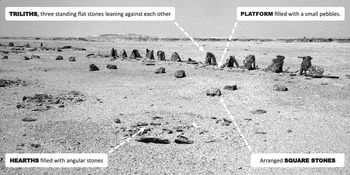
Trilith monuments are ritual spaces found across the coastal plains from Ḥaḍramawt in eastern Yemen to Raʾs al-Ḥādd in Oman. They consist of three flat pyramidal standing stones which lean against each other. The triliths are aligned in a row on a low platform filled with small pebbles. They are accompanied by an arrangement of square-shaped boulders and a row of large circular hearths to form a recognizable spatial configuration of trilith cluster (Figure 1). Together these items form a “trilith cluster,” the basic unit of trilith nomenclature (Garba Reference Garba2019: 149). Trilith clusters sometimes occur together with various ancillary stone structures such as cairn tombs, stone circles or boulders with engravings. Triliths have been archaeologically recorded in Ḥaḍramawt and the al-Mahra Governorates of Yemen (Dostal Reference Dostal1968; Rougeulle Reference Rougeulle1999; Bin ‘Aqil and McCorriston Reference Bin ‘Aqil and McCorriston2009; McCorriston et al. Reference McCorriston, Steimer-Herbet, Harrower, Williams, Saliège and Bin‘Aqil2011), and in the Ẓufār Governorate (Thomas Reference Thomas1929a, Reference Thomas1929b; Thesiger Reference Thesiger1946; al-Shahri Reference al-Shahri1991; Zarins Reference Zarins2001; Newton and Zarins Reference Newton and Zarins2010; Harrower et al. Reference Harrower, Senn and McCorriston2014; McCorriston et al. Reference McCorriston, Harrower, Steimer, Williams, Senn, Al Hādhari, Al Kathīrī, Al Kathīrī, Saliège and Everhart2014), al-Wusṭā Governorate (Jagher and Pümpin Reference Jagher and Pümpin2010; Jagher et al. Reference Jagher, Pümpin, Wegmuller and Winet2011; Genchi et al. Reference Genchi, Garba, Martino, Maiorano and Al-Ghafri2016, Reference Genchi, Garba, Martino, Maiorano and Al-Ghafri2017; Garba et al. Reference Garba2019, Reference Garba, Danielisová, Maiorano, Abbas, Chlachula, Daněček, Al-Ghafri, Neuhuber, Štefanisko and Trubač2020), and Ash Sharqiyah Governorates of Oman (de Cardi et al. Reference de Cardi, Doe and Roskams1977: 26–32; Doe Reference Doe1977; al-Jahwari Reference al-Jahwari2013, Reference al-Jahwari2018). Attempts to map their distribution have also been made (Dostal Reference Dostal1968: 54–55; de Cardi et al. Reference de Cardi, Doe and Roskams1977: 30–31, fig.7; Yule Reference Yule, Hoffman-Ruf and Salami2013: 25, fig. 14, 2014: 75; Garba Reference Garba2017: 46–48, Reference Garba2018: 503–504, Reference Garba2019: 153; al-Jahwari Reference al-Jahwari2018: 68; Yule Reference Yule2018: 462–466, figs. 16 and 19). This study and the question of who built the triliths are the subject of first author Garba’s dissertation.
Typical configuration of a trilith cluster, Wādī Ṣayy, Duqm. Photo: R. Garba 2010.

The Italian-Czech “Trilith Stone Monuments of Oman” (TSMO) archaeological expedition began field research of the trilith monuments in Oman in 2018. The main objective of the first two field seasons was to test and verify the trilith chronology and distribution by means of a more representative dataset of radiocarbon (14C) dates and to build a consolidated database of trilith sites. The investigation of the spatio-temporal patterning across a wider and more coherent geographical area sought to discover which people or peoples might have built them and to disentangle their function and meaning.
DATA COLLECTION AND METHODS
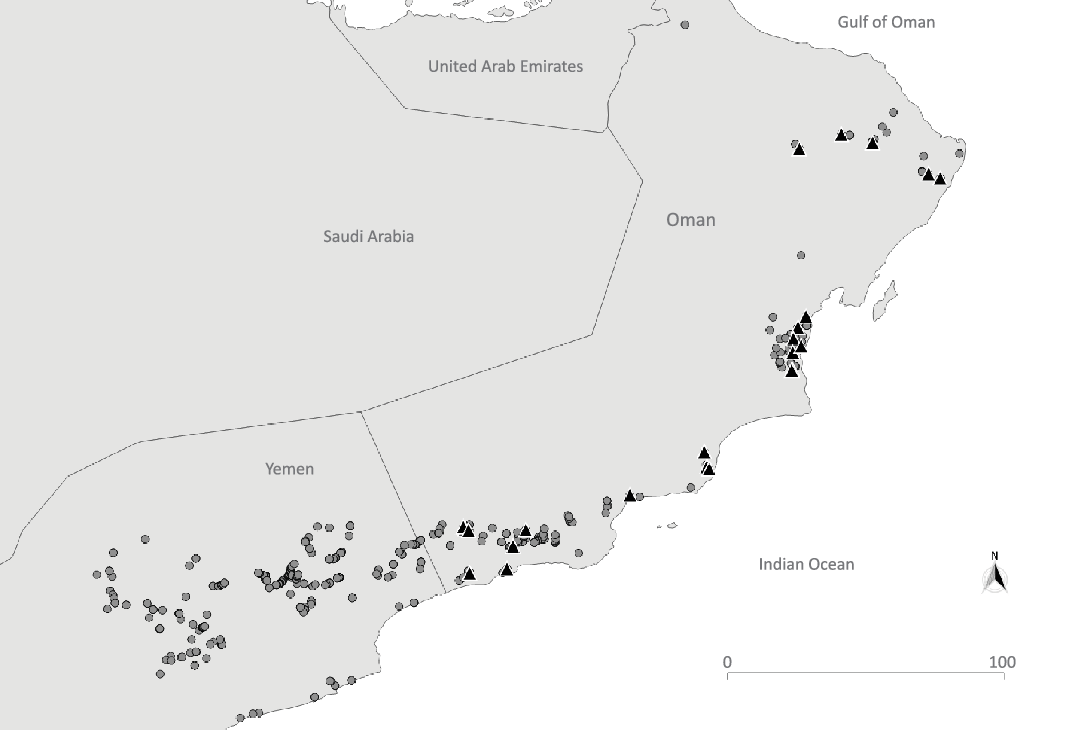
The sampling strategy focused on badly preserved trilith sites and large trilith complexes with six and more trilith clusters and sought to uncover the patterns behind such extensive installations. The sampling was conducted during the ground verification of trilith sites across the whole trilith distribution area in Oman. Through a combination of remote sensing, the TSMO ground surveys, and linking data from various archaeological sources, the trilith distribution dataset grew from an initial 231 trilith sites with 647 clusters (Garba Reference Garba2017, Reference Garba2018) to 692 trilith sites with 2844 clusters across an area from eastern Yemen to north-central Oman (Figure 2). During the first field campaign in 2018, seven trilith hearths were stratigraphically excavated but yielded just three charcoal samples. The scarcity of charcoal from the excavation of the trilith hearths led to more effective sondage of the centre of the hearths. This helped to preserve the remaining hearth material, and thus future data collection, and to maintain the visual integrity of the hearth. The reason for the lack of charcoal (irregular or one-time use, ritual removal, environmental conditions, etc.) is under investigation. In addition to the main large hearths, there were other (“secondary”) hearths located randomly around the trilith clusters. Across four field campaigns, we investigated 73 hearths, and this yielded 43 samples of charcoal or other organic material from 34 hearths (6 in the north-central Oman, 16 in south-central Oman, and 12 in southern Oman). Figure 2 shows the distribution of trilith sites and the location of sites which yielded organic material.
Distribution of trilith sites (dots) and locations which yielded organic samples (triangles). Source: trilith dB v14.8 (2.6.2020), TSMO sample dB v.19.6. (23.5.2020).

In addition to the small amount of charcoal, the trilith hearths yielded “pseudo-charcoal” material that quantitatively dissolved in NaOH during the ABA pretreatment process (four from the total of 34 samples). Pretreatment was carried out at the CRL 14C laboratory in Prague (Czech Republic). The samples in termoblok (at 90ºC) were leached repeatedly with 0.5 M HCl followed by 0.1 M NaOH and finally 0.01 M HCl. Before and after the alkaline extraction, the samples were rinsed with distilled water in order to adjust the pH of the extract to 6–8 (Gupta and Polach Reference Gupta and Polach1985; Jull et al. Reference Jull, Burr, Beck, Hodgins, Biddulph, Gann, Hatheway, Lange and Lifton2006; Simek et al. Reference Simek, Megisová and Bemš2019). The samples were dried at 60°C to reach constant weight. After pretreatment, the dry samples, together with CuO, were torch sealed under a dynamic vacuum into quartz glass tubes and combusted at 900°C for at least 8 hours. The resulting carbon dioxide was dried and transferred into the graphitization reactor. The batch method of graphitization with pure Zn as a sole reduction agent was derived from routines described by Rinyu et al. (Reference Rinyu, Orsovszki, Futó, Veres and Molnár2015) and by Orsovszki and Rinyu (Reference Orsovszki and Rinyu2015). The 30 pretreated charcoal samples were combusted, graphitized, sealed in vacuum, and sent for AMS measurements to the ICER laboratory in Debrecen (Hungary) with the international code “DeA-” (Molnár et al. Reference Molnár, Janovics, Major, Orsovszki, Gönczi, Veres, Leonard, Castle, Lange, Wacker, Hajdas and Jull2013a, Reference Molnár, Rinyu, Veres, Seiler, Wacker and Synal2013b; Handlos et al. Reference Handlos, Svetlik, Horáčková, Fejgl, Kotik, Brychova, Megisova and Marecova2018). The calibration software chosen was the OxCal 4.3.2 tool by Bronk Ramsey (Reference Bronk Ramsey2017) with the curve IntCal13 for atmospheric samples from the northern hemisphere (Reimer et al. Reference Reimer, Bard, Bayliss, Beck, Blackwell, Ramsey, Buck, Cheng, Edwards, Friedrich, Grootes, Guilderson, Haflidason, Hajdas, Hatté, Heaton, Hoffmann, Hogg, Hughen, Kaiser, Kromer, Manning, Niu, Reimer, Richards, Scott, Southon, Staff, Turney and van der Plicht2013).
RESULTS AND DISCUSSION
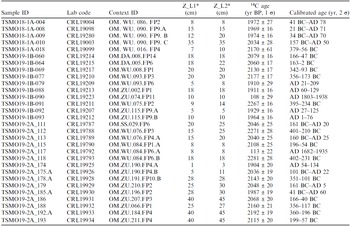
Triliths are generally assumed to date from the Samad Late Iron Age 200 BC–AD 300 (Yule Reference Yule2016: 65, fig. 31). An overview of the nine previous trilith dates from Yemen and Oman (de Cardi, Doe and Roskams Reference de Cardi, Doe and Roskams1977: 28; al-Shahri Reference al-Shahri1991: 193, 2000: 57; Cremaschi and Negrino Reference Cremaschi, Negrino and Avanzini2002: 342; Bin ‘Aqil and McCorriston Reference Bin ‘Aqil and McCorriston2009: 608; McCorriston et al. Reference McCorriston, Steimer-Herbet, Harrower, Williams, Saliège and Bin‘Aqil2011: 4, Reference McCorriston, Harrower, Steimer, Williams, Senn, Al Hādhari, Al Kathīrī, Al Kathīrī, Saliège and Everhart2014: 135–136) was provided recently by Garba (Reference Garba2019: 149). The new trilith 14C dataset from Oman provides a significant increase in the number of trilith dates. Table 1 summarizes the new trilith 14C dataset.
Results of 14C analysis. OxCal v4.3.2 Bronk Ramsey (Reference Bronk Ramsey2017), IntCal13 (Reimer et al. Reference Reimer, Bard, Bayliss, Beck, Blackwell, Ramsey, Buck, Cheng, Edwards, Friedrich, Grootes, Guilderson, Haflidason, Hajdas, Hatté, Heaton, Hoffmann, Hogg, Hughen, Kaiser, Kromer, Manning, Niu, Reimer, Richards, Scott, Southon, Staff, Turney and van der Plicht2013).

* Depth below the surface Level 1, Level 2.
Two samples (CRL19223 and CRL19792) show evidence of much later re-use of the trilith hearths in the 17th to early 20th century but still prior to the bomb peak. The samples are from different locations (Wādī ʿAīnain in al-Wusṭā and Wādī Sha‘ath near the Salalah port in Ẓufār) and suggest that the ancient pre-Islamic rituals assumed to be connected with the triliths might have continued among local tribes up to more modern times.
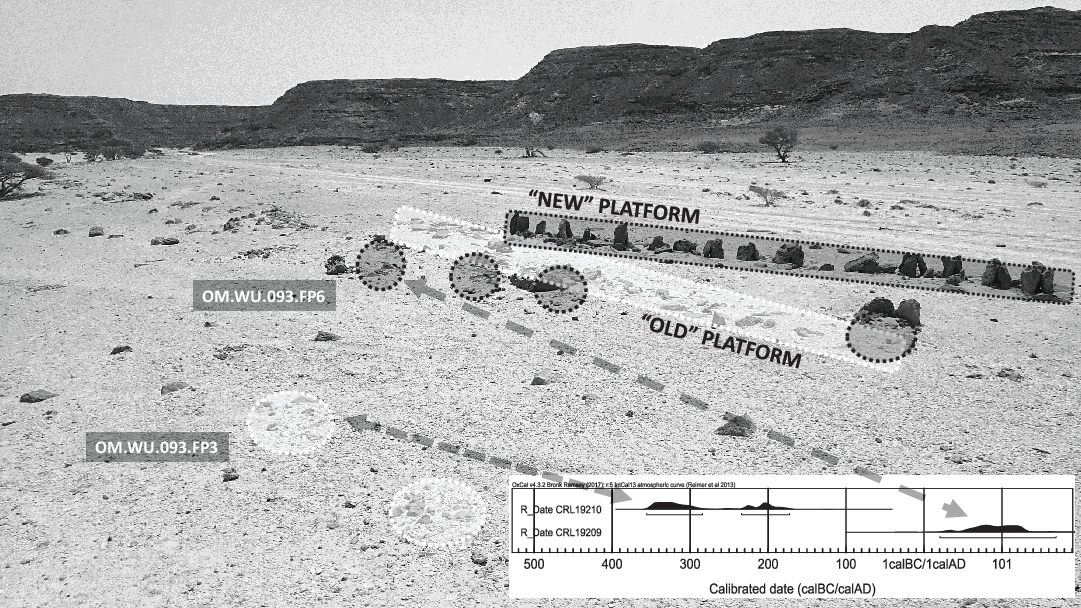
The key discovery with respect to the chronological tracing of trilith monuments was the OM.WU.093 trilith site at Wādī Wāṭif, which represents the overlay of two horizontally offset trilith clusters. The platforms and hearths show different levels of preservation (Figure 3), which suggests chronologically distinct construction phases or events. The two 14C dates (the first from hearth OM.WU.093.FP3 associated with the “earlier platform” TSMO19-1B-077, CRL19210, 2177 ± 17 BP, or cal BC 356–173 [2 σ]; the second from hearth OM.WU.093.FP6 associated with the “later platform” TSMO19-1B-079, CRL19209, 1910 ± 29 BP, or cal AD 21–209 [2 σ]) give a gap between the phases of between 227 and 475 years (2 σ). The absence of trilith standing stones on the “earlier” platform indicates re-use of the old standing stones during construction of the “later” platform. The layout and dating of the site suggest that the people who built and used the triliths might have returned to the same place after some 4 to 9 generations.
Wādī Wāțif two-phase trilith site with respective calibrated 14C dates. Source: TSMO project, 14C analyses OxCal v4.3.2 Bronk Ramsey (Reference Bronk Ramsey2017), IntCal13 (Reimer et al. Reference Reimer, Bard, Bayliss, Beck, Blackwell, Ramsey, Buck, Cheng, Edwards, Friedrich, Grootes, Guilderson, Haflidason, Hajdas, Hatté, Heaton, Hoffmann, Hogg, Hughen, Kaiser, Kromer, Manning, Niu, Reimer, Richards, Scott, Southon, Staff, Turney and van der Plicht2013).

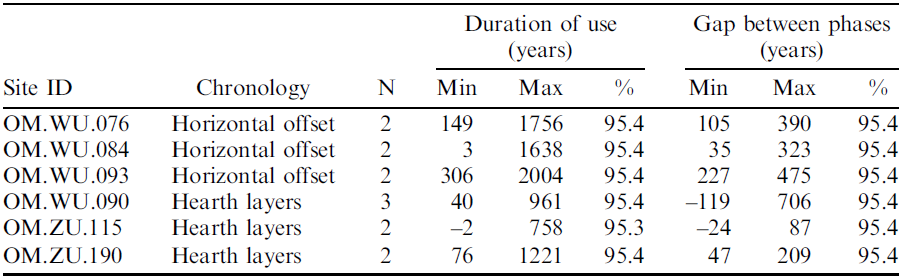
The trilith chronology was studied in two domains: temporal intra-trilith site chronology within a single trilith space; and spatio-temporal inter-trilith site chronology across Oman. For the intra-trilith chronology, the 14C dates from different strata of the same trilith hearth and two-phase trilith sites were analyzed. Calculations for the duration of use and the gap between phases of activity at individual trilith sites are presented in Table 2.
Calculations for the duration of use and the gap between phases of activity at individual trilith sites. OxCal v4.3.2 Bronk Ramsey (Reference Bronk Ramsey2017), IntCal13 (Reimer et al. Reference Reimer, Bard, Bayliss, Beck, Blackwell, Ramsey, Buck, Cheng, Edwards, Friedrich, Grootes, Guilderson, Haflidason, Hajdas, Hatté, Heaton, Hoffmann, Hogg, Hughen, Kaiser, Kromer, Manning, Niu, Reimer, Richards, Scott, Southon, Staff, Turney and van der Plicht2013).

Because of the small number of dated samples per site (no more than 3), the maximum values show the uncertainty of the dating method. Only the minimum values, if they are non-negative, provide useful information on the lower limit of duration of the sites. The two longest minimum figures for duration of use are from the two-phase sites OM.WU.093 at Wādī Wāțif at 306 years and OM.WU.076 at Wādī ʿAīnain at 149 years. Both are in the al-Wusṭā/Ẓufār borderland area. The intra-hearth 14C dates (samples CRL19925 and CRL199266) from site OM.ZU.190.FP4 at Aydim (Ẓufār) show repeated use of the hearth for a minimum duration of 76 years (2 σ) between level –1 to –3 cm and –5 to –11 cm layers. Three 14C dates (samples CRL19098, CRL19280 and CRL19003) from the OM.WU.090.FP9 hearth layers of the trilith site at Nafūn (al-Wusṭā) show a minimum duration of use of 40 years (2 σ). The OM.ZU.115.FP9 intra-hearth 14C dates (CRL19207 and CRL19212) from Ḥanūn (Ẓufār) show a minimum duration of negative 2 years (2 σ), thus no chronological events. Apart from the two-phase trilith site OM.WU.093, an additional two 14C pairs from two-phase trilith sites in nearby Wādī ʿAīnain were obtained from OM.WU.076 (samples CRL19788 and CRL19789) and OM.WU.084 (samples CRL19790 and CRL 19793). The data for the trilith site OM.WU.076 show a gap between the phases of 105–390 years (2 σ) and for OM.WU.084 a gap of 35–323 years (2 σ). These results can be independently reproduced using the OxCal model to calculate the duration of use and the gap between phases of activity at the trilith sites (see supplementary data: script file triliths_intra_site.oxcal and output file triliths_intra_site.pdf).
For the second investigation, the spatio-temporal inter-trilith regional chronology, hierarchical chronological cluster analysis (HCA) of the calibrated dates was calculated in order to estimate the chronological clusters. The distance between two dates was calculated as the inverse probability that they represent the same event (Dreslerová et al. Reference Dreslerová, Kozáková, Metlička, Brychová, Bobek, Čišecký, Demján, Lisá, Pokorná, Michálek, Strouhalová and Trubač2020; Demján and Pavúk Reference Demján and Pavúkin press). The probability that two calibrated 14C dates i and j, defined by mean 14C ages ti , tj and standard deviations σi , σj , represent the same event can be expressed as the ratio
 $${P_{ij}} = {{4\mathop \sum \nolimits_{t \in I} {f_{Calib}}\left( {t,{t_i},{\sigma _i}} \right){f_{Calib}}\left( {t,{t_j},{\sigma _j}} \right)} \over {{{\left( {\mathop \sum \nolimits_{t \in I} {f_{Calib}}\left( {t,{t_i},{\sigma _i}} \right) + \mathop \sum \nolimits_{t \in I} {f_{Calib}}\left( {t,{t_j},{\sigma _j}} \right)} \right)}^2}}}$$
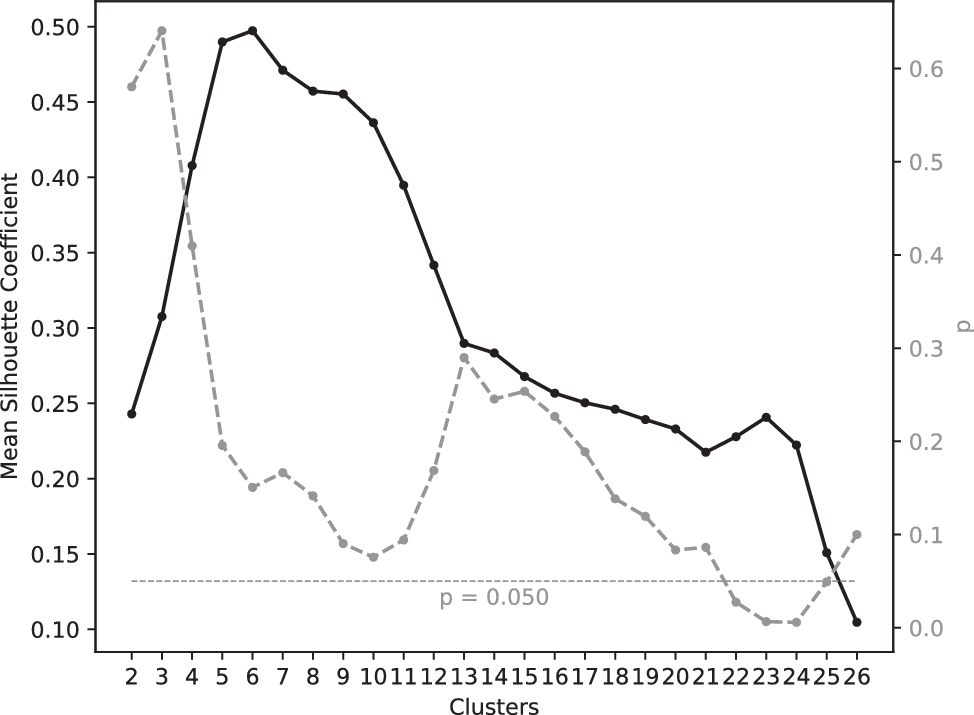
where I is the set of dates from the IntCal13 (Reimer et al. Reference Reimer, Bard, Bayliss, Beck, Blackwell, Ramsey, Buck, Cheng, Edwards, Friedrich, Grootes, Guilderson, Haflidason, Hajdas, Hatté, Heaton, Hoffmann, Hogg, Hughen, Kaiser, Kromer, Manning, Niu, Reimer, Richards, Scott, Southon, Staff, Turney and van der Plicht2013) and fCalib is the calibration function by Bronk Ramsey (Reference Bronk Ramsey2008). For every number of clusters that can be formed based on the HCA, the mean silhouette coefficient was calculated to quantify the consistency of the results of the clustering (Rousseeuw Reference Rousseeuw1987) together with the p-value (Figure 4).
Mean silhouette coefficient (solid line) and p-value (dashed grey line) as a function of the number of modeled clusters.

The results of HCA analysis on all 14C dates across Oman shows limited chronological clustering (p ≤ 0.05, 22 to 25 clusters from N = 30), which suggests something approaching the continuous use of trilith monuments in the region. The temporal extent of the use of a trilith hearth gives the earliest activity from cal BC 417 to 242 (2 σ) and the latest activity from cal AD 72 to 160 (2 σ). These dates represent the beginning and end termini of all available 14C dates modeled in OxCal as a single phase (see supplementary data: script file triliths_earliest_latest.oxcal and output file triliths_earliest_latest.pdf).
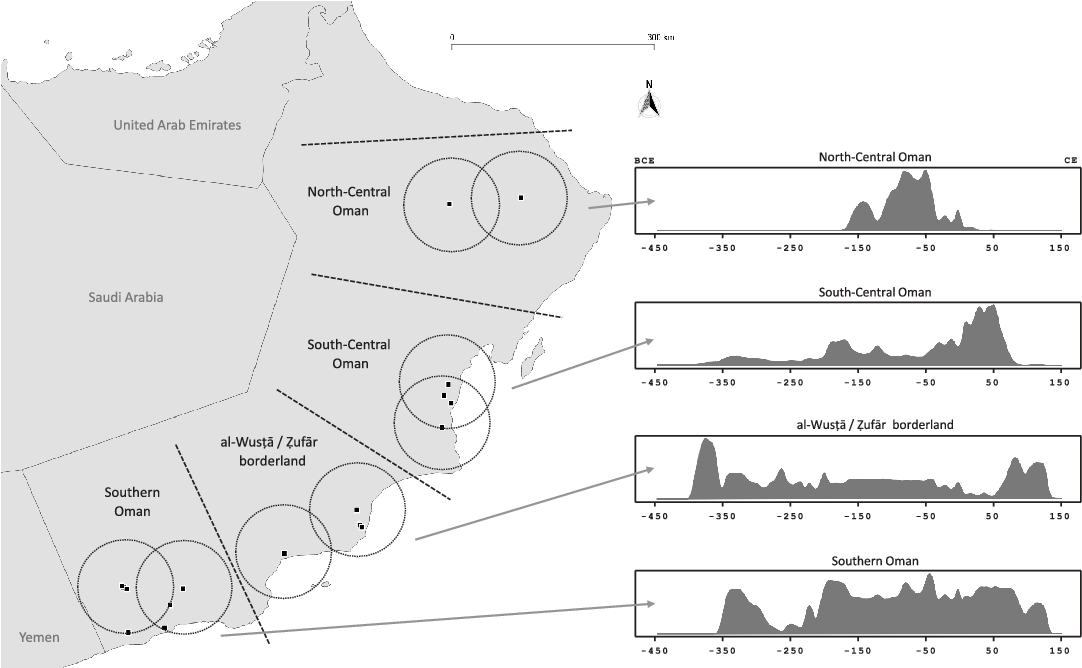
The spatio-temporal modeling was carried out in two steps: first, the dated sites were clustered into the same region if the distance between them was less than 150 km; secondly, the calibrated dates from each region were summed and normalized so that each resulting distribution had a sum of one. This eliminates a possible distortion due to uneven sampling. The results of the spatio-temporal modeling are shown in Figure 5 and could indicate the regional spatial dynamics of the people or peoples culturally associated with the use of trilith monuments. The preliminary spatio-temporal analysis indicates a southwest-to-northeast expansion of occupation from southern Oman (Ẓufār and al-Wusṭā/Ẓufār borderland) to north-central Oman (al-Dāḫilīyah, aš-Šarqīyah) during the 5th to 1st centuries BC, followed by a reverse northeast-southwest trajectory in the first two centuries of the Common Era. The existing dataset is still not sufficiently representative to provide a comprehensive interpretation of the pattern across the whole area of trilith distribution. Some 336 of the 692 registered trilith monuments are located in eastern Yemen which means valuable ground data were not available as a result of the conflict in the region. This is the first attempt, we hope of many, to study the spatial and temporal patterns of occupation by the people or peoples associated with trilith monuments.
Summed probability distributions of calibrated 14C dates from the examined regions.

CONCLUSIONS
The samples collected during the TSMO fieldwork showed evidence of intra-hearth events and provided data regarding the duration of use of the trilith hearths. The discovery of two-phase trilith sites brought valuable data into the trilith chronology and resulted in a revised range with respect to the use of trilith hearths in Oman, now believed to be from 410 BC to AD 158 (cal 2 σ). Three 14C dates from south-central Oman provided new evidence of the use of trilith monuments as early as the Iron Age III (600–300 BC) period, and the expansion of existing trilith affiliation with the Samad Late Iron Age (300 BC–AD 300) period. Two limitations should be mentioned with respect to trilith chronology. First, the dates obtained from the hearths represent a terminus ante quem (latest possible date) of use, not necessarily the first use of the hearths. Secondly, we assume that the hearths were built and used at the same time that the trilith stone arrangements were erected as the two features are part of a single ritual space. Means of mitigating these limitations include taking samples from the lower strata of the hearths and finding a trilith site with a lateral stratigraphy (two-phase sites with an overlay of horizontally offset trilith clusters built at different times). Both means were partially addressed in the new 14C dataset. The contemporary nature of the construction of the trilith stones and the use of hearths could be tested by OSL dating of sediments beneath trilith platform stones to obtain the time of construction (terminus post quem) of the trilith monument. Combining the new 14C dataset from the trilith hearths and the new trilith distribution database allowed, for the first time, the spatio-temporal analysis of the use of trilith monuments in Oman. The results allowed us to study the occupation patterns of tribal populations culturally associated with trilith monuments. The preliminary results show the use of trilith monuments in southern Oman in the 5th to 3rd century BC, an expansion into south-central Oman (Duqm/al-Wusṭā) in the 2nd century BC, followed by further expansion into east-central Oman in the 1st century BC resulting in the furthest geographical extent of the use of trilith monuments. In the 1st and 2nd centuries AD, we see a gradual retreat into south-central Oman and later to southern Oman. The new 14C dataset for trilith monuments contributes to our understanding of the distribution patterns and chronology of trilith monuments and their possible connection to the pastoralists, foragers and sedentary oasis populations of southeastern Arabia during the Iron Age.
ACKNOWLEDGMENTS
We thank the Ministry of Heritage and Tourism for permission to conduct fieldwork in Oman. We are grateful to the TSMO team in supporting the sample collection during the field seasons 2018–19. This publication was supported by OP RDE, MEYS, under the project “Ultra-trace isotope research in social and environmental studies using accelerator mass spectrometry”, Reg. No. CZ.02.1.01/0.0/0.0/16_019/0000728, by institutional funding of the Nuclear Physics Institute of the Czech Academy of Sciences (RVO61389005).
Supplementary material
To view supplementary material for this article, please visit https://doi.org/10.1017/RDC.2020.123