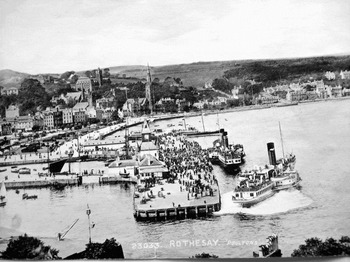
On 19 June 1900, during the heyday of the British seaside resort, a new gentleman's lavatory opened on one of the Firth of Clyde's most famous piers.Footnote 1 The Isle of Bute was a popular destination for Scottish Victorians, who would make the short journey from Glasgow by paddle steamer for a day of shopping or a weekend holiday. Despite its small size and close proximity to major cities, Rothesay, the island's only town, supported a large number of shops year round and hosted regular fairs during the summer. Travelers were also lured to the island by its diverse topography and by Rothesay Castle, which dates from 1230 and eventually devolved to the Stuarts. The island's moderate west-coast climate attracted a considerable number of visitors throughout the year (Figure 1).
View of Rothesay harbor c. 1900. Courtesy of the Bute Museum.

The gentleman's loo, operational today, occupies a small red and tan brick slanted-roof building on the pier and is approximately seventy feet long (Buteman 25 November 1899).Footnote 2 It is one of the first buildings that one sees when sailing in or out of the harbor. The interior is lavishly decorated with faux-marble and porcelain fixtures, a mosaic tiled floor, frosted windows, and a number of skylights that typify the Victorian interest in harnessing natural light. The tan glazed brick of the upper portion of the interior walls of the main room, containing twenty urinals and nine toilets, is accented by green tile and crown molding. A green and rich-brown accented border separates the upper and lower portions of the interior walls. The lower portion, in a dark-gold patterned tile accented by deep green and rich brown, harmonizes with the brown wood of the individual stall doors and the patterned mosaic floor tiles in beige, green, and brown. Fourteen circular-backed urinals stand along two walls and are fitted with white enameled “Adamant” fireclay alcoves and dark-grey and white “St. Anne” faux-marble serving as crown and siding. These urinals partly surround six others which stand in a hexagonal pattern in the center of the room. All include mosaic tiled treads and copper flush pipes. The nine toilets in self-contained rooms with mahogany wood paneling complete the design. As one official put it, “for appearance and up to dateness” the lavatory was “second to none in the West of Scotland” (Buteman 16 June 1900).
It was a technological marvel as well as a marvel of decor. Because the urinals and toilets were all connected to running water and a drainage system, ventilation never became the problem that it was for the lavatory's cast-iron predecessor. Although cast-iron lavatories, which dominated the urban landscape in the closing decades of the nineteenth century, were elaborately decorated externally, including intricate design, roof lamps, and, occasionally, potted plants, their interiors were austere. They often lacked sinks or, until the end of the century, advanced drainage systems; urinals were made of utilitarian stone and slate. Cleaning crews were required on a daily basis to remove the accumulated excrement to municipal dung heaps. In contrast, the technologically advanced and highly stylized gentleman's lavatory at Rothesay pier required only one employee, whose sole function was to insure that users paid the required fee and received commensurate service.
What kind of ideological work made possible the transformation of a men's lavatory into a facility for gentlemen? In recent years the lavatory has become an important site for cultural historians and queer theorists interested in the spatial construction of subjectivity. In Discipline and Punish Michel Foucault drew attention to the way in which the latrines at France's École Militaire “had been installed with half-doors, so that the supervisor on duty could see the head and legs of the pupils, and also side walls sufficiently high ‘that those inside cannot see one another’” (172). In Foucault's view, therefore, spatial boundaries within the lavatory play an important role in shaping heterosexual desire – attempting to “prevent debauchery and homosexuality” by regulating vision and facilitating disciplinary surveillance. Indeed, for many scholars since Foucault, the men's room “constitutes,” as Lee Edelman has argued, “a social technology” and a crucial zone for the “enactment of the body's compliance with the cultural regulation of desire” (152). Other cultural historians and queer theorists have taken a different view, seeing the lavatory as a sort of utopian space in which a range of body types, classes, and races intermix: “There exists a sort of democracy” in the lavatory, writes Laud Humphreys, where “men of all racial, social, educational and physical characteristics meet in these places for sexual union” (34). Jeffrey Weeks similarly contends that lavatories have long facilitated upper-middle-class men's “crossing the class divide” (114).
These approaches, though different in the degree to which they recognize the spatial possibilities for self-fashioning, have been enormously helpful in calling attention to the cultural and thus not simply functional role of the men's lavatory in modern life. It is a space that, in Edelman's words, “always necessarily functions in excess of a logic of mere functionality” (152). Yet such approaches rarely take seriously the need for properly historicizing their object of study. As a result, many of their arguments are strikingly ahistorical. The notion of the lavatory as a democratic space becomes problematized when examined historically; considering late-Victorian London, for example, one would need to distinguish between fee-based lavatories and those offered as a public convenience by municipal authorities. Indeed, Steven Maynard has pointed out that assertions like Weeks's – that lavatories facilitated the crossing of class lines in sexual encounters – must always be tested against historical data such as court records and witness testimony.Footnote 3
More to my point, however, the argument that the men's room always functions as a social technology, with the regulation or the satisfaction of desire as its primary aim, ignores the crucial role that fantasy played among the first generation of users experiencing the highly aestheticized lavatories of the 1890s. In this essay I will argue that these emergent lavatories in the late-Victorian period offered their users an opportunity to fantasize about cultural distinctions at a time when social agglomeration had become the norm. One woman writer in the 1870s noted that “the extraordinary ease and cheapness with which locomotion is now effected by persons of both sexes and of all ranks, and, one might almost add, of every age” constituted something of a social revolution (“Resting” 100). The sheer number of individuals utilizing the trains and paddle steamers, shopping in department stores, and moving through the streets of urban centers “greatly increased,” as Pam Morris notes in another context, “the opportunities for encountering others as bodily presences” (25). As I hope to show, utilizing the new fee-based and highly stylized lavatories such as the one at Rothesay became a means for some men to relieve themselves, as it were, from the crowd and thus to assert, however briefly, their own cultural distinctions. The lavatory at Rothesay pier, therefore, can be viewed as a response to anxieties about mass culture.
A central premise of this essay is that although luxurious lavatories were constructed as an extension of official efforts begun at midcentury to address hygienic concerns arising from the realities of bodily waste, they are also privileged spaces in which modes of identity are forged and fantasies are stimulated.Footnote 4 Certainly the lavatory attempts to fashion male subjectivity, as scholars ranging from Foucault to Edelman have demonstrated, according to culturally prevalent ideologies of gender, class, sexuality, and (throughout much of the southern United States during the twentieth century) race.Footnote 5 But the well-appointed, fee-based lavatory also accomplished a different kind of cultural work at the fin de siècle: for a moment the individual could escape from the crowd into a different kind of social space and imagine himself in culturally privileged terms – indeed, as a gentleman.
Public Conveniences from Midcentury to the 1890s
Because this essay identifies an aspect of the nineteenth-century men's lavatory that has not been studied before, I will provide a historical overview of the emergence of public facilities for bodily relief. The aestheticized lavatories at the end of the nineteenth century, after all, were constructed with the purpose of being differentiated from prevailing models. By the late 1890s, architects, municipal authorities, and others who played a role in constructing lavatories had almost fifty years of practical knowledge about public facilities. It will be useful, then, to review some of the sanitary, aesthetic, and social dimensions of public conveniences as they evolved over the course of the nineteenth century and informed the construction of the gentleman's lavatory at Rothesay pier.
From the early 1830s to the middle of the century, Britain experienced several outbreaks of typhus, smallpox, scarlet fever, influenza, and cholera. In the period between the first occurrence of cholera in 1831–32 and the second in 1848–49 – two epidemics that, combined, claimed more than ninety-four thousand lives in England alone – eight influenza epidemics affected tens of thousands more (Wohl 118, 120). Although there was a lack of consensus among medical professionals about how to prevent disease, increasing attention was being paid to what Edwin Chadwick called the “sanitary idea.” In The General Report on the Sanitary Conditions of the Labouring Classes in Great Britain, Chadwick argued that the lack of sewage facilities, clean water supplies, public or private accommodations, and basic hygiene rendered deadly what were otherwise preventable diseases.Footnote 6 Chadwick's views were not immediately embraced.Footnote 7 By 1848, owing in part to a public outcry over the desperate conditions of sanitation in many parts of the city of London, a Public Health Act was passed which included a mandate that any new houses built must include a water closet, privy, or ash pit (Palmer 23).
Municipal authorities throughout Britain thus sought to construct public lavatories as a response to the sanitation crisis.Footnote 8 At midcentury, the city of London had built more than seventy-four lavatories to combat pressing public health concerns. Although officials encouraged the poor, in the hope that they would acquire new hygiene habits, to use public lavatories, the conveniences were rarely constructed in areas that already needed them; “the present inhabitants” of one slum area in Edinburgh, a police commissioner told municipal authorities in 1853, “occupy a position on the social scale, too low to be benefited by the sanitary improvement you contemplate” (qtd. in Brunton 195). As the commissioner's comments suggest, lavatories were erected in major cities less in an attempt to combat prevailing sanitation problems than to anticipate new ones. Suburbs and predominantly residential areas were avoided on the understanding that individual homes had or would soon have a water closet or privy; slum areas were avoided out of a perception that their inhabitants were “irredeemably dirty” (Brunton 195). Although throughout much of the century, local government officials and engineers could not agree on the best ways to tackle urban hygiene and sanitation continued to be a problem of immense proportions in industrial towns and in London, public lavatories were increasingly erected in urban areas to meet projected needs, especially the increasing mobility of people. As Deborah Brunton has pointed out, the vast majority of lavatories were built in areas “traversed by large numbers of travellers and pedestrians, outside railway stations, by cab-stands, or next to bridges across city rivers where pedestrian traffic was funnelled along a small number of streets” (194). Urinals were offered as a free public service by municipal governments, and men were often charged a penny for water closets.
Thus, a logic of hospitality, I want to suggest, informed the construction of municipally administered lavatories. By locating public conveniences in zones primarily used by travelers, officials increasingly embraced the reality of a mobile population. Lavatories made various destinations more hospitable to those either traversing the city for work or traversing the nation for pleasure. Notions of hospitality, however, are rarely free of ideology. Although the primary motivating factor in the construction of public lavatories was the controlling of defecation and urination in city streets, some officials believed that their efforts had a strong moral component as well. Police authorities were concerned about the exposure of the human anatomy, particularly the penis, in conditions of unregulated urination, and they advocated public conveniences as a way to combat this “threat to moral order” (Brunton 191). While making urban centers and heavily visited areas more hospitable to the traveler, municipal authorities also saw lavatories as an important instrument for the cultivation of virtue.
Cultural anxieties about the exposure of a man's penis may account materially for early inattention to the construction of lavatories for women. Although public lavatories for women were constructed after the 1860s – well over a decade after municipal authorities began building lavatories for men – the overall percentage was quite small. Because women's skirts allowed them to urinate in public without necessarily exposing themselves, the authorities may have felt that providing services for them was a less pressing moral issue. Ideologically, however, the city streets were considered an extension of public life and therefore associated with men even if, practically speaking, women had to traverse them daily. In other words, culturally shaped notions about women's “natural” sphere and practical realities about their dress could both be invoked as reasons not to provide public accommodations for them.
One of the few men to reject the notion of compulsory domesticity for women was Paddington Vestry's medical officer, Dr. James Stevenson. Commissioned by the vestry to conduct a study on the need for public accommodations for women, Stevenson concluded that London municipalities needed to recognize the reality of women's mobility. Although he could not determine the exact “number of women who daily pass along our streets,” Stevenson argued that they constituted a significant percentage of those who use “steamboats, omnibuses, tramways, underground and over-ground railways, as well as. . . cabs and carriages” and that their numbers would likely increase (7–8). Stevenson's views were prescient. By 1891 more than 240,000 women were considered to hold a “professional occupation,” including positions in schools, hospitals, and offices (Rubinstein, Before 70).
Stevenson's essential insight was that the layout of the city needed to adapt to changing social realities. He argued that, while no one would insist on public accommodations for ladies in smaller towns, where the distances were shorter and neighbors looked out for one another, London's “populous wilderness” required a different response from the vestrymen. Stevenson's “Report on the Necessity of Latrine Accommodation for Women in the Metropolis” cited statements by medical professionals that attested to the inherent similarities in physical needs between women and men. Both required “food and drink” and, logically, both had bodies that required the means to expel “what the system cannot appropriate”: “the one organic necessity,” Stevenson observed, “involves the other” (11).
Although women who passed through the city streets had access to lavatories provided in milliners’ and confectioners’ shops, Stevenson claimed that the Paddington Vestry had, nonetheless, a moral responsibility to provide accommodations for them. In order to use the lavatories in commercial spaces – “to obtain this much needed accommodation” (13) –women needed to first purchase food or drink. “The money thus spent” on an unnecessary purchase simply in order to use the lavatory, Stevenson argued, “even when it is only a few pence, cannot always be conveniently spared” (13). As Erika Rappaport points out, Stevenson's case was persuasive; but it was ultimately not enough to convince either officials in Paddington or elsewhere to construct public conveniences for women, “even though prominent reform organizations and a private company were willing to build them” (84).
According to Rappaport, resistance to Stevenson's plan appears to have been motivated less by misapprehensions about the workings of female anatomy – the notion that they simply did not need to go as often as men – than by what she calls “fears about the masses and urbanization” (84). Rappaport's argument is not entirely convincing, for one could easily ask why such fears did not prevent lavatories for males from being constructed around the city of London. She does identify an important dimension to the discourse on public lavatories: the way in which they stood as a symbol for the increasing mixture of classes in urban centers and tourist areas. Lavatories enabled, as Rappaport points out, “mobility in and access to public life” (79). By 1875, almost two hundred urinals, most accommodating more than one male user, had been opened across the city (Brunton 189; Trumbach 106).
While the construction of lavatories for women lagged well behind those for men, their very existence by the end of the century represented a remarkable change in gender ideology. By the 1890s, “the New Woman was a tangible reality,” notes John Tosh, “daily encountered in the drawing room, as well as the office, the class room, and the street” (153). The urban geography was slowly reflecting this change. However, unlike the public lavatories for men, women's lavatories required all users to pay a penny – a charge that may have had an equal basis in economics and ideology; water closets were more expensive to build and required larger lavatories to accommodate them.Footnote 9 Men paid a penny to use water closets but had a free alternative when they needed to urinate, whereas women required water closets for both urination and defecation.Footnote 10
Men's Lavatories at the End of the Century
I have argued that a notion of hospitality informed efforts by municipal authorities to establish public accommodations in highly traversed areas. Because hospitality is often shaped by cultural assumptions, the construction of lavatories from midcentury forward reflected the strongly held belief in the natural division of the sexes into separate spheres. That the vast majority of public accommodations were for men enables us to see the extent to which hospitality itself became gendered. To be hospitable, therefore, a city or town sought to provide services for the male traveler irrespective of class. As a result, distinctions between different kinds of men began to break down. Indeed, throughout the 1850s and 1860s, British society was undergoing what Pam Morris has called “amorphous massification and aggregation” (165). The waning of social distinctions based on landed property and the movement toward the enfranchisement of the emergent middle class generated a kind of collective imagining of the forms that a modern mass culture would take. Although visions of this new collectivity differed, a large number of people had accepted by the 1860s that an aggregated society was inevitable (Morris 167). By the 1890s this transformation was almost complete; the city streets were teeming with all classes and both sexes, and public accommodation made mobility possible for many.
It is, therefore, not a coincidence that the emergence of public lavatories and of an ideology of collective society were coeval in the 1850s and 1860s. The development of a mass culture, firmly in place by the 1890s, greatly blurred social distinctions between the classes, and the upsurge of the New Woman challenged traditional notions of gender. It was precisely this anxiety about agglomeration and emergent feminism that contributed to the rise of new physical spaces in which social distinctions for men could be reasserted: the gentleman's club, the all-male recreational facility, and, the focus of this study, the well-appointed lavatory. By the turn of the century, the old cast-iron lavatory structures were being replaced in prominent tourist or middle-class areas with elaborately designed facilities utilizing the latest sanitary technology, including running water for both urinals and toilets and the installation of hand basins. The emerging lavatories were ornate and luxurious, including faux-marble crown molding and white enamel urinals. Urinating or defecating in public places increasingly became an aestheticized experience for which a man was required to pay an attendant. One response to the specter of an amorphous mass public was the development of lavatories that catered to the middle class's beliefs in its own sophistication and cultivation. Spending a penny, which has become a euphemism for urinating, was a mode in which middle-class men could reconstitute one aspect of the cultural distinction they imagined themselves to possess but to be in danger of losing.Footnote 11
This historical change reflected new beliefs about the cultural function of hospitality. If notions of hospitality informed, at least in part, the original construction of cast-iron conveniences, then the aestheticized lavatories that began to appear toward the end of the century are exemplary instances of what I call gentlemanly hospitality.Footnote 12 Although upper-middle-class men were not the only travelers, many of the infrastructural decisions in resort and holiday towns were being made with them in mind. What we today call the hospitality industry (deriving its name from the Latin verb hospitare, “to receive as a guest”), inchoate at the beginning of the nineteenth century, was becoming well established by the 1890s. The growth of the middle class, the expansion of the railway networks, and the production of paddle steamers that connected the British Isles contributed to its further development. New hotels and restaurants sprang up in tourist destinations, and local governments and business leaders invested in the necessary infrastructure to support tourism. A notion of gentlemanly hospitality was materially instantiated in the architectural design of these aestheticized lavatories, which sought to enact the figure on whom the concept was predicated.
By 1899 the specificity of the term gentleman was waning. Originally predicated on the ownership of landed property, the role of gentleman became by midcentury a cultural type to which one could aspire through various forms of self-fashioning. It required certain kinds of education and industry and the cultivation of specific moral qualities through self-discipline visible in one's daily presentation of self to others, according to James Eli Adams (1–19). But by the end of the nineteenth century, the specific crisis in masculinity – the way in which it became untethered from aristocratic ideals, to which the reconfigured notion of the gentleman was formulated as a response – had passed. The term gentleman thus became more capacious; social distinction was increasingly predicated on occupying certain social spaces. Those who paid the entrance fee to aestheticized lavatories could briefly recover the aura that surrounded the gentleman in his heyday. Indeed, an undeniable mystique surrounded the luxurious lavatory, to which only some men could gain access by paying a fee.
The Gentleman's Lavatory at Rothesay Pier
Having established both a historical context and a theoretical lens through which to view the construction of the new gentleman's lavatory at Rothesay pier, we can now proceed to a discussion of the edifice itself. Between 1880 and 1914, officials in seaside destinations vied with one another in building ever larger piers to support the increasing number of holiday-makers. They sought to provide distinctive tourist experiences by improving facilities for travelers. Huge investments were made throughout Britain in pier reconstruction, including installing promenade railings, lampstands, and commodious waiting rooms as well as abolishing unsanitary privies in favor of fee-based lavatories, particularly for men (Resorts 7). The construction of the new lavatory at Rothesay pier occurred as part of a wider plan for the harbor renovation.Footnote 13 “Steamers,” Ian Maclagan points out, “had increased in length to such an extent that three vessels could no longer be comfortably accommodated along the north face of the pier” (107). Although the Rothesay Harbour Trust had wanted to expand the pier in the early 1890s, disagreements between the members of the Trust and proprietors over the cost of renovations pushed back the plan until the end of the decade. As competition between resorts grew more fierce, however, municipal authorities began a restoration of Rothesay Castle, which, in addition to shopping, was a primary draw for Scottish Victorians. Meanwhile, Rothesay Harbour Trust officials began a process of evaluating the sanitary conditions of the pier; members of the Trust noted that the “older latrines were being done away with in cities like Glasgow” (Buteman 12 May 1900; 17 February 1900).
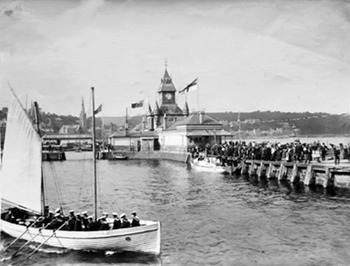
Indeed, the cast-iron predecessor to the gentleman's lavatory at Rothesay pier was increasingly seen as aesthetically displeasing, an “eyesore,” and potentially unsanitary (Buteman 2 June 1900). The lavatory, heavily frequented by working-class pier employees and holiday-makers, was considered to be a “nuisance,” with various employees congregating around the structure, “playing at pitch and toss” (Buteman 19 May 1900). The free lavatory was thus seen as contributing to a decrease in worker productivity; unregulated and widely accessible, it could distract workers from their responsibilities. Commissioned by the Rothesay Harbour Trust in 1899, the new lavatory at the pier was one particularly visible manifestation of the effort to improve the upper-middle-class travelers’ experience by providing a space that would separate them from the working-class employees and working-class tourists and abolishing the space where employees had congregated. To the extent that hospitality means meeting the basic needs of individuals temporarily away from home, the opening of an elaborately decorated lavatory for men who could afford the fee for its use neglected the needs of working-class men employed at the pier or visiting with their families.Footnote 14 In this new space, predicated on a notion of gentlemanly hospitality, one could briefly escape from the congestion of the pier, with its many working-class employees and working-class families on holiday, into the spaciousness of an elaborately decorated lavatory (Figure 2).
Rothesay harbor c. 1900. The gentleman's lavatory is the building on the left-hand side behind the arrival and departures hall. Courtesy of the Bute Museum.

In the summer of 1899, a committee of the Trust visited Glasgow and other Scottish cities in order to study various urinals, water closets, and lavatories. After their site visits and the subsequent architectural planning, the committee selected one of the most prestigious companies involved in the production of sanitary ware, Twyford's Ltd.Footnote 15 By the 1890s, Twyford's had become known for its high-quality products and lavatory accoutrements. Twyford's was a leading supplier of marble design for public urinals and private toilets. The company had installed the impressive gentleman's urinals at the Philharmonic building in Liverpool, which harmonized dark-green glazed floral-tile paneling with rouge marble fixtures, and had recently patented a Ming-blue daisy design for the home (Lambton 89, 74). In addition to “Royal Rouge,” the color scheme adopted by the designers of the Liverpool Philharmonic lavatories, customers could order a marble look in “Sage Green,” “Rich Brown,” “Silver Grey,” and “St. Anne's.” The process of marbling, Lucinda Lambton explains, involved transferring the print onto the “fired but unglazed pottery. . . by ladies in white gloves plying linen pads.” After the transfer, the pottery would pass through a “‘harding-on’ kiln before glazing” (Lambton 74). The effect of this process lent it color and warmth – a principle of marbling that the aesthetic movement had popularized in the closing decades of the nineteenth century.
Aesthetics, however, were not the only design concern. One of the chief considerations for the layout of the urinals and toilets at Rothesay seems to have been establishing discrete zones of privacy for each user. Because lavatories were increasingly seen as places where male homosexual desires were given expression, the architectural designs of the late-Victorian buildings themselves often attempted to rigorously enforce heteronormative ideals.Footnote 16 The lavatory's design sought to police nonnormative sexual desire by establishing full-body partitions between users of each urinal and individual compartments with toilets and full-length doors, thus inhibiting errant glances or sexual commerce between stalls. Twyford's signature “Adamant” fireclay insignia draws both the user's eye and the stream of urine to the center of the urinal itself, flushed by a constant stream of running water into the drainage system. These zones, therefore, reflect ways of managing anxieties about bodily proximity and potential homosexual encounters that informed the public discourse on the lavatory throughout the latter half of the century. Because gentlemanly hospitality is premised on a notion of heterosexual masculinity, the lavatory is structurally concerned with visual relations. It seeks to regulate the eyes of others as well as one's own. Yet the layout of the lavatory does not induce only a certain kind of blindness. From some positions, it could also facilitate seeing and being seen. While each of the fourteen urinals built along two walls positions the user toward the tan brick directly in front of him and the Adamant insignia roughly below him, the hexagonal stand in the center of the room with its six urinals provides a position from which one may observe individuals entering the lavatory and each toilet, the profiles of some users along the wall, and the eyes of those directly across from or at an angle to one's own urinal. The lavatory, therefore, both suppresses vision and, in true Foucauldian fashion, solicits it as well as the anxieties and the desires that accompany sight.
Beyond this disciplining aspect, however, such attentiveness to detail in design and layout contributed to an atmosphere of privacy and exclusivity. Customers of the lavatory, one member of the Trust asserted, “would be willing to pay for a privilege which they would not care to share with others for nothing” (Buteman 19 May 1900). The planning committee hired one Harry M. Smith at one pound per week to serve as the lavatory's first attendant. The fees for using the facility differed according to the service one required or desired: one penny was charged for using a urinal and a roller towel; two pennies for using a urinal and a hand towel; and one penny for using water closets (Buteman 16 June 1900). The scale of fees proved remarkably successful. In the first twenty days of operation, the lavatory made fifteen pounds, six shillings, and three pennies (Buteman 12 July 1900). In addition to providing luxurious accommodation in the men's room, Rothesay Harbour Trust officials sought to regulate the activity surrounding the building. They approved an application from one Patrick Harris to provide a boot-cleaning service immediately adjacent to the lavatory. Harris was, one Harbour Trust official argued, “a respectable man serving a public purpose” (Buteman 14 July 1900). The boot-cleaning service thus extended the notion of gentlemanly hospitality beyond the lavatory itself. Initially, the lavatory and related services were to be staffed during the summer from 7 a.m. to 10 p.m. and in winter from 8 a.m. to 7 p.m. Monday through Saturday; it was closed on Sundays (Buteman 19 May 1900).
The Trust's abolishing of free public accommodation in the late spring of 1900 and its plan to close the new lavatory one day a week met with resistance, however, from a number of different quarters. Middle-class visitors expressed displeasure in having no facility available for their use on Sundays, while a number of letters to the Buteman complained that working-class families and employees of the pier and the shipping companies no longer had any place to relieve themselves. Objecting to the comments by Captain Alexander Williamson, who represented the shipping interests on the Rothesay Harbour Trust, that Bute should follow Glasgow in no longer providing accommodations for workers, except for officers of vessels, one correspondent expressed disbelief: “Why he should wish to benefit any particular class is a puzzle” (Buteman 2 June 1900). Another correspondent asked, “How can a working man with a wife and family to keep on less than a pound a week be expected to pay a penny every time he wants to use the new closets when he comes to Rothesay for a day's holiday” (Buteman 23 June 1900). One would have no choice, the writer concluded, but to “trespass on private property or commit a nuisance on the foreshores or elsewhere.”
Although harbor officials agreed that the Isle of Bute would offer a distinctive amenity for the middle-class traveler, local residents and some working-class visitors argued that it would become infamous for its lack of free lavatories. “Rothesay is very badly provided for” in terms of public accommodation, one writer to the Buteman contended (2 June 1900). “Will it not make the town notorious,” another wondered, “that free accommodation will be denied to the public?” (21 April 1900). Of course, men of all classes were used to paying for privies even though, until the rise of aestheticized lavatories, most urinals were free.Footnote 17 The Buteman correspondent thus worried about the island's potential reputation as a place where no free urinals could be found, especially since the pier was one of the only places on the island where public conveniences were located. Another wondered what had happened to working-class outrage: working-class men, he wrote, “appear to be now much tamer in spirit than they used to be.” “I hope, however, they have enough spirit left to make a public protest,” the writer continued, “against the taking away of the privilege that has existed so many years” (28 April 1900). After enormous public pressure, the Trust agreed to construct two water closets for workers in “the least objectionable place” – behind an office and below its main floor (Buteman 16 June 1900).
Rothesay Lavatory as Fantasy Space
The cultural role of the aestheticized lavatory – the element of fantasy involved in the user's experience of that space – remains to be considered. In using the term fantasy, I mean to refer to the sense of congruence between an inner understanding of oneself in socially or culturally distinctive terms and the exterior space of the lavatory, which seems to affirm that belief.Footnote 18 One's sense of social or cultural distinction may range from broad to narrow. That is, one might model oneself on the aristocracy – as many in the Victorian middle-class did – and seek out spaces that reflect the beauties and luxuries of a privileged, gentlemanly lifestyle. Or one might simply believe oneself to possess a refined notion of privacy that requires a commensurate space for bodily relief. In either case, the lavatory as fantasy space provides a sense of security in individual identity and of stability in the world around oneself that, as Mark Girourard has argued, was so essential for Victorians.Footnote 19
It is easy to see the emergence of stylized lavatories at the end of the century as a reassertion of what Marxist critics have called aristocraticization. Clive Aslet and Alan Powers have noted the way in which houses in London tended to be modeled on great country estates, reproducing on a smaller scale the same floor plans of much larger rural and aristocratic villas (214). Certainly, the aestheticization of the public lavatory, motivated by an ideology of gentlemanly hospitality, also reproduced the beauties and luxuries ascribed to the aristocratic lifestyle and attempted to cultivate in its users a similar sense of privilege.Footnote 20 The aestheticized public lavatories, designed to surround the primarily middle-class user with opulent appointments and provide access to luxurious amenities, might be seen as part of a similar process. At the same time, however, the lavatories must be understood within the context of an aesthetic movement which sought in the closing decades of the century to celebrate the pleasures of the material world. Indeed, a Marxist theory of aristocraticization, while historically accurate, goes only so far in analyzing the gentleman's lavatory at Rothesay pier. It tells us very little about the way in which individuals might have experienced that space – the pleasures they might have derived from it and the fantasies such pleasures might have inspired.
The lavatory, of course, was not in any way a direct product of the aesthetic movement, but it does share many of the assumptions that underlay the movement's theory of designing and decorating space. One of its chief proponents, Oscar Wilde, had argued in a series of lectures in the 1880s that to render spaces more beautiful, one needed to incorporate colored marble, use “warmer” colors in more harmonious ways, bring together art and sanitary regulations, and turn one's back on cast-iron construction (O'Brien 404, 408). By the 1890s, many of these aesthetic principles had been absorbed within British culture. The principles that Wilde articulates, and which one also finds in evidence at Rothesay, help us to recognize the extent to which the lavatory cultivated aesthetic experience and the psychological and physical comforts derived therefrom.
But must we see the gentleman's lavatory solely as a domain for the middle-class male? The lavatory might also have functioned as a fantasy space for the working class, given that there was little outrage, as a correspondent to the Buteman noted, from their ranks.Footnote 21 Clearly, the cost of using the lavatory was prohibitive for many. Yet, if the proceeds from the lavatory in its first twenty days of operation exceeded fifteen pounds, then between 1,838 and 3,675 men used the facilities within that period.Footnote 22 The lavatory could, after all, accommodate twenty-nine users at any given time, with ample waiting room for many more. Moreover, if men could at all afford the expense, they were already accustomed to paying for privies when absolutely necessary. Thus we cannot discount the possibility that many working-class men also used these facilities.
In fact, the argument I have been advancing about the strong appeal that aestheticized lavatories held for the middle-class is equally applicable to at least some working-class men whose notions of privacy, Mary Poovey has persuasively argued, we still know so little about (130). Building on Poovey's observation, Martin Hewitt has suggested that when one looks attentively at the historical evidence, one can discern “something which looks more solidly like working-class versions of the ideologies of domestic privacy” (133). “I am in my own house, and an Englishman's house is his castle,” Hewitt quotes from one London working-class testimonial as a way of countering the long-standing assumption of the “permeability” of working-class space (133). These ideologies may, I suggest, have shaped working-class views on what kinds of spaces would have been appropriate to use in public for so private an act as urination or defecation. Men from rural counties, including the many workers raised on the Isle of Bute, might have had similarly developed notions of privacy. With the exception of Rothesay town, the island largely consisted (as it remains today) of fields planted in oats and potatoes or devoted to cattle-, sheep-, and horse-rearing. The rural outhouse, however primitive, was certainly not shared in the manner that cast-iron lavatories were in the city or at the pier. Similarly, the often spacious potting shed provided workers who may have lived in cramped quarters with their own spaces in which to work and reflect. The gentleman's lavatory at Rothesay pier, therefore, might have been seen by some as a comfortable (because private) space in which to relieve themselves – and thus worth the sacrifice of a penny for those who managed to afford it. And whereas the middle-class male, in using the lavatory, might have imagined himself in culturally privileged terms, the same could be said of someone from the working class. One spent a (material) penny at Rothesay, therefore, in order to be in proximity to a fantasy. At a time when agglomeration was the norm, the gentleman's loo provided an occasion to fantasize about a harmonious equivalence between an inner understanding of oneself as distinctive and the distinctive space one briefly occupied. For a fleeting moment, one could capture a state of congruence between self and world.