Introduction
Post-operative cognitive dysfunction refers to the post-operative central nervous system (CNS) dysfunction in patients with no mental disorder before surgery that results in dysphoria, changes in cognition, behavior and volition, and memory impairment (Baer et al., Reference Baer, Paloheimo and Randell1999; Johnson et al., Reference Johnson2002). POCD is a common post-operative CNS complication in elderly patients, and has been reported to be present in 26% of elderly patients undergoing non-cardiac surgery, one week after the surgery and in 10% at three months (Moller et al., Reference Moller1998).
Age, severity of surgery, and duration of anesthesia increases the risk of POCD (Moller et al., Reference Moller1998; Rasmussen et al., Reference Rasmussen2003; Hanning, Reference Hanning2005; Hovens et al., Reference Hovens, Schoemaker, van der Zee, Heineman, Izaks and van Leeuwen2012). Post-operative pain is also a risk factor (Wang et al., Reference Wang, Sands, Vaurio, Mullen and Leung2007), and the stress response and inflammatory reaction caused by surgery are thought to contribute to the development of this condition.
An increase in peripheral inflammatory mediators, such as occurs during the tissue damage caused by surgery, has been shown previously to cause cognitive decline (Hovens et al., Reference Hovens, Schoemaker, van der Zee, Heineman, Izaks and van Leeuwen2012). One cause of the increase in inflammatory mediators is an increase in prostaglandin synthesis due to an increase in cyclooxygenase-2 (COX-2) expression. Blocking prostaglandin production with a selective COX-2 antagonist before surgery is initiated, that is, in a pre-emptive manner, might therefore decrease both the prostaglandin-related increase in inflammatory mediators and also the incidence of POCD.
In the current study, we investigated the effect of pre-emptive analgesia with the selective COX-2 inhibitor, parecoxib sodium, in elderly patients undergoing hip replacement or femoral head resurfacing. Our primary interest was in its effect on post-operative cognitive function, but to examine possible mechanism of action, we also investigated the effect of its use on post-operative pain control and on serum biochemical markers for the surgical stress response, the inflammatory response, and the CNS damage.
Materials and methods
Elderly patients (≥65 years) who underwent total hip replacement or femoral head resurfacing between March 2012 and August 2013 and met the inclusion criteria were included in the current study. The study was approved by the Ethics Committee of our hospital. Patient consent was obtained after the entire research process was carefully explained, and all subjects took part in this study voluntarily.
Criteria for inclusion were the following: completion of an elementary education; ASA grade I-II; no neurological or psychiatric disorders, no long-term use of tranquilizers or antidepressants, no history of alcohol abuse or drug dependence, and a preoperative MMSE score of ≥21 points. Ninety patients met these criteria. Eleven refused to participate, nine did not complete the study, and the remaining 70 patients were included in the study. Patients were randomly divided into a control group (group C) and a parecoxib sodium group (group P) using a random number table. For this study, the superiority test was performed with one-sided t-test: α was 0.05 and the difference between two groups (Δ) was 1.0. This meant that at least 32 patients had to be recruited into each group during the double-blind treatment when the statistical power was 80%. Assuming that 10% of patients would withdraw during study period, 35 patients would be included into each group in the study. No patient received preoperative drug administration.
Peripheral venous lines were prepared after moving the patient into the operating room; heart rate (HR), SpO2, electrocardiogram (ECG) and blood pressure (BP) were monitored; invasive BP determination was performed using a radial arterial catheter; and sedation depth was monitored using a bispectral index (BIS) monitor. Before induction of anesthesia, 40 mg of parecoxib sodium (Lot: J20080045, Pharmacia and Upjohn Inc., USA) diluted to 5 ml with normal saline were injected intravenously in patients in group P, and the same volume of saline was injected in patients in group C. For induction of general anesthesia, 0.02–0.04 mg/kg of midazolam, 1.0–1.5 mg/kg of propofol, 2–3 μg/kg of fentanyl, and 0.8 mg/kg of cis-atracurium were administrated intravenously. Endotracheal intubation was performed after induction of general anesthesia, and the patient connected to a ventilator. The ventilation parameters were adjusted, and PETCO2 was maintained at 35–45 mmHg (1 mmHg = 0.133 kPa). Intravenous administration of 3–6 mg·kg−1·h−1 of propofol and 0.1–0.2 μg·kg−1·min−1 of remifentanil was employed to maintain anesthesia, and cis-atracurium was injected intermittently to maintain muscle relaxation. BIS values were maintained at 40–55 during surgery, and hemodynamic stability was maintained with vasoactive drugs if necessary. Patient-controlled analgesia (PCA) was used in the 72 h after surgery. For PCA, 400 mg of tramadol and 0.4 mg of fentanyl were diluted to 100 ml with normal saline, infused at a rate of 2 ml/h, a PCA volume of 0.5 ml, and a lockout time set to 15 min. The post-operative VAS score was maintained at ≤3 points, and 0.2 μg/kg of fentanyl was administered intravenously when the post-operative analgesic effect was poor.
Three ml blood samples were obtained from the peripheral vein one day before surgery (T0), 1 h (T1), 4 h (T2), 24 h (T3), and 72 h (T4) after surgery, and plasma cortisol, IL6, and S100β concentrations were measured by radioimmunoassay using ELISA Kits from R&D Systems, Minneapolis, Minnesota. Cognitive function (Wang et al., Reference Wang, Wu, Li, Xiao, Liu and Meng2002; Liu et al., Reference Liu2009; An et al., Reference An2011), was evaluated by measuring the MMSE score (Tombaugh and McIntyre Reference Tombaugh and McIntyre1992) and a neurological battery (forward and backward digit span, Stroop color interference, and verbal fluency tests) before and within 72 h after surgery, and the occurrence of POCD was recorded as follows: quantitative evaluation of cognitive function in the MMSE was carried out by asking patients a series of questions, including time and place orientation, attention, computing power, short-term memory, immediate recall, ability to copy a figure, etc. The highest score was 30 points, and a decrease of 2 points in the MMSE after surgery compared to the preoperative score or a post-operative decrease (Z-score ≥ 1.96) in two of the neurological tests was taken as the standard for diagnosing POCD (Casati et al., Reference Casati, Aldegheri, Vinciguerra, Marsan, Fraschini and Torri2003). The test was carried out by the same person. Operative time, anesthesia time, dose of intraoperative anesthetic, blood loss, amount of rehydration, perioperative complications, dosage of post-operative tramadol, and fentanyl in PCIA and additional fentanyl administration were recorded.
Statistical analysis
Categorical variables were presented by count and percentage. Continuous variables were normally distributed and were presented by mean and standard deviation (SD). Differences between the intervention group and the comparison group were compared using the independent two sample t-test for continuous variables, and the χ2 test or Fisher's exact test with Yate's correction if any cell number was less than five were used for the categorical variables. A repeated measure analysis of variance was used to compare the 5 time point means within groups. Difference among the 5 time points between the two groups was compared by independent two sample t-test. All statistical assessments were two-sided and evaluated at the 0.05 level of significance. Statistical analyses were performed with the SPSS software for Windows, version 18.0 (SPSS Inc, Chicago, IL, USA).
Results
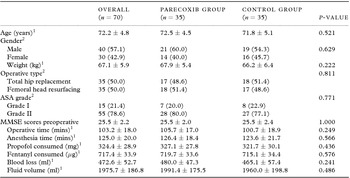
Demographic and operative characteristics of the 70 study patients are summarized in Table 1. The average age was 72.5 ± 4.5 years in the parecoxib group and 71.8 ± 5.1 years in the control group. More than half of the patients in each group were male (60.0% vs. 54.3%). There were no significant differences between the two groups in any demographic or operative characteristic.
Comparison of patient characteristics

Values are expressed as1 mean ± SD; 2 n (%). P- values are based on 1 independent two sample t-test; 2 χ2 test.
Abbreviation: ASA, American society of anaesthesiologists; MMSE, mini mental state examination.
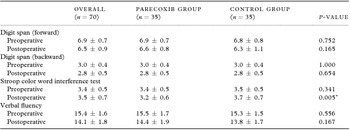
Table 2 compares the preoperative and post-operative neuropsychological battery results of the two groups. There were significantly fewer wrong times in the Stroop color word interference test in the parecoxib than the control group in the post-operative examination (3.2 ± 0.6 vs. 3.7 ± 0.7, P = 0.005). However, post-operative digit span and verbal fluency tests showed no significant difference between the two groups.
Comparison of neuropsychological battery at pre- and post-operative

Values are expressed as mean ± SD. P-values are based on independent two sample t-test.
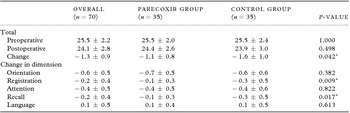
Table 3 compares post-operative changes in MMSE subscores in the two groups. There was a significantly smaller score change in the total MMSE score in the parecoxib than in the control group (−1.1 ± 0.8 vs. −1.6 ± 1.0, P = 0.042). There were also significantly smaller post-operative changes in registration and recall scores in the parecoxib than the control group (−0.1 ± 0.3 vs. −0.3 ± 0.5, P = 0.009 in registration; −0.1 ± 0.3 vs. −0.3 ± 0.5, P = 0.017 in recall).
Comparison of MMSE score change¶ between pre- and post-operative

Values are expressed as mean ± SD. P-values are based on independent two sample t-test.
¶Change in MMSE was defined as post-operative MMSE score minus preoperative MMSE score.
Abbreviation: MMSE, mini mental state examination.
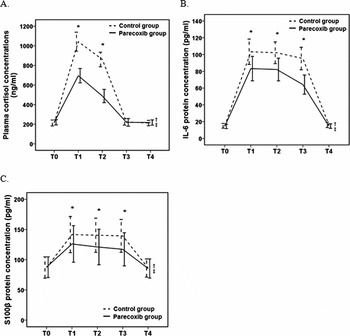
Figure 1 shows changes in plasma concentration (ng/ml) of cortisol, the biomarker for the stress response, IL-6 protein (pg/ml), the biomarker for the inflammatory response, and S100β protein (pg/ml), the biomarker for CNS damage, for the two groups at the five time points. Concentrations of all three markers rose after surgery and then gradually decreased until by 72 h after surgery they were back to pre-surgery values. However, the use of pre-emptive parecoxib significantly lessened post-surgery increases in each of the three parameters.
Change of plasma cortisol concentrations (A), IL-6 protein concentration (B), and S100β protein concentration (C) in the two groups at 1 d before operative (T0), 1 h after operative (T1), 4 h after operative (T2), 24 h after operative (T3), and 72 h after operative (T4). *Significant difference (P < 0.05) between the two groups. † indicates there were significant differences in different time for control group. ‡ indicates there were significant differences in different time for parecoxib group.

In both groups, changes in cortisol concentration, IL-6 protein concentration, and S100β protein concentration were significantly different at the different time points (all P-values ≤ 0.030), increasing 1 h after surgery and then decreasing to pre-surgery values by 72 h post-surgery. Plasma cortisol concentration and IL-6 and S100β protein concentrations, although higher than pre-surgery values, were significantly lower than control values from 1– 24 h after surgery (except for cortisol values at 24 h, which had returned to normal in both groups). At T1, plasma cortisol concentrations, IL-6 protein concentration, and S100β protein concentration of the parecoxib group were significantly lower than that of the control group (695.7 ± 73.4 vs. 1043.0 ± 96.6, P < 0.001; 83.3 ± 14.6 vs. 103.3 ± 15.1, P < 0.001; 126.1 ± 30.3 vs. 141.6 ± 30.0, P = 0.034, respectively). At T2, plasma cortisol concentrations, IL-6 protein concentration, and S100β protein concentration of the parecoxib group were significantly lower than that of the control group (488.2 ± 68.2 vs. 861.0 ± 74.5, P < 0.001; 82.2 ± 13.5 vs. 102.2 ± 13.0, P < 0.001; 121.1 ± 29.4 vs. 140.5 ± 28.3, P = 0.006, respectively). At T3, IL-6 protein concentration and S100β protein concentration of the parecoxib group were significantly lower than that of the control group (64.2 ± 11.4 vs. 95.3 ± 13.4, P < 0.001; 117.3 ± 27.5 vs. 139.4 ± 27.2, P = 0.001, respectively).
Analgesic use, that is, fentanyl and tramadol consumption during PCIA, and remedial amount of fentanyl used, was significantly lower in the parecoxib group than in the control group (601.7 ± 55.9 vs. 689.7 ± 45.1, P < 0.001; 14.3% vs. 37.1%, P = 0.029, respectively). In addition, the percent of patients with POCD was significantly lower in the parecoxib group than in the control group (28.6% vs. 54.3%, P = 0.029, Table 4).
Comparison of clinical characteristics at post-operative between control group and parecoxib group

Values are expressed as1 mean ± SD; 2 n (%). P-values are based on 1 independent two sample t-test; 2 χ2 test.
Abbreviation: PCIA, patient-controlled intravenous analgesia.
Discussion
Results of our study showed that, in elderly patients with hip surgery, pre-emptive analgesic treatment with parecoxib sodium in addition to routine analgesic treatment reduced the incidence of POCD, lessened the post-surgery increase in biomarkers for inflammation (IL6), neuronal damage (S100β) and the stress response (cortisol) and decreased post-operative use of analgesic medication (tramadol and fentanyl) compared with routine analgesic treatment alone.
Parecoxib sodium is an amide precursor of the COX-2 inhibitor valdecoxib, and is rapidly hydrolyzed to valdecoxib by liver carboxyl esterase after being injected intravenously. It inhibits the conversion of arachidonic acid to prostaglandins, and thus exerts anti-inflammatory and analgesic effects (Amabile and Spencer, Reference Amabile and Spencer2004; White, Reference White2005; Guo et al., Reference Guo, Shi, Fu, Yang, Wang and Dai2013). COX-2 is mainly distributed in the CNS, and its activity can be induced by noxious stimulation, inflammatory mediators, cytokines and growth factors (Esme et al., Reference Esme, Kesli, Apiliogullari, Duran and Yoldas2011; Bienhoff et al., Reference Bienhoff, Smith, Roycroft and Roberts2012; Peng et al., Reference Peng, Wang, Wang, Chen and Wang2012). Prostaglandins themselves increase pain by causing sensitization of peripheral and central pain receptors. They also cause an increase in the production of inflammatory mediators, and it is thought that a general increase in inflammatory mediators in the CNS is the primary cause of POCD.
The objective of pre-emptive analgesic treatment with COX-2 inhibitors, therefore, is by decreasing prostaglandin production, to lessen peripheral and central sensitization of pain receptors (Kissin, Reference Kissin2000; Kelly et al., Reference Kelly, Ahmad and Brull2001; Ochroch et al., Reference Ochroch, Mardini and Gottschalk2003; Mehta et al., Reference Mehta, Johnston, Cheung, Bello and Langford2008) and the CNS inflammation involved in POCD. After intravenous injection of a single 40 mg dose of parecoxib sodium, the dose used in this study, the drug begins to act 9–13 min later, reaches a peak effect in 2 h and continues to act for 6–12 h or longer (Stichtenoth and Frolich, Reference Stichtenoth and Frolich2003; Amabile and Spencer, Reference Amabile and Spencer2004).
Pre-emptive analgesic treatment with parecoxib sodium has previously been reported to relieve post-operative pain by decreasing central sensitization, and to decrease the inflammatory response by decreasing levels of pro-inflammatory cytokines such as IL-1β, IL-6, and IL-8 (Bao et al., Reference Bao2012; Peng et al., Reference Peng, Wang, Wang, Chen and Wang2012), results consistent with ours. In addition, it has been reported to reduce the generation of plasma endorphin in patients after surgery and inhibit the stress response (Shavit et al., Reference Shavit2005; Shavit et al., Reference Shavit, Fridel and Beilin2006; Miner, Reference Miner2008; Rezende et al., Reference Rezende, Reis, Duarte, Lima, Bakhle and de Francischi2009), results also consistent with ours.
Although the effect of pre-emptive analgesic treatment with NSAIDS on post-operative pain has been studied by many groups (Ochroch et al., Reference Ochroch, Mardini and Gottschalk2003; Martinez et al., Reference Martinez2007; Neuss et al., Reference Neuss, Koplin, Haase, Reetz and Mall2010; Bunyavejchevin et al., Reference Bunyavejchevin, Prayoonwech and Sriprajittichai2012), the effect on POCD has been less extensively investigated. POCD is thought to be caused by surgery-induced pro-inflammatory cytokine expression in the brain (Hovens et al., Reference Hovens, Schoemaker, van der Zee, Heineman, Izaks and van Leeuwen2012; Peng et al., Reference Peng, Wang, Wang, Chen and Wang2012; van Harten et al., Reference van Harten, Scheeren and Absalom2012). Our results are consistent with this hypothesis in that the decrease in POCD seen after pre-emptive parecoxib sodium was accompanied by a lessening of the post-surgical increase in biomarkers for both inflammation and neuronal damage.
But many factors may be related to POCD (Casati et al., Reference Casati, Aldegheri, Vinciguerra, Marsan, Fraschini and Torri2003; Rasmussen et al., Reference Rasmussen2003). Moller et al. (Reference Moller1998) reported that age, prolonged anesthesia time, low education level, secondary surgery, post-operative infection, and respiratory complications were risk factors for POCD. However, in the current study, there were no differences between the two groups in these risk factors, therefore it is unlikely that their influence affected the study results.
One difficulty in interpreting previous studies of POCD is that although many methods for the clinical diagnosis of POCD have been reported, there is no generally agreed upon standard, and this ambiguity causes significant differences in the incidence of POCD reported. Currently, most groups use a decrease in performance in two or three items in a sensitive test battery to diagnose POCD (Williams-Russo et al., Reference Williams-Russo, Sharrock, Mattis, Szatrowski and Charlson1995; Hanning, Reference Hanning2005). For this purpose, we used the MMSE, a widely used method for assessment of cognitive function that is a simple but accurate test with a sensitivity of 87% and a specificity of 82% (Tombaugh and McIntyre, Reference Tombaugh and McIntyre1992; Malloy et al., Reference Malloy1997).
One consideration that needs to be taken into account when using a COX-2 inhibitor in elderly patients is whether such use will cause adverse renal or cardiovascular effects. NSAIDs, including COX-2 inhibitors, are known to cause renal and cardiovascular toxicity, particularly in the elderly, who often have underlying contributory pathology, such as pre-existing renal disease, diuretic-induced hypovolemia, diabetes, or congestive heart failure (Musu et al., 2011; O’Neil et al., 2012; Ong et al., Reference Ong, Ong, Tan and Chean2013). However, most of these data come from studies of chronic NSAID use and may not apply to acute, single dose use such as in our study. We did not observe any renal or cardiovascular toxicity in our patients, however, it might be wise to exercise caution in giving pre-emptive parecoxib to elderly patients who also have other risk factors for renal or cardiovascular toxicity.
In conclusion, pre-emptive analgesia using 40 mg of parecoxib sodium reduced the incidence of POCD in elderly patients, in a manner consistent with a mechanism of decreasing a surgery-induced CNS inflammatory reaction.
Conflict of interest statement
The authors declare that they do not have any conflict of interest.
Author contributions
Yue Tian: conception and design, clinical studies, analysis, and interpretation, writing the article, critical revision of the article, and approving the final version.
Ping Zhao: conception and design, analysis and interpretation, critical revision of the article, and approving the final version.
Lu Li: clinical studies, data collection, writing the article, and approving the final version
Yao Guo: clinical studies, data collection, writing the article, and approving the final version.
Cong Wang: experimental studies, data collection, writing the article, and approving the final version.
Qian Jiang: experimental studies, data collection, writing the article, and approving the final version.