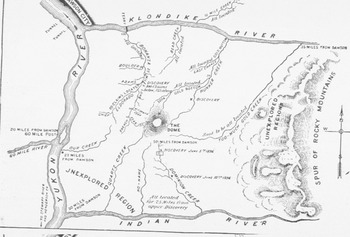
Starting with the California Gold Rush of 1849 a series of gold rushes occurred along the western side of North America as miners searched for the elusive yellow mineral.Footnote 1 Eventually these efforts culminated in the last, and perhaps greatest, gold rush: the Klondike rush of 1898–1899.Footnote 2 Located close to the Alaska border, but within the Yukon territory of Canada, the Klondike River is a tributary of the Yukon River. Although called the “Klondike Gold Rush,” gold was actually found in the smaller creeks that run into the Klondike and Indian Rivers.Footnote 3 As Figure 1 shows, the entire area was relatively small, and most of the gold was extracted from a half-dozen creeks—Bonanza, Eldorado, Hunker, and Dominion being the most famous.Footnote 4 In total about 12 million ounces have been mined from the area since discovery, with around 6 million ounces coming from Eldorado and Bonanza creeks.Footnote 5
GOLD BEARING CREEKS

Men had been prospecting in the Yukon river valley since the mid-1870s with enough success to pay for their mining supplies and minimal expenses within their small mining camps. When George Carmack staked his discovery claim on Rabbit (later Bonanza) creek on 17 August 1896, he followed the local custom of telling his fellow miners of the find and started what would eventually be three waves of gold rushes. The first was within a month of the strike when 200 claims were made by local miners in the area. The second rush occurred in the early part of 1897 when about 3,000 people arrived from various parts of Alaska and British Columbia.Footnote 6 These first two rushes claimed almost the entire paying creeks. Ironically, when the final massive rush of 30,000 people arrived in 1898, there was little opportunity for any fortune to be made. Disappointed, many left immediately. Others hung on, either establishing claims on untested creeks, purchasing existing claims, or working for claim owners. The Klondike rush ended almost as suddenly when gold was discovered in Nome Alaska on 27 July 1899, and 8,000 people left Dawson city in one week in August.Footnote 7 In total it is estimated 100,000 people set out for the Klondike, 30,000 reached Dawson, half of whom looked for gold, but only 4,000 found any. A few hundred got rich.Footnote 8
The Klondike rush took place in relatively modern times, and was documented in the press by adventurous journalists and photographers. At the time it was fairly easy for would-be gold kings to travel from various locations around the world to the launching pads of Seattle, Vancouver, and Victoria, thus contributing to the almost instantaneous rush of 30,000 individuals. However, the remoteness of the Klondike region meant that once the miners arrived on the Alaskan shores, the last few hundred miles had to made by foot—carrying all of their supplies on their backs.Footnote 9 As a result, for the first three years the mining technology resembled that of California a half-century before. However, within two years rail lines were laid, heavy equipment brought in, and modern mines established. Thus, the Klondike rush provides a short modern window on older placer mining practices where the weather and geological factors of the area had a strong impact.
The focus of this article is on information sharing. Starting with the very first miners who had reached the area, a social norm developed that any miner who struck gold would share this information with the other miners in the area. A miner did not have to go out of his way or incur costs to share the information, but he was expected to freely reveal his information to any miner who crossed his path. This practice not only held for the first strike on Bonanza Creek, it was maintained throughout the entire gold rush. This begs the question: why would miners behave this way? When a miner shares information about a gold find, he puts his valuable claim in jeopardy without receiving any benefit in return. There would appear to be a dominant strategy to stay quiet about a find. Indeed, successful miners in California or British Columbia did not share information on finds.Footnote 10 On the other hand, the community's interest is served by information sharing because it prevents socially wasted mining effort on unproductive locations. Something about the Klondike made it unique in solving this social problem.
The article's general hypothesis is that the extreme winter mining conditions and local geography of the Klondike exogenously led to very secure property rights over mining claims. Miners who shared accurate information regarding gold finds did so knowing that their claim would not be infringed upon by a future rush of miners. In more southern mines a miner might stake a claim and later find that its size would be reduced (either by vote at a miner's meeting or by threat of violence) to allow other miners in. This did not happen in the Klondike. Normally secure property rights are thought to arise over formal rules of law and independent court systems; however, in the far north and other mining areas of the Rocky Mountains these institutions were limited. In the Klondike the specific location, local geography, and extreme climate came together to secure rights and strongly complement the fledgling government institutions that were there at the time. As a result, it took only a small incentive payment from the state to induce miners to act in the social interest.
SHARING INFORMATION
One of the more interesting aspects of early Klondike gold mining was the social norm among miners to share information regarding strikes.Footnote 11 For example, when gold was discovered in August of 1896 it was not kept a secret, and news spread quickly among the several hundred miners in the district. The initial find was by Robert Henderson, who, after getting excited over finding eight cents of gold to the pan on Gold Bottom Creek, told everyone he knew on his way to register his claim—including George Carmack, who later staked on Bonanza Creek.Footnote 12 In doing so, Henderson was following the strict social norm of the area.
Social cooperation prior to the gold rush extended in other dimensions as well. Before 1894, when the Yukon territory was just a remote frontier with promise, miners respected each other's possessions, shared material goods, and looked out for one another. The general thrust of the miner customs seems to have been the “golden rule.”Footnote 13 To the extent there were disputes these were dealt with through “miners meetings.” These private institutions investigated, tried, and decided on all sorts of disputes and crimes in the area.Footnote 14 Miner's justice was swift and severe, with the punishment for theft usually a flogging and banishment from the region. As in other mining areas, actual violence and property crimes were relatively rare.Footnote 15 No doubt this success in hard justice stemmed from the small homogeneous population.Footnote 16 In 1885 it is estimated there were only 75 miners in the region, by 1892 this had grown to 1000, and by 1896 it was only 1700.Footnote 17
Whereas prior to 1890 the territory held only miners, by the mid-1890s traders and other nonminers had started to move in.Footnote 18 Once large numbers of people arrived during the gold rush, and certainly within the city of Dawson, the golden rule customs started to break down. As the population grew and became more diverse, the miner's meetings became less successful at achieving the social support necessary to settle disputes.Footnote 19 In addition, once the large amounts of gold were processed, men started to hide and guard it with light weapons.Footnote 20 In the gold fields, before the official survey was done, some miners colluded by staking “absentee” claims against new arrivals, later they jumped these claims for a partial interest.Footnote 21 On the journey out with their gold in tow, miners kept it well guarded and under surveillance.Footnote 22 Thus the Klondike was not a place where human vice was missing. Yet throughout the entire Klondike episode miners always shared information of new strikes. Why, if many of the social customs broke down with the arrival of large groups, did this seemingly irrational one remain?
My claim is that three characteristics of the region meant that property rights over gold in the ground were very secure, and that this security along with a small payment, created the incentive to share information and provide a large social good to the community. The three exogenous factors were: the proximity of the small mining area to the disputed U.S. border; the high latitude; and the severe cold winter weather. I describe each of these in turn.
The Disputed Alaskan Border
Part of the unique Klondike geography came from location. The Klondike, though entirely within the Yukon Territory, was close to the U.S. border, and the Alaska-Yukon border was partly in dispute.Footnote 23 Furthermore, most of the miners were Americans.Footnote 24 As news of valuable gold being mined by Americans continued to reach Ottawa during the 1880s, it was thought the sovereignty of the region was jeopardized. In response, the Dominion of Canada sent a force of 20 North West Mounted Police (NWMP), along with surveyors, title registrars, and a magistrate to the area in 1894—two years prior to the Bonanza discovery.Footnote 25 By 1897 there were 96 policemen in the area, and by 1898 there were 288.Footnote 26 Had the Klondike region been located in the Northwest Territory or somewhere else farther away from the U.S. border, it is highly unlikely the NWMP would have been present. Likewise, had the Klondike region straddled the Alaska border it is unlikely the NWMP would have been effective.
It was helpful that the NWMP did a commendable job, as every historian and contemporary writer notes.Footnote 27 The effectiveness of policing is often credited to “able and incorruptible” leadership, but is perhaps better attributed to the geography of the area.Footnote 28 Both the Klondike region and the mine fields had only a few entry points.Footnote 29 As a result, the NWMP were able to strategically control the area with only a few hundred men. As the miner Haskell noted “One might think that a handful of police could do very little with the thousands of miners. . . But. . . the country is of such a nature that a few police can hold all the points at which gold must pass in going out of the country.”
Furthermore, the NWMP and other government agents were not allowed to own mining claims. Unlike in California where desertion from state law enforcement and the army was common, the police of the Klondike remained at their posts. Again, geography was a factor because there was little point in deserting to such a small area with limited entry and exit points. Anyone deserting would quickly be caught. Thus, the location and geography of the Klondike led to the early arrival of police, helped the police to enforce the Dominion laws, and helped to maintain the police ranks by limiting their options to abandon.
The strong government presence in the Canadian Klondike region meant that miners operated under the Canadian mining regulations.Footnote 30 It also meant that miners operated under the watch of a host of government mining officials.Footnote 31 Under these regulations miners had to register with the mining district and would be given a miner's license with a number. When gold was discovered miners had to physically stake the claim, and sign one of the stakes along with their number. Miners then had three days to register their claim (unless the commissioner's office was more than ten miles away, in which case an extra day was allowed for every ten miles), the registration cost was $15, and only one claim per person was allowed within a district (unless other mining claims were purchased). Thus miners could only claim a second mine if they relinquished the original one. The mining claim granted a right to mine for one year. Thereafter it cost the miner $100 per year to mine. Miners could only be away for 72 hours, unless they went for supplies or had some other reason approved by the superintendent of mines. Claims could be sold or mortgaged, and miners could be represented by proxy.
Mining regulations existed in other gold rushes along the Rocky Mountain range. However, none of those laws existed in the strict regulatory environment present in the Klondike, nor from the very beginning of the gold rush.Footnote 32 Although the Canadian mining regulations were similar to those in the United States, there was one important difference. Mining districts in Canada were generally larger than in the United States. According to Sam Dunham, in the United States “a separate mining district may be established on every creek where a discovery is made.”Footnote 33 In Canada the district “shall mean the territory along a river and its affluents.”Footnote 34 Given the small size of the Klondike area, this meant there were only two districts. Because a miner who made a “discovery” claim was allowed two claims within the district, the larger districts made this second claim payment more significant.
The High Latitude
Staking mines required measurement and surveying, which under normal circumstances, and in southern mines, miners easily conducted. However, measurement was not easy in the Klondike.Footnote 35 In the depth of winter there were very limited hours of sunlight and in the heart of summer the sun never set. Both conditions made navigation and direction difficult because the sun was either flat on the horizon or directly overhead.Footnote 36 Before proper surveyors worked in the area, miners were seriously bogged down in disputes over mine locations and boundaries, which hindered their ability to mine and trade sites. In his reports to the federal government in Ottawa, land surveyor Ogilvie notes how happy the miners were for their land to be surveyed, aside from the obvious benefit of defining property:
Another source of satisfaction to all is that they now know distances and directions. Many miners remark to me “we now know how we are going, we can see where south is.” In this high latitude in the summer months it is impossible to tell when the sun is near the meridian because its change in altitude is so little for eight or nine hours. . . . This helps to explain much of the variance in the direction of points as given by miners and others. . . .Footnote 37
The government surveyors were part of the Dominion infrastructure sent to the Klondike before the rush, along with the land title office for claim registration. The high latitude of the Klondike seriously hindered the miner's ability to administer their own governance of the creeks, and practically forced them to welcome the government survey. In accepting the official surveys, miners automatically submitted to the authority of the NWMP.
The Weather
Humans have tended to live in temperate and moderate climates; as a result, extreme weather conditions usually are irrelevant. In the Klondike, however, the weather conditions were severe. At 64°N latitude and 165 miles south of the Arctic Circle, the base city of Dawson was a hostile environment virtually every month of the year. Dark, long, frigid, winters; permanently frozen ground; and short, hot, but wet, summers were shocking to all who ventured there.Footnote 38 Extensive commentary about the weather is found in the diaries of the miners who made the trek into the Klondike, and rightly so. Temperatures in the winter could reach as low as −70° Fahrenheit, and on average there were only 90 frost-free days per year.Footnote 39 The extreme cold and length of winter was the defining weather characteristic of the Klondike. Unlike southern mines, the Klondike ground was perma-frost—frozen all year long. In addition, all creeks and rivers were frozen during the long winter, making conventional mining impossible for most of the year.Footnote 40
The frozen ground created a unique form of mining. From 1896 to 1900 the arduous journey to the Klondike prevented any serious mechanical tools, such as steam engines and dredging equipment, from reaching the mines. To thaw the ground during the winter the miners made fires over the spot they wanted to mine. When the fire died out they would scrape a few inches of melted soil out, hoist it out of the mine in a bucket, and place the muck on a “dump.” In the late spring and summer when the creeks would thaw, the dump would be sluiced and panned for gold. Burning continued down the shaft until bedrock was hit 20 to 30 feet below the surface. If a vein of gold was discovered, miners would “drift” by following it using the same burning method.Footnote 41
The weather of the area dictated this method of mining for several reasons. First, the frozen ground was stable and allowed the miners to dig without bracing. Second, because all water was frozen during the winter, the mines were dry. Once the spring run off started, mines would often fill with water and require pumping. Third, and most important, given the relative air pressure in the bottom and surface of the mines during the winter, the deadly gases produced by the fires would exit the mines. In other words the intense winter air created a strong updraft in the mines. Harold Innis notes how this draft was reversed when summer arrived: “Moderation of the temperature made it more difficult to get adequate draught for fires, and in many cases gases and smoke accumulating at the bottom after a night's burning made it dangerous for men to work.”Footnote 42 Diaries of miners who pushed the limits of the waning winter months mention burning eyes as the sign the gases were not leaving. Robert Kirk notes that “several deaths have already occurred in the Klondike mines from suffocation by gas and smoke.”Footnote 43 During the summer the gases would stay below ground and prevent entry into the mine. Thus the smoke and gas acted as a security fence for the mine during the summer months.
Throughout most of the winter, the air temperature was so cold that the melted muck loaded in the base of the mine would be frozen solid by the time it reached the top. If not frozen then, it would quickly freeze on the dump. Just as important, any gold in the dump was invisible when frozen. For example, Kirk states:
Frequently small particles of gold can be seen in the gravel dumps when the gravel is first thrown from the bucket, but the moment it freezes they become practically invisible.Footnote 44
These three factors came together like a perfect storm to secure rights to gold in the mine fields. The frozen gold in the dump could not be stolen, the poisonous summer mines could not be used, the site had to be marked by a government official, and limited entry points acted as security check points and were occupied by NWMP, who were there in excessive numbers due to the border issue. Gold claims were thus protected, which eliminated the major cost of sharing information. But what was the benefit to sharing?
The Incentive to Share
Information sharing is almost always a social good. The benefits of belonging to a community that shares information on strikes is that a miner avoids wasting resources looking in the wrong spot after a discovery is made. However, the cost of sharing information is the threat that a discovery will not be respected by other miners. Thus a miner will hide information regarding his find if he believes others will jump his claim, or if he believes his size of claim will be reduced as others move into the district. Thus a necessary condition for information sharing is the prevention of claim stealing or other types of claim encroachment.Footnote 45 As mentioned, the presence of the police, the reliance on government officials for registration and surveys, and the natural protection of the gold by the weather while it was in the ground all meant that a miner's claim was secure. Miners who shared information regarding their find, did so knowing that their claim would not be infringed upon.
A sharing norm, however, provides an incentive to free ride on the efforts of successful prospectors, leading to too little search effort for gold. This was offset by Canadian mining regulations that allowed the discoverer to register two discovery claims within the mining district. All others were allowed to register just one. As mentioned earlier, the larger Canadian mining districts meant that this constraint was seriously binding and made the payment of an extra claim more significant. No doubt the value of the second claim was closely related to the first, and it thus became a robust, incentive-compatible, regulation that was flexible enough to handle the different values of claims that arose on different locations. Once the initial set of property rights was established through registration, any miner could buy as many claims as he wanted. The extra claim provided an incentive to look for gold rather than to free ride on the searching of others. Still, the question might be asked: why tell others when silence would appear to be weakly dominant? However, given that the police were willing and able to protect the discovery claim, the miner did not face a cost of revelation and stood to benefit. Indeed, because claims were commonly traded, as more miners rushed to the site the value of the discovery claim increased, further encouraging revelation.Footnote 46 The unique environment of the Klondike thus allowed for a simple solution to the problem of information hoarding.
TWO TESTS OF THE HYPOTHESIS
The Constant Claim Size
Evidence for the security of mining claims is found in the remarkable outcome from 1898 when the 30,000 soon-to-be-disappointed miners arrived. When situations like these arose in California the result was often a redistribution of claims. John Umbeck states that the following quote was “fairly representative of the actual allocation process.”Footnote 47
The first workers on the bar had taken up claims of a generous size, and soon the whole bar was occupied. The region was full of miners and they came pouring down upon the river, attracted by the reports of a rich strike, until their tents and campfires presented the appearance of a vast army. Those without claims far exceeded in number the fortunate ones. A miners' meeting was called to make laws. Majority ruled in a mining camp in those days, and it was voted to cut down the size of claims to forty feet. The claim owners were powerless to resist, but had to admit to the fiat of the majority.Footnote 48
The Klondike could hardly have been more different. Rather than revolt, theft, or redistribution, there was respect for the property rights of the existing miners, even though the new comers were well armed.Footnote 49 Many of the 30,000 stampeders of 1898 ended up working on gold mines owned by others, and there is ample evidence of large numbers of workers on mine sites. Under the Canadian mining laws a creek claim was 500 feet long, running up and down the direction of the creek. In addition, the claim would have a width up to the rim of either side of the creek, and this distance varied between 250 to 2,000 feet on the proved creeks depending on the terrain.Footnote 50 A miner who owned the claim would often hire workers by wages and mine the entire site. Alternatively, he would use share contracts with two or three miners. A share contract was seldom given for the entire claim, but rather given for a section. The standard lay section was 50 feet, and meant that a standard claim could have ten lay contracts at one time. Thus a 500 foot claim could have as many as 20–30 miners working on shares. Indeed, Sam Dunham, a meticulously observant bureaucrat for the U.S. Department of Labor, traveled the entire Klondike gold fields and reported lists of workers on each of the mines. He notes that when workers were employed by wages there were 10 men per mine on average, with as many as 18 or 20. When workers were paid by the share, there almost always two or three workers per share.Footnote 51 His observations are also supported by the reports of individual miners. For example, William Stanley was quite successful as a miner and formed a partnership with three others. However, from his accounts, they and others hired many other miners to work their claims.Footnote 52 Another miner, J. Clements, also records the hiring of many miners to work his claim.Footnote 53 Thus, rather than have the size of claim adjust to accommodate the influx of new miners, the claim sizes were fixed, and workers were hired to work them.Footnote 54 The large number of employees on any given mine reflects the fact that the original miners held on to their entire claims—including any second discovery claim. Unlike the California experience, where the arrival of newcomers often meant a reduction in claim size, tenure in the Klondike was secure. Umbeck finds that claim size varied inversely with its value.Footnote 55 He also generally finds claim sizes were small and fluid with respect to the number of miners in the district. Miners would move into an area, stake and register claims, and form small partnerships and local associations. As new miners moved in, the claims would often be redivided, shrinking in size based on the number of individuals involved. Umbeck interprets this as an outcome of the underlying threat of violence as a method of allocating claims.Footnote 56 A similar result occurred in Alaska during the period of the Klondike rush. As noted, Alaskan mining camps were, in practice, governed by the miners. Speaking of Alaska, Walter Billard, claims that:
in each gulch, prospectors are at liberty to stake out claims not already taken, the size of the claims being determined by vote of all the miners in each gulch, according to the richness of the gravel.Footnote 57
Notably, Alaskan gold fields were spread out across the state, and the equivalent of the NWMP was not present.
Information Sharing in California and British Columbia
CALIFORNIA
California provides a high profile test of the Klondike hypothesis that weather and geography lead to a particular property right structure in the mining area. In terms of remoteness, the two gold fields were quite similar.Footnote 58 On the other hand, there were important differences in the two regions. The California gold fields ran along the Sierra Nevada range and spread west through the San Joaquin valley. Unlike the Klondike, the California mining area was less well defined and contained at least three large separate regions. J. S. Holliday indicates mines were spread out over 10,000 square miles.Footnote 59 It is generally estimated that about 90,000 miners arrived in California in 1849. This suggests that the Klondike had three times the concentration of potential miners per square mile compared to California. Although California had variations in temperature and rainfall throughout the year, compared to the Klondike it was temperate and hospitable. The ground was never frozen, and the length of daylight varied little in comparison. Most importantly, given the transfer of government from Mexico to the United States and the abolishment of all Mexican laws in 1849, California had no formal mining laws when the first strike was made, and certainly no government infrastructure as existed in the Klondike prior to the rush. The absence of government institutions is the cornerstone of Umbeck's thesis, and is well documented in the historical literature.Footnote 60 Rodman Paul notes that after the initial discovery on the American River by James Marshall “there were no well developed American mining codes and no federal regulations other than the general policy that mineral lands not otherwise provided for were not subject to sale or preemption.”Footnote 61 But he also goes on to point out that the strong presence of Indians in the area also hindered the effective property rights of local miners.
. . . still another stumbling block was provided by the presence of hostile Indians. . . . In the northwest,. . . the aborigines were a more competent crew than elsewhere in the state, and by utilizing the very difficult terrain of their native habitat they were able to remain in the field, as a real though sporadic menace, . . . Their power was not broken until. . . the American Civil War.Footnote 62
In addition, many of the mining claims in California were held by Chinese and foreigners. The property rights of these miners were often less secure than for others.Footnote 63 Thus, for several reasons we can be confident that the general security of tenure on Californian mines was less than the on those in the Klondike. Miners were spread out, property rights were not enforced by government agencies, and the climate did not protect gold in the ground.Footnote 64 In California it was not the social custom for miners to share information of a gold strike.Footnote 65 This behavior is seen right from the very first discovery. James Marshall was building a sawmill for John Sutter when he discovered some small nuggets in the American River. According to William Johnson “He sought out Sutter and conspiratorially insisted that they lock themselves in a room.” Later when Sutter visited the sawmill site for himself he “asked the mill hands to keep the secret to themselves . . .”Footnote 66 As is well known, Sutter had no legal title to any of the land, and indeed, was uncertain whether the land belonged to the state or local Indians. When Sutter checked out the find he insisted his workers keep the find a secret. Marshall had told Sutter of the find on 28 January. Nevertheless, word of the find started to leak out; by mid-April a newspaper editor for the San Francisco Star went to the sawmill to confirm the rumors. He found that “At the mill both James Marshall and the Mormon crew, still mindful of Sutter's desire for secrecy, were somewhat closemouthed.”Footnote 67 Thus three months after the find no official announcement or sharing of information had taken place.
Indeed, it was not until 12 May 1849 that Samuel Brannan rushed down streets in San Francisco yelling “Gold! Gold!” that news of the find “officially” reached the outside world. So unusual is the sharing of information that Umbeck naturally asks: “Why would a miner announce publicly the existence of gold on land to which he had no exclusive rights?”Footnote 68 The answer, of course, was that Brannan was not a miner. He was an entrepreneur who had established mining supply stores at Coloma and Sutter's Fort in the mining area, and who had prepurchased virtually all available local mining supplies. According to Holliday (p. 41) he quickly grew rich on profit margins of 500 percent.Footnote 69
Keeping strikes a secret was the common practice in California, not just at the outset, but throughout the rush. Johnson notes that “. . . those who were more successful tended to be secretive about it, not wanting others to crowd in on their discovery. Newcomers who asked for advice on where to start digging were usually directed to locations that had been thoroughly worked over.”Footnote 70 When William Downie discovered a lot of gold in an area that came to be known as Downieville, he and his partners kept the find a secret as long as they could.Footnote 71 Holliday notes many similar instances.Footnote 72 For example, quoting Swain's diary (the basis of the book) “Miners practice many arts to deceive others with regard to what they may be doing. Especially this is the case if they are doing well, when they generally say they are doing nothing.”
Of course, this difference in information sharing is explained by the difference in the degree of effective property rights. The larger area, the lack of a third-party police, government surveyors, and land registry offices, when combined with the vast stretches of territory led to a situation where miners knew they would be unable to completely defend their mines in light of waves of gold seekers.
BRITISH COLUMBIA
The British Columbia gold rushes of 1858 along the Fraser River and 1862 in the Cariboo provide a similar example as California, and so the discussion will be brief. In the 1850s the region was virtually uninhabited by whites, with only a series of small Hudson Bay forts such as Victoria and Fort Langley scattered across the southern part of the territory. Britain had just lost the Oregon territory to American settlers, and there was concern over the ability to hold British Columbia as well. It was the insecurity of property rights over the entire region which led to the attempt to keep the initial gold finds secret. Beverley Boissery notes:
It can be no wonder, then, that when the first stories of gold surfaced in today's British Columbia, the government took great care to keep them secret. As early as August 1850 the governor of Vancouver Island, Richard Blanshard, reported to the colonial secretary in London that he had seen “a very rich specimen of gold ore” from the Queen Charlotte Islands, and the Hudsons Bay Company sent expeditions to investigate. The company provided supplies such as explosives and mining tools for one in 1851, and forty men agreed to work for just their share of the profits. The leader of this expedition claimed British possession of the islands and drove away a party of Americans who had heard rumours of another potential goldfield. p. 12, 2003
The governor James Douglas passed the Gold Act in 1859 in an attempt to establish crown ownership over the gold, institute a miner's license, and create gold commissioners. However, unlike the Klondike, the state was never able to police the vast territory, and mining towns were run in a similar fashion as in California. As in California, there was no information-sharing norm. Consider the story of William Dietz.
A Dutchman, William Dietz, was among them. After deciding to explore the surrounding area by snowshoe, he allegedly fell down a snowbank into the depression of a creek bed and, on a whim, pawed through the snow. When he opened his hand, he saw not only gravel but gold. Staking a claim immediately, he returned to Antler Creek and then traveled to Quesnel Forks for supplies. Unfortunately, he had not been able to hide his excitement. Prospectors traced his snowshoe tracks and, ignoring eight-foot mounds of snow, staked their claims.Footnote 73
In the Klondike, there was no need for tracking.
CONCLUSION
Behavior that looks “altruistic,” such as the giveaway of valuable information, is a puzzle for economists. One solution is to argue that individuals like being altruistic, and therefore the behavior is utility maximizing. Another solution is to argue that altruism can survive in an evolutionary environment.Footnote 74 Neither of these conjectures fits well with the information sharing during the Klondike rush. A final solution is to suggest the behavior actually had some private benefit, and was not altruistic at all.Footnote 75 In the case of the Klondike this latter explanation is a better fit for why miners shared information about strikes to other miners.
Miner behavior outside the mining camp suggests they were not particularly altruistic. Once the gold was in sacks in Dawson, waiting to be shipped out, the miners were careful with it:
Notwithstanding the confidence that exists among miners, and which had been necessary at the camp, we did not trust the people at Dawson City,. . . so we took turns about in guarding our wealth. Four of us were on duty all the time with Winchesters, while the others amused themselves by strolling about the town.Footnote 76
On the journey out of the Yukon, miners would guard their gold night and day.
On the 18th of June, 1897 I left Dawson City on the. . . steamer “P. B. Weare.”. . . On this boat the miners loaded their gold,. . . Many of the men would not talk, but with grips, bags, strong boxes, belts, tin tomato cans, and other odd receptacles filled with the glittering metal, sat on guard in their 4 by 6 state rooms.Footnote 77
Rather than altruism, information sharing was simply incentive compatible.
In the Klondike when a strike was made, the lucky miner registered his discovery claim knowing it was secure. When the rush was on for establishing rights to claims adjacent to discovery, there was no expectation that the initial claim was in jeopardy. Regardless of how many other miners showed up, the claim size did not adjust. Unlike the California case, the 30,000 late comers did not force existing miners to redivide the claim sites. Many disappointed simply left, some went and looked elsewhere, some purchased either whole or partial claims, but most went to work on existing sites as employees. Thus, unlike the California case where the mine size shrank, in the Klondike mines ended up having many miners work a specific mine. Miners did not have to subdivide mines in order to defend what they were able to keep.
The property rights were respected because the close to 300 police had no problem protecting 200 miles of creeks. Had the gold rush been spread out across the entire Yukon territory as it had been in California, it seems unlikely any policing would have been effective. However, given the tight concentration of gold, the formal government infrastructure, and the general geographical and climatic constraints, there was little incentive for desertion, and a small area to police. Policing protected the property rights of the miners against jumping, and therefore, did not hinder the incentives to share information on gold strikes, and encouraged miners to maintain legal claim sizes and legally subdivide or amalgamate them through contract.
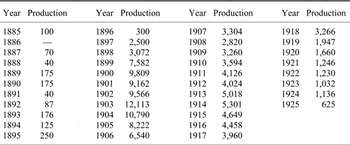
Appendix: Yukon Gold Production
YUKON GOLD PRODUCTION, 1885–1925(1,000s of $)

Source:
Annual Report of the Mineral Production of Canada, 1926, p. 117.