I. INTRODUCTION
Due to environmental concerns, it becomes more and more important to find alternative energy sources beyond fossil fuels with increasing demand of energy. Lithium-ion batteries (LIB) have drawn significant research attention due to their unique advantages of relatively high energy densities. Applications of LIB have been extended from consumer electronics to large-scale grid energy storage. However, the energy density of currently existing LIB remains insufficient to meet the requirements for applications in electric vehicles and hybrid electric vehicles, and thus it is desirable to develop much higher energy density rechargeable batteries with low cost. Reference Whittingham1–Reference Bruce, Freunberger, Hardwick and Tarascon3 There has been significant progress in the development of high energy density anode materials such as Si-based alloy etc. over the recent years. Reference Liu, Xun, Vukmirovic, Song, Olalde-Velasco, Zheng, Battaglia, Wang and Yang4–Reference Cui, Ruffo, Chan, Peng and Cui8 However, the low capacity of cathode materials is still one of the major obstacles for developing high-performance batteries. Sulfur has been considered as one of the promising candidates of such cathode materials due to its high theoretical capacity (1675 mAh/g) and its natural abundance. Despite the above advantages, there are still many challenges in developing a practical lithium–sulfur battery for commercialization. As known so far that the problems of lithium–sulfur batteries include: (i) very poor conductivity of sulfur (10−16 S/m at 293 K); (ii) large volumetric expansion upon lithiation (80%); (iii) dissolution of the intermediate polysulfides during charge–discharge processes. Reference Yamin, Gorenshtein, Penciner, Sternberg and Peled9,Reference Mikhaylik and Akridge10 These problems result in fast capacity fading and low Coulombic efficiency and therefore result in poor cycle performance of lithium–sulfur cells. Considerable efforts have been devoted to solve the above mentioned problems in the Li–S battery system such as encapsulating sulfur particles with conductive carbon, Reference Ji, Lee and Nazar11–Reference Guo, Xu and Wang14 grapheme oxide, Reference Wang, Yang, Liang, Robinson, Li, Jackson, Cui and Dai15,Reference Ji, Rao, Zheng, Zhang, Li, Duan, Guo, Cairns and Zhang16 or polymer binder, Reference Xiao, Cao, Xiao, Schwenzer, Engelhard, Saraf, Nie, Exarhos and Liu17,Reference Li, Meduri, Chen, Qi, Engelhard, Xu, Ding, Xiao, Wang, Wang, Zhang and Liu18 adding confinement for sulfur particles such as loading sulfur into carbon nanotubes Reference Chen, Dong, Ge, Wang, Wu, Lu and Chen19 and designing core–shell structure Reference Seh, Li, Cha, Zheng, Yang, McDowell, Hsu and Cui20 etc.
Conductive polymer, poly(3,4-ethylenedioxythiophene) (PEDOT), has been used in lithium–sulfur batteries to coat carbon/sulfur particles to minimize polysulfide dissolution and improve the electrochemical performance of Li–S batteries. Reference Yang, Yu, Cha, Wu, Vosgueritchian, Yao, Bao and Cui21,Reference Li, Zhang, Zheng, Seh, Yao and Cui22 The advantages of PEDOT with both good electrical conductivity and enhanced affinity for sulfur and polysulfides have been shown. In this study, we used PEDOT as polymer binder and commercial micrometric sulfur particles to study the performance of Li–S batteries. The electrochemical performance of PEDOT-based sulfur electrode was compared with that of conventional polymer binder of polyvinylidene difluoride (PVDF)-based sulfur electrode. Meanwhile, the impact of particle size of sulfur on the electrochemical performance was also studied by comparing commercial micrometric sulfur electrode and synthesized nanometric sulfur electrode. Finally, electrochemical performance of sulfur cells with high viscosity electrolyte and low viscosity electrolyte was compared to study the lithium-ion diffusion impact on the polysulfide dissolution.
II. EXPERIMENTAL
A. Materials
The micrometric sulfur powder was purchased from Mallinckrodt Company. Nanometric sulfur was prepared as described in previous study Reference Li, Zheng, Yang, Seh, Liu and Cui23 and Na2S2O3, HCl, and polyvinylpyrrolidone used were from Sigma-Aldrich. The acetylene black (AB) was purchased from Denka Japan and PVDF was from Kureha America, Inc. N-methyl-2-pyrrolidone (NMP) was from Sigma-Aldrich (anhydrous, 99.5%). The lithium bis(trifluoromethanesulfonyl)imide (LiTFSI), 1,3-dioxolane/1,2-dimethoxyethane (DOL/DME) (with volume ratio of 1:1), polyethylene glycol dimethyl ether (PEGDME), and LiNO3 used in electrolyte were from Aldrich. The molecular weight of PEGDME is around 500 Dalton.
B. Electrode fabrication and cell testing
The polymers were first dissolved in NMP with a concentration of 5% by weight. Commercial micrometric sulfur powder and AB were added into the binder-NMP solution. The weight ratio of these three components is: 50% sulfur, 10% PVDF/PEDOT, and 40% AB. The mixture was first mixed in ultrasonic bath for 30 min and then stir-mixed for 1 h to form a slurry. The formed slurry was then coated on 18-µm-thick battery grade aluminum sheet using a Mitutoyo doctor blade and an Elcometer motorized film applicator. Typical mass loading of active material was ∼0.5 mg/cm2 for sulfur. After NMP dried off, the electrodes were further dried in vacuum oven at 50 °C for overnight.
2325-type coin cells (parts from National Research Council Canada) were assembled in an argon-filled glove box with oxygen mixing ratio of 0.1 ppm and dew point of −70 °C. The sulfur electrode was 1/2″ OD and the counter electrode was lithium metal disk of 11/16″ OD (Li foil from FMC-Lithium Co.). The separator used was polypropylene film (Celgard® 2400). The electrolyte used was a freshly made solution of LiTFSI (1 M) in DOL/DME or PEGDME containing LiNO3 (1% wt.). Reference Zhang24 Galvanostatic cycling tests were performed on a Maccor series 4000 cell tester (Maccor, Inc., Tulsa, OK). The voltage window was 1.5–2.6 V.
III. RESULTS AND DISCUSSION
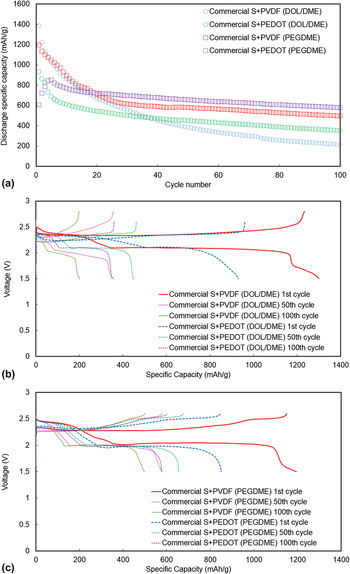
The cycle performance of the lithium–sulfur cells with different polymer binders and different electrolytes is shown in Fig. 1(a). As shown in the figure, initial capacity of PVDF-based Li–S cells is generally higher than the PEDOT-based ones. With DOL/DME electrolyte, the initial capacity of PVDF binder based cell and PEDOT binder based cell is around 1400 mAh/g and 900 mAh/g, respectively. With PEGDME electrolyte, the initial capacity of PVDF binder based cell is around 1200 mAh/g, whereas that of PEDOT binder based cell is only around 600 mAh/g. The higher initial capacity of PVDF binder based cell could be ascribed to the better adhesion, which prevented more polysulfide from dissolution in the electrolyte. However, the capacity retention of PVDF binder based cell is much poorer than that of PEDOT binder based one. After 100 cycles, the capacity retention of the PVDF binder based cell and PEDOT binder based cell using PEGDME electrolyte is 42% and 68%, respectively. Within 40 cycles, both PVDF-based cells have the capacity dropped lower than their corresponded PEDOT-based cells. The fast decay of capacity for the PVDF-based cells is ascribed to the nonconductive property of PVDF. The volumetric change of sulfur particles in PVDF cell during charge–discharge processes could push particles out of the conductive carbon network and resulted in deactivation of some sulfur particles. On the other hand, PEDOT is a conductive polymer, and sulfur particles glued with PEDOT could be still conductive even when they were disconnected from the conductive carbon network. This is a very similar phenomenon as that observed in silicon system. Reference Liu, Xun, Vukmirovic, Song, Olalde-Velasco, Zheng, Battaglia, Wang and Yang4 Recent studies also demonstrated that chemical adsorption between sulfur/polysulfide and the conductive polymer may play an important role for performance enhancement of Li–S batteries. Reference Song, Xu, Gordin, Zhu, Lv, Jiang, Chen, Duan and Wang25,Reference Xu, Song, Gordin, Sohn, Yu, Chen and Wang26 In our Li–S system, application of PEDOT helps increasing adhesion between particles, and the volume changes can be better accommodated. On the other hand, as discussed in the above studies, conductive PEDOT may also help in increasing the chemical adsorption between sulfur/polysulfides and reducing polysulfide dissolution into electrolyte, and effectively enhances the cell performance.
Electrochemical performance of sulfur electrodes. (a) Cycle performance of commercial S and PVDF or PEDOT cells using DOL/DME or PEGDME electrolytes; (b) Voltage profiles of PVDF cell and PEDOT cell using DOL/DME-based electrolyte; (c) Voltage profiles of PVDF cell and PEDOT cell using PEGDME-based electrolyte.

Figure 1(b) shows the voltage profiles of PVDF cell and PEDOT cell using DOL/DME-based electrolyte. In Fig. 1(b), the long plateau at around 2 V for the first cycle of PVDF cell is over 700 mAh/g, indicating the initial good utilization of sulfur particles and conversion of polysulfides to Li2S2 and Li2S at the beginning. This plateau of PVDF cell becomes ∼260 mAh/g at the 50th and 130 mAh/g at the 100th cycle, indicating the loss the active material during cycling. As mentioned above, the deactivation of some sulfur particles due to volumetric change in the cell could be the reason for this. Though the same plateau shortening also occurred in the PEDOT cell, the capacity decay is slower than that of PVDF cell. This plateau of PEDOT cell is still over 220 mAh/g at the 100th cycle. The better cycle performance could be ascribed to the conductivity of the binder used in PEDOT cell.
Figure 1(c) shows the voltage profiles of PVDF cell and PEDOT cell using PEGDME-based electrolyte. Previous studies have shown that viscosity of electrolyte solvent plays an important role in sulfur cell performance. Reference Shin and Cairns27,Reference Shim, Striebel and Cairns28 The smaller initial capacity of both cells using PEGDME electrolyte is due to the higher viscosity of PEGDME than that of DOL/DME. Particularly for PEDOT cell, the first cycle discharge capacity contribution from elemental sulfur to polysulfides is around 520 mAh/g in DOL/DME electrolyte and around 290 mAh/g in PEGDME electrolyte, indicating easier lithium ions transport in DOL/DME electrolyte. The diffusion coefficient of lithium ions is smaller in PEGDME, which could result in higher resistance or impedance and larger over potential of the running cell. This is in good agreement with the voltages observed in Fig. 1(c). For an instance, during the first discharge, the voltage of PEDOT cell at the end of the process of elemental sulfur to polysulfides is 2.1 V in DOL/DME electrolyte and 2.0 V in PEGDME electrolyte. On the other hand, during the first charge, most of the oxidation processes occurred below 2.35 V in DOL/DME electrolyte but above 2.35 V in PEGDME electrolyte. All of these indicate the higher over potential in PEGDME electrolyte, which resulted in lower capacity within the same cut-off voltage window in this electrolyte. However, high viscosity of PEGDME also effectively prevents partial polysulfide dissolution in the electrolyte so the PEGDME cells show better capacity retention upon cycling than DOL/DME cells.
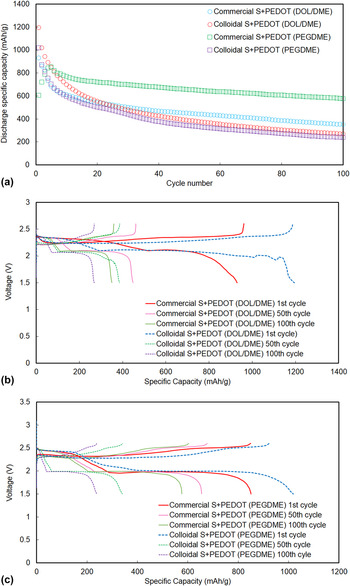
With conductive PEDOT binder, lithium–sulfur cells with different sulfur particle size and different electrolytes have been studied and their cycling results are shown in Fig. 2(a). With DOL/DME electrolyte, the initial capacity of commercial micrometric sulfur cell is around 900 mAh/g, whereas that of nanometric sulfur cell is around 1200 mAh/g. With PEGDME electrolyte, the initial capacity of commercial micrometric sulfur cell and nanometric sulfur cell is around 600 mAh/g and 1000 mAh/g, respectively. The higher initial capacity of nanometric sulfur cell with both electrolytes is ascribed to the larger surface area and more sulfur utilization. The higher initial capacity of cells with DOL/DME electrolyte is consistent with Fig. 1(a). Capacity retention of micrometric sulfur cell, however, is much better than that of the nanometric sulfur cell. After 100 cycles, the capacity retention of micrometric sulfur cell and nanometric sulfur cell using PEGDME electrolyte is 68% and 23%, respectively. This could be ascribed to the more polysulfide dissolution in the electrolyte of the latter as a result from its significantly larger surface area.
Electrochemical performance of sulfur electrodes. (a) Cycle performance of commercial S/PEDOT and colloidal S/PEDOT cells using DOL/DME or PEGDME electrolytes; (b) Voltage profiles of commercial S/PEDOT and colloidal S/PEDOT cells using DOL/DME-based electrolyte; (c) Voltage profiles of commercial S/PEDOT and colloidal S/PEDOT cells using PEGDME-based electrolyte.

The voltage profiles of micrometric sulfur cell and nanometric sulfur cell using DOL/DME-based electrolyte are shown in Fig. 2(b). In this figure, the long plateau at around 2.1 V for the first discharge of nanometric sulfur cell is over 800 mAh/g, indicating the initial good utilization of sulfur particles and conversion of polysulfides to Li2S2 and Li2S at the beginning. This plateau became shorter and shorter at the 50th (210 mAh/g) and the 100th cycle (180 mAh/g), indicating the fast loss of the active materials due to dissolution of polysulfides during cycling. Though the same plateau shortening also occurred in the micrometric sulfur cell, the capacity decay is slower than that of nanometric sulfur cell. This better cycle performance of micrometric sulfur cell could be ascribed to the less polysulfide dissolution in micrometric sulfur cell.
Figure 2(c) shows the voltage profiles of micrometric sulfur cell and nanometric sulfur using PEGDME-based electrolyte. The smaller initial capacity of both cells using PEGDME electrolyte is due to the higher viscosity and low lithium-ion diffusion of PEGDME than that of DOL/DME, which is in good agreement with that shown in Fig. 1. Therefore, the initial capacity of both cells using PEGDME is smaller. Meanwhile, the higher viscosity of PEGDME also effectively prevents partial polysulfide dissolution so that the PEGDME cells have much better capacity retention, which is also consistent with that shown in Fig. 1. It has to be noted that the capacity of the micrometric sulfur cell with PEGDME electrolyte is not stabilized until the sixth cycle due to the large particle size and low electrolyte uptake. So we use the voltage profile of the sixth cycle as the beginning cycle in Fig. 1(c). The most striking feature in this figure is the quick decrease of the capacity contribution from elemental sulfur to polysulfides for nanometric sulfur cell. The capacity decreased from 439 mAh/g at the first cycle to only 38 mAh/g at the 100th cycle, indicating the quick loss of active material during cycling. On the other hand, this capacity of micrometric sulfur cell decreased from 287 mAh/g to 225 mAh/g, indicating a much better retain of active material. This could be ascribed to the particle and polymer binder interaction. Reference Liu, Zheng, Song and Battaglia29 The nanometric sulfur particles consumed the PEDOT binder, which resulted in a poor adhesion and poor connection between particle network.
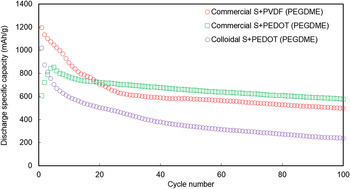
The cycle performance of micrometric sulfur cell with PVDF binder, micrometric sulfur cell with PEDOT binder, and nanometric sulfur cell with PEDOT binder is compared in Fig. 3. After 100 cycles, the capacity of PEDOT binder micrometric sulfur cell is 578 mAh/g with a capacity retention of 68%. For PVDF cell, the capacity is 496 mAh/g and capacity retention is 42% after 100 cycles. For PEDOT binder nanometric sulfur cell, the capacity is 239 mAh/g and capacity retention is 23% after 100 cycles. These results demonstrated that sulfur cathode made from PEDOT binder and commercial micrometric sulfur powder had the best cycle performance.
Electrochemical performance of three sulfur electrodes using PEGDME-based electrolyte.

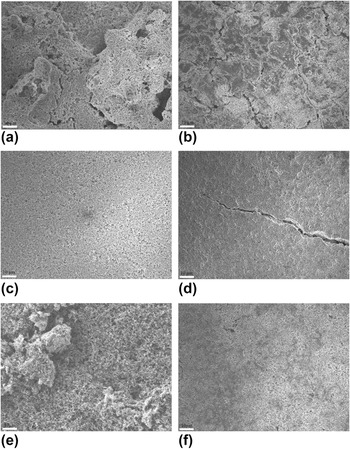
To find out the fading reason of the above three cells, SEM images were taken with pristine electrodes and after-cycled electrodes (Fig. 4). Before cycling, the micrometric sulfur particles [Fig. 4(a)] were distinguished and the electrodes have rough surface compared to the nanometric particles [Fig. 4(c)], but both particles were smoothly coated with the PEDOT binder. However, PVDF binder showed limited affinity with micrometric sulfur particles and the electrode was inhomogeneous [Fig. 4(e)], which confirmed that the PEDOT has better affinity with sulfur species. Reference Li, Zheng, Yang, Seh, Liu and Cui23 Although the nanometric sulfur delivered the better electrode, it could not sustain the volume change in the charge–discharge cycles due to their large surface area and limited availability of the binder, which was majorly attributed to the fast capacity lost and severe cracks appeared in the electrode after cycling [Fig. 4(d)]. The fast fading of the batteries with PVDF binder was attributed to the insulation nature of the PVDF, although its high strength could maintain the integrity of the electrode. The PEDOT was used as a semiconductor and helped to transfer electrons besides its ability to retain active sulfur species. Reference Li, Zheng, Yang, Seh, Liu and Cui23 Therefore, the SEM images are in good agreement with the electrochemical performance of the cells.
SEM images of sulfur electrodes. (a) Pristine micrometric sulfur-PEDOT electrode, (b) after-cycled micrometric sulfur-PEDOT electrode, (c) pristine nanometric sulfur-PEDOT electrode, (d) after-cycled nanometric sulfur-PEDOT electrode, (e) pristine micrometric sulfur-PVDF electrode, (f) after-cycled micrometric sulfur-PVDF electrode.

IV. CONCLUSIONS
In this study, the electrochemical performance of lithium–sulfur cells with different polymer binder (PVDF versus PEDOT), different particle sized sulfur powder (micrometric vs. nanometric), and different electrolyte (DOL/DME vs. PEGDME) was investigated. We have demonstrated that PEDOT conductive polymer with commercial micrometric sulfur effectively improved the performance of Li–S batteries due to the bifunction of PEDOT with both good electrical conductivity and enhanced affinity for sulfur and polysulfides. The micrometric sulfur cell has better cycle performance than the synthesized colloidal nanometric sulfur cell, which could be ascribed to the relatively lower sulfur utilization and better prevention of polysulfide dissolution. Meanwhile, the better performance of cells with PEGDME electrolyte than that of DOL/DME electrolyte is due to the larger viscosity, lower particle mobility, and lower polysulfide dissolution. The increased conductivity by conductive polymer and the large viscosity of PEGDME play important roles in the better cycle performance.
ACKNOWLEDGMENTS
This research was funded by the Assistant Secretary for Energy Efficiency, Vehicle Technologies Office of the U.S. Department of Energy under Batteries for Advanced Transportation Technologies (BATT) Program under the contract no. DE-AC02-05CH11231.