Introduction
Hand hygiene is one of the most effective measures to prevent microbial transmission and infection in health care. 1,Reference Lotfinejad, Peters and Tartari2 Over three decades, key milestones have included replacing traditional handwashing with soap and water with alcohol-based handrub (“system change”) and implementing a multimodal strategy to influence healthcare workers’ behavior. This innovation, pioneered at the Geneva University Hospitals Reference Pittet, Hugonnet and Harbarth3 spurred international research Reference Pittet, Boyce and Allegranzi4 and led the World Health Organization (WHO) to develop and test the multimodal hand hygiene improvement strategy (MMIS). 5–7
Building on scientific evidence, WHO, the United States Centers for Disease Control and Prevention (CDC) and the Society for Healthcare Epidemiology of America (SHEA) issued comprehensive hand hygiene recommendations. 1,Reference Lotfinejad, Peters and Tartari2,Reference Boyce and Pittet8,Reference Glowicz, Landon and Sickbert-Bennett9 Despite being a simple measure, the 2009 WHO guidelines 1 highlighted research gaps, marking the beginning of an era of intense investigation into infection prevention and control (IPC). In 2017, international experts revisited and updated the 2009 research agenda. Reference Pittet, Boyce and Allegranzi4
One major advancement was the WHO MMIS, recognized as the gold standard for promoting behavioral change in hand hygiene at the point of care. 5,Reference Allegranzi, Gayet-Ageron and Damani6 The MMIS has since been adapted for broader IPC use and incorporated as a core component of WHO’s recommendation for effective IPC programs. 5,10 WHO global surveys (2011, 2015, 2019) investigating the status of hand hygiene programs according to a framework based on the MMIS 11,Reference Kilpatrick, Tartari and Gayet-Ageron12 reported an intermediate level of hand hygiene implementation. Reference Kilpatrick, Tartari and Gayet-Ageron12,Reference De Kraker, Tartari and Tomczyk13
This study aims to establish an international consensus on critical research priorities for advancing hand hygiene in health care (2023–2030). The consensus seeks to coordinate efforts among stakeholders, funders and researchers to address urgent evidence gaps.
Methods
A multiphase approach (Figure 1), including a Delphi consensus process Reference Jones and Hunter14–Reference Powell, Waltz and Chinman16 was used to determine research priorities on hand hygiene in health care. The study protocol adhered to recommendations from the Conducting and REporting of DElphi Studies (CREDES). Reference Jünger, Payne, Brine, Radbruch and Brearley17 Ethical approval was obtained from WHO’s Ethics Review Committee (ERC #0170).
Flowchart of the study process for identifying the 2023–2030 research agenda for hand hygiene in health care. Note: HH, hand hygiene; HAI, healthcare-associated infection; AMR, antimicrobial resistance. This process was carried out between March 2022 and February 2023, using the Delphi consensus methodology to identify research priorities for hand hygiene in healthcare settings. The research agenda for 2023–2030 was developed based on input from an international panel of experts, in consultation with WHO methodologists.

A meta-review and an analysis of the research gaps identified in “Hand hygiene: a handbook for medical professionals” Reference Pittet, Boyce and Allegranzi4 building on the WHO hand hygiene guidelines 1 provided the basis for preliminary research priorities categorized into six domains: (1) system change; (2) training and education; (3) evaluation and feedback; (4) reminders and communications; (5) institutional safety climate; and (6) the impact of hand hygiene improvement on antimicrobial resistance and healthcare-associated infections (HAIs.)
Participants
A Technical Advisory Group (TAG) on Hand Hygiene in Healthcare Research was established, 18 comprising 27 experts across six WHO regions and World Bank economic income levels 19 ; gender balance was also ensured. Additional experts were recruited through literature searches, WHO networks and regional offices. Experts were assigned to domain-specific working groups to refine research priorities.
Delphi procedure
A modified Delphi process comprising a pre-determined number of survey rounds, was used to establish the final research priorities for hand hygiene. Delphi studies were conducted for each of the six domains (Figure 1), with two rounds of online surveys administered between March 2022 and February 2023. Surveys remained open for 10 days, with two reminders sent for completion. Results were analyzed to produce a final list of research priorities categorized into six thematic domains, with priorities ranging from 14 and 52 per domain.
Participants attended an online meeting before each Delphi survey to receive instructions and review preliminary research priorities. The working group chair and facilitator led the discussions to refine priorities by rephrasing, removing duplicates, and merging similar topics. Feedback informed the final list of research priorities for inclusion in round 1. Surveys were administered via the piloted Welphi platform, 20 ensuring clarity and ease of use.
Round 1
Participants were provided access to a web-based questionnaire containing the identified research priorities, and they rated each one according to the research priority setting dimensions (Table 1) and their assessment of the need for further evidence. A 5-point Likert scale was used, ranging from 1 (“totally disagree”) to 5 (“totally agree”), with an additional option of “unable to rate.” The primary objective was to achieve consensus on the research priorities to be included in the final hand hygiene research agenda for each of the six domains. Survey respondents were also invited to provide comments, including suggestions for revising the proposed priorities and proposing additional items for consideration (Supplementary Material, Appendix A). Consensus was defined as ≥70% of participants agreeing or strongly agreeing with a research priority statement, a threshold considered appropriate in previous Delphi studies. Reference Soriano, Murthy, Marshall, Relan and Diaz21–Reference Niederberger and Spranger23 “Disagreement” was defined as occurring when 35% or more of the responses fell within the extreme ranges of the Likert scale. For each research priority statement, consensus proportions were calculated based on the number or percentage of respondents, excluding the “unable to rate’ responses.
Research priority setting dimensions

Round 2
Participants who completed round 1 were invited to participate in round 2, which focused on re-evaluating the research priorities that had not reached a consensus in the first round. Round 1 results were shared with participants, including a visual representation of the distribution of scores from all respondents, alongside their individual score, using the same rating scale. Participants were asked to consider the responses of others and review their ratings, with the option to either confirm or modify them based on the additional insights gained from the group feedback.
Statistical analysis
Survey data were analyzed using SPSS version 25 (IBM, Armonk, NY, USA). Descriptive statistics summarized participants’ responses, with consensus calculated for each priority. Ranking was based on mean scores and standard deviations calculated for each item.
Results
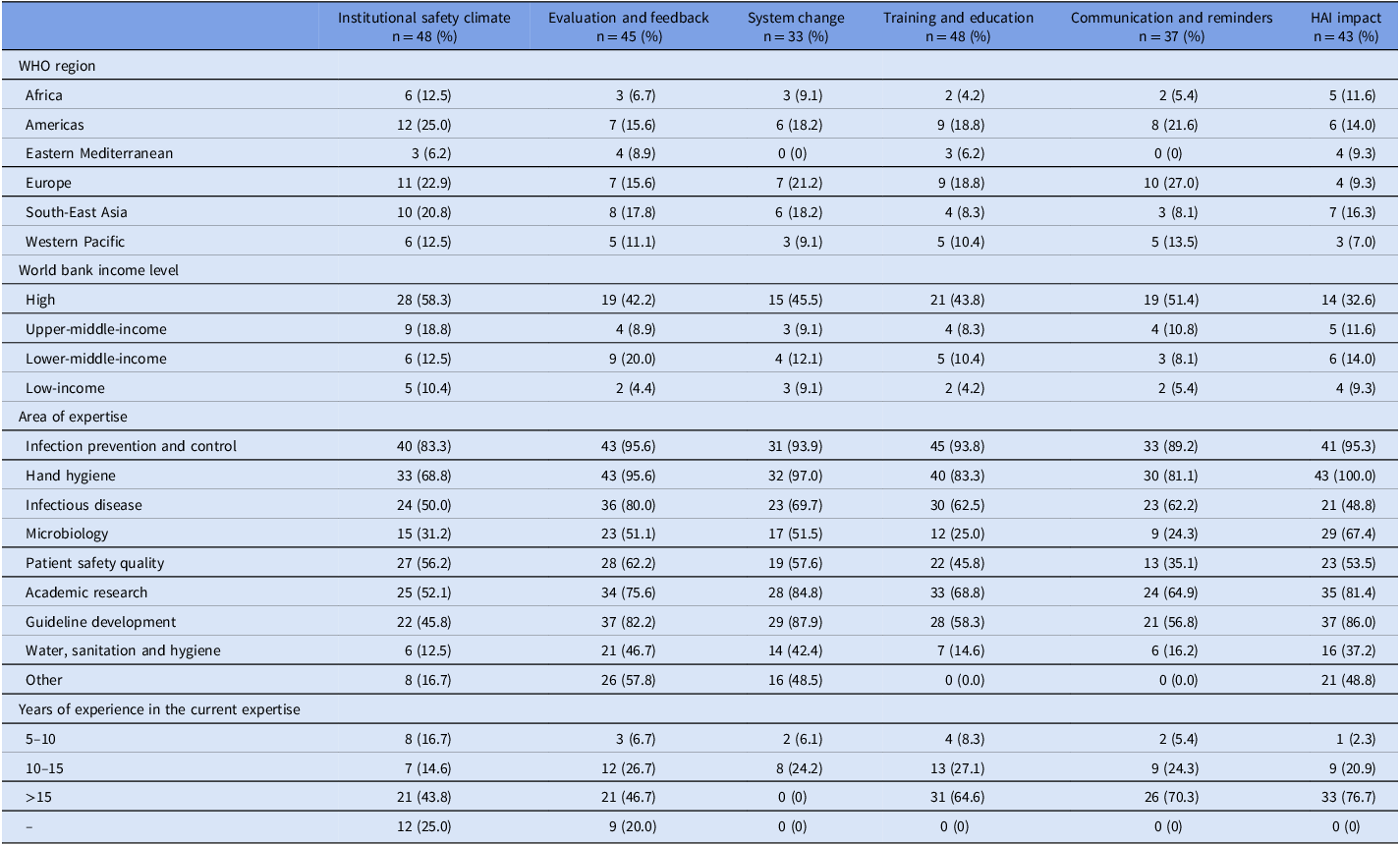
Following a meta-review of the literature and expert consultations, a preliminary list of 192 research priorities was developed. Through the six Delphi studies, 14 statements did not reach the predefined consensus level and were eliminated, resulting in a final list of 178 priorities (Table 2). A panel of 105 international hand hygiene experts, including the WHO Technical Advisory Group of Experts on Hand Hygiene in Healthcare representing all WHO regions and World Bank income levels participated. Overall, there was a high level of agreement among respondents, with 121 research priorities reaching >80% consensus. Participants (n = 105) came from multiple disciplines, including IPC (72%), infectious diseases (45.6%), microbiology (28%), patient safety and quality (49%), and research and academia (45.6%); 40% had over 15 years of experience in their respective fields. A high response rate (92%) was achieved on average for the Delphi surveys. There was a higher representation of participants from high-income countries 57/105 (54%) than low-income countries 27/105 (26%) (Table 3). The rate of “unable to rate” responses across all rounds and domains was 1.85%, calculated as the proportion of “unable to rate” answers (3.42) relative to the total number of responses (185).
Final 2023–2030 research agenda for hand hygiene in health care categorized into six thematic domains following expert consensus

AHBR, alcohol-based hand rub; MMIS, multimodal improvement strategy.
Research priorities were identified and ranked based on the Delphi process conducted with a panel of international experts.
Characteristics of Delphi panel of international experts

System change
Of the 41 experts invited to participate in round 1 of this domain, 34 (83%) responded and were invited to round 2. Of these, 33 (98%) responded. Fifty-one research priority statements were initially included and classified in the following technical areas within this domain: (1) general system change issues/enabling environment; (2) surgical hand preparation; (3) hand hygiene agents; (4) reactions to hand hygiene agents; (5) barriers/enablers to hand hygiene compliance; (6) the skin microbiome; and (7) dynamics of hand transmission. Finally, 45 statements reached consensus among respondents, with 24 (53.3%) achieving a consensus level of >80% (Supplementary Material, Appendix B) and six were excluded (Supplementary Material, Appendix C). The top three research priorities with the highest consensus are presented in Table 4.
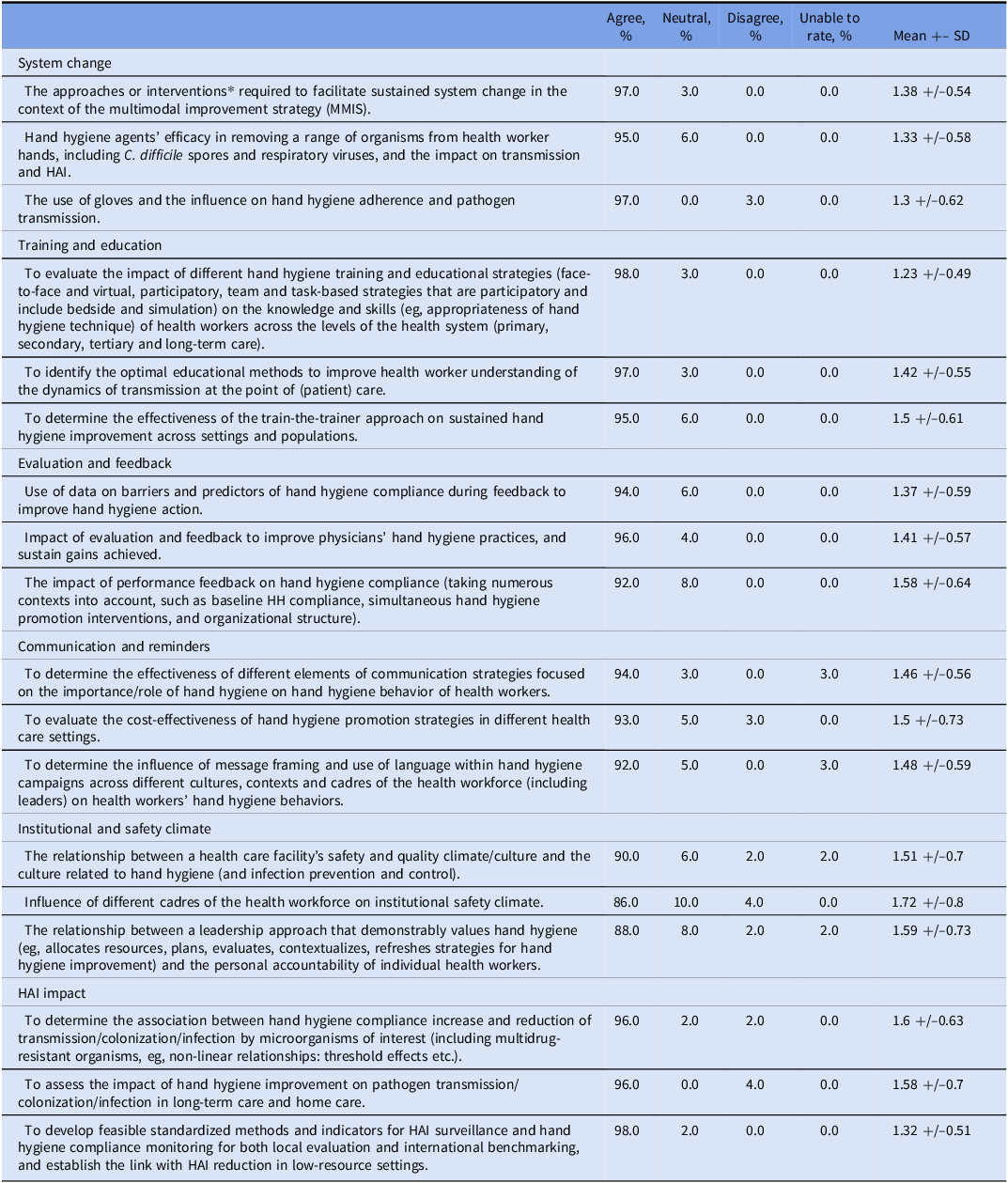
Highest hand hygiene research priorities categorized into six thematic domains following expert panel consensus.

HAI, healthcare-associated infection; AMR, antimicrobial resistance; MMIS, multimodal improvement strategy.
The table presents the top three research priorities from each of the six thematic domains, based on the highest consensus agreement achieved by the expert panel and the highest mean score.
Training and education
Of the 57 experts invited to participate in round 1 of this survey item, 48 (87%) responded. Fifteen research priority statements were initially included and all achieved consensus in round 1, including 13 (71%) with a level of consensus >80% (Supplementary Material, Appendix B). Research priority statements were classified in the following technical areas within this domain: (1) training and education strategies; (2) training and education of IPC specialists, healthcare workers and other personnel; and (3) hand hygiene in specific patient populations and situations. The top three research priorities with the highest consensus are presented in Table 4.
Evaluation and feedback
Of the 49 experts invited to participate in round 1 of this survey item, 48 (98%) completed the survey and were invited to round 2. Of these, 45 (94%) responded to the questionnaire. Forty-one research priority statements were included and classified into the following technical areas within this domain: (1) compliance with hand hygiene best practices; (2) physicians and hand hygiene; (3) monitoring hand hygiene performance; (4) performance feedback; (5) monitoring within your institution; and (6) external regulation and evaluation. All proposed statements reached consensus through the two survey rounds; 25 statements (61%) reached a consensus level of >80% (Supplementary Material, Appendix B). The top three research priorities with the highest consensus are presented in Table 4.
Reminders and communications
Of the 43 experts invited to participate in round 1 of this survey item, 38 (88%) responded and were invited to round 2. Of these, 37 (97%) responded to the questionnaire. Fourteen research priority statements were initially included in the survey and classified in the following technical areas within this domain: (1) hand hygiene promotion; (2) hand hygiene marketing approaches; and (3) hand hygiene campaigns and communication. Finally, 13 statements reached consensus among respondents, with 9 (69.2%) achieving a consensus level of >80% (Supplementary Material, Appendix B), and one was excluded (Supplementary Material, Appendix C). The top three research priorities with the highest consensus are presented in Table 4.
Safety climate/culture change
Of 57 experts invited to participate in round 1 of this survey item, 50 (88%) responded and were invited to round 2. Of these, 48 (96%) responded. Thirty-six research priority statements were initially included in the survey and classified in the following technical areas within this domain: (1) general aspects of safety climate/culture change and hand hygiene; (2) personal accountability for hand hygiene; (3) leadership; (4) patient participation and empowerment; and (5) religion and tradition. Finally, 31 statements reached consensus among respondents, with 22 (71%) achieving a consensus level of >80%, and five were excluded (Supplementary Material, Appendix C). The top three research priorities with the highest consensus are presented in Table 4.
Impact of hand hygiene on HAIs and the transmission of antimicrobial resistance
Of 49 experts invited to participate in round 1 of this survey item, 46 (94%) responded and were invited to round 2. Of these, 43 (93%) responded to the questionnaire. Thirty-five research priority statements were initially included in the survey and classified in the following technical areas within this domain: (1) effect of hand hygiene on transmission, colonization and/or infection; (2) hand hygiene impact in specific settings; (3) hand hygiene impact in settings with limited resources; (4) the economic impact of improved hand hygiene. Finally, 33 statements reached consensus among respondents, with 30 (85.7%) achieving a consensus level of >80%, and two were excluded (Supplementary Material, Appendix C). The top three research priorities with the highest consensus are presented in Table 4.
Discussion
The establishment of a prioritized 2023–2030 research agenda for hand hygiene in healthcare settings is a crucial step toward addressing the persistent gaps in IPC evidence. To the best of our knowledge, this is the only existing comprehensive research agenda that has identified 178 research priorities for hand hygiene in health care through a multiphase, structured consensus approach using a Delphi process and achieving consensus among 105 international experts from multiple disciplines. A high level of consensus (>80%) was achieved on 121 research priorities, underscoring critical areas needing attention and providing a roadmap for future research and practice improvement. Recently, other research agendas have been published, including those focused on multidrug-resistant organisms transmission prevention, antimicrobial resistance, antibiotic stewardship and cleaning, and environmental hygiene, thus highlighting the growing emphasis on systematic approaches to address critical knowledge gaps and healthcare challenges. Reference Bertagnolio, Dobreva and Centner24–Reference Smith, Crnich and Donskey27
Among the highly prioritized research areas in the domain “evaluation and feedback,” recommendations with over 85% consensus highlighted the role of unobtrusive monitoring methods such as electronic monitoring compliance systems (87%). This suggests a strong need to integrate advanced monitoring technologies to provide real-time feedback and improve hand hygiene practices. Little is known about the long-term advantages and unintended consequences of electronic monitoring systems and further research is recommended. Reference Lotfinejad, Peters and Tartari2,Reference Gould, Hawker, Drey and Purssell28
In the “system change” domain, there was a very high consensus (91%) on the importance of legislative and policy mechanisms for sustaining system change, highlighting the necessity for robust regulatory frameworks to support hand hygiene initiatives. Consensus was also reached on the critical need to develop new international standards for the efficacy of hand hygiene products and to explore the economic impact of local versus imported hand hygiene formulations. In addition, evaluating the cost-effectiveness of the WHO MMIS achieved a high consensus (91%), highlighting the need for studies on cost-effectiveness and economic analyses to evaluate the financial implications of hand hygiene interventions that can further support resource allocation and justify investment in hand hygiene improvements across all resource settings. Reference Özçelik, Lerouge, Cecchini, Cassini and Allegranzi29–31
Important gaps identified the need to understand the role of the skin microbiome and hand transmission dynamics and how these biological factors influence overall hand hygiene effectiveness. The high level of agreement on the influence of human factors, such as the placement of sinks and the role of glove use, indicates a growing recognition of the need to design hand hygiene systems that are both user-friendly and effective in preventing contamination. Reference Clack, Stühlinger, Meier, Wolfensberger and Sax32
In the “training and education” domain, there was strong agreement (95% consensus) that more research is needed to evaluate the effectiveness of train-the-trainer approaches across various settings, reflecting their potential to standardize hand hygiene training and to ensure continuous capacity-building and improvement. Reference Tartari, Fankhauser and Masson-Roy33,Reference Saito, Okamoto, Fankhauser, Tartari and Pittet34 These recommendations will help shape future research by focusing on developing scalable and sustainable hand hygiene interventions, emphasizing the role of technology and structured training programs. Reference Tartari, Kilpatrick, Deeves, Pittet and Allegranzi35
Several research priorities that achieved a high consensus (>90%) highlighted critical knowledge gaps. For example, the high level of agreement from the expert group in investigating the relationship between hand hygiene compliance and the reduction in HAI incidence underlines the gap in this area across countries, which demands robust studies to establish causal inferences and quantify the impact of hand hygiene on HAI incidence, thereby providing empirical evidence to inform policy and practice.
The final research agenda emerged with two important cross-cutting themes. First, it stressed the potential role of technology, from electronic monitoring to innovative tools for training and education. Reference Tartari, Kilpatrick, Deeves, Pittet and Allegranzi35 Artificial intelligence is poised to play a transformative role in training, offering personalized learning experiences, adaptive feedback, and real-time performance assessment, which could enhance hand hygiene education and compliance monitoring. Reference Dai and Ke36 This finding reflects an opportunity to leverage technological advancements to enhance IPC measures. The second theme was the relationship between a positive institutional safety climate and improved hand hygiene practices. Research in this area, especially the influence of leadership and organizational culture, will be crucial in fostering healthcare organization environments where hand hygiene practices are consistently prioritized. Reference Pittet, Boyce and Allegranzi4,Reference Vikan, Haugen and Bjørnnes37
The research agenda was designed to be global in scope, addressing shared challenges across income settings while placing particular emphasis on bridging knowledge gaps in low-income settings. Experts were asked to rate priorities based on standardized dimensions—impact/significance, cost-effectiveness, and feasibility, ensuring consistency across evaluations while allowing for the incorporation of contextual realities. Although the agenda is global, it is not prescriptive but adaptive, encouraging local adaptations to align with specific country contexts and needs. For instance, while advanced technological interventions are highlighted, their implementation in low-income countries could focus on low-cost, scalable adaptations. Similarly, policy-related priorities may be tailored to reflect variations in healthcare infrastructure and governance systems. Adaptation ensures that the agenda remains relevant and actionable across diverse settings.
Strengths and limitations
The Delphi process is a strength of our study as it involved international experts from diverse backgrounds and locations worldwide. It also preserved anonymity between the participants and their feedback during the study phases and rounds, thus enhancing the credibility of all responses. The Delphi study was informed by a meta-review, and a high response rate was achieved in the surveys, ensuring that the final consensus on the future research agenda for hand hygiene was widely accepted. The literature provides varying thresholds for acceptable agreement among participants in Delphi studies. We preselected a threshold of 70% in each round, which was within the range of agreement rate values suggested in the literature (51%–100%). Reference Niederberger and Spranger23,Reference Hsu and Sandford38–Reference Diamond, Grant and Feldman41
Our study has some limitations. Despite efforts to invite internationally-renowned experts with extensive experience from diverse geographic regions and income settings, some regions remained underrepresented, and most respondents were from high-income countries. This composition may have introduced bias, as priorities identified by participants from high-income settings may not fully align with the needs or applicability to low-income settings. While we achieved a reasonable spread of countries, further diversifying the expert panel could have mitigated this limitation. Nonetheless, the Delphi method carries an inherent risk of overlooking certain areas due to the subjectivity of expert opinions and variations in thresholds for acceptable agreement in Delphi studies. These factors may have resulted in some important areas being missed or underemphasized.
A potential limitation is the high level of agreement among the expert panel, which may have made it challenging to rank the research priorities effectively. However, this also highlights the broad consensus on key research areas, allowing different research groups to focus on distinct aspects. Finally, internal biases among experts may have influenced the choices and cannot be ruled out.
In conclusion, we believe that this prioritized research agenda of 178 items for hand hygiene in health care offers a comprehensive guide for healthcare organizations, researchers, clinicians, policy-makers and funding bodies across various resource settings. By focusing on areas such as advanced monitoring technologies, legislative support, structured training programs, and addressing critical knowledge gaps through transdisciplinary research, the agenda aims to globally enhance the quality and safety of healthcare delivery. The WHO IPC global strategy, 42 action plan and monitoring framework 43 identify the development of a global research agenda for IPC as a key action to support countries in creating their national research agendas. This Delphi study provides a legitimacy and enhanced value to this work and is intended to help countries to meet the global targets of national research agendas. 43
Supplementary material
The supplementary material for this article can be found at https://doi.org/10.1017/ice.2025.32
*WHO Technical Advisory Group (TAG) on hand hygiene research included the following members and co-authors: Yewande Alimi (Africa Centres for Disease Control and Prevention, Ethiopia), Jameela AlSalman (Arabian Gulf University, Bahrain), Abdallah Al Qayoodi (Ministry of Health, Oman), Fernando Bellissimo-Rodrigues (University of São Paulo, Brazil), John Conly (University of Calgary and Alberta Health Services, Canada), Prakash Ghimire (Tribhuvan University, Nepal), M. Lindsay Grayson (University of Melbourne, Australia), Mushtuq Mohammad Husain (Institute of Epidemiology, Disease Control and Research, Bangladesh), Paul Hunter (University of East Anglia (United Kingdom of Great Britain and Northern Ireland), Kushlani Jayatilleke (Sri Jayewardenepura General Hospital, Sri Lanka), Samuel Kaba (Institutional Care Division, Ghana Health Service, Ghana), Pamela Yew Fong Lee (Sarawak General Hospital, Ministry of Health, Sunway University, Malaysia), Margaret Leong (Pacific Community, Fiji), Fernanda C. Lessa (International Infection Control Branch, Centers for Disease Control and Prevention, Atlanta, USA, Maryanne McGuckin (McGuckin Methods International, USA), Geeta Mehta (IPC independent consultant, India), Inmaculada Fernandez Moreno (Hospital Parc Taulí Sabadell, Spain), Peter Nthumba (AIC Kijabe Hospital, Kenya), Folasade Ogunsola (Infection Control Africa Network, Nigeria), Molly Patrick (Centers for Disease Control and Prevention, USA), Diamantis Plachouras (European Centre for Disease Prevention and Control, Sweden), Jacqui Reilly (Glasgow Caledonian University, United Kingdom of Great Britain and Northern Ireland), Kyla Smith (WaterAid, United Kingdom of Great Britain and Northern Ireland), Miranda Suchomel (Medical University of Vienna, Austria) and Seto Wing Hong (School of Public Health, Hong Kong Special Administrative Region, China).
Acknowledgements
We thank the following external experts who contributed their time and expertise to the Delphi surveys: Basma Ahmed Abdelshafy (communications consultant, Egypt), Raheelah Ahmad (City College of London, United Kingdom of Great Britain and Northern Ireland), Amal Al-Maani (Ministry of Health, Oman), Abed Alra’oof M.Saleem (Palestinian Ministry of Health), Darcy Anderson (University of North Carolina, USA), Anucha Apisarnthanarak (Thammasat University Hospital, Thailand), Hiba Azrag, (Federal Ministry of Health, Sudan), Chedly Azzouz (High Institute of Nursing Sciences, Tunisia), Amy Elizabeth Barrera (Resolve to Save Lives, South Africa), Loséni Bengaly (Gabriel Touré University Hospital of Bamako, Mali), Sean Berenholtz (John Hopkins Armstrong Medical Institute, USA), Gao Bin (Tianjin Medical University, China), Michael Borg (Departments of Infection Control and Sterile Services, Mater Dei Hospital, Malta), John Boyce (IPC independent consultant, USA), Yehuda Carmeli (Tel Aviv University, Israel), Evangelina Vazquez Curiel (Patient Network for Patient Safety, Mexico), Ratna Devi (Daksham Health and Education, India), Linda Dickey (Association for Professionals in Infection Control and Epidemiology, USA), Angela Dramowski (Stellenbosch University, South Africa), Guy Dub (independent consultant-designer United Kingdom of Great Britain and Northern Ireland), Riham El-Asady (Ain Shams University, Egypt), Jehan El-Kholy (Cairo University, Egypt), Katherine Ellingson (University of Arizona, USA), Rehab Elsokkary (Zagazig University, Egypt), Dale Fisher (Global Outbreak Alert and Response Network steering committee, National University of Singapore, Singapore), Qiao Fu (West China Hospital, Sichuan University, China), Petra Gastmeier (Charité, University Medical Center Berlin, Germany), Nkwan Jacob Gobte (Infection Control African Network, Kenya), Dinah Gould (Cardiff University, United Kingdom of Great Britain and Northern Ireland), Helen Hamilton (WaterAid, United Kingdom of Great Britain and Northern Ireland), Rola Hammoud Houcheimi (Lebanese Society for Quality and Safety in Healthcare, Lebanon), Sonja Hansen (Charité, University Medical Center Berlin, Germany), Marcela Hernandez (Hospital de Los Niños, Costa Rica), Loreen Herwaldt (University of Iowa, USA), Chelsea Huggett (WaterAid, Australia), Ghada Ismail (University Hospitals Ain Shams Universities, Egypt), Annette Jeanes (University of London Hospitals, United Kingdom of Great Britain and Northern Ireland), Kathleen Jharie (Academic Hospital, Suriname), Irungu Kamau (Ministry of Health, Kenya), Elaine Larson (Association for Professionals in Infection Control and Epidemiology, USA), Namata Kamoga (Community Health and Information Network, Uganda), Piyawan Limpanyalert (Healthcare Accreditation Institute, Thailand), Anna Levin (University of São Paolo, Brazil), Moi Lin Ling (Asian Pacific Society of Infection Control, Singapore), Yves Longtin (Jewish General Hospital, Canada), Elisabetta Mantengoli (Careggi University Hospital, Italy), Kalisvar Marimuthu (Tan Tock Seng Hospital, Singapore), Ana Maruta (United States Federal Centers for Disease Control and Prevention, Zimbabwe), Marylouise McLaws (University of New South Wales, Australia), Nagwa Metwally (Patients for Patient Safety Network, Egypt), Susan Michie (University College London, United Kingdom of Great Britain and Northern Ireland), Heather Moran (Mozambique, United Nations Children’s Fund (UNICEF)),Claudia Andrea Hoyos Murillo (Ministry of Public Health, Ecuador), Nico Mutters (European Committee on Infection Control, Switzerland), Rajeev Peeyush Nagassar (Sangre Grande Hospital, The Eastern Regional Health Authority, Trinidad and Tobago), Babacar Ndoye (independent expert, Infection Control Africa Network, Senegal), Tochi Okwor (Nigeria Centers for Disease Control, Nigeria), Mauro Orsini (Ministry of Health, Chile), Fernando Otaiza (Ministry of Health, Chile), Pierre Parneix (Université de Bordeaux, France), Daniela Pires (Imperial College, United Kingdom of Great Britain and Northern Ireland), John Prakash (Christian Medical College, India), Sally Roberts (Aukland City Hospital, New Zealand), Viviana E. Rodriguez (Institute for Clinical Effectiveness and Health Policy, Argentina), Victor Rosenthal (University of Miami, Miller School of Medicine, USA), Hiroki Saito (St Marianna University School of Medicine, Japan), Sharon Salmon (Global Outbreak Alert and Response Network, Philippines), Enrique Castro Sanchez (University of West London, United Kingdom of Great Britain and Northern Ireland), Hugo Sax (University Hospital of Zurich, Switzerland), Anne Simon (Université Catholique de Louvain, Belgium), Andrew Stewardson (Monash University, Australia), Paul Tambyah (Yong Loo Lin University and National University Hospital, Singapore), Kok Hian Tan (SingHealth, Singapore), Anh Thu Le Thi (Viet Nam Infection Control Society, Viet Nam), and Akeau Unahalekhaka (Chiang Mai University, Thailand).
We thank the following WHO staff and consultants who contributed to the WHO hand hygiene research agenda: Joanna Esteves Mills (Department of Environment, Climate Change and Health), Bruce Gordon (Department of Environment, Climate Change and Health), Ann Thomas (UNICEF global), Robert Dreibelbis (London School of Hygiene and Tropical Medicine, United Kingdom of Great Britain and Northern Ireland), Alexandra Czerniewska (London School of Hygiene and Tropical Medicine, United Kingdom of Great Britain and Northern Ireland), Landry Cihambanya (Emergency Preparedness and Response, WHO Regional Office for Africa, Brazaville, Congo), Ana Paula Coutinho Rehse (Infectious Hazard Management Programme, WHO Regional Office for Europe, Copenhagen, Denmark), Aparna Sing Shah, (Health Surveillance, Disease Prevention and Control, WHO Regional Office for South-East Asia, New Delhi, India), Howard Sobel (Reproductive, Maternal, Newborn, Child and Adolescent Health, WHO Regional Office for the Western Pacific, Manila, Philippines), Maha Ismail Talaat(Antimicrobial Resistance (AMR), WHO Regional Office for the Eastern Mediterranean, Cairo, Egypt), and Bassim Zayed (AMR and IPC, WHO Jordan Country Office for Jordan).
Financial support
This study was funded by WHO.
Competing interests
The authors have no competing interests to declare.
Ethical standard
Approval was obtained from the WHO Ethics Review Committee (ERC #0170) for the conduct of the study. Participants were informed of the study’s purpose and implied consent for participation was obtained by returning the survey. The research team at the WHO IPC Hub and Task Force restricted access to the confidential respondent data. Participation was voluntary and all relevant information regarding the survey’s purpose, benefits to the participant, data use and confidentiality, instructions and time lines were available online on the Welphi platform and in an invitation letter before completion of the survey. Only aggregated data were presented and countries/respondents were not identified.
Disclaimer
The opinions expressed in this article are those of the authors and do not reflect the official position of WHO or the CDC. WHO and CDC take no responsibility for the information provided or the views expressed in this article.