1. Introduction
The concept of transaction costs is everywhere in modern economics but not in mainstream health economics. In several authoritative books, the concept is only mentioned briefly and without much elaboration (Hodgson, Reference Hodgson2008: 245). This article attempts to slightly redress this omission by giving a transaction costs economics (TCE) analysis of healthcare regulation in the United States.
TCE provides a theory to explain the choice for efficient governance structures. Governance structures are ‘systems of rules plus the instruments that serve to enforce the rules’. Following Ostrom's definition of institutions, the first component of this global definition comprises: who is eligible to make decisions concerning transactions, ‘what actions are allowed or constrained, what aggregation rules will be used, what procedures must be followed, what information must or must not be provided and what payoffs will be assigned to individuals dependent on their actions’ (Furubotn and Richter, Reference Furubotn and Richter2000: 5–6). So, governance structures settle the role, rights, duties, and expectations of transaction partners.
The optimal governance structure is the structure with the lowest governance costs, that is, transaction and management costs, at a certain level of the dimensions of transactions: asset specificity, frequency and risk of transactions (Coase, Reference Coase1937; Williamson, Reference Williamson1985: 52–61). Transaction costs are costs involved for addressing bounded rationality and potential opportunistic behavior, that is, ‘self-interest-seeking with guile’ (Williamson, Reference Williamson1985: 45, 65). Asset specificity refers to the degree that assets are tied to specific transactions and cannot be used for other transactions (1985: 52–55). Frequency refers to transactions of a recurring kind or the commonality with which trade takes place. Risk refers to the approximation of hazards within a certain environment. In TCE, Knightian or Keynesian uncertainty is ignored (Williamson, Reference Williamson1983: 23 fn. 6).
The features of governance structures determine the strength of their instruments and, with this, the height of governance costs involved in addressing one or a combination of dimensions of transactions. The features of governance structures are: assignment of property rights, contract law regime, reputation effects and risk. The key categories of instruments of governance structures are: administration, incentives, adaptation and contract enforcement (Williamson, Reference Williamson1991: 281).
In TCE, governance costs of governance structures are not assessed by referring to the zero transaction costs criterion. A simple straightforward comparison of public governance costs with zero transaction costs in the hypothetical ideal market easily results in qualifying public governance being inefficient. According to Williamson (Reference Williamson1999: 316), an examination of public governance costs in ‘remediableness terms’ might be much more informative. The remediableness criterion ‘holds that an extant practice or mode of organization for which no feasible superior mode can be described and implemented with expected net gains is presumed to be efficient’ (emphasis in original) (Williamson, Reference Williamson, Ménard and Shirley2005: 59). This criterion takes account of government failures, among which falls the hazard of probity (Williamson, Reference Williamson1999: 323). Probity refers to the loyalty and rectitude with which transactions are discharged.
The efficiency presumption may be rebutted if the governance structure lacks acceptable origins or acceptable practices, or if it is based on conceptual error or pathology (Williamson, Reference Williamson1999: 317). With regard to healthcare, examples of these four reasons might be respectively: (1) unconstitutionality of public governance; (2) strategic political behavior; (3) misdiagnosis of market failures or misinterpretation of effects of Congress’ power to regulate healthcare; and (4) structural unbalanced adaptation mechanisms.
Williamson (Reference Williamson1999) touches upon relations between features of governance structures and their instruments to address hazards. However, these relations are rather implicit or not elaborated at all. Knowledge about the material content of features of governance structures and its relation with instruments to address hazards brightens up the explanation of the comparative efficiency of governance structures.
This article addresses the question if regulation or public/private hybrid is the most efficient governance structure to provide universal healthcare coverage in the United States. It analyzes the material content of determinants of costs of public governance in the disputed US healthcare reform 2010. In 2010, 25 lawsuits were filed to challenge the Patient Protection and Affordable Care Act (PPACA) (Dranias, Reference Dranias2010; ProCon.org, 2011). The PPACA is amended by the Health Care and Education Reconciliation Act (HCERA). Together they constitute ObamaCare and regulate the insuring transaction between insurers and applicants.
ObamaCare involves a choice for regulation to address adverse selection, that is, it addresses the asymmetric information between private insurers and applicants that results in an over-representation of high risks in the insured population. It sets aside the robust public healthcare insurance option that aims to address the risk of increasing costs due to mark up pricing. This option concerns a state-run insurance agency (in TCE terms: a bureaucracy) that competes with private insurers in order to keep healthcare costs down. It is included in bills that precede ObamaCare, namely the Consumers Health Care Act of 2009 (CHCA, 2009) and the Affordable Health Care America Act (AHCAA, 2009: §§321–331). The combination of bureaucracy and regulation may be labeled public/private hybrid (Kaplan and Rodgers, Reference Kaplan and Rodgers2009: 5).
This paper is organized as follows. Section 2 gives a brief review of the American healthcare reform 2010 in order to set the stage for the analysis of efficient governance structures in healthcare. Section 3 specifies the theoretical framework of the TCE approach to public governance structures. Section 4 examines the characteristics of public governance of healthcare in the United States. This practical exercise consists of an analysis of the distinctive features of governance structures as they are incorporated in ObamaCare and several documents concerning 25 ObamaCare-lawsuits filed in 2010. Section 5 analyzes categories of instruments of governance structures in connection with features of governance structures. The article ends with conclusions and some discussion notes.
2. Healthcare overhaul in the United States
In the period 2007–2009, healthcare in the United States is characterized by an increasing number of underinsured and uninsured citizens due to not only voluntary decisions, that is, adverse selection (McCollum et al., Reference McCollum, Winship, Jacquot, Makar, Hubener, Osterhaus, Rivkin, Casey, Spohn, Harned and Cobb2010a: 23), but also due to rationing practices to address adverse selection. These practices are rescission of coverage if enrollees become sick due to pre-existing conditions (Waxman and Stupak, Reference Waxman and Stupak2010: 4) and medical underwriting (Dubina and Hull, Reference Dubina and Hull2011: 14–15). Medical underwriting is the process in which insurers use personal health status data to decide upon applicants’ healthcare coverage. Due to this practice, insurance may become unaffordable for, among others, children with congenial defects who are not eligible for Medicaid or the Children's Health Insurance Program.
Until 2010, costs of uncompensated healthcare provided to the underinsured and uninsured patients are passed to others in the form of higher prices and higher premiums. Hadley et al. (Reference Hadley, Holahan, Coughlin and Miller2008: w411) found that premiums are 1.7% higher due to this kind of cost shifting. These higher premiums, ‘in turn, may lead to more lower-risk individuals opting out of coverage, which would result in even higher premiums’ (Uccello, Reference Uccello2009: 2). It is against this ‘premium spiral’ that Congress passed the PPACA in March 2010 (Vinson, Reference Vinson2010: 4).
ObamaCare provides an almost universal healthcare coverage. In order to realize this, the PPACA mandates, first, large employers (§§1511–1515) to offer a healthcare insurance plan to their employees, second, health insurance issuers to accept everybody who applies for basic insurance (§2702) and, third, individuals to enroll in a healthcare insurance program (§1501). Some individuals are exempted from the penalty for not complying with the insurance mandate, namely: ‘individuals with certain religious objections, individuals who belong to certain faith-based healthcare cooperative organizations, American Indians, persons without coverage for less than three months, undocumented immigrants, incarcerated individuals, persons for whom the lowest cost pal exceeds 8% of income, individuals with income below the tax filing threshold and persons with financial hardships’ (McCollum et al., Reference McCollum, McMaster, Bruning, Abbott, Shurtleff, Caldwell, King, Cox, Suthers, Corbett, McKenna, Wasden, Jackley, Zoeller, Stenehjem, Barbour, Brewer, Gibbons, Pedue, Sullivan, Brown, Ahlburg, Winship, Jacquot, Makar, Hubener, Upton, Rivkin, Casey, Spohn, Harned and Cobb2010: 10).
The almost universal healthcare coverage concerns ten areas of care listed in Section 1302 of the PPACA. It is up to the United States Department of Health and Human Services to provide details on the essential healthcare.
The individual mandate is essential to create effective healthcare insurance markets (PPACA, 2010: §1501; Hall, Reference Hall2011: 297). The policy of mandating insurers to accept every applicant may invoke free riding behavior if it is not accompanied by an individual mandate (Bobroff and Lazarus, Reference Bobroff and Lazarus2010: 2–8). It may bankrupt insurers (Kessler, Reference Kessler2011: 43).
Strategic political considerations may lay behind differences between the PPACA and the healthcare reform bills that preceded the PPACA. For example, the severability clause is deliberately omitted in the PPACA (Lawrence, Reference Lawrence2010: 2) just like the tax labeling of the penalty for not complying with the minimal coverage provision (Vinson, Reference Vinson2010: 12–16). Both are included in Affordable Health Care America Act (AHCAA, 2009: §501 and §255, respectively) but left out in the PPACA. A severability clause stipulates that provisions of a law are independent, so that if one provision is not enforceable or constitutional, the whole law is not declared to be unenforceable.
3. Two contracting schemes
Williamson elaborates two complementary contracting schemes:
(1) The simple contracting scheme presents a ‘natural order’ of governance structures in relation to the level of safeguards of transactions. For theoretical consistency, this order begins with markets and ends with bureaucracy. However, one also may start with bureaucracy and end with markets (Williamson, Reference Williamson1998: 47; Reference Williamson1999: 337; Williamson et al., Reference Williamson, Hodgson and Gindis2007: 378–379). Safeguards are needed because of bounded rationality and potential opportunistic behavior.
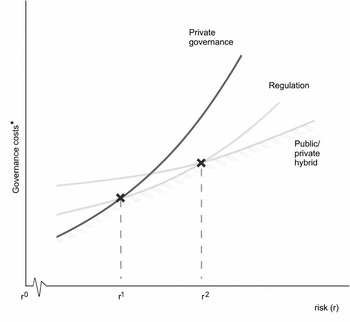
(2) The governance costs contracting curves scheme presents the order of private governance structures along the dimension asset specificity, frequency or risk. Due to different governance costs functions, the ‘natural order’ of the market, hybrid and firm differs for different levels of asset specificity, frequency or risk. The governance costs scheme for private governance structures may be extended to public governance structures as well. See Figure 1.
Figure 1Governance costs contracting scheme
Source: Adapted from Williamson (Reference Williamson1991: 284); Ménard (Reference Ménard2006).
* Measured not in absolute terms but in remediableness terms.
r0 = low risk
r1 = medium risk
r2 = high risk


In Figure 1, Williamson's private governance costs scheme is extended to public governance structures, namely, the governance structures regulation and public/private hybrid are added. The dimension of transactions is risk. This dimension is chosen because ObamaCare aims to address the risk of adverse selection.
Figure 1 shows that governance costs are rather low for transactions performed at a low level of risk, but increase at higher levels of risk; hence, the governance costs functions have a rather low intercept with the vertical axis, but a rather steep slope. The reason that costs are rising with the level of risk is obvious: the higher the risks, the more or stronger safeguards are required. The steep slope reflects the assumption of diminishing marginal returns to investment in safeguards.
Figure 1 also shows that costs of a public/private hybrid governance structure are higher than costs of private governance structures that address transactions at a low level of risk. This is so because different governance structures embody different sets of features and instruments. A specific set of features and instruments may suit the addressing of a certain risk level better than another.
Although it is mind-boggling to contemplate a private structure that provides collective goods, that is, goods everyone can freely consume without lowering the consumption possibilities of others, it seems to be obvious that contracts will be highly incomplete if private parties are involved in managing special interest distribution or sovereign transactions, among which, foreign affairs, the military, foreign intelligence and managing the money supply. Highly incomplete contracts may cause grave difficulties because private parties are much more focused on cost control than public agencies. To save on costs, private parties may abstain from investment to nurture and harness qualities that are highly recommended for the provision of collective goods, namely probity and a committed staff (Williamson, Reference Williamson1999: 307–308, 320–322). This gives public agencies a comparative advantage to provide goods that require a high degree of probity and communal commitment. The other way round, governance costs concerning the provision of private goods, which are goods that are subject to the price mechanism, might be higher under public governance than under market governance. Namely, civil servants have to figure out who wants what and have to fully account for the spending of public money, whereas market prices provide not only information but also incentives. Because public governance is associated with higher search and enforcement costs than the market as far as it concerns the provision of pure individual goods, public governance may be qualified being less suitable to perform this task. Differences in suitability to perform specific transactions lay behind the intersections of governance structures in Figure 1.
Cost curves of governance structures intersect. A shift from one governance structure to another ideally occurs at intersection points in order to achieve the lowest governance costs possible. Ignoring asset specificity and frequency, private governance structures are the preferred choice if risk has values between r0 (zero) and r1. Regulation is preferred if risk is between the values r1 and r2. Public/private hybrid is chosen if risk is higher than r2. However, if different levels of asset specificity and/or frequency are simultaneously taken into account, the result might be that public/private hybrid is chosen to address a medium level of risk.
Regulation is ‘often beset with asset specificity, as with natural monopoly, or by information asymmetries, as with consumer and worker health and safety regulation’ (Williamson, Reference Williamson1999: 320). However, with regard to natural monopoly, also risk is a relevant dimension to decide upon regulation. Namely, ‘competitive bidding for the right to be the sole provider’ may eliminate monopoly profits, but not the risks that circumvent long-term complex contracts. Technological developments may threaten the producer's ‘right to serve’ and the consumer's ‘right to be served’ may be threatened due to, for example, ‘holding up’ consumers or their arbitrary and capricious treatment. Notwithstanding that regulation is problematic as well, the risks associated with the right to be the sole provider may be higher and, consequently, regulation may be optimal (Goldberg, Reference Goldberg1976: 431, 439–440).
Williamson (Reference Williamson1992: 336) qualifies regulation as a hybrid mode of governance structure. As such, it is located in the ‘natural order’ of governance structures between the private governance structures and bureaucracy (Williamson, Reference Williamson1999: 337). This paper labels regulation not as a hybrid in order to avoid confusion with other hybrids, namely cooperation structures between private firms or between private firms and public agencies.
4. Features of public governance structures
Governance structures are characterized by assignment of property rights, contract law regime, risk and reputation. In this section, these four features are dealt with one after another.
Assignment of property rights
‘Most industrialized nations in the OECD, along with Taiwan, seek to operate their health systems on the Principle of Social Solidarity. It means to them that healthcare is to be viewed as a so-called ‘social good’, like elementary and secondary education in the United States. That perspective, in turn, implies that the financial burden of healthcare for the nation as a whole should be allocated to individual members of society roughly in accordance with the individual's ability to pay, and that the needed healthcare should be available to all members of society on roughly equal terms’ (emphasis in original) (Reinhardt, Reference Reinhardt2010: 10).
ObamaCare aims to regulate the financing and purchase of healthcare in line with the principle of social solidarity. It gives all citizens the legal right to healthcare by prohibiting insurance companies to deny coverage if enrollees become sick due to pre-existing conditions with the exception of cases of fraud and intentional misrepresentation (PPACA, 2010: §2712), by subsidizing the poor, by mandating insurance, and by banning medical underwriting practices (§2705). The includability provisions of ObamaCare, that is, the provisions that ensure universal healthcare coverage, reallocate property rights of different stakeholders and redefine responsibilities (Champlin and Knoedler, Reference Champlin and Knoedler2008: 913). In other words, these provisions infringe upon one's personal autonomy (Lepiscopo, Reference Lepiscopo2010: 43). It evokes resistance within a culture that preserves freedom of choice and entrepreneurship.
ObamaCare approaches healthcare as a quasi-collective good. Quasi-collective goods are individual goods, such as healthcare, to which public or collective traits are attributed. Cost shifts induced by uninsured patients who cannot pay for their medical treatment are an example of collective trait of individual goods.
The bills that preceded ObamaCare assigned more collective characteristics to healthcare than ObamaCare. The initially proposed robust public insurance option approached all applicants for health insurance (uninsured and insured citizens who want to change from insurer) as a common pool for not only private governance structures but also for public governance structures. To satisfy the opposition of vested interest groups, who objected that the government would establish a competing health insurance agency, the collective character of healthcare is restricted to giving all citizens the right to healthcare coverage.
Individual mandate
Government intervention in healthcare is a rather controversial issue in the United States. That may explain that 2 lawsuits against ObamaCare were filed in 2009, that is, in advance to ObamaCare, and 25 lawsuits against ObamaCare were filed in 2010. The ObamaCare plaintiffs that filed a lawsuit in 2010 contest especially Congress’ authority to penalize individuals for non-compliance. In all but three of these lawsuits, the individual mandate is challenged. The ObamaCare-plaintiffs are rather diversified. Categories of plaintiffs are, among others:
(1) Healthy Americans who ‘take a calculated risk based on uncertainty of future events’ and prefer to pay for their own healthcare services if and as needed (Holder et al., Reference Holder, Sebelius, Geithner, Machen and White III2010: 3);
(2) Individuals who prefer to pay for medical services out of pocket (Kessler, Reference Kessler2011: 6);
(3) Worshippers who object to join the healthcare insurance because this infringes upon their religious believe that God will provide for their needs (Kessler, Reference Kessler2011: 8) or because one might indirectly become involved with elective abortion coverage (Muise, Reference Muise2010: 4). From this perspective, the minimum coverage provision violates the right to free exercise of religion and free association (Staver et al., Reference Staver, McAlister and McRorie2010: 2);
(4) Individuals who fear loss of privacy because of disclosure of highly personal and confidential information (Bolick et al., Reference Bolick, Cohen, Dranias and Schneider2010: 17, 23, 40–41);
(5) Individuals who do not want to be either placed in debt by the penalty for not complying or to be compelled to work (Hansen, Reference Hansen2010:31);
(6) Intervenors who want to protect their fundamental rights of liberty and justice (Heghmann and Heghmann, Reference Heghmann and Heghmann2011: 11–22);
(7) Small employers who have to divert resources from their business activities in order to buy healthcare insurance for themselves and their dependants claim that these costs may endanger the continuity of their businesses (McCollum, Reference McCollum, Winship, Jacquot, Makar, Hubener, Osterhaus, Rivkin, Casey, Spohn, Harned and Cobb2010a: 19);
(8) Doctors who object being constrained in their opportunities to prescribe treatments or drugs that they think is in the best interest of their patients (Lawrence, Reference Lawrence2010: 2); and
(9) Attorney Generals who are the state's chief enforcement officers and have ‘to defend the [state's anti-mandate] law and the associated sovereign power to enact it’ (Vinson, Reference Vinson2011, 18).
All persons listed here are granted standing to challenge ObamaCare. Given the standing of the plaintiffs and the ripeness of the claim, that is, it is not premature, Court has to answer the question if the contract law regime allows Congress to enforce an individual mandate. The judicial issues behind this question focus on two formal distinctions: the distinction between regulating and taxing, and the distinction between activity and inactivity (Cole, Reference Cole2011: 9). This is more than semantics. The distinction determines if ObamaCare is ruled to be constitutional.
Contract law regime
ObamaCare involves two types of multilateral contracts: contracts between authorities at the federal, state and local levels of government, and contracts of the federal state with different groups of citizens. First, these contracts are subject to the Constitution. Some ObamaCare plaintiffs are afraid that the government gets too much power (Muise and Yerushalmi, Reference Muise and Yerushalmi2011: 23; Vinson, Reference Vinson2011: 42). Second, these contracts are subject to Administrative Law.
The Constitution
The Constitution is not a code of laws but a set of principles to promote democratic freedoms and to ‘reduce the risk of tyranny and abuse’ by governments at every level (Vinson, Reference Vinson2011: 3). The principles are subject to interpretation. This implies that ideological framing might enter the judicial process. If ObamaCare is ruled to be constitutional, the plaintiffs have to reconcile themselves to their fate. Then, ‘no trial or appeal process is available’ anymore against the penalties for not complying with the individual mandate (Purpura and Laster, Reference Purpura and Laster2010: 24).
Congress’ Power to Penalize Individuals for not Complying with the Individual Mandate
The dispute regarding Congress’ power to expropriate individuals by penalizing them for not complying with the minimum coverage provision focuses on the formalistic question if the penalty is a regulatory device or a tax for purposes of the Anti-injunction Act. The Anti-injunction Act provides that ‘no suit for the purpose of restraining the assessment or collection of any tax shall be maintained in any court by any person . . . ’ (Vinson, Reference Vinson2010: 7). If the penalty is a tax, the individual mandate is constitutional because constitutional restraints on Congress's power to tax are few and courts are generally without authority to restrain the assessment or collection of any tax (Vinson, Reference Vinson2010: 11).
There are five indicators to qualify a penalty being a tax in legal contexts (Staman and Broughner, Reference Staman and Broughner2010: 4). It may be characterized being a tax:
(1) If the primary motive of a provision is to generate revenue;
(2) If the amount of the penalty is roughly proportional to the length of time during the year that the taxpayer and his or her dependents lack coverage;
(3) If it does not only fall on individuals that knowingly deviate from the exempt conduct;
(4) If it is enforced by government entities that are traditionally charged with the enforcement of taxes; and
(5) If Congress has qualified it as such.
Judge Vinson (Reference Vinson2010: 12–16, 18, 40) disqualifies the penalty being a tax because Congress has not qualified the penalty as a tax and the penalty is not enforced by entities that are traditionally charged with the enforcement of taxes.
Congress’ Power to Regulate Commerce (Commerce Clause)
If the penalty is not a tax, Vinson (Reference Vinson2011: 40) argues that ‘the Constitutionality of the individual mandate will turn on whether the failure to buy health insurance is “activity”’. The Commerce Clause gives Congress the power to regulate commercial activities (2010: 60).
In accordance with the position of the plaintiffs in the case of the State of Florida, et al., v. U.S. Department of Health and Human Services, et al. (abbreviated hereafter as State of Florida), and supported by 105 economists, among whom the Nobel Laureates Smith and Prescott (Bradbury, Reference Bradbury2011, judges Vinson (Reference Vinson2011: 56) and Hudson (Reference Hudson2010: 4) ruled that the individual mandate to purchase healthcare insurance is unconstitutional. They argue that the healthcare market, just like all other markets that are common in modern economic life, is ‘subject to the basic laws of supply and demand and consumer choice, and it is these laws that will determine the kinds and amounts of goods and services purchased by consumers’ (Bradbury, Reference Bradbury2011: 19). Data concerning average expenditures per year per person are published and individuals are assumed to be able to reasonably estimate costs for the coming year (2011: 20–21). However, it is a statistical fallacy to attribute aggregate properties of a group to the individuals of that group and it neglects that 9 to 12 million uninsured are denied coverage due to pre-existing conditions (Dubina and Hull, Reference Dubina and Hull2011: 17), that is, uninsurance is not always a voluntary choice. With their partial approach to short-term insurance they trivialize the set of conditions that makes healthcare unique. This set concerns the combination of: externalities; the unequal distribution of healthcare needs; the often required expert diagnosis to identify healthcare needs (Hodgson, Reference Hodgson2008: 237, 242–252); ‘the unavoidable need for medical care; the unpredictability of such need; the high cost of care, which frequently far outstrips an individual's or family's ability to pay; the fact that providers cannot refuse to provide care in emergency situations, and generally will not in many other situations; and the very significant cost-shifting that underlies the way medical care is paid for’ in the United States (Laane et al., Reference Laane, Rosen, Thorpe and Haghighat2011: 18–19). The costs shifting not only implies costs related to healthcare provided to the uninsured and the administration related to medical underwriting (Staver et al., Reference Staver, Staver, Mihet, Crampton and McAlister2011: 260a–261a; PPACA, 2010: §1501) but also costs related to private insurance practices to address adverse selection, and costs related to losses for the economy due to poor health and short lifespan of the uninsured (PPACA, 2010: §10106).
Contrary to the District Court judges who ruled ObamaCare to be unconstitutional, Judges Moon (Reference Moon2010), Steeh (Reference Steeh2010) and Kessler (Reference Kessler2011: 45–49) assert that abstaining from insurance is an activity and consequently they ruled ObamaCare to be constitutional. In accordance with the position of the government, supported by the amicus brief of 38 economic scholars, among whom the Nobel Laureates Akerlof, Arrow and Maskin (Rosen, Reference Rosen2010; Laane et al., Reference Laane, Rosen, Thorpe and Haghighat2011), these judges argue that nobody can ‘opt out’ of the healthcare market (Vinson, Reference Vinson2011: 45). Once upon one's lifetime, even if one does not intend to use medical care, one often ends up using it anyway. Individuals only can make a choice regarding when and how to pay for services, which they may expect to receive. If an individual does not have the funds to pay for healthcare and he or she is not insured, this individual may have to face a debt or the costs may have to be paid by providers of medical services (CBO, 2008: 13) and/or by those affected by a patient's bankruptcy (PPACA, 2010: §1501).
Sooner or later nearly everybody has to face healthcare costs and how one pays for healthcare affects market prices, that is, influences interstate commerce. From this perspective, regulation fits into the Commerce Clause. According to the 38 economists that support the reform, one does not have to be afraid that ObamaCare gives Congress the power to regulate everything. Not any other industry is as unique as healthcare if its characteristics are assessed in combination rather than separately (Laane et al. Reference Laane, Rosen, Thorpe and Haghighat2011: 19). Healthcare cannot serve as a precedent for other regulations.
Administrative Law
As soon as the Supreme Court rules ObamaCare to be constitutional it is definitively subject to Administrative Law. Administrative Law governs the activities of administrative agencies. Administrative agencies, such as the United States Department of Health and Human Services, ‘exist to transform general governmental policy into operational reality’ (Mclean, Reference McLean2001: 67). Administrative agencies are in charge to enforce ObamaCare. With their power to adjudicate, legislate, and enforce ObamaCare they may affect the multilateral contracts involved by ObamaCare. These contracts concern the private stakeholders as well as the local and state authorities.
Multilateral contracts with different groups of citizens
ObamaCare stipulates the duties and rights of different groups of citizens in their mutual relationships. If insurers, American citizens or large employers fail to comply with ObamaCare, their omission may result in a shift of costs to other stakeholders. To prevent this, ObamaCare provides a penalty for not complying with the law. In turn, they may file suit for a refund if appropriate (Administrative Procedure Act 5 U.S.C. §702). Next to them, physicians ‘have to meet certain “quality reporting” standards and will have to attain an undefined quality of care to cost ratio that the federal government will deem appropriate or face reductions in Medicare reimbursement rates, with no administrative or judicial recourse’ (Staver et al., Reference Staver, McAlister and McRorie2010: 9).
The contract law regime concerning the regulation of the multilateral contracts with different groups of citizens is simple in comparison to that of public-private partnerships. Public and private entities that cooperate in a hybrid are subject to different laws. First, private parties may solve misbehavior of employees by internal settlements, that is, forbearance, whereas civil servants are subject to procedures and guidelines concerning ethical behavior in public agencies. Second, the initially proposed establishment of the Health Insurance Exchange includes a robust Public Health Insurance Option. In this construction, private insures have to meet several federal and state requirements, such as taxes and antitrust law, whereas the Public Health Insurance Option is exempted from these requirements (Hoff, Reference Hoff2009: 1).
Interference with state sovereignty
Next to the contract relations between the government at the federal level and the private stakeholders, there is the relation between the authorities at federal, state and local levels of government. The contract law regime concerning conflicting state and federal laws is clear. If there is a conflict, federal law is supreme under Article 6 of the Constitution, called the Supremacy Clause. The PPACA provision, concerning the minimum health coverage, conflicts with the anti-mandate statutes of several states (Cauchi, Reference Cauchi2010). If ObamaCare is ruled to be constitutional, the states’ anti-mandate statutes are materially ineffective.
Federal interference with state sovereignty is challenged in the State of Florida, among other things, because ObamaCare imposes ‘unaffordable” bureaucracy costs upon states: States become responsible for providing healthcare services (McCollum et al., Reference McCollum, Winship, Jacquot, Makar, Hubener, Osterhaus, Rivkin, Casey, Spohn, Harned and Cobb2010b, 15), reporting requirements are extended (Stabenow, Reference Stabenow2011), new employees have to be hired and trained, and new and existing employees have to devote a considerable portion of their time to implement ‘the Act (collectively the “administrative mandate”)’ (Bolick et al., Reference Bolick, Cohen, Dranias and Schneider2010: 34).
The imposed administrative costs are not all compensated by the federal government (McCollum et al., Reference McCollum, McMaster, Bruning, Abbott, Shurtleff, Caldwell, King, Cox, Suthers, Corbett, McKenna, Wasden, Jackley, Zoeller, Stenehjem, Barbour, Brewer, Gibbons, Pedue, Sullivan, Brown, Ahlburg, Winship, Jacquot, Makar, Hubener, Upton, Rivkin, Casey, Spohn, Harned and Cobb2010: 17–8; McCollum et al., Reference McCollum, Winship, Jacquot, Makar, Hubener, Osterhaus, Rivkin, Casey, Spohn, Harned and Cobb2010b: 13). This is one of the reasons that the plaintiffs contend that ObamaCare ‘could bankrupt the states’ (McCollum et al., Reference McCollum, Winship, Jacquot, Makar, Hubener, Osterhaus, Rivkin, Casey, Spohn, Harned and Cobb2010a: 32). It places states for an untenable Hobson's choice (Vinson, Reference Vinson2011: 7): they cannot afford the costs and they cannot leave the program because they would ‘lose the federal matching funds that are necessary and essential to provide healthcare coverage to their neediest citizens’. Also the option to amend their Medicaid program is no real option because this requires mutual agreement with the Centers for Medicare & Medicaid services (CMS). Nevertheless, Vinson (Reference Vinson2011: 12) dismisses their coercion and commandeering claim because the states ‘joined Medicaid voluntarily’.
Risk
Public governance is subject to specific types of risk: (1) misallocation of Congress’ power, (2) opportunistic behavior by agencies or local authorities, (3) the hazard of probity of civil servants, and (4) the risk of non-compliance with the law.
The risk of misallocation of Congress’ power may be the result of lobbying (Spithoven, Reference Spithoven2011) or political framing. Both may result in a misinterpretation of Congress’ power ‘to regulate intrastate noncommercial activity based on its effects, [which is at issue in the State of Florida]. Consideration of effects necessarily involves matters of degree . . .’ and poses three hazards (Vinson, Reference Vinson2011: 20):
(1) A too broad interpretation of effects of Congress’ authority to regulate noncommercial activities results in a limitless federal power;
(2) A too narrow interpretation of effects of enumerated federal powers undermines the protection and control of commerce among states; and
(3) A too standardized interpretation of effects of federal powers results in a too strong influence of subjective judges on political decision making.
The plaintiffs in the State of Florida think that ObamaCare is subject to the form of misinterpretation that is mentioned under a.
The second form of risk concerns the risk that agencies or local authorities may develop their own standards, which cannot be related to the goals of central authorities. For example, agencies may apply accounting practices that are not completely according to the spirit of the complex set of rules laid down by the federal government. Local administrative authorities may be reluctant to repeal these practices as long as it does not cost them money. Namely, not all the 28 states that filed a lawsuit against ObamaCare may be assumed to comply whole-heartedly with the PPACA provisions if ObamaCare is ruled to be constitutional. In other words, the federal state cannot blindly trust administrations of partly self-governing states.
The third risk concerns the hazard of probity within public agencies, in the present case especially the United States Health and Human Services Secretary. ObamaCare gives civil servants wide latitude in implementing the law. Their administrative discretion requires them to apply the highest levels of ethical behavior, that is, they must abstain from corruption, nepotism, self-enrichment, fraud and waste, and take appropriate action if the Standard of Conduct is breached. With the exception of wasteful use of funds (§1311), the PPACA does not set ethical codes for agencies. In general, Standards of Conduct for civil servants are established by the United States Office of Government Ethics.
The fourth risk is that of non-compliance with the provisions of ObamaCare. Besides non-compliance with the insurance mandates, examples of provisions that are subject to non-compliance are those aiming to lower healthcare costs such as the tax on extreme luxurious health plans (§9001), the provisions to address ‘excess’ hospital readmissions (§3025), the limitation on excessive remuneration paid by certain health insurance providers to any employee, directors or independent contractors (§9014), the best practices method that requires health plans to focus on treatments that has proven to be most effective (§§3011–3015), and the Medical Loss Ratio (MLR) provision (§1331). The latter sets the share of premiums for healthcare coverage that may be spent on administration. The risk of non-compliance with the MLR provision is rooted in the possibility for accounting tricks: administration activities in the form of utilization reviews for reducing unnecessary treatment may be approached as medical expenditure. Medical expenditure includes ‘activities such as quality reporting, effective case management, care coordination, chronic disease management, and medication and care compliance initiatives’ (HHS, 2010: 74875).
If the risk of non-compliance with the costs curtailing PPACA-provisions materializes, the robust healthcare insurance option might be a feasible alternative. However, the benefits of cost curtailing have to be compared with the risks associated with public/private governance. One of these risks is the risk of hold-up. Partnerships usually imply that partners have access to non-public price, output, costs and purchase sensitive information. Disclosure of this information may raise competition concerns. The fear that the contracting party may disclose sensible information may withhold the private firm to reveal possible irregularities by administrative agencies and the other way round.
Reputation effects
In the United States, government intervention in society and economy is received with severe skepticism. Higher taxes, price setting, cuts in existing government programs (Medicare), increased government involvement in day-to-day medical decision making and growing bureaucracy are all potential consequences of healthcare reform that frighten Americans. Consequently, healthcare reform is easily interpreted to constitute infringement of fundamental liberties.
ObamaCare is criticized for distorting the market (Getchell et al., Reference Getchell, James, McCullough, Russell and Hambrick2010: 15), being bureaucratic (administrative mandate) and being a form of socialism. Among others, the Independent American Party of Nevada, explicitly claims that ObamaCare establishes ‘Socialism as a civil/ secular religion’ (Hansen, Reference Hansen2010: 19), and Republicans tend to qualify ObamaCare as a step in the direction of socialism. These allegations are prevalent enough to make Obama (Reference Obama2009) feel obliged to state explicitly, in his address to the American Medical Association, that his reform is not about ‘socialized medicine and government takeovers; long lines and rationed care; decisions made by bureaucrats and not doctors’. ObamaCare bolsters the employer-based insurance system.
Continuation of private healthcare insurance is the default value for healthcare reform in the United States (Heghmann and Heghmann, Reference Heghmann and Heghmann2011). The PPACA (§1501) explicitly mentions that it builds upon and strengthens the private employer-based health insurance system. Physicians keep autonomy over patients care and may continue to work in private practices or hospitals. Consequently, ObamaCare is anything but radical. It closely resembles the 2006 Massachusetts reform and bolsters the employer-based insurance system.
Strategic reasons may explain why Congress abstained from qualifying the penalty for failing to comply with the individual mandate being a tax. According to Vinson (Reference Vinson2010: 27), the members of Congress did not describe the penalty as revenue-generating, possibly because they wanted ‘to insulate themselves from the potential electoral ramifications of their votes’. So, Congress may have decided to omit to qualify the penalty as a tax in order to avoid to be held accountable for taxes they proposed.
Next to this, reputation of politicians is in danger by challenging their trustworthiness. With regard ObamaCare, the trustworthiness of politicians is challenged:
(1) Already by the pure fact that legal actions are taken (Erich and Shreta, Reference Erich and Shreta2011). Every incidence of ruling ObamaCare to be unconstitutional may influence the credibility of the present government and frustrate passing another piece of legislation;
(2) By the allegation that Congress and Obama have abused their power to regulate healthcare (Irion, Reference Irion2010: 339);
(3) By asking access to the records concerning closed door negotiations (Orfanedes and Aldrich, Reference Orfanedes and Aldrich2010: 2–3) and in doing so suggesting that objectionable practices occurred in getting the PPACA accepted in Congress.
The criticism of market distortion is also applicable to the public/private hybrid. Distortions arise because of different tax regimes for public agencies and private firms. Another source of market distortion is the lower funding costs because governments may borrow money at lower interest rates. Next to this, the robust public insurance option is run by the state. This is a form of socialism.
Summary of features
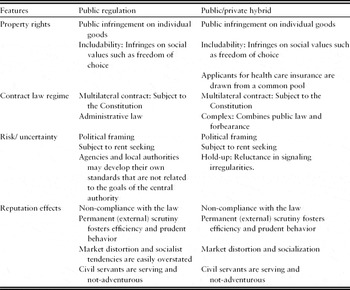
The assignment of quasi-collective property rights proves to be a cardinal feature of regulation and the public/private hybrid. The culture of freedom of choice for entrepreneurs and consumers sets limits to the quasi-collective assignment of property rights and frames the reputation of legislators and civil servants.
The assignment of quasi-collective property rights is calibrated with the prevailing contract law regime. The insurance mandates are subject to a constitutionality test and the enforcement of ObamaCare is subject to Administrative Law.
The assignment of quasi-collective property rights to healthcare is subject to several risks such as political disputes, misinterpretations by authorities and lobbying by specific stakeholders. These risks may negatively influence the reputation of the Obama administration. The criticisms of market distortion and socialist tendencies of the Obama administration are easily given.
Table 1 gives an overview of features concerning the public governance structures regulation and public/private hybrid.
Features of governance structures

5. Key categories of instruments of governance structures
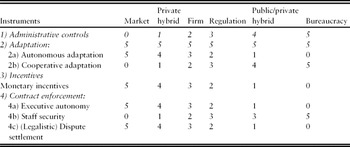
Williamson (Reference Williamson1999) distinguishes four categories of instruments of governance structures: administrative controls, adaptation, incentives and contract enforcement. He classifies these instruments on a weak–strong continuum along the ‘natural order of governance structures’. It results in a specific compilation of instruments attributed to governance structures. See Table 2.
Categories of instruments of governance structures

Source: Adapted from Williamson Reference Williamson1999: 314, 336. 0 = zero 1 = weak/low 3 = semi-strong 5 = strong/high
Administrative controls
Administrative controls concern collection of information with regard to transactions. It may involve orientation upon possible transactions, registration of concluded contracts and performance of contracts.
The market is characterized by low administrative controls, whereas public governance is characterized by rather strong controls as can be seen in Table 2. With regard to regulation the strong administrative controls may be explained by:
(1) Providers of public services who might be more responsive to lobbyists than to the public interest. Therefore, administrative safeguards are enforced to control them. These safeguards may take many forms, including direct supervision, extensive notice-and-comment rulemaking, extensive reporting requirements (Stabenow, Reference Stabenow2011), and conflict-of-interest regulations. For example:
a. Civil servants have to fully account for their performance of their narrowly-formulated duties.
b. Nursing facilities are subject to programs to prevent and detect criminal, civil and administrative violations (PPACA, 2010: §6102).
c. Health insurers have to clearly account for the costs (PPACA, 2010: §2718) in order to enable a premium reviewing process to ensure that consumers get value for their dollars requires (§2794).
(2) The requirement of collecting information and monitor processes. This concerns:
a. The compliance with insurance mandates.
b. The quality reporting requirements for physicians and hospitals.
c. The assessment of the eligibility for subsidies or tax credits for small employers (PPACA, 2010: §§1401–21).
d. The figuring out who is eligible for subsidies, how much each person or family is eligible for and redetermining this eligibility regularly (Bondi et al., Reference Bondi, Wilson, Bruning, Abbott, Shurtleff, Caldwell, Strange, Schuette, Suthers, Corbett, Ryan, McKenna, Wasden, Jackley, Zoeller, Stenehjem, Barbour, Brewer, Horne, Gibbons, Olens, Sullivan, DeWine, Schmidt, Mead, Hollen, Schneider, Branstad, Brown, Ahlburg, Winship, Jacquot, Makar, Hubener, Osterhaus, Rivkin, Casey, Spohn, Harned, Cobb and Kawski2011: 19).
Administrative controls in the withdrawn proposal to establish a robust health insurance option might have been stronger than under regulation because this agency may enter into administrative contracts, which require strict monitoring, and it has to collect data for being able to establish premiums and payment rates (AHCAA, 2009: §321). These tasks directly increase administrative costs.
Adaptability
Every governance structure copes differently with risks. The one relies more on autonomous and the other more on cooperative adaptation. According to Williamson (Reference Williamson, Ménard and Shirley2005; Reference Williamson2010), adaptation may be assumed to be irrelevant for the choice of governance structures if cooperative and autonomous adaptations are in balance. This might be true for the effectiveness of adaptation but untrue with regard to the costs of adaptation. Collective adaptation involves negotiations. This has become clear in the whole process of drafting the healthcare reform. The more a governance structure relies on collective adaptation, the higher negotiation costs are.
Collective adaptation to contingencies with regard to ObamaCare is subject to political decision making just like the lawsuit against ObamaCare. All the states that filed/joined the State of Florida have a Republican antecedence. Because political motives are involved, cooperative adaptation may defect. In line with this deficiency in collective adaptation, implementation of ObamaCare might become frustrated. This is a real risk. For example, the House passed several bipartisan amendments to the Full-Year Continuing Appropriations Act (H.R. 1) with the consequence that the Obama administration gets less money than requested to carry out the ObamaCare-provisions (Elmendorf, Reference Elmendorf2011).
Because neither individuals nor the state know best, the demand for essential healthcare benefits has to be interactively assessed (Hodgson, Reference Hodgson2008: 249). Incremental adaptation is the responsibility of administering agencies. Radical adaptations are the responsibility of legislators. Adaptations might be hampered by lobbying activities or by political strategic considerations. Politicians may have their own political agenda (Drew, Reference Drew2009). For example, Republicans and Democratic Blue Dogs are focused on keeping the government as small as possible. This may enforce them ‘to strip the Department of Health and Human Services of the money necessary to implement the law's requirement that all Americans buy health insurance’ (Reich, Reference Reich2011). This might threaten a smooth enforcement of ObamaCare.
With regard to cooperative adaptation, a public/private hybrid would be less suitable to address adverse selection than regulation. A hybrid allocates more authoritative power to the government than regulation and this is more associated with an un-American culture. Therefore, a hybrid to address adverse selection is likely to meet much more resistance to adapt to changes in demand and supply of healthcare.
Incentives
An appeal to communal sentiments is inherent to healthcare, which is operated on the principle of social solidarity. Examples of utility interdependent communal incentives are: social or professional status, sympathy or interest in the well being of patients. With regard to, for example, Medicare, physician's communal interests are institutionalized in reimbursement rates that require physicians to provide healthcare below the normal market price (Staver et al., Reference Staver, McAlister and McRorie2010: 9). Another institution is the use of capitation compensation of physicians under Medicare. This institution may prevent physicians, on the one hand, to refer costly patients to other physicians or to withhold them the necessary treatment and, on the other hand, to prescribe unnecessary treatments which might occur if one is paid on a fee-for-service basis. Capitation is remuneration of healthcare workers based on the average expected healthcare utilization for each enrolled person assigned to that healthcare worker, whether or not that person actually seeks healthcare.
Communal and monetary incentives in ObamaCare may be qualified to be unbalanced: Physicians need to take into account patients’ interests, but do not always fully do so, and often do not take into account the impact of their decisions on other patients. Insurers may end up subsidizing the costs of care for the uninsured, but this may hardly affect their incentives with respect to decisions about their own enrollees. Drug manufacturers may sometimes engage in philanthropic activities, as do other for-profit companies, but often it is with an eye toward increasing profits in the long run by securing the goodwill of legislators and the public. At the same time, the strength of communal incentives within public agencies is not at all clear, particularly given the rent seeking behaviors of vested interest groups. If actors are driven by monetary incentives, whereas public governance assumes communal incentives, these actors may enrich themselves at the costs of others. These imbalances in incentives may result in rising healthcare costs.
A public/private hybrid in healthcare involves a much stronger infringement upon discretionary powers of private parties than ObamaCare. The robust health insurance option sets prices for healthcare at competitive levels, that is, between Medicare and the average of the premiums levied by private insurers (AHCAA, 2009: §323). Consequently, competition by the robust health insurance option might enforce lower premiums in the private sector. It reduces the role of pecuniary incentives in healthcare insurance. Due to political controversies and the fact that several doctors already contest the individual mandate, this choice is not feasible. For an institution to be effective, it is necessary that it has a critical mass of support.
Contract enforcement
Contract enforcement concerns two types of devises: probity enforcing and coercion-constraining institutions. With regard to the probity enforcing devises, Williamson (Reference Williamson1999) mentions discretionary power and stability of jobs as two components of contract enforcement. The coercion-constraining enforcement mechanisms or legalistic dispute settlements are related to the Constitution and Administrative Law. Related to ObamaCare, these devices concern different types of suits: firstly, the lawsuits concerning its constitutionality and, secondly, as of 2014, agencies have to face post-collection suit for refund if unexpected improper penalty levying may occur.
Probity enforcement devises
The first probity enforcement devise relates to the loss of autonomy of civil servants in comparison to employees in the private sector. This loss is compensated by a higher job security. However, if public funds are scarcely diverted to PPACA agencies, as seems to be the case (Elmendorf, Reference Elmendorf2011), the hazard of probity might become a serious issue. Namely, a shortage of funds might endanger job security and this might affect the loyalty and rectitude of employees.
With regard to imbalances in pecuniary and communal incentives, ObamaCare tries to nurture and harness, in terms of Hodgson (Reference Hodgson2008: 250), ‘professional ethos of care and obligation that is above and beyond any pecuniary motive for healthcare workers’. For example, the PPACA (2010: §3022) directs the Secretary of Human Health Services to establish The Medicare Shared Savings Program for fee-for-service beneficiaries. This is an integrated care delivery model using Accountable Care Organizations to reduce costs and improve quality.
With regard to the public/private hybrid, it might be said that payment negotiations for items such as drugs and healthcare services (AHCAA, 2009: §323) are tasks that try the civil servant's mettle. Therefore, the robust healthcare insurance agency has to employ a more rigorous scrutiny of employees than the agencies in charge of implementing regulations.
Coercion-constraining devises
The first coercion-constraining devise is the constitutionality test. This is rather costly: The plaintiffs in the State of Florida thought it necessary to agree upon sharing costs ‘to cover resources and personnel to pursue the case’. The same reason may also lay behind the negotiation of a discount rate. The combined plaintiffs in the State of Florida succeeded in getting the constitutional scholar to engage at 26% of his usual charges (Health Care Lawsuit, 2011). The ObamaCare litigation shows that a constitutionality test heavily leans on exegeses of earlier cases. The ObamaCare-lawsuits refer often to cases of the Supreme Court or the District Courts of Appeal.
The second coercion-constraining devise is the post-collection suit. However, it is doubtful that individuals may follow this legal path. ‘Congress specifically exempted and divorced the penalty from all the traditional enforcement and collection methods used by the Internal Revenue Service [IRS], such as tax liens, levies, and criminal proceedings.’ (Vinson Reference Vinson2010, 18). If somebody does not sign up for insurance and refuses to pay the penalty, the only thing the IRS can do is to deduct the penalty from any tax credit or current or future federal benefits a taxpayer is due (Tanner, Reference Tanner2010, 3). This flaws the effectiveness of ObamaCare.
Summary of key categories of instruments
The strength of instruments is related to the features of governance structures:
(1) Assignment of property rights and instruments: Contract enforcement is rather easy when property rights are clear and unambiguous. However, property rights might be highly disputable when quasi-collective goods are involved. For example, economists prove to adhere to opposing views concerning the quasi-collective character of healthcare. Disagreement about the character of a service or a good complicates contract enforcement. Even lawsuits may become involved. Besides this, contract enforcement is handicapped because, due to the fact that the penalty is treated as a tax, the IRS is bounded in its possibilities to sanction individuals for non-compliance with the individual mandate. The provision of quasi-collective goods appeals to communal sentiments. This incentive is not limited to civil servants who are in charge with the implementation of the law. It also applies to private stakeholders. In the present case especially the physicians: ‘A physician is expected to earn a living by helping others and at the same time he is expected to help when there is need’ (Spithoven, Reference Spithoven2011: 76). Appropriate institutions have to be in charge to enforce a balance between both interests.
(2) Contract law regime and instruments: The Constitution and Administrative law serve to constrain the power of the regulator. They enable stakeholders to file a suit. Besides this contract enforcement devise, also adaptation mechanisms are related to the contract law regime. Because multilateral contracts are involved, legislators have to balance the interests of several stakeholders in order to come to an agreement concerning adaptations. This requires cooperation. However, strategic behavior of politicians may frustrate collective adaptation.
(3) Reputation effects and instruments: Public governance has a bad reputation. It is easily suspected of improper spending of taxpayer money. This has implications for the intensity of administration: In order to monitor the spending of tax money civil servants have to provide a meticulous justification of all decisions and spending.
(4) Risk and instruments: Just like everybody, civil servants are subject to potential opportunistic behavior. Fore example, they are vulnerable to lobbying. In order to mitigate the hazard of probity, public agencies may guarantee stability of jobs. This may weaken but not eliminate the need for meticulous justification all their decisions and actions.
The instruments prove to be imbalanced. The imbalances concern, on the one hand, the adaptation mechanisms and, on the other hand, the incentive mechanisms. These imbalances are related to the controversies concerning the quasi-collective character of healthcare.
6. Conclusion and some discussion notes
Private insurers address adverse selection in health insurance with medical underwriting and rescinding healthcare coverage if enrollees become sick due to pre-existing conditions. These rationing practices result in denying coverage to citizens with high healthcare risks. The increase in numbers of uncovered citizens with high risks increases the risk of uncompensated care. If providers of healthcare shift these costs to insurers in the form of higher prices, insurance premiums are likely to increase. Higher premiums result in increasing adverse selection, which in turn is counteracted with intensifying rationing practices. The resulting premium spiral is addressed by ObamaCare, that is, the governance structure that regulates healthcare in the United States.
Given the culture of freedom of choice for entrepreneurs and consumers, ObamaCare provides a calibrated system of features to regulate healthcare. Its rather weak assignment of quasi-collective property rights reflects the criticism of market distortion and the alleged socialist inclinations of Democrats. In line with this, the state run robust health insurance option is cancelled and the individual mandate is deliberately exempted from the tax laws, that is, the penalty for non-compliance with the individual mandate is exempted and divorced from all the traditional enforcement and collection methods used by IRS.
The instruments to address adverse selection are strongly related to the features of the relevant governance structure. The operation of healthcare under the principle of social solidarity requires cooperative adaptation, on the one hand, between the private sector and politicians, and, on the other hand, between Democrats and Republicans. Next to this, it requires communal incentives supported by civil servants and private stakeholders.
The probity of civil servants is enforced with tenured contracts and severely monitored. They have to fully account for their actions and decisions. Therefore, administrative costs are rather high.
Politicians, economists and judges take opposite positions in assessing the quasi-collective character of healthcare. In line with this they also differ in position concerning the constitutionality of ObamaCare. The different positions are based on different frames. The partial analysis of short-term healthcare insurance approaches insurance as an isolated transaction, that is, outside its social context. It results in a support of the hypothesis that ObamaCare is unconstitutional. The integral analysis of long-term healthcare insurance approaches insurance as a social transaction, that is, in its social context. It results in supporting the hypothesis that ObamaCare is constitutional. The partial approach ignores uncertainty, qualifies uninsurane as a free choice and consequently plays down private rationing practices. The integral approach recognizes the unpredictability of unavoidable individual need for healthcare and qualifies uninsurance as a decision that might shift costs to others.
If the Supreme Court rules ObamaCare to be constitutional, it may be qualified being a comparative efficient governance structure to address adverse selection. First, the market is unsuitable because its rationing practices generate cost shifts that might worsen adverse selection. Secondly, a state run insurance option meets too much resistance due to its socialist character. This leaves regulation as the best suited governance structure to address adverse selection.
The qualification of regulation as a comparative efficient structure to address adverse selection does not pull out its flaws. There are flaws in its efficiency due to unbalanced adaptation and incentives mechanisms. There is a flaw in effectiveness due to weak devices to enforce the individual mandate. The choice for a penalty in stead of for a tax for non-compliance with the individual mandate weakens the enforcement of this provision.
With the observation that market governance of healthcare insurance is subject to a self-reinforcing premium spiral insurance premium spiral and that Congress passed the reform Act against this spiral, it may be concluded that TCE's relevance for the study of the emergence of institutions springs paradoxically from the deductive method of constructing static governance structure models and from comparison of different static positions, in time, given that the inbuilt system of determinants of governance structures has a unique steady state solution (Brenner, Reference Brenner1966: 107). A comparison of two static positions may result in a list of variables that are the drivers of change. This may concern already recognized variables or primarily left out exogenous variables. With regard to the present case, this comparison may suggest the following set of hypotheses: (1) Adverse selection endanger the profitability of private insurance; (2) competition between insurers results in intensification of rationing policies such as rescission of coverage and medical underwriting; (3) rationing policies result in cost shifts; (4) costs shifts to providers of healthcare may result in higher prices for healthcare; (5) higher prices may result in higher insurance premiums; (6) higher premiums foster adverse selection; (7) the mutual strengthening of increasing premiums and rationing practices to address adverse selection result in a premium spiral; (8) the premium spiral is a reason to choose for regulating healthcare; (9) citizens may be assumed to whole-heartedly support regulation in the form of a ban on private rationing practices to address adverse selection; (10) possible resistance to regulation might weaken because universal coverage may nurture the principle of social solidarity through the support of bans on private activities to counter adverse selection.