Introduction
Long sea journeys to Antarctica expose seafarers to unique life conditions mentally as well as physically due to the severe weather and stressful work conditions, in addition to being far away from one's home country, family and friends. Response to stress is a reaction of the central nervous system to environmental stimuli, which are perceived as threats to homeostasis.
Long journeys can lead to serious health impairments that can cause changes in various biological systems, particularly during rough sea weather when waves cause the ship to rock (rolling and pitching). However, Antarctic environmental conditions also pose challenges to the human body (Norman Reference Norman1991, Palinkas Reference Palinkas1991, Lugg & Shepanek Reference Lugg and Shepanek1999, Reed et al. Reference Reed, Reedy, Palinkas, Van Do, Finney and Case2001) and have varied morbidity patterns (Cattermole Reference Cattermole1999, Bhatia & Pal Reference Bhatia and Pal2012, Lou et al. Reference Lou, Gu and Zhong2015). Exposure to environmental extremes is physiologically stressful and can influence performance. This may be due to a combination of physiological, psychological and environmental stressors, which lead to alterations in biological activities (Brenner et al. Reference Brenner, Shek and Shephard1998, Mitchell et al. Reference Mitchell, Dugas, McFarlin and Nelson2002). Antarctica is a unique place to study the state of human health under the influence of environmental stress. It is also used as a natural laboratory to expand our knowledge of physiology, psychology and the impacts of environmental stressors on various systems of the human body (Carrère et al. Reference Carrère, Evans, Stokols, Harrison, Clearwater and McKay1991).
Experimental evidence has shown that stress modulates the production of secretory immunoglobulin A (sIgA) (Jarillo-Luna et al. Reference Jarillo-Luna, Rivera-Aguilar, Garfias, Lara-Padilla, Kormanovsky and Campos-Rodríguez2007, Martínez-Carrillo et al. Reference Martínez-Carrillo, Godinez-Victoria, Jarillo-Luna, Oros-Pantoja, Abarca-Rojano and Rivera-Aguilar2011) and the expression of polymeric immunoglobulin receptor (pIgR) (Reyna-Garfias et al. Reference Reyna-Garfias, Miliar, Jarillo-Luna, Rivera-Aguilar, Pacheco-Yepez, Baeza and Campos-Rodríguez2010). Through transcytosis, this receptor transports immunoglobulin-pIgR (dimeric IgA-polymeric IgR and polymeric IgA-polymeric IgR) complexes through intestinal epithelial cells. When arriving at the other side of these cells, pIgR is cleaved to release sIgA and secretory component (SC), a peptide derived from pIgR in the intestinal lumen (Brandtzaeg Reference Brandtzaeg2009). Together with the intestinal microflora, both sIgA and pIgR play an essential role in two important intestinal processes: protecting against pathogenic agents that invade and/or colonize the intestinal epithelium and modulating the inflammatory bowel response in order to maintain homeostasis (Bruno et al. Reference Bruno, Rogier, Frantz, Stefka, Thompson and Kaetzel2010, Drago-Serrano et al. Reference Drago-Serrano, Rivera-Aguilar, Reséndiz-Albor and Campos-Rodríguez2010).
In general, it is believed that IgA is the first line of defence against harmful environmental factors due to its dominance in the immune system of the mucous membrane. IgA is the major glycoprotein to have been described in recent years. It is produced by mature B cells (Mestecky & McGhee Reference Mestecky and McGhee1987) in the blood and excreted in body fluids (Klentrou et al. Reference Klentrou, Cieslak, MacNeil, Vintinner and Plyley2002), such as saliva and tears, as well as in isopharyngeal, bronchial, gut and urogenital secretions (Gleeson Reference Gleeson2000), and it freely penetrates through the mucous membranes. The IgA class is characterized by considerable heterogeneity. There are two subclasses: IgA1 and IgA2, which differ in structure and distribution and occur in different proportions in the tissues and organs of the human body (Mestecky et al. Reference Mestecky, Lue, Tarkowski, Ladjeva, Peterman, Moldoveanu and Peeters1989, Kerr Reference Kerr1990, Macpherson et al. Reference Macpherson, McCoy, Johansen and Brandtzaeg2008). The differences between the IgA subclasses relates only to 22 amino acids within their hinge regions (Macpherson et al. Reference Macpherson, McCoy, Johansen and Brandtzaeg2008). In the IgA2 molecule, there is a deletion of 13 amino acids in this region; however, the hinge region of the IgA1 molecule contains three to five linked oligosaccharide domains, which are not found in IgA2.
The immune response mounted by IgA arises in response to many pathogens and is induced locally in the mucous membranes. Secretion of IgA in saliva is stimulated by various factors, such as stress or physical activity (Proctor & Carpenter Reference Proctor and Carpenter2007). The elimination and composition of saliva depends on the activity of the sympathetic and parasympathetic nervous systems. Bodily activity stimulates the autonomic nervous system, which can reduce the amount of saliva and/or inhibit its elimination (Dhabhar & McEwen Reference Dhabhar and McEwen1997). It is now known that modulation of sIgA is affected by the duration (acute or chronic) and intensity of stress. Multiple sessions of stressors over a period of several days, weeks or months exemplifies chronic stress (Klentrou et al. Reference Klentrou, Cieslak, MacNeil, Vintinner and Plyley2002), which regulates the systemic immune response. The synthesis of IgA is a significant mechanism at play in the mucosa that promotes immunity without causing inflammation. Several cytokine signals have been shown to be involved in IgA production, and TGF-β is an efficient immunosuppressive cytokine that is involved in the development and functioning of many immune cells, including T and B cells, dendritic cells (DCs) and natural killer (NK) cells (Flavell et al. Reference Flavell, Sanjabi, Wrzesinski and Licona-Limón2010), mediated mainly by TGF-β cytokine signalling (Cerutti & Rescigno Reference Cerutti and Rescigno2008).
The focus of this research on the expedition to Antarctica is the ship journey itself, which leaves expeditioners very stressed due to the rolling and pitching of the ship and the adverse weather conditions in the Southern Ocean. The 34th Indian Scientific Expedition to Antarctica (ISEA) expedition encountered seven major cyclones (> 95 knots) on the way to Antarctica, which made the expeditioners feel stressed and tired. There are no reports available on the impact of extreme environmental conditions on mucosal immunity. Thus, the aim of the present study is to explore the impact of Antarctic environmental stress on the humoral and mucosal components, primarily IgA, IgA1 and IgA2 and salivary TGF-β, the first such study of its kind.
Materials and methods
Study subjects
Twelve expedition members (all males) had volunteered as subjects for the study. Their ages ranged from 22 to 60 years, with a mean age of 40 years. Subjects had undergone pre-departure clinical, psychological and laboratory examinations to ensure they represented a healthy population during their entire Antarctic stay. The expeditioners neither had any signs or symptoms indicative of infection during the study, nor had they used drugs that could significantly affect their immunological parameters. Before beginning the sample collection, all of the members/volunteers were made aware of the complete study design and its importance. Various samples were collected based upon the willingness of the volunteers and the logistical support available. The environmental features at all time points are summarized in Table I.
Environmental features.

Sample collection
Blood and saliva (2 ml each) were collected from the expedition members in the morning between 06h00 and 07h00 on empty stomach at three different time points: at Cape Town as the baseline collection (T1); at the Larsemann hill area (Bharati station) after completion of 15 days of the ship journey to reach Bharti station (T2); and at Schirmacher Oasis (Maitri station) after completion of a stay of 30 days (T3). Clot activator vacutainers were used to collect blood samples, which were stored at 4°C for 2 h, leaving behind a clear serum. The serum was collected in fresh tubes and centrifuged at 1300 rpm for 10 min. The serum was stored in small aliquots for further analysis at -40°C. Using the spitting process, 2 ml of unstimulated saliva were collected in sterile tubes and centrifuged at 1200 rpm for 10 min, and the transparent fluid was drawn out carefully, excluding the pellet at the bottom, and transferred into storage vials at -40°C.
Quantification of cortisol in serum and saliva
Cortisol was quantified according to the manufacturer's protocol (R&D System, USA). Briefly, a pre-coated 96 microwell plate with anti-cortisol antibody was incubated with 20 μl of standard and serum, or saliva samples, followed by incubation with cortisol-horseradish peroxidase (HRP) conjugate for 45 min at room temperature at 200 rpm on a plate shaker. The plates were washed thrice with a wash buffer. Finally, the colour was developed using a peroxide/3,3’,5,5'-tetramethylbenzidine (TMB) substrate solution and stopped within 15 min by acidification with a stop solution. Absorption was measured at 450 nm.
Quantification of serum IgA and sIgA and its subtypes
IgA, IgA1 and IgA2 in serum and saliva were quantified using a sandwich enzyme-linked immunosorbent assay kit (Fine Test, China). Briefly, in pre-coated microplates, standards or samples were added to each well and incubated for 90 min at 37°C. Biotin-labelled anti-IgA, anti-IgA1 and anti-IgA2 detection antibodies were added after washing. After 60 min of incubation, HRP-streptavidin conjugate was added, followed by incubation for 30 min at 37°C. TMB substrate was added for blue colour development, and the reaction was stopped using an acidic stop solution. Absorbance was measured at 450 nm in the microplate reader and the concentration was calculated based on the standard curve.
Quantification of salivary TGF-β
Salivary TGF-β was quantified according to the manufacturer's protocol (Fine Test, China). Briefly, the microplate was pre-coated with anti-TGF-β capture antibody. Standards and samples were added to each well and incubated at 37°C for 90 min, followed by biotin-labelled detection antibody being added to each well. After 60 min of incubation at 37°C, HRP-steptavidin conjugate was added, followed by incubation for 30 min at 37°C. Furthermore, TMB substrate was added for blue colour development, and the reaction was stopped using an acidic stop solution provided with the kit. Absorbance was measured at 450 nm, and the concentration was calculated based on the standard curve.
Statistical analysis
Parameters were evaluated without missing any data. Repeated-measures analysis of variance with Tukey's multiple comparison post hoc test and correlations were performed in order to analyse the data using GraphPad Prism 5.0 and SPSS 21 statistical software. Data are presented as medians with interquartile ranges (IQRs). A P value of ≤ 0.05 was considered significant.
Results
For the assessment of changes in mucosal immunity of the summer expedition members, IgA, IgA1 and IgA2 were estimated in saliva and serum samples.
Estimation of salivary IgA
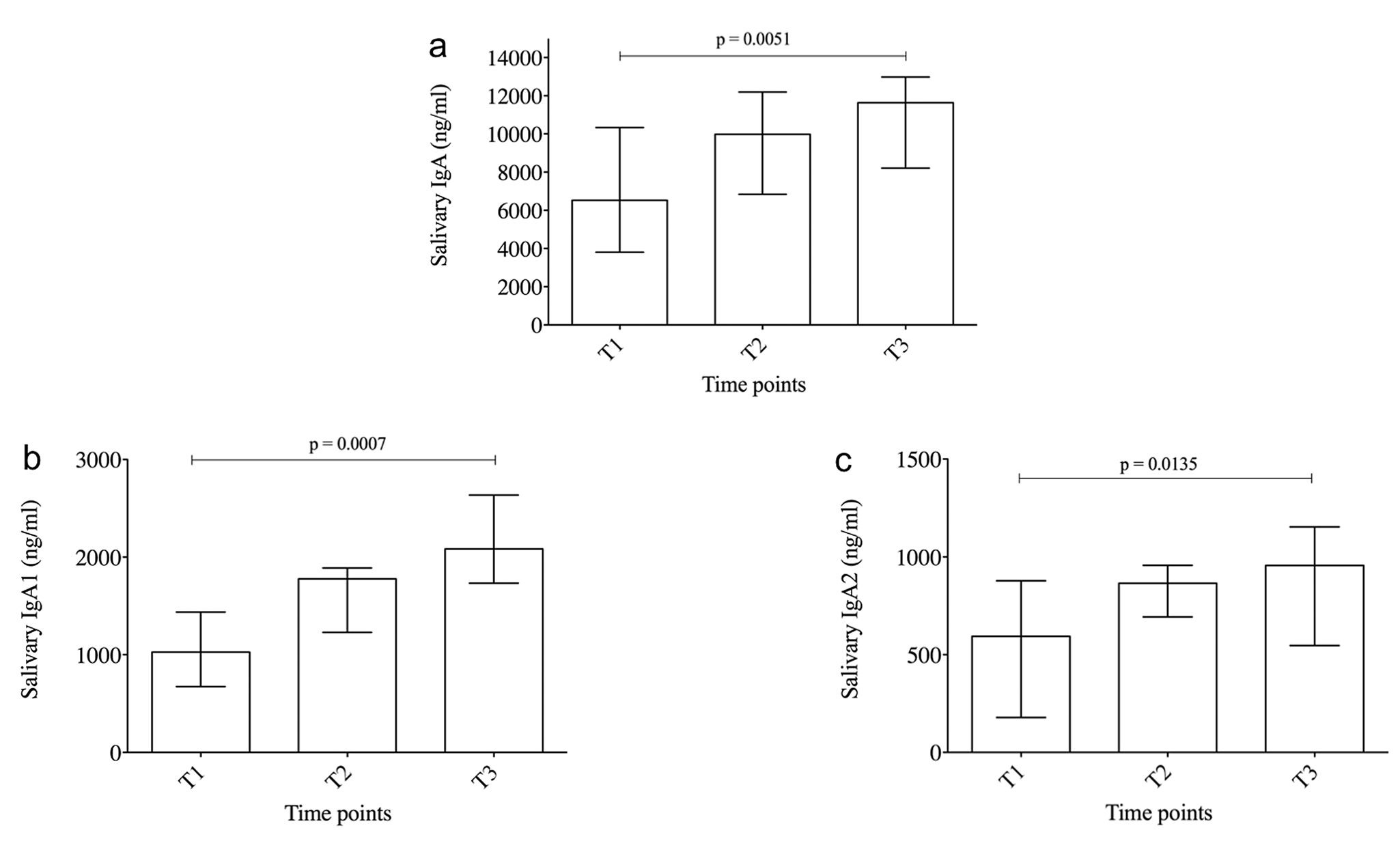
Before proceeding to Antarctica at the T1 time point, the median salivary IgA concentration was 6526 (3803–10 330) ng/ml. Interestingly, the concentration rose to 9983 (6839–12 199) ng/ml after 15 days of the ship journey at T2. The concentrations of salivary IgA further increased to 11 640 (8204–12 982) ng/ml after staying at Maitri station (T3) for 1 month, which was significantly higher (P = 0.0051) than compared to T1. The overall level of salivary IgA was increased after 1 month of staying at the Indian Antarctic station (Fig. 1a).
Salivary IgA and its subtypes. Changes in salivary a. IgA, b. IgA1 and c. IgA2 levels in the 34th Indian Scientific Expedition to Antarctica (ISEA) at T1 (baseline at Cape Town), T2 (at Larsemann hill area, Bharati station) and T3 (at Schirmacher Oasis, Maitri station).

Estimation of salivary IgA
The median salivary IgA1 titre was 1027 (674–1437) ng/ml before proceeding to Antarctica at T1, which is considered as the control. The levels at T2 increased to 1776 (1229–1888) ng/ml after 15 days of the ship journey. The salivary IgA1 level increased even more to 2084 (1733–2635) ng/ml after 1 month of staying at Maitri station (T3), indicating a significant increase compared to baseline at T1 (P = 0.0007) (Fig. 1b).
Estimation of salivary IgA2
The median concentration of salivary IgA2 was 594 (178–878) ng/ml before moving to Antarctica at T1. The concentration rose to 866 (693–957) ng/ml at T2, although this was not a significant increase. The salivary IgA2 level became 957 (547–1153) ng/ml after a 1 month of staying at Maitri station (T3). Overall, the concentrations of salivary IgA2 during vessel travel and at Maitri station changed significantly (P = 0.0135) compared to the levels at T1 (Fig. 1c).
Estimation of salivary cortisol
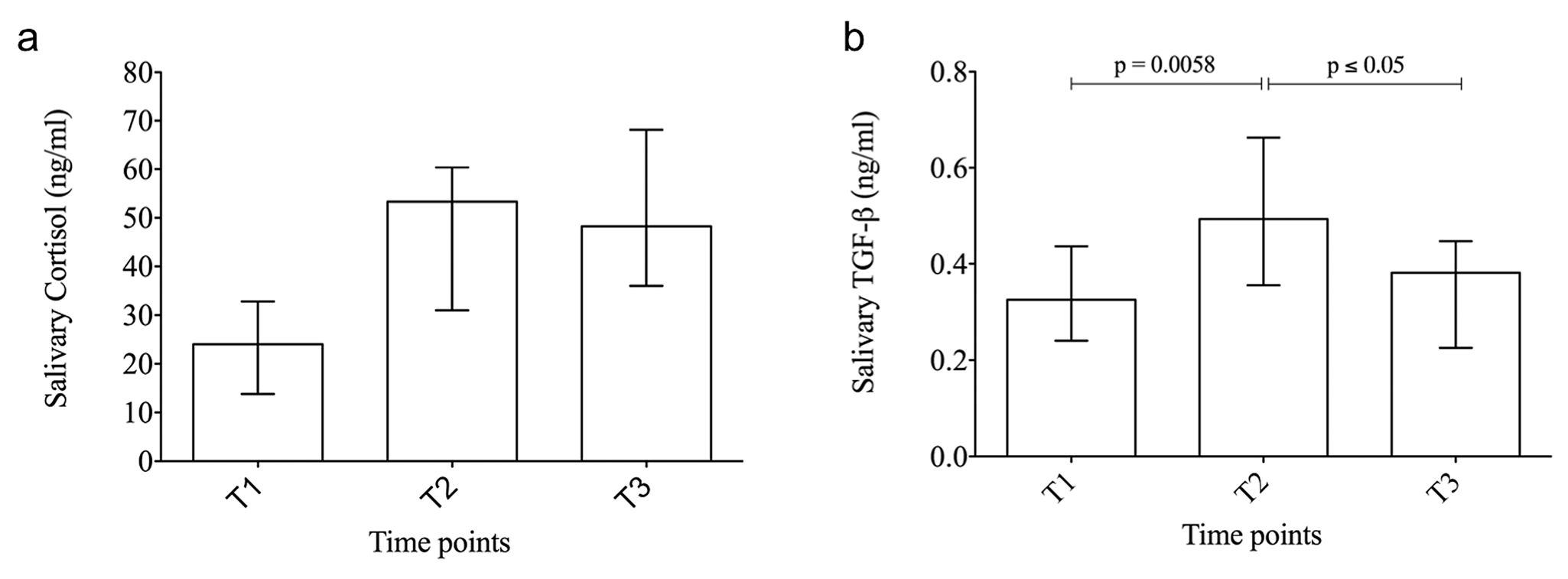
Cortisol was measured in saliva samples of the summer expedition members at various time points. There was no significant change at any point, as indicated in Fig. 2a.
Salivary cortisol and TGF-β. Changes in a. salivary cortisol and b. TGF-β levels during the 34th Indian Scientific Expedition to Antarctica (ISEA) at T1 (baseline at Cape Town), T2 (at Larsemann hill area, Bharati station) and T3 (at Schirmacher Oasis, Maitri station).

Estimation of salivary TGF-β
Salivary TGF-β1, a characteristic cytokine for mucosal immunity, was estimated in the expedition members. Before leaving Cape Town at T1 (baseline), the salivary TGF-β level was 0.325 (0.240–0.436) ng/ml. After 15 days of the ship journey to reach Bharti station (T2), this level increased significantly to 0.493 (0.356–0.662) ng/ml (P = 0.0058). However, after staying in Maitri station (T3) for 1 month, this level dropped significantly (P ≤ 0.05) to 0.382 (0.225–0.447) ng/ml as compared to T1 (Fig. 2b).
Estimation of serum IgA
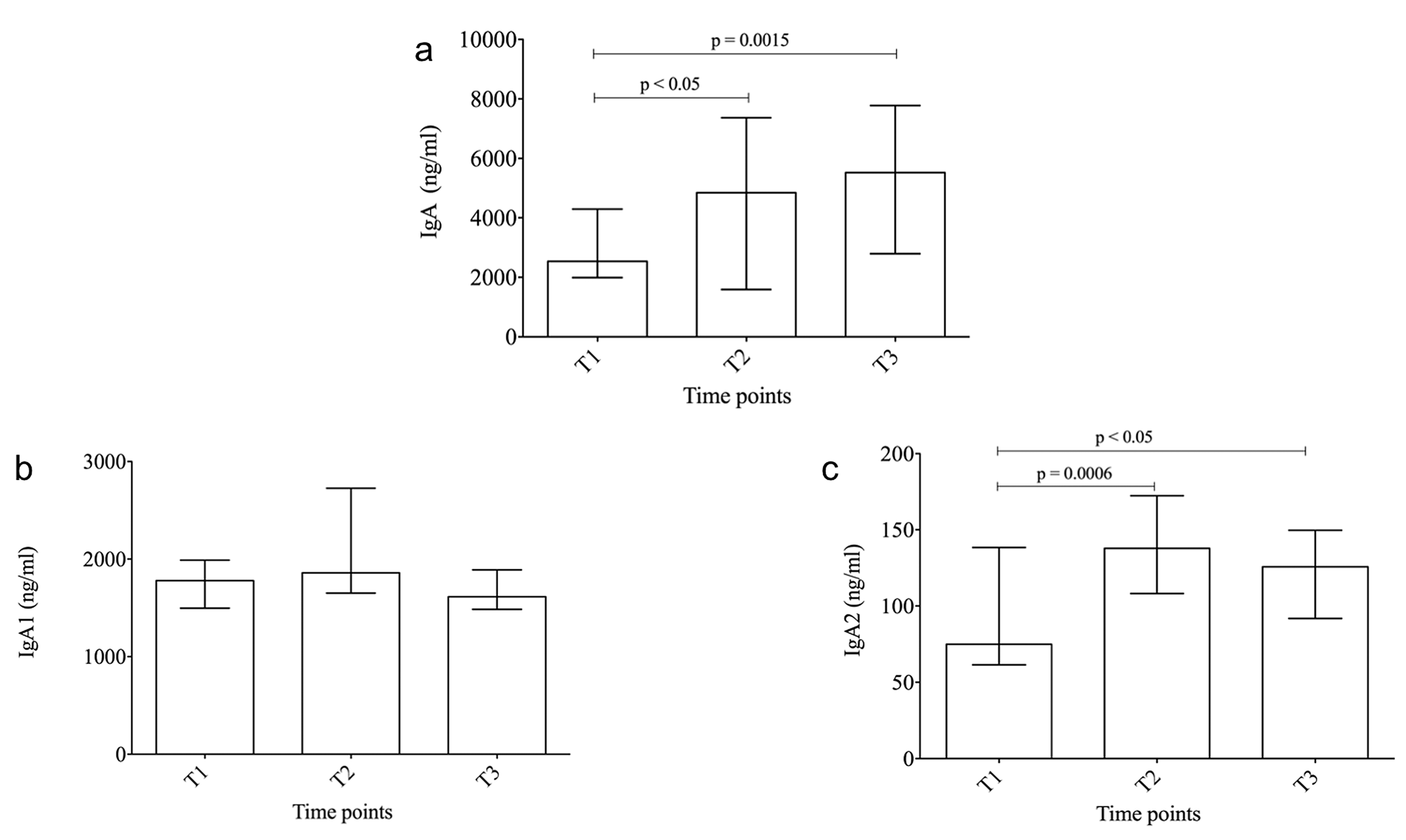
The median concentration of serum IgA before leaving for Antarctica at Cape Town (T1) was 2540 (1993–4293) ng/ml. The level increased significantly (P < 0.05) to 4850 (1590–7370) ng/ml after being on board for 15 days before reaching Bharti station (T2). The level further increased significantly (P = 0.0015) to 5525 (2793–7778) ng/ml after 1 month staying at Maitri station (T3) as compared to at T1 (Fig. 3a).
Serum IgA, IgA1 and IgA2. Changes in serum a. IgA, b. IgA1 and c. IgA2 levels during the 34th Indian Scientific Expedition to Antarctica (ISEA) at T1 (baseline at Cape Town), T2 (at Larsemann hill area, Bharati station) and T3 (at Schirmacher Oasis, Maitri station).

Estimation of serum IgA1
The median concentration of IgA1 was 1780 (1497–1990) ng/ml before proceeding to Antarctica at Cape Town (T1). After reaching Bharti station (T2), the IgA1 concentration increased to 1859 (1652–2727) ng/ml. Surprisingly, the levels decreased slightly to 1615 (1486–1889) ng/ml after staying for 1 month at Maitri station (T3). No significant alteration was observed at any point during the summer expedition (Fig. 3b).
Estimation of serum IgA2
The median concentration of IgA2 at Cape Town (T1) was 74.9 (61.4–138) ng/ml, which increased significantly (P = 0.0006) to 138 (108–172) ng/ml after reaching Bharti station (T2). A slight decrease was observed in the levels after 1 month staying at Maitri station (T3) to 126 (91.8–150) ng/ml, which is still significantly higher (P < 0.05) as compared to T1 (Fig. 3c).
Discussion
Based on the IgA profile in Indian expeditioners’ saliva and serum samples, the effect of the extreme environmental conditions of Antarctica on the mucosal immune system was investigated and compared with their respective baseline values as controls. Samples were analysed for IgA, IgA1, IgA2, cortisol and salivary TGF-β. In this study, we provide evidence that the Antarctic environment induces increases in salivary and serum IgA, significantly affecting mucosal immunity. Interestingly, both sIgA1 and sIgA2 showed increases throughout the expedition as compared to the baseline level.
In recent years, much research has been aimed at explaining why physiological stress affects the immune system of the human body. The immune system is part of the complex and interconnected network of the brain, neurotransmitters and neuropeptides, secretory glands and various types of immune cells, and no single measure of ‘immune functioning’ can fully explain immune competence. However, in experimental research dealing with human subjects, only a few immunological parameters can be measured for practical and ethical reasons. In general, IgA is recognized as the first line of defence against harmful environmental factors due to its dominance in the mucosal immune system. sIgA levels are thought to vary depending on physiological conditions and physical activity.
IgA represents a major class of antibodies present in the body's secretions, such as saliva or tears, and in the mucosal lining of the intestine (Cunningham-Rundles Reference Cunningham-Rundles2001). Salivary secretions and their composition depend on the activity of the sympathetic and parasympathetic nervous systems. Environmental stressors such as cold, isolation and fear, which stimulate the autonomic nervous system, can reduce the amount of saliva and/or reduce secretions. This could be the reason for the significantly increased levels of the salivary and serum IgA in the expedition members. In addition to changes in saliva volume, physical activity can also cause changes in the concentrations of some of its components, such as immunoglobulins and α-amylases (Bishop & Gleeson Reference Bishop and Gleeson2009). Many studies have shown an increase in total protein in the saliva after intense exercise (Cavas et al. Reference Cavas, Arpinar and Yurdakoc2005, Hübner-Woźniak et al. Reference Hübner-Woźniak, Lutosławska, Sendecki and Sitkowski1997, Reference Hübner-Woźniak, Sendecki and Borkowski1998). This is explained by the high activity of the β-adrenergic receptor in the salivary glands (Walsh et al. Reference Walsh, Blannin, Clark, Cook, Robson and Gleeson1999). Some authors have noted a significant decrease in the concentration of salivary IgA following intense physical exercise (Fahlman et al. Reference Fahlman, Engels, Morgan and Kolokouri2001, Nieman et al. Reference Nieman, Henson and Fagoaga2002, Walsh et al. Reference Walsh, Bishop, Blackwell, Wierzbicki and Montague2002). On similar lines, the expedition members have to perform various logistical activities during the expedition, which involve extensive physical activity. This could be the reason for the significant increase in sIgA in the expedition members. The relationship between extreme environment and the suppression of the immune system is not yet fully understood. Salivary IgA plays an important role in protecting against invasive pathogens and preventing infections. Reduced IgA levels may increase the risk of upper respiratory tract infections (Mackinnon & Hooper Reference Mackinnon and Hooper1994, Gleeson et al. Reference Gleeson, Hall, McDonald, Flanagan and Clancy1999).
We studied members of the 34th ISEA in a single team experiencing similar levels of environmental stressors such as cold, isolation, confinement, day-night cycle, psychological fear and other factors summarized in Table I related to the Antarctic expedition. This enabled us to investigate the effects of daily rhythms and lifestyle factors on salivary and serum IgA. The interesting phenomenon about the Antarctic summer is that there is bright sunlight throughout the day from October to February as the sun essentially never sets during this period. We demonstrated that the increase in sIgA levels was not significant during the summer expedition. Wada et al. (Reference Wada, Orihara, Kamagata, Hama, Sasaki and Haraguchi2017) have shown in mice models that sIgA increases during the day phase due to activation of the sympathetic nervous system (Wada et al. Reference Wada, Orihara, Kamagata, Hama, Sasaki and Haraguchi2017). Age could be another reason for the higher salivary IgA levels. A similar finding is reported by Khan et al. (Reference Khan, Katti, Baba and Khan2015), who showed that adults aged 20-60 years have higher sIgA levels than children and elderly persons. However, daily mood decline has also been associated with changes in sIgA, particularly increasing negative mood associated with decreasing sIgA levels (Stone et al. Reference Stone, Cox, Valdimarsdottir, Jandorf and Neale1987). IgA includes two subclasses in humans, IgA1 and IgA2, which are distributed unequally in body fluids (Delacroix et al. Reference Delacroix, Dive, Rambaud and Vaerman1982, Brandtzaeg & Johansen Reference Brandtzaeg and Johansen2005). IgA1 is dominant in serum, while IgA2 makes up a significant contribution to secretions. Both IgA1 and IgA2 are present in external secretions as sIgA, a form of polymer that is more resistant to proteolytic enzymes than any other isotypes (Mestecky et al. Reference Mestecky, Moro, Kerr, Woof and Mestecky2005). Similarly, our data also show a higher level of serum IgA1 as compared to sIgA1 and a significant alteration in sIgA2. However, the characteristic psychological changes that occur in Antarctica are not consistent with changes in salivary IgA levels. Our data are further supported by a study on Caucasian men reporting increased sIgA levels related to gender, age and seasonal effects (Weber-Mzell et al. Reference Weber-Mzell, Kotanko, Hauer, Goriup, Haas and Lanner2004).
From the above data and the findings from the 28th ISEA, it can be inferred that sIgA levels could be a potential biomarker of stress in the environment of Antarctica (Mishra et al. Reference Mishra, Yadav and Ganju2012). However, within each Antarctic expedition, the relative stress varies, and so does individuals coping ability with stress. Some expeditioners experience more disharmony than others, either before the departure of the summer expedition or during the winter period. Specific psychological factors decide the individual's physical and psychological reactions (Ursin et al. Reference Ursin, Bergan, Collet, Endresen, Lugg and Maki1991). It is true that not all stressors affect everyone equally, and also individuals’ responses to those stresses vary (Wood et al. Reference Wood, Lugg, Hysong and Harm1999). During each expedition, the scientific programme to be undertaken also results in different stressors, with different levels of physical and psychological stress experienced by the expeditioners.
Our literature search revealed a shortfall of papers on the impact of extreme environmental conditions on salivary cytokines. Most papers on salivary cytokines and immunoglobulins are related to oral infections, periodontal diseases and autoimmune conditions such as Sjögren's syndrome (Rhodus et al. Reference Rhodus, Dahmer, Lindemann, Rudney, Mathur and Bereuter1998, Nagler & Nagler Reference Nagler and Nagler1999, Fox & Stern Reference Fox and Stern2002, Graves Reference Graves2008, Roescher et al. Reference Roescher, Tak and Illei2009). Past studies on cytokines and immunoglobulins showed that stress affects immunity (Mishra et al. Reference Mishra, Chauhan and Naik2006, Reference Mishra, Yadav, Shweta, Chanda, Ganju, Majumdar and Ilavazhagan2010, Reference Mishra, Yadav, Chanda, Majumdar and Ganju2011). TGF-β strongly affects both mucosal and systemic immunity and degradation, either by inducing B cells to produce IgA or by regulating the movement of T lymphocytes into the mucosal chamber (Mackinnon & Hooper Reference Mackinnon and Hooper1994). In addition, TGF-β may enhance IgA polyclonal production. These results indicate that TGF-β plays a critical role in IgA production (Sonoda et al. Reference Sonoda, Matsumoto, Hitoshi, Ishii, Sugimoto and Araki1989). Salivary cortisol was evaluated as a measure of physiological stress. Previous studies had suggested that serum cortisol levels decreased during the summer expedition in Antarctica (Lugg et al. Reference Lugg, Ursin, Donovan, Muller and Quinn1995).
Various studies are available focusing on the serum levels of immunoglobulins in the Antarctic environment, but these are contradictory (Muchmore et al. Reference Muchmore, Tatem, Worley, Shurley, Scott, Edholm and Gunderson1973, Tashpulatov Reference Tashpulatov1974). On the other hand, the majority of environmental toxin stress-related studies indicate increased serum levels of immunoglobulins (Maes et al. Reference Maes, Hendriks, Van Gastel, Demedts, Wauters and Neels1997, Mishra et al. Reference Mishra, Chauhan and Naik2006, Williamson et al. Reference Williamson, White, Poole, Kleinbaum, Vogt and North2006). To date, there is no known factor that would act as a stimulus for higher serum and salivary IgA levels in the Antarctic expedition. The results of the various laboratories differ due to several factors such as the age of the expedition members, the experimental method for measuring the immune response, the collection of samples, the assay methods and genetic factors, which may serve as possible explanations for the controversial and inconsistent findings in the Antarctic research as far as immunological parameters are concerned. However, we found an increasing pattern in sIgA1, sIgA2, IgA1 and salivary cortisol levels throughout the summer expedition. Therefore, further studies are required on the larger subject numbers to draw any confirmatory conclusions.
Acknowledgements
The authors thank National Centre for Antarctic and Ocean Research (NCPOR) for their logistical support during the expedition and all of the participants of the study. The authors also thank two anonymous reviewers for their feedback.
Financial support
BB would like to recognize the Defence Research and Development Organisation, India (DRDO, DIP265) for the research fellowship.
Author contributions
BB participated in the expedition, collected samples and wrote the manuscript. BB, HT and MRE conducted the experiments and analysed the data. LG designed the experiment, interpreted the results and edited the manuscript. SBS and BK provided the facilities and resources.
Ethics statement and volunteer consent
All expedition participants understood the nature of the study and gave their written consent for research purposes. The Ethics Committee of the Defence Institute of Physiology and Allied Sciences, DRDO, New Delhi, India, approved all of the relevant parameters of the study. The study protocols were in accordance with the approved guidelines.