INTRODUCTION
Protozoan flagellates of the genus Trypanosoma (Euglenozoa: Kinetoplastida) are obligate parasites of all classes of vertebrates and are usually transmitted by haematophagous invertebrates. Divergence among species, their wide host range and their global distribution suggest that trypanosomes are at least 100 million years old and could date from the first land vertebrates (Stevens et al. Reference Stevens, Noyes, Schofield and Gibson2001; Hamilton et al. Reference Hamilton, Stevens, Gaunt, Gidley and Gibson2004, Reference Hamilton, Gibson and Stevens2007; Simpson et al. Reference Simpson, Stevens and Lukes2006).
Trypanosoma species have a worldwide distribution and vary from host-restricted to generalist parasites. They range from non-pathogenic species to those that are highly pathogenic and important agents of human and livestock diseases. Arthropods (insects and ticks) are the vectors of trypanosomes of mammals and birds, whereas leeches transmit trypanosomes among aquatic vertebrates. Trypanosomes of amphibians and reptiles are transmitted by leeches, flies and mosquitoes (Hoare, Reference Hoare1972; Stevens et al. Reference Stevens, Noyes, Schofield and Gibson2001; Hamilton et al. Reference Hamilton, Stevens, Gaunt, Gidley and Gibson2004, Reference Hamilton, Gibson and Stevens2007; Ferreira et al. Reference Ferreira, Campaner, Viola, Takata, Takeda and Teixeira2007, Reference Ferreira, De Souza, Freitas, Campaner, Takata, Barrett, Shaw and Teixeira2008; Viola et al. Reference Viola, Campaner, Takata, Ferreira, Rodrigues, Freitas, Duarte, Greco, Barrett, Camargo and Teixeira2008).
The first crocodilian trypanosome was described in Africa and initially named T. kochi but later renamed T. grayi (Dutton et al. Reference Dutton, Todd and Tobey1907; Hoare, Reference Hoare1929). Its life cycle was entirely elucidated by Hoare (Reference Hoare1931), including its transmission by tsetse flies. In Africa, 3 species of Crocodylidae are known to be parasitized by trypanosomes: Crocodylus niloticus, Crocodylus cataphractus and Osteolaemus tetraspis (Dutton et al. Reference Dutton, Todd and Tobey1907; Hoare, Reference Hoare1929, Reference Hoare1931). In Brazil, the Alligatoridae Caiman crocodilus and Caiman yacare were found to be infected by trypanosomes (Lainson, Reference Lainson1977; Nunes and Oshiro, Reference Nunes and Oshiro1990).
Crocodilians, lizards, snakes and chelonians inhabiting terrestrial and aquatic environments around the world have long been known to be infected with trypanosomes (Hoare, Reference Hoare1931; Telford, Reference Telford and Kreier1995). Crocodilia and Aves are sister taxa, and together constitute the clade Archosauria within the Diapsida, which also comprises the orders Squamata and Sphenodontia of the former Reptilia. Two families of crocodilians, Crocodylidae and Alligatoridae, with 8 genera and 23 species are found in tropical regions (Janke et al. Reference Janke, Gullberg, Hughes, Aggarwal and Arnason2005; Roos et al. Reference Roos, Aggarwal and Janke2007). The majority of species of Crocodylidae occur in Africa and Asia, with only 2 species in northwest South America and none in Brazil. The Alligatoridae (alligators and caimans) occur almost exclusively in North, Central and South America. Brazil harbours 5 species of Alligatoridae, and C. yacare and C. crocodilus are the most abundant species occurring in wetlands in the Pantanal and Amazonia, respectively (Roos, Reference Roos1998).
Trypanosomes appear to be highly prevalent (~80%) among African crocodiles, whereas the prevalence in South American caimans ranges from ~5% in C. crocodilus to 46% in C. yacare (Hoare, Reference Hoare1929, Reference Hoare1931; Lainson, Reference Lainson1977; Nunes and Oshiro, Reference Nunes and Oshiro1990). Due to the scarcity of blood trypanosomes in crocodilians, trypanosomes have usually been detected by the microhaematocrit method. Field and experimental observations have not referred to any harmful effects of trypanosomes upon crocodilians despite the persistence of infections in these animals for years (Hoare, Reference Hoare1931; Lainson, Reference Lainson1977).
It is now generally accepted that the genus Trypanosoma is monophyletic and consists of 5 major clades (Hamilton et al. Reference Hamilton, Stevens, Gaunt, Gidley and Gibson2004, Reference Hamilton, Gibson and Stevens2007; Simpson et al. Reference Simpson, Stevens and Lukes2006). However, the phylogenetic relationships among some clades within this genus remain to be clarified (Stevens et al. Reference Stevens, Noyes, Schofield and Gibson2001; Hamilton et al. Reference Hamilton, Gibson and Stevens2007). Despite successive studies and the inclusion of increasing numbers of species, reptilian trypanosomes remain poorly represented in phylogenetic studies and were not clustered in one well-established clade. Although more than 80 trypanosome species have been reported in reptilians (Telford, Reference Telford and Kreier1995), to our knowledge only about 9 are available in culture to date (Viola et al. Reference Viola, Campaner, Takata, Ferreira, Rodrigues, Freitas, Duarte, Greco, Barrett, Camargo and Teixeira2008). In contrast, there are several cultures of isolates from birds (Lukes et al. Reference Lukes, Jirku, Dolezel, Kral'ová, Hollar and Maslov1997; Votýpka et al. Reference Votýpka, Oborník, Volf, Svobodová and Lukes2002, Reference Votýpka, Lukes and Oborník2004). T. grayi, a parasite infective for Crocodylus niloticus, isolated not from a crocodile but from the gut of naturally infected tsetse flies, is the only trypanosome cultured so far (MacNamara and Snow, Reference MacNamara and Snow1991; Dirie et al. Reference Dirie, Wallbanks, Molyneux and McNamara1991; Minter-Goedbloed et al. Reference Minter-Goedbloed, Pudney, Kilgour and Evans1983). The phylogenetic analyses of diapsidian trypanosomes consist of T. grayi, 4 species from lizards, 2 from snakes and several from birds (Hamilton et al. Reference Hamilton, Stevens, Gaunt, Gidley and Gibson2004, Reference Hamilton, Gibson and Stevens2007; Viola et al. Reference Viola, Campaner, Takata, Ferreira, Rodrigues, Freitas, Duarte, Greco, Barrett, Camargo and Teixeira2008). All these studies revealed the polyphyly and separation of these trypanosomes in clades that can be associated with vertebrate and/or invertebrate hosts. Trypanosomes of the Squamata (lizards and snakes) were associated with sand flies (Telford, Reference Telford and Kreier1995; Viola et al. Reference Viola, Campaner, Takata, Ferreira, Rodrigues, Freitas, Duarte, Greco, Barrett, Camargo and Teixeira2008). T. grayi and the bird trypanosome T. bennetti clustered together in all previous phylogenetic studies despite weak support values and although they are separated by relevant genetic distances. Obviously, these trypanosomes are not transmitted by the same vectors (Haag et al. Reference Haag, O'hUigin and Overath1998; Votýpka et al. Reference Votýpka, Oborník, Volf, Svobodová and Lukes2002, Reference Votýpka, Lukes and Oborník2004; Stevens et al. Reference Stevens, Noyes, Schofield and Gibson2001; Hamilton et al. Reference Hamilton, Stevens, Gaunt, Gidley and Gibson2004, Reference Hamilton, Gibson and Stevens2007). T. therezieni from chameleon was positioned within the anuran trypanosome clade, which comprises species transmitted by leeches in aquatic environments as well as by flies and mosquitoes (Hamilton et al. Reference Hamilton, Stevens, Gaunt, Gidley and Gibson2004, Reference Hamilton, Stevens, Gidley, Holz and Gibson2005; Ferreira et al. Reference Ferreira, Campaner, Viola, Takata, Takeda and Teixeira2007, Reference Ferreira, De Souza, Freitas, Campaner, Takata, Barrett, Shaw and Teixeira2008). In addition, T. chelodina, from an aquatic turtle (Anapsida), clustered with fish trypanosomes in a clade formed by species transmitted by aquatic leeches that is closest to anuran trypanosomes (Telford, Reference Telford and Kreier1995; Jakes et al. Reference Jakes, O'Donogue and Adlard2001). The phylogeny of avian and crocodilian trypanosomes remains an unresolved issue. Previous analyses have shown that these trypanosomes are separated into 2 non-monophyletic clades, one formed by T. grayi and the bird trypanosome T. bennetti, and other comprising the other avian trypanosomes related to T. avium and T. corvi (Haag et al. Reference Haag, O'hUigin and Overath1998; Stevens et al. Reference Stevens, Noyes, Schofield and Gibson2001; Votýpka et al. Reference Votýpka, Oborník, Volf, Svobodová and Lukes2002, Reference Votýpka, Lukes and Oborník2004; Hamilton et al. Reference Hamilton, Gibson and Stevens2007). Although T. bennetti strongly differed from most bird trypanosomes in these and in a previous study (Kirkpatrick et al. Reference Kirkpatrick, Terway-Thompson and Iyengar1986), isolates related to this species have been found in African birds (Sehgal et al. Reference Sehgal, Jones and Smith2001). The intriguing placement of T. grayi closest to T. bennetti in phylogenetic trees strongly underlines the need for analysis of trypanosomes isolated directly from crocodilians, since T. grayi isolates included in the phylogenies of Trypanosoma came from tsetse flies rather than crocodiles (MacNamara and Snow, Reference MacNamara and Snow1991; Dirie et al. Reference Dirie, Wallbanks, Molyneux and McNamara1991; Minter-Goedbloed et al. Reference Minter-Goedbloed, Leak, Minter, McNamara, Kimber, Bastien, Evans and Le Ray1993; Haag et al. Reference Haag, O'hUigin and Overath1998; Stevens et al. Reference Stevens, Noyes, Schofield and Gibson2001; Votýpka et al. Reference Votýpka, Lukes and Oborník2004). T. grayi isolates from tsetse can be morphologically confounded with trypanosomes from birds (Molyneux, Reference Molyneux1973), lizards and other unknown hosts, as exemplified by T. grayi-like F4, which came from tsetse captured in an area where crocodiles are absent (Minter-Goedbloed et al. Reference Minter-Goedbloed, Pudney, Kilgour and Evans1983), and is phylogenetically distant from T. grayi (Hamilton et al. Reference Hamilton, Stevens, Gaunt, Gidley and Gibson2004, Reference Hamilton, Gibson and Stevens2007).
The hypotheses that T. grayi-like trypanosomes from tsetse could come from varanid lizards rather than crocodiles or that T. grayi and T. varani could be the same species were discarded because cross-experimental infections revealed restriction of these species to tsetse and sand fly, respectively (Minter-Goedbloed et al. Reference Minter-Goedbloed, Leak, Minter, McNamara, Kimber, Bastien, Evans and Le Ray1993). Separation of T. grayi and T. varani was confirmed by phylogenetic studies (Hamilton et al. Reference Hamilton, Stevens, Gaunt, Gidley and Gibson2004, Reference Hamilton, Stevens, Gidley, Holz and Gibson2005; Viola et al. Reference Viola, Campaner, Takata, Ferreira, Rodrigues, Freitas, Duarte, Greco, Barrett, Camargo and Teixeira2008). There is field and experimental evidence favouring the crocodilian origin of T. grayi isolates from tsetse. Experimental infections unravelled the complete life cycle of T. grayi and its cyclical transmission between crocodiles and tsetse flies. In addition, T. grayi was never recovered from tsetse collected in areas free of crocodiles, and high prevalence of T. grayi in crocodiles occurs only in areas infested by tsetse flies (Hoare, Reference Hoare1929, Reference Hoare1931; Minter-Goedbloed et al. Reference Minter-Goedbloed, Pudney, Kilgour and Evans1983; MacNamara and Snow, Reference MacNamara and Snow1991). Examination of trypanosomes from other crocodilian species of distant geographical origin can help to resolve positioning and phylogenetic relationships of T. grayi within Trypanosoma. Phylogenetic trees can help to reconstruct evolutionary and ecogeographical histories and provide insights into the evolution of parasites and their hosts. Strong host-parasite associations suggest a common shared evolutionary history (Paterson and Banks, Reference Paterson and Banks2001; Poulin and Keeney, Reference Poulin and Keeney2007). Comparative phylogeny and ecogeographical patterns of parasites and their vertebrate and invertebrate hosts can help to resolve evolutionary history and ecology of their hosts (Sehgal et al. Reference Sehgal, Jones and Smith2001; Nieberding and Olivieri, Reference Nieberding and Olivieri2006; Maia da Silva et al. Reference Maia da Silva, Junqueira, Campaner, Rodrigues, Crisante, Ramirez, Monteiro, Coura, Añez and Teixeira2007). In this study, we addressed the phylogenetic relationships of crocodilian trypanosomes by comparing isolates from South American Caiman yacare with T. grayi and avian trypanosomes.
MATERIALS AND METHODS
Collection site, distribution of crocodilian species in Brazil, and handling of caimans
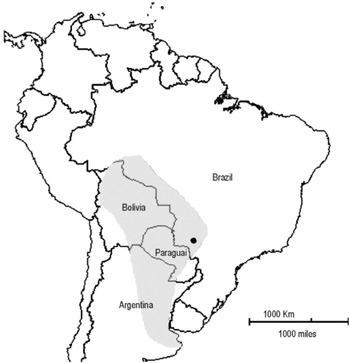
Captures of caimans (Caiman yacare) from the Pantanal in the State of Mato Grosso do Sul (Miranda-Abobral region), a wetland region in central Brazil (Fig. 1) were carried out in the Miranda River and lake environments between 2001 and 2005. C. yacare is the only crocodilian species found in the study area and is widespread in Brazil, Argentina, Bolivia and Paraguay (Fig. 1). This species has the southernmost distribution of all caimans and, like C. crocodilus, which is found from southern Mexico to northern Argentina without overlapping with C. yacare, occurs in very large numbers in a variety of habitat types, such as wetlands, rivers and lakes. Other species of caimans and alligators inhabit the borders of the Brazilian Pantanal and Amazonia but have never been found in the collection site used in this study (Roos, Reference Roos1998).
Geographical origin of trypanosomes isolated from Caiman yacare wild caught in the Pantanal biome (Miranda wetland) (•) in Central Brazil. Marked in grey is the distribution of this caiman species in wetlands from South America.

After handling and immobilization, the captured animals were anaesthetized and bled by tail or heart puncture using sodium citrate as anticoagulant. Once blood samples and ectoparasites had been collected, the caimans were identified and returned to the same place where they had been captured. All procedures were performed with the permission and according to the recommendations of IBAMA (The Brazilian Institute for the Environment and Renewable Natural Resources, Licenses numbers: 038/2002 and 024/2004).
Isolation and morphology of caiman trypanosomes from blood samples and culture
Blood samples from caimans were examined for the presence of trypanosomes by the microhaematocrit centrifugation method (MH). Regardless of the results of MH, the blood samples were inoculated in tubes containing a biphasic medium (BAB-LIT) consisting of 15% rabbit red blood cells mixed with 4% Blood Agar Base overlaid with liquid LIT (Liver Infusion Tryptose) medium supplemented with 10% FBS (Ferreira et al. Reference Ferreira, Campaner, Viola, Takata, Takeda and Teixeira2007). All positive cultures were transferred to monolayers of Hi-5 insect feeder cells (Trichoplusia ni) overlaid with Grace's medium supplemented with 10% FBS (Viola et al. Reference Viola, Campaner, Takata, Ferreira, Rodrigues, Freitas, Duarte, Greco, Barrett, Camargo and Teixeira2008). These cultures were used for morphological analysis and stored in liquid nitrogen in our culture collection. After successive passages in Hi-5 cell cultures, the trypanosomes were adapted to grow in LIT medium supplemented with 10% FBS and flagellates from these cultures were used for DNA preparation.
For morphological analysis, glass-slide smears were prepared from the caiman blood samples using either whole blood, buffy coats from MH capillary tubes or tissue imprints (kidney, spleen, heart, lung and liver). Samples from cultures in Hi-5 cells were also smeared on glass slides. All smears were fixed with methanol, stained with Giemsa and photographed.
PCR amplification of SSU rDNA and gGAPDH gene sequences and data analysis
Genomic DNA of cultured trypanosomes was extracted by the classical phenol-chloroform method. PCR amplifications of the variable regions V7-V8 SSU rDNA (small subunit of ribosomal DNA) or whole SSU rDNA were carried out using the oligonucleotides and reaction conditions described before (Rodrigues et al. Reference Rodrigues, Paiva, Campaner, Stevens, Noyes and Teixeira2006; Viola et al. Reference Viola, Campaner, Takata, Ferreira, Rodrigues, Freitas, Duarte, Greco, Barrett, Camargo and Teixeira2008; Ferreira et al. Reference Ferreira, De Souza, Freitas, Campaner, Takata, Barrett, Shaw and Teixeira2008). Amplifications of the gGAPDH (glyceraldehydes-3-phosphate dehydrogenase glycosomal) sequences were carried out using the oligonucleotides and reaction conditions previously described (Hamilton et al. Reference Hamilton, Stevens, Gaunt, Gidley and Gibson2004). The PCR products were cloned and sequenced and the sequences aligned using ClustalX (Thompson et al. Reference Thompson, Gibson, Plewniak, Jeanmougin and Higgins1997). The resulting alignments were manually refined.
We created 4 alignments for phylogenetic inferences: A1, consisting of SSU rDNA sequences without regions of ambiguous alignment (data not shown); A2, comprising the V7-V8 regions of SSU rDNA; A3, consisting of sequences from gGAPDH (data not shown); and A4, including concatenated SSU rDNA and gGAPDH sequences obtained using a published alignment (ALIGN001079) from a large set of taxa (Hamilton et al. Reference Hamilton, Stevens, Gidley, Holz and Gibson2005) for guidance. Sequences of SSU rDNA and gGAPDH genes from caiman trypanosomes determined in this study were aligned with sequences of selected trypanosomes representative of all major clades within the genus Trypanosoma (Hamilton et al. Reference Hamilton, Gibson and Stevens2007). In addition, sequences from other trypanosomatid genera were also included in these alignments. All these sequences were retrieved from GenBank (Accession numbers SSU rDNA/gGAPDH): Herpetomonas samuelpessoai (U01016/AF047494), H. megaseliae (U01014/DQ092547), H. muscarum (L18872/DQ092548), Phytomonas sp. (AF016322/AF047496), Leishmania major (AF303938/AF047497), L. tarentolae (M84225/DQ092549), Crithidia fasciculata (Y00055/AF053739), Leptomonas sp. Nfm (AF153043/AF339451), L. peterhoffi (AF153039/AF322390), Wallaceina brevicula (AF153045/AF316620), Trypanosoma rotatorium (AJ009161/AJ620256), T. mega (AJ009157/AJ620253), T. fallisi (AF119806/AJ620254), T. binneyi (AJ132351/AJ620266), T. sp. K&A (AJ009167/AJ620252), T. granulosum (AJ620551/AJ620246), T. sp. CLAR (AJ620555/AJ620251), T. sp. Gecko (AJ620548/AJ620259), T. varani (AJ005279/AJ620261), T. vivax (U22316/AF053744), T. brucei rhodesiense (AJ009142/AJ620284), T. evansi (AJ009154/AF053743), T. simiae (AJ009162/AJ620293), T. congolense (U22318/AJ620291), T. sp. AAT (AJ620557/AJ620264), T. avium Rook (U39578/AJ620262), T. avium Chaffinch (AJ009140/AJ620263), T. sp. D30 (AJ009165/AJ620279), T. theileri (AJ009164/AJ620282), T. cyclops (AJ131958/AJ620265), T. sp. TL.AQ.22 (AJ620574/AJ620280), T. sp. ABF (AJ620564/AJ620278), T. sp. H25 (AJ009168/AJ620276), T. dionisii (AJ009151/AJ620271), T. cruzi marinkellei (AJ009150/AJ620270), T. cruzi (AJ009147/X52898), T. cruzi (AJ009149/AJ620269), T. rangeli (AJ009160/AF053742), T. rangeli (minasense) (AJ012413/AJ620274), T. vespertilionis (AJ009166/AJ620283), T. conorhini (AJ012411/AJ620267), T. sp. F4 (AJ620547/AJ620260), T. pestanai (AJ009159/AJ620275), T. sp. AAP (AJ620558/AJ620277), T. lewisi (AJ009156/AJ620272), T. sp. R5 (AJ620568/AJ620281), T. microti (AJ009158/AJ620273).
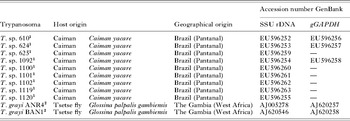
Phylogenies were inferred using maximum likelihood (ML), Bayesian (B) and parsimony (P) analyses. Parsimony and bootstrap analyses were carried out using PAUP* version 4.0b10 (Swofford, Reference Swofford2002) with 100 (alignments A1-3) or 500 (A4) random-sequence-addition replicates followed by branch swapping (RAS-TBR), Bayesian analysis was performed in MrBayes v3.1.2 (Huelsenbeck and Ronquist, Reference Huelsenbeck and Ronquist2001) and ML were performed using RAxML v.7.0.0 (Stamatakis, Reference Stamatakis2006) as previously described (Ferreira et al. Reference Ferreira, Campaner, Viola, Takata, Takeda and Teixeira2007, Reference Ferreira, De Souza, Freitas, Campaner, Takata, Barrett, Shaw and Teixeira2008). Tree searches employed GTRGAMMA with 100 maximum parsimony-starting trees. Model parameters were estimated in RAxML over the duration of the tree search and nodal support was estimated with 500 bootstrap replicates. The alignments used in this study are available from the authors upon request and can be obtained via the EMBLALIGN database via SRS at http://srs.ebi.ac.uk under Accession numbers: ALIGN 001260 (v7-v8 SSU rRNA gene), ALIGN 001261 and ALIGN 001262 (SSU rRNA and gGAPDH genes). Nucleotide sequence data from caiman trypanosomes reported in this paper are available in the GenBank database under the Accession numbers listed in Table 1.
Host and geographical origin of Trypanosoma grayi and trypanosome isolates from Brazilian Caiman yacare

1 Trypanosomes isolated from Caiman yacare in this study.
2 T. grayi isolates from tsetse (MacNamara and Snow, Reference MacNamara and Snow1991).
RESULTS
Occurrence and morphology of trypanosomes in caimans
We examined the blood of 86 specimens of Cayman yacare by microhaematocrit (MH) and haemoculture. Microhaematocrit (MH) examination was positive for 18 animals (21%) and the combination of MH and haemocultures yielded a prevalence rate of 35%. Blood smears of MH buffy coats from caimans had small numbers of trypanosomes, indicating low parasitaemias.
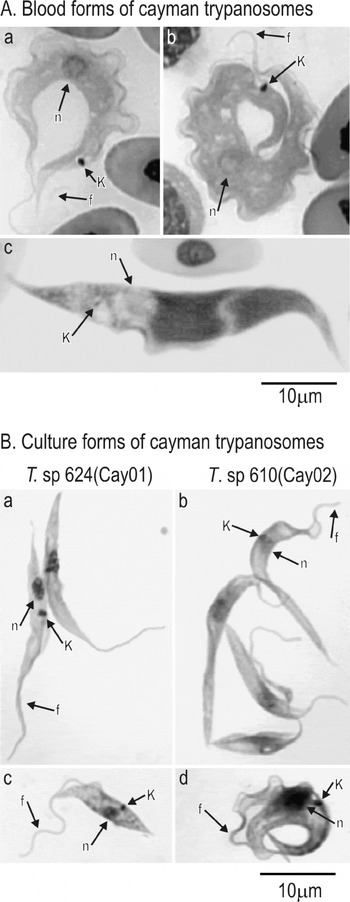
Giemsa-stained blood smears showed large, wide trypomastigotes that were usually roll-shaped with pointed overlapping extremities. Morphometrical analysis of 50 blood trypomastigotes revealed an average length of 49 μm, an average width of 7·7 μm at their broadest point, a large and many-folded undulating membrane and a free flagellum of variable size. The kinetoplast is large and positioned adjacent to the outer body margin, very far (mean of 14·6 μm) from the round and almost central nucleus. Dividing forms were not observed. The results of analyses of Giemsa-stained imprints of caiman kidney, liver, lung, spleen and heart were, in general, negative. However, lung and kidney imprints from 2 caimans revealed scarce trypomastigotes distinct from those detected in peripheral blood samples. These tissue forms were very large (mean length of 68 μm and average width of 7·8 μm) and very finely pointed at both ends, with prominent longitudinal striations. The nucleus at the posterior extremity appeared as a colourless area, was large, oval and close to a large vacuole that was associated with a very small kinetoplast (Fig. 2A). Unfortunately, no culture was obtained from the blood of the two caimans with these tissue forms.
Selected microphotographs of Giemsa-stained trypanosome forms from Caiman yacare. (A) Trypomastigotes in blood smears (a, b) from naturally infected caimans or (c) in lung imprint. (B) Culture forms of caiman trypanosomes in Hi-5 cells: epimastigotes of isolates 624 (a) and 610 (b) and trypomastigotes of isolates 624 (c) and 610 (d). k, kinetoplast; n, nucleus; f, flagellum.

Isolation and morphology of cultured caiman trypanosomes
Of the 86 caiman haemocultures, 17 (19·77%) yielded haemocultures positive for trypanosomes and 9 isolates have since been maintained in culture. These trypanosomes came from 5 caimans that were positive for trypanosomes by MH and 12 that were negative. The fact that some haemocultures for MH-positive caimans were negative and that only 9 cultures could be established after successive passages suggested the existence of trypanosomes with different growth requirements. Cultures were maintained in monolayers of Hi-5 cells and used for morphological analysis. According to their general morphological traits, isolates from caimans could be divided into 2 morphotypes. The morphotype 1 (represented by isolates 624, 625, 1092, 1100, 1101, 1102, 1119 and 1120) consisted of epimastigotes with a large kinetoplast positioned near the nucleus and a narrow undulating membrane (Fig. 2B). The second morphotype was only observed in isolate 610, in which the epimastigotes were larger and wider, with a conspicuous undulant membrane and a small kinetoplast. Stationary cultures (after 15 days) of isolate 610 had a high proportion of large and roll-shaped trypomastigotes, whereas cultures of morphotype 1 presented fewer and smaller trypomastigotes (Fig. 2B).
Barcoding and genetic relatedness of caiman trypanosomes using SSU rDNA sequences
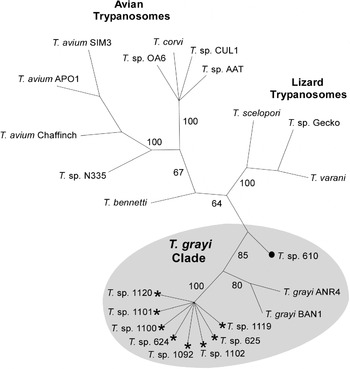
To assess the genetic polymorphism among caiman trypanosomes, sequences of the variable V7-V8 region of the SSU rDNA (~750 bp) were determined for the 9 isolates of caiman trypanosomes. Comparison of the aligned sequences showed that the 8 isolates with morphotype 1 shared almost identical sequences (average of ~100% similarity) and were assigned to genotype Cay01. In contrast, isolate 610 of morphotype 2 was assigned to genotype Cay02, which diverged significantly from Cay01 isolates (~3·3%). Thus, sequence divergence and the positioning in the V7-V8 SSU rDNA derived dendrogram confirmed separation of the caiman isolates into 2 genotypes (Fig. 3). Sequences from 2 T. grayi isolates (ANR4 and BAN1) of tsetse from The Gambia, West Africa, sharing 99·7% similarity were also included in the alignment of V7-V8 SSU rDNA. Analysis of the similarity matrix and positioning in the dendrogram revealed a very close genetic relatedness between T. grayi isolates and caiman trypanosomes, forming an assemblage (clade T. grayi) harbouring the 9 caiman isolates and 2 T. grayi isolates sharing high sequence similarity (~98·3% average) (Fig. 3). Similarities of sequences between T. grayi and caiman trypanosomes ranged from ~98·6% (Cay01) to ~96·8% (Cay02).
Dendrogram inferred by parsimony analysis using sequences from V7-V8 SSU rDNA (1125 characters) from 9 trypanosome isolates from Caiman yacare (genotype T. sp Cay01* and T. sp Cay02•), 2 T. grayi isolates, 9 isolates of bird trypanosomes, and 3 lizard trypanosomes. The numbers at nodes correspond to percentage of bootstrap values derived from 100 replicates.

Previous phylogenetic studies based on SSU rDNA sequences have demonstrated that the closest relative to T. grayi was T. bennetti (Haag et al. Reference Haag, O'hUigin and Overath1998; Votýpka et al. Reference Votýpka, Oborník, Volf, Svobodová and Lukes2002, Reference Votýpka, Lukes and Oborník2004; Hamilton et al. Reference Hamilton, Stevens, Gaunt, Gidley and Gibson2004, Reference Hamilton, Gibson and Stevens2007). In this study, the partial SSU rDNA sequences from the 9 isolates of caimans were compared with their closest sequence matches in GenBank. Results agreed with all these previous studies demonstrating that caiman trypanosomes are closest to T. grayi and confirmed highest similarities of sequences from crocodilian trypanosomes with T. bennetti and other avian trypanosomes. We then evaluated the genetic relatedness among all 9 caiman isolates, T. grayi, T. bennetti, and other avian and lizard trypanosomes using alignment 2 (Fig. 3). In this analysis, T. bennetti was placed closer to other avian trypanosomes than to crocodilian trypanosomes, although its position was weakly supported. The crocodilian trypanosomes formed a clade separated from both avian and lizard trypanosomes (Fig. 3).
Phylogenetic tree based on concatenated SSU rDNA and gGAPDH sequences from crocodilian trypanosomes
This study focused on achieving an understanding of the phylogenetic and taxonomic relationships of trypanosomes isolated from caimans (C. yacare) in Brazil. Taking into account genetic polymorphism of variable V7-V8 SSU rDNA sequences, we selected the following caiman isolates for sequencing of entire SSU rDNA and gGAPDH genes aiming for a broader phylogenetic analysis: Isolate 610, which represents the genotype Cay02, and isolates 624 and 1092, which represent the commonest genotype Cay01. Phylogenies inferred using concatened SSU rDNA and gGAPDH sequences tightly clustered together T. grayi and trypanosomes from caimans generating the clade T. grayi. This monophyletic assemblage comprised all crocodilian trypanosomes sharing respectively ~97% and 93·5% of SSU rDNA and gGAPDH sequence similarities. T. grayi was closer to the caiman isolate of genotype Cay01 (~98·7% and 92·4% of SSU rDNA and gGAPDH sequence similarities, respectively) than to isolates of genotype Cay02 (~94·6% and 91·4%).
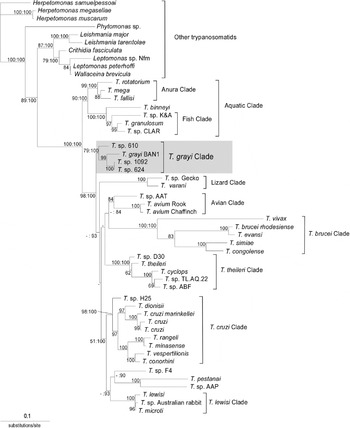
The placement of the clade T. grayi in the phylogeny of Trypanosoma was not well-supported in the phylogenetic trees inferred in this study. This clade was positioned close to the trypanosomes nested in the Aquatic (mostly from anurans and fishes) and lizard clades. Nevertheless, positioning of clade T. grayi within Trypanosoma and its relationship with other clades, including those formed by lizard and bird trypanosomes, could not be resolved by either ML or B analyses (Fig. 4). Inclusion of a large number of isolates can help to clarify this unresolved phylogeny. However, gGAPDH sequences and cultures of T. bennetti and other avian trypanosomes were not available. Positioning of the T. grayi clade showed in the combined tree was very similar in a tree generated by alignment consisting exclusively of gGAPDH sequences (data not shown).
Phylogenetic tree based on concatenated SSU rDNA and gGAPDH gene sequences of 41 trypanosomes using non-trypanosomes trypanosomatids as outgroups. An alignment (3011 characters, −Ln=25680·127478) comprising 3 trypanosomes from Brazilian caimans, T. grayi and trypanosome representatives of the major clades within Trypanosoma was employed for maximum likelihood and Bayesian analyses. Single values at nodes are ML bootstrap values. Multiple values at major nodes are in order. ML bootstrap and Bayesian support values derived from 500 replicates (-support value <50).

In summary, the trypanosomes from caimans clustered together with T. grayi in all the generated phylogenetic trees, irrespective of gene, alignment, taxon coverage or analytical method, to form a monophyletic clade of crocodilian trypanosomes clearly separated from all other trypanosomes.
DISCUSSION
The historic evolutionary processes that have led to the present-day phylogenetic structure of the taxon Trypanosoma are still poorly understood. In almost all phylogenies, T. grayi, an African trypanosome from Crocodylus niloticus transmitted by tsetse flies, was positioned closest to T. bennetti, an intriguing avian trypanosome (Kirkpatrick et al. Reference Kirkpatrick, Terway-Thompson and Iyengar1986), whereas trypanosomes from other birds and reptiles were separated into unrelated branches. This finding generated considerable questioning and gave rise to the need for additional studies of crocodilian and avian trypanosomes (Haag et al. Reference Haag, O'hUigin and Overath1998; Stevens et al. Reference Stevens, Noyes, Schofield and Gibson2001; Votýpka et al. Reference Votýpka, Oborník, Volf, Svobodová and Lukes2002).
We reported here a survey of trypanosomes in Caiman yacare (Alligatoridae) carried out in the Pantanal wetlands of Brazil. Trypanosomes were detected by a combination of microhaematocrit and haemoculture in 35% of the caimans examined, from which 9 cultures were obtained. To our knowledge, these are the only trypanosomes isolated from the blood of crocodilians available in culture to date.
Previous studies reported trypanosomes in 2 Caiman species in Brazil: T. cecili in C. crocodilus from Amazonia (Lainson, Reference Lainson1977) and an unnamed species in C. yacare from the Pantanal (Nunes and Oshiro, Reference Nunes and Oshiro1990). Attempts to culture these trypanosomes failed. However, morphological peculiarities of blood trypomastigotes suggested that they belonged to different species. Caiman blood trypomastigotes found in the present survey were indistinguishable from those described by Nunes and Oshiro (Reference Nunes and Oshiro1990) in the same host species but distinguishable from those described in tissue imprints of C. crocodilus (Lainson, Reference Lainson1977). However, we also detected forms in tissue imprints of C. yacare that were similar to those reported for C. crocodilus. As the trypanosome described in C. crocodilus was not cultivated, it was not possible to evaluate whether these different forms correspond to trypanosomes of different species or to different developmental stages of the same species. Nevertheless, trypanosomes from blood and tissue of these two species of Brazilian caimans could be clearly differentiated from the blood forms of T. grayi (Hoare, Reference Hoare1931; Lainson, Reference Lainson1977).
Like most trypanosomes, except those that are human and livestock pathogens, reptilian trypanosomes have been historically classified according to the morphology of blood trypomastigotes, the ‘one host – one species’ paradigm, their geographical origin and, sporadically, the results of cross-infection experiments with vertebrate and/or invertebrate hosts (Telford, Reference Telford and Kreier1995). However, molecular analyses have cast doubts on the validity of trypanosome taxonomy based on these parameters (Stevens et al. Reference Stevens, Noyes, Schofield and Gibson2001; Maia da Silva et al. Reference Maia da Silva, Junqueira, Campaner, Rodrigues, Crisante, Ramirez, Monteiro, Coura, Añez and Teixeira2004; Hamilton et al. Reference Hamilton, Stevens, Gaunt, Gidley and Gibson2004, Reference Hamilton, Stevens, Gidley, Holz and Gibson2005; Rodrigues et al. Reference Rodrigues, Paiva, Campaner, Stevens, Noyes and Teixeira2006; Ferreira et al. Reference Ferreira, Campaner, Viola, Takata, Takeda and Teixeira2007; Viola et al. Reference Viola, Campaner, Takata, Ferreira, Rodrigues, Freitas, Duarte, Greco, Barrett, Camargo and Teixeira2008).
The variable V7-V8 region of SSU rDNA has been used in our laboratory for DNA barcoding of trypanosomatids. According to the results of this and previous studies, these sequences are sufficient to distinguish all species examined to date and can thus be used to scan for species to be included in phylogenetic studies (Maia da Silva et al. Reference Maia da Silva, Junqueira, Campaner, Rodrigues, Crisante, Ramirez, Monteiro, Coura, Añez and Teixeira2004; Cortez et al. Reference Cortez, Ventura, Rodrigues, Batista, Paiva, Añez, Machado, Gibson and Teixeira2006; Rodrigues et al. Reference Rodrigues, Paiva, Campaner, Stevens, Noyes and Teixeira2006, Reference Rodrigues, Neves, Garcia, Viola, Marcili, Maia da Silva, Sigauque, Batista, Paiva and Teixeira2008; Ferreira et al. Reference Ferreira, Campaner, Viola, Takata, Takeda and Teixeira2007, Reference Ferreira, De Souza, Freitas, Campaner, Takata, Barrett, Shaw and Teixeira2008; Viola et al. Reference Viola, Campaner, Takata, Ferreira, Rodrigues, Freitas, Duarte, Greco, Barrett, Camargo and Teixeira2008). In addition, V7-V8 SSU rDNA sequences are useful for analysing polymorphisms and genetic relationships among closely related taxa and can be included in larger sequence data sets to infer phylogenies. Comparison of V7-V8 SSU rDNA sequences of the 9 caiman isolates obtained in this study with all available trypanosome sequences in GenBank demonstrated that these isolates are indeed different from all previously sequenced trypanosomes. The sequence divergences are sufficiently high to justify granting species status to the two genotypes of caiman trypanosomes identified in this study. Our finding of genetic polymorphism among trypanosomes of the same species of caiman wild-caught in the same location indicates that the diversity of crocodilian trypanosomes must be very high. Until further data about their genetic diversity, morphological and biological features are gathered; we shall refer to the new trypanosomes characterized in this study as Trypanosoma sp. 624 (Cay01) and T. sp. 610 (Cay02).
Although sufficient to distinguish between species of trypanosomatids in general, the use of partial or whole SSU rDNA sequences alone is considered insufficient for inferring deep level phylogenies and additional gene sequences are needed to help unravel polytomies in Trypanosomatidae (Hamilton et al. Reference Hamilton, Stevens, Gaunt, Gidley and Gibson2004, Reference Hamilton, Gibson and Stevens2007). Therefore, in addition to SSU rDNA sequences, we also sequenced the gGAPDH gene from 3 of the new caiman isolates. The general branching pattern of the phylogenetic trees inferred in this study was largely concordant with those shown in a previous analysis based on combined sequences of SSU rDNA and gGAPDH (Hamilton et al. Reference Hamilton, Gibson and Stevens2007). In all our analyses, irrespective of the genes and analytical methods used, the 9 trypanosomes from caimans were tightly clustered together with T. grayi, generating a monophyletic assemblage of trypanosomes that we called the T. grayi clade. The close relationship between caiman trypanosomes and T. grayi pointed towards crocodiles as vertebrate hosts of the latter. In the phylogenetic trees generated using independent or combined data set of SSU rDNA and gGAPDH gene sequences, all major clades of trypanosomes were well resolved. However, these phylogenies were unable to clearly resolve the relationship among trypanosomes nested in the clade T. grayi and those from other clades. The trees inferred using the combined data set without caiman trypanosomes (data not shown) had a topology that was very similar to that described using a larger data set of concatenated SSU rDNA and gGAPDH sequences, which was equally unable to resolve the relationships among trypanosomes from lizard, birds and those clustered in the Aquatic clade (Hamilton et al. Reference Hamilton, Stevens, Gidley, Holz and Gibson2005, Reference Hamilton, Gibson and Stevens2007).
The crocodilian trypanosomes nested in the clade T. grayi identified in our analyses are parasites of hosts from continents separated by at least 100 million years. However, the small genetic distance between trypanosomes from crocodile and caiman suggested recent divergence compared to the old separation of their hosts. Phylogeographical and fossil evidence indicated the origin of crocodilians in Gondwana and a basal split between Crocodylidae and Alligatoridae at 97–103 mya in the late Cretaceous (Janke et al. Reference Janke, Gullberg, Hughes, Aggarwal and Arnason2005; Roos et al. Reference Roos, Aggarwal and Janke2007; Jouve et al. Reference Jouve, Bouya and Amaghzaz2008). At this time trypanosomatids were already present in insects and, possibly, also in the blood of dinosaurs (Poinar and Poinar, Reference Poinar and Poinar2004; Poinar, Reference Poinar2007). Molecular dating suggests that the extinction of the dinosaurs could to some extent parallel the crocodilian evolution (Roos et al. Reference Roos, Aggarwal and Janke2007).
Crocodilians and birds are the only archosaurians that survived the mass extinction associated with the Cretaceous-Tertiary boundary ~65 mya (Janke et al. Reference Janke, Gullberg, Hughes, Aggarwal and Arnason2005; Roos et al. Reference Roos, Aggarwal and Janke2007). Data from the historic process that led to the present-day distribution of crocodilians, which is best explained by overseas dispersion of salt-tolerant African species rather than vicariance, can help to understand the close relationships among extant species of Crocodylus in all continents. The circumtropical radiation of Crocodylus has been confirmed by several fossil records dating from the Pliocene (5·3 to 1·8 mya) and is apparently unrelated to continental drift, land bridges or any other geological phenomenon (Dessauer et al. Reference Dessauer, Glenn and Densmore2002). The discovery in north-eastern Brazil of a new species of Dyrosauridae, extinct crocodyliforms that lived from the Cretaceuos to the Eocene, that is closely related to crocodylomorphs of the Paleocene from northern Africa, suggests that dyrosaurids have crossed the Atlantic Ocean from the western coast of Africa to South America, from there they could have dispersed to North America (Barbosa et al. Reference Barbosa, Kellner and Viana2008). Therefore, the close relationships between caiman and crocodile trypanosomes, respectively from Brazil and Africa, may be due to relatively recent dispersion of African crocodilians. Host switching of trypanosomes from Crocodylidae to Alligatoridae by yet unknown American vectors should be responsible for emerging of T. grayi-related trypanosomes in American crocodilian hosts. An alternative hypothesis for the close relationship between crocodile and caiman trypanosomes would be the ancient dispersion of vectors. Fossils of ancestral tsetse flies from the Oligocene have been found in North America, suggesting that these flies may have dispersed trypanosomes worldwide before they became limited to Africa by global climate changes (Jordan, Reference Jordan, Lane and Crosskey1993). There is no information about vectors of caiman trypanosomes. The candidates are haematophagous leeches, known to transmit trypanosomes to fishes and anurans, and sand flies and culicids, which are insect vectors of anuran and lizard trypanosomes (Ferreira et al. Reference Ferreira, De Souza, Freitas, Campaner, Takata, Barrett, Shaw and Teixeira2008).
The relationships between trypanosomes of the African crocodile and South American caiman may reflect an ancient shared evolutionary history between these trypanosomes and their crocodilian hosts. However, more data are required to add consistency to this hypothesis. Actually, further investigations are needed to clarify the phylogenetic relationships between avian and crocodilian trypanosomes as shown in this and in previous studies (Haag et al. Reference Haag, O'hUigin and Overath1998; Votýpka et al. Reference Votýpka, Oborník, Volf, Svobodová and Lukes2002; Hamilton et al. Reference Hamilton, Stevens, Gaunt, Gidley and Gibson2004). A comprehensive analysis using sequences from additional genes may resolve the phylogeny of trypanosomes. Furthermore, an enlarged set of trypanosomes from crocodilians of diverse species and geographical origins is necessary for a better understanding of the evolutionary history of these trypanosomes.
We are grateful to several students for their invaluable help with the fieldwork during capture of caimans. This work was supported by grants from the Brazilian agency CNPq. L. B. Viola, R. C. Ferreira and A. C. Rodrigues are post-doctoral fellows sponsored by the CNPq.