


Introduction
Populism has become a major force in contemporary politics, and a substantial literature documents its institutional consequences. Populists in government weaken constitutional compliance (Gutmann and Rode, Reference Gutmann and Rode2025), the rule of law (Kyriacou and Trivin, Reference Kyriacou and Trivin2026), and economic freedom (Celico and Rode, Reference Celico, Rode, Gwartney, Lawson and Murphy2023) and undermine democratic checks more broadly, with right-wing variants more prone to target minority protections (Huber and Schimpf, Reference Huber and Schimpf2017). These patterns reflect populist logic. As a thin ideology that pits a morally pure ‘people’ against a corrupt ‘elite’ and claims an exclusive mandate (Mudde and Rovira Kaltwasser, Reference Mudde and Rovira Kaltwasser2017), populism distrusts intermediaries between rulers and ruled (Müller, Reference Müller2017a) and frames independent institutions and pluralist components as obstacles to a singular volonté générale (Mudde, Reference Mudde2004; Müller, Reference Müller, Rovira Kaltwasser, Taggart, Ochoa Espejo and Ostiguy2017b). This logic justifies attempts to weaken the judiciary, the press, minority rights, and regulatory agencies (Bugarič and Kuhelj, Reference Bugarič and Kuhelj2018; Grzymala-Busse, Reference Grzymala-Busse2019; Guriev and Papaioannou, Reference Guriev and Papaioannou2022).
Civil society, however, has received less direct empirical attention as a target of populist influence. We define civil society as voluntary associations, NGOs, unions, and movements around shared purposes, operating with autonomy from the state and the market (Edwards, Reference Edwards2014), and examine it through legislative representation, measured as the seat-share-weighted presence of left- and right-wing populist parties. We ask how civil society changes when populist parties gain more legislative representation. Our contribution is threefold: we place civil society at the centre by constructing two direct outcome measures, civil-society freedom and civil-society structure; we study legislative populism by combining party-level populism scores with lower-house seat shares, which captures populist influence even when populist parties do not control the executive; and we examine how ideological alignment and institutional veto players condition the association between populist representation and civil society.
In some countries, interference in civil society reflects a systematic strategy of populist control. Under Orbán and PiS, the Hungarian and Polish governments invoked national sovereignty to justify restrictions on pluralism, pressure courts, discredit pro-EU and human-rights NGOs, and use referenda to claim popular backing (Bill, Reference Bill2022; Müller, Reference Müller2017a; Scheppele, Reference Scheppele2019). However, similar mixtures of methods appear from Western Europe to Latin America and Southeast Asia, though Latin American populists often incorporate civic actors rather than overtly repress them (de la Torre, Reference de la Torre, Rovira Kaltwasser, Taggart, Ochoa Espejo and Ostiguy2017; Muno and Pfeiffer, Reference Muno and Pfeiffer2022). Thus, populist pressure on civil society, whether through repression or incorporation, reflects a deeper hostility towards pluralism, since populists treat organisations as either obstacles to or instruments of their claim of exclusive representation.
We study this pattern in a panel of 79 countries from 1970 to 2019. To capture the civil-society environment, we use six Varieties of Democracy indicators and reduce them to two factors by factor analysis: civil-society freedom, denoting the extent to which associations can form, operate, speak, and access resources without interference or repression, and civil-society structure, denoting the breadth and composition of participation, especially anti-system mobilisation and women’s and minority rights.
Estimating conditional within-country associations in two-way fixed-effects models with country and year fixed effects, we find that greater right-wing populist representation is related to declines in both civil-society freedom and structure, with a stronger association where right-wing parties dominate the legislature. Left-wing populism is not as strongly or robustly related to civil society, with a negative association for civil-society freedom only in strongly left-dominated settings. Mechanism-related diagnostics suggest these associations work more through legal-administrative and discursive deterioration than through fiscal transmission.
Literature and theoretical framework
The literature on the consequences of populism is now large. We first present the most relevant studies, noting both results and lacunae, and then build a theoretical framework and testable implications. Both are organised around populism’s consequences for institutions, culture, and the economy.
The existing literature
Institutional effects
Populism affects institutions in two directions.Footnote 1 In office, populists reshape the formal and informal rules that structure political and economic interaction, while those rules in turn moderate populist behaviour. Celico and Rode (Reference Celico, Rode, Gwartney, Lawson and Murphy2023) find that across democracies, populist governments reduce economic freedom, with stronger adverse effects in non-OECD countries, and Gründler et al. (Reference Gründler, Hackenberger, Potrafke and Berggren2024) similarly show that governments with more left-leaning economic ideologies restrict economic freedom, although institutional checks moderate these effects. Huber and Schimpf (Reference Huber and Schimpf2017) document that both left- and right-wing populists erode democratic checks, with right-wing variants more prone to target minority protections. Sáenz de Viteri and Bjørnskov (Reference Sáenz de Viteri and Bjørnskov2018) link populist regimes in Latin American and Caribbean contexts to constitutional reforms that weaken checks and balances. Gutmann and Rode (Reference Gutmann and Rode2025) likewise show that constitutional compliance falls when populists enter government; Cachanosky et al. (Reference Cachanosky, Bastos, Padilla and Hernandez2025) show that left-populist regimes in Latin America impose long-term institutional deterioration, and Kyriacou and Trivin (Reference Kyriacou and Trivin2026) show that populists weaken the rule of law where legal institutions are already fragile. These outcomes may be indirectly relevant for civil society, since formal rules shape voluntary organisations, and a tendency to meddle with institutions can signal willingness to weaken counterforces, including civil society.
Moderators also matter. Independent courts, free media, and federal structures raise the costs of power concentration and civic-space restriction (Bauer and Becker, Reference Bauer and Becker2020; Magalhães and Garoupa, Reference Magalhães and Garoupa2024). Right-leaning legislatures seldom obstruct right-wing populist initiatives, whereas left-leaning legislatures are more prone to do so (de la Torre, Reference de la Torre, Rovira Kaltwasser, Taggart, Ochoa Espejo and Ostiguy2017; Morawski and Brzezinski, Reference Morawski and Brzezinski2024; Mudde and Rovira Kaltwasser, Reference Mudde and Rovira Kaltwasser2013). Time in power amplifies these effects as governments refine NGO laws, use audits to target CSOs, and pressure media and courts, with consequences that persist (Gutmann and Rode, Reference Gutmann and Rode2025; Lewkowicz et al., Reference Lewkowicz, Woźniak, Lewczuk and Marcol2024). What this literature does not yet explain is how these institutional dynamics translate into civil-society conditions directly.
Economic effects
A substantial literature investigates economic consequences. Funke et al. (Reference Funke, Schularick and Trebesch2023) estimate the causal effects of 51 populist leaders since 1900 using event-study local projections and synthetic controls, finding long-run GDP per capita losses of around 10 percent under populist leadership and documenting economic disintegration and broader institutional erosion (cf. Štrobl et al., Reference Štrobl, Sáenz de Viteri, Rode and Bjørnskov2023). These costs vary across cases: in Latin America, costs were high under Hugo Chávez in Venezuela (Grier and Maynard, Reference Grier and Maynard2016) but smaller under Rafael Correa in Ecuador, where dollarisation constrained monetary financing and mitigated populism’s macroeconomic costs (Absher et al., Reference Absher, Grier and Grier2020; Cachanosky et al., Reference Cachanosky, Salter and Savanti2022, Reference Cachanosky, Gibson and Ocampo2026). More generally, macro-fiscal costs vary with institutional constraints: Bastos et al. (Reference Bastos, Cachanosky and Faintich2025) argue that term limits and regime length shape whether populists behave more like short-horizon ‘roving bandits’, with sharper boom-bust dynamics, or longer-horizon ‘stationary’ actors, with more gradual rent extraction. Short-run effects can run the other way: Brzezinski and Sałach-Dróżdż (Reference Brzezinski and Sałach-Dróżdż2024) document short-term economic gains in Poland between 2016 and 2019, while Wysocki et al. (Reference Wysocki, Wójcik and Freytag2024) show that the same policies weakened longer-term fiscal sustainability. Asutay et al. (Reference Asutay, Ball and Freytag2025) link these phases through a ‘walking-stick’ real-sector reallocation mechanism of an initial boom, followed by weaker productivity and inflation. For civil society, the longer-run phase matters directly through budget cuts and indirectly through charitable giving, volunteering, and attitudes towards others.
Despite extensive research on the economic and institutional effects of populism, direct evidence on civil-society outcomes remains limited and largely regional or thematic. Juon and Bochsler (Reference Juon and Bochsler2020) show how populists in office affect the broader democratic public sphere, including freedoms of association, assembly, speech, and media conditions, but their dependent variable is democratic quality across several functions, not civil-society freedom and structure. Cole and Schofer (Reference Cole and Schofer2024) estimate how populism affects social inclusion and exclusion, reflecting the policy environment facing civil society, but their outcomes are policy outputs and liberal-democratic institutional quality rather than associational autonomy and civic composition. The closest related study is Ivanov (Reference Ivanov2025), which examines Central and Eastern Europe using V-Dem indicators of civil-society control and participation together with ESS measures of civic culture. Ivanov measures populist exposure as years with at least one populist cabinet party and finds that longer populist tenure is associated with tighter control over civil-society organisations, with the clearest patterns in Hungary and Poland. The study also shows that GDP per capita is positively associated with civil-society participation. These findings leave open whether legislative populist representation is associated with civil-society freedom and structure in a broader cross-national panel and whether these associations differ between right- and left-wing populism.
Cultural effects
Several studies examine the cultural correlates and consequences of populism. In two recent overviews, Bjørnskov (Reference Bjørnskov, Hartwell, Rode and Stöckl2026) finds that more populism correlates with lower social trust, although the direction of causality remains contested. Berggren and Nilsson (Reference Berggren, Nilsson, Hartwell, Rode and Stöckl2026) show that most empirical studies associate populism with higher intolerance but that studies using stronger causal designs produce mixed results, pointing to conditional effects shaped by context, framing, and counter-mobilisation. Counter-reactions sometimes strengthen tolerance, even as populist discourse can stimulate intolerant attitudes under some conditions. Following Putnam (Reference Putnam2020), these cultural effects shape how people interact, whether they engage in voluntary organisations, and how strong that engagement is. Bjørnskov and Berggren (Reference Bjørnskov and Berggren2026) find that populists weaken the rule of law and that particularly right-wing populists undermine civil liberties, both often prerequisites for a vibrant civil society. However, the institutional, economic, and cultural literatures approach civil society mainly through adjacent outcomes rather than through civil-society conditions directly. This motivates the framework developed next, which links these three strands to legal-administrative, fiscal, and discursive channels affecting civil-society freedom and structure.
Theoretical framework
We use the institutional, economic, and cultural literatures from the previous section as the basis for three channels through which populist representation may be associated with civil-society conditions. Institutional effects motivate a legal-administrative channel, economic effects a fiscal channel, and cultural effects a discursive channel. These channels need not operate independently; governments may combine statutory change, resource allocation, and public delegitimisation.
Notably, not only populists take an interest in civil society, restrict speech, or use administrative power. All parties may favour aligned organisations and disadvantaged opponents, and non-populist parties may also seek to constrain civil society. What distinguishes populism in our argument is the anti-pluralist claim to represent a single authentic people, which makes autonomous intermediary organisations suspect when they speak for alternative constituencies, monitor power, defend minority or rights-based claims, or contest populists’ representative monopoly. Populists may also draw support from parts of civil society and actively mobilise, fund, or incorporate aligned organisations. The expected pattern is therefore a selective reshaping of civic space: autonomous watchdog and rights-oriented organisations become more vulnerable to legal, fiscal, and discursive pressure, while aligned or state-dependent organisations may be protected, mobilised, or incorporated. This is why we analyse both civil-society freedom and civil-society structure.
We now examine the three channels. First, a legal-administrative channel operates through statutory change and discretionary enforcement. Governments can narrow civic space by revising registration requirements, reporting obligations, and operating rules for associations; by restricting external funding from domestic or foreign sources (Dupuy et al., Reference Dupuy, Ron and Prakash2016; Heiss, Reference Heiss and Davies2019); and by employing vague legislative language, including ‘foreign agent’ framings, that widens administrative discretion and facilitates arbitrary audits, fines, and de-registration (Buyse, Reference Buyse2018; Lacey, Reference Lacey2019). Politicised oversight and selective investigations raise the cost of dissent and legal uncertainty of CSOs, inducing them to exit, self-censor, or shift priorities (Peters and Pierre, Reference Peters and Pierre2022).
Second, a fiscal channel concerns the subset of civil society that depends on public grants, contracts, tax privileges, procurement, or international funding flows. Governments can reallocate support away from independent organisations and toward aligned organisations, replace stable, programmatic funding with short-term discretionary contracts, and use austerity or procurement rules to shift resources away from certain groups (Brombo, Reference Brombo, Ruzza, Berti and Cossarini2021; Chiodi, Reference Chiodi, Ruzza, Berti and Cossarini2021; Ruzza, Reference Ruzza2020). This channel bears most directly on professionalised and grant-dependent NGOs but extends into membership-based associational life, where that too is heavily state-funded, as in much of Northern Europe. Proper testing would require harmonised cross-country panel data on NGO funding streams, grant allocation, tax treatment, audits, and licensing practices, which are not available at our sample scale (Skocpol, Reference Skocpol2003; Toepler et al., Reference Toepler, Zimmer, Fröhlich and Obuch2020).
Third, a discursive channel delegitimises autonomous associations as agents of elites or foreign interests, weakening their social standing and reducing the willingness of citizens and firms to cooperate with them. Leaders cultivate direct links to ‘the people’ through rallies, referendums, and social media, which sidelines intermediary organisations and reinforces their narrative that independent CSOs lack authenticity (Palonen, Reference Palonen2009; Ruzza, Reference Ruzza2020). Through speech and writing, populists can shape the cultural standing of civil society, helping them concentrate power by legitimising their claim to represent the public will.Footnote 2
These channels map onto the two civil-society dimensions we study. Legal-administrative and discursive pressure should be reflected most directly in civil-society freedom, while discursive pressure may additionally reshape civil-society structure by delegitimising rights-based organisations, discouraging women’s and minority-oriented mobilisation, or stimulating anti-system mobilisation. Fiscal pressure is captured only indirectly by the available cross-national data. Table A8 in the Online Appendix maps each channel to its observable implications and measures. The channels are not mutually exclusive causal mechanisms cleanly isolated in our data; they organise the observable implications of our argument.
Partisan alignment in legislatures is a further feature of our framework. Populists are typically minority actors who advance policy through coalitions, agenda control, and committee access provided by ideologically proximate parties. Alignment on the same side of the left–right spectrum gives minority actors influence to narrow civic space and lends credibility to threats to withhold fiscal resources from dissenting organisations. When the majority bloc is right-leaning, right-wing populists can more easily target cosmopolitan, human-rights, or minority-oriented organisations and favour conservative civil-society surrogates; when it is left-leaning, left-wing populists more easily tie organisations to the state through incorporation, which reduces autonomy.
The asymmetry we expect between right- and left-wing populism follows from Mudde and Rovira Kaltwasser’s (Reference Mudde and Rovira Kaltwasser2013) distinction between exclusionary and inclusionary populism. Their framework distinguishes inclusion and exclusion along material, political, and symbolic dimensions. In contemporary Europe, where right-wing populism is typically tied to nativism, ‘the people’ is often defined against immigrants, minorities, and cosmopolitan elites. This makes rights-based NGOs, watchdog groups, and minority associations likely adversaries, especially through legal-administrative restrictions and discursive delegitimation (Huber and Schimpf, Reference Huber and Schimpf2017). In contemporary Latin America, left-wing populism has been inclusionary, defining ‘the people’ as previously excluded socio-economic groups and mobilising unions, neighbourhoods, indigenous and social-policy organisations through redistributive and participatory arrangements (Roberts, Reference Roberts2006). Hugo Chávez’s misiones sociales, communal councils, and Bolivarian Circles in Venezuela, together with Rafael Correa’s constituent assembly and participatory institutions in Ecuador, illustrate this incorporation strategy (Mudde and Rovira Kaltwasser, Reference Mudde and Rovira Kaltwasser2013; Muno and Pfeiffer, Reference Muno and Pfeiffer2022; Panizza and Miorelli, Reference Panizza and Miorelli2009). This is a difference of degree rather than kind: exclusionary and inclusionary features can coexist, and populists may themselves mobilise civil society, as in Hungary’s Civic Circles (Palonen, Reference Palonen2009). Inclusionary arrangements may therefore leave participation intact, reducing autonomy through financial, organisational, or administrative dependence on the state. We consequently expect weaker and less systematic civil-society effects under left populism, which operates more through incorporation and dependence than overt restriction.
Institutional veto players are our final framework component. We expect them to condition the populism-civil-society relationship by constraining the legal-administrative channel. Where courts, second chambers, subnational governments, or independent agencies can block or delay statutory and regulatory change, the legal-administrative channel is harder to deploy, and the expected decline in civil-society freedom is smaller. Strong veto players also raise the cost of administrative overreach. These constraints are not absolute. If the legislative environment is ideologically aligned with populists, bargaining and appointments can gradually weaken checks while governments substitute toward discursive and fiscal tools that are less constrained by formal vetoes. The net prediction is that strong veto players cushion, but do not eliminate, populism’s negative impact on civil society, with a smaller cushion when alignment favours populists.
The framework, summarised in Figure 1 and Table A8 in the Online Appendix, yields four testable implications: (1) stronger right-wing populist representation is associated with weaker civil-society freedom and less pluralistic civil-society structure; (2) average associations for left-wing populism are more modest and less systematic because incorporation can coexist with participation; (3) ideological alignment between populists and parties on the same side of the economic left–right spectrum makes the association more negative by easing access to legal-administrative, fiscal, and discursive instruments; and (4) robust veto players attenuate the negative association, although this attenuation is weaker when alignment is favourable to populists.
Theoretical framework.

Data and empirical strategy
Data
The sample
The unit of analysis is the country-year. The panel covers 79 countries between 1970 and 2019 for which four components can be harmonised: party-level populism scores, party-level economic ideology, lower-house seat shares, and V-Dem civil-society indicators. The sample is therefore determined by comparable party, legislative, and civil-society data, rather than by geographic classification. Our main explanatory variables presuppose a multiparty legislative arena in which parties can be assigned populism and ideology scores and lower-house seat shares can be used to construct comparable measures of legislative representation. Using the Bjørnskov and Rode (Reference Bjørnskov and Rode2020) regime classification, we retain electoral democracies and multiparty autocracies, but exclude single-party regimes and regimes without elections because seat-share-weighted legislative populism and the left-minus-right ideology measure are not comparable in those settings. Cases such as Belarus and Venezuela enter only for country-years in which the necessary multiparty legislative and party data exist, and the electoral democracy indicator distinguishes full electoral democracies from multiparty autocracies. The estimates apply to countries with modern party systems and multiparty legislative institutions, including some hybrid and backsliding regimes, and should not be extrapolated to closed authoritarian regimes or to all V-Dem countries. Because the restriction excludes some regimes with highly constrained civic space, it likely narrows the variation in civil-society outcomes that the analysis can detect. For the list of countries included, see Table A1 in the Online Appendix.
Outcome variables
We use Varieties of Democracy (V-Dem) data on civil-society organisations (CSOs) to form our outcome variables (Coppedge et al., Reference Coppedge, Gerring, Knutsen, Lindberg, Teorell, Altman, Angiolillo, Bernhard, Cornell, Fish, Fox, Gastaldi, Gjerløw, Glynn, Good God, Grahn, Hicken, Kinzelbach, Marquardt, McMann, Mechkova, Neundorf, Paxton, Pemstein, von Römer, Seim, Sigman, Skaaning, Staton, Sundström, Tannenberg, Tzelgov, Wang, Wiebrecht, Wig and Ziblatt2025): anti-system movements, consultation, entry and exit, participatory environment, repression, and women’s participation.Footnote 3 These indicators capture, respectively, civil-society movements that oppose the current political system and seek fundamental change; consultation of major civil-society organisations by policymakers; state control over the founding, registration, operation, and dissolution of CSOs; how widespread, voluntary, socially embedded, and diverse CSO participation is; repression through legal restrictions, harassment, or coercion; and barriers to women’s participation and organisations advocating women’s interests. They are based on annual country-expert ratings aggregated with a Bayesian measurement model. See Table A2 in the Online Appendix for details. As described in the section on ‘Reducing the dimensionality of civil-society measures’, we use factor analysis to derive two outcome variables: civil-society freedom and civil-society structure, with an extended indicator-level test reported in Table A13 of the Online Appendix.
Main explanatory variable
Our populism data are from Celico et al. (Reference Celico, Rode and Rodríguez Carreño2024), who provide two continuous party-year populism indicators on a 0-10 scale for parties in 169 countries from 1970 to 2019: an ideational indicator anchored in the POPPA expert survey and a rhetorical indicator anchored in the Global Party Survey. We use the former as our baseline measure because it corresponds most closely to the theoretical definition used above: populism as a thin-centred ideology that frames politics as a moral struggle between a virtuous people and a corrupt elite, emphasising anti-elitism, people-centrism, and a Manichean worldview. To extend coverage beyond the parties and years observed in POPPA, Celico et al. train a random forest regression on survey-based populism scores and expert-coded party characteristics, then predict scores for additional parties and years. The resulting variable is therefore a supply-side, party-level expert-survey measure of populist profile. Matched to updated party-ideology data for 79 countries from Berggren and Bjørnskov (Reference Berggren and Bjørnskov2017), we compute legislature-level measures by weighting each party’s populism score by its share of seats in the lower house, separately for left and right parties. These constitute our main populism variables.Footnote 4
This measurement choice reflects a trade-off in the study of populism. As outlined by Hawkins (Reference Hawkins2009), populism can be measured through textual or rhetorical indicators, programmatic and expert-survey party indicators, leader-level classifications, or behavioural indicators. For our purposes, a behaviour-coded measure based on restrictions on NGOs, consultation practices, repression, licensing, or other civil-society-relevant actions would risk incorporating the dependent variable, or a proximate mechanism, into the treatment. We therefore treat populism as a supply-side party profile and ask whether greater legislative representation of parties with such profiles is associated with subsequent civil-society conditions.
The ideology coding follows Berggren and Bjørnskov (Reference Berggren and Bjørnskov2017) and places parties on an exclusively economic policy dimension with five categories: communist and unreformed socialist (−1), reformed socialist (−0.5), modern social democratic (0), conservative (+0.5), and classical liberal (+1). We define left-wing parties as the first three categories and right-wing parties as the last two. This economic coding does not build cultural exclusion, anti-pluralism, or minority-related claims into the left–right classification itself and does not capture cultural or transnational cleavages directly, thereby reducing direct conceptual overlap between the ideology variable and the populism measure. Consequently, the right-populism estimates should be interpreted as applying to right-wing populism as it appears in party competition, not as isolating a culturally purified component of populism. We therefore interpret the estimates as capturing the association between civil society and empirically observed right-wing populism, including the cultural content through which it often operates. Using this coding, we construct an ideology measure for the legislature as a whole as the seat share of left-wing parties minus the seat share of right-wing parties.
Control variables
In addition, we add a small set of control variables to obtain a parsimonious specification and thus avoid bad controls. We draw data on the logarithm of real purchasing-power-adjusted GDP per capita, the logarithm of population size, trade volumes as percent of GDP, and government consumption from the Penn World Tables, mark 10 (Feenstra et al., Reference Feenstra, Inklaar and Timmer2015), all lagged one year to avoid simultaneity bias. From Bjørnskov and Rode’s (Reference Bjørnskov and Rode2020) dataset of regime types and regime transitions, we add a dummy variable measuring whether a country-year was a full electoral democracy; the comparison category is multi-party autocracy. From this dataset, we also construct a dummy variable for each country-year, taking the value 1 if there is an election to the legislative chamber that is included in our study and 0 otherwise. We also include a measure of legislative diversity in the form of a Herfindahl-Hirschman index of ideology (using data from Berggren and Bjørnskov, Reference Berggren and Bjørnskov2017).
Additional variables
We explore whether the association between populist representation and civil society is conditioned by institutional veto players, using Henisz’s (Reference Henisz2000) PolConIII measure. The index captures the number of independent government branches with veto power over policy change, party alignment across branches, and preference heterogeneity within each legislative branch. It is scaled between 0 (no veto players) and 1 (maximal veto strength). We recode it as two dummy variables: a weak condition taking the value 1 when the index is above 0.25 and a strong condition taking the value 1 when the index is above 0.5. We refer to the index based on the 0.25 cutoff as a ‘simple’ index and the alternative as a ‘restrictive’ index.
For mechanism-related diagnostics, we use two variables from the Varieties of Democracy (Coppedge et al., Reference Coppedge, Gerring, Knutsen, Lindberg, Teorell, Altman, Angiolillo, Bernhard, Cornell, Fish, Fox, Gastaldi, Gjerløw, Glynn, Good God, Grahn, Hicken, Kinzelbach, Marquardt, McMann, Mechkova, Neundorf, Paxton, Pemstein, von Römer, Seim, Sigman, Skaaning, Staton, Sundström, Tannenberg, Tzelgov, Wang, Wiebrecht, Wig and Ziblatt2025) dataset: rule of law and discussion freedom. The former is the rule-of-law index, which we think of as a proxy for the legal-administrative channel; the latter is the average of discussion freedom for men and women, which is likely to capture the discursive channel. We prefer discussion freedom over more comprehensive variables, capturing, e.g., freedom of speech, as previous studies find that it is directly associated with violence (e.g., Eskildsen and Bjørnskov, Reference Eskildsen and Bjørnskov2022). The rule-of-law index is measured on a 0–1 scale, while discussion freedom uses a 0–4 scale.
In a robustness test, we use populism in the executive as the populism variable instead of the legislative measures of our baseline. This measure is based on the same data from Berggren and Bjørnskov (Reference Berggren and Bjørnskov2017) and Celico et al. (Reference Celico, Rode and Rodríguez Carreño2024) as our other ideology and populism measures. We calculate populism in the executive branch for left- and right-wing cabinets as the average populism in government, weighted by the seat shares in parliament of coalition partners, and define left-wing governments as those with average ideology at or below a score of 0.
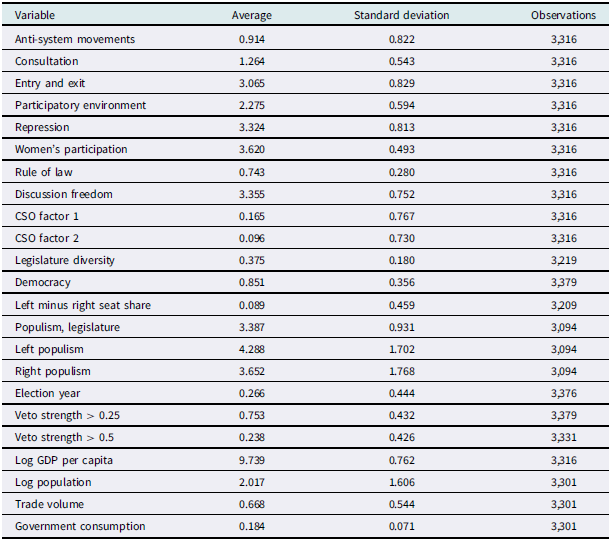
Descriptive statistics are presented in Table 1.
Descriptive statistics

Table 1. Long description
A table presenting descriptive statistics for various variables. The table has 27 rows and 4 columns. The columns are labeled ‘Variable’, ‘Average’, ‘Standard deviation’, and ‘Observations’. Each row lists a different variable along with its corresponding average, standard deviation, and number of observations. The variables include ‘Anti-system movements’, ‘Consultation’, ‘Entry and exit’, ‘Participatory environment’, ‘Repression’, ‘Women’s participation’, ‘Rule of law’, ‘Discussion freedom’, ‘CSO factor 1’, ‘CSO factor 2’, ‘Legislature diversity’, ‘Democracy’, ‘Left minus right seat share’, ‘Populism, legislature’, ‘Left populism’, ‘Right populism’, ‘Election year’, ‘Veto strength > 0.25’, ‘Veto strength > 0.5’, ‘Log GDP per capita’, ‘Log population’, ‘Trade volume’, and ‘Government consumption’. Each variable has a specific average value, standard deviation, and number of observations listed in the respective columns.
Reducing the dimensionality of civil-society measures
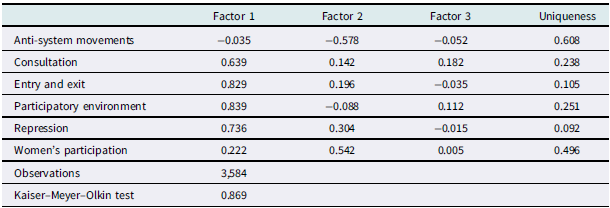
Using the six indicators of civil-society organisations, as described in the preceding section, would risk both multiple-test bias and using variables that are plausibly structurally related. We therefore reduce the dimensionality of the civil-society data through factor analysis. We use an oblique rotation technique (Promax) because general economic development, democracy, and broad-based policy choices may affect all elements at the same time, and oblique rotation allows for an estimated degree of correlation between the obtained factors. We report the factor solution in Table 2, with the Kaiser–Meyer–Olkin test score well above the standard for indicating factor-analysis suitability.
Factor analysis, CSO indicators

Table 2. Long description
A table showing factor analysis of civil-society data with six indicators. The table has six rows and five columns. The columns are labeled Factor 1, Factor 2, Factor 3, and Uniqueness. The row labels are Anti-system movements, Consultation, Entry and exit, Participatory environment, Repression, and Women’s participation. The table also includes Observations and Kaiser-Meyer-Olkin test values. Row 1: Anti-system movements, Factor 1: -0.035, Factor 2: -0.578, Factor 3: -0.052, Uniqueness: 0.608. Row 2: Consultation, Factor 1: 0.639, Factor 2: 0.142, Factor 3: 0.182, Uniqueness: 0.238. Row 3: Entry and exit, Factor 1: 0.829, Factor 2: 0.196, Factor 3: -0.035, Uniqueness: 0.105. Row 4: Participatory environment, Factor 1: 0.839, Factor 2: -0.088, Factor 3: 0.112, Uniqueness: 0.251. Row 5: Repression, Factor 1: 0.736, Factor 2: 0.304, Factor 3: -0.015, Uniqueness: 0.092. Row 6: Women’s participation, Factor 1: 0.222, Factor 2: 0.542, Factor 3: 0.005, Uniqueness: 0.496. Observations: 3584. Kaiser-Meyer-Olkin test: 0.869.
Notes: Promax-rotated factor loadings are reported. Higher values of factor 1 indicate greater civil-society freedom, meaning more consultation, freer entry and exit, a stronger participatory environment, and less repression. Higher values of factor 2 indicate a civil-society structure more oriented toward women’s participation and less toward anti-system movements.
The factor solution results in two well-defined factors; a third factor is poorly defined with no factor loading above 0.2. The first factor is easily interpretable, as consultation, entry and exit, participatory environment, and repression load highly on it. We interpret this as a general component capturing civil-society freedom and protection of its independence. The second factor consists of anti-system movements and women’s participation, which load with opposite signs, as well as a moderate loading on repression. A higher score thus indicates a civil society structured towards women’s participation and similar causes, while a lower score means that it more consists of anti-system and anti-government movements. We therefore refer to the two factors as factor 1 or 2, or civil-society freedom and civil-society structure.Footnote 5
Empirical strategy
Our empirical strategy is dictated by the structure of our data. We estimate standard panel OLS models with country and year fixed effects, with standard errors clustered at the country level. The baseline specification is:
 \begin{align}{Y}_{ct}^{k}=&\alpha _{c}+\lambda _{t}+\beta _{L}LPop_{c,t-\ell}+\beta _{R}RPop_{c,t-\ell}+\mathit{\gamma }Ideol_{c,t-\ell}+\delta _{L}\left(LPop_{c,t-\ell}\times Ideol_{c,t-\ell}\right)\\&+\delta _{R}\left(RPop_{c,t-\ell}\times Ideol_{c,t-\ell}\right)+{{\it X}}_{c,t-1}^{{\rm \prime}}\theta +\varepsilon _{ct}.\end{align}
Here,
 ${Y}_{ct}^{k}$
denotes civil-society factor k, with k = 1 for civil-society freedom and k = 2 for civil-society structure, in country c and year t. LPop and RPop denote seat-share-weighted left- and right-wing populist representation in the lower house. Ideol is the left-wing seat share minus the right-wing seat share. X is the vector of controls: log GDP per capita, log population, trade volume, government consumption, legislature diversity, and the electoral democracy indicator. The baseline models use a one-year lag, ℓ = 1, while the lag-robustness specifications set ℓ = 2, 3, 4. The specifications without interactions and the specifications using aggregate legislative populism are nested versions of the same model. The coefficients are estimated from within-country changes in populist representation and civil society, net of shocks common to all countries in a given year. Country fixed effects, α
c
, absorb approximately time-invariant factors, including political culture and long-standing policy traditions, while year fixed effects, λ
t
, absorb global events. The estimates should therefore be read as conditional within-country associations rather than as causal estimates.
A caveat is that bicausal dynamics are possible. The mechanisms developed above run from populist representation to civil-society conditions, but reverse causality cannot be ruled out if a weaker civil society fosters populist success by leaving a social-contextual vacuum that populists can exploit (Boje, Reference Boje2021; Putnam, Reference Putnam2020).Footnote 6 A possible ‘populism-inoculating’ role of civil society may coexist with pressure from populist forces on the strength and character of civil society. Our fixed-effects design does not fully separate these relationships, so our empirical focus is whether increases in populist representation are followed by changes in civil-society conditions in ways consistent with the theoretical mechanisms.Footnote 7
We conduct two timing diagnostics. First, we vary the lag length of ideology and populism. If contemporaneous reverse causality dominated the estimates, one might expect the associations to attenuate as lags lengthen. Persistence under longer lags is informative, but it does not rule out anticipatory responses, slow-moving reverse causality, or omitted time-varying country-level confounders. Second, following Bjørnskov and Berggren (Reference Bjørnskov and Berggren2026), we exploit the fact that party ideology and legislative populism change mainly in election years by interacting the populism and ideology terms with an election-year indicator. Non-election-year estimates are less likely to reflect contemporaneous feedback from civil-society conditions to electoral outcomes, but they are not immune to endogeneity, since civil society may change gradually before elections and since party splits, coalition changes, or parliamentary entry and exit can still reflect broader political developments. We therefore interpret both exercises as diagnostics of temporal plausibility, while the main estimates remain conditional within-country associations.
Results
This section presents the results of our empirical analysis, relating legislative populist representation and its left-wing and right-wing varieties to the two factors identified by our factor analysis: civil-society freedom and civil-society structure.
Main results
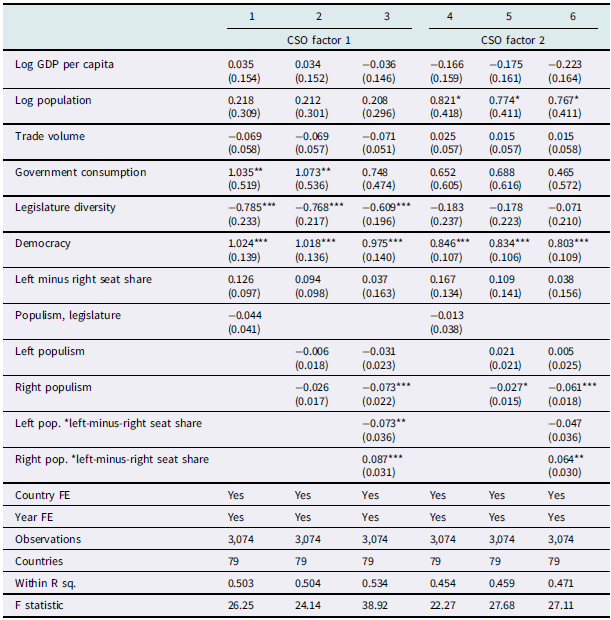
Table 3 reports the baseline two-way fixed-effects estimates with country and year fixed effects and standard errors clustered at the country level.
Main results

Table 3. Long description
The table presents a comparison of various economic and political factors across six different models. It includes columns labeled 1 through 6, each representing a different model, and rows labeled with different factors such as Log GDP per capita, Log population, Trade volume, Government consumption, Legislature diversity, Democracy, Left minus right seat share, Populism, legislature, Left populism, Right populism, Left pop. *left-minus-right seat share, and Right pop. *left-minus-right seat share. Each cell contains numerical values and standard errors in parentheses. The table also includes indicators for Country FE, Year FE, Observations, Countries, Within R sq., and F statistic. Row 1: Log GDP per capita, 0.035 (0.154), 0.034 (0.152), -0.036 (0.146), -0.166 (0.159), -0.175 (0.161), -0.223 (0.164). Row 2: Log population, 0.218 (0.309), 0.212 (0.301), 0.208 (0.296), 0.821* (0.418), 0.774* (0.411), 0.767* (0.411). Row 3: Trade volume, -0.069 (0.058), -0.069 (0.057), -0.071 (0.051), 0.025 (0.057), 0.015 (0.057), 0.015 (0.058). Row 4: Government consumption, 1.035** (0.519), 1.073** (0.536), 0.748 (0.474), 0.652 (0.605), 0.688 (0.616), 0.465 (0.572). Row 5: Legislature diversity, -0.785*** (0.233), -0.768*** (0.217), -0.609*** (0.196), -0.183 (0.237), -0.178 (0.223), -0.071 (0.210). Row 6: Democracy, 1.024*** (0.139), 1.018*** (0.136), 0.975*** (0.140), 0.846*** (0.107), 0.834*** (0.106), 0.803*** (0.109). Row 7: Left minus right seat share, 0.126 (0.097), 0.094 (0.098), 0.037 (0.163), 0.167 (0.134), 0.109 (0.141), 0.038 (0.156). Row 8: Populism, legislature, -0.044 (0.041), -0.013 (0.038). Row 9: Left populism, -0.006 (0.018), -0.031 (0.023), 0.021 (0.021), 0.005 (0.025). Row 10: Right populism, -0.026 (0.017), -0.073*** (0.022), -0.027* (0.015), -0.061*** (0.018). Row 11: Left pop. *left-minus-right seat share, -0.073** (0.036), -0.047 (0.036). Row 12: Right pop. *left-minus-right seat share, 0.087*** (0.031), 0.064** (0.030). Row 13: Country FE, Yes, Yes, Yes, Yes, Yes, Yes. Row 14: Year FE, Yes, Yes, Yes, Yes, Yes, Yes. Row 15: Observations, 3074, 3074, 3074, 3074, 3074, 3074. Row 16: Countries, 79, 79, 79, 79, 79, 79. Row 17: Within R sq., 0.503, 0.504, 0.534, 0.454, 0.459, 0.471. Row 18: F statistic, 26.25, 24.14, 38.92, 22.27, 27.68, 27.11.
Note: *** (**) [*] denote significance at p < 0.01 (p < 0.05) [p < 0.10]. Numbers in parentheses are standard errors clustered at the country level. Higher values of CSO factor 1 indicate greater civil-society freedom. Higher values of CSO factor 2 indicate a civil-society structure more oriented toward women’s participation and less toward anti-system movements. The ideology variable is left-wing seat share minus right-wing seat share, so negative values indicate right-dominated legislatures.
Three findings stand out. First, right-wing populist representation is negatively related to both civil society outcomes. A higher seat-share-weighted level of right-wing populism in the legislature is associated with lower civil-society freedom and a weaker civil-society structure, and the marginal association becomes more negative as the right-wing majority becomes larger.Footnote 8 The magnitude is also politically significant. For a one-standard-deviation increase in right-wing populism (1.8 index points on a 10-point scale), the implied differences are 0.17 standard deviations for factor 1 and 0.15 standard deviations for factor 2 at a balanced legislature. These differences become larger in legislatures with strong right-wing dominance (at a relative share of −0.9): 0.35 and 0.29 standard deviations, respectively. These results align with our theoretical expectation that right-wing populist representation is associated with noticeable pressure on civil society.
Second, left-wing populism is not robustly related to either civil society outcome. Across specifications, left-wing populism is, on average, indistinguishable from zero and does not attain statistical significance. This should not be interpreted as evidence that left-wing populism is necessarily benign for civil society. Rather, the result is consistent with the theoretical expectation that left-wing populism often works through incorporation, state linkage, and selective support for allied organisations rather than through broad legal or discursive restriction of the civic sphere. Such strategies may reduce organisational autonomy without producing a clear decline in the V-Dem indicators that load on civil-society freedom and structure. There is one exception: its interaction with the ideological composition is negative and statistically significant for factor 1. When the legislature is more left-dominated, left populism is associated with weaker civil-society freedom. A one-standard-deviation increase in left-wing populism is related to a 0.21 standard deviation decrease in this civil-society indicator at a value of the ideology measure of 0.9, which is considerably smaller than the corresponding estimate for right-wing populism. We do not find a robust counterpart for factor 2.
Third, ideological alignment conditions the association between populism and civil society. The ideology variable is defined as the left-wing seat share minus the right-wing seat share, so negative values indicate right-dominated legislatures and positive values indicate left-dominated legislatures. This coding means that the right side of the political spectrum appears on the left side of Figures A3 and A4 in the Online Appendix. The interaction terms show that the negative association for right-wing populism is strongest when the legislature is right-dominated, while the corresponding left-populism pattern is weaker and appears only for civil-society freedom in strongly left-dominated legislatures. This is consistent with the argument that populist parties can exercise influence through ideologically proximate allies even when they do not command a majority on their own.
Figure A3 plots the conditional marginal associations between populism and civil-society freedom across the legislature’s ideological composition. The right-wing populism line becomes more negative as the legislature becomes more right-dominated, while the left-wing populism line is close to zero across most of the range but turns negative in strongly left-dominated legislatures. Figure A4 shows the corresponding estimated marginal associations for civil-society structure. The right-wing populism line again becomes more negative as the legislature becomes more right-dominated, although the slope is somewhat smaller than for civil-society freedom. Left-wing populism remains indistinguishable from zero across most ideological compositions. The two figures show that the main negative association is concentrated in right-wing populism, especially when right-wing parties dominate the legislature. We report the empirical distribution of right- and left-wing populism in Figures A5 and A6 in the Online Appendix and interpret these estimates with this pattern in mind.
Control variables behave as expected. Electoral democracy is strongly and positively associated with both factors; legislature diversity enters negatively for factor 1, and the macro controls are either modest or imprecisely estimated.
Exploring timing and veto players
In Section A.2 of the Online Appendix, we report several timing diagnostics: changing the lag length of populism, adding lagged dependent variables, interacting populism and ideology with election years, and estimating whether lagged civil-society conditions predict subsequent legislative populism. We also ask whether strong veto institutions condition the association between populism and civil society. Because results for factor 2 remain weaker and more fragile, we focus here on CSO factor 1.
First, the negative association between right-wing populism and factor 1 is stable and precisely estimated across 2–4-year lags. Adding lagged dependent variables, both as a standard one-year lag and as the value observed immediately before the last election, makes the right-wing populism estimates slightly smaller, as expected in such specifications, while they remain negative. Reversing the direction of the association by asking whether lagged civil-society conditions predict subsequent legislative populism provides little indication of a clear reverse-direction association from weaker civil society to later right-wing populist representation. Finally, in the election-year test, the negative association between right-wing populism and civil society remains statistically significant and broadly similar in size, while the election-year interaction terms offer limited indication that the main results are driven by election-specific feedback from civil society to political outcomes. For left-wing populism, the pattern is more qualified, consistent with the weaker and less systematic associations reported in the main results.
Introducing an indicator for the strength of veto players and interacting it with ideology and populism, two robust patterns emerge. First, veto player strength attenuates the negative association between right-wing populism and civil society: on average, the negative right-populism association with civil-society freedom and civil-society structure is smaller where institutional veto players are strong. Second, the attenuation is weaker when ideological alignment favours the right. Hence, when right-wing parties dominate a legislature, the attenuating role of veto players is weakened.
Testing legislative versus executive populism
Exploring our findings in a different direction, the Online Appendix provides a comparison between legislative and executive populism. When we replace the seat-share-weighted legislative measure with an executive-branch measure, defined as the average populism score of parties in government, the estimated conditional associations weaken, and the interaction terms become statistically insignificant. However, when legislative and executive populism are included simultaneously, the legislative-populism estimates remain approximately the same size and retain statistical significance, while the executive-populism estimates remain smaller and statistically weak. This supports our focus on legislative representation and suggests that executive-only measures may miss part of the association between populism and civil society, while also showing that legislative and executive measures capture different dimensions of populist influence.
Additional tests
The Online Appendix offers a set of additional tests and information. First, it provides an overview of the conceptual connections between theoretical channels, observable implications, and empirical measures, as well as the corresponding mechanism-related regressions. These tests use V-Dem’s measures of rule of law and discussion freedom as proxies for a legal-administrative and a discursive channel. Stronger right-wing populist representation is associated with lower subsequent rule of law and discussion freedom, with the total marginal association becoming more negative as the legislature tilts to the right. When these variables are added to the baseline civil-society regressions, they enter positively, while the right-populist coefficients become smaller and less precise. This pattern is consistent with legal-administrative and discursive deterioration but should be read as a partial decomposition of related institutional and discursive conditions rather than as an identified mediation test. Additional specifications that proxy the fiscal channel with broad macroeconomic and fiscal aggregates do not reveal systematic patterns. We interpret this null cautiously, since these aggregates are distant proxies for the fiscal instruments most relevant to civil society.
Finally, the Online Appendix also provides a series of robustness tests. We re-estimate the baseline specifications after excluding the 10% of country-years with the highest populism scores; examine whether the results are driven by regime transitions or autocracy by excluding post-socialist transition observations, autocratic country-years, and observations around regime transitions; and report specifications using the six constituent V-Dem civil-society indicators separately, as well as the two religious-civil-society indicators available in V-Dem. Throughout, the coefficients on right-wing populism and its interaction with the ideological composition of the legislature remain similar in magnitude and significance to the baseline for civil-society freedom. The factor 1 results are not driven by a single underlying indicator: consultation, entry and exit, participatory environment, and repression show relatively consistent right-populism patterns. The factor 2 results are more differentiated, and the religious indicators do not show a systematic right-populism pattern. Additional tests show that the factor structure remains broadly stable when excluding one region at a time and when excluding regime-transition observations.
Concluding remarks
A dynamic and free civil society is widely viewed as a cornerstone of a flourishing society, fostering social trust, reciprocity, and collective problem-solving that neither markets nor the state can supply on their own (Edwards, Reference Edwards2014; Ostrom and Ostrom, Reference Ostrom, Ostrom and Savas1977; Putnam, Reference Putnam2020). Strong, autonomous associations are also linked to higher democratic quality and more resilient institutional performance (Grahn and Lührmann, Reference Grahn and Lührmann2021). Since the rise of populism, there is widespread concern that this view of politics and society will constrain civil society as an independent sphere with an alternative popular grounding. We therefore ask whether populist politics help or hinder civil society and under what conditions.
Using a country-year panel covering 79 societies with modern party systems and multiparty legislative institutions, we examine how the strength of populist parties in the legislature relates to two core dimensions of the civic sphere: freedom from state control and the structure of participation. We also study how these relationships vary with the ideological balance of legislatures and with institutional checks, using lagged specifications and election-year interactions as timing diagnostics while recognising that these diagnostics do not eliminate all endogeneity concerns.
Three results stand out. First, stronger right-wing populist representation is associated with subsequent declines in civil-society freedom and changes to civil-society structure: more repression of civil-society organisations, more restricted participation, and a shift towards more anti-system movements and less focus on women’s participation and rights. Magnitudes are modest at ideologically balanced legislatures, roughly one fifth of a standard deviation for a one-standard deviation increase in right-wing populism, and larger where right-wing parties dominate. At the associational level, this structural shift parallels Cole and Schofer’s (Reference Cole and Schofer2024) policy-level finding on right-populist restriction of women’s and gay rights and complements Ivanov’s (Reference Ivanov2025) Central and Eastern European evidence that longer populist tenure is associated with tighter control over CSOs and, especially in Hungary and Poland, lower civil-society participation. Second, average associations for left-wing populism are small and often indistinguishable from zero, with a detectable negative association for civil-society freedom in strongly left-dominated legislatures and no robust counterpart for structure. This should not be read as evidence that left-wing populism has no civil-society consequences, especially given evidence that Latin American left-populist regimes can weaken liberal-democratic institutional quality over time (Cachanosky et al., Reference Cachanosky, Bastos, Padilla and Hernandez2025). Rather, the weaker estimates may reflect incorporation, state linkages, and selective support for allied organisations, which can reduce autonomy without registering as broad restrictions in our baseline civil-society factors. Third, institutional checks attenuate, but do not eliminate, the negative association between right-wing populism and both outcomes, and this attenuation is weaker when partisan alignment favours the right. Diagnostic checks provide little indication that these patterns are driven by election-year feedback, lagged outcome persistence, reverse-direction associations from civil society to subsequent populism, the most extreme populism observations, or regime-transition contexts.
These findings extend research on the consequences of populism beyond executive rule, macroeconomic outcomes, broad democratic indicators, and policy outputs. Studies such as Cachanosky et al. (Reference Cachanosky, Bastos, Padilla and Hernandez2025), Cole and Schofer (Reference Cole and Schofer2024), Funke et al. (Reference Funke, Schularick and Trebesch2023), Hawkins and Mitchell (Reference Hawkins and Mitchell2025), and Juon and Bochsler (Reference Juon and Bochsler2020) examine important institutional, economic, democratic, and social-policy consequences of populism. We complement this work by treating civil society itself as the outcome and by distinguishing civil-society freedom from civil-society structure. We also extend Ivanov’s (Reference Ivanov2025) analysis by moving from a regional cabinet-tenure measure of populist exposure to a broader panel of continuous legislative populist representation, while separating right- and left-wing populism. Finally, the results contribute to debates about why the consequences of populism are conditional: ideological alignment and veto players shape when populist representation is associated with weaker civic conditions, which links the empirical results to the legal-administrative and discursive channels developed in this study.
The main pattern is a shift toward lower autonomy and a less pluralistic structure, in which critical organisations face greater legal-administrative or discursive pressure while aligned organisations may be protected, mobilised, or incorporated. Such a pattern is consistent with the idea that civil society may persist but in a less autonomous form and may sometimes be used to consolidate and legitimise populist projects (Naxera et al., Reference Naxera, Gueorguieva and Irrera2024). Veto players matter because they make this reshaping harder, but institutional checks are less protective when the legislative environment is ideologically favourable to the right.
Four limitations should be kept in mind. First, time-varying factors such as differential crisis exposure, demographic change and, in particular, migration composition, and asymmetric technical change and adaptation cannot be fully accounted for given the lack of consistent cross-country data. Second, although all countries covered in this paper have constitutions that formally define a competitive democratic political process, not all are de facto democracies, and the sample is also defined by the availability and comparability of party-level populism, party ideology, legislative seat shares, and V-Dem civil-society indicators in settings with multiparty legislative institutions. It hence includes some hybrid and backsliding regimes but excludes single-party and non-electoral regimes, so the findings should not be extrapolated to closed authoritarian regimes. Third, our baseline outcomes capture general civil-society freedom and structure rather than every possible sector of associational life. Religious civil society, which we only consider as a robustness test in the appendix, may, for example, follow a distinct logic: right-wing populist parties and ideologically proximate allies may privilege conservative religious organisations while constraining watchdog, minority-oriented, or rights-based CSOs. Finally, our left–right ideology measure captures economic policy rather than cultural or transnational cleavages. This avoids building cultural exclusion directly into the ideology variable, but it still means that the right-populism estimates refer to empirically observed right-wing populism, including its cultural content.
Future work could merge our panel with new datasets on NGO laws, licensing and audit intensity, public grant flows to associations, and litigation patterns; use administrative data on registrations and funding to test whether alignment and veto logic replicate within countries; and clarify how civic ecosystems mediate support for populist parties and how counter-mobilisation operates. In all, the analysis documents a robust association between right-wing populist representation and weaker civil-society conditions, while identifying institutional and partisan conditions under which this association is stronger or weaker.
Online Appendix
Available at https://www.christianbjoernskov.com/bjoernskovrodedata/


 Open access

