Since its origins in the 1960s, the Haddon matrix has served injury prevention professionals as a tool to better understand strategies to anticipate and prevent injuries and promote safety.Reference Haddon1 Based on the research of William Haddon, Jr., and Hugh De Haven, this tool – once known as the phase-factor matrix – aids users in identifying, organizing, and classifying factors that influence and contribute to outcomes of interest (eg, reducing injuries, infections, and infrastructure damage), during and after selected events (eg, motor vehicle crashes [MVCs], infectious disease outbreaks, disasters).Reference Haddon1,Reference Haddon2 The Haddon matrixʼs primary purpose is to naturally align risk factors with the classic epidemiologic triad of host, agent, and environment (with “environment” subdivided into “physical” and “sociocultural”).Reference Haddon2,Reference Barnett, Balicer and Lucey3 This allows specific event factors to be modified through a consistent epidemiologic framework.Reference Haddon2,Reference Williams4
The Haddon matrixʼs 3 rows depict the 3 time phases used within injury prevention work: pre-event, event, and post-event.Reference Williams4 Information in each cell contributes to decision-making approaches to mitigate negative outcomes due to the event of interest.Reference Runyan5 Such information guides users toward focused task-oriented actions to enhance organizational posture and maximize response. The Haddon matrixʼs organizational structure allows for a “big picture” analysis, as well as more granular exploration of a public health challenge.Reference Barnett, Balicer and Blodgett6
Since the inception of the tool, its application has evolved and expanded. Originally built around the mechanics of MVC injuries, early use focused on the energy damageReference Haddon7 from crashes to improve vehicle safety.Reference Haddon1,Reference Albertsson, Björnstig and Falkmer8-Reference Moghisi, Mohammadi and Svanstrom10 This was an apt early model, as MVCs have a clearly distinct set of pre-event, event, and post-event phases for study. The matrix was subsequently applied to topics such as food securityReference Hecht, Biehl and Barnett11 burns,Reference Deljavan, Sadeghi-Bazargani and Fouladi12,Reference Sadeghi-Bazargani, Azami-Aghdash and Arshi13 falls,Reference Sattin14,Reference Runyan15 firearms injuries,Reference Sorenson16 residential fires,Reference Peck, Kruger and van der Merwe17 school violence,Reference Haddon7 workplace violence,Reference Runyan, Zakocs and Zwerling18 pesticide poisoning,Reference Eddleston, Buckley and Gunnell19 childhood injuries,Reference Dowd, Keenan and Bratton20,Reference Grossman21 and infectious disease outbreaks such as pandemic influenza and severe acute respiratory syndrome.Reference Barnett, Balicer and Lucey3,Reference Tiwari, Tarrant and Yuen22 Recently, the matrix has served as a platform from which to research bioterrorism risk,Reference Pappas, Panagopoulou and Akritidis23 preparedness and response to terrorism,Reference Gofin24,Reference Varney, Hirshon and Dischinger25 radicalism,Reference Post26 and cyber-attacks.Reference Michael, Voas and Laplante27
OPPORTUNITIES FOR EXPANSION AND INNOVATION
The Haddon matrix has a potential for broadened application and innovation. For example, opportunities exist in rigorous, metrics-driven evaluation of critical infrastructure using the matrix. A 2002 study by the National Research Council concluded that better protection of critical infrastructure would make the nation safer.28 The World Health Organization, as a component of its Framework for Action 2005–2015, sought to enhance resilience to disasters for hospitals and health facilities as part of its multi-agency Safe Hospitals Initiative.29 Despite these wide-ranging applications, the Haddon matrix has rarely been used to examine vulnerable infrastructure,Reference Farmer, Nelson and Graham30,Reference Reissman, Kowalski-Trakofler, Katz, Southwick, Litz and Charnet31 including hospitals.Reference Tiwari, Tarrant and Yuen22 This gap is critical given the large global burden of earthquake-associated morbidity, mortality, and displacementReference Doocy, Daniels and Packer32 and adverse impact on critical infrastructure such as hospitals.Reference Kirsch, Mitrani-Reiser and Bissell33
Traditionally, Haddon matrices rely on expertise from the fields of injury prevention, public health, epidemiology, and industrial safety.Reference Haddon1,Reference Barnett, Balicer and Lucey3,Reference Albertsson, Björnstig and Falkmer8,Reference Eddleston, Buckley and Gunnell19,Reference Dowd, Keenan and Bratton20,Reference Lin and Kraus34,Reference Wall35 We propose that a broader set of disciplines – including various engineering disciplines, law, and behavioral sciences – be incorporated into a single matrix. Inclusion of these key components of risk assessment will yield a more comprehensive approach that begins to mitigate the lack of interdisciplinary cross-pollination in the peer-reviewed literature. This paper will illustrate how the Haddon matrix can integrate these seemingly disparate disciplines to yield innovative insights about hospital earthquake preparedness.
HADDON MATRIX INPUTS
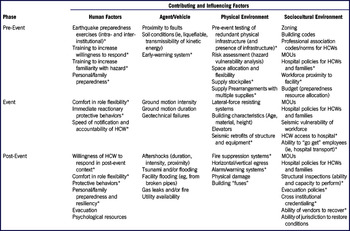
Effective hospital preparedness efforts require thoughtful pre-event, event, and post-event strategies aligned with the mitigation and preparedness, response, and recovery phases of emergency management.Reference McLoughlin36 Table 1 presents a conceptual overview of hospital earthquake preparedness within a Haddon matrix framework. As described in detail below, this matrix melds interdisciplinary perspectives from civil, structural and mechanical engineering, law, and the behavioral sciences. Given some factors are immutable, such as geographic faults, preparedness specialists should seek to focus on factors under their control. Specifically, highlighted are opportunities, or potentially modifiable factors, that are accessible through valid testing instruments,37 training, and evaluation. Here we propose focusing on engineering, policy, and behavioral sciences as the particular disciplines most relevant to the identified modifiable factors. By proactively engineering safer facilities and developing policies and behavioral interventions that support resiliency, hospitals will be better prepared through the 3 time phases.
The Haddon Matrix and Hospital Earthquake Preparedness

* Opportunities – potentially modifiable factors.
HCW = health care workers; MOU = memorandum of understanding.
Engineering
Engineering challenges affecting hospitals during and after earthquakes can vary widely. These challenges can include geotechnical issues, structural failures (including collapse of the building), and nonstructural physical damage. The Haddon matrix can assist in integrating engineering concepts to better advise hospital planners and improve organizational posture to contend with the unique and variable engineering challenges posed by earthquakes. Physical infrastructure for a hospital includes the physical plant (eg, buildings), grounds (eg, parking lots), and mechanical systems (eg, air handling, medical gases, fire suppression). In many seismic areas, the physical infrastructure is vulnerable to damage during an earthquake.Reference Takagi and Wada38 It is particularly important to consider the vulnerability of the built environment in areas with older buildings and infrastructure, economically developing countries, and regions with infrequent earthquakes.Reference Brancati39 In addition to the physical infrastructure of the hospital, it is critical to consider the connecting physical infrastructure (eg, utilities, transportation). All infrastructures are interdependent, and damage to 1 type of infrastructure can spread out and impact other areas of a community, including hospitals.Reference Cimellaro, Reinhorn and Bruneau40,Reference Cimellaro, Solari and Bruneau41 Further, physical damage inside and around the hospital can pose a risk to patients, families, visitors, and staff.
Within the Haddon matrix, engineering concepts map primarily to the Agent/Vehicle and the Physical Environment factors of the hospitalʼs actual infrastructure. Both of these factors connect naturally to geographic factors inherent to the earthquake, such as proximity to fault lines, ground motion factors, and subsequent after effects such as tsunamis, in the pre-event, event, and post-event time frames, respectively. In the pre-event phase, considerations of the hospitalʼs proximity to faults and the local soil conditions are 2 key risk factors within the agent/vehicle domain. Both factors provide relevant feedback on predictable ground behavior (probability of liquefaction, lateral spread, and settlement) during an earthquake, as well as the expected characteristics of the ground motions at the site.Reference Seed and Idriss42,Reference Seed, Romo and Sun43 To account for the soil conditions, fault proximity, and probable ground motions/behavior, the International Building Code requires formal subsurface characterization studies.44 Incorrectly or inaccurately accounting for soil behavior during an earthquake can lead to unanticipated geotechnical failures on and around the hospital grounds. These ground failures may include extensive liquefaction, ground faulting, and ground subsidence, each of which can cause failures of the physical plant, damage to walls and foundations, or overturning of the buildings.Reference Tokimatsu, Mizuno and Kakurai45-Reference Jacques, McIntosh and Giovinazzi47 Such failures are considered in the event phase of the Haddon matrix.
For hospitals to continue to operate during and after an earthquake, the physical infrastructure must maintain its integrity. To assess this, pre-event testing of the primary and redundant physical infrastructure should be considered. Primary infrastructure includes the structural system of the building, the utilities coming into and out of the building (eg, power, water, communications, wastewater, medical gases), and the mechanical distribution systems in the building. The ability of the primary systems to continue to function can be assessed through computer modeling and simulation, historical records, exercises, or risk analysis modeling. Each critical system in a hospital should have a redundant or secondary backup to ensure continuity of operations if the primary systems fail.Reference Bruneau, Chang and Eguchi48 Examples of redundant or secondary systems include using dual systems for the structural frames (eg, combining 2 types of structural systems in a single building),Reference Maley, Sullivan and Corte49-Reference Karakostas, Lekidis and Makarios52 alternative power supplies for critical operations (eg, automatic generator power switching for ventilators), and alternative central or robust portable medical gas systems.
Engineering concerns during the event-phase require considerations of both geotechnical issues and structural performance. Earthquakes cause ground shaking. The intensity and duration of the ground shaking cause damage or failures to the built environment. While both the intensity and the duration of the earthquake shaking is unknowable beforehand, estimations can be made to inform the preparedness discussion because earthquake response plans are developed in the pre-event phase. Ground shaking and other geotechnical failures such as liquefaction, ground settlement, and lateral spread can be considered as response plans are developed. Mitigation measures can be implemented to limit the negative impacts of geotechnical failures during the event.
Building characteristics and structural systems should be considered as event-phase physical environment factors while developing an earthquake response plan because they will be the direct line of defense against the ground shaking and other geotechnical failures. Building characteristics, including the age, height, and construction material, provide information on the projected behavior and performance of the building during an earthquake. A rudimentary study of building performance can be estimated based on the building characteristics. This allows emergency planners to perform a risk assessment for damage or potential collapse prior to conducting a detailed structural analysis.Reference Kircher, Whitman and Holmes53,Reference Barbat, Pujades and Lantada54
An event-phase engineering-informed topic includes buildings using energy- dissipating devices (fuses) to absorb earthquake energy. The fuses limit the damage to critical structural systems during an event by localizing the energy and damage in easy-to-replace components. After an earthquake, these fuses need to be inspected and possibly replaced to ensure future structural integrity of the building.Reference Erochko, Christopoulos and Tremblay55,Reference Qu, Liu and Hou56 Another engineering event-phase and post-event consideration is the seismic susceptibility of the workforce. This refers to the seismic vulnerability of the employees’ residences and is found in the matrix under Sociocultural Environment factors (though it fits under Physical Environment too). Informed assumptions are made about structural resilience based on typical factors for the region, such as height, age or construction, material, and so forth, of residential housing and not on an actual inventory of staff member homes. For example, risk considerations for the staff of Queen Elizabeth Hospital,Reference Yeh and Yuen57,Reference Giridharan, Ganesan and Lau58 who live in Hong Kongʼs high rises, vary from staff at California Pacific Medical Center, who live in San Francisco residential flats, mid-rises, and a suburban tract.59 Estimations for the vulnerability of employee housing can be obtained through computer simulation.Reference Vickery, Skerlj and Lin60 Beyond housing, staff availability in the post-event phase will be dependent on the functionality of the transportation network.Reference Khademi, Balaei and Shahri61
Items specific to post-event activities involve response considerations with direct and severe impacts to patient care and occupant safety. These include facility flooding, gas leaks, and/or fire, utility damage,Reference Dueñas-Osorio and Kwasinski62 and damage to the plant (structural and nonstructural),Reference Schultz, Koenig and Lewis63-Reference Yavari, Chang and Elwood65 mechanical, and electrical systems. Ground failures also disrupt the interconnected physical infrastructure, causing breaks in utilities or impassible roads.Reference Bird and Bommer66 Because emergencies of this nature may require patient and/or staff evacuation,Reference Yanagawa, Kondo and Okawa67 vertical and horizontal egress must be considered. Cross-institutional credentialing and the timeliness to reconstitution will then become critical post-event sociocultural and physical environment considerations.
Policy
Regulatory issues permeate disaster preparedness, response, and recovery.Reference Hodge68 By accounting for the legal environment, the Haddon matrix can assist hospital emergency planners to identify law and policy issues that may impede the provision of care during and shortly after an earthquake.
In Table 1, pre-event factors include an organizational risk assessment, which is typically conducted by hospitals as part of the hazard vulnerability analysis required by the Joint Commission and its international counterparts. This analysis considers factors – including natural and human-caused events – that may impact demand for or the ability to offer hospital services.69 In the pre-event stage, a hospitalʼs internal policies should be critically evaluated, including the flexible allocation of space. By understanding which physical spaces can be repurposed during and after an event to meet dynamic patient care needs, a hospital can better anticipate response options. During the pre-event stage, hospitals can also ensure that they have met or surpassed building code requirements, including retrofitting infrastructure to meet current standards.Reference Hodge, Garcia and Anderson70
Prior to an event such as an earthquake, policies should be established to allow for mutual aid. Typically enacted through memoranda of understanding (MOUs), these policies must be tested to ensure that staff are familiar and resources are rapidly available. During and immediately after an earthquake, an MOU with a neighboring hospital or health system can help an affected hospital meet surge capacity or maintain continuity of operations.Reference Sauer, McCarthy and Knebel71,72 If a hospital is unable to meet demands for care, MOUs can also facilitate evacuation of injured staff or patients, prioritization of limited resources, and resource allocation in the period immediately after a disaster.Reference Jobe83,Reference Niska and Shimizu73 Given the rapid occurrence and unpredictability of a disaster, along with the specialty needs of critical care patients (eg, ventilator or extracorporeal membrane oxygenation dependence), emphasis should be placed on establishing and testing these agreements in advance of disasters.
Post-event, jurisdictional policies for credentialing and licensure may determine whether an affected hospital can maintain a robust health care workforce as the area recovers from the disaster. For example, the Emergency Management Assistance Compact (EMAC) can accelerate deployment of responders to states facing a disaster.74 EMAC facilitates licensure portability, meaning that health care providers from out-of-state receive temporary licensure reciprocity or waiver to allow them to provide care in the state experiencing the disaster with accompanying liability protection. States have enacted additional laws, such as the Uniform Emergency Volunteer Health Practitioners Act, to similarly facilitate deployment of volunteer health care providers to states following a disaster.75
Behavioral Sciences
A hospitalʼs human infrastructure is its most critical resource and is key to hospitals’ resilience and rapid recovery following a disaster such as an earthquake. Because reluctance to present for work could negatively affect the health systemʼs capacity to meet post-earthquake medical needs,Reference Koh, Lim and Chia76 the Haddon matrix can help identify areas where interventions to improve willingness are most needed. From a behavioral sciences perspective, pre-event activities include training to increase the willingness to respond (WTR) and return to work among hospital staff; training to increase familiarity with relevant hazards (ie, earthquake-specific preparedness); and personal/family preparedness. This creates value because many of the factors that influence health care workers’ (HCW) WTR are amenable to interventions (noted as potentially modifiable factors in Table 1).Reference Qureshi, Gershon and Sherman77-Reference Harrison, Errett and Rutkow79 Another pre-event item relevant to the human infrastructure dimension is hospital policies for HCWs and families. Such policies advise decision-making processes relative to HCWs missing work, calling in sick, working overtime, and the rationale behind these (eg, caring for a child or relative). Last, noted on the matrix is workforce proximity to the facility, which may inform workforce planning and availability considerations in an infrastructure-destructive event, such as an earthquake.
Event-phase considerations involve crisis risk communication via the speed of notification of HCWs. Relevant research on the local public health workforce suggests the importance of comfort in role flexibility, which is driven by the institutional ability to instill workers’ self-efficacy in the roles they will perform, and their value to the mission, during earthquake response.Reference Barnett, Thompson and Errett80 From a workforce management standpoint, willingness of HCWs to respond and protective behaviors are listed in Table 1 for consideration and analysis. Protective event behaviors are those of the staff (eg, evacuating buildings or sheltering-in-place, per training protocols) and of the hospital (eg, increased security presence post-event). HCW access to a hospital refers to the ease with which HCWs can secure passage during and after a disaster, such as in jurisdictions that allow hospital staff to travel to work even when driving restrictions are imposed. When access is constrained, the ability to “go get” employees is limited by the resources that hospitals can leverage to collect employees from their homes and transport them to work. In some states, National Guard vehicles transport critical hospital staff (eg, intensive-care-unit nurses) when road conditions are prohibitive (eg, during hurricanes, snow storms).Reference Stuhltrager81 Pre-event personal and family preparedness is a consideration that has a significant impact on workforce dynamics during and after an earthquake, and is noted as highly correlated with event and post-event HCW WTR.Reference Harrison, Errett and Rutkow79,Reference Kinnunen and Mauno82 Increased household and family preparedness reduces work–family conflict and improves HCWs’ ability to focus on their jobs.Reference Kinnunen and Mauno82
Items specific to post-event activities involve the consequence-phase willingness of HCWs to respond and psychological resources. The willingness of HCWs to respond in post-event contexts remains a consideration worthy of preparatory effort and planning and thus remains in this phase. While initial WTR may have been addressed through training and effective disaster risk communication, long-term responsiveness has a tendency to wane.Reference Jobe83 Post-earthquake recovery may take months to years,Reference Chang84 and strategies must be considered to prevent long-term HCW fatigue. Complementing this are considerations given to mitigation and treatment of mental health sequelae. Collectively, these are noted in the matrix as psychological resources.
HADDON MATRIX OUTPUTS
The outputs of the Haddon matrix may be viewed along 4 categories: decision support, conceptual organization, conceptual integration, and opportunities. Foremost, the matrix is a decision support and root-cause analysis tool. Use of the matrix for quantitative and qualitative assessments and decision support for unique challenges has been described elsewhere.Reference Haddon1,Reference Haddon7 Second, the matrix provides conceptual organization to incident management. It allows users to work through the contributing factors and associated details behind each aspect of preparedness, mitigation, and response in a logical, temporally sequenced and organized fashion. The matrix thus helps parcel out complex scenarios into manageable segments.Reference Barnett, Balicer and Lucey3 Third, it provides conceptual integration by facilitating the users’ analytic reviews and assessments of the relationships among each of the various aspects of preparedness, mitigation, and response for the given scenario. For example, pre-event redundancies in the physical infrastructure are correlated with post-event staff WTR and take on expanded and unusual roles. By ensuring staff know that their safety is prioritized and continually evaluated, their self-efficacy will be increased post-event. Ultimately, this logical process enables planners to picture how and where (1) strategies or activities overlap; (2) reliance within or across epidemiologic or event dimensions occur (cascading relianceReference Wilsch, Henry and Herrmann85,Reference Little86 ); (3) sequencing of actions is required; and (4) factors apply in multiple cells making them priorities. Such visualization facilitates an ordered and efficient approach as users uncover singular solutions to address multiple infrastructure and operational issues, be they disparate, interconnected, or inter-reliant.Reference Barnett, Balicer and Blodgett6,Reference Wald, Jaiswal and Allen87 This enables optimal targeting of incident-specific interventions. “Opportunities” comprise the fourth output of the matrix. These are potentially modifiable factors that present prospects for users to leverage resources or improve conditions during pre-event planning to improve organizational preparedness, response, and resilience.
OPPORTUNITIES FOR SYNTHESIS
Recent, highly consequential earthquakes in Iran, Chile, Japan, China, and Nepal suggest that urbanization and growth in geologically vulnerable parts of the globe portend earthquakes’ growing impact on humanity.37 This paperʼs novel contextual examination of the Haddon matrix can enhance critical infrastructure disaster preparedness by assisting hospital leaders, health care facility administrators, and emergency management professionals in integrating essential principles of behavioral sciences, policy, law, and engineering in the context of earthquake preparedness. This multidisciplinary approach is essential due to the complex nature of such disasters, their rapid onset, and the broad variation in impact and outcomes.Reference Kirsch, Mitrani-Reiser and Bissell33,Reference Wald, Jaiswal and Allen87 Given these considerations, there may be value to using an associative approach to the Haddon matrix – one informed by subject matter experts not previously considered – to evaluate a hospitalʼs susceptibility and resilience. By incorporating engineering, law and policy, and behavioral sciences – atypical factors for a Haddon matrix – more comprehensive preparedness can occur from an all-hazards standpoint. The utility of this approach is further underscored given that earthquakes are not as easily simulated in training as are scenarios like mass casualty shootings, chemical/biological contamination, or a loss of utilities. The principles discussed here are not, however, limited to earthquakes; rather, they have applicability across a spectrum of risks.
CONCLUSION
The Haddon matrix provides a user-friendly way to integrate current engineering concepts, behavioral sciences, and legal/policy dimensions in the context of hospital preparedness for earthquakes. To the best of our knowledge, this is the first such application of the Haddon matrix. Using the matrixʼs framework to apply risk assessment principles to hospital preparedness for earthquakes enables an interdisciplinary collaboration between the social and physical sciences. This systematic approach allows modifiable and non-modifiable factors to be readily identified to reduce hospital-based vulnerabilities to earthquakes. As described above, this goal can be accomplished through the collaborative use of the Haddon matrix to facilitate infusion of various disciplines into emergency operation plans, policies, procedures, and standards of hospital emergency planners. While hospitals reflect just 1 aspect of overall community vulnerability to earthquakes, they are a critical element in developed and developing nations alike. Our articulation of the Haddon matrixʼs relevance to hospital disaster planning can be extended in future work to systematically examine other societal vulnerabilities to earthquakes through the tripartite perspectives of engineering, human behavior, and law and policy.
Financial Support
This work was supported by a grant from the National Science Foundation (#1234228).
Conflict of Interest Statement
The author has no conflict of interest to declare.